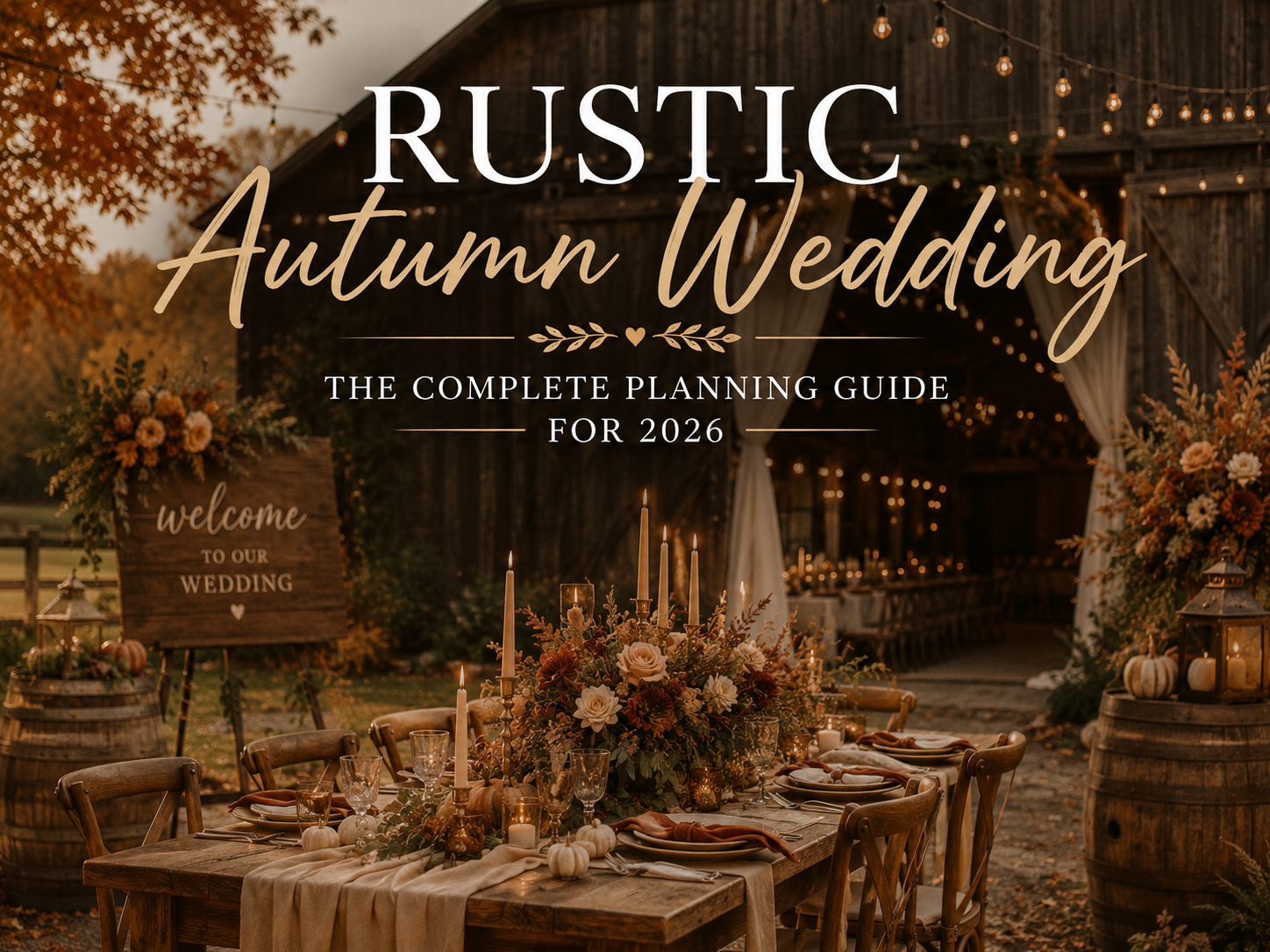
Rustic Autumn Wedding – The Complete Planning Guide for 2026
The Rustic Autumn Wedding Edit · 2026
Rustic Autumn Wedding
The Complete Planning Guide for 2026
Color palette, venue, flowers, decor, fashion, stationery, menu, lighting, guest experience, and everything in between — your definitive guide to planning the perfect rustic autumn wedding.
A rustic autumn wedding is not a style imposed on a season. It is what happens when you step back, listen to what October is already saying, and build a celebration from exactly what the land around you has to offer.
Introduction
Why the Rustic Autumn Wedding Is the Most Naturally Beautiful Celebration You Can Plan
Of all the wedding aesthetics available to a couple in 2026, the rustic autumn wedding is the one that requires the least artifice and rewards the most genuinely. It does not ask you to import anything from elsewhere or impose a look that belongs to another context. It asks you to pay attention — to the quality of light in an October barn, to the colour of a hedgerow in the week before the clocks change, to the smell of woodsmoke and damp earth that no scented candle has ever quite replicated — and then to build a celebration from those observations. When it is done well, it looks completely inevitable. As though the wedding grew from the landscape rather than being placed within it.
The rustic aesthetic in 2026 has matured significantly from the hessian-and-mason-jar interpretation that dominated the early years of the trend. Today’s rustic autumn wedding is one of sophisticated naturalism — deeply rooted in the actual materials of the season and the genuine character of rural architecture, but executed with a precision and creative intelligence that produces something genuinely beautiful rather than simply crafty. The exposed beam is there because it is beautiful in the candlelight, not because it is a prop. The wildflower arrangement overflows its vessel because a skilled florist chose that effect deliberately, not because no one knew how to arrange flowers. The distinction matters — and it is the difference between a rustic autumn wedding that photographs magnificently and one that looks like a Pinterest mood board assembled in a car park.
This guide covers every element of the rustic autumn wedding in full — from the color palette and the venue to the flowers, decor, fashion, stationery, menu, lighting, and the guest experience — with the practical depth and creative specificity you need to plan something that is genuinely, completely extraordinary.
Color Palette
The Rustic Autumn Wedding Color Palette: Borrowed Directly From the Land
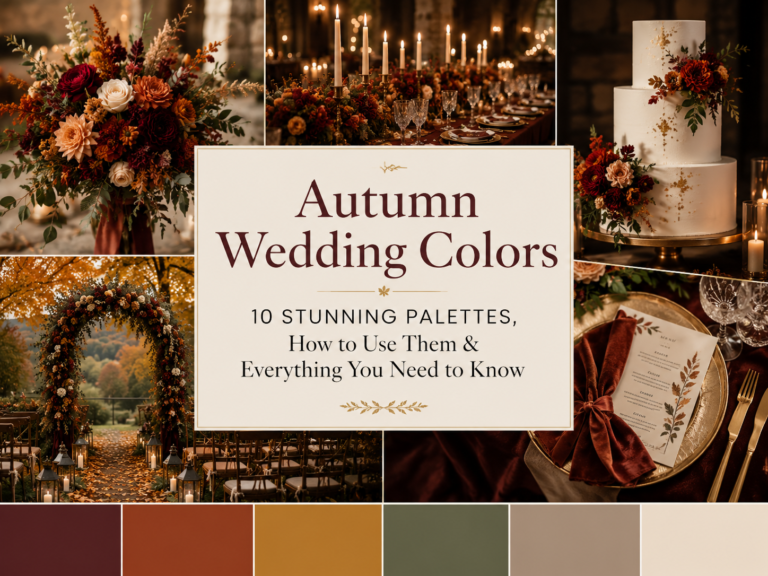
The rustic autumn wedding color palette is not assembled from a trend forecast or a wedding magazine. It is looked at — in the hedgerow, in the field, at the edge of the wood at four o’clock on an October afternoon. Burnt sienna and warm rust. Deep burgundy and the near-black of a sloe berry. The tawny gold of a turning oak leaf. The dusty sage of dried rosemary. The bone-white of a lichen-covered branch. These are not colors chosen for a wedding — they are the colors the countryside chooses for itself every year, without prompting, without help, and without any stylist’s intervention.
The most important principle when building a rustic autumn wedding color palette is restraint. Choose an anchor — burnt sienna, deep burgundy, or warm terracotta — and build outward from it with only two or three complementary tones. The rustic aesthetic relies on warmth and natural cohesion rather than variety and visual complexity. A palette of burnt sienna, warm cream, and dusty sage is more beautiful in this context than a palette of six equally strong autumn colors competing for attention. The goal is for the room to look as though the colors arrived naturally — because in a rustic setting, with the right materials, they almost do.
Burnt Sienna
The anchor. Warm, earthen, unmistakably autumnal.
Warm Cream
The lightener. Prevents heaviness, brings breath.
Harvest Gold
The warmth. In candleholders, foliage, and metallic detail.
Chestnut
The depth. In textiles, wood, and table surfaces.
Dusty Sage
The contrast. In foliage, bridesmaids, and herb details.

Venue
The Rustic Autumn Wedding Venue: Where the Architecture Does the Work
The rustic autumn wedding venue is not a neutral backdrop dressed up to look rustic. It is a space with genuine character — exposed timber, stone walls, flagstone floors, working fireplaces, oak beams, or the kind of agricultural architecture that took centuries to acquire its particular quality of patinated beauty. The best rustic autumn wedding venues are those where the decorators need to do relatively little because the space already says most of what needs to be said. Where candlelight falls on walls that have absorbed generations of warmth. Where the ceiling beams are real rather than decorative. Where the barn smell — dried hay, aged timber, cold stone — is present as a fourth design element alongside light, flowers, and food.
🌾
The Converted Barn
The gold standard of rustic autumn wedding venues. Exposed beams, oak floors, and stone walls provide everything the aesthetic requires. The barn does not need to be decorated so much as activated with candlelight and seasonal florals.
🏡
The Working Farm
A farm that is still in agricultural use brings an authenticity that a purely decorative rustic venue cannot replicate. The smells, the sounds, the proximity to the actual harvest — all of these enrich the atmosphere beyond what any styling team can manufacture.
🌲
The Woodland Estate
A rural estate with woodland on its grounds provides the most naturally spectacular outdoor backdrop available for the ceremony and golden-hour portraits. The trees do the decorating — especially in mid-October at peak foliage colour.
⛺
The Tipi or Yurt
A tipi or yurt on a rural site brings the outside inside in the most literal and atmospheric way. The canvas walls, the central wood burner, and the circular structure create an intimacy that no conventional venue building can replicate at any price point.

“Visit every rustic venue in October, at dusk, with a lit candle. If the space becomes more beautiful in that light — if the shadows add rather than subtract — you have found the right venue. The rustic autumn wedding belongs to candlelight and to no other.”
— The Rustic Autumn Wedding Edit
Flowers
Rustic Autumn Wedding Flowers: Gathered, Wild, and Abundantly Beautiful
The flowers at a rustic autumn wedding should look as though they were gathered from the fields and hedgerows surrounding the venue on the morning of the wedding. Not arranged — gathered. The rustic floral aesthetic is one of deliberate imperfection and natural abundance: blooms that spill over their vessels, foliage that trails across the table, arrangements that appear asymmetric and uncontrived even when they are the result of considerable florist skill and hours of careful construction. The goal is always the same — to make the flowers feel as though they belong to the place and the season, not to a generic wedding supply catalogue.
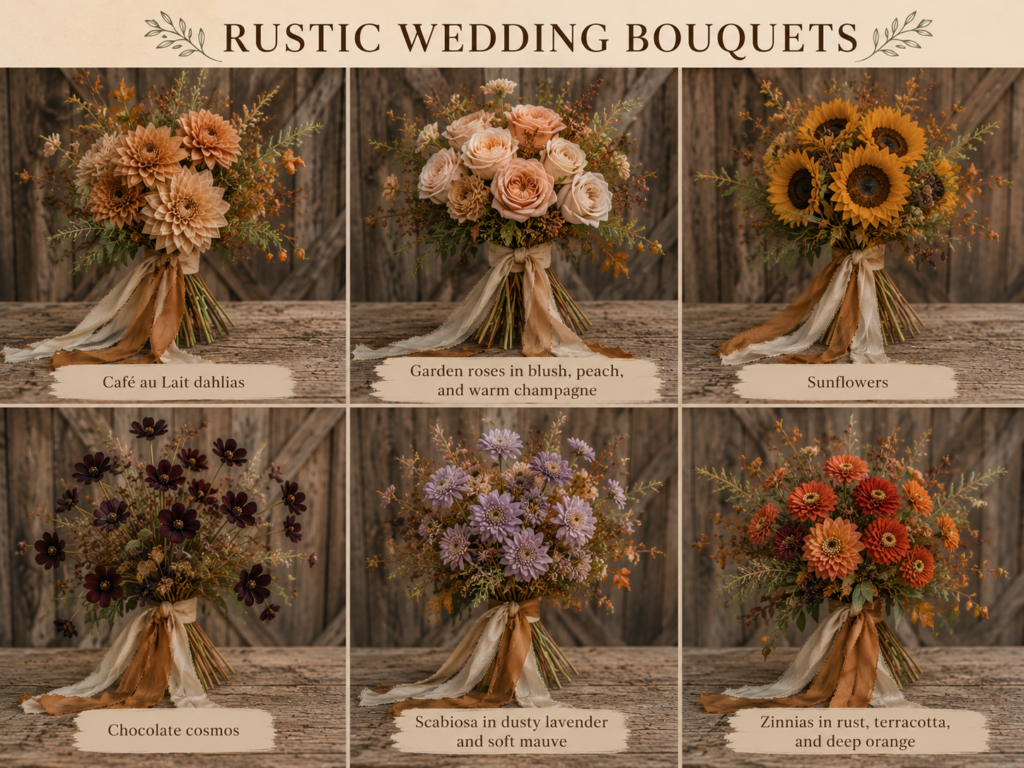
Blooms to Request
- Café au Lait dahlias — the defining rustic autumn bloom
- Garden roses in blush, peach, and warm champagne
- Sunflowers for joyful autumn abundance and warmth
- Chocolate cosmos — dark, velvety, intensely seasonal
- Scabiosa in dusty lavender and soft mauve
- Zinnias in rust, terracotta, and deep orange
Foliage & Botanicals
- Turning copper beech and oak branches
- Rosehips on trailing stems — orange-red and wild
- Blackberries and sloe berries on the vine
- Dried pampas grass for architectural height
- Wheat and barley stems for harvest authenticity
- Fresh herbs — rosemary, thyme, sage — for fragrance
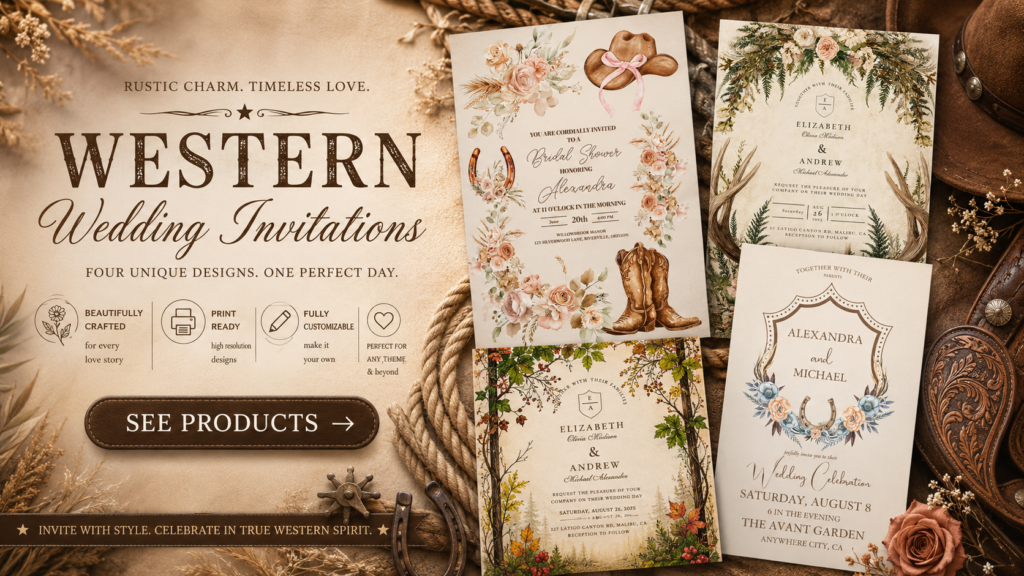
Decor
Rustic Autumn Wedding Decor: Texture, Patina, and Natural Material
The materials of rustic autumn wedding decor are those that carry the evidence of time and the outdoors — reclaimed wood, aged iron, terracotta, raw linen, bark, moss, and stone. Nothing should look new. Nothing should look like it arrived in a factory box. The most successful rustic autumn wedding decor pieces are those with a history of genuine use or those crafted from materials taken directly from the natural world around the venue. A centrepiece vase that is an aged terracotta pot from a local garden centre. A table plan displayed on a slice of reclaimed oak trunk. Place cards written on dried magnolia leaves. These details cost less than their hired or purchased alternatives and produce a more authentic, more atmospherically powerful result.
🌿 Table Decor
Raw linen runners, aged terracotta vessels, mismatched brass and iron candleholders in varying heights, foliage trails, scattered acorns and seed pods, and place cards on dried leaves or kraft card. Every element should look as though it was found, not bought.
🪵 Structural Elements
Reclaimed wood slices as cake stands and place risers. Log rounds as centrepiece bases. Hay bales dressed with throws for outdoor seating. Wooden ladders hung with foliage and fairy lights as decorative backdrop features.
🏺 Vessels & Containers
Aged terracotta pots, antique milk churns, old stone crocks, wicker baskets, and vintage jam jars tied with twine. Avoid anything that reads as manufactured or pristine — the rustic vessel should carry the character of its history.
Fashion
Rustic Autumn Wedding Fashion: Warmth, Texture, and Genuine Personal Style
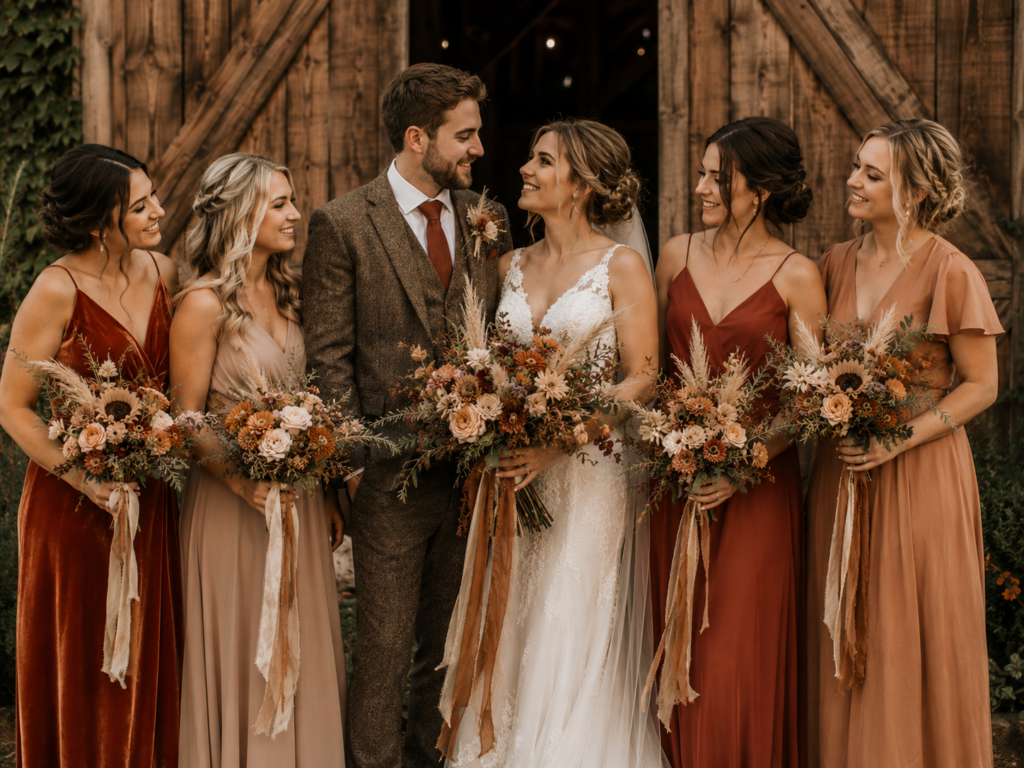
The rustic autumn wedding creates a specific and genuinely liberating fashion context — one that rewards texture, warmth, and personal authenticity above strict formality or trend compliance. The bride in a flowing bohemian lace gown with a wildflower crown looks completely at home in a barn setting in a way she might not at a ballroom wedding. The groom in a well-cut tweed suit with a tattersall shirt and brogues makes complete, beautiful sense in a converted farmyard where the same look would look slightly out of place at a London hotel. The rustic setting gives couples permission to dress in a way that feels genuinely, personally right — and that is one of its greatest gifts.
The Bride
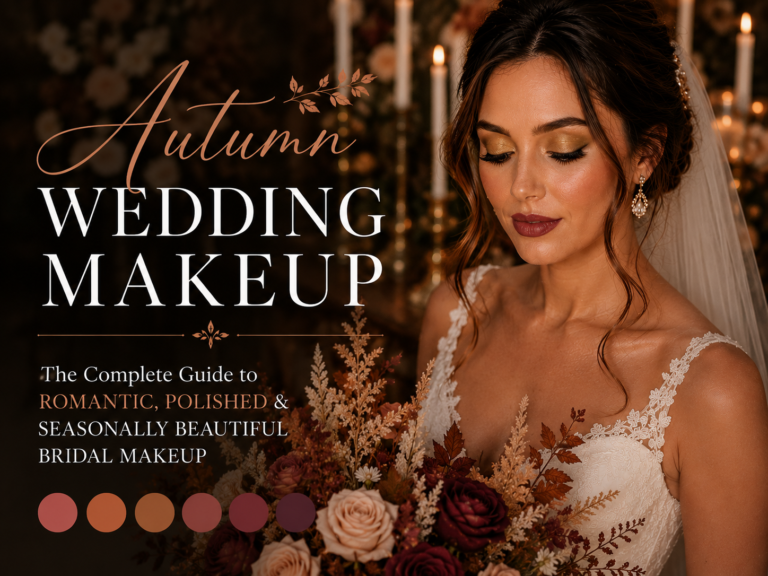
A floaty A-line or boho lace gown in warm ivory or champagne suits the rustic aesthetic beautifully. Long sleeves are not only seasonally practical but aesthetically perfect — a long-sleeved lace gown in an autumn barn is one of the most completely right images in all of wedding photography. A wildflower or dried botanical crown instead of a veil. Block-heeled ankle boots rather than stilettos for outdoor terrain. A loose, gathered half-up hairstyle with face-framing tendrils and fresh flowers tucked through the arrangement.
The Groom
A heritage tweed three-piece in a warm herringbone, check, or windowpane pattern is the defining rustic autumn groom look. Paired with a tattersall or chambray shirt, a knitted tie, and a pair of well-polished leather brogues, it is an ensemble of extraordinary character and seasonal appropriateness. The buttonhole should echo the bridal bouquet — a single bloom or a small sprig of rosemary and rosehip is infinitely more beautiful than a complex arrangement at the lapel.
The Bridesmaids
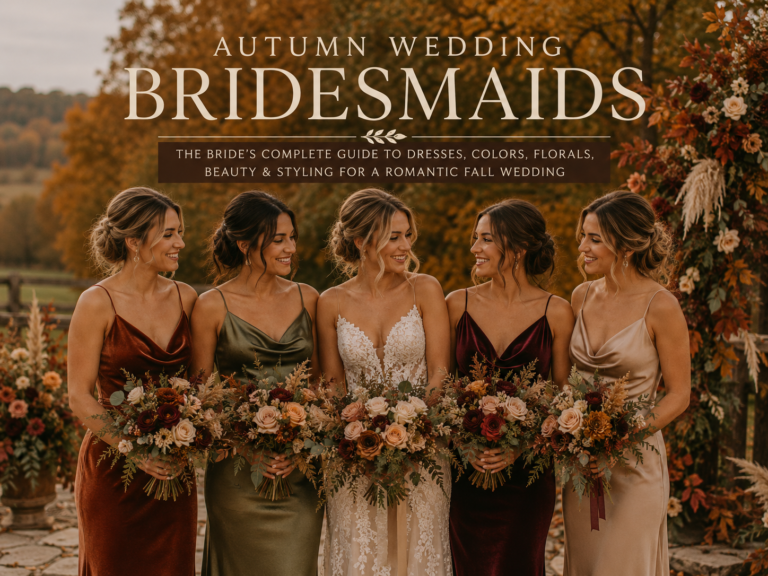
Mismatched bridesmaids dresses in a shared tone — all in dusty sage, all in warm terracotta, or all in deep rust — with each bridesmaid choosing her own silhouette. This approach is the most genuinely rustic of all bridesmaid styling formats, reflecting the same philosophy of personal authenticity over rigid uniformity that underpins the entire aesthetic. Each dress in a natural, breathable fabric — chiffon, cotton voile, or washed silk.
Stationery
Rustic Autumn Wedding Stationery: Where the Aesthetic Begins
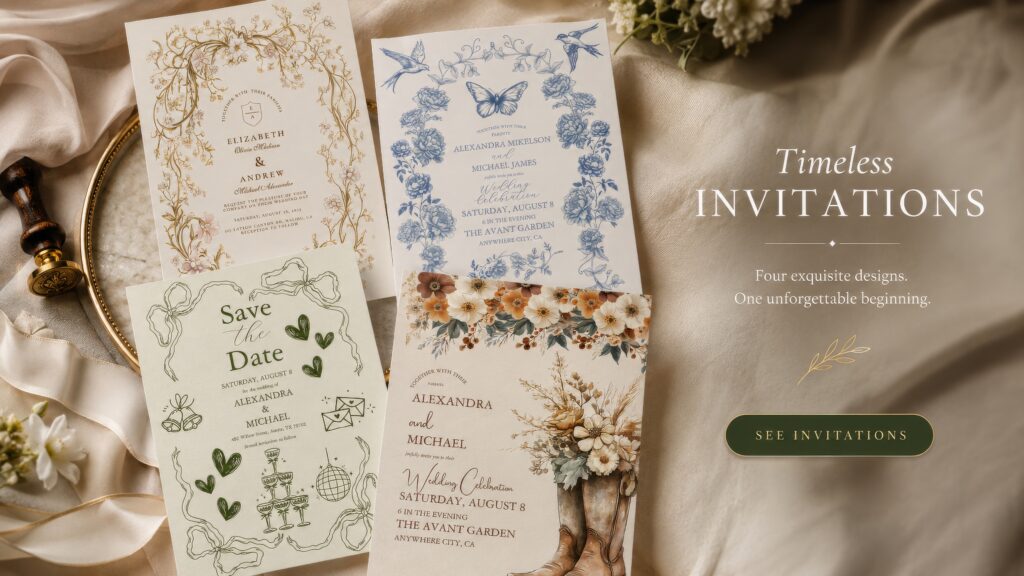
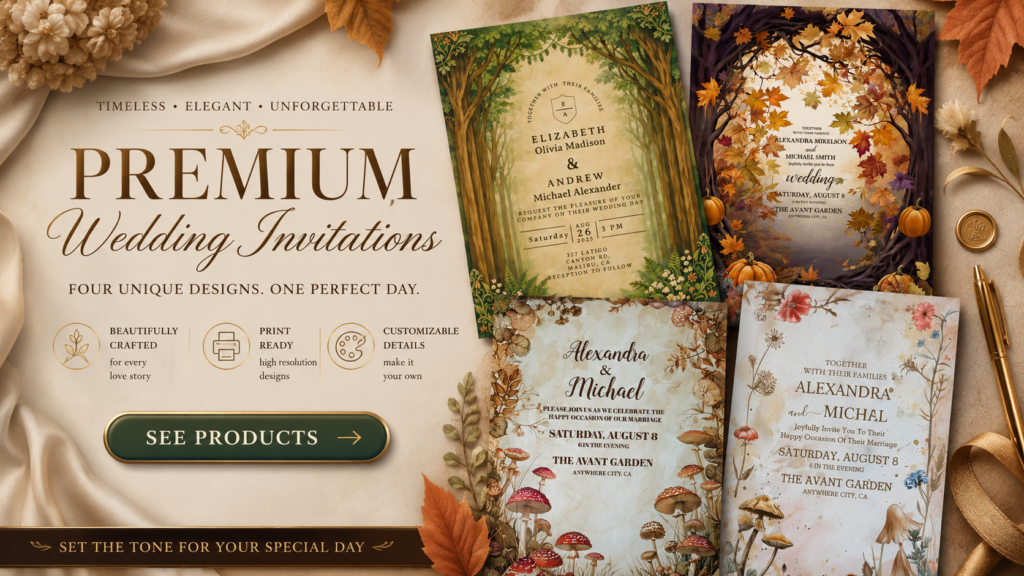
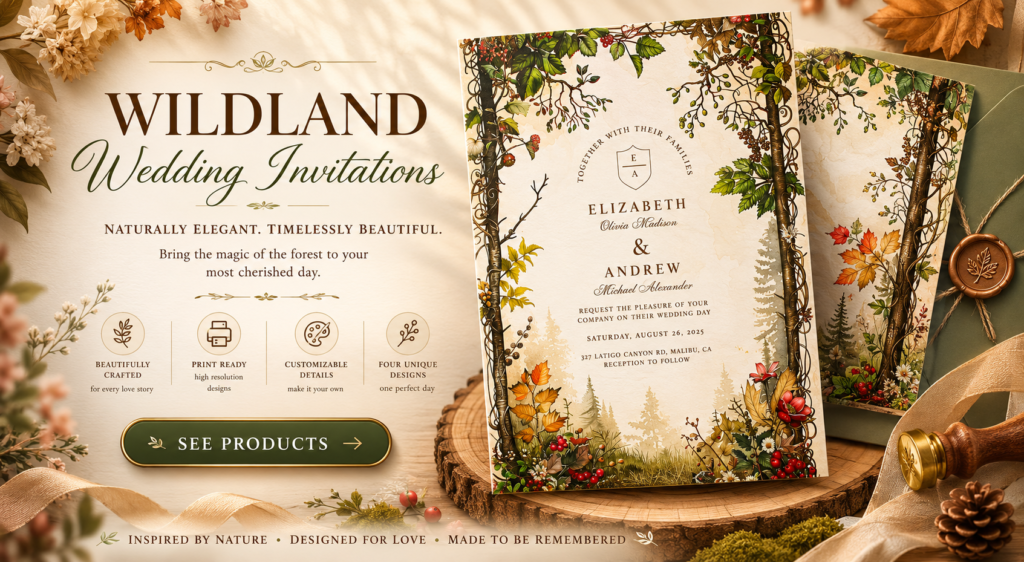
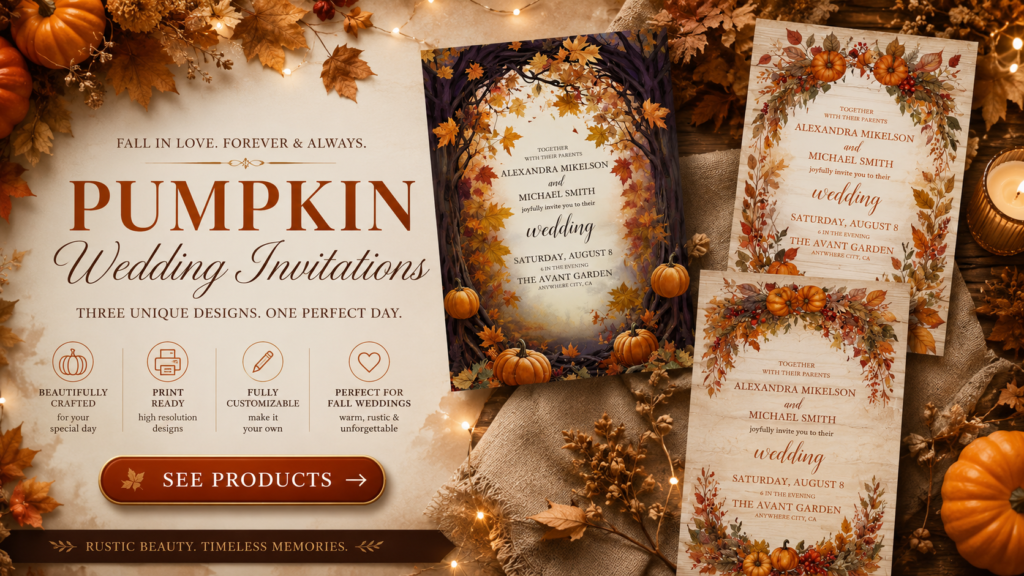
The rustic autumn wedding stationery suite is the first physical encounter a guest has with the aesthetic of the day — arriving months before the wedding itself and setting every expectation for what is to come. It should carry the same natural, tactile, season-specific character as every other element of the celebration. Kraft paper and recycled card stock. Botanical illustration in watercolour — autumn leaves, dahlias, rosehips, and dried grasses rendered in the warm tones of the palette. Hand-lettered or letterpress-printed type rather than digital script fonts. Wax seals in harvest gold or terracotta. Natural twine or pressed dried flowers tucked inside the envelope.
Stationery Materials
- Kraft card — the most naturally rustic paper stock available
- Aged-edge or hand-torn cream card for a softer alternative
- Recycled cotton or seed paper for an environmental commitment
- Wax seals in harvest gold, terracotta, or deep burgundy
- Natural twine, dried herb sprigs, or pressed leaves in envelopes
- Botanical watercolour illustration as the primary design motif
On-the-Day Stationery
- Table plan on a reclaimed oak slice or foliage-dressed easel
- Menus printed on kraft card with botanical illustration header
- Place cards on dried magnolia leaves with hand lettering
- Order of service in a simple folded kraft booklet
- Table names using species of autumn trees rather than numbers
- Favour tags on jars of local honey or homemade jam
Menu
The Rustic Autumn Wedding Menu: Honest, Seasonal, and Deeply Satisfying
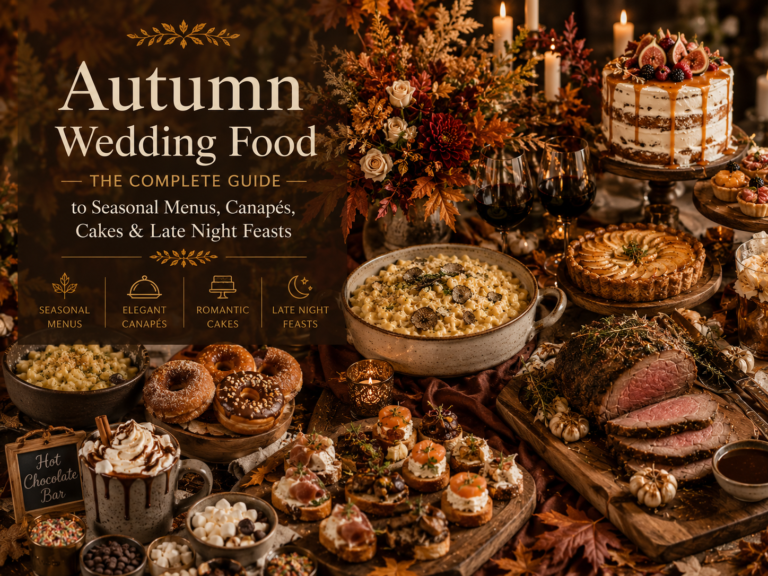
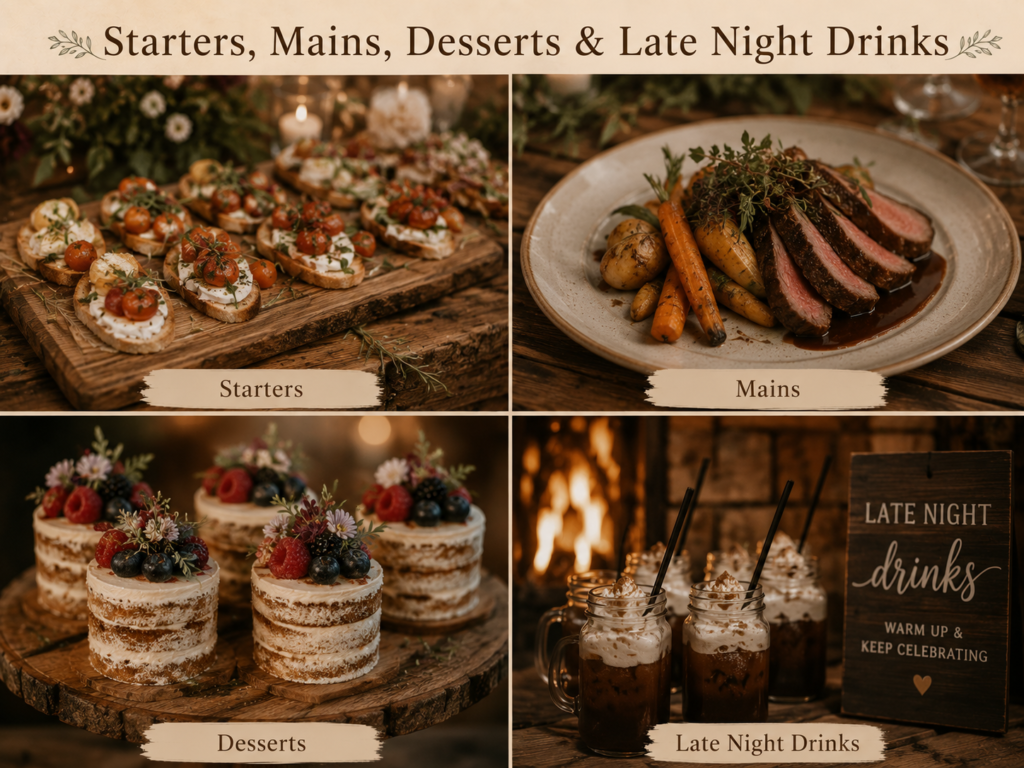
The rustic autumn wedding menu is guided by the same principle as every other element of the aesthetic: honesty. Food that is what it appears to be, made from ingredients that belong to the season and the region, served in a format that suits the relaxed, convivial atmosphere of a barn or farmhouse celebration. The most successful rustic autumn wedding menus are those built around slow-cooking and sharing — a whole shoulder of lamb carved at the table, great bowls of roasted root vegetables passed between guests, freshly baked bread broken and shared. This approach to service transforms the dinner from a catered event into something closer to the harvest feast it is meant to evoke.
🥣
Starters
Roasted butternut soup with sourdough. Wild mushroom bruschetta with truffle oil. Smoked trout with horseradish cream and pickled cucumber. Baked camembert with rosemary and honey for the table to share.
🍖
Mains
Slow-roasted lamb shoulder with rosemary jus. Braised venison with celeriac and red wine. Wild mushroom and chestnut Wellington. Roasted root vegetables, dauphinoise potatoes, and buttered greens for the table.
🍮
Desserts & Late Night
Apple and blackberry crumble with clotted cream. Sticky toffee pudding with salted caramel. Cheese board with fig chutney and honeycomb. Late night: warm spiced cider doughnuts and hot chocolate station.
🍻
Drinks
Mulled cider on arrival. Local ales and ciders on the bar. A full-bodied red wine from a small producer. Elderflower pressé for non-drinkers. Sloe gin cocktail as the evening signature drink.
Lighting
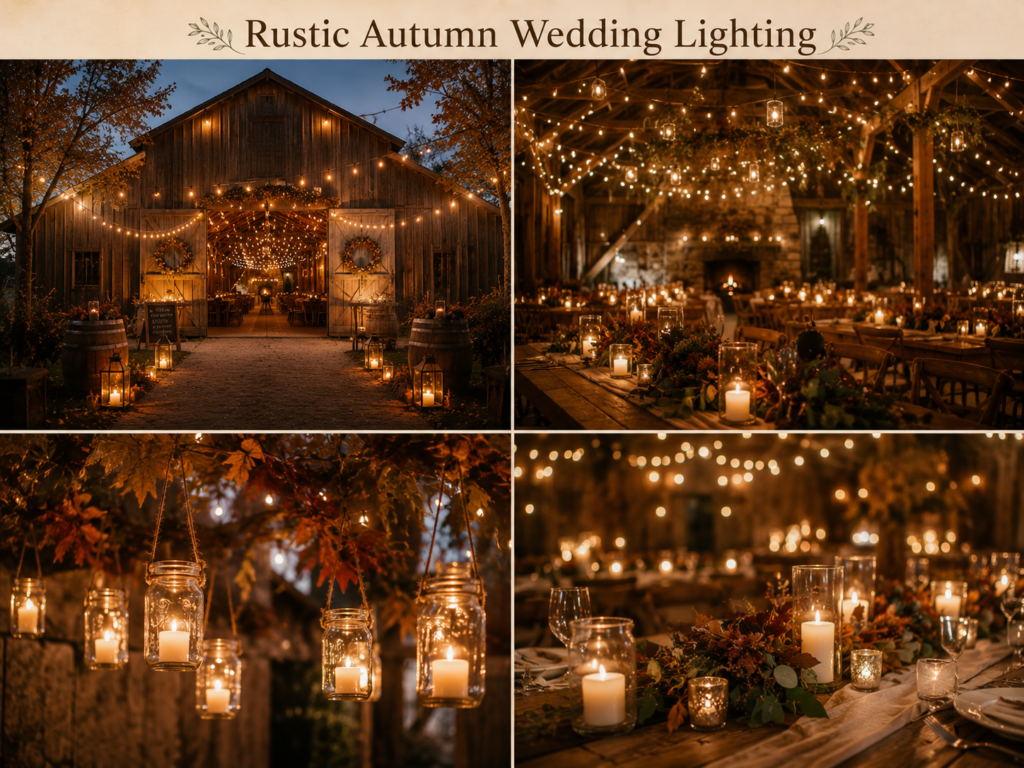
Rustic Autumn Wedding Lighting: The Warmth That Makes Everything Beautiful
In a rustic autumn wedding, lighting is not decoration — it is atmosphere. Real candles are non-negotiable. The specific quality of a real flame in a barn or stone room — the flicker, the shadow, the warmth — is entirely irreplaceable by any electrical alternative, however sophisticated. Confirm your venue’s candle policy from your very first conversation and choose your venue in part on the basis of its answer. A rustic venue that does not permit real candles significantly limits the atmospheric ceiling of the entire celebration.
Essential Light Sources
- Pillar candles in aged iron and terracotta holders — always
- Taper candles in mismatched brass candlesticks along the tables
- Tea lights in amber glass votives scattered between table elements
- Edison bulb strings across barn rafters — warm white only
- A wood-burning fire or open fireplace as the centrepiece of warmth
- Copper or iron lanterns with real candles lining pathways
Lighting Principles
- Never use cool or blue-white light — warmth is the only acceptable tone
- Layer light sources at multiple heights for visual depth and complexity
- Use antique mirrors to double candlelight without adding more candles
- Dim all overhead venue lighting — overhead kills atmosphere
- Test the lighting scheme at a venue visit before the wedding day
- Brief your photographer on the lighting conditions in advance
Guest Experience
The Rustic Autumn Wedding Guest Experience: Warmth, Welcome, and Wonder
The rustic autumn wedding creates a specific guest experience that differs profoundly from that of a formal hotel or stately home wedding — and when it is executed with genuine care and generosity, it is the most warmly remembered of all wedding formats. Guests at a rustic autumn wedding feel less like attendees at an event and more like participants in a genuine celebration — welcomed into a warm, personal, beautiful world and invited to make themselves completely at home within it. This feeling of belonging is the most valuable thing you can create for the people who have travelled to share your day, and it is achieved not through expensive gestures but through a hundred small, considered acts of welcome and warmth.
🍎 The Arrival
A mug of mulled cider pressed into every guest’s hand the moment they arrive. A lantern-lined path from the car park. A fire already burning. Music already playing softly. The arrival at a rustic autumn wedding should feel like coming home to the best possible version of a farmhouse on a cold October evening.
🧣 Comfort Details
Blanket baskets at the venue entrance for guests who step outside. Wellies available in a range of sizes for any outdoor movement. Hand warmers in paper bags as favours. Woollen throws draped over hay bales and chairs throughout the venue. Practical warmth presented as decoration.
🎵 Entertainment
A folk or acoustic band rather than a pop covers act. Lawn games in the afternoon for early-arriving guests. A bonfire with seating as an evening alternative to the dance floor. A stargazing moment for those who need to step outside and breathe the October air.
🎁 Favours
Local honey, homemade jam, or sloe gin in a miniature jar. A small packet of seasonal wildflower seeds. A dried botanical mini-wreath. A sprig of fresh rosemary tied with twine. The rustic favour should be edible, plantable, or beautiful — preferably all three.
The Most Important Guest Experience Investment
Nothing at a rustic autumn wedding generates more genuine, universally felt guest warmth than the arrival moment — and specifically the warmth of what they are handed in the first thirty seconds. A mug of mulled cider, the scent of spice and apple filling the air, the sound of music already playing, the sight of a fire already burning: this combination, costing almost nothing to produce relative to the total wedding budget, creates an emotional impression that no floral installation or catering upgrade can replicate. Invest in the arrival moment above almost everything else.
Common Mistakes
10 Rustic Autumn Wedding Mistakes to Avoid
The rustic autumn wedding is one of the most forgiving aesthetics in all of wedding planning — its natural materials and seasonal palette are difficult to make look wrong. But there are specific, recurring mistakes that derail even the most carefully planned rustic celebrations. The ten below represent the most common and the most impactful — knowing them is the most direct route to avoiding them.
- Choosing a rustic venue that is actually just a barn-shaped room. A venue with exposed beams applied to a modern concrete structure is not a rustic venue. Visit with your eyes open for what is authentic and what is decorative — the difference is immediately apparent in photographs and in person.
- Underestimating the cold. Autumn evening temperatures in a stone barn or rural venue can be genuinely, uncomfortably cold. Heating, blankets, and a working fire are practical requirements, not optional extras. A cold guest is a distracted guest — and distracted guests leave early.
- Overdoing the hessian and mason jars. The rustic aesthetic does not require these items. In excess they read as dated rather than charming. Use natural materials with more variety and less reliance on specific trend props that have been widely circulated for the past decade.
- Using cool-toned lighting. Cool white Edison bulbs, blue-tinted uplighting, or fluorescent venue strip lights left on will destroy the atmosphere of any rustic autumn wedding reception. Insist on warm tones throughout and dim or remove every overhead fitting the venue will allow.
- Choosing a catering style that does not suit the setting. A formal plated dinner served by white-gloved staff in a barn reads as incongruous and slightly uncomfortable. The sharing feast, the informal buffet, and the family-style service suit the rustic aesthetic far more naturally — and almost always generate more genuine guest enjoyment.
- Neglecting the outdoor spaces. The most atmospheric elements of a rustic autumn wedding — the lantern trail, the bonfire, the stargazing moment — happen outdoors. Underinvesting in the outdoor experience because the weather might be poor means sacrificing the elements that are most often described as the highlights of the day.
- Booking a band or DJ who does not suit the setting. A high-energy pop covers act in a barn can work — but only if that energy is genuinely wanted. A folk band, an acoustic duo, or a carefully curated playlist suits the rustic aesthetic more naturally and creates a more consistent atmosphere throughout the evening.
- Ignoring the practical details of a rural venue. Car parking on grass, access roads not suitable for certain vehicles, limited bathroom facilities, no mobile phone signal, no mains electricity. Rural and rustic venues often come with practical limitations that need to be identified, communicated, and resolved long before the wedding day itself.
- Using too many colors. The rustic autumn palette works on restraint. Three strong seasonal tones applied consistently across every element will always produce a more beautiful and more photographically coherent result than six competing colors that each individually suit the season but collectively create visual noise.
- Forgetting that rustic means genuine, not just styled. The rustic autumn wedding that truly succeeds is one where the aesthetic is a reflection of who the couple actually are — their relationship to the countryside, their genuine love of the season, their natural warmth and hospitality — rather than a look assembled from trend references. Guests can feel the difference. The photographs show it clearly. Authenticity is the most important rustic element of all.
“The rustic autumn wedding that guests describe years later with the most warmth and the most specific detail is never the most elaborately decorated one. It is the one where everything felt genuine — where the welcome was warm, the food was honest, and the world the couple built felt completely, recognisably like them.”
— The Rustic Autumn Wedding Edit
Final Thoughts
The Rustic Autumn Wedding Is Built From Who You Actually Are
Of all the wedding aesthetics available to a couple in 2026, the rustic autumn wedding is the one most deeply rooted in authenticity — in a genuine relationship with the natural world, with the season, with the particular beauty of the rural landscape in October. It cannot be faked, and the best versions of it are never assembled from trend references and prop catalogues. They are built from observation and love — from knowing what the light looks like at four o’clock on a clear autumn afternoon, from choosing food that tastes of the harvest because you genuinely love the harvest, from welcoming guests with the same warmth and simplicity you would extend to them in your own kitchen on a cold evening.
Plan every element with that authenticity at the centre. Choose the barn because you love it, not because it is fashionable. Choose the palette from what you see in the landscape around you, not from a website. Ask your florist to bring you the hedgerow, not a reinterpretation of it. Feed your guests as you would feed people you love — generously, warmly, with food that tastes of the season and the land. And light real candles. Always real candles.
When all of that is in place — the right venue, the honest food, the seasonal flowers, the warm light, the genuine welcome — you will not need to check whether the rustic autumn wedding you have built looks beautiful. You will simply walk through the door at the end of the afternoon, look at the room you have created, and know that it does. Completely and without question.