Purple Goth Wedding
The Dark Wedding Edit · 2026
Purple Goth Wedding
The Complete Guide to Deep Plum, Violet & Amethyst — the Most Romantically Dark Palette in Gothic Bridal Design
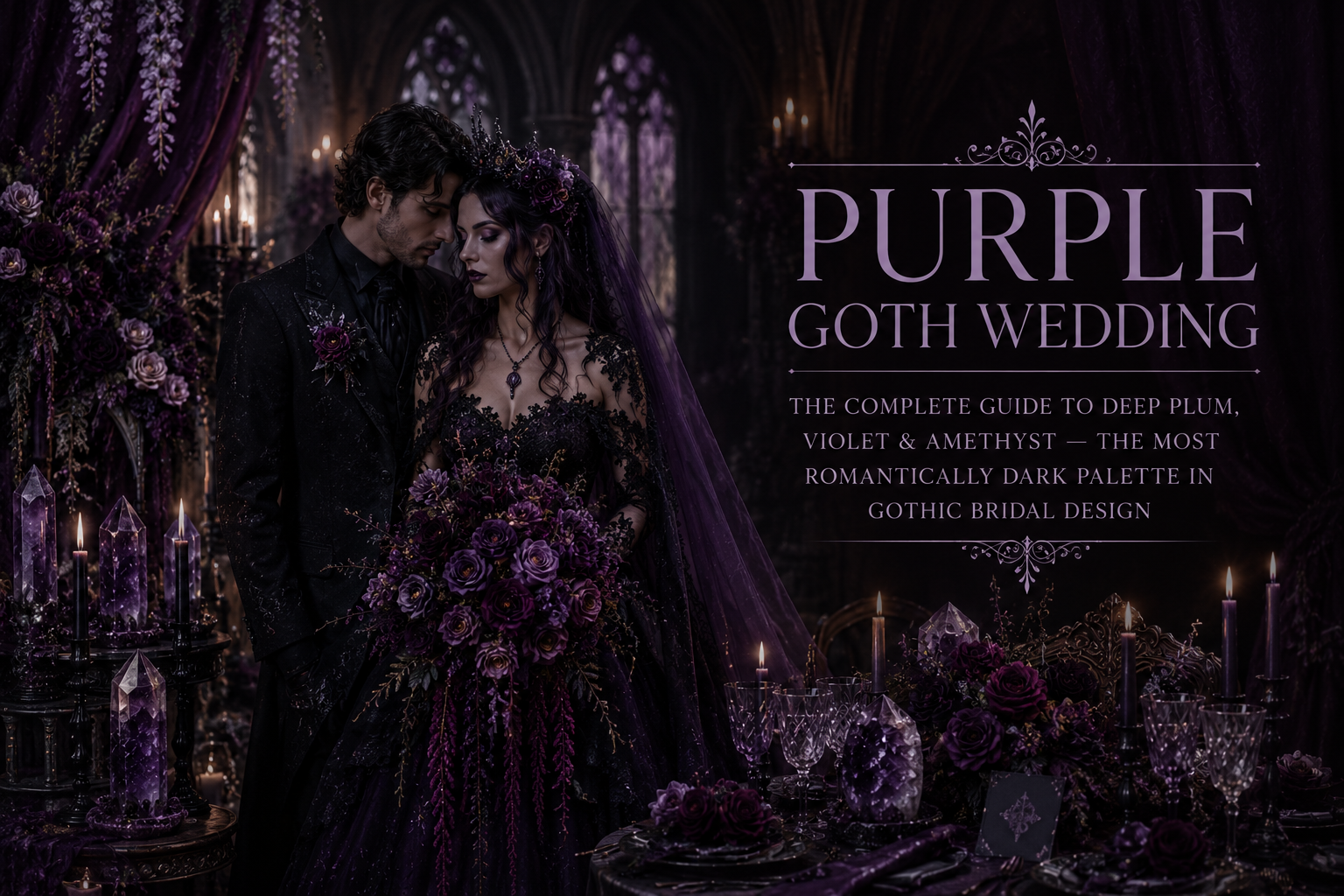
From near-black plum ceremonies and amethyst-draped receptions to violet floral arrangements, purple velvet fashion, and the specific visual world where the gothic tradition’s deepest and most beautiful colour reaches its full ceremonial power — your complete guide to planning a purple goth wedding.
Purple is the gothic tradition’s most personal colour. Black communicates darkness as a fact. Oxblood communicates warmth and passion. Navy communicates cool elegance. But purple — specifically the deep, saturated plum that exists at the boundary between red and blue, between warm and cold, between regal formality and organic darkness — communicates something that none of the others can: the specific quality of a darkness that is also, unmistakably, beautiful.
Section One
Why Purple Is the Gothic Tradition’s Most Powerful Wedding Colour
Purple has been the colour of ceremony, of sacred ritual, of royalty, and of mourning for longer than any other colour in the Western tradition — and this accumulated weight of meaning, compressed into a single saturated wavelength at the meeting point of red warmth and blue cool, makes it the most symbolically loaded of all the colours available to a gothic wedding palette. The Roman emperors reserved it for themselves alone. The Catholic Church uses it for Advent and Lent — the seasons of anticipation and penance, of spiritual preparation for the most significant moments in the liturgical year. The gothic novel reaches for it when it wants to communicate the specific quality of aristocratic, melancholy, deeply felt romantic darkness. And in the natural world, it is the colour of the flowers most associated with magic, mystery, and the specifically twilight quality of beauty that exists at the edge of the visible spectrum: lavender and foxglove and nightshade, wisteria and iris and the dark dahlias that are the gothic floral tradition’s most beloved botanical subject.
The purple goth wedding is not simply a gothic wedding in which purple replaces black as the primary colour. It is a specific aesthetic direction that uses the full range of the purple spectrum — from the near-black of the deepest plum through the rich saturation of amethyst and violet to the dusty, faded quality of aged lavender and mauve — to communicate a quality of romantic, ceremonially serious, deeply personal beauty that the fully achromatic gothic palette cannot approach. It is warmer than the gothic aesthetics that rely exclusively on black, charcoal, and navy. It is more symbolically complex. And it produces photographs of extraordinary chromatic richness and depth — particularly in the specific light conditions (candlelight, dusk, diffused natural light through cloud) that favour the purple spectrum above all others.
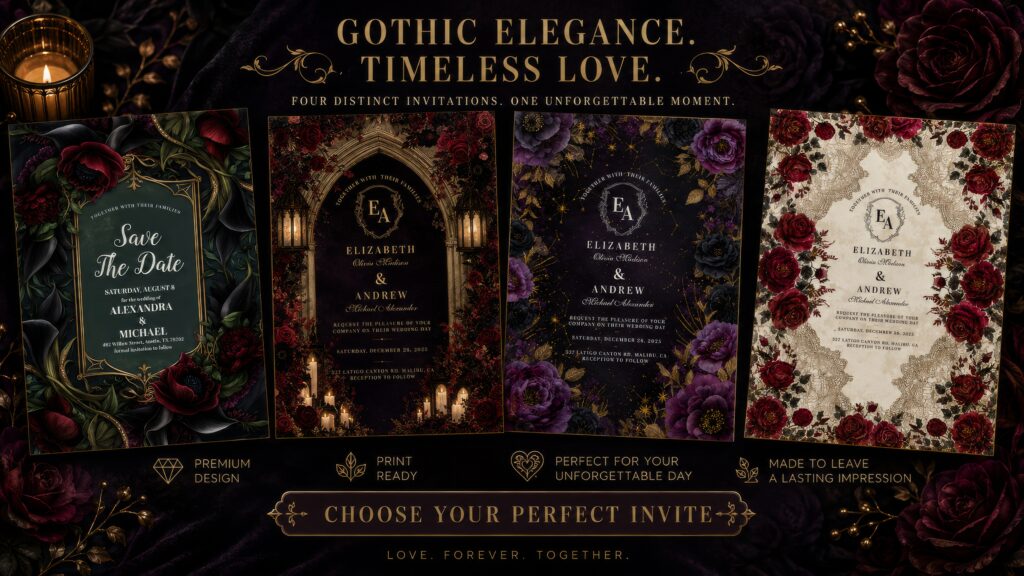
What Purple Communicates
- The historical weight of ceremony, royalty, and sacred ritual
- The romantic darkness of the gothic tradition at its warmest and most personal
- The specific twilight quality of natural beauty at the edge of visibility
- Depth and mystery — the colour that contains both warm and cool simultaneously
- The botanical world of magic and mourning — nightshade, foxglove, wisteria, iris
- A quality of aristocratic, deliberate, seriously considered beauty rather than casual dark aesthetic
Why It Works in Wedding Photography
- Purple absorbs and reflects light differently from every other dark colour — it has a specific luminosity that makes it glow in low light conditions
- In candlelight, deep plum takes on an inner warmth that no other dark colour produces
- In natural diffused light, violet and amethyst tones achieve a saturated depth of colour that photographs as chromatic richness rather than simple darkness
- Against pale skin, deep plum provides maximum tonal contrast without the coldness of black
- The purple botanical palette — dark dahlias, anemones, sweet peas, wisteria — photographs with extraordinary depth in every light condition
Shop the Collection
Browse our most loved designs — customizable invitations, party supplies, and stationery for every celebration.
Section Two
The Purple Goth Spectrum: Five Aesthetic Directions
The purple goth wedding encompasses a wide range of aesthetic directions — from the darkest near-black plum that is barely distinguishable from the fully achromatic gothic palette to the soft, faded lavender of the boho goth tradition — and each produces a completely different quality of visual experience, requires a different set of complementary colours, and suits a different type of celebration and venue. Understanding which point on the purple spectrum belongs most completely to your aesthetic sensibility is the most important creative decision in purple goth wedding planning.
01
Deep Plum Gothic
The darkest and the most formally gothic of all purple wedding directions — the near-black plum that exists at the extreme dark end of the purple spectrum, where the colour is more felt than seen: a warmth in the darkness, a richness in what might otherwise read as simply very dark. This is the plum of deep purple velvet in candlelight, of the darkest dahlias and anemones against a stone wall, of a sky at the precise moment when the last light has left the horizon and the colour that remains is not black but something warmer and stranger. Deep plum gothic is the direction for couples who want the full weight of the gothic tradition but with a quality of colour and warmth that the pure black palette cannot provide. It pairs most powerfully with near-black, aged ivory, and antique gold — creating a palette of extraordinary formal richness that suits the grandest historic venue contexts perfectly.
02
Amethyst & Violet
The most richly saturated of all purple goth directions — the true amethyst and violet register where the colour is fully expressed at its maximum intensity, neither darkened toward plum nor softened toward mauve. This is the purple of the gemstone itself: the specific crystalline, luminous quality of amethyst that contains light within its saturation rather than absorbing it. Paired with the darkest possible black-and-charcoal palette, amethyst and violet provide a quality of jewel-like chromatic intensity that is completely distinctive from any other dark wedding palette. Against candlelight and black, saturated violet reads with extraordinary visual depth. Against natural daylight, it communicates a quality of deliberate, unapologetic colour commitment that belongs specifically to the gothic tradition in its most assertively beautiful register.

03
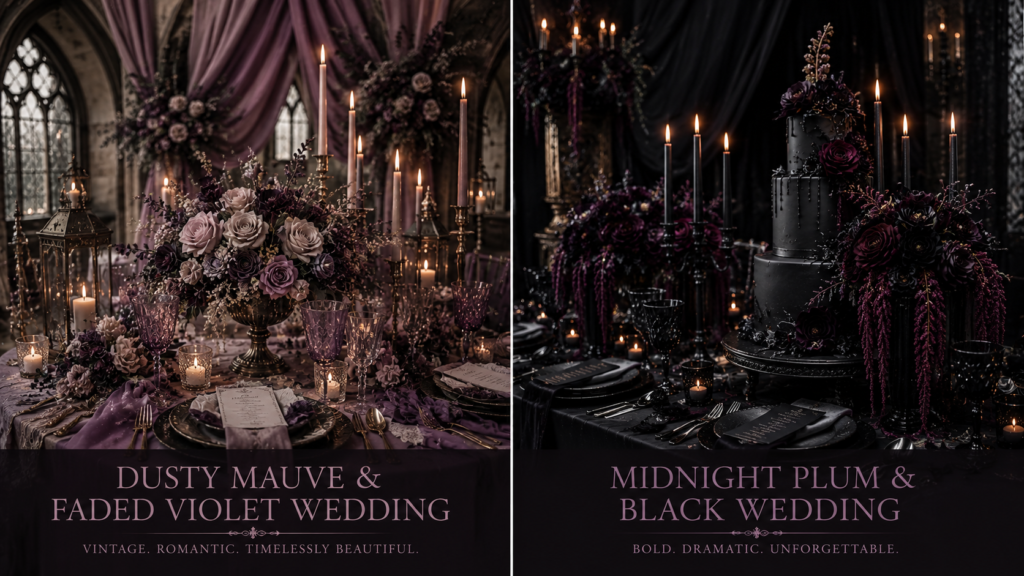
Dusty Mauve & Faded Violet
The softest and the most romantically melancholy of all purple goth directions — the specific desaturated, faded quality of purple that has been bleached by time and light to something paler and more delicate than its original saturation. This is the purple of dried lavender, of pressed violets, of antique silk that was once vivid and is now beautiful in its fading. Dusty mauve and faded violet suit the boho goth and dark romantic aesthetics most naturally, providing a purple that reads as both dark and gentle — the colour of something that has been beautiful for a long time rather than something that is being beautiful now. It pairs with aged ivory, soft sage green, dried botanical matter, and the warm amber of antique gold in a palette of extraordinary, quietly sophisticated romantic depth.
04
Midnight Plum & Black
The vampire ball and Victorian gothic direction — where midnight plum and near-black are used in equal proportion, creating a palette in which the purple is always present but always at the edge of visibility, emerging from the darkness rather than existing within the light. This is the purple goth palette for the most formally dramatic and the most historically grounded of all gothic wedding aesthetics: the great hall, the vaulted stone ceiling, the long table with candelabras, and the couple in the centre of it all wearing the specific combination of near-black and deep plum that communicates the gothic tradition’s most serious and most formally beautiful register. Silver is the preferred metallic for this direction — it provides the contrast of the light against the darkness without the warmth of gold, which belongs more properly to the warmer purple directions.
05
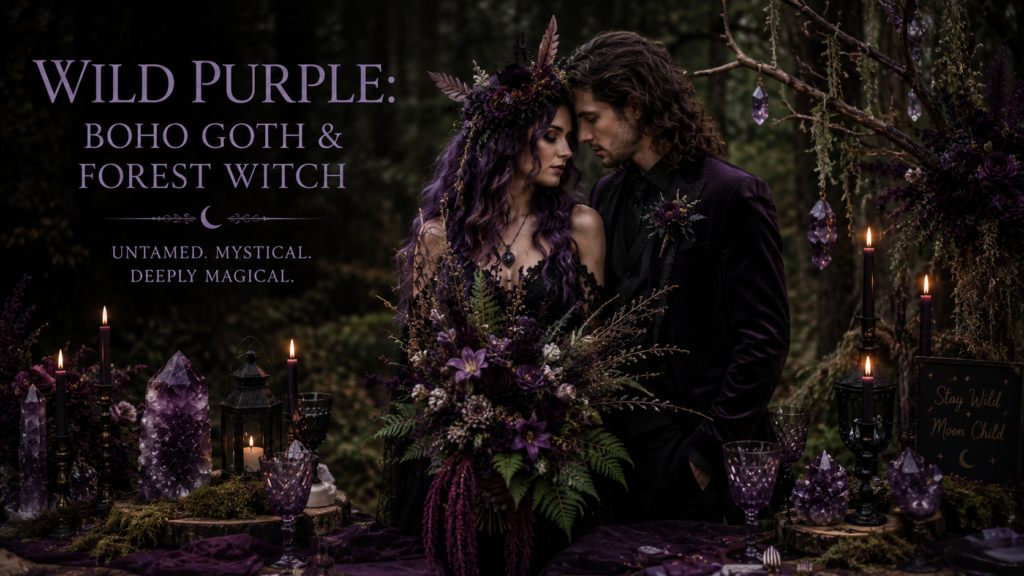
Wild Purple: Boho Goth & Forest Witch
The most organically grounded of all purple goth directions — drawing on the specific purple of the natural world in its wildest and most abundantly botanical form: the purple of foxglove and wild thyme, of knapweed and devil’s-bit scabious, of allium spheres against a dark green hedge and of nightshade berries in the hedgerow at the end of summer. This direction belongs to the forest goth, the witchy wedding, and the boho goth aesthetics — purple expressed through botanical abundance rather than through architectural formality, and the dark palette achieved through the depth of the botanical species chosen rather than through the darkness of the surface colours applied to the venue and the fashion. It suits outdoor and botanical garden settings most naturally and produces photographs of extraordinary organic depth in which the purple tones are always alive and always growing rather than static and architectural.
Section Three
The Purple Goth Colour Palette
The purple goth palette is built from the full range of the purple-to-violet spectrum at its darkest and most saturated — with black and near-black as the structural anchors that prevent the purple from reading as conventionally romantic rather than gothically beautiful, and with silver, aged ivory, or antique gold as the light contrast elements that prevent the palette from collapsing into undifferentiated darkness. Every successful purple goth palette contains all three of these elements in the right proportions: the purple identity, the dark anchor, and the light contrast. The specific positions within the purple spectrum, and the specific relationship between warm and cool tones within the palette, determine which of the five sub-aesthetic directions above the palette belongs to.
Deep Plum
The primary identity colour — dark, warm-cool, the defining purple gothic tone
Near-Black
The dark anchor that prevents purple from reading as merely romantic
Rich Violet
Maximum colour saturation — the amethyst register
Midnight Purple
The blue-leaning dark register — closer to indigo than plum
Dark Lilac
The medium register — between mauve and violet
Dusty Mauve
Faded, aged, the boho goth entry point
Silver
The cool metallic contrast — moonlight and crystal
Dark Rose
The warm bridge between plum and oxblood
Antique Gold
The warm metallic — for plum and dusty mauve directions
Aged Ivory
The light anchor — warmth without brightness
Section Four
Purple Goth Wedding Fashion
Purple goth bridal fashion is the most chromatic of all dark bridal choices — because the purple wedding dress is not a neutral, achromatic statement but a committed, assertive chromatic declaration that communicates the specific register of beauty the bride is inhabiting. The bride who wears deep plum velvet is making a different statement from the bride in black velvet, and a completely different statement from the bride in ivory: she is claiming the colour that has been the colour of ceremony, of power, and of the specifically romantic gothic tradition for millennia, and she is wearing it not as an accident but as a deliberate and deeply considered creative decision. The purple goth bridal look at its most powerful is one of the most personally expressive and the most visually extraordinary in all of alternative bridal design.
Bridal Looks
- Deep plum velvet gown — the single most defining purple goth bridal choice; velvet in deep plum communicates the gothic tradition’s most richly saturated aesthetic and photographs with extraordinary depth in every light condition, particularly candlelight where the velvet’s pile creates a specific inner warmth that flat-woven fabrics cannot approach
- Violet or amethyst silk charmeuse or crepe — for a more flowing, less formally heavy purple bridal look; the liquid quality of silk in a saturated violet or amethyst tone communicates the colour with maximum purity while allowing the dress to move with the organic, free-spirited quality that the boho goth and wild purple directions require
- Ivory or cream with purple floral embroidery — for the bride who wants the conventional bridal silhouette in a neutral ground with botanical embroidery in violet, lilac, and dark plum providing the gothic colour throughout the dress’s surface decoration rather than in the ground fabric itself
- Dark lace over plum slip — black or very dark grey lace over a deep plum silk slip, creating a visual effect of darkly purple complexity in which the lace pattern reads against the plum ground with extraordinary visual depth
- Amethyst crystal crown — a handmade crown incorporating raw amethyst crystals, dark botanical elements, and silver wire; the most immediately communicative purple goth bridal accessory and the one that most directly references the gemstone tradition of the colour
- Dark purple floral crown — assembled from the specific deep violet botanical species: sweet peas in midnight purple, dark sweet williams, allium, lavender, and small dark anemones; a crown that communicates the living botanical world of the colour rather than the mineral one
Groom Looks
- Deep plum or midnight violet velvet jacket — the most directly complementary groom garment for a purple goth celebration; velvet in the same or a closely adjacent purple tone as the bride’s dress communicates colour intention and aesthetic cohesion simultaneously, and photographs with the same quality of chromatic depth as the bridal velvet
- Black suit with plum or violet shirt and dark tie — the more conservative purple goth groom option; the black suit providing the dark anchor while the plum or violet shirt introduces the palette’s primary colour through the most visible garment element in a seated or standing portrait
- Dark purple brocade or jacquard waistcoat — under a black or charcoal suit, a dark purple brocade waistcoat with a botanical or geometric pattern communicates the aesthetic’s specific combination of gothic formality and chromatic richness through the most elaborately decorated layer of a conventional suiting combination
- Silver cufflinks with amethyst stones — small but visually significant: the gemstone quality of amethyst in silver settings communicating the purple gothic aesthetic through the specific object tradition of fine jewellery rather than through the broader garment
- Purple botanical buttonhole — allium, lavender, dark sweet peas, or a single dark anemone with its dramatic dark centre and pale stamens; the buttonhole that communicates the specific botanical world of the purple goth aesthetic through the groom’s most visible floral detail
Section Five
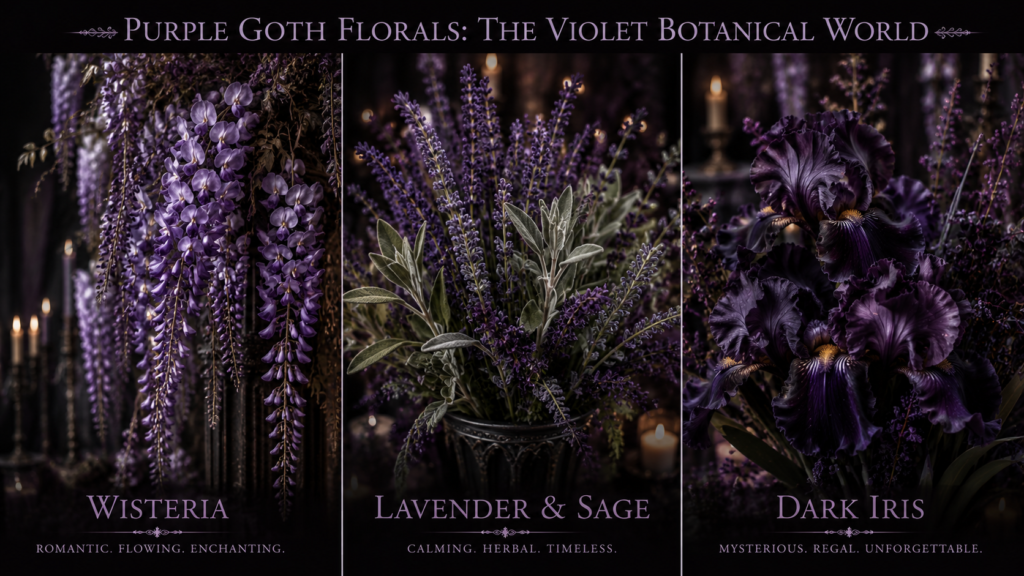
Purple Goth Florals: The Violet Botanical World
The purple floral palette is the richest of all gothic floral directions — because the botanical world provides an extraordinary range of purple-spectrum flowers, from the pale lilac of sweet peas and the dusty mauve of lavender through the saturated violet of allium and iris to the near-black plum of the darkest dahlia and anemone varieties. No other single colour has this depth and variety in the botanical world, which means that a purple goth floral scheme can be built entirely from species whose colour naturally inhabits the palette, producing arrangements of extraordinary chromatic unity and botanical authenticity that no artificially dyed or out-of-season flowers could approach.
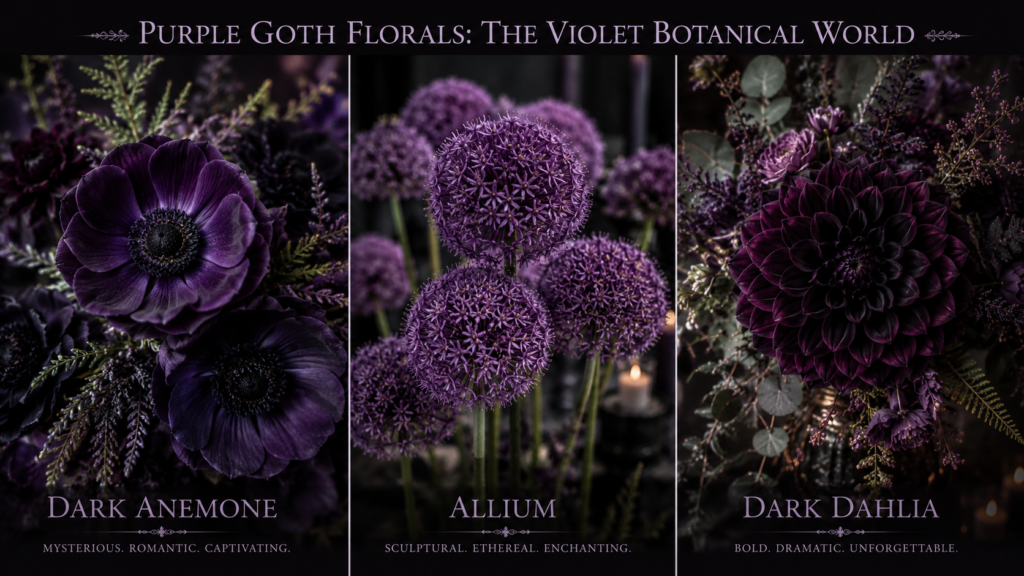
🌸 Dark Anemone
Deep purple anemones with their dramatic near-black centres and contrasting pale stamens — the single most visually powerful purple gothic flower available. The anemone’s specific combination of deep violet-purple petals and its striking dark centre creates a flower of extraordinary tonal contrast that reads as definitively gothic while remaining entirely within the purple botanical palette. Available from autumn through spring.
🌿 Allium
The architectural purple — the spherical allium head on its long, straight stem providing a quality of geometric botanical drama unavailable in any other purple flower. Giant allium spheres in deep violet provide both the most visually distinctive silhouette in the purple botanical palette and the most completely gothic of all sphere-form flowers, communicating the specific quality of a natural object that is both beautiful and slightly threatening. Pairs perfectly with trailing ivy and dark foliage in ceremony arches.
🌷 Dark Dahlia
Deep purple and near-black dahlias — ‘Black Wizard’, ‘Karma Choc’, ‘Chat Noir’, and the deep plum cultivars that sit at the exact point where purple becomes almost indistinguishable from the darkest gothic tones — are the most dramatically beautiful purple gothic flower available in late summer and autumn. Their complex, multi-petalled form provides extraordinary surface detail at close range while communicating a quality of dark abundance and depth at the full arrangement scale.
🌺 Wisteria
The cascading purple — wisteria’s hanging clusters of pale violet to deep purple flowers, with their sinuous, spiralling stems and their specific quality of botanical abundance, provide the most completely Art Nouveau-adjacent of all purple floral elements and the most beautiful cascading botanical decoration available for a ceremony arch. The specific dusty lavender-to-violet range of wisteria flower colour, combined with its abundant cascading habit, makes it the defining purple goth botanical for outdoor ceremonies and arch decoration.
💜 Lavender & Sage
Lavender as the pale, fragrant, herbally grounded element of the purple floral palette — its grey-green stems and tiny pale violet flowers providing texture, scent, and the specific quality of the Mediterranean and Provençal landscape that gives any purple wedding an additional layer of sensory richness. Dried lavender for the boho goth and dusty mauve directions; fresh lavender for the wilder botanical and forest witch directions. The scent alone communicates a quality of presence and memory that visual elements alone cannot approach.
🌸 Dark Iris
The most structurally complex and the most symbolically loaded of all purple flowers — the dark bearded iris in its deepest purple-black cultivars (‘Before the Storm’, ‘Hello Darkness’, ‘Sable Night’) providing a flower of extraordinary visual complexity, botanical specificity, and gothic symbolic depth. The iris has been associated with royal ceremony, with messages between worlds, and with the specific quality of beauty that exists at the border of the visible and the invisible. In the purple goth floral vocabulary, it is the most completely serious and the most symbolically appropriate of all the available species.
Section Six
The Purple Goth Reception Table
The purple goth reception table is the interior space in which the palette achieves its most completely realised and its most atmospherically powerful expression — because deep plum and violet respond to candlelight with a specific quality of inner luminosity that no other dark colour produces. A deep plum velvet runner beneath dark candelabras, with arrangements of deep purple dahlias and trailing dark foliage in aged silver or dark iron vessels, surrounded by the amber warmth of multiple candle flames, is one of the most beautiful table configurations available in all of gothic wedding reception design. The purple glows from within the darkness rather than merely sitting within it.
The Table Surface
- Deep plum velvet table runner — the primary surface element; its specific quality of absorbing the candle light along its length while reflecting it in the pile creates a visual effect of the table itself glowing in the darkness
- Near-black or dark wood base — the table surface that most effectively communicates the gothic anchor; bare dark wood or black linen beneath the velvet runner
- Silver candleholders and candelabras — silver as the preferred metallic for the darker, cooler purple directions; aged gold for the warmer plum and dusty mauve directions
- Amethyst crystals as table scatter — raw amethyst points, geodes, and tumbled stones placed among the botanical elements as geological accents that reference the colour’s gemstone tradition
- Dark berries and purple fruit — blackberries, dark grapes, sloe berries, and plums placed along the botanical runner as edible still-life elements in the palette
The Botanical Centrepieces
- Cascading dark violet dahlia arrangements — the primary floral element; deep purple and near-black dahlias spilling from aged silver or dark iron vessels with trailing dark foliage
- Allium sphere centrepieces — giant allium heads on their long stems in dark glass vessels, their spherical forms providing architectural interest against the flowing botanical matter around them
- Dried lavender bundles — tied with dark velvet ribbon, placed at intervals along the table runner as both decorative and aromatic elements
- Dark anemone and sweet pea scatter — individual blooms from the arrangement species placed loosely along the table surface, creating the sense of petals that have fallen naturally
- Foxglove spires in tall vessels — for vertical drama; the foxglove’s specifically purple-pink spired form providing the most completely wild-botanical element available in the purple gothic floral palette
Section Seven
The Purple Goth Ceremony
The purple goth ceremony space is built from the same chromatic logic as the reception table — deep purple as the primary decorative colour, near-black as the structural anchor, and the specific light conditions that make purple glow rather than merely read as a dark colour. The most powerful light conditions for the purple ceremony are either full candlelight in a historic interior or the specific quality of overcast outdoor light that desaturates warm colours while allowing the blue-shifted cooler tones of the purple spectrum to read with their maximum depth. A purple goth ceremony in diffused natural light in a flower-rich outdoor setting — with a wisteria or allium arch, purple botanical aisle markers, and the bride in deep plum velvet against the specific grey-green of an overcast sky — produces images of extraordinary chromatic depth in which the purple tones achieve their most completely saturated photographic presence.
The Purple Botanical Arch
A ceremony arch of cascading wisteria or abundant allium, deep purple sweet peas, dark iris, trailing foxglove spires, and dark foliage — all in the purple-to-near-black botanical palette. Constructed on a twisted branch or aged iron arch structure rather than a white metal hoop, so that the structural material itself communicates the gothic rather than the conventional bridal aesthetic. The purple botanical arch is the most consistently extraordinary ceremony image available in the purple goth direction.
Purple Pew Ends & Aisle
Dark purple botanical bunches tied with deep plum velvet ribbon at pew ends or chair backs, with the specific quality of multiple flower arrangements in the same deep purple palette creating the visual effect of walking through a corridor of colour toward the arch. Dried lavender bundles on pew ends for the softer, more aromatic purple directions; allium heads and dark dahlia pew decorations for the more dramatically saturated directions.
The Candlelit Stone Interior
A ceremony in a candlelit historic interior — church or castle hall — with the purple botanical decoration and the deep plum velvet of the bridal party illuminated by multiple flame sources. The specific quality of purple in candlelight — the way the colour takes on an inner warmth in amber light that it does not have in natural daylight — makes the candlelit interior ceremony the most atmospherically powerful context available for the purple goth aesthetic.
Wisteria-Draped Venue
A venue or ceremony space where living wisteria is already growing — on a garden wall, over a pergola, or along the facade of an old building — provides the most completely authentic purple botanical ceremony setting available. The flowering wisteria in late April and May provides the entire purple botanical aesthetic in a single growing plant, and a ceremony held beneath or within it requires almost no additional floral decoration to communicate the full visual world of the purple goth celebration.
Section Eight
Purple Goth Wedding Cakes
The purple goth wedding cake is one of the most visually distinctive and the most consistently photographed of all alternative wedding cake directions — because deep purple in cake decoration reads with an immediate and unmistakable chromatic presence that no other dark palette can match, and because the combination of purple fondant or buttercream with dark botanical decoration and silver or gold metallic accents produces objects of extraordinary visual beauty that communicate the aesthetic instantly and completely at every scale from the full-room view to the close-up detail shot.
Deep Plum Fondant With Dark Botanical Cascade
A near-black plum fondant cake with dark purple and violet botanical elements cascading down the side — deep dahlia blooms, anemones, allium heads, dark sweet peas and trailing ivy — in the full purple-to-near-black botanical palette. Silver or aged gold metallic accents in the botanical decoration and on the tier separators. One of the most consistently saved purple goth cake formats across all wedding platforms.
Amethyst Geode Cake
A cake with one face cut away to reveal an interior of sugar crystal formation in amethyst purple and violet tones — replicating the specific visual quality of a geode opened to expose its crystalline interior. The geode cake format is most powerfully executed in the purple palette, where the amethyst colour reads with the specific luminous, crystalline quality of the actual gemstone. The most technically ambitious and the most uniquely beautiful of all purple gothic cake formats.
Ombre Purple Watercolour
A smooth buttercream cake with a watercolour ombre effect moving from near-black at the base through deep plum and rich violet to dusty mauve and pale lavender at the top — the full purple spectrum displayed across a single object in the same way the evening sky moves through its colour registers from darkness to light. Fresh botanical decoration in the corresponding purple species at each tier level.
Section Nine
Purple Goth Wedding Photography
Purple goth wedding photography requires a specific technical understanding from the photographer that many wedding photographers do not automatically possess — because the purple spectrum presents unique exposure and colour rendering challenges that other dark palettes do not. Deep purple and violet tones are the most difficult of all colours for digital camera sensors to render accurately, particularly in mixed or low light conditions: they tend to shift either too blue or too red in the camera’s automatic white balance, and in post-processing they can easily become desaturated or shifted in hue if the editing is not specifically attentive to the purple tones. A photographer who understands how to correctly expose and render deep purple — who shoots at the right white balance settings for the specific light conditions, who understands how to preserve the warmth of plum against the cooler notes of violet in the same frame, and who knows how to edit the final images to preserve the full chromatic depth of the palette — will produce photographs of extraordinary quality.
Best Light for Purple
Overcast natural light provides the most accurate and the most deeply saturated rendering of purple tones — the diffused, cool-white quality of an overcast sky removes the warm bias of golden hour that can push purple toward red-brown and allows the colour to read at its full chromatic depth and purity. Candlelight in a dark interior produces a completely different and equally beautiful result — the amber warmth of flame pushes purple toward plum and creates the specific inner-glow quality that makes deep plum velvet by candlelight one of the most photogenic colour combinations in all of indoor wedding photography.
Blue Hour Purple
The blue hour — the twenty minutes after sunset when the ambient light has a specific cool blue-violet quality — is the most completely natural context for the purple goth aesthetic, because the light itself inhabits the same region of the colour spectrum as the palette. A portrait made in blue hour light, with the deep plum of the dress existing in the same tonal register as the ambient light of the sky, creates an image of extraordinary chromatic unity in which the palette and the environment are genuinely indistinguishable.
Purple Velvet in Candlelight
Deep plum or midnight purple velvet in a fully candlelit interior — the pile of the velvet absorbing and reflecting the amber flame light simultaneously, creating a specific inner warmth within the dark fabric that photographs as a quality of glowing depth unavailable in any other fabric or any other light condition. The most atmospherically extraordinary indoor purple portrait format and the one that most completely communicates the gothic tradition’s deepest aesthetic quality.
Amethyst Detail Shots
Close-up photographs of raw amethyst crystals among the botanical table decoration, or of the amethyst crown in raking natural light that reveals the crystalline structure of the stones — producing detail images of extraordinary natural beauty in which the colour of the decoration, the colour of the gemstone, and the colour of the palette are all simultaneously and perfectly present in a single frame.
Wisteria Cascade Portrait
The bride or couple photographed beneath a living wisteria in full flower — the cascading purple-to-lavender of the flower clusters creating a canopy of colour above and around the subjects, the specific quality of diffused light filtered through wisteria bloom providing the most completely beautiful purple ambient light available in any natural context. The most iconic and the most consistently saved purple goth wedding portrait format.
Dark Allium Field Portrait
The couple photographed within or beside a field of allium in full sphere bloom — the floating violet globes on their long stems creating the most surreal and the most specifically purple-botanical backdrop available in any natural wedding photography setting. Available in late spring, when allium reaches its peak and the specific combination of tall stems and spherical violet heads produces a landscape that communicates the purple goth aesthetic through nothing but genuine botanical abundance.
Bonus — Highly Shareable
10 Purple Goth Wedding Images Everyone Saves on Pinterest
The photographs and details that consistently drive the highest saves, shares, and inquiries across every wedding platform in the dark purple aesthetic.
01
Deep Plum Velvet Bride Beneath Wisteria
A bride in deep plum or midnight purple velvet photographed beneath cascading wisteria in full flower — the colour of the dress and the colour of the wisteria bloom existing in the same purple register, creating a portrait of extraordinary chromatic unity that is the defining purple goth wedding image.
02
Amethyst Geode Cake Detail
A close photograph of the geode cake interior — the sugar crystal formation in amethyst purple and violet tones, catching the light with the specific crystalline luminosity of the actual gemstone. The most visually extraordinary purple goth cake detail image and the one most consistently shared across all alternative wedding platforms.
03
Dark Dahlia Bouquet Flat Lay
Deep purple and near-black dahlia bouquet flat-laid on dark velvet or linen — the full range of the dark purple botanical palette visible: allium heads, dark anemones, deep sweet peas, trailing dark foliage. The most completely purple goth floral image and the one that most powerfully communicates the specific botanical vocabulary of the aesthetic.
04
Candlelit Plum Velvet Reception Table
The purple goth reception table by candlelight — deep plum velvet runner, dark botanical centrepieces, multiple candelabras, amethyst crystals among the flowers, and the specific quality of purple glowing from within the darkness of the table when multiple flame sources illuminate it. The most atmospherically extraordinary purple goth table image.
05
Amethyst Crystal Crown Detail
A close portrait of the bride wearing an amethyst crystal crown — the raw crystal points and the dark botanical elements of the crown photographed in raking natural light that reveals the crystalline structure of the stones. One of the most immediately distinctive and the most widely shared purple goth bridal accessory images available.
06
Couple in Allium Field
The couple photographed within or beside a field of allium at full sphere bloom — the floating violet globes creating one of the most surreal and most distinctively purple botanical backdrops available in any wedding photography context. Available in late May, when allium reaches its peak.
07
Dark Iris Close-Up
A macro photograph of a near-black bearded iris — its complex petal structure, its velvety surface texture, and the specific deep purple-to-black of its colour photographed in soft natural light. The most technically extraordinary and the most botanically specific of all purple goth detail images, communicating the colour’s depth at a scale where its full complexity becomes visible.
08
Blue Hour Portrait With Purple Palette
A full portrait in blue hour light — the ambient blue-violet of the post-sunset sky and the deep plum of the dress existing in the same tonal register, creating an image of extraordinary chromatic unity. The couple in the foreground, the purple sky behind them, every element of the image inhabiting the same spectrum.
09
Ombre Purple Cake in Candlelight
The ombre purple watercolour cake photographed in the candlelit reception — the gradient from near-black at the base through rich violet to pale lavender at the top, illuminated by flame light, creating an image that communicates the full range of the purple spectrum from darkness to light in a single object.
10
Purple Velvet Groom & Bride Portrait
A formal portrait of the couple — bride in deep plum velvet gown and amethyst crown, groom in midnight violet velvet jacket — in a candlelit or overcast natural light setting, both garments in the same purple register, communicating the aesthetic’s total commitment to the colour through the most complete and the most formally beautiful image available in the entire purple goth wedding photography canon.
“Purple is not a dark colour that has been made bright, and it is not a bright colour that has been made dark. It is the colour that exists at the exact meeting point of those two qualities — simultaneously warm and cool, simultaneously regal and melancholy, simultaneously the colour of ceremony and the colour of twilight. The couple who chooses it for their celebration chooses not a compromise between darkness and beauty but the specific point at which they are exactly the same thing.”
— The Dark Wedding Edit
Final Thoughts
Choose Your Purple. Commit to It Completely. Let the Colour Do What It Has Always Done.
The purple goth wedding succeeds when the couple identifies their specific point on the purple spectrum — deep plum or amethyst, dusty mauve or midnight violet, the wild botanical purple of foxglove and allium or the formal gemstone purple of velvet and crystal — and then commits to it completely across every element of the celebration. The most powerful purple goth weddings are those in which the colour is present in the fashion, the florals, the reception table, the cake, and the lighting simultaneously, creating a total aesthetic experience in which every element the guest encounters reinforces the same chromatic world. This is more demanding than the achromatic gothic palette, because it requires chromatic consistency across categories that conventionally use colour for accent rather than for total commitment. But the result — when achieved — is something genuinely extraordinary: a celebration that communicates, through the full deployment of the most symbolically loaded colour in the gothic tradition, a quality of romantic seriousness and beautiful darkness that no other aesthetic direction can produce.
Choose the direction: plum for formal gothic grandeur; amethyst and violet for saturated chromatic commitment; dusty mauve for the boho goth and romantic directions; midnight plum for the most formally dark Victorian gothic aesthetic; wild purple for the botanical, outdoor, and forest witch directions. Identify the specific species that belong to your botanical palette. Find the venue that will allow candlelight, or the outdoor setting where the purple botanical world already grows. Apply the palette with total conviction across every element from the dress to the cake to the table scatter. And when the first portrait is made — bride in deep plum velvet beneath wisteria in overcast light, or beside candlelight in a stone hall, or in the blue hour when the sky and the dress inhabit the same spectrum — you will understand why this specific colour has been the colour of ceremony for as long as ceremony itself has existed.