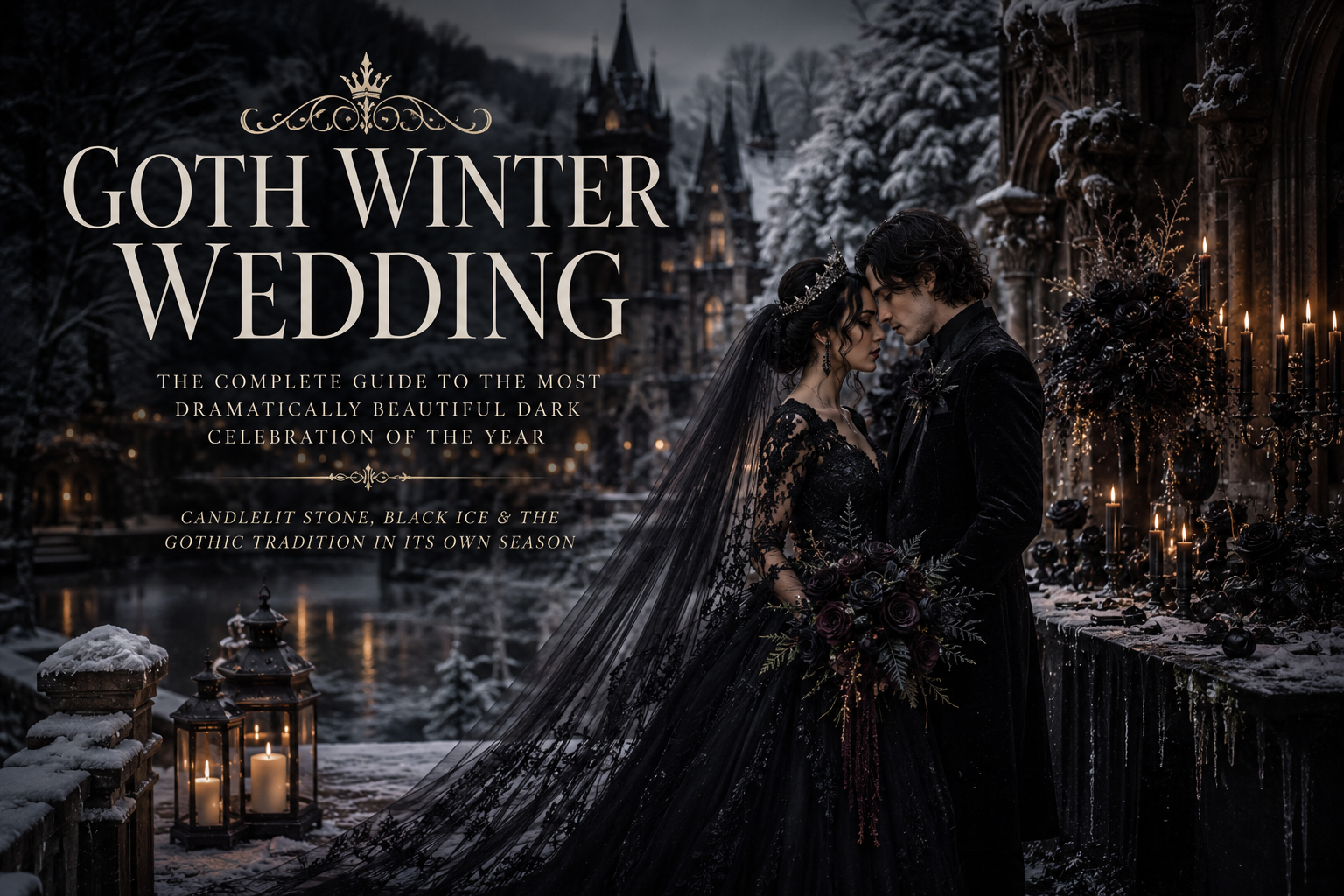
Goth Winter Wedding
The Dark Wedding Edit · 2026
Goth Winter Wedding
The Complete Guide to the Most Dramatically Beautiful Dark Celebration of the Year — Candlelit Stone, Black Ice & the Gothic Tradition in Its Own Season
From frost-covered stone ceremony grounds and velvet-draped great halls to bare branch silhouettes against winter sky, black rose and hellebore arrangements, and the specific atmospheric world where the gothic tradition and the darkest season become completely indistinguishable — your definitive guide to the goth winter wedding.
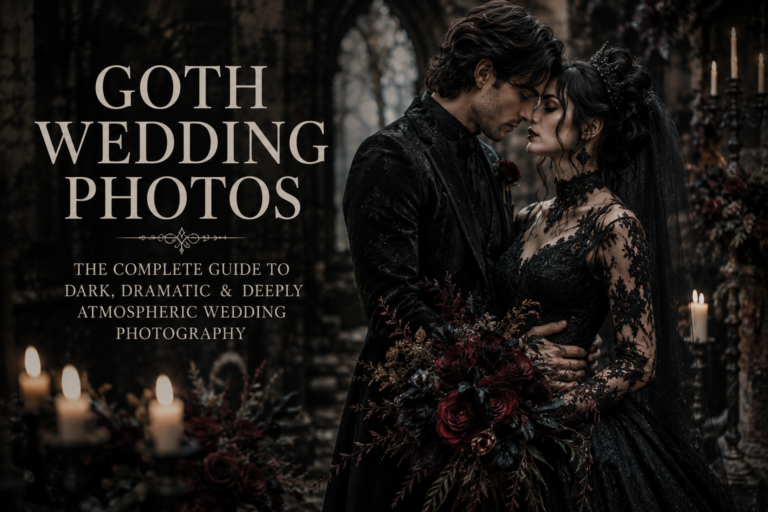
The gothic tradition was not invented for summer. It was invented for exactly this: the long dark evenings of December, the frost on stone, the specific quality of candlelight in a cold room that no electric light can replicate, and the understanding that beauty is not diminished by darkness but made more visible by it — the way a single candle communicates more about the nature of light than a thousand watts of even illumination ever could.
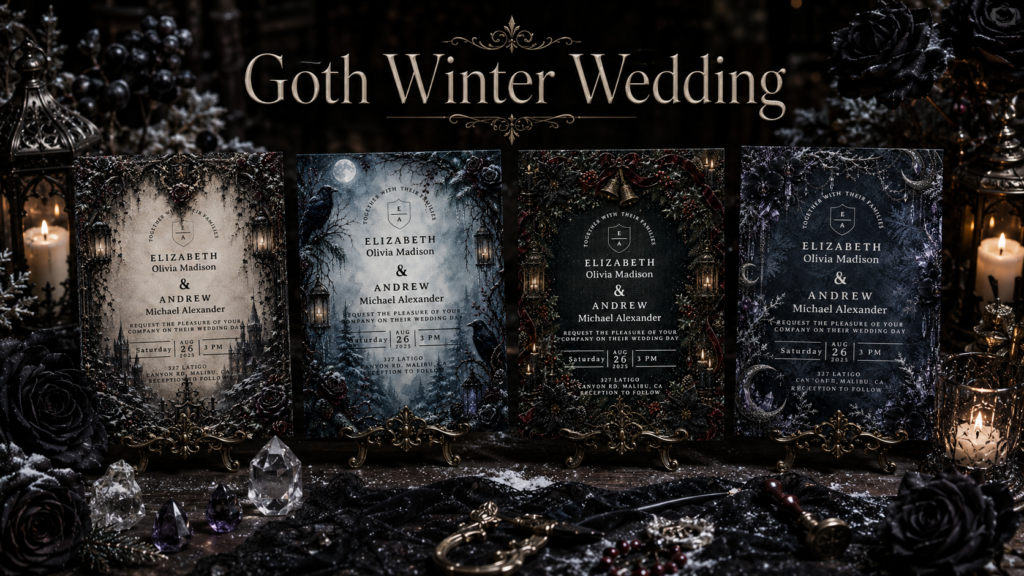
Section One
Why Winter Is the Gothic Tradition’s Truest Season
The case for the goth winter wedding begins not with practical advantages or photographic qualities but with a deeper argument: winter is the only season in which the natural world and the gothic tradition are genuinely, structurally aligned rather than merely aesthetically complementary. The gothic tradition has always been concerned with three things above all others — the relationship between light and darkness, the beauty that exists in proximity to ending, and the specific quality of human ceremony conducted against the indifference of time and nature. Winter is the season that enacts all three of these concerns without any human intervention. The darkness arrives at three in the afternoon and does not retreat until eight the following morning. Every bare tree and frost-covered surface communicates the beauty-in-ending that the gothic tradition has always sought to articulate. And the cold and the dark and the enormous emptiness of the winter sky communicate the indifference of the natural world to human ceremony more powerfully than any season since the last one in which genuinely dark things happened.
The goth winter wedding is not a conventional winter wedding made dark with gothic decoration. It is a gothic wedding for which winter is the natural and the most completely appropriate season — the season in which every element of the gothic aesthetic is amplified rather than accommodated. Candlelight in summer is a decorative choice. Candlelight in December is the only response to genuine darkness. Black velvet in July is a statement against the ambient warmth and colour of the natural world. Black velvet in January belongs to the landscape around it as completely as the bare branches belong to the January sky. The goth winter wedding does not impose the gothic aesthetic on the season; it recognises that the season and the aesthetic have always been speaking about the same things, and simply arranges for them to speak about them together, on the same evening, in the same stone room or the same frost-covered landscape.
What Winter Gives the Gothic Aesthetic
- Genuine, deep darkness arriving at three in the afternoon — allowing fully candlelit ceremonies from the earliest practical start time
- Frost and ice as photographic background elements of extraordinary visual power
- Bare branch architecture — the skeletal form of deciduous trees stripped to their graphic essence against white or grey sky
- The specific quality of cold air on breath — the small cloud of vapour that communicates physical presence in winter and belongs to no other season
- Mist and fog at ground level — the atmospheric phenomenon that most directly communicates the gothic quality of a world only partially visible
- The warmth-within-cold contrast — the physical sensation of the candlelit interior against the frozen exterior that no other season provides
The Goth Winter Advantage
- The most extraordinary historic venues available at the most accessible prices and with the most exclusive attention
- Velvet, heavy lace, and faux fur — the most materially luxurious gothic fashion options requiring no practical compromise for warmth
- Hellebores, dark evergreen foliage, and winter botanical abundance available at their peak
- Snow and frost as setting elements that transform any venue or landscape into something approaching the quality of the most extraordinary black-and-white photography
- The long dark evening — twelve or more hours of darkness in which the candlelit celebration can achieve its full atmospheric power
- A genuinely distinctive celebration experience that guests remember not as a nice wedding but as something that felt genuinely different from anything they had experienced before
Section Two
Five Goth Winter Aesthetic Directions
The goth winter wedding encompasses a range of distinct aesthetic directions, each drawing on a different aspect of winter’s dark character and each producing a completely different quality of visual experience. The specific direction you choose determines your venue, your colour palette, your floral approach, and whether your celebration is primarily an interior experience of candlelit grand darkness or an exterior experience of frost and bare branch and the specific drama of the winter landscape at its most austere.
01
The Grand Candlelit Gothic
The goth winter wedding at its most formally magnificent — a celebration in a grand historic interior, a castle great hall or vaulted stone chamber, fully candlelit from ceremony through to the end of the reception, with the gothic aesthetic expressed at maximum formal intensity. Black velvet and deep plum against stone, candelabras taller than a person, dark botanical abundance in iron and aged brass vessels, and the specific quality of a hundred candles burning simultaneously in a stone room that was built centuries ago for exactly this quality of night. This is the direction that most completely justifies the choice of winter over any other season — not merely because the early darkness allows candlelight to come into its power from three in the afternoon onward, but because the cold outside makes the warmth within feel like something earned and something precious, and the darkness outside makes the light within feel like the most serious and the most beautiful thing in the world.
02
Black Ice & Frost Gothic
The most visually dramatic and the most explicitly winter-specific of all goth directions — built around the specific visual qualities of frost, ice, and the crystalline cold beauty of the deeply frozen landscape. Every surface covered with frost communicates a quality of cold transformation — the world made alien and exquisitely beautiful simultaneously — that is the purest and most specific expression of the winter gothic aesthetic. Dark velvet or near-black wool against frost-white stone or a frozen landscape provides tonal contrast of extraordinary power. The specific photographic quality of breath visible in cold air, of frost crystals visible on every surface in raking morning light, and of the landscape under conditions that make it look as though it has been waiting for centuries to be witnessed at this specific moment — these are the elements that make the black ice and frost gothic direction the most completely winter-specific and the most photographically extraordinary of all dark wedding aesthetics.

03
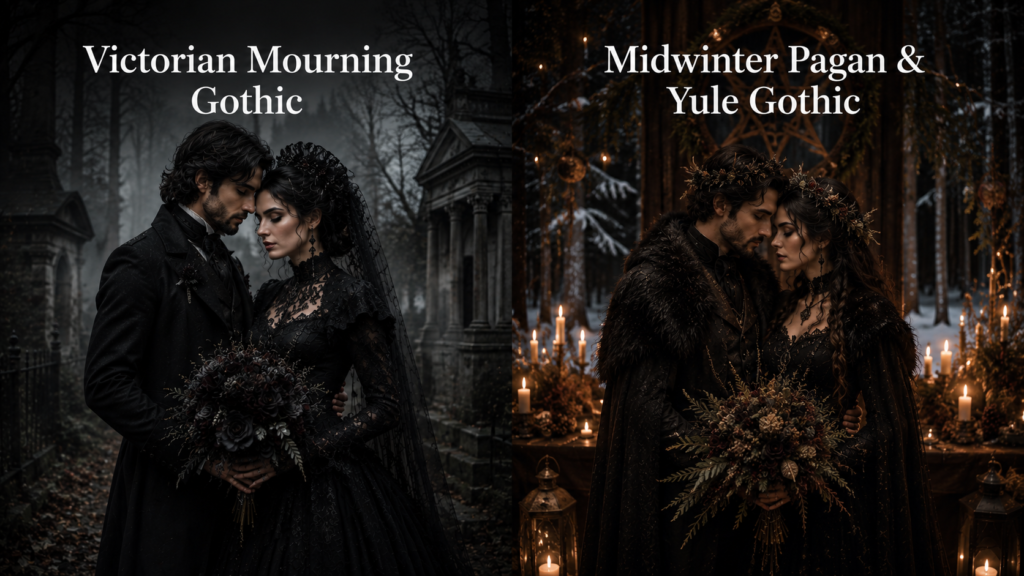
Victorian Mourning Gothic
Drawing directly on the rich and deeply specific visual world of the Victorian mourning tradition — the jet jewellery, the black crape and bombazine, the elaborate mourning rituals that the Victorians developed into one of the most visually extraordinary material cultures ever produced around human grief. Applied to a celebration rather than a bereavement, the Victorian mourning aesthetic communicates the gothic tradition’s most historically grounded and most materially specific visual language: black lace and jet, white lilies and dark evergreen, the specific quality of Victorian formal dress translated into bridal context. It is, deliberately and knowingly, a celebration that understands the relationship between the marriage ceremony and the acknowledgement of mortality that underpins it — that to make a permanent commitment to another person is also, implicitly, to acknowledge all the ways in which that commitment will eventually end.
04
Midwinter Pagan & Yule Gothic
The most ritually grounded and the most seasonally specific of all goth winter directions — drawing on the pre-Christian midwinter tradition of Yule and the winter solstice, the oldest human celebration of the year’s darkest point and the acknowledgement that from this moment, with great difficulty and over great time, the light will begin to return. The Yule gothic wedding uses the ritual language of the midwinter tradition — the need-fire, the Yule log, the evergreen as a symbol of life persisting through the darkest months, the specific astronomical event of the solstice as the ceremony’s deepest temporal frame — to create a celebration of extraordinary symbolic depth. It is a wedding held at the exact moment when the year is darkest and the light begins to return: there is no more gothic thing available in the entire calendar.
05
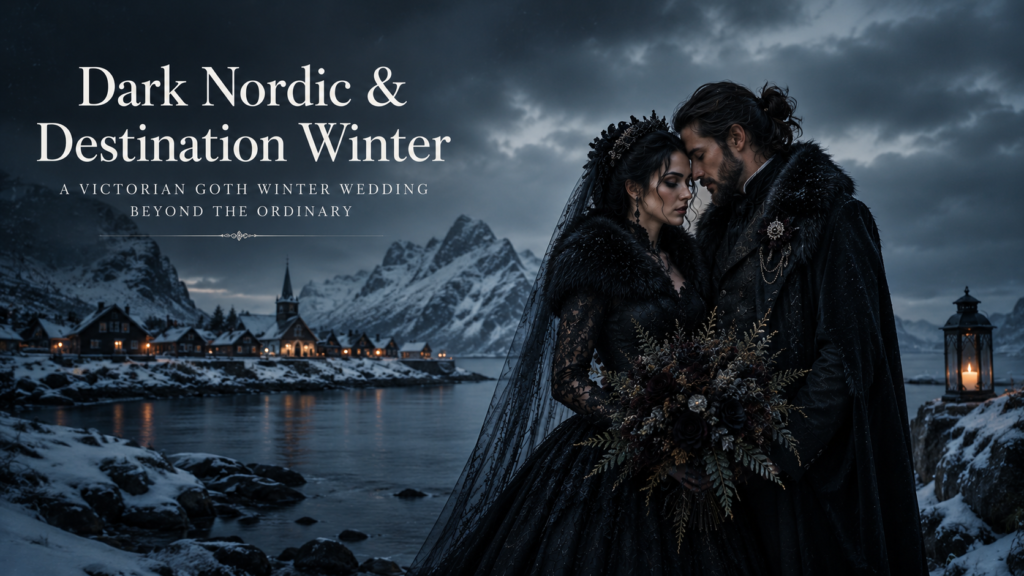
Dark Nordic & Destination Winter
The most geographically ambitious of all goth winter directions — a celebration in a specifically and dramatically dark winter landscape, chosen because winter makes it incomparably more beautiful and incomparably more gothic than at any other time of year. The Icelandic landscape under snow and the aurora borealis. The frozen birch forests of Scandinavia, every trunk silver-white and every shadow blue. The Highland winter of Scotland, where the brief winter daylight has a quality of cold, dramatic beauty unique to that specific latitude. These are settings that exist at their most completely gothic only in winter, and the couple who makes the journey to reach them in the darkest months will produce photographs of completely unrepeatable and entirely location-specific beauty.
Section Three
The Goth Winter Colour Palette
The goth winter palette is the most tonally complete of all dark wedding palettes — because it contains both the extreme dark of the gothic tradition and the extreme pale of the winter landscape simultaneously, creating a palette of extraordinary contrast and depth. Near-black and deep plum as the primary dark elements, answered by the frost white and ice blue of the winter landscape, with the amber warmth of candle flame and the silver of moonlight on snow as the metallic and contrast elements. It is a palette that works in two completely different registers — the interior candlelit register, where the deep jewel tones and near-black are fully expressed against the amber of flame, and the exterior register, where the same dark tones read with maximum power against the pale, desaturated, visually simplified world of the frost-covered landscape.
Gothic Black
The absolute dark — the base of everything
Midnight Plum
The warmest dark — velvet in winter light
Midnight Navy
The winter sky at the deepest part of the night
Oxblood
Holly berry, dark wine, the gothic red of winter
Silver
Moonlight, frost crystal, cold metal
Frost White
The cold light element — snow and breath and cold sky
Candlelight Amber
The warmth of naked flame against absolute dark
Dark Evergreen
Pine, holly, ivy — winter’s only living colour
Aged Ivory
The warm white — old lace and winter candlelight
Ice Blue
The cool contrast — frozen water and winter sky
Section Four
Goth Winter Wedding Venues
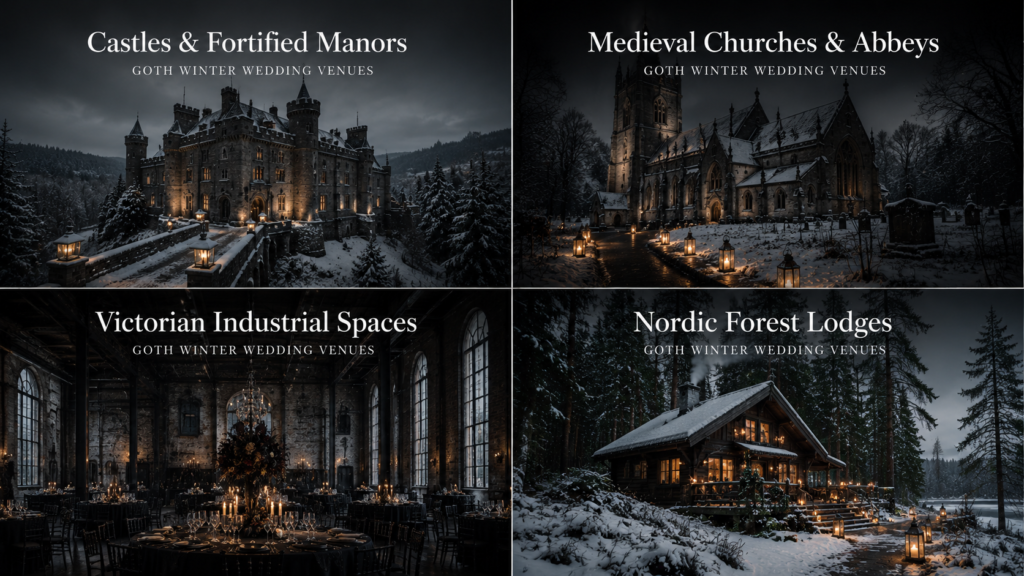
The goth winter venue is the setting that most powerfully amplifies the season’s own dark qualities rather than compensating for them. It is not the venue that is warm enough in December or that has enough indoor space to accommodate the cold — it is the venue whose specific character becomes more completely itself in winter than at any other time of year. The gothic aesthetic has always been most at home in spaces that communicate age, weight, and the accumulation of human significance over time: stone buildings that have absorbed centuries of fire warmth and candlelight, great halls whose scale is most fully communicated in the dark months, courtyards and churchyards whose winter desolation communicates the most fundamental of all gothic qualities — the beauty that exists in emptiness.
🏰
Castles & Fortified Manors
A castle in winter is the most completely goth winter venue available. The stone walls that have been absorbing heat from fires for centuries, the great halls whose vaulted ceilings communicate the full scale of human ambition in the most direct architectural terms, the courtyards and towers that are most dramatic and most atmospherically powerful under frost or snow — all of these qualities reach their fullest expression in winter and in no other season. The goth winter castle wedding is the version of this aesthetic that most completely justifies the historic venue’s existence as a wedding setting.
⛪
Medieval Churches & Abbeys
The medieval church in deep winter — with the churchyard under frost, the bare yew trees ancient and dark against the white ground, and the interior prepared with hundreds of candles and dark botanical abundance — achieves the most completely realised gothic ceremony experience available in any setting. The combination of genuine historical sanctity, the specific quality of candlelight in cold stone, and the winter frost visible through every window creates a ceremony of extraordinary atmospheric power.
🏭
Victorian Industrial Spaces
Converted Victorian mills, warehouses, and industrial buildings — with their high ceilings, exposed iron and brick, and the specific quality of nineteenth-century industrial architecture — respond to winter dark and gothic candlelit decoration with extraordinary atmospheric depth. Their practical infrastructure makes them the most manageable of all goth winter venue types, and their architecture communicates the gothic tradition’s relationship with the Victorian period most directly.
🌲
Nordic Forest Lodges
For the Dark Nordic direction: timber lodges in Scandinavian pine forest under snow, Highland shooting lodges in the Scottish winter landscape, or mountain refuges in the deep cold of the Alpine winter. These venues are most completely themselves in the darkest months, most dramatically beautiful when the landscape around them is under snow, and most powerfully atmospheric when the pine forest outside and the fire within exist in the most direct possible dialogue.
Section Five
Goth Winter Wedding Fashion
Goth winter bridal fashion is the most materially luxurious and the most seasonally unconstrained of all dark wedding fashion directions — because winter imposes no practical ceiling on the weight, the warmth, or the darkness of what can be worn, and actively rewards the most ambitious and the most materially substantial choices with photographs of extraordinary quality. Black velvet absorbs and scatters winter light with a quality of depth and inner warmth available in no other fabric in any other season. Heavy lace over dark slip reads with maximum complexity in the low, directional light of winter afternoons. And the specific accessories that winter permits — faux fur wraps, dramatic cloaks, heavy jewellery, the theatrical outerwear that no summer celebration can accommodate — give the goth winter bridal look a quality of grand, slightly theatrical, entirely serious beauty that is available in no other season.
Bridal Looks
- Black or near-black velvet gown with long train — the most completely goth winter bridal choice and the one that most powerfully communicates the aesthetic through a single material and colour decision; photographed against frost or snow it provides maximum tonal contrast, and photographed by candlelight it achieves a quality of inner warmth that no other dark fabric produces
- Deep plum or midnight navy velvet — the slightly warmer and slightly more chromatic alternative to full black, providing the same material luxury and photographic quality with the addition of the specific wavelength of colour that makes the gothic tradition something more than pure darkness
- Black lace over midnight slip — black or very dark grey lace over a midnight-dark silk slip, the lace botanical pattern reading against the dark ground as a veil between the visible and the invisible; the most gothic of all bridal fabric combinations and the most completely appropriate for the Victorian mourning direction
- Dark fur-lined or faux-fur cloak — worn for outdoor ceremonies, the frost-covered courtyard portrait session, and the entrance; the most dramatically beautiful and most immediately communicative of all goth winter outerwear choices
- Jet and dark crystal crown or headpiece — jet as the historically correct Victorian mourning jewellery stone, set in silver or aged iron with dark botanical elements; the headpiece that most directly references the Victorian tradition while communicating the specific aesthetic with complete seriousness
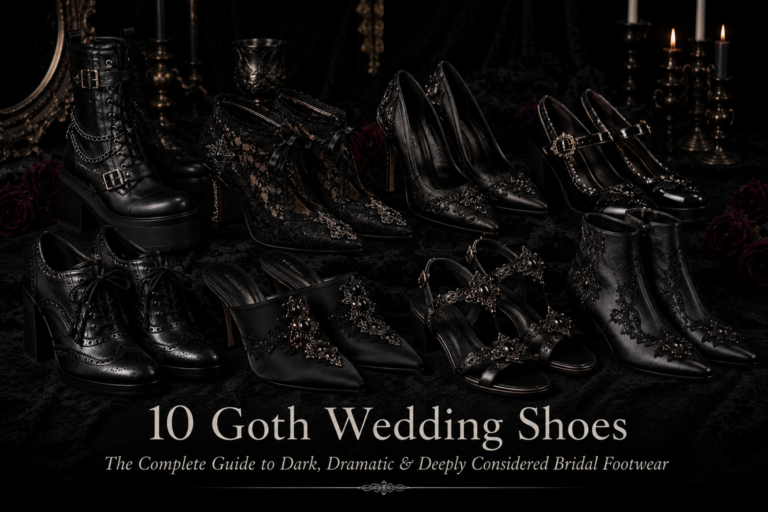
- Black or dark leather heeled boots — the most seasonally appropriate and the most aesthetically congruent goth winter footwear; knee-high or ankle, with buckle or lace detailing that references the Victorian boot tradition
Groom Looks
- Full black velvet or black wool evening suit — the groom’s most formally gothic choice for winter; a black suit or frock coat in velvet or heavy wool communicates the Victorian formal gothic tradition with complete historical accuracy and contemporary elegance simultaneously
- Black or midnight plum velvet jacket — the more immediately striking of the two options; a velvet jacket in near-black or deep plum over black trousers communicates the aesthetic’s specific combination of formal elegance and material darkness most directly
- Black cravat with jet pin — the Victorian formal neckwear in its most gothic form; a black silk cravat with a jet or dark crystal stickpin communicating the mourning aesthetic through the most visible formal detail in the groom’s look
- Dark wool greatcoat for outdoor moments — a long dark wool greatcoat for the exterior ceremony and portrait sessions; the most dramatically silhouetted and the most completely season-appropriate groom outerwear available
- Dark evergreen and hellebore buttonhole — the goth winter buttonhole par excellence: a sprig of dark pine, a single hellebore flower facing downward in the specific way that hellebores always do, dark berries and silver-tipped dried elements; the most completely season-specific goth bridal botanical detail
Section Six
Goth Winter Florals: Hellebores, Black Blooms & Dark Evergreen
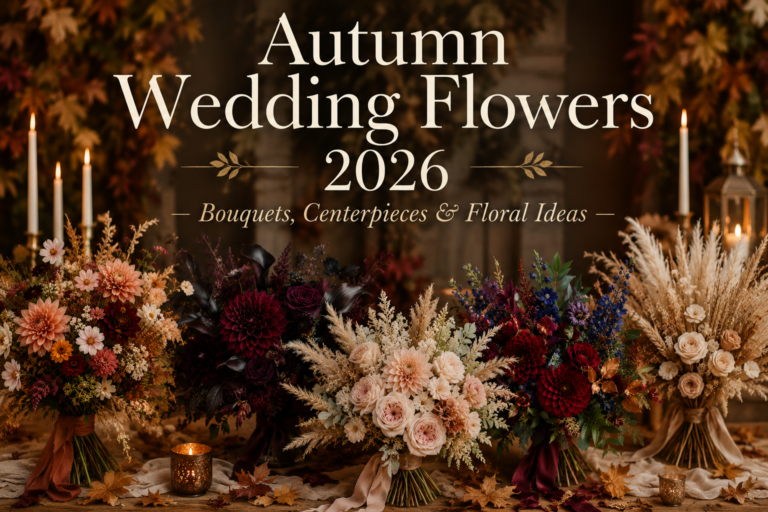
Goth winter florals draw on the most dramatically gothic of all seasonal botanical worlds — the plants that flower in the darkest months, that survive conditions that kill everything less committed to existence, and that carry the specific symbolic weight of the winter gothic tradition. The hellebore — the flower that blooms in snow, faces the ground in perpetual melancholy, and comes in the deepest near-black and dark plum cultivars available in the bridal botanical vocabulary — is the defining flower of the goth winter celebration. Dark evergreen foliage provides the structural backbone. Berries communicate the gothic red of the winter hedgerow. And the dried and preserved botanicals of the season add the specific quality of things preserved beyond their natural season — which is one of the most fundamentally gothic qualities available in any material.
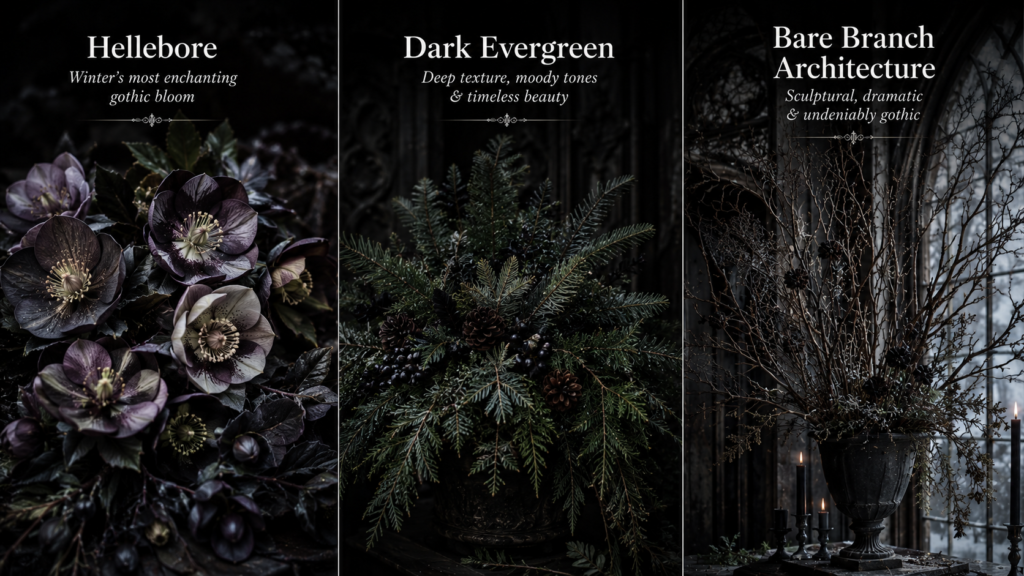
🌸 Hellebore
The goth winter flower — flowering through December, January, and February in the deepest near-black, dark plum, and greenish-white cultivars, the hellebore is the only flower that genuinely belongs to the darkest months and that communicates their specific quality of persisting beauty through the most hostile conditions. Its characteristic downward-facing position — hiding its beauty from the casual viewer, requiring you to lift the flower to see it — is one of the most perfectly gothic qualities available in any botanical species. ‘Black Beauty’, ‘Dark and Handsome’, ‘Wedding Party Black Diamond’ — these are the cultivars that make the goth winter bouquet unmistakable.
🌿 Dark Evergreen
Dark holly, pine and spruce branches, yew, juniper, and the deepest-toned ivy — these are the evergreen species that provide the structural backbone of the goth winter arrangement, their year-round persistence communicating the gothic tradition’s interest in things that survive through the dark. Yew in particular carries the most specific gothic symbolic weight of any evergreen — ancient, poisonous, churchyard-planted, and associated with death and rebirth in every culture that has planted it near the dead.
🌲 Bare Branch Architecture
Lichen-covered bare branches as the structural elements in ceremony arches and floral installations — their stripped, skeletal forms communicating the winter aesthetic’s specific quality of beauty-through-absence with a directness that no artificially added decoration can approach. A ceremony arch built from bare birch or willow branches with hellebores and dark evergreen at its base communicates the goth winter aesthetic more completely than any more elaborate structure.
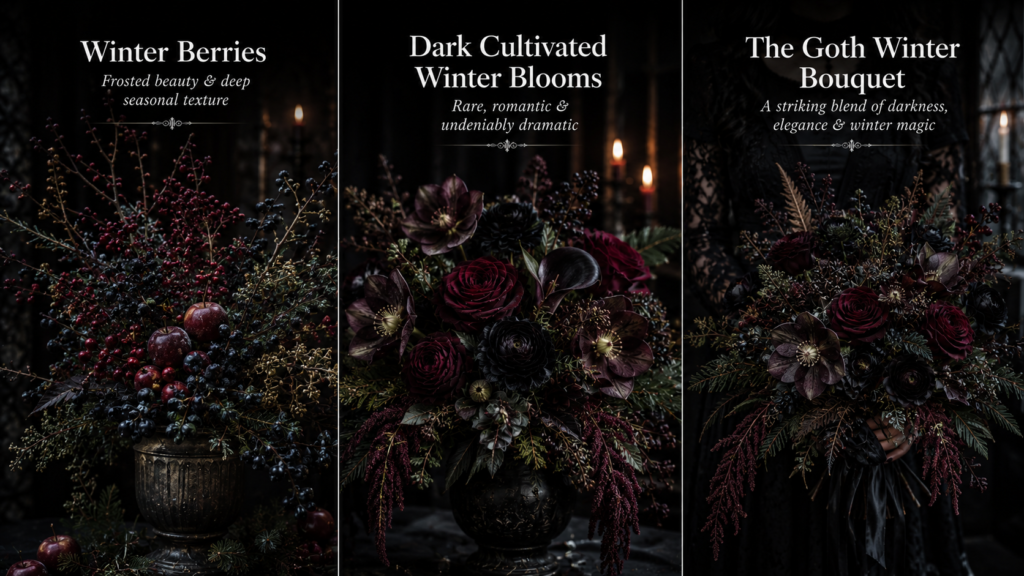
🍎 Winter Berries
Holly berries in their specific vivid red-scarlet against dark green, hypericum berries in dark coral and burgundy, skimmia berries in near-black, and the dark fruit of the ivy in its deepest winter blue-black — these winter berries provide the colour punctuation of the goth winter arrangement, their specific bright jewel tones reading with maximum intensity against the dark evergreen and near-black botanical backdrop.
🌹 Dark Cultivated Winter Blooms
Dark anemones in near-black with their dramatic pale stamens — available throughout winter from specialist growers. Black or near-black tulips in late winter. Dark lisianthus in deep plum and near-black. White amaryllis as the structural winter statement flower with its extraordinary architectural scale. These cultivated dark winter flowers supplement the native botanical palette with additional colour depth and the specific quality of dark flowers that have been cultivated specifically for their darkness rather than their brightness.
The Goth Winter Bouquet
Bound with dark velvet ribbon in near-black or midnight plum, the goth winter bouquet is structured around hellebores as the primary flower — their downward faces communicating the specific quality of the gothic tradition’s relationship with beauty that does not perform itself — surrounded by dark evergreen foliage, bare lichen branches, winter berries, and dark anemones. Dense, dark, materially rich, and absolutely specific to the season in every element. The most goth bouquet available in any month of the calendar.
Section Seven
The Goth Winter Ceremony
The goth winter ceremony is the most atmospherically powerful of all dark wedding ceremony formats — because winter provides, for free and without requiring a single decorative decision, the specific conditions that the gothic aesthetic has always required: genuine darkness, genuine cold, and the specific quality of candlelight that only exists when it is the only alternative to an exterior that is genuinely and deeply dark. A ceremony beginning at three-thirty in December in a candlelit stone interior, with the winter darkness and the frost visible through every window, is conducting itself in exactly the conditions for which the gothic ceremony aesthetic was invented.
The Candlelit Stone Ceremony
A ceremony conducted in a candlelit stone interior — church, castle hall, or vaulted chamber — with hundreds of candles the only light source, the winter darkness pressing against every window, and the warm amber of the flames illuminating dark velvet and aged stone with the specific quality of light that the gothic tradition has always used as its primary atmospheric tool. The most completely gothic ceremony available in any season and the most completely appropriate to the goth winter aesthetic.
The Frost-Covered Outdoor Ceremony
For the frost and ice direction: a brief outdoor ceremony in a frozen landscape, the ceremony space marked by iron lanterns and bare branch decoration, the frost visible on every surface, the breath of each person present visible in the cold air. Short, symbolically complete, and immediately followed by the warmth of the candlelit interior reception. Produces photographs of completely extraordinary atmospheric power that exist nowhere else in the wedding photography canon.
The Yule Fire Ceremony
For the Yule gothic direction: a ceremony conducted around a need-fire or bonfire, with the ceremony space defined by the fire’s light and warmth rather than by any architectural boundary. The Yule log lit at the ceremony, the couple’s handfasting cords made from the specific protective botanical materials of the tradition, the ceremony conducted at the exact moment of the solstice or as close to it as practical logistics allow. The most ritually serious and the most cosmically grounded of all goth winter ceremony formats.
Timing: The Deep Afternoon
The goth winter ceremony belongs at three or three-thirty in the afternoon — when the last of the winter light is still present for the exterior portrait window, but when the candles within the venue are already competing with the ambient light from outside, creating the specific liminal quality of a space that is simultaneously lit by the world and by its own internal flame. The ceremony concludes as darkness falls completely and the reception begins in full candlelit night.
Section Eight
The Goth Winter Reception: The Great Dark Feast
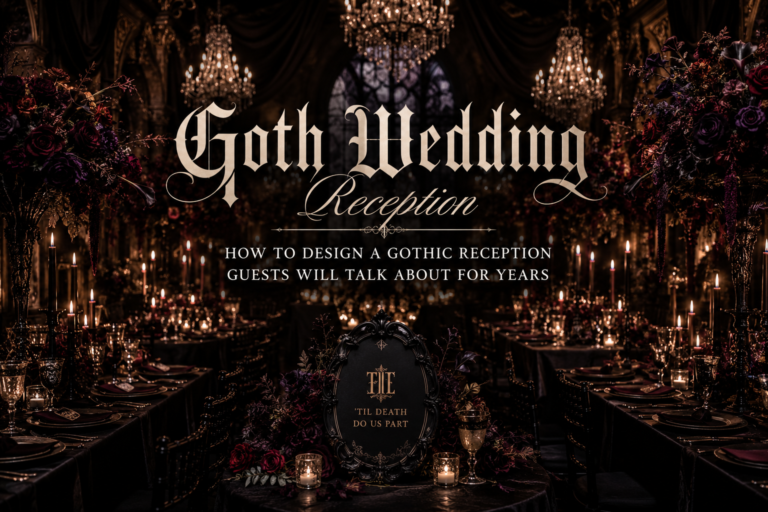
The goth winter reception is the most atmospherically complete of all dark wedding reception formats — because winter’s long darkness, combined with the specific qualities of the gothic aesthetic’s most powerful interior expression, creates a reception that exists entirely within candlelight from the moment it begins, surrounded by ten or more hours of genuine darkness outside. This is not a reception that transitions into its best version as the evening progresses. It is a reception that begins in its best version — fully dark outside, fully candlelit within, the cold making the warmth feel precious, the darkness making the light feel like a collective and deliberate act — and continues in that state for as long as the guests and the candles last.
The Dark Long Table
- Near-black or midnight plum velvet runner — the primary surface material, its warmth and depth amplified by the multiple flame sources above it
- Candelabras at maximum height and number — not tasteful occasional candles but an abundance of candles at every possible height, creating the specific forest-of-light effect that is the goth winter reception’s most defining atmospheric quality
- Dark hellebore and evergreen centrepieces in aged silver or iron vessels — low enough for guests to see across, dark enough to require the candlelight to illuminate them
- Holly, dark berries, and dark fruit — pomegranates, dark plums, black grapes, and winter berries scattered along the velvet runner as the gothic harvest of the darkest season
- Jet and crystal accents — black jet beads and dark crystal elements placed among the botanical matter as the jewellery of the winter table
The Gothic Winter Feast
- Mulled sloe gin and dark berry cocktails as the arrival drink — the most gothic of all winter welcome beverages, communicating the hedgerow darkness through both the colour and the flavour of the drink
- Black garlic, truffle, and dark mushroom dishes — the gothic palette applied to the food menu; dark ingredients communicating the aesthetic through taste and through the visual quality of the dishes as they are served
- Smoked and spiced everything — the specific smoky, spiced, deeply warm food register that belongs to the midwinter feast tradition in every culture that has ever survived a dark winter
- Black wax seal favours — small jars or boxes sealed with near-black or midnight-coloured wax in a botanical or sigil stamp pattern; the most goth favour format available and the one that communicates the aesthetic through the object of the favour itself
Section Nine
Goth Winter Wedding Cakes
The goth winter wedding cake is the most dramatically dark and the most seasonally specific of all gothic wedding cake formats — because the combination of near-black or midnight-toned cake with the specific botanical vocabulary of the winter gothic world produces objects of extraordinary visual power that belong completely to the season and to the aesthetic simultaneously. The most powerful goth winter cakes communicate the specific world of the dark season through every element of their decoration: the near-black of the frost-covered midnight sky, the deep botanical darkness of the hellebore and the evergreen, the silver of moonlight on ice.
Dark Hellebore Gothic Cascade
A near-black fondant or deep midnight navy cake with cascading fresh or sugar hellebores — their downward-facing forms communicating the specific gothic quality of the flower even in sugar form — accompanied by dark evergreen, winter berries, bare lichen branches, and dark anemones. Silver metallic accents at the tier edges. Photographed in the candlelit reception space where the near-black cake surface reflects the amber of multiple flame sources with extraordinary atmospheric depth. The most completely goth winter cake available.
Black Forest Dark Chocolate Cake
A dark chocolate cake in the classic tradition, reinvented for the goth winter aesthetic — deep chocolate sponge with dark cherry and sloe filling, a smooth dark chocolate ganache exterior decorated with edible silver leaf, bare branch sugar work, dark berries, and white chocolate snowflake dusting. The most flavour-appropriate and the most seasonally grounded of all goth winter cake formats, drawing on both the gothic tradition of excess and the winter tradition of warming, darkly rich food.
Bare Branch & Frost Cake
A near-white or very pale grey cake with sugar bare branch work extending across its surface — the specific skeletal beauty of the winter tree translated into sugar, with silver and ice blue metallic accents creating the quality of frost on branch and silver on stone. Dark botanical elements at the base tiers, hellebores and holly berries providing the only dark and living colour against the pale winter surface. The most graphically powerful and the most tonally dramatic of all goth winter cake formats.
Section Ten
Goth Winter Wedding Photography
Goth winter wedding photography operates in two completely distinct visual worlds — the exterior winter landscape with its frost, its bare branches, and the specific quality of winter light, and the interior candlelit space with its amber warmth against deep shadow — and the most extraordinary goth winter wedding photographs are those that exist at the boundary between these two worlds: the exterior portrait made in the fifteen minutes of winter light just before the darkness takes over completely, the interior portrait where the winter frost is visible through the window behind the subject, the ceremony image where the candles within and the winter dark without are in precise balance. A photographer who understands both registers and knows how to work in the transition between them will produce images of extraordinary atmospheric power unique to this specific season and this specific aesthetic.
The Last Light Portrait
The fifteen-minute window around three to three-thirty in December — when winter light achieves its most dramatically directional quality, raking across the frost-covered landscape from almost horizontal angle, illuminating dark velvet and dark lace from one side with the specific quality of low-angle winter sun that exists nowhere in any other season. Black velvet in this light communicates a quality of deep, inner warmth that no summer or spring light can approach. The most important and the most irreplaceable single photographic window in the goth winter wedding calendar.
Frost & Bare Branch
Dark velvet or near-black wool against frost-covered stone, bare branches, or a snow-covered landscape — the maximum tonal contrast available in any outdoor wedding photography context. The pale, desaturated, visually simplified world of the frost-covered exterior provides the most powerful possible ground for dark fashion, making the subject the single point of warmth and depth in a landscape that has temporarily abandoned both.
Candlelit Interior by Flame Only
Portraits made by candlelight alone — no flash, no reflector, no supplementary light source — the amber of multiple flame sources illuminating dark velvet with the specific quality of warmth and soft directional shadow that is entirely unique to naked flame. Requires a photographer who shoots in low light without flash and who understands how to achieve exposure accuracy in the specific warm colour temperature of candle light. The most atmospherically extraordinary indoor gothic portrait format available.
Breath in Cold Air
The visible breath in cold air — the small cloud of vapour that communicates physical presence in winter and exists in no other season — photographed as both subjects speak or laugh, creating a portrait of extraordinary immediacy and physical reality. The single most goth-winter-specific photographic detail available and the one that communicates the season with complete directness through the most ordinary of all human physical acts.
The Winter Fog Portrait
Winter fog and mist at ground level — when the specific quality of thick atmospheric vapour transforms the landscape into something only partially visible, making every tree and building appear at a different depth of focus — creates the most completely gothic natural photographic condition available. A portrait in winter fog in full gothic fashion communicates the specific quality of things that are present but not entirely visible with complete and irreplaceable atmospheric power.
Aurora Borealis
For the Dark Nordic direction: the aurora borealis above a snow-covered landscape, with the couple in the foreground in full gothic fashion — the specific quality of the northern lights’ green and violet atmospheric display providing the most dramatically beautiful and the most completely other-worldly natural backdrop available anywhere on earth, existing only in the specific winter darkness of high northern latitudes.
Bonus — Highly Shareable
10 Goth Winter Wedding Images That Stop Everyone Mid-Scroll
The photographs and design decisions that consistently drive the highest saves, shares, and inquiries in the goth winter wedding space.
01
Black Velvet Bride in Snow or Frost
Near-black velvet bride against frost-covered stone or snow-covered landscape — the maximum tonal contrast available in outdoor bridal photography, the warmth of the velvet existing as the single point of organic depth in a landscape that has temporarily become a study in cold monochrome. The defining goth winter bridal image and the most consistently saved dark wedding portrait across all platforms.
02
Great Hall Candelabra Reception
The reception table in a vaulted stone great hall — multiple candelabras creating a forest of amber light above the dark velvet runner and hellebore centrepieces, the stone walls of the hall glowing with reflected flame, winter frost visible through the windows. The most completely goth winter table image and the one that most powerfully communicates the aesthetic’s fullest atmospheric expression.
03
Candlelit Church Ceremony at Dusk
The medieval church processional at three-thirty in December — candles on every pew end, the altar massed with dark evergreen and hellebores, winter darkness already visible through the windows, and the wedding party in full gothic fashion moving through the amber warmth of the fully candlelit nave. Among the most atmospherically extraordinary and the most historically resonant ceremony photographs available in all of wedding photography.
04
Breath in Cold Air Portrait
Both subjects photographed outdoors with visible breath — the small cloud of vapour between them communicating the cold, the physical presence, and the specific quality of two human beings in the winter darkness simultaneously. The most season-specific and the most emotionally direct of all goth winter portrait details. Entirely unavailable in any other season.
05
Dark Hellebore Bouquet Detail
A close portrait of the goth winter bouquet — near-black hellebores facing downward, dark evergreen foliage, winter berries, lichen branches, dark velvet ribbon — in raking winter light or candlelight. The most botanically specific and the most season-accurate of all dark bridal bouquet images and the one that most powerfully communicates the goth winter aesthetic through a single close-range photograph.
06
Bare Branch Silhouette Against Winter Sky
The couple silhouetted beneath bare branches against the specific pale grey-white of the December or January sky — the skeletal tree architecture above communicating the gothic aesthetic’s most direct relationship with the winter landscape, and the human figures at its base communicating the specific quality of being small within something vast and indifferent and entirely beautiful.
07
Gothic Fireplace Portrait
The couple photographed beside a working stone fireplace — the firelight illuminating dark velvet and pale skin with the most intimate, most directional, and most ancient of all artificial light sources. The goth winter fireplace portrait communicates both the gothic tradition’s relationship with flame and the winter tradition’s relationship with warmth in a single, quietly extraordinary image.
08
Winter Fog Portrait
Full gothic fashion in dense winter fog — the vapour transforming the surrounding landscape into something only partially present, the dark figure or figures emerging from or retreating into the visible with the specific quality of the gothic tradition’s most characteristic spatial relationship: the presence that is also an absence, the visible that is also concealed.
09
Dark Cloak Exit in Snow
The bride in a dark wool or velvet cloak emerging from the venue into falling snow — the dark cloak and the white snow creating the most complete possible expression of the goth winter aesthetic’s fundamental tonal world, the figure moving from the candlelit warmth of the interior into the dark cold of the exterior in the single most dramatically gothic exit photograph available.
10
Aurora Borealis Gothic Portrait
Full gothic fashion beneath an active aurora borealis — the specific green and violet atmospheric display of the northern lights providing the most dramatically beautiful and the most completely otherworldly natural backdrop available anywhere on earth. Available in Iceland and northern Scandinavia in winter only, producible only in the specific darkness of the high northern latitude winter night: the most extraordinary goth wedding portrait available anywhere on the planet.
“The gothic tradition did not invent darkness. It learned to read it. To understand that when the light is genuinely scarce — not artificially dimmed but genuinely absent, crowded out by the dark months themselves — every flame communicates something essential: that the human being who keeps a flame burning in the cold and the dark is making the most fundamental and the most continuously necessary creative act available to anyone. A candle against December darkness is not a decorative choice. It is a position.”
— The Dark Wedding Edit
Final Thoughts
Find the Stone. Light the Candles. Let December Do What It Has Always Done.
The goth winter wedding succeeds when the couple stops treating the season as a backdrop for the gothic aesthetic and starts treating it as the aesthetic itself — when they understand that December and January are not months in which the gothic tradition can be expressed but months in which it is simply present, available, and more completely and more powerfully itself than in any other part of the year. The darkness outside makes the candles within mean something. The cold outside makes the warmth within feel like a gift rather than a convenience. The frost on stone and bare branch makes every human figure in dark fabric look as though they belong to the most completely gothic natural world available on this specific planet.
Choose the direction that belongs most completely to your dark vision — the grand candlelit gothic of a great hall in December, the frost-and-bare-branch austerity of the black ice direction, the Victorian formal depth of the mourning aesthetic, the cosmic seriousness of the Yule gothic, or the extraordinary landscape ambition of the dark Nordic destination. Find the venue that already contains the winter gothic quality before a single candle is lit or a single hellebore is placed — the stone building whose cold is the cold of centuries, the churchyard whose yew trees pre-date the names carved in the stones beneath them, the landscape whose frost communicates the specific quality of a world temporarily simplified to its most essential form. Wear the darkest fabric you own in the deepest shade that belongs to your palette. Light as many candles as the venue allows, and brief the photographer to make the portraits in the fifteen-minute window of last winter light before the darkness completes itself. Then allow the season to do what it has always done for the gothic tradition: provide the most powerful possible evidence that beauty and darkness are not opposites, but the same thing seen from different angles.
Shop the Collection
Browse our most loved designs — customizable invitations, party supplies, and stationery for every celebration.