Woodland Goth Wedding
Woodland Wedding · 2026
Woodland Goth Wedding — Dark Enchanted Forest Guide 2026
From twisted branch arches and candlelit dark forest ceremonies to midnight botanical reception tables and moonlit fairy goth atmospheres — the complete guide to a woodland goth wedding that is genuinely enchanted.
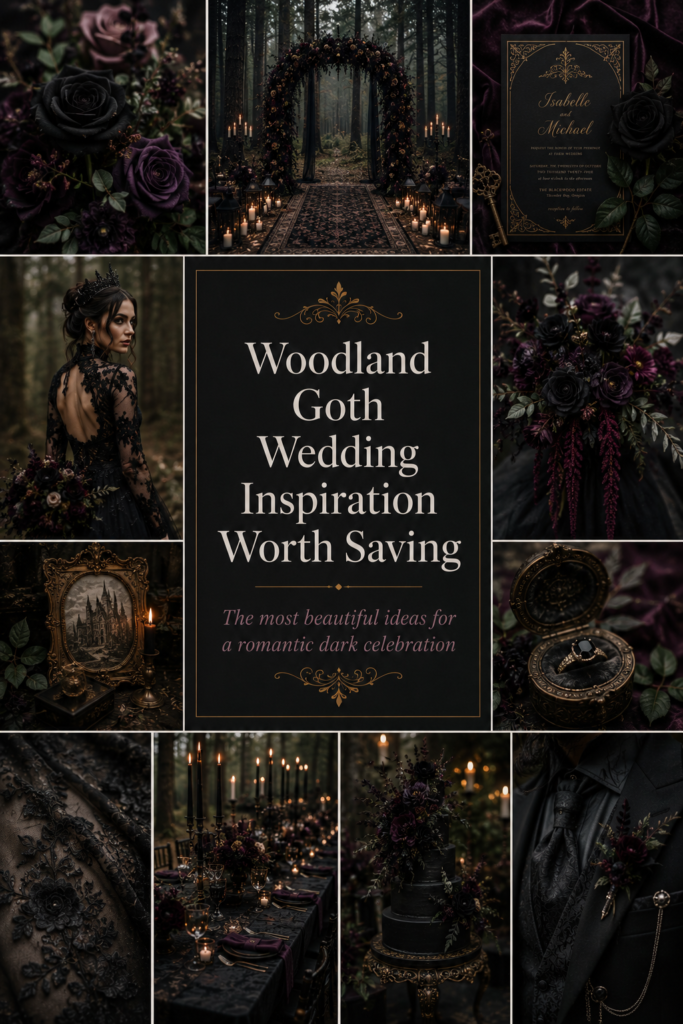
There is a version of the forest that appears after the wedding guests in the lighter aesthetics have gone home — when the afternoon light has finished and the trees have stopped being amber and started being black against a darkening sky. This forest has been here the whole time, underneath the golden wedding aesthetic that surrounded it, and it is for the dark woodland wedding bride that it becomes the primary setting rather than the dramatic background. A gothic forest wedding is not a Halloween event in the woods. It is a genuine celebration of what the forest becomes when the light leaves it — deeper, stranger, more beautiful in the register of things that are beautiful because they are also slightly frightening. This guide covers every element of a woodland goth wedding for 2026: the aesthetics, the palettes, the ceremony and reception, the dark botanical florals, and the stationery that carries this atmosphere from the first envelope to the last candlelit detail.
Ancient trees do not stop being extraordinary when the light leaves them. They simply become extraordinary in a different way — the way that things become extraordinary when human beings can no longer claim credit for the beauty, when the dark does all the work and the moonlight decides what to illuminate and nothing is asking permission.

Section 01
What Is a Woodland Goth Wedding?
The woodland goth wedding aesthetic is defined not by what it borrows from gothic convention but by what it borrows from the forest at its most atmospheric: the specific quality of old trees in deep shadow, the way moonlight reads differently on dark foliage than on light, the particular silence of a forest in November that is not absence of sound but presence of a different quality of listening. This is not skull candelabras and black ballgowns in a woodland clearing, though either of those elements might appear in the most committed version. It is something more specific and more genuinely beautiful: a dark romantic celebration that treats the forest’s own darkness as the primary aesthetic resource rather than something to be decorated over.
The distinction between a gothic forest wedding and a Halloween event in the woods is the same as the distinction between the woodland wedding aesthetic generally and a themed party in a garden centre: one is genuine and the other is costume. The woodland goth aesthetic at its most beautiful is an entirely genuine response to the actual qualities of forest darkness — the way old bark and lichen look in candlelight, the specific visual depth of deep burgundy against dark foliage in a low-light setting, the atmosphere that exists in certain clearings between old trees when the occasion calls for it and the darkness has been allowed to be itself rather than pushed back by bright electric lights. The costume version adds props to a lit space. The genuine version removes lights from a naturally dramatic one and sees what remains.
The forest is the ideal setting for dark romance for the same reason it is the ideal setting for any wedding: it already provides the atmosphere you need. In a light woodland aesthetic, what the forest provides is golden light and botanical abundance. In the dark woodland wedding aesthetic, what the forest provides is shadow, depth, the visual complexity of dark organic textures in low light, and the specific atmospheric quality of old wood and ancient growth that no interior designer has ever successfully replicated. The goth woodland bride is not fighting the forest to create her atmosphere — she is simply letting it do what it was always going to do after the afternoon light left, and building her celebration around what it reveals.
Section 02
The Four Woodland Goth Aesthetics
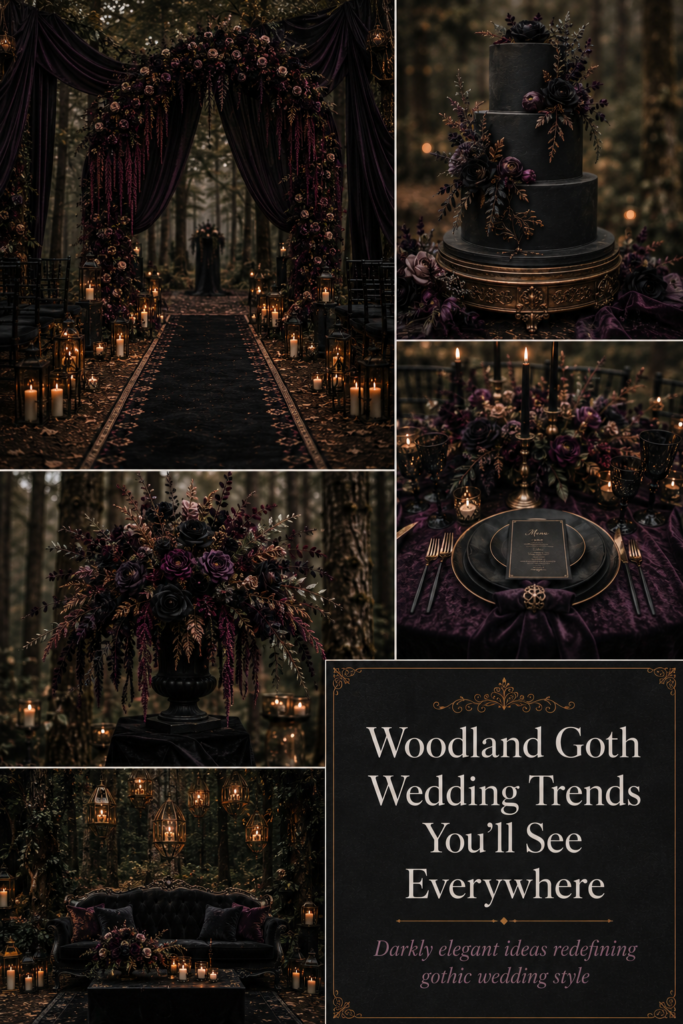
Dark woodland romance is not monolithic. Four distinct aesthetics exist within the broader woodland goth category, each responding to a different quality of forest darkness.
Aesthetic 2.1
Dark Goth Forest
Twisted branches, deep shadows, ancient wood
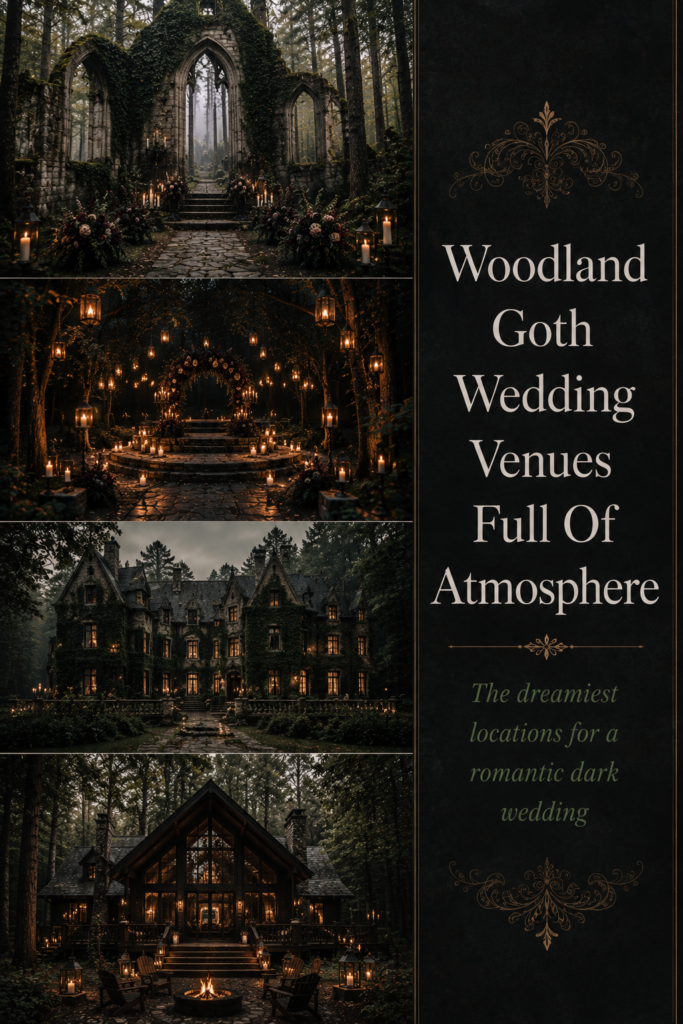
The most directly and unambiguously dark of the four — the dark goth forest aesthetic takes the oldest, most atmospheric elements of deep woodland and treats them as primary decorative material rather than incidental backdrop. Twisted branches used deliberately in the ceremony arch rather than avoided for being irregular. Deep shadow as an atmospheric condition to be managed with candles rather than eliminated with lighting. Forest floor elements — dark moss, lichen-covered bark, fallen wood with genuine age and texture — incorporated into every decorative surface from the ceremony arch to the reception tables. The colour palette is the forest’s own darkest palette: near-black green, charcoal, deep earth tones, with antique gold as the only warm light source.
This aesthetic requires a venue with genuine old woodland character — trees old enough to have the specific quality of twisted, darkened bark that no managed plantation can replicate, dense enough to hold shadow even in the afternoon. The ceremony timing for the dark goth forest aesthetic is later than for any other woodland wedding: late afternoon, so the light is already beginning to fail when the vows are spoken, and the shift from last daylight to first candlelight happens during the ceremony itself. This is one of the most dramatically atmospheric moments available to any woodland wedding in any aesthetic, and it is exclusively available to the couple willing to embrace the darkness rather than schedule around it.
Stationery for this Aesthetic
The Goth Forest Theme stationery collection carries the dark forest’s atmospheric depth into every printed piece — botanical illustration in the specific dark tones of old woodland after the light has left it. The Goth Forest Theme collection — fully customizable with your names, date, and wedding details.
Aesthetic 2.2
Fairy Goth Forest
Moonlit magic and forest darkness in equal measure
Where the dark goth forest aesthetic is primarily about shadow, the fairy goth aesthetic is about the specific quality of light that exists only in forest darkness: moonlight, fairy lights against near-black foliage, the luminescence of pale flowers in deep shade. This is the woodland goth aesthetic for the bride who finds the forest most beautiful not when it is dark but when it is lit from within by things smaller and more mysterious than the sun. Deep twilight botanical tones — indigo, deep purple, forest green shot with silver — alongside fairy lights positioned to suggest fireflies or fallen stars rather than conventional wedding decoration.
The fairy goth forest aesthetic suits evening ceremonies and receptions specifically, and it requires the right kind of fairy light installation to achieve its most beautiful form: not a dense uniform canopy of light but scattered, irregular, positioned to suggest that the light arrived there by its own logic rather than by a lighting designer’s. The comparison that illuminates the distinction is between a forest in summer visited at night, where the fireflies make their own decisions about where to be, and a conference centre with fairy light curtains installed on all four walls. One is an atmosphere. The other is a decoration.
Stationery for this Aesthetic
The Fairy Goth Theme stationery collection belongs to the moonlit register of this aesthetic — botanical illustration where darkness and magic exist simultaneously, for the bride whose invitation should feel like a message from a forest after midnight. The Fairy Goth Theme collection — fully customizable with your names, date, and wedding details.
Aesthetic 2.3
Whimsy Dark Forest
Gothic edge alongside botanical enchantment
The most playfully dark of the four — the whimsy dark forest aesthetic holds gothic darkness and whimsical enchantment in deliberate tension, producing a celebration that is neither straightforwardly dark nor straightforwardly light but something more interesting than either. Mushroom details alongside deep burgundy florals. Fairy lights that are slightly too irregular and slightly too sparse to read as simply decorative. Botanical illustration that contains both wildflower abundance and dark atmospheric depth in the same design. This is the woodland goth wedding aesthetic for the couple who want their celebration to feel genuinely unexpected — who find the combination of playfulness and darkness more interesting and more specific than either alone.
Styling the whimsy dark forest aesthetic requires a light touch on the darkness: the botanical whimsy should be present enough that the gothic elements read as deliberate contrast rather than as the dominant register. A table with moss and mushroom details alongside dark burgundy florals and black taper candles is a whimsy dark forest table. The same table with only the dark florals and black candles is a dark goth table. The addition of the whimsical botanical details is what creates the tension that defines this specific aesthetic — and maintaining that tension throughout every element of the celebration, from the ceremony arch to the stationery, is the primary styling challenge.
Stationery for this Aesthetic
The Whimsy Goth Wedding stationery collection carries both magic and darkness into every printed piece — botanical illustration that is as playful as it is dark, for a celebration that refuses to be only one thing. The Whimsy Goth Wedding collection — fully customizable with your names, date, and wedding details.
Aesthetic 2.4
Fall Goth Forest
Autumn darkness, harvest gothic
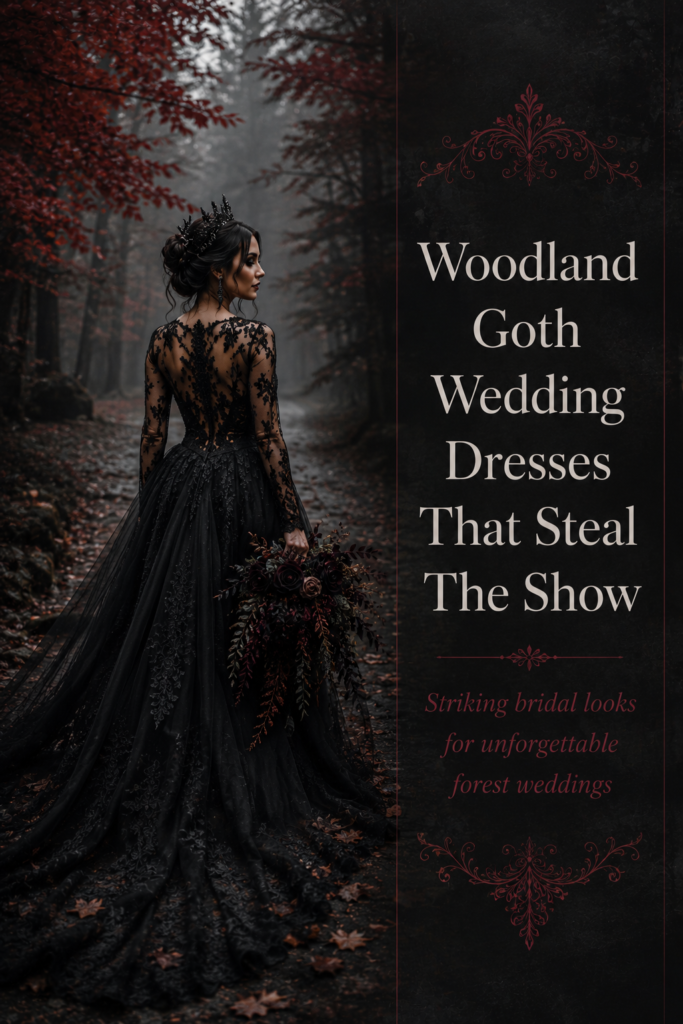
The most seasonally specific of the four — the fall goth forest aesthetic combines the turning canopy of the autumn forest with the atmospheric darkness of the goth woodland aesthetic, producing a palette that is simultaneously the warmest and the most dramatically dark available across the four styles. Deep burgundy and rust in the foliage; near-black forest green in the understorey; antique gold in the candlelight and the stationery details; and the harvest harvest gothic warmth of October in a forest where the light has already largely left by five in the afternoon. This is the aesthetic for the October woodland wedding that embraces the darkness of the season rather than scheduling around it.
The fall goth forest aesthetic works best when it acknowledges the specific quality of October woodland darkness: not the cold, stark darkness of winter but the warm, amber-edged darkness of a forest that still has colour in its canopy but has lost its light. The ceremony timing for this aesthetic is the same as for all dark woodland aesthetics — late afternoon, when the failing light is itself the most atmospheric element available. But in October, the failing light has a quality that no other month provides: it is still warm-toned as it disappears, the last amber of the turning canopy visible in the last of the sky, before full dark arrives and the candles become everything.
Stationery for this Aesthetic
The Fall Goth Theme stationery collection carries the autumn forest’s harvest darkness into every printed piece — deep botanical illustration in the specific tones of October woodland at dusk. The Fall Goth Theme collection — fully customizable with your names, date, and wedding details.
Section 03
Woodland Goth Color Palettes
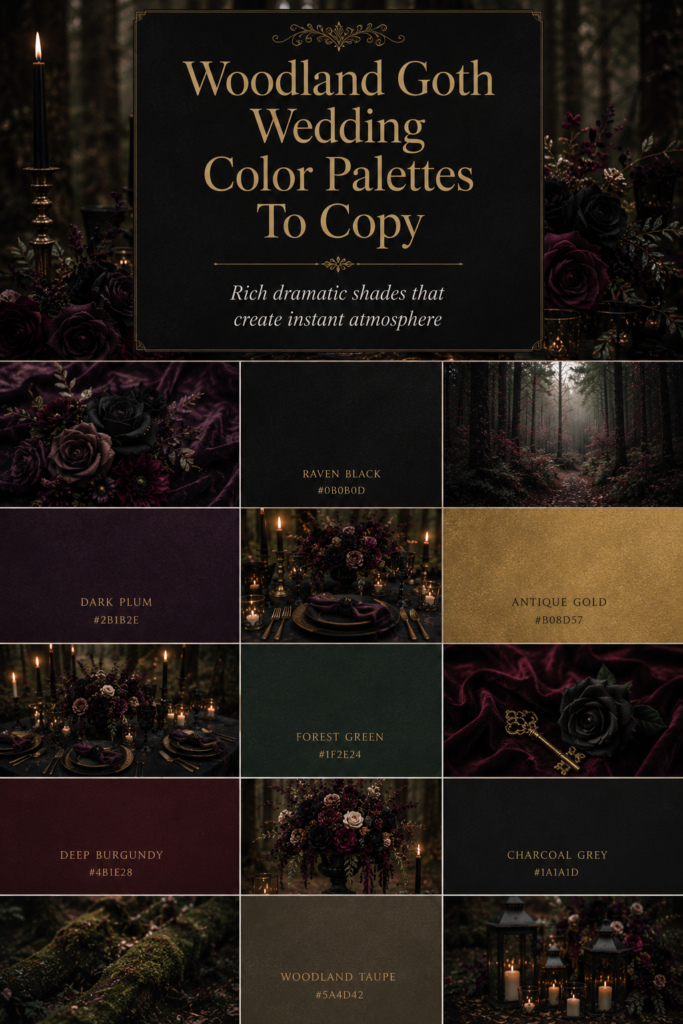
Midnight Forest
Near-black green · Charcoal · Antique gold · Deep ivory
The most purely dark of the four — the palette of an old forest at full night, where green has become almost black and the only warmth is in the candlelight. This palette suits the dark goth forest aesthetic most directly and requires genuine forest darkness to achieve its most beautiful form. In candlelight, the near-black green surfaces absorb the warmth and return something deeper and richer than the original colour — which is one of the specific qualities that makes this palette extraordinary in low-light photography.
Twilight Botanical
Deep purple · Forest green · Silver · Pale ivory
The fairy goth palette — twilight colours and the specific quality of light that belongs to the hour when the sky is still darkening and the stars are not yet fully committed to being visible. Deep purple and forest green as the dominant botanical tones, with silver as the metallic note that takes moonlight rather than candlelight as its reference. This palette is the most specifically romantic of the four and photographs most beautifully in the blue hour — that twenty-minute window between sunset and full dark when the sky does the most extraordinary things.
Harvest Gothic
Deep burgundy · Dark rust · Near-black · Antique gold
The fall goth palette — the warmest of the four, for the autumn forest wedding that wants darkness and warmth in the same frame. Deep burgundy and dark rust are the colours that the forest and the florals contribute; near-black is what the shadows between them become as the light fails; antique gold is the candlelight that makes all three readable and beautiful. This palette photographs with the greatest range and depth of the four — the tonal distance between the deepest burgundy and the warmest gold creates a visual richness that is most apparent in low-light photography.
Dark Whimsy
Deep plum · Forest black · Copper · Warm cream
The whimsy dark forest palette — intentionally less austere than the midnight forest and harvest gothic palettes, with warm copper as the metallic note and warm cream as the light-bringing element that keeps the palette from reading as uniformly dark. The tension between the dark and the warm in this combination is what creates the specific visual quality of the whimsy dark aesthetic: beautiful and slightly unsettling in equal measure, which is of course exactly the right quality for a celebration that holds both darkness and enchantment deliberately.
Section 04
The Woodland Goth Ceremony
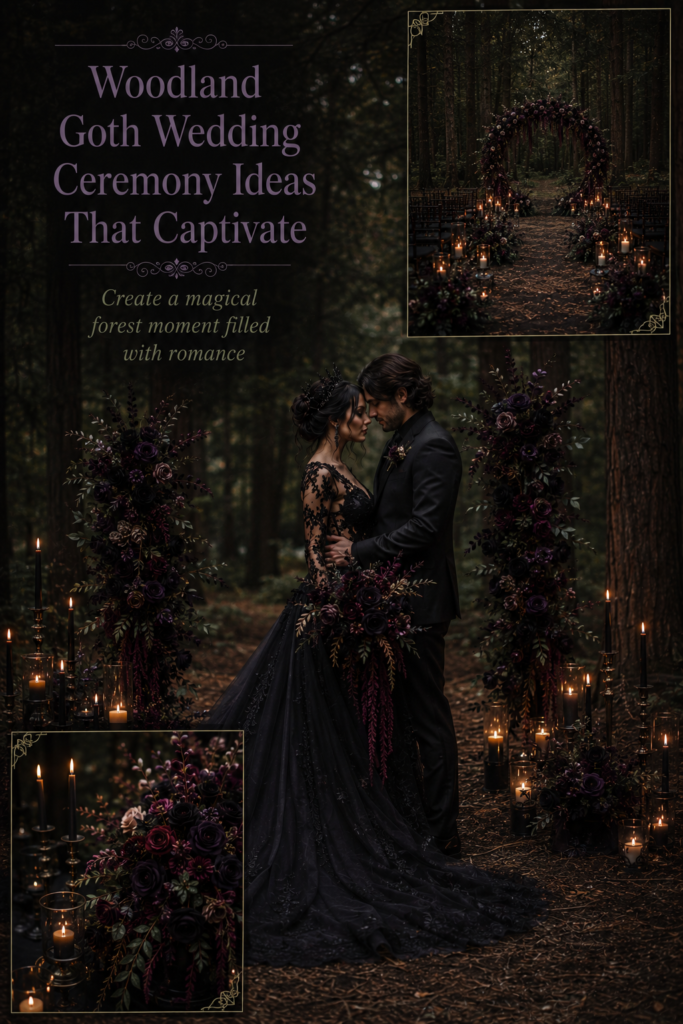
The ceremony timing for a woodland goth wedding is the most consequential of any wedding planning decision in this aesthetic, because the darkness of the forest at the right hour is the primary decorative element — and it cannot be purchased, scheduled away from, or replicated with lighting. For the dark goth forest and fairy goth aesthetics, the ceremony should begin no earlier than four-thirty, and five o’clock or later is preferable in autumn and winter months when the light fails earlier. The specific visual experience the couple is creating — vows spoken in the last light of the day while candlelight from the aisle lanterns becomes visible as that light fails — is available only at this timing and in this setting, and it is genuinely not available anywhere else at any other time.
The twisted branch arch is the defining ceremony structure of the dark woodland aesthetic and it should be constructed rather than discovered — twisted, irregular branches selected specifically for their visual character and assembled into an arch that looks as though the forest shaped it over time rather than a decorator assembled it that morning. Dead or weathered branches in grey and dark brown, wound with dark foliage and a very sparing amount of deep burgundy or near-black botanical material, create a structure that photographs as genuinely architectural rather than merely decorative. Avoid the temptation to add too much botanical material to the arch: the twisted branch structure is the point, and concealing it beneath flowers misses the essential aesthetic principle of this style.
The aisle for a woodland goth ceremony should feel like walking further into darkness rather than toward a lit altar. Candle lanterns at ground level on both sides of the aisle, positioned at intervals that create pools of warm light separated by genuine darkness, are the most effective and most atmospherically honest aisle decoration for this aesthetic. Dark foliage rather than flowers at the base of each lantern, if botanical detail is wanted at ground level. No petal path — fallen dark leaves for autumn ceremonies, dark moss for any season. The guests’ walk to their seats, in this ceremony setting, should feel like moving through a forest in the last of the light, and the ceremony space itself should feel like a clearing that has been lit by candles for some ancient and important purpose.
Section 05
The Woodland Goth Reception
The woodland goth reception is built entirely around candlelight as the dominant light source, with no overhead electric lighting and fairy lights used dramatically and sparingly rather than as a general ambience tool. The distinction between a woodland goth reception and a conventionally lit reception in a woodland setting is almost entirely a lighting decision: in a space lit predominantly by candles, with minimal fairy lights at height, the dark botanical centrepieces and velvet table details become primary elements in the visual composition rather than accessories to a generally bright room. Remove the bright overhead light and the darkness of the decor becomes beautiful. Restore it and the entire aesthetic collapses into something that simply looks dark rather than feeling deliberately atmospheric.
Table styling for a dark woodland wedding reception: long wooden tables with near-black or deep forest green linen runners rather than pale table cloths; dark floral centrepieces with deep burgundy roses and dark botanical foliage in vessels of aged brass, dark ceramic, or black iron rather than conventional glass; black or very deep burgundy taper candles in aged brass holders at varying heights alongside pillar candles in low glass vessels; velvet napkins in deep burgundy or forest green; and stationery pieces — menus, place cards, table numbers — in the same dark botanical illustration as the invitation suite. Every surface should feel as though it belongs to the same visual world as the dark forest outside, rather than offering a conventional and comfortable contrast to it.
Fairy lights in the woodland goth reception are used at the opposite end of the density spectrum from the enchanted forest aesthetic. Where the enchanted forest wants abundant, warm, atmospheric light from fairy lights, the woodland goth uses them as punctuation rather than fill: a single string at canopy height that reads as slightly too sparse to be conventional decoration, positioned so it looks as though the lights appeared there by their own logic rather than a decorator’s plan. The effect should be of having stumbled upon a forest where something is happening rather than a venue where something has been installed. Fairy lights used in this way — sparingly, irregularly, at the height that makes them most visible against the dark canopy — create an atmosphere that is categorically different from and more powerful than the same lights used at conventional density.
Section 06
Woodland Goth Florals
The dark botanical aesthetic of a woodland goth wedding requires flowers and foliage that genuinely belong to its visual register rather than conventionally beautiful flowers placed against a dark setting. Dark dahlias in near-black burgundy, deep chocolate brown, or the specific dark red that reads as burgundy in daylight and nearly black in candlelight are the primary structural flowers of this aesthetic: they have the density and visual weight to hold their own against the drama of the setting, and they photograph with extraordinary depth in low-light conditions where paler flowers tend to read as flat. Black calla lilies are the most dramatically specific choice and are genuinely available rather than a fictional flower — deep purple-black with the specific sculptural quality that makes them the most photographically distinctive blooms in this palette.
Deep burgundy roses at various stages of opening, from tight bud to fully blown, provide the most compositional variety within the dark floral palette and suit every register of the woodland goth aesthetic from the darkest to the most whimsical. Roses in the darkest available varieties — those named for darkness and wine and shadow rather than for summer brightness — photograph with the richest colour depth and the most visual interest in candlelight. Alongside the dark flowers: twisted dark foliage in deep burgundy smoke tree leaves, near-black Italian ruscus, dark ivy, and occasional silver botanical material that creates contrast without breaking the dark register. Forest floor botanical elements — dark moss, lichen-covered bark, weathered twig sections — complete the arrangement as base material that belongs to the woodland setting entirely.
The bridal bouquet for a woodland goth wedding should be handled differently from the conventional bouquet — carried lower and slightly forward from the body rather than held flat against it, so the trailing dark foliage has visual presence in the ceremony photographs. The dark florals should be held against the specific dress colour and tested in the specific ceremony lighting conditions before the final selection is made — a dark burgundy arrangement held against a midnight blue dress in candlelight reads very differently from the same arrangement held against ivory fabric in afternoon light. The most powerful photographs of dark floral woodland bouquets are taken in the specific lighting conditions of the ceremony and reception rather than in a studio flat lay, because the bouquet’s visual qualities depend on the light the celebration itself provides.
Section 07
Woodland Goth Wedding Stationery
The stationery for a woodland goth wedding carries the aesthetic’s specific visual register into the world before the wedding itself has occurred — and it does this in the most intimate and deliberate way available to any wedding planning decision. The save the date arrives in a guest’s mailbox and establishes, in a single image, what kind of wedding this is going to be. For a woodland goth celebration, that image should communicate dark enchantment, genuine depth of botanical atmosphere, and the specific quality of a forest that takes its own darkness seriously. The guest who receives a dark botanical woodland invitation and understands immediately that they have been invited to something that will be genuinely different from other weddings they have attended has been correctly informed. The guest who receives a generic floral invitation for the same celebration has been misled.
The typography and paper choice for dark woodland goth stationery matter as much as the illustration. Typography with genuine historical character — old serif, blackletter for the most committed aesthetic, natural script for the more romantic registers — belongs to the visual language of this celebration in a way that contemporary or sans-serif typography does not. Paper in cream or off-white rather than bright white, because bright white competes with the dark botanical illustration rather than receding behind it. Envelopes in deep forest green or near-black with gold wax seals, so the first impression made on the guest — even before the envelope is opened — is consistent with the aesthetic of the day they are being invited to.
The stationery flat lay for a woodland goth wedding is among the most distinctive and most shareable images produced at any wedding in this aesthetic — dark botanical illustration on cream card, laid against real dark moss and lichen-covered bark, alongside a single dark dahlia or deep burgundy rose, photographed in the specific low light of a forest in late afternoon. These images communicate the entire atmosphere of the celebration in a single frame, and they perform consistently as some of the most saved woodland wedding images on Pinterest because they show something genuinely distinct from the warm-toned botanical flat lays that dominate the category. The dark botanical stationery flat lay is the visual proof that this wedding is different, and it should be planned as deliberately as any other element of the day.
The six collections below each belong to one or more of the four woodland goth aesthetics described in Section 02. All are fully customizable with your names, date, and wedding details, and all can be extended across the full stationery suite — from the first save the date through to the last thank you card — so the dark botanical visual story runs consistently through every piece of paper a guest encounters before, during, and after the celebration.
Shop the Collections
Six Woodland Goth Stationery Collections
Goth Forest Theme
The most directly dark forest collection — botanical illustration in the specific atmospheric tones of ancient woodland after the light has left it.
Fairy Goth Theme
Moonlit magic and botanical darkness in the same frame — for the fairy goth aesthetic where enchantment and shadow are inseparable.
Whimsy Goth Wedding
Playful dark enchantment — botanical illustration that holds whimsy and gothic shadow in deliberate creative tension.
Fall Goth Theme
Autumn darkness and harvest gothic warmth in the same botanical composition — for October woodland goth celebrations where the season and the aesthetic converge.
Forest Woodland Wedding
Deep forest botanical illustration with ancient woodland character — the bridge between the woodland aesthetic and its darkest expression.
Enchanted Woodland Wedding
Forest magic in botanical illustration form — for woodland goth celebrations where enchantment is the primary register alongside darkness.
Frequently Asked Questions
Common Questions
What is a woodland goth wedding?
A woodland goth wedding is a dark romantic celebration built around the specific atmospheric qualities of a forest after the afternoon light has gone — shadow, depth, the visual complexity of old organic textures in candlelight, and the particular atmosphere that exists in certain clearings between ancient trees when the darkness has been allowed to be itself. It is distinct from a costume or themed gothic event in that it treats the forest’s own darkness as the primary aesthetic resource rather than adding theatrical gothic props to a lit space. The result is a celebration that is genuinely atmospheric and deeply beautiful in a register that no other wedding aesthetic can quite reach.
What time should a woodland goth ceremony start?
Later than most weddings and later than most wedding planners will initially suggest: no earlier than 4:30pm, and 5pm or later in autumn and winter months. The defining visual experience of a dark woodland ceremony — vows spoken in the last light of the day while the candle lanterns along the aisle become visible as that light fails — is only available at this timing. In October and November, darkness arrives early enough that a 5pm ceremony creates the full progression of golden hour, blue hour, and full dark within the natural schedule of a wedding day, without requiring guests to stay unusually late.
What flowers are best for a woodland goth wedding?
Dark dahlias in near-black burgundy or deep chocolate brown, black or deep purple calla lilies, deep burgundy roses in their darkest available varieties, dark chocolate cosmos, and twisted dark foliage in burgundy smoke tree leaves or near-black Italian ruscus. Forest floor botanical elements — dark moss, lichen-covered bark, weathered twig sections — complete the dark botanical vocabulary. The consistent principle: flowers and foliage that have genuine visual depth and richness in low-light conditions rather than ones that photograph best in bright daylight. Dark dahlias and deep burgundy roses both achieve their most beautiful form in candlelight rather than direct sun.
What stationery suits a woodland goth wedding?
Dark botanical illustration with typography that has genuine historical character — old serif, natural script, or blackletter styles rather than contemporary sans-serif. The Goth Forest Theme collection for the most directly dark forest aesthetic; the Fairy Goth Theme for moonlit forest magic; the Whimsy Goth Wedding for the playful-dark aesthetic; and the Fall Goth Theme for the autumn woodland goth celebration. All fully customizable with your names, date, and wedding details.
Woodland Goth Wedding Stationery · 2026
Shop Dark Woodland Stationery Collections
Six dark forest collections for every woodland goth aesthetic — fully customizable with your names, date and wedding details.