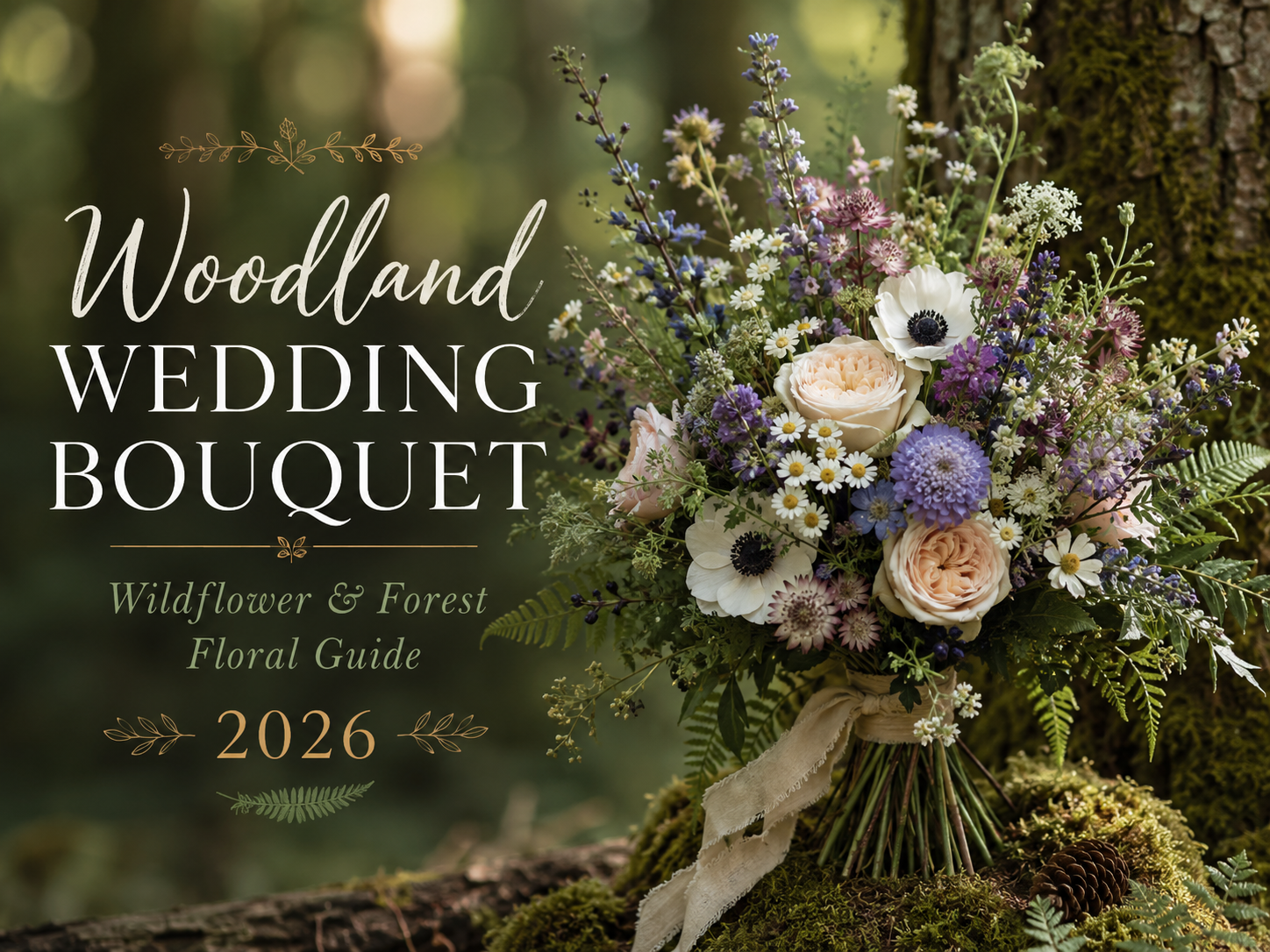
Woodland Wedding Bouquet — Wildflower & Forest Floral Guide 2026
Woodland Wedding · 2026
Woodland Wedding Bouquet — Wildflower & Forest Floral Guide 2026
From loose wildflower meadow bouquets and mushroom forest arrangements to dark botanical fairy posies and antler-accented rustic designs — the complete guide to woodland wedding flowers in 2026.
A woodland wedding bouquet should feel found rather than made. Not assembled in a studio from flowers that arrived in boxes, but gathered from a hedgerow on a still September morning — stems at different heights, foliage still carrying a little dew, the whole thing looking exactly like the meadow it came from. The bride who wants this knows it instinctively: she has been saving photographs of flowers that look as though they grew where they stand, arrangements that look more like a moment than a composition. This guide identifies seven woodland bouquet styles for 2026, explains which flowers and forest floor elements belong to each, covers the seasonal choices available to every woodland bride, and describes how the bouquet connects — as it must — to the stationery suite that begins the wedding’s visual story months before the flowers are even chosen.
Wildflowers grow where they choose and nowhere else. They are not grateful for good soil and they do not take instruction. They are beautiful in exactly the way that things are beautiful when no one has told them how to be — which is to say, completely and without apology.
Section 01
The Woodland Bouquet Philosophy
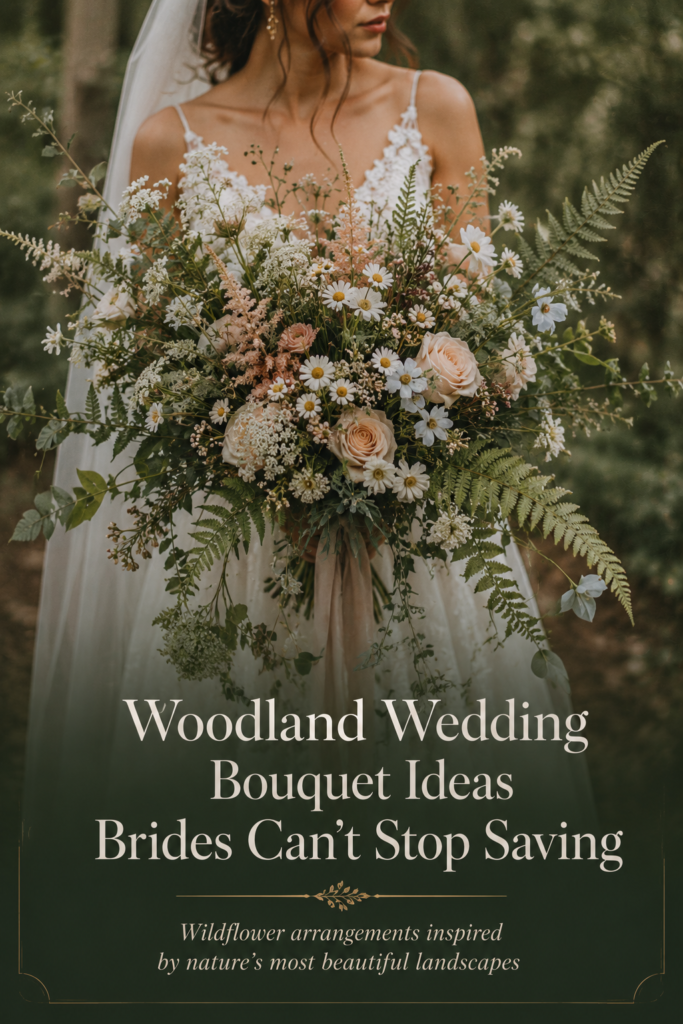
The woodland wedding bouquet differs from a traditional bridal bouquet in the same way a hedgerow differs from a formal garden: one was designed; the other simply grew. Traditional bridal bouquets are exercises in precision — every stem placed, every petal counted, the whole thing constructed to achieve a deliberate visual effect from a specific angle. A woodland bouquet is the opposite exercise. The skill involved is the skill of making something look unconstructed, which is not less skill but a different kind: knowing which flowers look genuinely gathered and which only look gathered in a vase; knowing how much visual variety creates abundance without creating chaos; knowing when to stop adding stems and let the arrangement breathe.
The “gathered not arranged” principle is the central philosophy of every woodland bouquet style, and it applies from the loosest wildflower posy through to the most dramatically botanical dark fairy arrangement. What it means in practice: stems should not all be the same height; the silhouette of the bouquet should be irregular rather than circular; foliage should trail beyond the line of the flowers rather than being contained within it; different textures should be present rather than a single smooth visual register; and the colour palette should reference the specific season and setting rather than an abstract combination of complimentary shades. A wildflower bouquet in full summer should look like that meadow in that month, not like a general concept of wildflowers. An autumn forest floor bouquet should smell of October and look as though it might have grown in the shade of a specific old oak.
Woodland bouquets photograph magnificently for several reasons that all trace back to the same principle. Natural textures in the botanical material — the irregular surface of a poppy petal, the specific weight of a dahlia head, the papery translucency of dried honesty — respond to natural light the way the forest does: with depth, variation, and the specific quality of beauty that belongs only to unmanufactured things. Against a woodland backdrop, a loosely gathered wildflower woodland bouquet disappears into its setting in the best possible way: the bride looks as though she belongs to the landscape, not as though she arrived in it carrying a designed object. The most saved bridal photographs on Pinterest across the woodland category consistently share this quality.
The 2026 woodland bouquet trends reflect the same aesthetic movements that have shaped every other element of the woodland wedding aesthetic this year. Mushroom details — ceramic mushroom picks tucked between wildflower stems, dried mushroom specimens incorporated as botanical accents — have moved from unusual to requested. Dried elements have become genuinely integrated rather than used as filler: dried grasses, seed heads, preserved foliage, and dried wildflowers now carry the same visual weight in a bouquet as fresh flowers, creating arrangements with exceptional texture and seasonal depth. Forest floor botanicals — ferns, moss details, bark accents — appear in bouquets at a level of confidence that would have seemed overly avant-garde three years ago. And antler accent pieces, for the rustic woodland bride, have found their way into bouquet wrapping and handles in ways that are genuinely elegant rather than thematic.
Section 02
Seven Woodland Wedding Bouquet Styles
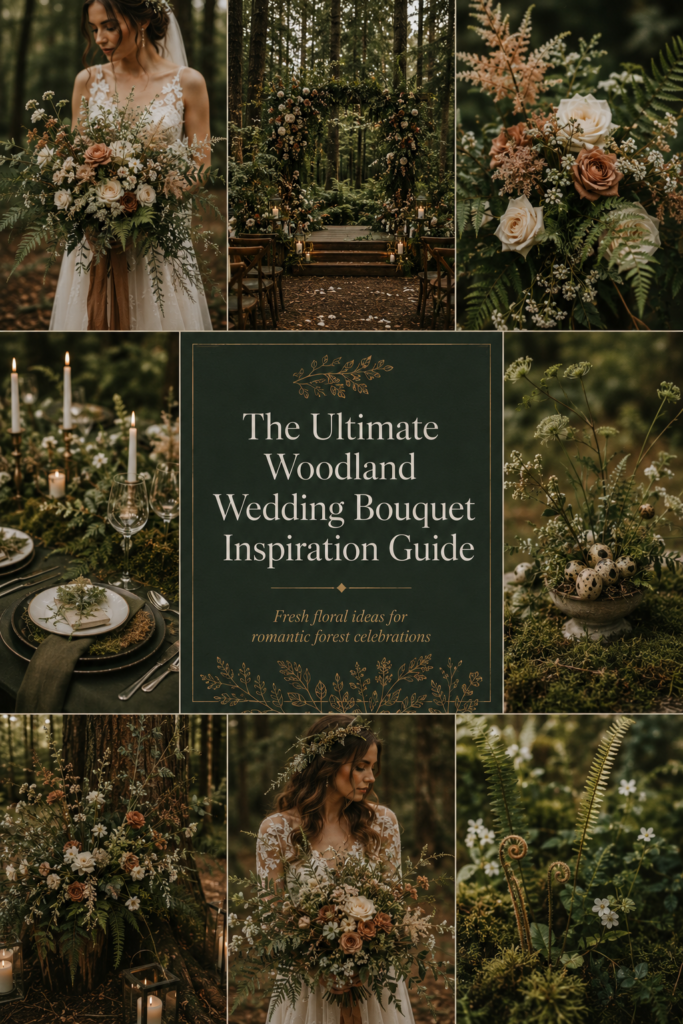
Seven distinct woodland bouquet styles, each drawing on a different aspect of what makes a forest beautiful. Find the description that matches the bouquet you have been imagining.
Bouquet Style 2.1
The Wildflower Meadow Bouquet
The wildflower woodland bouquet is the most iconic and the most requested of the seven styles — the one that appears most frequently in the mood boards of brides who feel most at home in a meadow in August, who find the particular abundance of a hedgerow in full flower more beautiful than any designed arrangement, who want their bouquet to look exactly like the flowers they passed on the drive to the venue. The loose, gathered, hedgerow-picked aesthetic is also the most technically demanding to execute well, because the margin between looking genuinely discovered and looking genuinely unfinished is narrower than it appears.
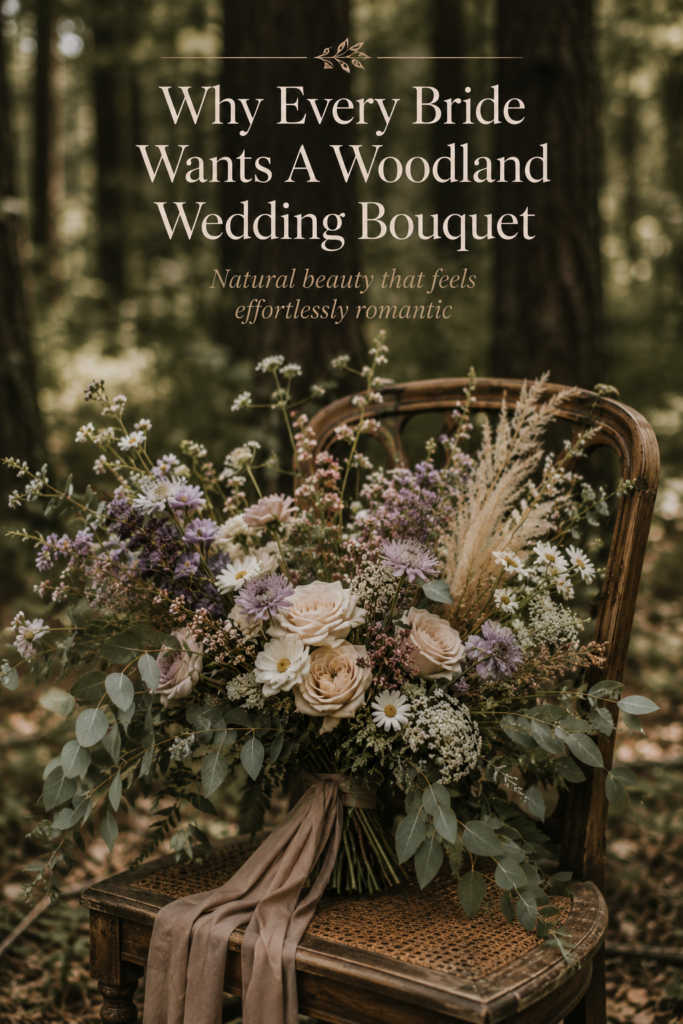
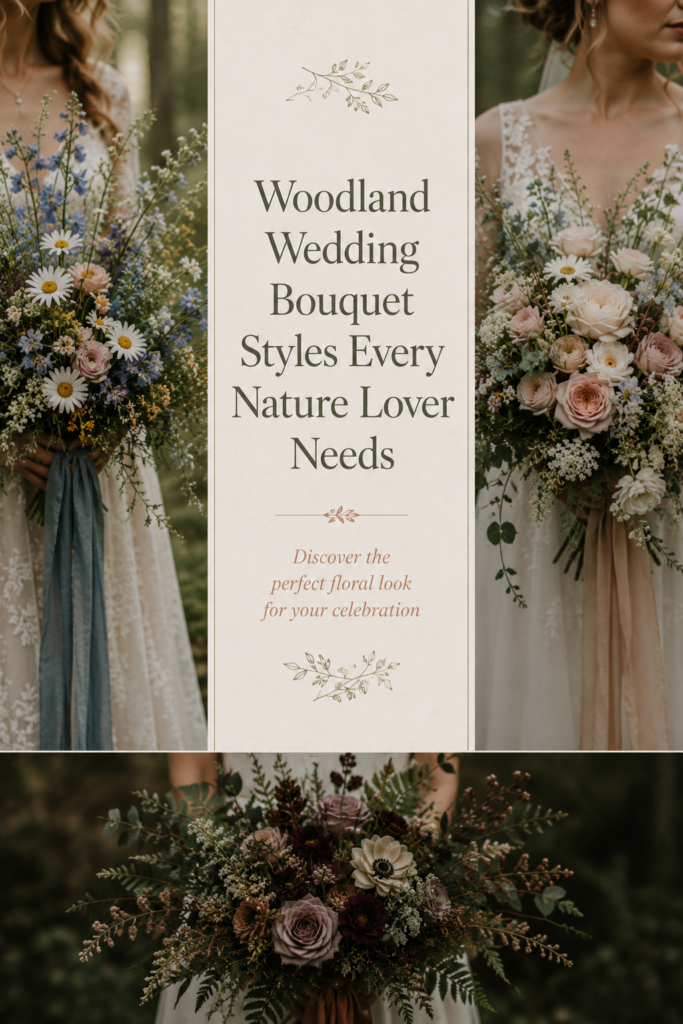
The flowers that work best for a wildflower meadow bouquet are those with genuinely organic forms: cosmos in their slightly papery softness, with petals that overlap in a way that looks accidental; cornflowers in brilliant blue that photograph against green foliage with exceptional visual contrast; sweet peas in their characteristic clustering, trailing from the arrangement rather than standing within it; Queen Anne’s lace in white froth that fills space with a lightness no other flower quite replicates; and poppies, when in season, with their crumpled tissue-paper petals and slightly drooping heads that give the bouquet a specific quality of looking freshly cut. For late summer and autumn, late cosmos alongside the first dahlias, rosehips and berries beginning to colour, and dried grasses carrying the transition between growing season and harvest.
Achieving the wildflower aesthetic without it looking unfinished is a question of controlled restraint rather than simply buying a lot of flowers and holding them loosely. The structural stems — the taller, more architectural ones that give the bouquet its vertical dimension — should be placed first and held lightly, then the filler flowers added at varying heights so no two are at the same level. Foliage should be genuinely trailing rather than tucked: a stem of vine or trailing fern that actually falls below the bride’s hand when she holds the bouquet contributes movement and depth that contained foliage cannot. The finished silhouette should be wider than it is tall, fuller on one side than the other, and slightly different in every photograph because it moves.
Stem wrapping for a wildflower bouquet should be as honest as the flowers: undyed linen ribbon wound once and tied in a simple bow rather than elaborately knotted; botanical twine or raffia for the most rustic register; a length of gathered hessian for barn and countryside venues. The wrapping should disappear behind the flowers rather than becoming a decorative element in its own right. The single addition that most elevates a wildflower bouquet handle is a stem or two of the same botanical material woven through the wrapping at the bind point, as though the flowers have been held together by the same hedgerow that grew them.
Complete the Floral Story
A wildflower bouquet sets a visual language for the entire wedding — and the stationery should speak that same botanical dialect from the first save the date onwards. The Wildflower Woodland Wedding collection — fully customizable with your names, date, and wedding details.
Bouquet Style 2.2
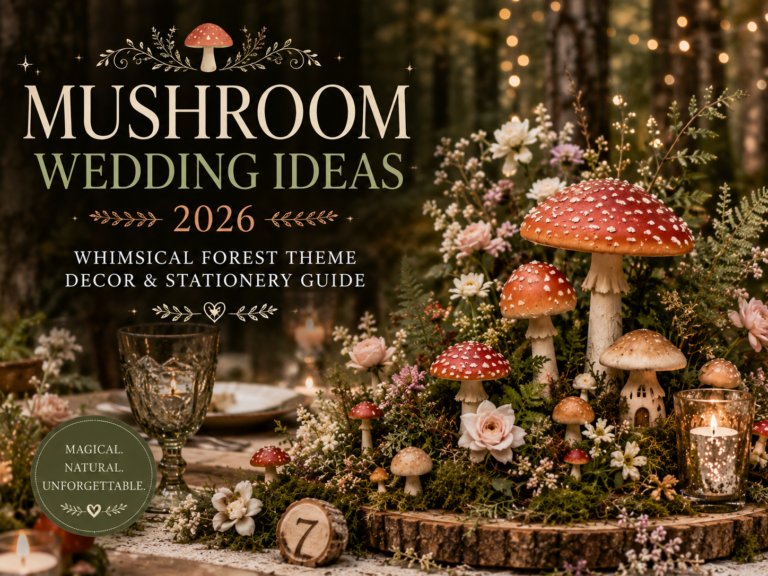
The Mushroom Forest Bouquet
The mushroom wedding bouquet is the most unexpectedly beautiful bridal arrangement of 2026, and the speed at which it has moved from a specialist niche into mainstream woodland wedding planning tells you something about how much the aesthetic landscape has changed. Small ceramic or resin mushrooms — in the forms of fly agaric, oyster mushrooms, or the more understated field mushroom varieties — can be incorporated into a wildflower arrangement as botanical picks, positioned so they appear to grow from the stems of the surrounding flowers rather than being placed beside them. The effect, when it works, is the specific magic of discovering something in a bouquet that you didn’t expect to be there: a small cap just visible between a cosmos stem and a trailing fern frond, looking as though it grew there overnight.
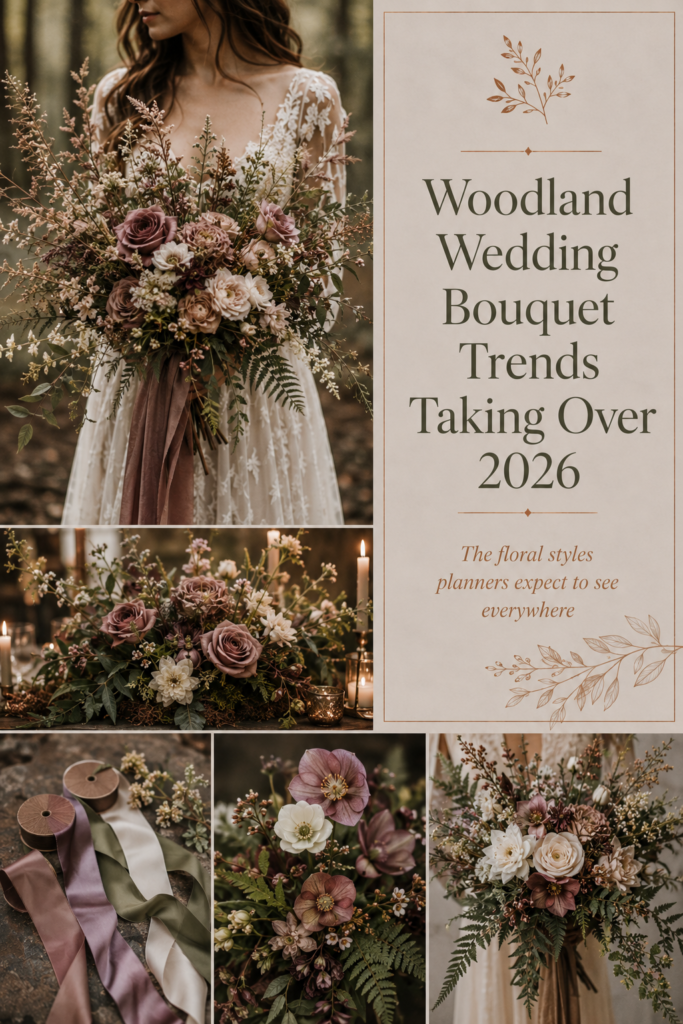
The flowers that complement mushroom details most naturally are those with organic looseness and forest-floor character: cosmos in cream and soft pink that read as wildflower rather than cultivated, ferns in their multiple varieties providing the woodland floor context that makes the mushroom elements legible, dried grasses and seed heads adding the textural depth of a late-season meadow, and small woodland botanical specimens — wood sorrel, herb Robert, tiny ivy trails — that belong to the same ecological moment as real mushrooms. The colour palette of this bouquet is the warmest of the seven: cream, warm ivory, soft earth tones, the specific copper-brown of autumn mushroom caps, occasional notes of terracotta or deep rose.
Dried or preserved mushroom elements — carefully dried specimens that retain their form and a significant portion of their colour through the preservation process — offer the most genuinely natural alternative to ceramic picks. A dried shiitake or a cluster of small preserved forest mushrooms, tucked into the base of a wildflower arrangement alongside dried grasses and preserved ferns, creates the forest floor aesthetic at its most literal: a bouquet that looks as though someone walked through a woodland clearing in October and gathered everything they found. This style photographs best against forest settings at the same time of year — autumn foliage behind a mushroom bouquet creates an image with the specific depth and warmth of the season.
The mushroom bouquet is at its most beautiful when the surrounding botanical material is itself earthy and textural: not the crisp, precise blooms of a formal arrangement, but the slightly-past-peak quality of flowers in their last good week of the season, alongside botanical material that has dried or seeded. This quality of being-almost-autumn is the most specific and most beautiful quality of this bouquet style, and it requires a florist brief that specifically asks for this register rather than the more conventional abundance-and-freshness aesthetic of most bridal arrangements.
Complete the Floral Story
The mushroom forest bouquet belongs to the same world as mushroom woodland stationery — botanical illustration that treats the forest floor with the same genuine respect as the flowers themselves. The Mushroom Woodland Wedding collection — fully customizable with your names, date, and wedding details.
Bouquet Style 2.3
The Forest Floor Botanical Bouquet
The most purely woodland of the seven styles — the forest floor botanical bouquet contains almost no conventional flowers and almost everything that grows below them: ferns in their multiple varieties, trailing ivy and wood sorrel, lichen-covered twig sections incorporated as structural elements, fresh moss in small dense clusters, dark botanical foliage in the specific deep greens and near-blacks of ancient woodland shade. This is the forest floor bouquet for the bride who finds the forest most beautiful at ground level, who is more moved by a cluster of hart’s tongue fern against old stone than by any designed floral arrangement, and who wants her bouquet to feel like a piece of living forest carried into the ceremony.
The fern varieties that work best in bouquets are those with architectural form that reads clearly in photographs: maidenhair fern with its delicate black stems and fan-shaped fronds that photograph with extraordinary lightness against darker foliage; hart’s tongue fern in its glossy, strap-shaped form that provides strong linear contrast to the more organic shapes of other botanical material; male fern for the most substantial presence; and ostrich fern for dramatic height and cascading movement. These can be combined in a single arrangement that reads as genuinely diverse in texture and form, rather than a uniform mass of greenery. Adding occasional moments of botanical colour — a small cluster of wood violets, a few stems of wild garlic in flower, a spray of red campion — brings light into the arrangement without breaking its woodland register.
Keeping forest floor elements fresh through a wedding day requires specific handling. Ferns are among the more resilient cut botanicals and hold their form well when the stems are cut cleanly at an angle and kept in water until the last possible moment before the ceremony. Moss, if incorporated, should be the fresh variety rather than dried, kept slightly damp in a sealed bag until needed. Lichen-covered elements and bark sections are non-botanical and carry no hydration requirement, making them the most logistically straightforward additions. The bouquet should be wrapped and refrigerated, or at least kept cool, from its completion until the moment it is carried. In warm weather, working with the more heat-tolerant botanical varieties — ferns and foliage rather than delicate wildflower blooms — gives the arrangement the best chance of remaining beautiful through a full day.
This bouquet style suits deep woodland venues and ceremonies held in genuine forest clearings most naturally, because it is the most context-specific of the seven: a forest floor bouquet in a formal venue or a garden setting loses some of its visual logic without the forest around it. Against a backdrop of old trees, dappled light, and genuine woodland, the same arrangement becomes one of the most visually complete and moving bridal images available.
Complete the Floral Story
The forest floor botanical bouquet speaks the visual language of ancient woodland — and deep forest stationery carries the same grandeur and nature-connected weight through every paper detail of the day. The Forest Woodland Wedding collection — fully customizable with your names, date, and wedding details.
Bouquet Style 2.4
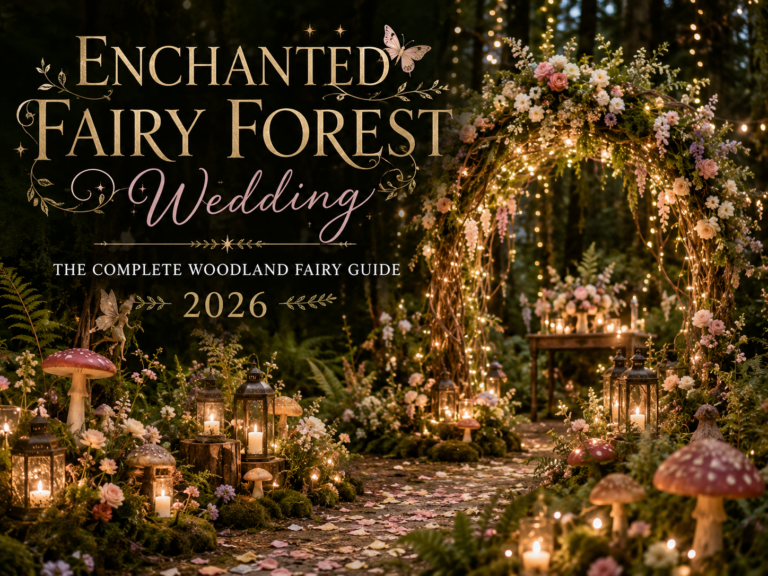
The Enchanted Botanical Bouquet
Where wildflower meets magical — the enchanted forest bouquet incorporates the unusual botanicals that feel as though they could only grow in a forest where the ordinary rules of nature have been suspended. Trailing jasmine winding through fern fronds. Climbing rose stems with their thorns left intact and their leaves still attached. Lunaria — the seed pods of honesty, silvery and papery and translucent, like small moons pressed flat — distributed through the arrangement in a way that makes the bouquet seem to be lit from within. Unusual fern varieties in deep bronze-green alongside the more conventional green varieties. Stems with dramatic seed heads — teasels, agapanthus gone to seed, dried love-in-a-mist — that add architectural height and the specific quality of plants that have been allowed to complete their full seasonal journey.
The enchanted botanical bouquet is distinguished from the wildflower meadow bouquet primarily by the inclusion of unusual and unexpected botanical elements rather than the familiar meadow flowers: the genuinely rare or difficult-to-source botanical specimens that a bride with a specific vision will seek out rather than simply requesting, the kind of flowers and foliage that appear in the paintings of botanical illustrators who went to the forest in search of something extraordinary rather than something conventionally beautiful. Trailing jasmine adds scent as well as visual texture, which means this is also the bouquet with the strongest sensory claim on a wedding morning — the getting-ready room with a jasmine bouquet nearby is a different and more memorable experience than one without.
The colour palette of the enchanted botanical bouquet is deliberately varied: soft ivory and cream for the jasmine and the lunaria, the specific warm green of climbing rose leaves alongside the cooler green of ferns, occasional moments of deep rose or pale blush from any flowers incorporated alongside the botanical elements, and the papery silver-white of dried seed heads and honesty that creates the impression of moonlight distributed through the arrangement. This palette photographs with the specific quality of natural complexity — no single tone dominant, the eye moving through the arrangement finding something new at each stop.
Styling the enchanted botanical bouquet: its trailing elements — jasmine, climbing rose, long fern fronds — mean it needs more length in the handling than a compact wildflower posy. Holding it slightly lower than a conventional bouquet, so the trailing elements have room to fall rather than being crushed against the body, is the most important styling decision. The bouquet should not be held flat against the body but slightly forward and low, so every trailing element has its full visual presence in photographs.
Complete the Floral Story
The enchanted botanical bouquet belongs to the visual world of enchanted woodland stationery — botanical illustration with the same depth and magic as the trailing jasmine and silvery honesty in the flowers themselves. The Enchanted Woodland Wedding collection — fully customizable with your names, date, and wedding details.
Bouquet Style 2.5
The Boho Woodland Bouquet
The boho woodland bouquet is the most abundant and most free-spirited of the seven — the arrangement that most openly celebrates the beauty of things that grow in an undirected way. Pampas grass in its plume form, dried and golden-ivory, provides height and movement that nothing else quite replicates. Dried grasses in varieties from slender wild barley to the broader, more architectural dried stems of miscanthus create the textural base of the arrangement. Wildflowers — fresh in summer and spring, dried or pressed in autumn and winter — add colour and botanical familiarity. The whole arrangement is held together with less formal structure than any of the other six styles: the boho woodland bouquet is the one where slightly more is slightly more, where the edge of the arrangement is deliberately untidy, and where the goal is abundance rather than precision.
In autumn, the boho woodland bouquet reaches its most complete and most beautiful form. Dried elements that would have been transitional additions in summer become primary material: pampas grass in its full late-season form, alongside dried wheat and grasses, dried wildflowers in the warm terracotta, dusty rose, and ivory tones of the late growing season. Fresh additions — dahlias in rust and copper, late cosmos, rosehips and autumn berries — provide the colour notes that prevent the arrangement from reading as purely dried. The palette is the warmest of the seven styles: earth tones, warm neutrals, the specific amber-gold of things that have been in the sun for an entire summer and are now in their last, richest state.
The boho woodland bouquet pairs most naturally with the earthy boho dress aesthetic — flowing natural fabrics, undyed ribbon, the overall quality of beauty without effort. The two together create a visual coherence that is difficult to achieve by mixing a structured or formal dress with a loose boho bouquet, or vice versa. The bride who wants this specific aesthetic tends to know it before she arrives at a florist: she has been accumulating images of dried grass and soft wildflowers and earthy autumn colour for months, and her challenge is communicating that aesthetic clearly enough that the florist understands what “undone” means in this context.
Briefing a florist for a boho woodland bouquet: the most useful phrase is not a list of specific flowers but a description of the quality you want. “I want it to look as though someone gathered it from a hedgerow in October and has been carrying it for a few minutes” communicates more than a list of specific stems, because it establishes the register of abundance-without-intention that is the boho bouquet’s defining quality. Specific stems can then be added to that vision rather than the vision being constructed from specific stems.
Complete the Floral Story
The boho woodland bouquet’s earthy, free-spirited warmth belongs to boho woodland stationery — organic botanical illustration that carries the same undirected abundance from the invitation through to every table detail. The Boho Woodland Wedding collection — fully customizable with your names, date, and wedding details.
Bouquet Style 2.6
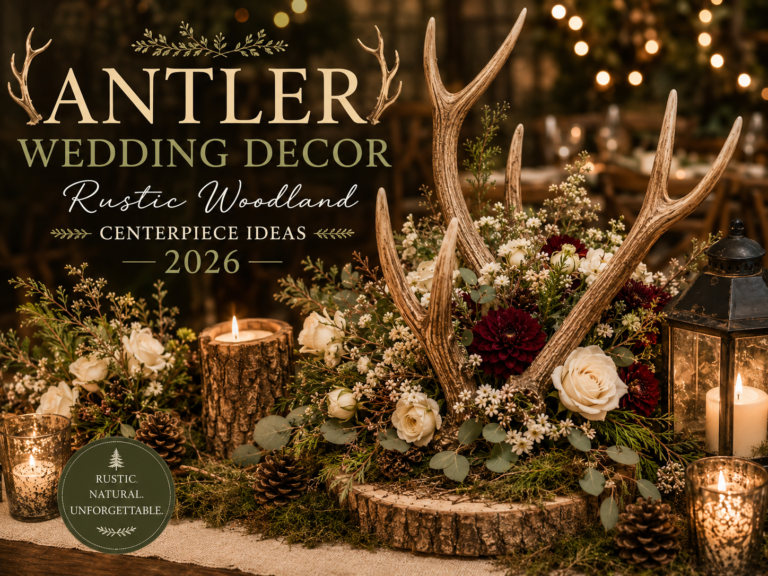
The Antler & Wildflower Bouquet
The most distinctly rustic of the seven styles — the antler and wildflower bouquet incorporates real or resin antler elements alongside woodland botanicals in a way that is more elegant and more considered than the word “antler bouquet” perhaps suggests to a conventional bridal imagination. Small antler picks — sections of real shed antler or high-quality resin replicas — can be incorporated into the stem bundle of a wildflower arrangement so they appear at the same height as the flower heads, looking as though they are simply another botanical element that happens to be made of something other than plant matter. Deer motif bouquet charms in aged bronze or antique brass, attached at the stem bind point, add the woodland wildlife reference more subtly. And natural antler handles — a section of shed antler used as the structural grip around which the botanical material is bound — create the most directly rustic version of the style.
The flowers that complement antler elements most naturally are those with genuine seasonal character and a palette that belongs to the same woodland-rustic register: thistles in their sharp structural form alongside the unexpected softness of their purple flowers; heather in clumps that provide texture and the specific muted purple of late Scottish summer; deep dahlias in burgundy and rust that have the richness and solidity to hold visual weight alongside the physical substance of real antler; and rustic autumn blooms — chrysanthemums, late sunflowers in their slightly past-peak form, berries and rosehips — that belong to the same harvest register as the antler itself. The palette of this bouquet is the warmest and most specifically autumnal of the seven: deep burgundy, warm rust, muted purple, cream, and the brown of real antler.
The antler element in this bouquet should feel discovered rather than placed: a small antler pick that appears between two dahlia stems as though it grew there, rather than a prominent antler piece positioned at the front of the arrangement as a deliberate focal point. The restraint of using antler details at the edges and interior of the arrangement, rather than featuring them centrally, is what creates the quality of a woodland wedding bouquet rather than a hunting-themed prop. Context matters as much in the bouquet as it does in the centrepiece: generous botanical material around the antler elements makes them feel natural; sparse botanical material around them makes them feel themed.
Stem wrapping for the antler and wildflower bouquet should be the most rustic of the seven styles: rough botanical twine, hessian ribbon with frayed edges, a strip of natural leather for the most Western-influenced version. If a natural antler handle is used, the wildflower material is bound directly to it with twine, allowing the antler surface to be partially visible through the stem bind rather than being entirely concealed. This creates the impression of a bouquet that has been constructed in the forest itself from what was available, which is exactly the impression worth working for.
Complete the Floral Story
The antler and wildflower bouquet belongs to the visual world of antler woodland stationery — rustic wildlife botanical illustration in warm earthy tones that carry the same honest, nature-connected warmth through every printed detail. The Antler Woodland Wedding collection — fully customizable with your names, date, and wedding details.
Bouquet Style 2.7
The Dark Fairy Bouquet
For the alternative woodland bride who finds the forest most beautiful at dusk rather than at noon, the dark fairy bouquet is the most dramatically distinctive of the seven — an arrangement of deep colours and dramatic botanical form that belongs to the older, stranger end of the fairy tale tradition. Dark dahlias in near-black burgundy or deep chocolate brown, their dense petals creating a visual weight and depth that pale flowers cannot match. Black or deep purple anemones with their distinctive dark centres intensified by the surrounding flower. Deep burgundy roses at various stages of opening, from tight bud to fully blown, so the arrangement has genuine variety within its dark register. And chocolate cosmos — the most specifically named flower in this list — in their extraordinary deep red-brown that appears to darken further in low light.
The foliage for a dark fairy bouquet should match the dramatic register of the flowers: dark Italian ruscus in near-black green, deep burgundy smoke tree leaves in their burgundy-to-near-black seasonal colour, trailing dark ivy, and the occasional stem of silver or black-veined botanical material that creates contrast without breaking the dark palette. The effect of this combination in photographs taken in woodland shade or candlelight is genuinely extraordinary: the dark flowers and foliage absorb light rather than reflecting it, creating depth rather than surface, and the whole arrangement reads as genuinely three-dimensional in a way that pale arrangements in the same light rarely do.
Dark bouquets photograph with particular power against forest settings for a specific reason: the dark tones of the arrangement create visual separation from the surrounding greenery rather than blending into it, and this separation allows the bouquet to read as a distinct compositional element against the natural backdrop. In full afternoon sunlight, a dark bouquet has its colour most accurately represented but least dramatically presented; in woodland shade or the first hour after sunset, the same arrangement becomes more itself, the depth of the colours more apparent, the drama of the composition more complete. The most beautiful photographs of dark fairy bouquets are almost always taken in low or diffuse light.
Styling the dark fairy bouquet: the dramatic quality of the flowers means that accessories and dress details should be considered in relation to the bouquet as well as in relation to each other. A dark fairy bouquet held against a pale ivory dress creates a specific visual contrast that can be extraordinarily beautiful if the other styling details align with it; held against a dark forest green or midnight dress, the bouquet becomes harder to read as a distinct element. The choice is a genuinely compositional one rather than a matter of personal preference, and the most useful test is to hold the actual flowers (or similar colours) against the actual dress material in natural light before making the final call.
Complete the Floral Story
The dark fairy bouquet belongs to the atmospheric world of moody enchanted woodland stationery — botanical illustration in twilight tones that carry the same dramatic beauty from the first invitation to the last candlelit detail. The Fairy Goth Theme collection — fully customizable with your names, date, and wedding details.
Section 03
Woodland Bouquet Flowers by Season
3.1 — Spring Woodland Bouquet Flowers
Spring woodland flowers are the most specifically forest-floor of all the seasonal choices: bluebells, which should be used with full awareness that they are protected in many regions and should not be foraged from wild populations, can be sourced from specialist growers and create the specific colour of a bluebell wood in April that no other flower replicates. Wild garlic flowers in white clusters provide structural froth alongside a specific botanical scent that belongs entirely to early spring in deciduous woodland. Wood anemones in pale white and the specific yellow-green of their undersides create a delicacy that suits the fairy forest and enchanted botanical aesthetics. Primroses in their simple, unassuming form bring the earliest colour. Lily of the valley, classic and heavily scented, bridges the gap between woodland and formal bridal better than any other spring flower and can be incorporated into almost any of the seven bouquet styles. Early ferns and forest floor botanicals in their unfurling spring forms — the specific tightly coiled fiddlehead shape of new fronds — provide the most immediately recognisable spring woodland detail.
3.2 — Summer Woodland Bouquet Flowers
Summer is the most abundant season for woodland wedding flowers and the one with the widest variety of suitable choices. Foxgloves, where they can be sourced ethically from specialist growers, are the most architecturally distinctive of the summer woodland flowers, their tall spires creating vertical drama in any arrangement. Wild roses in their simple, five-petalled form — very different from the cultivated roses of conventional bridal floristry — carry the specific character of hedgerows in June. Elderflower in white froth clusters, used fresh rather than dried, is perhaps the most quintessentially English summer woodland flower and creates the scent-memory of a summer woodland walk whenever it is used. Meadow wildflowers at the height of their season — cosmos, sweet peas, cornflowers, ox-eye daisies, and field scabious — provide the palette for every version of the wildflower meadow bouquet. And full summer ferns in their developed frond form give the forest floor botanical bouquet its most complete and lush expression.
3.3 — Autumn Woodland Bouquet Flowers
Autumn is the peak season for the woodland wedding aesthetic and the period with the richest palette of suitable botanical material. Dahlias in every variety — ball dahlias in deep burgundy and rust for the antler and dark fairy styles, café au lait dahlias in their warm cream-to-blush range for the wildflower and enchanted styles, dark chocolate dahlias for the most moody arrangements — provide the structural weight and colour depth that summer wildflowers cannot. Chrysanthemums in bronze and amber tones belong specifically to October and photograph beautifully against autumn woodland backdrops. Berries and rosehips in deep red and orange bring harvest warmth alongside botanical structure. Deep roses in varieties that carry autumnal warmth rather than the brightness of summer roses complete the palette. And the full complement of dried botanical material — grasses, seed heads, dried wildflowers, preserved foliage — becomes genuinely seasonal in autumn rather than a stylistic choice, which is when it photographs most naturally.
3.4 — Winter Woodland Bouquet Flowers
Winter woodland bouquets are the most dramatically minimal of the four seasons and, in their own register, among the most beautiful. Hellebores in their downward-facing form — which requires the stems to be conditioned carefully to prevent wilting — carry deep burgundy, rose, white, and near-black colours that belong to the dark fairy and enchanted aesthetics. Winter berries on branch stems provide structural height and the specific red-to-orange palette of a forest in January. Evergreen foliage in its many varieties — yew, holly, deep green ivy, eucalyptus in its silvery winter form — provides the structural botanical base of winter arrangements. Dried botanical elements that were accessories in other seasons become primary material in winter: pampas, dried grasses, seed heads, preserved leaves. White anemones with their distinctive dark centres are among the most beautifully minimal winter flowers available and suit every woodland aesthetic from wildflower to enchanted to dark fairy. And the specifically silvery foliage of winter eucalyptus creates a colour note that belongs entirely to this season and no other.
Section 04
Woodland Bouquet Stems & Wrapping
4.1 — Natural Stem Wrapping Options
The stem wrapping of a woodland bouquet is a genuine extension of the bouquet’s aesthetic language and should be chosen with the same care as the flowers themselves. Linen ribbon is the most versatile and most woodland-appropriate choice across all seven styles: its natural texture and slight unevenness of weave create a quality that belongs to handmade rather than manufactured, and its range of natural tones — undyed cream, warm ivory, soft sage, dusty rose — can be matched to any of the seven bouquet palettes without competing with the flowers. Botanical twine and raffia suit the most rustic and earthy styles — the boho woodland and antler and wildflower bouquets — where the texture of the binding material is part of the overall aesthetic rather than a supporting detail. Hessian in its natural brown tone suits barn and countryside venues and is the most robustly rustic wrapping option. Silk ribbon in ivory or very soft blush suits the fairy and enchanted botanical aesthetics, where a touch of luxury in the wrapping material complements the more delicate botanical elements. And bare stems, held together at the bind point with a single turn of fine wire and nothing else, suit the most minimal and earthy boho presentations.
4.2 — Adding Natural Details to the Stems
The stem area of a woodland bouquet is an opportunity for detail that most brides overlook until they see it done well in a photograph. Trailing ribbon ends — long enough to fall below the flowers when the bride holds the bouquet at her natural height — add movement and visual interest to the lower third of the composition that the flowers themselves cannot always provide. Small botanical picks at the bind point, the same material as the botanical accents in the arrangement itself, create continuity between the lower stem area and the upper floral arrangement. Mushroom or acorn details woven into the wrapping rather than placed in the flowers work particularly well for the mushroom forest and rustic woodland styles, providing the motif reference at a more intimate scale than the flower-level details. And the wax seal — perhaps the most specifically stationery-adjacent detail available to a woodland bride — applied to a loop of ribbon at the bouquet’s stem bind point, using the same seal stamp as the invitation suite, is one of the most quietly beautiful connections between the paper and floral elements of the day that anyone can plan.
Section 05
Bridesmaid Bouquets & Woodland Florals
5.1 — Bridesmaid Bouquet Styles
The bridesmaid bouquets in a woodland wedding should be clearly related to but distinctly smaller than the bridal bouquet — sharing the same botanical vocabulary, the same stem wrapping material, and the same seasonal palette, but reduced in scale and perhaps in complexity so that the bridal bouquet remains visually primary. A wildflower meadow bridal bouquet scales beautifully to a smaller wildflower posy for bridesmaids, the same flowers and foliage gathered more compactly and held at a height that allows the bride’s larger arrangement to read clearly in group photographs. Single stem botanical picks — a single large dahlia with a stem of eucalyptus and a few trailing fern fronds — are the most elegant minimal alternative for bridesmaids who prefer not to carry a full posy, and they work particularly well for larger wedding parties where a full bouquet for every attendant becomes logistically complex.
5.2 — Flower Girl Details
Wildflower crowns are the most immediately recognisable and most photographically beautiful flower girl detail for any woodland wedding. Loosely wound with seasonal wildflowers and foliage in the same palette as the bridal bouquet, positioned at the back of the head where they can trail slightly, and made in the same style as the bridal hair accessories if any are used, they create the most consistent visual thread between the bridal party’s floral details. Petal baskets with forest floor elements — a small basket lined with moss, filled with fresh petals in the same wildflower colours as the ceremony arch florals, with a small ceramic mushroom or forest creature tucked into the handle — are the most specifically woodland version of the classic flower girl basket. Small botanical posies, scaled to the size of a child’s hand rather than an adult’s, round out the options for flower girls who prefer to carry rather than wear their botanical detail.
5.3 — Boutonnieres for Woodland Grooms
The groom’s boutonniere should reference the bridal bouquet without reproducing it. A single thistle for the antler and wildflower aesthetic, with a small stem of heather and a single fern frond — three elements, simply bound, in the same twine as the bridal bouquet wrapping — creates a boutonniere with genuine woodland character that reads clearly in photographs without competing visually with the bridal arrangements. A small mushroom element for the mushroom forest aesthetic: a tiny ceramic mushroom wired beside a simple wildflower bloom. A single dark dahlia or deep rose for the dark fairy aesthetic, with a stem of dark foliage. Antler charm boutonnieres — a small antler charm in aged brass or bronze, wired to a stem of heather and a few botanical leaves — are the most specific and most memorable boutonniere option for the rustic antler wedding. In every case, the boutonniere should share the same botanical vocabulary as the bridal bouquet and the same stem wrapping material, so it reads as belonging to the same aesthetic world rather than as a separate decision.
Section 06
The Bouquet & Stationery Connection
Of all the elements of a woodland wedding, the bouquet and the invitation suite are the two most photographed in their own right — the two objects that most frequently appear in isolation, removed from the context of the venue and the occasion, and expected to communicate the entire aesthetic register of the celebration in a single frame. Detail shots of the bouquet alongside the invitation suite — the linen-ribbon wrapped stems resting against a botanical illustration that shares the same wildflower palette, the wax seal on the invitation echoing the wax seal on the bouquet handle — are consistently among the most saved images from any woodland wedding on Pinterest, because they achieve something very specific: they show the wedding’s visual language in its most concentrated and most beautiful form, two objects in conversation with each other across the gap between paper and living botanical material.
Matching bouquet style to stationery choice is, once the principle is understood, largely instinctive. A wildflower meadow bouquet in cosmos and sweet peas calls for botanical wildflower illustration in the same loose, abundant style as the flowers themselves. A mushroom forest bouquet calls for mushroom woodland stationery that carries the same earthy forest-floor warmth as the ceramic mushroom picks and dried grasses in the arrangement. A dark fairy bouquet in deep dahlias and dark botanical foliage calls for moody enchanted forest stationery designs — not because the colours necessarily match, but because the atmospheric register is the same. An antler and wildflower bouquet calls for rustic woodland wildlife stationery that belongs to the same honest, nature-connected aesthetic as the botanical twine wrap and the thistle stems. The pairing happens naturally when you choose stationery that shares the same botanical language as your flowers, rather than trying to replicate specific design elements from one medium in the other.
The flat lay photography opportunity is worth planning deliberately rather than hoping it happens. Photographers consistently report that the getting-ready period — the hour or two before the ceremony when the bouquet has just arrived, the invitation suite is still in its envelope, and the natural light in the preparation room is at its best — is the most reliable time to create these detail shots. Bring your invitation suite, save the date, and any ribbon or botanical details from the planning process to the ceremony venue for the morning of the wedding. Lay them out on a wooden surface, a section of bark, or a bed of fresh moss alongside the bouquet. Ask your photographer to treat this arrangement as a deliberate subject rather than a casual detail. The images that result from five minutes of deliberate attention to this shot will be among the most saved and shared from your entire wedding.
The seven woodland stationery collections below were designed to pair with the seven woodland bouquet styles described in this guide — each sharing the same botanical language as the flowers your florist will create, so the visual story begun in the invitation is completed in the bouquet, and the photograph of the two together tells the whole story in a single frame.
Shop the Collections
Seven Collections, Matched to Seven Bouquet Styles
Bouquet pairing: Wildflower Meadow / Cottagecore
Wildflower Woodland Wedding
For wildflower meadow and abundant botanical bouquet brides — wildflower illustration that shares the same loose, gathered botanical language as cosmos and sweet pea arrangements.
Bouquet pairing: Mushroom Forest
Mushroom Woodland Wedding
For mushroom forest and whimsical botanical bouquet brides — earthy forest floor illustration that belongs to the same world as ceramic mushroom picks and dried grasses.
Bouquet pairing: Forest Floor Botanical
Forest Woodland Wedding
For forest floor botanical and deep woodland bouquet brides — deep forest botanical illustration with the same ancient, nature-connected quality as ferns and lichen-covered twigs.
Bouquet pairing: Enchanted Botanical
Enchanted Woodland Wedding
For enchanted botanical and trailing wildflower bouquet brides — botanical magic in illustration form that pairs with jasmine and dried lunaria as naturally as it does with the most magical ceremony spaces.
Bouquet pairing: Boho Woodland
Boho Woodland Wedding
For boho pampas and earthy wildflower bouquet brides — free-spirited botanical illustration in warm earthy tones that carries the same undirected abundance as dried grasses and autumn wildflowers.
Bouquet pairing: Antler & Wildflower
Antler Woodland Wedding
For rustic antler and wildflower bouquet brides — wildlife botanical illustration in honest earthy tones that belongs to the same world as thistle stems and botanical twine handles.
Bouquet pairing: Dark Fairy
Fairy Goth Theme
For dark fairy and dramatic botanical bouquet brides — moody enchanted forest illustration in twilight tones that carries the same atmospheric register as dark dahlias and deep burgundy foliage.
Frequently Asked Questions
Common Questions
What flowers are best for a woodland wedding bouquet?
The best flowers for a woodland wedding bouquet are those that look as though they grew nearby: cosmos, cornflowers, sweet peas, Queen Anne’s lace, and poppies for the wildflower meadow style; dahlias in rust and burgundy, chrysanthemums, and rosehips for autumn; hellebores, white anemones, and evergreen foliage for winter; and foxgloves, wild roses, and elderflower for summer. The consistent principle is flowers with organic forms and a palette that belongs to the specific season and forest setting rather than a florist’s cultivated range. Forest floor botanicals — ferns, trailing ivy, moss, lichen-covered elements — are as important as the flowers themselves and should be chosen with the same care.
How do I get the wildflower gathered look for my bouquet?
The most useful briefing instruction for a florist is a description of the quality you want rather than a list of specific flowers: “I want it to look as though it was gathered from a hedgerow this morning — stems at different heights, foliage trailing, the silhouette wider than it is perfectly circular.” This communicates the controlled artlessness of the woodland style more effectively than any flower list. Ask for trailing foliage that genuinely falls below the bind point rather than being contained within the arrangement, flowers at varying heights within the bunch rather than at the same level, and a stem wrapping in linen ribbon or twine rather than anything polished or formal.
What seasonal flowers work for a woodland bouquet?
Spring: bluebells (sourced from growers, not foraged), lily of the valley, wood anemones, primroses, and unfurling fern fronds. Summer: foxgloves, wild roses, elderflower, cosmos, sweet peas, and cornflowers at the height of their season. Autumn: dahlias in rust and burgundy, chrysanthemums, rosehips, late cosmos, and the full range of dried botanical material. Winter: hellebores, white anemones, winter berries on branch stems, evergreen foliage, and dried elements. In every season, local and seasonal flowers suit the woodland aesthetic more naturally than imported or out-of-season options, because they belong to the specific forest and the specific moment the wedding takes place in.
How do I match my woodland bouquet to my wedding stationery?
Match by atmospheric register rather than by specific flowers: wildflower meadow bouquets pair with the Wildflower Woodland Wedding collection, mushroom forest bouquets with Mushroom Woodland Wedding, forest floor botanical bouquets with Forest Woodland Wedding, dark fairy bouquets with Fairy Goth Theme, and antler bouquets with Antler Woodland Wedding. All are fully customizable with your names, date, and wedding details.
Woodland Wedding Stationery · 2026
Complete Your Woodland Wedding — From Bouquet to Stationery
Seven woodland stationery collections matched to every bouquet style — fully customizable with your names, date and wedding details.