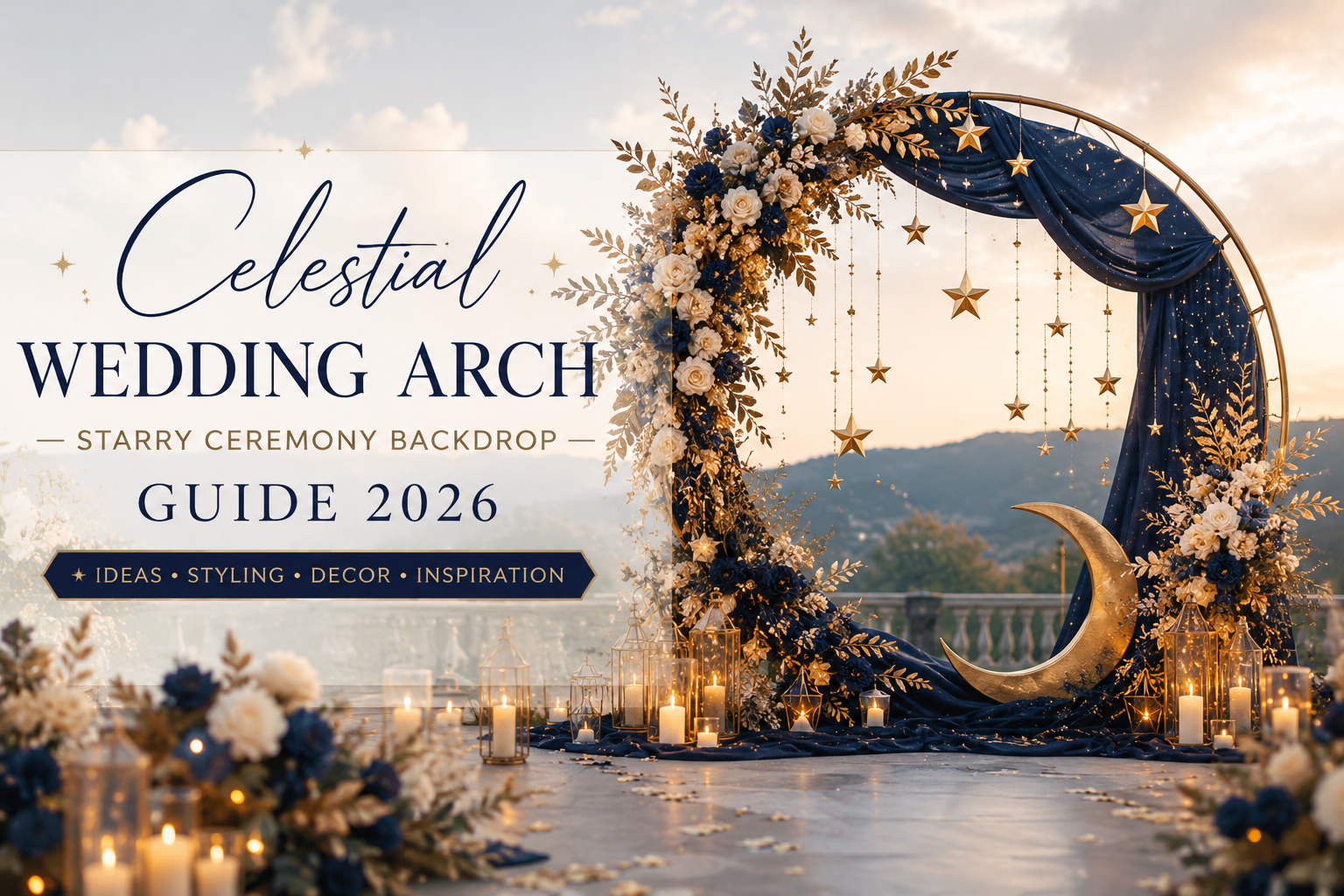
Celestial Wedding Arch — Starry Ceremony Backdrop Guide 2026
Celestial Wedding · 2026
Celestial Wedding Arch — Starry Ceremony Backdrop Guide 2026
Six celestial arch styles, practical building guidance for every setting and budget, seasonal arch directions, and the stationery that carries the arch’s visual world into the ceremony program held beside it.
The ceremony arch is the most photographed single element of any wedding — it appears behind the couple in every portrait, in every wide ceremony shot, in every candid taken from the congregation, and in the memory of every guest who attended. For a celestial wedding, the arch is not simply the floral frame for the vows: it is the portal between the ordinary world and the cosmos, the physical structure through which two people pass into the celestial space of the ceremony, and the visual argument for the entire aesthetic rendered at architectural scale.
This guide covers six distinct celestial arch styles with the specific materials and decisions that make each one work, practical building and installation guidance for any setting and any level of DIY involvement, seasonal arch directions for spring through winter, and the stationery connection that completes the visual world of the celestial arch in the printed layer of the ceremony.
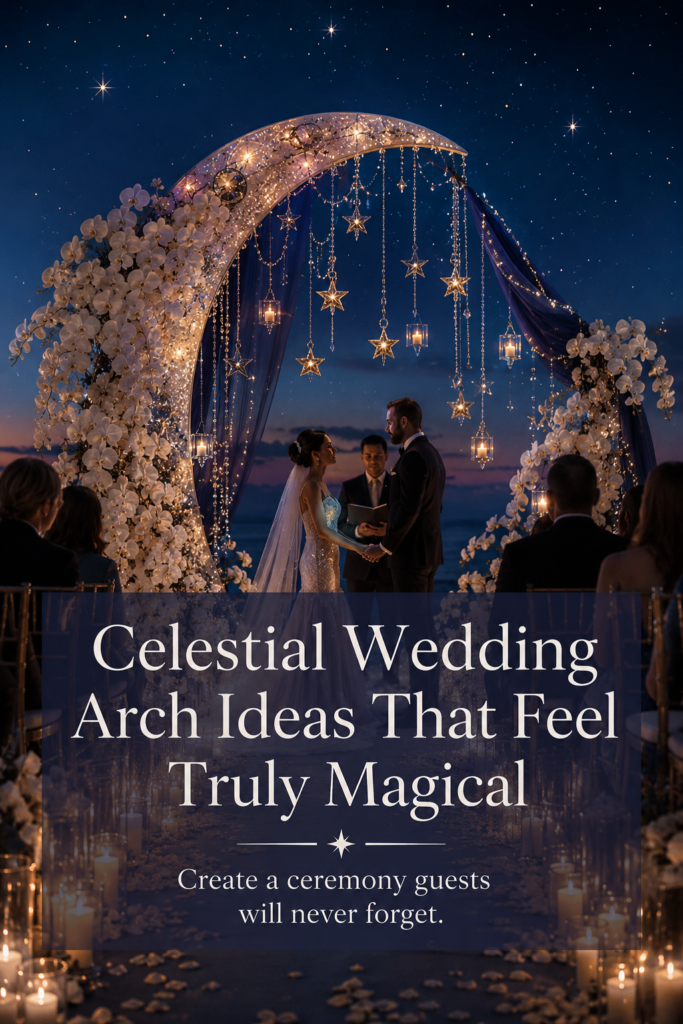
“To stand under an arch of stars is to stand at the threshold of two lives becoming one — with the universe as the witness. The celestial arch does not decorate the ceremony; it makes the ceremony’s claim visible.”
Section 01 The Celestial Ceremony Arch Philosophy
The arch has been the threshold symbol of human ceremony for as long as human ceremony has existed — the point at which the ordinary world ends and the sacred space begins, the structural marker of transition from one state to another. In the celestial wedding, the arch is not simply a floral decoration over the ceremony position: it is the cosmic portal, the physical rendering of the aesthetic’s most fundamental claim, which is that the ceremony is taking place not simply in a decorated room or a beautiful garden but within the universe itself. The celestial arch makes this claim visible at architectural scale, which is why it is the most important single design decision in the entire celestial wedding.
What makes a wedding arch celestial rather than simply floral is not primarily the flowers used — it is the specific celestial vocabulary integrated into the arch’s design. Star scatter applied to floral material in the specific irregular pattern of a real constellation (not a uniform random scatter but the actual geometric relationship of a named constellation) positions the arch in the celestial rather than the decorative. Moon phase details — a large crescent moon form at the arch’s apex, or a sequence of moon phases built into the floral arrangement — give the arch a specific celestial identity that reads as chosen for meaning rather than for aesthetic compatibility. Constellation wire work — fine gold wire bent into constellation line patterns and embedded within or extending from the floral material — provides the specific geometric quality of the star chart that distinguishes the celestial aesthetic from any other dark-and-romantic wedding direction.
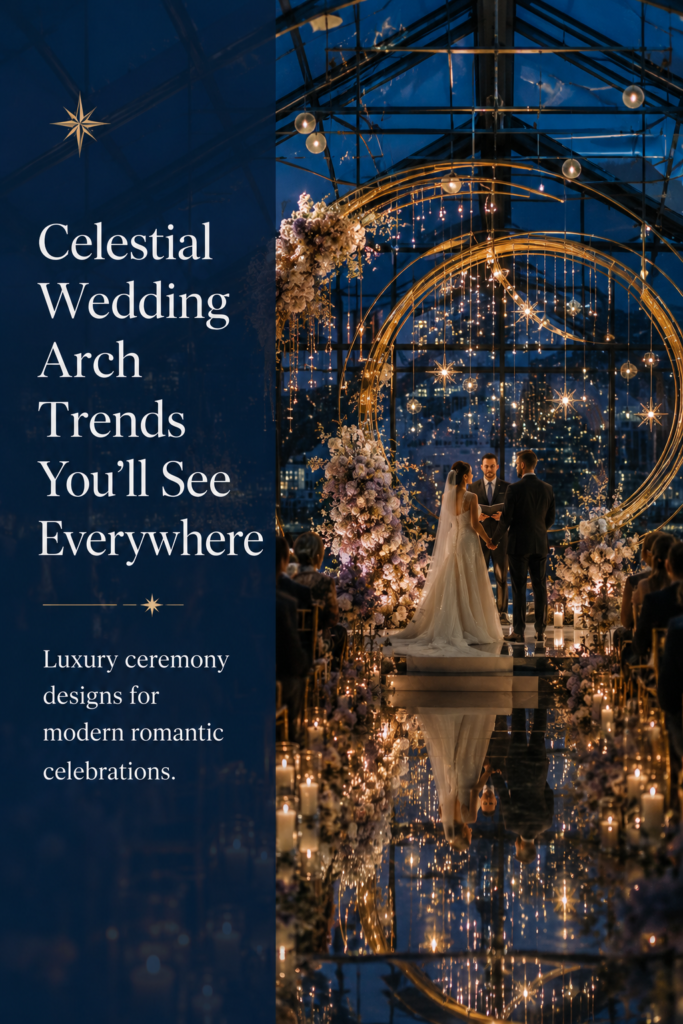
The celestial arch is the ceremony’s visual centrepiece in a way that no other single element achieves, because it is present in photographs taken from every angle and at every moment of the ceremony. The wide ceremonial shot (with the couple small under the arch and the full arch architecture visible) is the photograph that most completely communicates the celestial aesthetic — the couple as the human centre of the cosmic claim, the arch as the visible structure of the universe around them. The planning priority for the celestial arch should reflect this: it should receive the most attention, the most specific design thought, and the most appropriate proportion of the decoration budget of any single element in the entire celebration.
Section 02 Six Celestial Arch Styles
Six distinct approaches to the celestial ceremony arch — from the most romantically floral to the most dramatically dark, from the most historically specific to the most organically botanical. Each one makes a different visual argument about what the celestial ceremony means.
2.1 The Starry Night Floral Arch
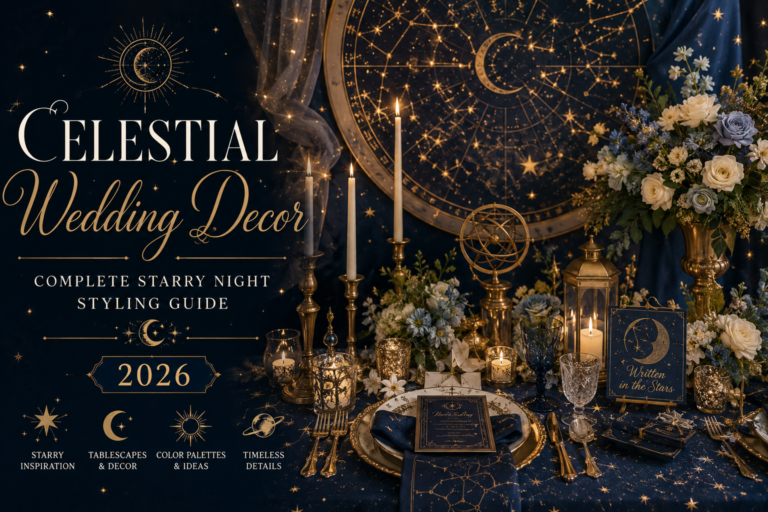
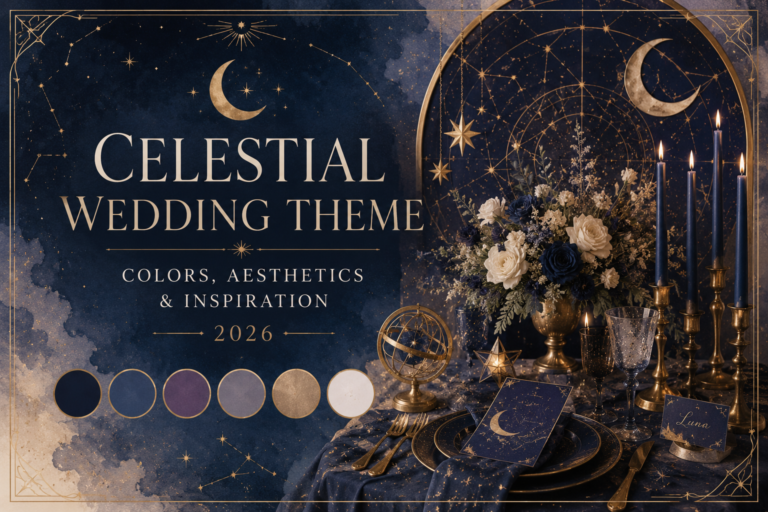
The Starry Night Floral Arch is the most romantically beautiful and the most broadly accessible of the six celestial arch styles — it uses the classic starry night palette (midnight blue and white florals against a dark structural frame) to create an arch that reads as a piece of the night sky made tactile and human-scaled. The floral vocabulary: deep blue delphinium in the most saturated cultivars as the primary sky element; white anemone with dark centres as the star-scatter flowers (each one individually read as a bright star against dark space); silver dusty miller as the moonlit foliage that provides the reflective quality; dark ivy or dark eucalyptus as the deep-shadow foliage; and fine gold wire constellation forms embedded in the floral material at three or four points, visible on close examination but not dominant at distance.
The structure: a circular moon arch in blackened or dark bronze metal is the most specifically celestial frame for the Starry Night Floral Arch, because the circular form references the full moon — the most ancient and most universal celestial circle — and provides a complete frame for the ceremony that reads as a portal in the most literal visual sense. The floral arrangement should be concentrated at the lower portions of the arch (approximately 40% of the circumference) with the upper 60% left bare so that the dark metal circle itself is visible against the backdrop, reading as the sky through which the florals are a foreground element.
The specific star scatter detail that distinguishes the Starry Night Floral Arch from a generic dark floral arch: fine iridescent or warm gold star-form confetti or micro-stars applied directly to the flower heads and foliage at irregular intervals, so that the arch catches and returns the ambient light in the specific scattered way that the actual starfield returns the light of distant suns. This detail is visible in close-up photography (the individual stars on individual petals) and in the specific quality of the arch’s overall luminosity (slightly lighter and more alive than a plain dark floral arch would be).
The Celestial Starry Nights collection and Mystical Black Gold Celestial suite carry the Starry Night Floral Arch into the ceremony program — deep midnight and warm gold in the most romantic and most broadly beautiful register of the celestial aesthetic, held by guests at the moment they are looking at the arch itself.

2.2 The Constellation Wire Arch
The Constellation Wire Arch is the most editorial and the most visually distinctive of the six celestial arch styles — it uses gold wire constellation forms as the primary visual element rather than as a supporting detail within a floral arrangement, producing an arch that is minimal, precise, and unmistakably celestial in the specific way of the star chart tradition rather than in the decorative way of generic celestial motifs. The concept: a simple structural arch (circular or rectangular, in dark metal) from which large gold wire constellation forms hang or extend as the primary decoration, with minimal botanical material added only where it enhances the constellation forms rather than competing with them.
The constellation choice for the wire arch should be personal and specific: the constellation of the couple’s wedding date, the constellation of the season in which the ceremony takes place, or the specific constellations associated with the couple’s birth months. The wire forms should be large enough to read clearly at ceremony distance (the smallest dimension at least 30 centimetres) and should include the connecting lines between stars as well as the star points themselves, so that the constellation reads as a drawn constellation map rather than as a random scatter of gold wire forms. The wire should be warm antique gold rather than bright metallic — the antique quality reads as astronomical illustration rather than as decoration.
The Constellation Wire Arch photographs most distinctively of the six styles when captured in the wide ceremonial shot — because the gold wire constellation forms read as floating in space when the background behind them is dark (a dark backdrop, a dark interior, or a darkening evening sky), and the couple beneath them reads as standing within the constellation itself rather than beneath a decorated arch. This is the most precise and most intellectually specific of the six celestial arch aesthetics, and it is most appropriate for the couple who wants their arch to communicate the celestial aesthetic through intelligence and precision rather than through abundance and drama.
The Black Gold Celestial suite carries the Constellation Wire Arch’s precision and editorial quality into the ceremony stationery — the most graphically clean and most specifically constellation-calibrated of the dark celestial printed elements.

2.3 The Dark Celestial Arch
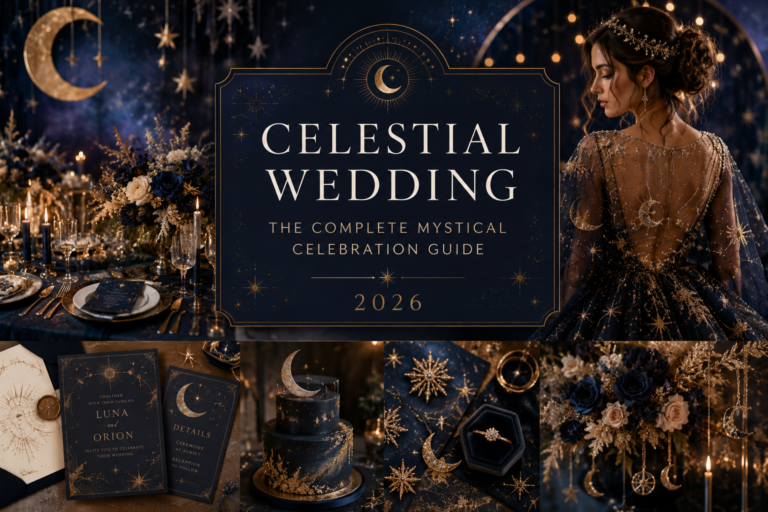
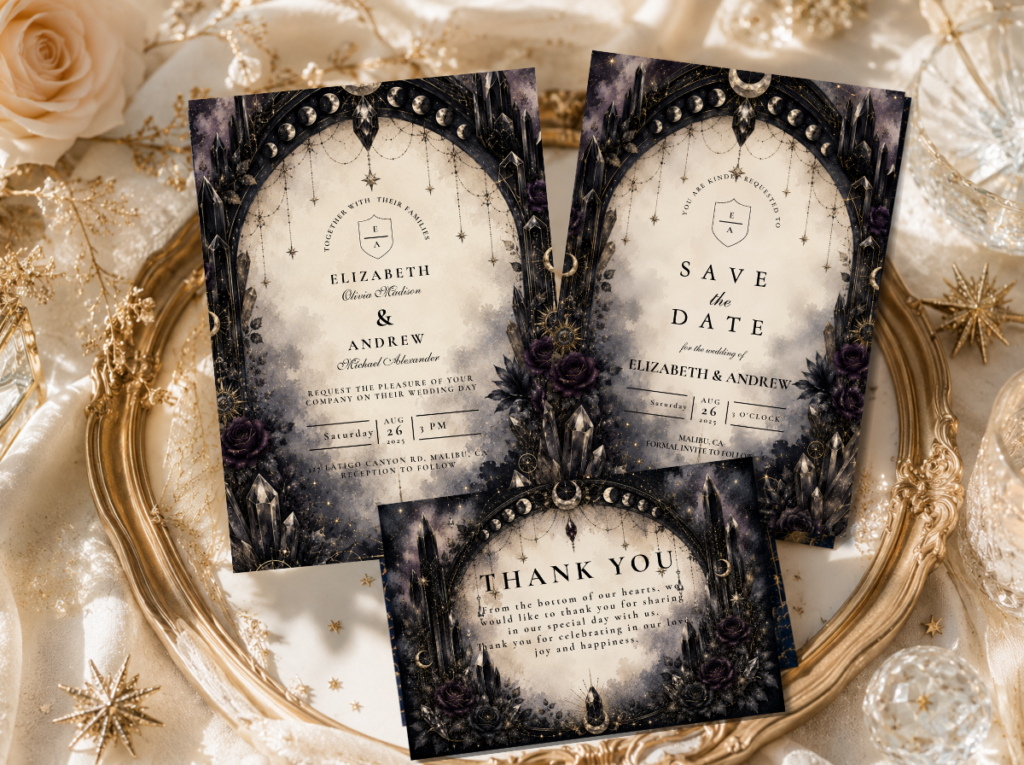
The Dark Celestial Arch is the most dramatically atmospheric of the six styles — it uses deep midnight fabric draping as the primary material rather than floral arrangement, producing an arch that is more about darkness and its quality than about the flowers within the darkness. The fabric draping: deep midnight blue or near-black velvet or heavy chiffon, hung from the arch frame in loose, slightly asymmetric folds so that the fabric catches and holds the darkness rather than reflecting light, and moves slightly in any air movement to produce the swirling, dynamic quality of the galaxy aesthetic. Gold star scatter — either physical star-form embellishment on the fabric itself or warm fairy lights at star density integrated into the fabric folds — provides the points of light within the darkness.
The floral elements of the Dark Celestial Arch are secondary to the fabric and the light: deep burgundy or near-black dahlias, dark calla lily, and dark sweet peas as the primary flowers (chosen for their darkness rather than their colour variety); silver dusty miller as the minimal foliage accent; and no white or cream floral elements that would break the commitment to darkness and warmth rather than darkness and lightness. The fabric draping should be the visual dominant, with the florals reading as elements within the fabric rather than as the arrangement from which the fabric falls.
The Dark Celestial Arch is most appropriate for indoor venues with significant ceiling height — because the fabric draping requires height to fall with sufficient drama, and because the darkness of the arch reads as most powerful in a space where the surrounding architectural darkness amplifies rather than fights against the arch’s own dark quality. It is also the most dramatically different from any non-celestial arch style — the fabric-and-star combination is unmistakably specific rather than generically beautiful, which is the quality that most strongly communicates a genuinely designed and specifically considered celestial aesthetic.
The Celestial Dark collection carries the Dark Celestial Arch’s deep midnight and gold quality into the ceremony program — the most atmospherically aligned printed element for the most dramatically atmospheric arch style.
2.4 The Botanical Celestial Arch
The Botanical Celestial Arch is the most lushly beautiful and the most romantically abundant of the six arch styles — it brings the celestial aesthetic into dialogue with the organic, flowing, richly textured botanical world in the specific tradition of Art Nouveau illustration, where flowers and star forms coexist in the same organic visual language. The principle: a deeply floral arch in which every botanical choice has been made for its specific celestial association (astrantia for its star-shaped floret form; white cosmos for its celestial name and star-form petals; dried lunaria for its lunar name and moon-disc shape; deep blue delphinium for its midnight sky colour) combined with gold wire constellation forms that appear within the botanical material as if they have grown there rather than been placed.
The specific quality that distinguishes the Botanical Celestial Arch from a simply lush floral arch is the precision of the celestial botanical choices: the arch should read as assembled from the specific flowers of the celestial world rather than from a generally beautiful floral palette. White cosmos grouped at the widest points of the arrangement (the star-scatter quality of the cosmos at density suggests the Milky Way); astrantia positioned at intervals throughout (the individual star form visible on close examination); dried lunaria pods woven through the foliage (the moon discs reading as specifically lunar rather than simply silver); and the constellation wire forms visible within the botanical mass as the geometric precision within the organic abundance.
The Botanical Celestial Arch is the most appropriate of the six styles for garden, outdoor, and glasshouse venues — because the abundance of botanical material reads as naturally contextual in spaces where plant material is already present in the environment, and because the Art Nouveau quality of the organic celestial combination is most at home in settings that share the same natural richness. It is also the most photogenic of the six styles in natural daylight (the botanical material and the gold wire detail photograph most beautifully in the warm, ambient, slightly diffuse light of an overcast sky or a glasshouse), and the most appropriate for afternoon and daytime ceremonies.
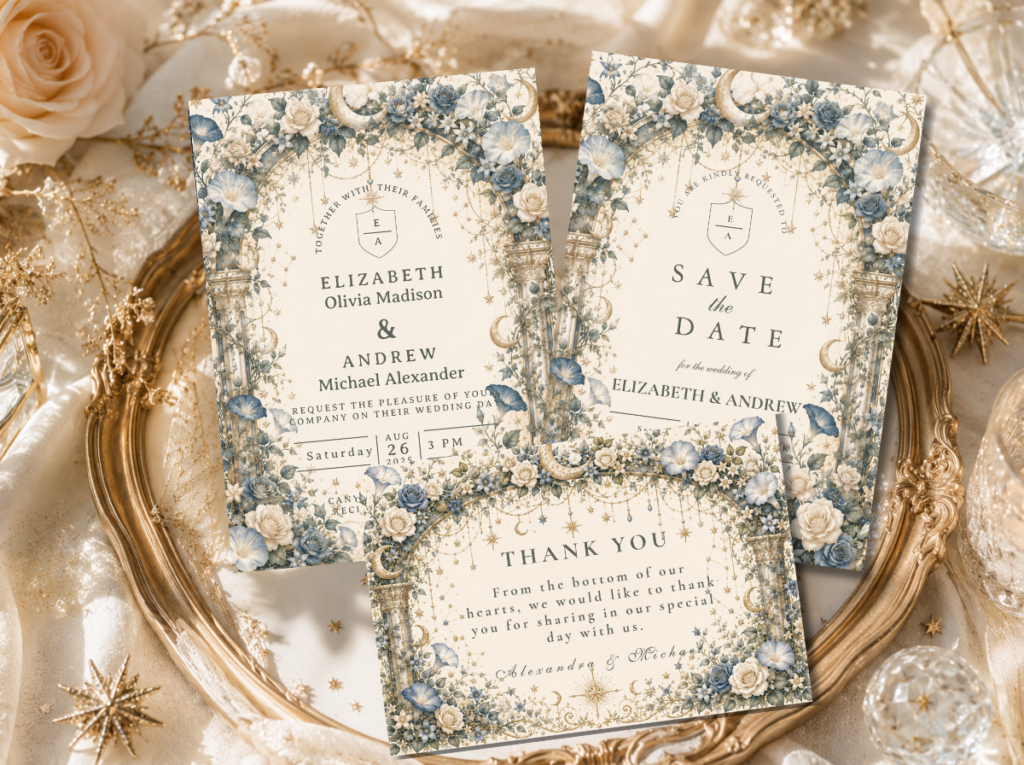
The Celestial Art Nouveau Blue Gold suite and Celestial Floral collection carry the Botanical Celestial Arch into the ceremony stationery — flowing organic botanical-celestial line-work in deep teal and warm gold, the stationery most specifically matched to the arch’s own botanical aesthetic.

2.5 The Vintage Star Map Arch
The Vintage Star Map Arch is the most intellectually specific and the most historically grounded of the six celestial arch styles — it takes the visual tradition of the antique celestial atlas as its primary reference and renders it at architectural scale, creating an arch that reads as a three-dimensional page from the most beautiful historical star chart ever produced. The primary element: a large-format reproduction of a specific historical star map (or a custom star map of the couple’s wedding date and location in the historical illustration style) used as a backdrop behind and above the ceremony position, either printed on fabric and hung from the arch frame or on paper mounted as a large-format display behind the arch structure.
The frame elements of the Vintage Star Map Arch: an antique-styled arch in aged brass, antique gold, or warm bronze finish — never chrome or modern metallic — decorated with warm botanical elements in the dried and aged register of the vintage celestial aesthetic (dried grasses, dried allium pods, dried lavender, aged rose heads in cream and blush, dried honesty pods for their lunar association). The gold frame against the star map backdrop, with botanical elements that carry the warm sepia and aged quality of the historical atlas page, produces an arch that reads as entirely from a different era and entirely from the same designed world.
The Vintage Star Map Arch is most appropriate for venues with inherent historical character — stone buildings, university halls, old barns with aged timber, Victorian institutions — where the antique aesthetic of the arch reads as contextually appropriate rather than as a period costume. It is also the most appropriate for the dark academia and vintage celestial wedding aesthetic directions, which are the celestial aesthetics most naturally suited to the scholarly, historically grounded, and intellectually specific qualities of the vintage star map visual tradition.
The Cosmic Vintage Constellation suite carries the Vintage Star Map Arch into the ceremony program — historical astronomical cartography in warm sepia and antique gold, the most historically specific and most scholarly stationery option for the most historically grounded arch style.

2.6 The Garden Celestial Arch
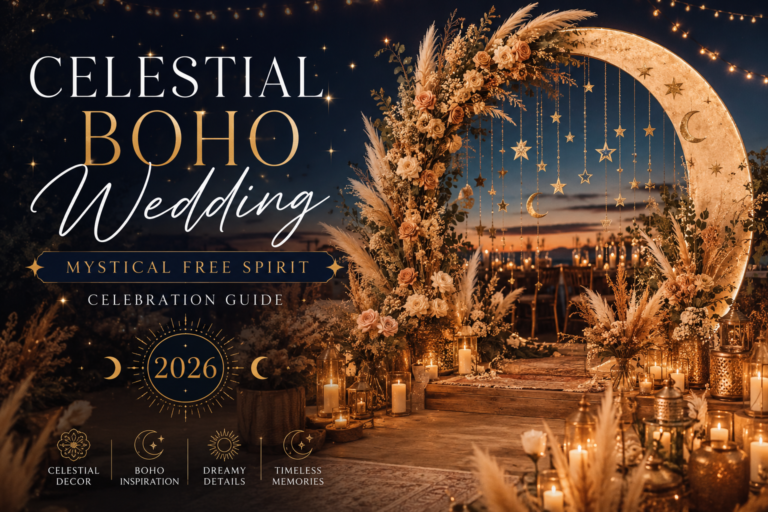
The Garden Celestial Arch is the most accessible and the most versatile of the six celestial arch styles — it brings the celestial aesthetic into the warm, natural, abundantly beautiful world of the garden wedding, producing an arch that reads as genuinely belonging to its outdoor setting while carrying the celestial identity through specific botanical choices and gold star scatter applied throughout the natural floral material. The Garden Celestial Arch is the most appropriate for outdoor spring and summer settings, for afternoon ceremonies in natural light, and for couples who want the celestial aesthetic to read as warm and organic rather than dramatic and atmospheric.
The floral vocabulary of the Garden Celestial Arch: a broader range of garden flowers than the more specifically curated celestial styles (roses, peonies, garden hydrangea, climbing clematis, jasmine trails) combined with the specific celestial botanical elements (white cosmos as the star-scatter flower, silver dusty miller as the moonlit foliage, dried lunaria pods as the lunar botanical element) and gold star scatter applied at irregular intervals throughout the arrangement. The garden flowers provide the organic abundance and natural scale of a garden arch; the celestial botanical elements and the gold star scatter position the abundance in the celestial aesthetic rather than in a generic garden floral direction.
The Garden Celestial Arch is the most forgiving of the six styles in terms of DIY construction — because the abundance of the garden floral style accommodates the irregularities of self-assembled arrangements more naturally than the more precisely calibrated styles (the constellation wire arch requires geometric precision; the dark fabric arch requires controlled draping). Garden flowers at density with star scatter and lunaria pods read as abundantly beautiful even when assembled without professional-level precision, which makes the Garden Celestial Arch the most accessible entry point for couples who want to build significant arch elements themselves.
The Celestial Garden collection carries the Garden Celestial Arch into the ceremony stationery — deep rose, midnight blue, and antique gold in the warmest and most organically romantic register of the garden celestial aesthetic.
Section 03 Building Your Celestial Arch
Structural Considerations
The structural decision — circular vs rectangular vs natural branch arch — is the first and most consequential decision in building any celestial arch, because the structure determines the visual register of the entire arch before any floral or fabric material is added. The circular moon arch (a single large circle, typically 2 to 2.4 metres in diameter, in metal) is the most specifically celestial arch structure available, because the circle directly references the full moon and provides a complete frame that reads as a cosmic portal rather than a decorative gateway. The rectangular or square arch reads as more architectural and less specifically celestial — it is appropriate for the Constellation Wire and Dark Celestial arch styles, which rely on the frame’s architectural quality rather than on its celestial symbolism. The natural branch arch (assembled from large fallen branches or cut branches in a loose triangular or arched form) is most appropriate for the Garden Celestial and Botanical Celestial styles, where the organic quality of the frame contributes to the natural aesthetic.
Materials and Celestial Detail
Metal arch frames in blackened steel, dark bronze, or aged brass finish are the most appropriate structural materials for celestial arches — because their dark or warm-dark finish reads as celestially appropriate in a way that silver or chrome finishes do not. Wooden arch frames can be appropriate for the garden and rustic celestial arch styles, where the warmth of natural wood reads as contextually relevant. For the darker celestial arch styles, the frame colour matters: a bright white or pale grey metal frame against a dark floral arrangement reads as a colour conflict; a dark or dark-toned frame disappears into the visual composition and allows the floral or fabric material to be the visual dominant.
Celestial detail additions — gold wire constellation forms, moon phase metal elements, small crescent moon and full circle pendants — can be incorporated into any arch style. The most effective placement: single large constellation forms at the arch’s apex (one form, large, precisely placed, visible as the first thing seen when looking at the arch from a distance); smaller wire forms embedded within the floral material at intervals (visible only on close examination, providing the reward-on-examination quality that distinguishes a designed celestial arch from a generally beautiful one). Fairy lights at star density can be integrated into any arch by weaving warm amber micro-lights through the floral material on a fine copper wire — the copper wire disappears into the botanical material while the warm amber lights provide the star-scatter effect from within the arrangement.
Working with Natural Light
The celestial arch’s appearance changes significantly across the lighting conditions of the ceremony — and the most beautiful celestial arch photographs are typically taken at the moment when the ambient light is shifting rather than at the moment of maximum brightness or maximum darkness. In outdoor settings, the arch photographs most beautifully at golden hour (the last 30 minutes before sunset), when the warm amber quality of the low-angle sunlight enriches the gold metallic elements of the arch and creates the specific combination of warm and dark that the celestial aesthetic seeks. For indoor settings with controlled lighting, the arch should be lit with a single warm wash light from slightly above and to one side, rather than from directly below (which produces an artificial dramatic effect) or from directly above (which flattens the depth of the floral arrangement). The ceremony photographer should be briefed explicitly about the arch’s most photogenic angle — typically the wide shot from the congregation position, looking toward the arch with the ceremony space visible through its frame.
Section 04 Celestial Arch by Season
Spring & Summer Celestial Arch
The spring and summer celestial arch is most naturally a Garden Celestial or Botanical Celestial direction — because the abundance of available fresh botanical material in spring and early summer allows the most lushly beautiful version of the botanical arch styles, and because the warm, long daylight of summer evening ceremonies provides the most beautiful natural light for arch photography. The specific seasonal considerations: spring arches should incorporate the celestial botanical elements most available in early season (white anemone, blue delphinium, clematis, white cosmos); summer arches can add the full range of summer garden florals (garden roses, peonies, hydrangea) alongside the celestial-specific botanical elements. The timing of a summer celestial ceremony should account for the late astronomical twilight — if a genuinely starlit ceremony is intended, the outdoor ceremony should begin no earlier than 45 minutes before sunset to complete before the sky is fully dark, or begin at sunset and continue into the early starlit period.
Autumn Celestial Arch
The autumn celestial arch brings the specific warmth and depth of the autumn botanical palette into the celestial aesthetic — deep dahlias in amber, copper, and burgundy; dried seed heads and dried botanical elements; late-season garden roses in warm tones; and dried lunaria pods as the lunar botanical element most specifically autumn in its natural drying period. The star scatter on an autumn arch should be in warm antique gold rather than cool silver to match the warm palette of the season. The autumn arch is most appropriate for the Harvest Moon Aesthetic arch direction (warm amber and deep midnight combined) and for the Rustic Celestial autumn direction (dried and natural botanical material in warm earth tones with star scatter). For more guidance on the full autumn celestial aesthetic, see the Celestial Fall Wedding guide in this series.
Winter Celestial Arch
The winter celestial arch is the most dramatically atmospheric of the four seasonal directions — because the winter botanical elements available for arch-making (white hellebore, frosted eucalyptus, silver-grey foliage, dark calla lily, dried silvery botanicals) are the most specifically celestial in their cool, pale, and dark-and-light contrasting quality. Frost on outdoor arch elements in very cold conditions is not a problem to solve but an aesthetic contribution: the crystalline quality of frost on botanical material is the most natural expression of the winter celestial aesthetic available at the arch scale, and an arch that has acquired frost overnight before a morning ceremony is a more beautiful and more specifically celestial arch than any amount of deliberate decoration could achieve. For more guidance on the winter celestial aesthetic in full, see the Celestial Winter Wedding guide in this series.
Section 05 The Arch & Ceremony Stationery Together
The ceremony program is the stationery element most directly in dialogue with the arch — because guests hold it while looking at the arch, it is visible in photographs of the congregation during the ceremony, and it is the first printed element guests encounter that should communicate the same visual world as the arch above the ceremony position. When the program and the arch belong to the same designed world — the same palette temperature, the same botanical or celestial illustration quality, the same relationship between darkness and gold — the ceremony reads as a complete visual environment rather than as a decorated space with printed additions.
The botanical celestial arch and its ideal program: an invitation and program suite in the botanical-and-celestial Art Nouveau register, with the same organic flowing line-work in the printed illustration as exists in the gold wire constellation forms within the arch’s floral arrangement. When a guest holds a program that carries the astrantia star-form illustration in its printed header while looking at an arch that contains actual astrantia in its floral arrangement, the visual connection between the printed and the decorated produces a depth of design coherence that guests register even if they cannot name it.
The program photograph — the image of the ceremony program held up against the arch — is among the most shareable and most saved detail photographs in the celestial wedding category on Pinterest. A deep midnight program with gold constellation work, held by a guest in front of the Starry Night Floral Arch, creates a flat lay at arm’s length that communicates the entire celestial aesthetic of the wedding in a single image. The program should be designed with this specific photograph in mind: the front of the program is the public face that appears in the arm’s-length photograph, and its visual quality should be calibrated for photographability as well as for functionality as a printed guide to the ceremony.
The Mystical Black Gold Celestial suite produces the most dramatically photographable ceremony program for the arm’s-length photograph in front of the Starry Night Floral Arch — deep midnight and warm gold in the most complete and most atmospheric expression of the celestial aesthetic at the program scale.
Section 06 Celestial Arch Stationery Connection
The celestial wedding arch and the celestial stationery suite should be designed as a visual pair rather than as separately sourced elements from the same aesthetic category — because the most coherent and most photographically powerful celestial weddings are those in which every element, from the arch to the invitation to the place card, belongs to the same specific designed world rather than to the general celestial aesthetic. The invitation is the guest’s first encounter with the celestial world of the celebration; the arch is their most memorable encounter with it; and the visual relationship between the two — when it is a close relationship — produces the specific quality of a celebration that has been genuinely and completely designed rather than assembled from compatible aesthetic sources.
The matching principle: botanical celestial arch ― botanical celestial stationery. If the arch’s primary visual language is the organic botanical-and-celestial combination of the Art Nouveau tradition, the stationery suite should carry the same flowing organic botanical illustration rather than the more geometric or more dramatically dark quality of the other celestial stationery directions. A guest who received a botanical celestial invitation and walks into a ceremony with a Botanical Celestial Arch above the vows has experienced the visual continuity of a completely designed world: the same world they carried in an envelope for the weeks before the wedding is the same world they are standing in.
Dark dramatic arch ― dark dramatic stationery. The Dark Celestial Arch, with its midnight fabric draping and deep floral elements, requires stationery in the same deep-and-dark register — near-midnight or near-black stock, warm antique gold illustration, the specific quality of darkness that reads as atmospheric rather than simply dark. A warm cream or light-toned invitation presented alongside a dramatically dark arch creates a visual register mismatch that reads as two aesthetic decisions from the same category rather than one aesthetic decision from the same design. The stationery for the Dark Celestial Arch should be as dark and as committed to atmospheric depth as the arch itself.
The flat lay photograph that most completely communicates the celestial arch aesthetic for Pinterest: the invitation suite placed on the ground in front of the arch and photographed from above, so that both the arch’s floral and structural elements are visible above and behind the stationery arrangement. This requires the photographer to be positioned at the correct angle and the arch florals to be low enough to provide a background frame for the invitation flat lay — it is worth discussing this specific photograph with the photographer in advance as a priority ceremony day image, because it is among the most saved and most shared celestial wedding photographs available in the entire category.
Celestial Arch
Celestial Wedding Arch
The dedicated celestial arch collection — the most specifically arch-calibrated stationery for every celestial arch style.
Starry Night
Celestial Starry Nights
Midnight blue and warm gold — for the Starry Night Floral Arch ceremony program and invitation.
Dark Celestial
Celestial Dark
Near-midnight and antique gold — the most atmospherically aligned stationery for the Dark Celestial Arch.
Signature Atmospheric
Mystical Black Gold Celestial
The most photographically dramatic suite — for the arm’s-length program photograph in front of the Starry Night Floral Arch.
Art Nouveau Botanical
Celestial Art Nouveau Blue Gold
Flowing organic botanical-celestial line-work — the stationery most directly matched to the Botanical Celestial Arch style.
Vintage Constellation
Cosmic Vintage Constellation
Historical star atlas quality — for the Vintage Star Map Arch and dark academia celestial ceremony directions.
Frequently Asked Questions
What makes a wedding arch celestial?
A wedding arch becomes celestial through the integration of specific celestial vocabulary rather than through a generally dark or romantic palette alone. The specific elements that most reliably communicate the celestial aesthetic in an arch: gold wire constellation forms embedded in or extending from the floral material (the geometric precision of constellation line-work against organic botanical material is the most immediately distinctive celestial identifier); moon phase details at the arch’s apex (a crescent moon form, or a full circle referencing the full moon, positions the arch in the specific celestial symbolic tradition); star scatter applied in a constellation pattern rather than randomly through the botanical material (the specific irregularity of a real constellation distribution reads as designed and intentional rather than as generic decoration); and midnight-blue or near-black florals that provide the sky quality against which lighter elements read as stars. The structure that most specifically communicates the celestial arch concept is the circular moon arch — because the circular form directly references the full moon and provides a complete frame that reads as a cosmic portal rather than a decorative gateway.
What flowers work for a celestial wedding arch?
The celestial arch has a specific botanical vocabulary, and the most effective arches draw from it rather than from a generally dark or romantic flower palette. The flowers most specifically suited to the celestial arch: deep blue delphinium (the closest colour to the midnight sky available in the floral world); white anemone with dark centres (the most star-like of all wedding flowers, individually reading as bright stars against dark sky); silver dusty miller (the most moonlit of all foliage, reflecting low light in a way that reads as lunar); dried lunaria seed pods (lunar by name and full-moon disc in form); white cosmos (celestially named, star-form, and delicate enough to suggest the diffuse quality of the Milky Way when grouped); astrantia (star-shaped floret form, rewarding on close examination); and dark dahlias in near-black or deep burgundy (for the deep-space darkness of the darkest celestial arch styles). The gold wire constellation forms embedded in any of these botanical combinations are the specific detail that most clearly positions the arch in the celestial aesthetic rather than in a generally beautiful dark floral direction.
How do I create a celestial wedding arch on a budget?
The most impactful celestial arch elements can be achieved at lower cost than the full floral arch by prioritising the celestial-specific details over floral abundance. The highest-impact celestial detail at the lowest material cost: gold wire constellation forms (fine brass or copper wire bent into constellation patterns using a printed star chart as the reference — the material cost is minimal and the effect is the most specifically celestial available); star scatter applied to existing foliage or simple dried botanical material rather than to expensive fresh flowers (iridescent micro-stars or gold confetti stars at arm’s-reach scale produce the star-scatter effect on any botanical material); dried lunaria pods integrated into simple foliage arrangements (lunaria is available dried at very low cost and provides the most specifically lunar botanical element with minimal investment); and a circular metal arch frame in dark finish as the structural element (which reads as a moon portal in itself, before any decoration, and which provides the most celestial structural form available at any budget level). A simple circular dark arch with gold wire constellation forms and dried lunaria pods produces a more specifically celestial arch than an abundantly floral non-circular arch with no specific celestial detail, regardless of the cost difference.
What stationery matches a celestial wedding arch?
The stationery that best matches a celestial wedding arch is the suite whose illustration quality and palette temperature most closely echoes the arch’s own visual register. Botanical Celestial Arch — Art Nouveau botanical-celestial stationery (the Celestial Art Nouveau Blue Gold collection or the Celestial Floral collection): both carry the same organic botanical-and-celestial line-work. Starry Night Floral Arch — midnight and gold stationery (the Celestial Starry Nights collection or the Mystical Black Gold Celestial suite): the deep midnight and warm gold carried from the arch into the invitation and program. Dark Celestial Arch — dark celestial stationery (the Celestial Dark collection or the Mystical Black Gold Celestial): the most atmospheric and most committed to darkness and warmth. Vintage Star Map Arch — historical constellation stationery (the Cosmic Vintage Constellation suite): the most historically specific and most scholarly. Garden Celestial Arch — the Celestial Garden collection: the warmest and most garden-appropriate register. The six collections in the showcase above cover every celestial arch direction; the ceremony program, which guests hold while looking at the arch, is the most important single stationery element to match to the arch’s visual world.
Complete the Celestial Portal
Find the Stationery That Matches the World the Arch Creates
The program is held up in front of the arch for the most saved photograph of the day — choose the collection that carries the same visual world as the arch itself, and let the printed and the decorated speak to each other.