Celestial Wedding Decor
Celestial Wedding · 2026
Celestial Wedding Decor — Complete Starry Night Styling Guide 2026
Ceremony arch to reception table, lighting philosophy to DIY ideas — the complete decoration guide for every celestial wedding aesthetic.
The celestial wedding aesthetic is, at its core, a decoration philosophy as much as a visual style — because the night sky itself is a decorated space, and the goal of every decision in the celestial wedding is to make the human-built environment feel, even briefly, as if it belongs to the same order of beauty as what exists naturally above it. This is a high ambition, and it requires a decoration approach that is as considered in its logic as it is beautiful in its execution.
This guide covers every layer of the celestial wedding decoration from ceremony arch to reception table to stationery suite — including the specific lighting decisions that matter more than any other single decoration element, practical DIY guidance for couples building elements themselves, four palette-specific decoration directions, and the complete stationery showcase for the printed layer of the celestial world.
“The night sky is the original decorator — no human hand can reproduce what it places above us every evening without effort, without cost, and without ever repeating itself exactly. Every celestial wedding borrows this quality and tries, in its best moments, to deserve it.”
Section 01 The Celestial Decoration Philosophy
The single most important conceptual shift in planning celestial wedding decoration is this: darkness is not a problem to solve — it is the primary decoration material. Every successful celestial wedding interior has been designed with this understanding, and every unsuccessful one has failed because the couple or their decorator treated the deep palette as a background challenge rather than as the central design element. The night sky is beautiful because of its darkness. The stars are visible because of it. The goal of the celestial wedding decorator is not to fill the dark with light but to place light within the dark in the specific way that the actual sky does — sparsely, irregularly, in clusters and constellations rather than in uniform distribution.
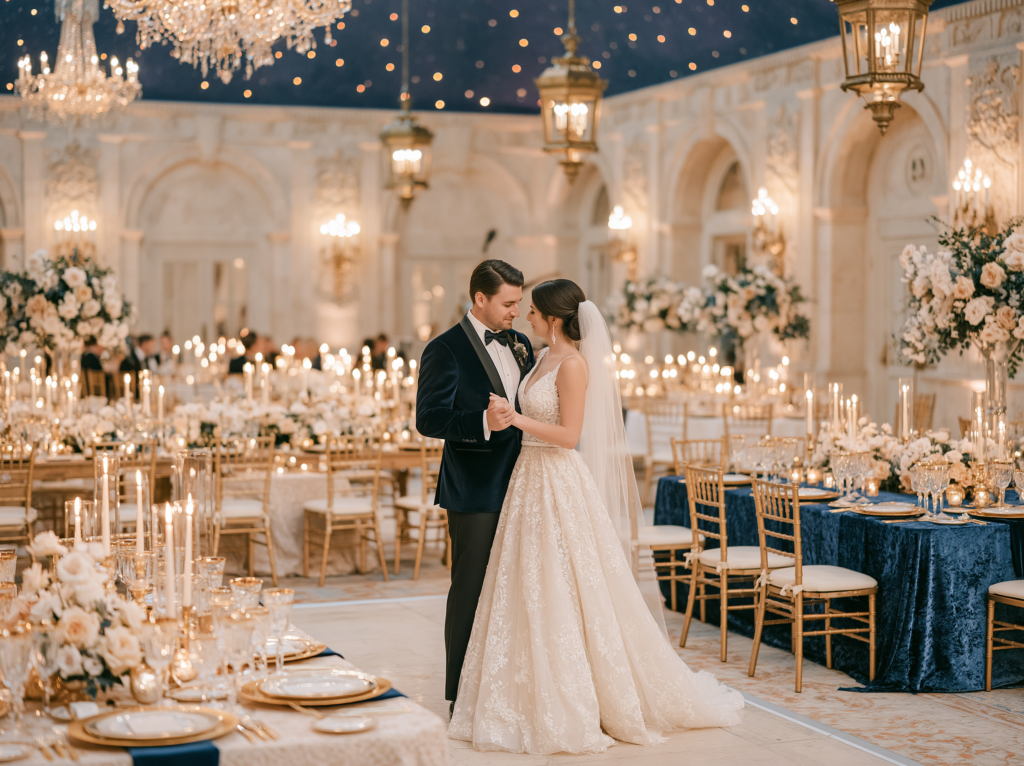
Lighting is the primary celestial decorator — more consequential than any floral arrangement, any fabric drape, any prop or centrepiece. A perfectly decorated celestial table in wrong light reads as a themed table. The same table under warm candlelight at low overhead ambient reads as a moment from a different world. The three-layer lighting approach described in Section 04 of this guide is the technical foundation of the celestial decoration philosophy: it should be understood and planned before any other decoration decision is made, because every other element will be seen through that lighting.
The layered celestial look — sky above, stars around, earth below — is the spatial logic that organises every decoration decision in the celestial wedding. The ceiling treatment creates the sky: deep fabric draping, fairy light installations at star density, or the actual night sky through glass or open sky access. The middle layer (walls, floral installations, arch elements, draping) creates the stars-around quality: the floating, atmospheric, enveloping experience of being inside a space that has been designed with the night sky in mind. The floor and table level creates the earth-below quality: grounded, material, warm, the human element from which the couple looks upward into the decorated sky above them. Each layer has its own decoration vocabulary, and the most coherent celestial wedding decorations address all three simultaneously.
DIY celestial wedding decor is one of the most searched sub-categories within celestial wedding planning — because the celestial aesthetic, unlike some other high-production wedding aesthetics, is genuinely accessible to couples who want to build significant elements themselves. The specific DIY celestial decoration elements that produce the highest visual impact relative to skill and material investment are: star-scattered tablecloths (fine glitter or iron-on vinyl constellation transfers on dark linen), moon phase candle holders (painted or vinyl-decorated glass holders), constellation string art (gold wire on dark board in the pattern of a specific constellation), and galaxy painted vases (the same sponge-paint galaxy technique used in professional celestial cake decoration, applied to ceramic or glass vessels). All of these are covered in more detail in Section 05.
Section 02 Celestial Ceremony Decorations
The ceremony is where the celestial aesthetic is most fully itself — because the ceremony’s fundamental quality (two people standing before witnesses and making promises) is already a cosmic act, and the decoration should amplify rather than compete with that quality.
2.1 The Celestial Ceremony Arch
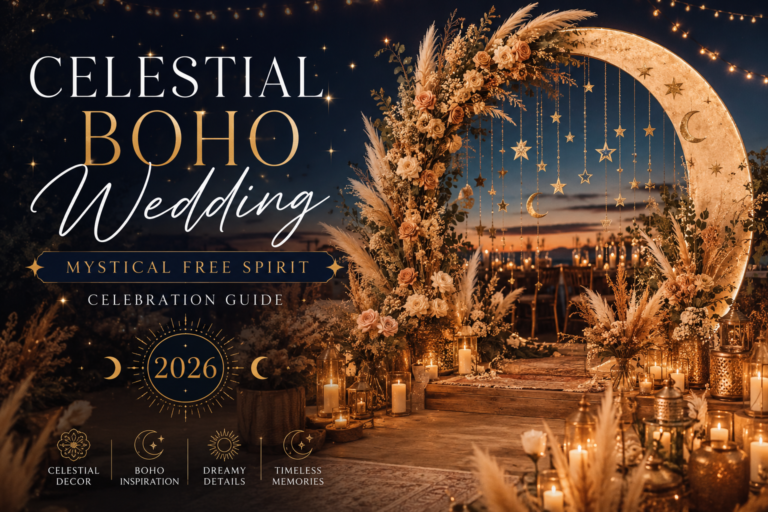
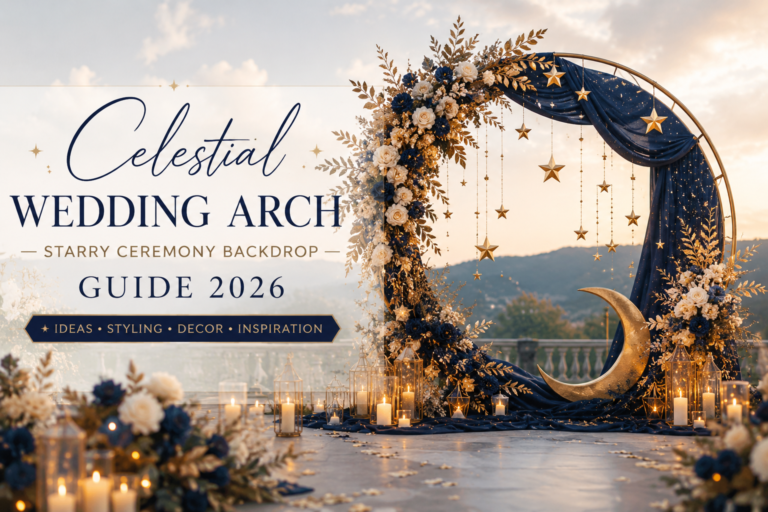
The celestial ceremony arch is the single most photographed decoration element of the celestial wedding — it appears in every portrait, every wide shot, every moment of the ceremony, and it sets the visual register for everything that follows. The celestial arch wedding aesthetic covers a wide range: from the most dramatic (a circular moon arch in blackened metal, completely draped with deep midnight blue and dark floral elements, with tiny fairy lights embedded in the floral material to suggest the starfield behind the flowers) to the most minimal (a simple metal arch with a single large crescent moon form at its apex, and no further decoration, relying entirely on scale and material quality rather than abundance).
The floral vocabulary for the celestial arch: deep midnight blue delphinium, dark burgundy or near-black dahlia, white or cream garden roses as the light accent (the moon in the floral composition), dried astrantia and dried lunaria for their explicitly celestial botanical connections, and trailing eucalyptus or smilax for movement and length. The celestial botanical combination — where constellation forms are suggested by the negative space between flower clusters rather than illustrated explicitly — is the most sophisticated execution of the floral arch and the one that photographs most beautifully at close range, revealing its intention only on examination.
Draped midnight fabric with star scatter is the alternative to the full floral arch and the more accessible of the two approaches for couples building significant elements themselves: a framework of two uprights with a crossbar, draped with midnight navy or black velvet or chiffon fabric, with star-scatter fairy lights or iron-on vinyl stars applied directly to the fabric surface. This approach is particularly effective outdoors at dusk or after dark, when the draped fabric disappears into the surrounding darkness and the star scatter becomes luminous against the deep field — producing the visual effect of a celestial arch that appears to float in the night sky rather than stand on the ground.

The Black Gold Celestial collection brings the ceremony arch palette into the stationery suite — deep midnight and warm gold across the invitation, ceremony program, and envelope, so that every printed element carried by guests at the arch matches the arch’s own visual language.

2.2 Aisle Styling
The celestial ceremony aisle is the bride’s or couple’s first moment inside the decorated world — the path from the known into the ceremonial — and it should be styled with this quality of transition in mind rather than as a simple decorated walkway. Star scatter petals in deep burgundy or midnight blue, with white or cream petals concentrated at the centre of the aisle in a pattern that suggests a path of moonlight rather than a conventional petal arrangement, create the most distinctively celestial aisle ground treatment. Avoid the even, dense carpet of petals that reads as conventional wedding; the celestial aisle ground treatment should have the specific irregularity of natural scattered light.
Moon phase lanterns — a series of lanterns along each side of the aisle, each containing a different moon phase silhouette cut or painted onto its glass, so that walking the aisle is walking through the lunar cycle — are the most narrative of the celestial aisle decoration elements and the most specific to the celestial aesthetic rather than to a generic romantic aesthetic. The lanterns should be in blackened metal or aged brass, never chrome or modern metallic, and the candles inside should be real flame rather than LED wherever safety permits, because the quality of real flame through the moon phase silhouettes is the specific quality that makes this element work.
Constellation markers — small metal or card signs placed at intervals along the aisle, each marked with a constellation name and a simple constellation diagram in the style of an antique star chart — transform the aisle walk into a navigation through the celestial map, and give guests who arrive early something specific and beautiful to observe before the ceremony begins. The constellation names can be chosen for personal significance or simply for their visual beauty, and the signs can serve double duty as the seating area markers (Orion for the left, Andromeda for the right, for example) before serving as aisle decoration once guests are seated.

2.3 The Altar & Backdrop
The ceremony backdrop — the visual element directly behind the couple as they exchange vows — is the most-photographed single surface of the entire celestial wedding. Every portrait, every ceremony shot, every candid taken from behind the officiant: all of them show the backdrop, which means the backdrop carries the visual argument of the celestial aesthetic in more images than any other single element. A star map backdrop — a large-format reproduction of a specific night sky chart (the sky as it appeared above the venue on a significant date for the couple) printed on fabric or paper and stretched on a frame — is the most personally specific celestial backdrop available and the one most suited to the vintage and dark academia registers of the aesthetic.
The galaxy drape backdrop — deep midnight blue or near-black fabric with either fairy lights sewn or clipped to it in a constellation pattern, or star-scatter vinyl applied in a galaxy distribution — is the most dramatic and the most associated with the classic and dark celestial aesthetics. The key calibration for this element: 20% stars, 80% darkness. The common mistake is too many lights, which produces a generic fairy light backdrop rather than a celestial one. The specific sparsity of stars in the actual night sky is what the decoration is attempting to evoke, and it requires restraint in the quantity of light applied.
A celestial botanical installation — a large-format arrangement of deep midnight florals, dried celestial botanicals, and trailing elements (eucalyptus, smilax, dried lunaria) installed directly against the wall or hanging from a rigging point above — is the most texturally rich and most organically beautiful of the backdrop options, and the one that photographs with the most visual depth at close range. The botanical installation is the only backdrop option that can combine the celestial aesthetic with genuine floral beauty simultaneously, and it is the correct choice for the couple who wants the ceremonial backdrop to read as organically beautiful rather than as deliberately theatrical.

The Mystical Black Gold Celestial collection brings the altar’s midnight-and-gold palette into the ceremony program — a program that reads as a celestial map, to be held in guests’ hands at the very moment they are looking at the celestial backdrop, so that the printed element and the decorated space are in visual dialogue.

2.4 Ceremony Programs as Celestial Maps
The ceremony program for a celestial wedding is simultaneously a functional document and a decoration element — because guests hold it throughout the ceremony and it is visible in every photograph of the congregation, and because a beautifully designed celestial program can itself be an artwork that guests keep long after the wedding. A program designed as a celestial map — the order of service set within the layout of a star chart, the constellation of the wedding month positioned as the header, the couple’s names written where the brightest star in that constellation appears — is one of the most extraordinary printed elements available to any wedding aesthetic, and it is specifically available to the celestial wedding in a way it is not to any other.
The program should be printed on card stock that reads as celestial in itself: deep midnight navy, near-black, or very dark charcoal for the dramatic celestial aesthetics; aged parchment or warm cream for the vintage celestial aesthetics. The typography should be in gold or warm cream, and the constellation illustration quality should match the invitation suite so that every printed element handled on the day reads as part of the same designed world. A program that belongs to the same suite as the invitation — same illustration register, same palette temperature, same typographic voice — produces a visual coherence that guests register even if they cannot name it.

Section 03 Celestial Reception Decorations
3.1 Table Centrepieces
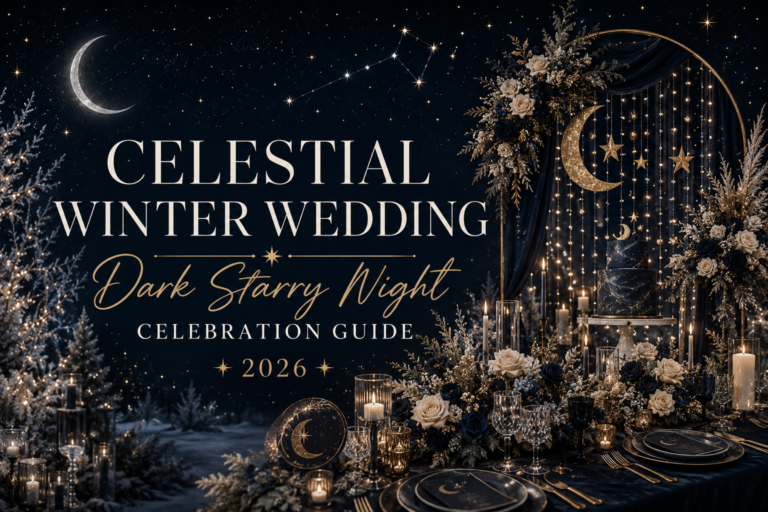
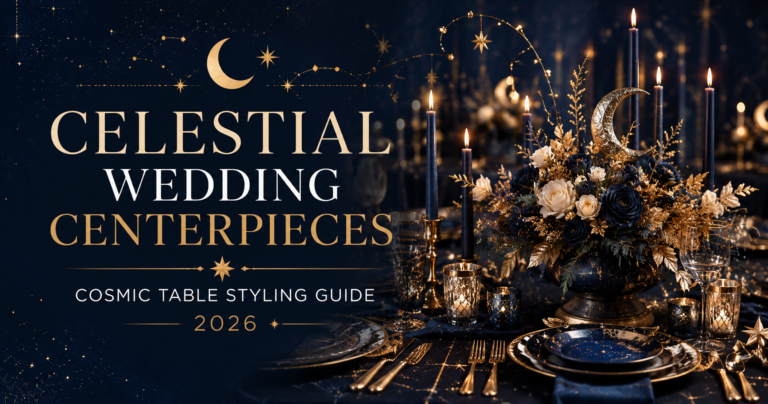
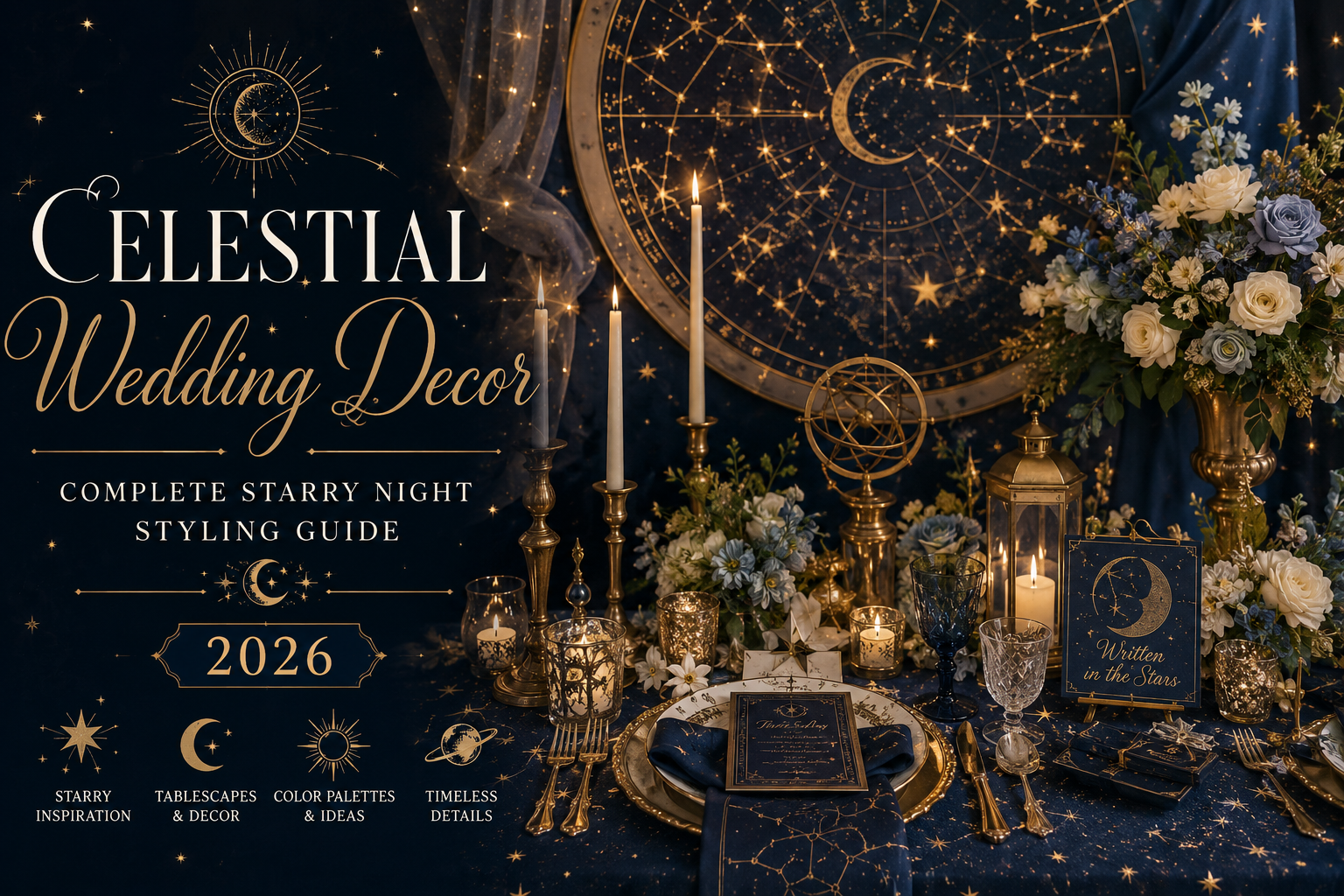
The celestial table centrepiece should do three things simultaneously: evoke the night sky in its visual vocabulary, read as beautiful at the close distance of a dinner table, and provide sufficient visual complexity to reward examination by guests seated beside it for several hours. The three-element centrepiece structure described in the complete celestial wedding guide — low votives at the base level, dark floral cluster at the mid level, tall taper in blackened metal at the high level — provides the structural foundation. The celestial specificity comes from the details within that structure.
Galaxy globe terrariums as centrepiece focal points: a large glass vessel (a round fishbowl, a cylinder, an apothecary jar) partially filled with dark sand, river stones, or activated charcoal in midnight blue or black, from which a dark floral arrangement emerges as if growing from the cosmic substrate. The glass vessel is then lit from below with a small battery-operated LED in warm white or amber, so that the arrangement glows from within against the dark base material. The effect — a dark, glowing vessel from which deep flowers emerge toward the ceiling — is one of the most genuinely beautiful centrepiece formats available in the celestial category.
Constellation candle arrangements: a flat tray in blackened metal or dark slate, on which candles are placed in the specific pattern of a chosen constellation — not in a grid or uniform cluster but in the actual geometric relationship of the stars that form the constellation shape. The candles should vary in height to suggest the different magnitudes of the stars (brighter stars = taller candles; fainter stars = shorter tea lights), and the entire arrangement should be oriented so that the constellation reads correctly when viewed from the primary photography angle. This is a technically specific centrepiece that requires a constellation chart reference during setup, but the result — when executed correctly and photographed close — is one of the most precisely celestial centrepiece formats available.
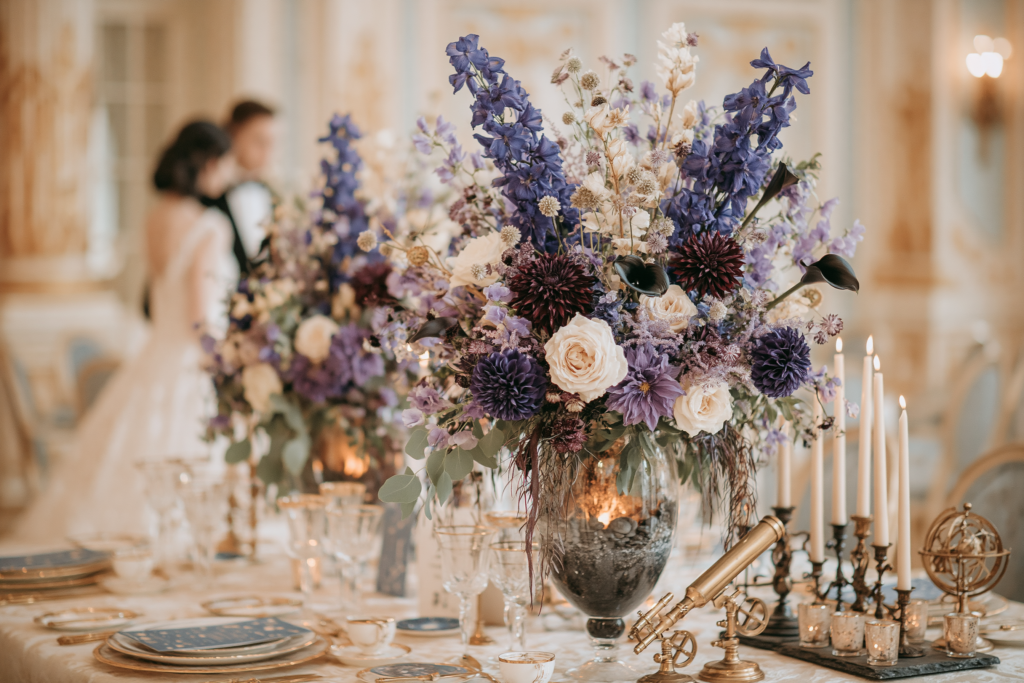
The Celestial Starry Nights collection brings the table centrepiece palette into place cards, menu cards, and table numbers — midnight blue and warm gold in the same constellation vocabulary as the centrepiece itself, so that the printed elements at the table read as continuous with the decorated surface they sit on.

3.2 Table Settings
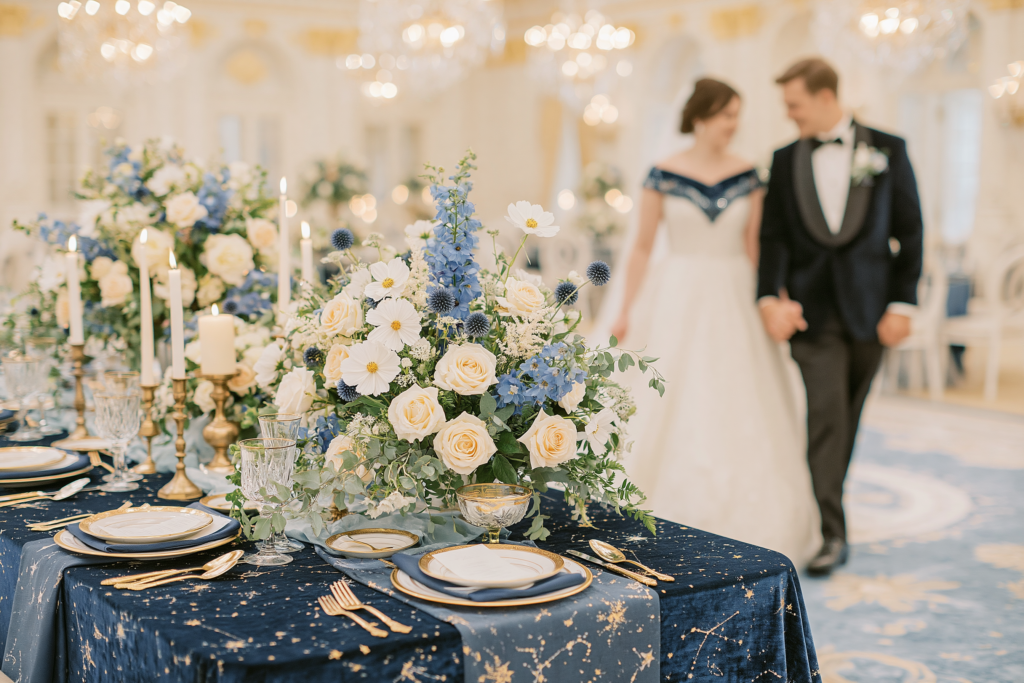
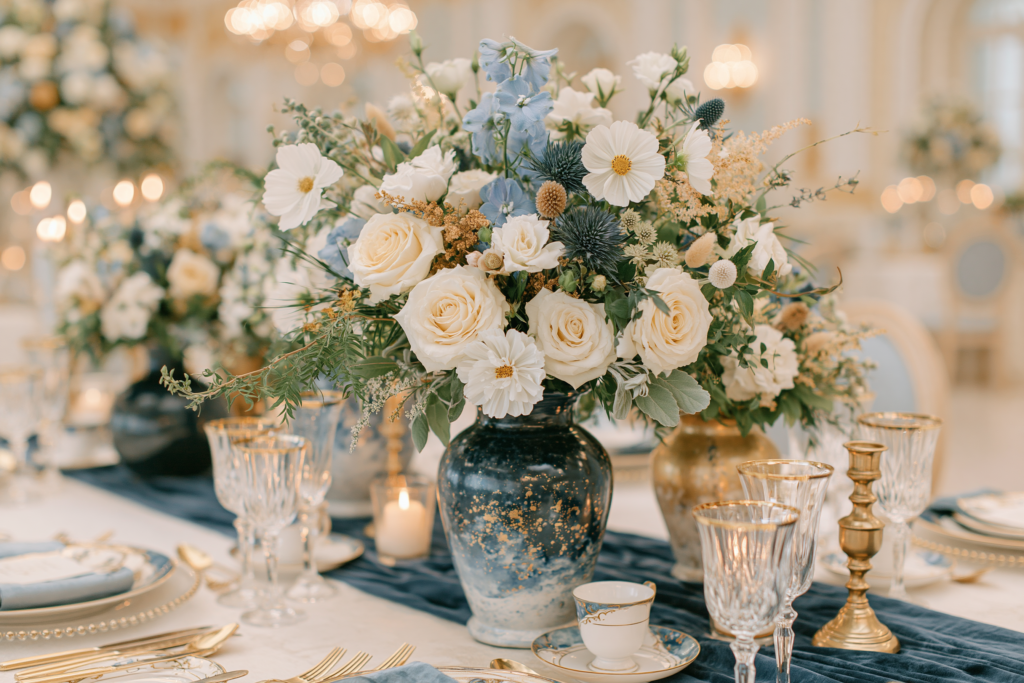
The table linen is the base of every other table-level decoration decision, and in the celestial aesthetic it must be dark: midnight navy velvet runner on warm ivory cloth, or deep charcoal linen in a fully dark table setting, or the warm aged linen of the vintage celestial direction. The specific combination of deep linen runner over a lighter base cloth produces a table with visual depth — the dark runner reads as the night sky, the lighter cloth at the edges reads as the horizon — that a single-cloth table in either colour alone cannot achieve.
Gold celestial flatware — cutlery in antique gold or warm brass rather than the standard silver — is the table setting decision that most changes the temperature of the entire table, because it replaces the cool, grey quality of silver with the warm, amber quality of gold, which is the correct temperature for the celestial palette. Gold celestial flatware is widely available in vintage-style and antique-finish versions that suit every celestial aesthetic from the most classic to the most vintage. The napkins should be folded simply (a celestial wedding table does not need theatrical napkin folding) and tied with a piece of dark ribbon or a dried botanical sprig rather than a ring, unless moon phase napkin rings — small rings with a moon phase cast in antique gold metal — are available in the palette’s metallic.
Celestial place cards as mini star maps are one of the most shareable and most remembered details of a celestial wedding reception — a small folded card with the guest’s name on one side and a hand-lettered or printed constellation on the other, so that each guest finds their personal constellation at their seat. The constellation can be the guest’s star sign, the constellation of their birth month, or simply the most visually beautiful constellation in the collection. The place card should match the invitation suite’s illustration register and palette, completing the visual continuity from the first envelope the guest received to the last printed element they touch at the reception.
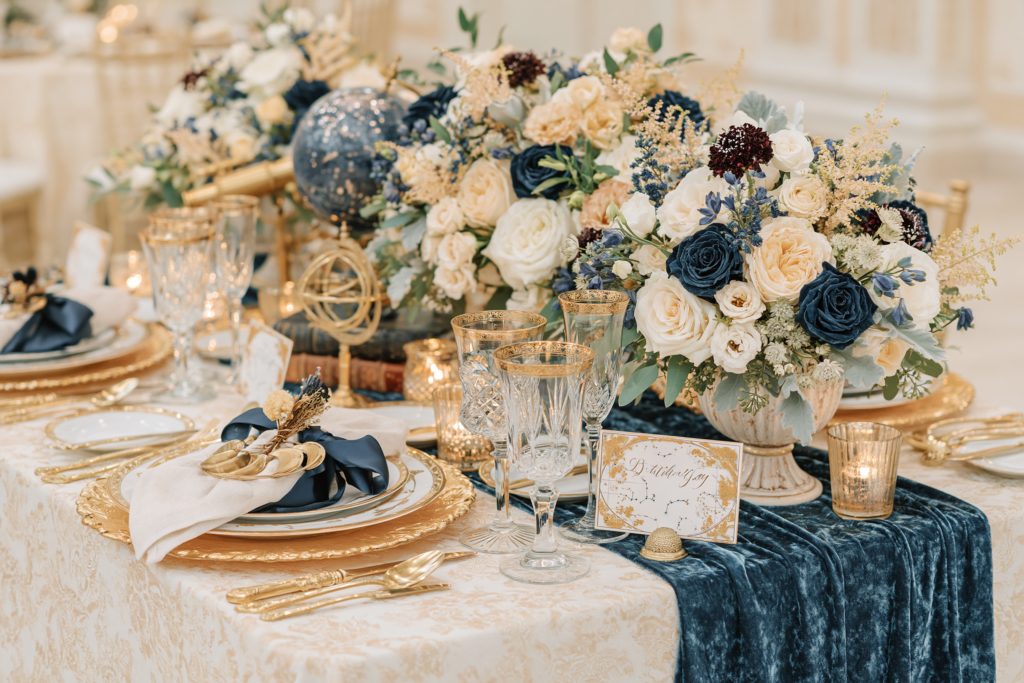
The Vintage Celestial Renaissance collection produces the most beautiful celestial place card and menu card — aged parchment with antique gold constellation work, extending the vintage star map aesthetic from the invitation suite to every printed element at the table.

3.3 Celestial Wedding Seating Chart
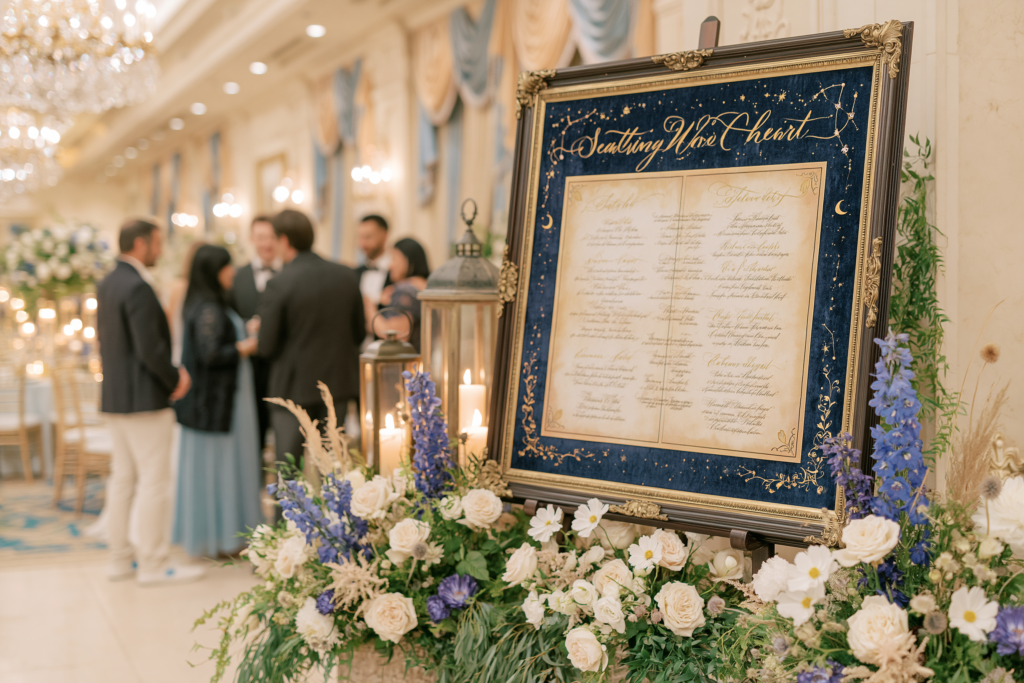
The celestial wedding seating chart — or table plan — is one of the most searched celestial wedding decoration elements, and with good reason: it is a large-format piece that guests interact with immediately on arrival, that is photographed in detail and in context, and that sets the visual register of the entire reception space before guests enter it. A constellation seating chart uses the framework of a star map to organise and present the seating information — each table is a named constellation, and the seating chart shows the actual constellation diagram alongside the table number and names of guests assigned to it.
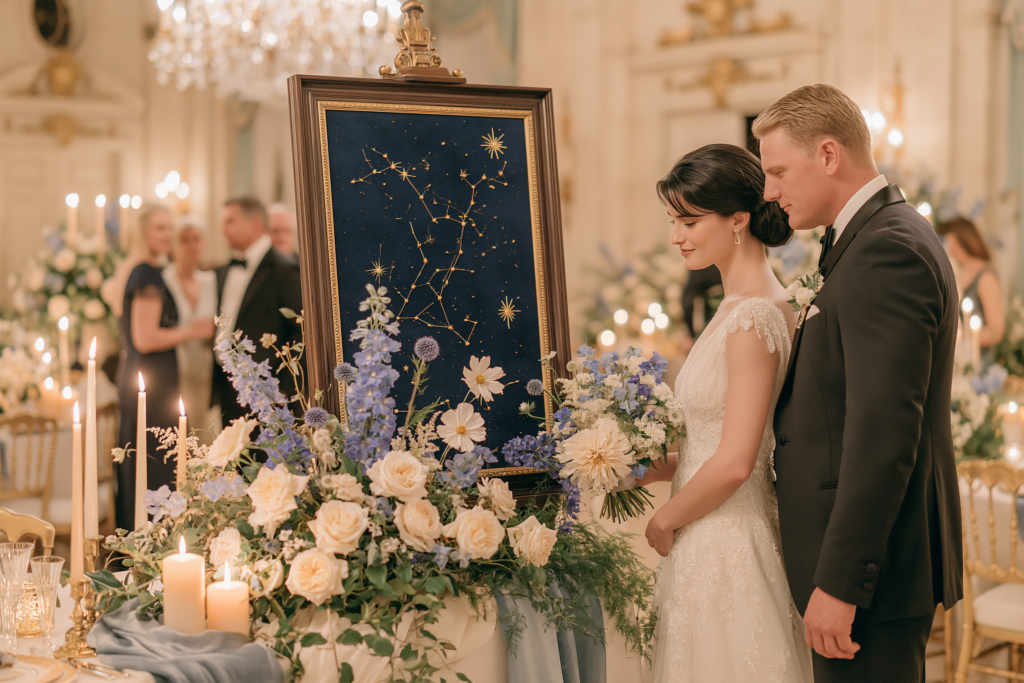
The most dramatic format: a large-format print or hand-lettered display on dark midnight or near-black board, with constellation diagrams in gold and guest names in warm cream, mounted in a dark wood or blackened metal frame and lit from below or to the side with a single warm light source. The most intimate format: individual constellation cards in an antique frame or on a deep velvet backing board, so that guests find their table by finding their constellation in the array. The galaxy seating display — a large acrylic panel with the guest names written in gold against a galaxy-printed background — is the most visually spectacular of the format options but requires the most material investment and the most professional execution to avoid reading as a craft project rather than a designed element.
3.4 Signage & Welcome Details
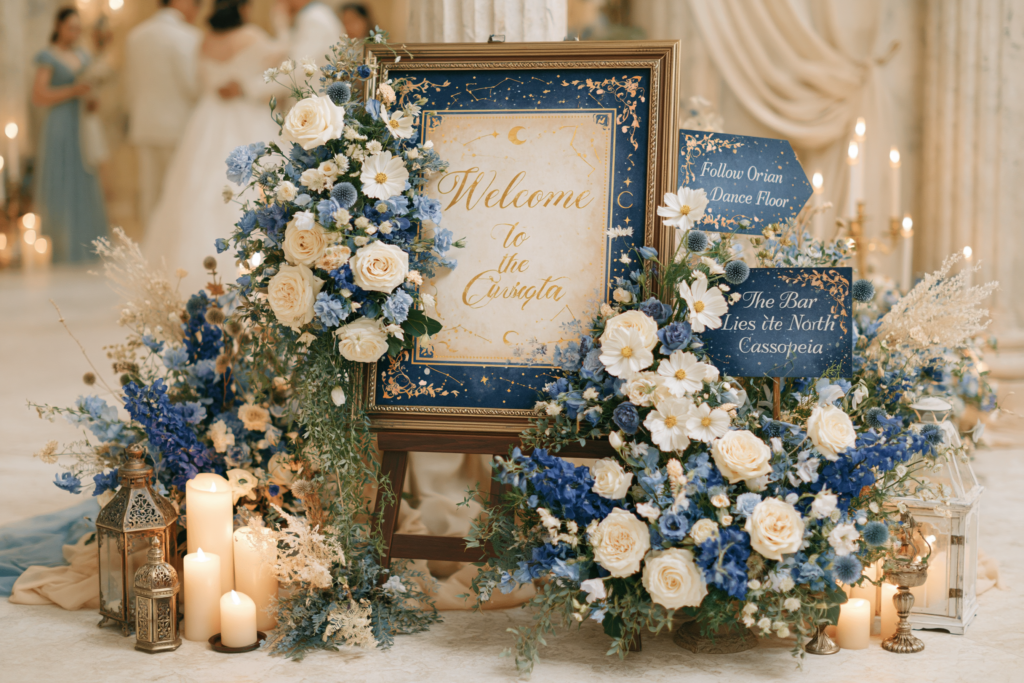
The welcome sign for a celestial wedding — the first piece of decoration that arriving guests encounter — should be in the same visual language as the ceremony arch and the stationery suite: deep background, warm gold typography, constellation detail in the corners or as a border element. It should not be a generic calligraphy welcome sign with a star added; it should read as a specific celestial object in itself, as if it were a page from the star atlas of this specific celebration.
Directional signs with constellation detail — small signs directing guests to the ceremony, the reception, the bar, the dancing — should carry the same visual language as every other printed celestial element: the same palette temperature, the same illustration register, the same typographic style. A constellation directional sign that reads ‘Follow Orion to the dance floor’ or ‘The bar lies north of Cassiopeia’ transforms functional signage into a continuation of the celestial world-building, and gives guests who read them the specific pleasure of a celebration that has thought through every detail.
Section 04 Celestial Lighting Design
Lighting is not one of the decoration decisions in a celestial wedding — it is the decoration decision, the one that determines whether every other element succeeds or fails. A celestial reception space with perfect centrepieces and perfect table settings under wrong lighting reads as a themed party. The same space under perfectly calibrated warm, low, layered lighting reads as the night sky made intimate. The lighting plan should be the first decoration decision made and the last to be finalised, and it should have a dedicated budget allocation rather than being treated as a backdrop to the visible decoration elements.
The three-layer celestial lighting approach: overhead ambient at the absolute minimum level required for safety navigation (guests should be able to see each other and find their seats, nothing more — all the interesting light should come from table level and accent sources, not from overhead); accent lighting on architectural features and key decoration elements (pin spots on centrepieces, wash lighting on the ceremony arch or backdrop, uplighting on any stone or masonry walls in warm amber rather than the standard white or blue); and the starfield layer — the specific layer that makes the space celestial rather than simply dimly atmospheric.
The starfield lighting layer can be achieved in several ways depending on the venue and budget. Fairy lights at star density — not at the density of a fairy light canopy (which reads as light installation) but at the specific sparsity of the actual night sky (which reads as starfield) — are the most accessible and most versatile starfield option. The critical calibration is 20% light to 80% darkness across the ceiling plane: at this ratio the ceiling reads as sky; below 20% it reads as a dark room; above 20% it reads as a light installation. LED pin-spot lights on a dimmer, set to point downward at slight angles from a dark ceiling, produce the most realistic star effect and the most adjustable result. Projected star effects using a professional projection system are the most dramatic and the most controlled, but require professional installation and are not available in all venues.
The colour temperature of every light source in the celestial wedding should be warm — 2700 Kelvin or below for all LED sources, real flame for candle sources. Cool white light (4000 Kelvin and above) removes the warmth from the gold metallic elements of the celestial palette, makes midnight blue read as flat and graphic rather than atmospheric and deep, and destroys the specific quality of warm darkness that is the fundamental experience the celestial wedding decoration is designed to create. This is a technical specification that should be communicated explicitly to any lighting supplier or venue technician — ‘warm white’ is not specific enough; 2700K or below is the correct temperature reference.
Candlelight is the most naturally celestial artificial light source available and should be used in the highest quantity that safety permits. Not as scattered accent detail but as a significant proportion of the total table-level light: a celestial reception table at which every guest has three or four candles within their immediate visual field, flickering at slightly different rates, creating a constantly shifting pattern of warm light and warm shadow, is a table that belongs to the night sky in a way that no amount of overhead lighting or LED decoration can replicate. The specific quality of candlelight — warm, irregular, alive — is the quality of starlight itself, which is why it is the most important single decoration material available to the celestial wedding decorator.
Section 05 DIY Celestial Wedding Decor Ideas
The celestial wedding aesthetic is one of the most DIY-accessible in the entire wedding category — because many of its most effective elements depend on paint, fabric, wire, and light rather than on specialist confectionery or floral techniques, and because the aesthetic rewards the specific, the handmade, and the personal more than it rewards the purchased and the generic. A constellation string art piece made by the couple from a specific personal star chart will always read as more genuinely celestial than a generic purchased star-scatter decoration, because the specificity of the reference is itself the aesthetic quality.
Star-Scattered Tablecloths
Dark tablecloths or table runners with star scatter applied at home using fabric paint, iron-on vinyl, or loose glitter in a temporary adhesive are among the most high-impact and lowest-cost DIY celestial decoration elements available. The key technique decision: apply the stars in a constellation pattern from a reference chart rather than in a random scatter, so that the tablecloth carries genuine celestial specificity rather than generic decoration. Use a reference for a specific constellation — the one that corresponds to the wedding month, or one that has personal significance — and apply the stars in the correct geometric relationship. The table then becomes a sky map as well as a table, which is the level of specificity the celestial aesthetic rewards.
Moon Phase Candle Holders
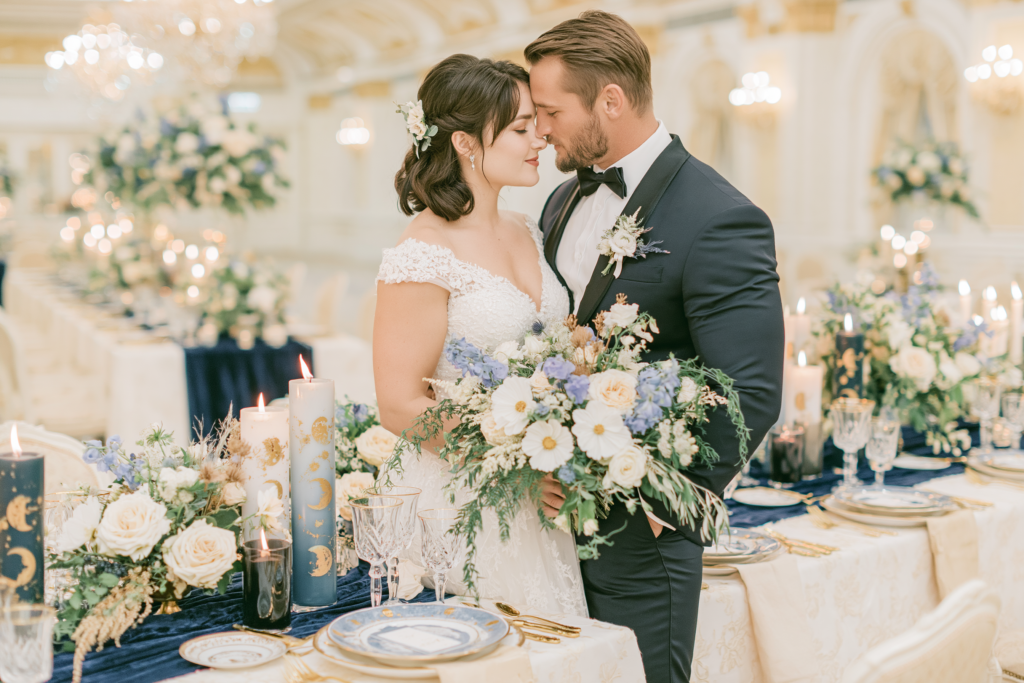
Plain glass candle holders or cylindrical vases painted or vinyl-wrapped with moon phase silhouettes are one of the most widely shared DIY celestial wedding elements, and for good reason: the moon phase sequence (new moon, waxing crescent, half moon, waxing gibbous, full moon) is one of the most recognisably celestial graphic forms available, it reads beautifully when backlit by candlelight, and it can be produced in bulk at low cost using either black vinyl cut to moon phase shapes or black paint applied with a round sponge at different fill levels. Place the completed moon phase holders along the aisle, in clusters on the centrepiece tray, or in a line along the cake table to create the most effective visual impact.
Constellation String Art
A piece of string art — gold wire or thin gold cord strung between small nails on a dark board in the pattern of a specific constellation — is one of the most beautiful and most personally specific DIY celestial decoration pieces available. The board can be deep midnight blue velvet-covered foam board, dark wood, or dark card; the nails are small panel pins placed at the star positions of the chosen constellation (using a printed constellation chart as the reference, scaled to the board size); and the wire connects the star positions in the constellation’s traditional line pattern. A string art constellation piece in the couple’s personal significance constellation — the one visible on the night they first met, or the night of the proposal — is a genuine piece of art that can be hung in the home after the wedding.
Galaxy Painted Vases
Plain ceramic or glass vases painted with the galaxy painting technique (the same technique used in professional celestial cake decoration) produce striking centrepiece vessels at very low material cost. The technique: apply diluted acrylic paint in midnight blue, deep purple, and very dark grey to the outside of the vase using a wide flat brush in overlapping washes, blending while wet; add tiny dots of white paint flicked with a fine brush for stars while the base layers are still slightly wet; finish with a light scatter of gold paint or gold lustre dust applied with a soft brush for the warm gold accent. The resulting vessel reads as galaxy-painted at close range and as beautifully deep-toned at a distance, and suits every celestial aesthetic from the most dramatic to the most vintage when the colour choices match the overall palette.
Celestial Garlands
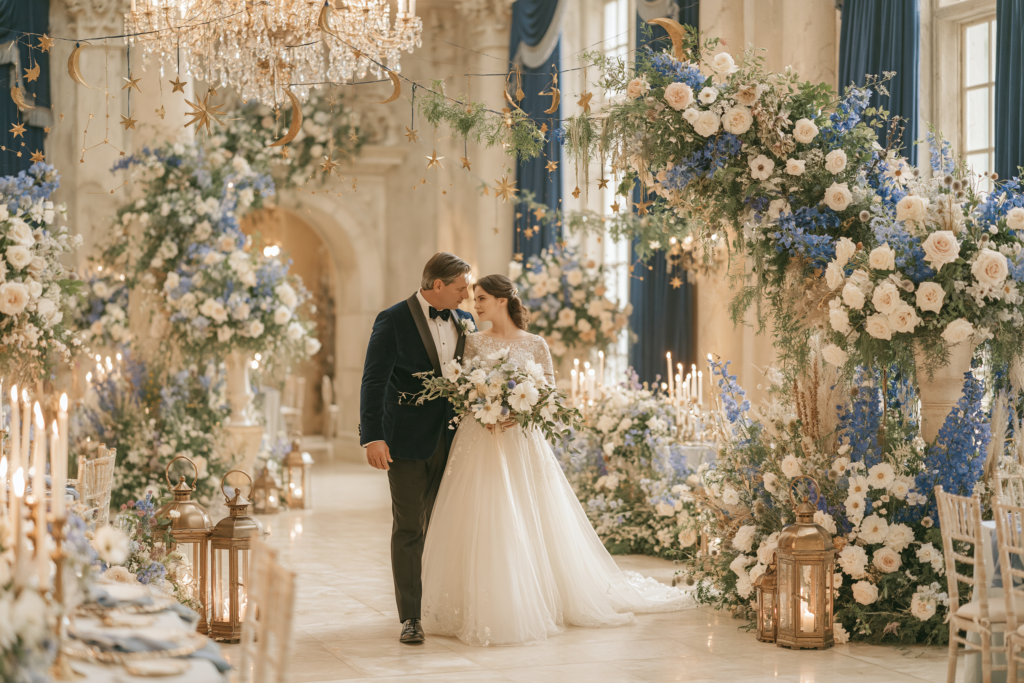
Garlands of gold wire-wrapped crescent moons, stars, and constellation forms — available from paper or card cut with a craft die cutter in the chosen shapes — are among the most versatile DIY celestial decoration elements, suitable for hanging between tables, draping across the ceremony backdrop frame, winding through centrepiece arrangements, or hanging in the windows of the venue. The key quality decision: use warm antique gold card or metallic paper rather than bright shiny gold, which reads as party decoration rather than celestial decoration. A garland of crescent moons in brushed antique gold card, strung on dark thread at varying intervals (rather than evenly spaced), reads as genuinely celestial; the same shapes in bright shiny gold or silver reads as birthday party.
Section 06 Celestial Decor by Color Palette
Four distinct palette directions with their specific decoration vocabularies — choose the one that matches the wedding’s aesthetic direction and use it as the reference for every decoration decision.
Palette 01
Midnight Blue & Gold
Midnight Navy · Warm Antique Gold · Silver Stars · Deep Cream
The most classic and most broadly accessible celestial palette. Midnight navy velvet runners, warm antique gold flatware and votives, white or cream florals as the light accent, deep blue delphinium and burgundy dahlia as the dark floral elements. The ceiling treatment: navy drape with warm fairy lights at star density. The table linen: midnight runner on warm ivory cloth. The centrepiece: constellation candle tray in blackened metal with varying-height candles.
Palette 02
Deep Black & Silver Stars
Near-Black · Antique Gold · Cool Silver · Midnight
The most dramatically atmospheric palette — requires the most lighting design but produces the most striking room. Near-black or very dark charcoal linen throughout; silver star scatter on the tablecloth; antique gold flatware as the warm note that prevents the palette from reading as cold or funereal; near-black floral elements (dark dahlias, black calla lily) with the absolute minimum of light-coloured floral accent. Lighting: candlelight as primary table-level source, pin-spot starfield overhead.
Palette 03
Purple Galaxy & Antique Gold
Deep Amethyst · Midnight Purple · Antique Gold · Silver
The most magical and most mystical of the four palette directions — associated with the whimsigoth and mystical celestial aesthetics. Deep plum or grape tablecloths; amethyst and silver floral elements (dark purple orchid, deep lavender, dried astrantia); gold flatware in a warm amber tone; moon phase candle holders in silver for the table surface. The ceiling treatment: alternating deep purple and midnight draping panels with integrated silver-toned fairy lights at star density.
Palette 04
Vintage Parchment & Constellation Gold
Aged Parchment · Burnished Gold · Deep Sepia · Warm Ivory
The warmest and most historically grounded of the four directions — associated with the vintage celestial and dark academia aesthetics. Aged cream or natural linen tablecloths; antique brass candleholders; aged celestial prints in ornate frames as centrepiece elements; dried botanicals and old-fashioned roses in warm cream and apricot. The signage in calligraphic style on parchment card. Constellation table names from the historical celestial atlas vocabulary.
Section 07 Stationery as Celestial Decoration
In a celestial wedding, the stationery is decoration — not as a figure of speech but as a literal description of the role it plays in the designed world of the celebration. The celestial table plan is a piece of art displayed at room scale. The place card is a personal object connecting each guest to their constellation. The menu card is a printed artefact from the visual world the couple has built, placed on the table for guests to find when they sit down. The ceremony program is a document held in guests’ hands during the most important moment of the day, visible in every photograph taken of the congregation, and carried home as a keepsake that preserves the specific celestial identity of this specific celebration.
The celestial seating chart as stationery object: a large-format constellation map on which the table names, table numbers, and guest names are integrated into the star chart layout — so that finding your table is finding your position in the celestial map of the celebration — is one of the most distinctive and most personal decoration elements available to any wedding aesthetic. It should be designed in the same illustration register as the invitation suite (the same constellation quality, the same palette temperature, the same typographic voice), printed at sufficient scale to be read at reasonable distance, and mounted and lit as a piece of art rather than as a functional sign.
The celestial place name card, menu card, and table number are the three stationery elements that guests interact with most directly during the reception — handling them, reading them, photographing them alongside the table decoration, taking them home. When these elements are designed with the same intention and the same quality as the invitation suite, they complete the visual identity of the celestial wedding in a way that no decoration element can replace: they are the part of the celestial world that guests take with them. A guest who takes home a constellation place card, a menu card whose typography is as beautiful as the celestial illustration it sits beside, and a ceremony program that reads as an antique star chart has experienced a celestial wedding in every dimension — not just visually but materially and in memory.
The six stationery collections below cover every palette direction of the celestial wedding, from the most dramatically dark to the most warmly vintage. Browse all six before choosing — the right collection is the one whose palette most closely matches the specific palette direction chosen for the wedding’s decoration, because the stationery and the decoration should read as part of the same designed world rather than as two separately sourced layers of the same theme.
Classic Celestial
Celestial Starry Nights
Midnight blue and warm gold — the stationery for Palette 01 and the Gold Constellation table setting.
Dark & Dramatic
Celestial Dark
Near-black and antique gold — the stationery for Palette 02 and the most atmospheric celestial table plan.
Warm & Luminous
Celestial Gold
Sun and moon warmth — the stationery for garden ceremonies and the warmest celestial table settings.
Mystical
Celestial Purple
Deep plum and silver — the stationery for Palette 03 and the most magical celestial seating chart.
Signature Suite
Mystical Black Gold Celestial
The most dramatically atmospheric suite — the stationery for the darkest celestial ceremony programs and table plans.
Antique Maps
Vintage Celestial Renaissance
Parchment and antique gold — the stationery for Palette 04 and the most literary vintage celestial place cards.
Explore the Full Celestial Wedding Series
Every planning category for the complete celestial wedding — use the guides below alongside this decoration resource.
Coming Soon
Celestial Wedding — Complete Celebration Guide 2026
Venue, ceremony design, reception, and the full stationery showcase.
Coming Soon
Celestial Wedding Theme — Colors & Aesthetics 2026
Eight celestial palettes with swatches, feelings, and venue guidance.
Coming Soon
Celestial Wedding Dress — Starry Night Bridal Guide 2026
Six celestial dress styles, fabrics, embellishments, and accessories.
Coming Soon
Vintage Celestial Wedding — Complete Mystical Retro Guide 2026
Four vintage celestial aesthetics: Renaissance, Victorian, Art Nouveau, Dark Academia.
Coming Soon
Celestial Wedding Cake — Cosmic & Starry Night Designs 2026
Six celestial cake styles, flavours, toppers, and cake table styling.
Coming Soon
Celestial Wedding Flowers Guide
Which florals to choose for each of the eight celestial aesthetics.
Frequently Asked Questions
What decorations do you need for a celestial wedding?
The core decoration categories for a celestial wedding are: ceremony arch (star-and-moon floral arch, draped midnight fabric with star scatter, or celestial botanical installation); aisle styling (star scatter petals, moon phase lanterns, constellation aisle markers, celestial candle path); reception centrepieces (galaxy globe terrariums, constellation candle arrangements, moon phase floral centrepieces); table settings (midnight linen, gold flatware, star-scattered chargers, celestial place cards and menu cards); lighting design (the single most consequential decoration element — three-layer system of minimal overhead ambient, accent spots on key elements, and sparse starfield fairy lights or pin spots); and stationery (which functions as decoration in a celestial wedding — seating chart, place names, menu cards, and ceremony programs are all decorated objects as much as functional documents). The full decoration guide above covers all of these in order of the wedding day timeline.
What is the most important celestial wedding decoration?
Lighting, by a significant margin. The darkness of the celestial palette means that every other decoration element — the florals, the linen, the centrepieces, the arch — is seen through the quality of the lighting, and wrong lighting can make perfectly executed decoration read as a themed party rather than as a genuine celestial world. The most important single lighting decision is the overhead ambient level: it should be set at the absolute minimum required for safe navigation, with all the interesting light coming from table level (candles) and accent sources (spots on key elements). The second most important lighting decision is the colour temperature: all light sources should be 2700 Kelvin or below (warm white or warmer) — cool white light removes the warmth from the gold elements of the palette and flattens the atmospheric quality the decoration is designed to create.
How do you DIY celestial wedding decorations?
The five most impactful DIY celestial wedding decoration elements, in order of visual impact relative to effort and material cost: (1) Star-scattered tablecloths — dark linen with iron-on vinyl or fabric-paint stars applied in a constellation pattern from a reference chart. (2) Moon phase candle holders — plain glass holders decorated with black vinyl or paint in moon phase silhouettes, backlit by real candle flame. (3) Constellation string art — gold wire on small nails driven into dark board in a specific constellation pattern, using a printed star chart as the reference. (4) Galaxy painted vases — plain ceramic or glass vessels painted with the layered sponge galaxy technique in midnight blue, deep purple, and warm white, finished with gold lustre. (5) Celestial garlands — antique gold card moons, stars, and constellation forms strung on dark thread in irregular spacing. The critical quality decision across all five: use warm antique gold rather than bright shiny gold or silver, which reads as party decoration rather than celestial aesthetic.
What is a celestial wedding seating chart?
A celestial wedding seating chart (also called a constellation seating chart or star map table plan) organises and displays the wedding seating information using the framework of a celestial map — each table is named for a constellation, and the seating chart shows the actual constellation diagram alongside the guest names for each table. The most dramatic format is a large-format print on deep midnight or near-black board with constellation diagrams in gold and guest names in warm cream, mounted in a dark frame and lit from below. The most intimate format is individual constellation cards in an antique frame or on a velvet backing board. The seating chart for a celestial wedding should be designed in the same illustration register as the invitation suite — the same constellation illustration quality, the same palette temperature, the same typographic style — so that it reads as part of the same designed world rather than as separately sourced decoration. It is one of the most photographed elements of the reception space and one of the most effectively personal.
Complete the Decorated World
Find the Stationery That Belongs to the Same Night Sky as Your Decorations
The place card, the menu, the seating chart, the ceremony program — all of them are decoration. Choose the collection that matches your palette and let the printed world complete the celestial one.