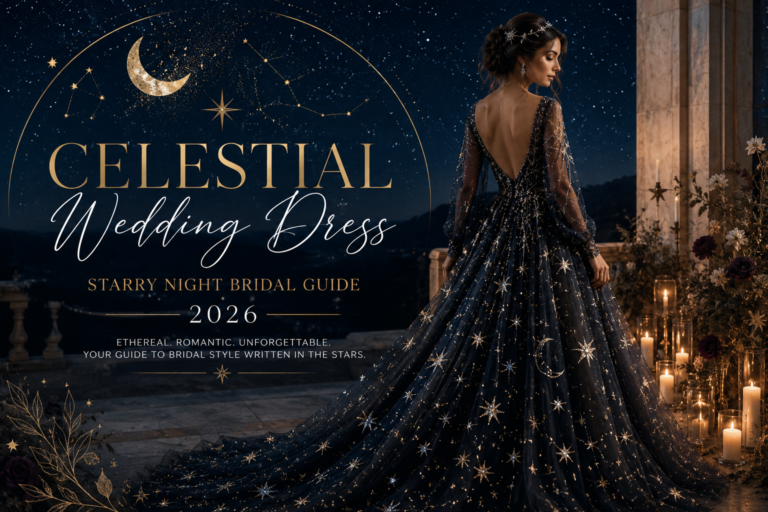
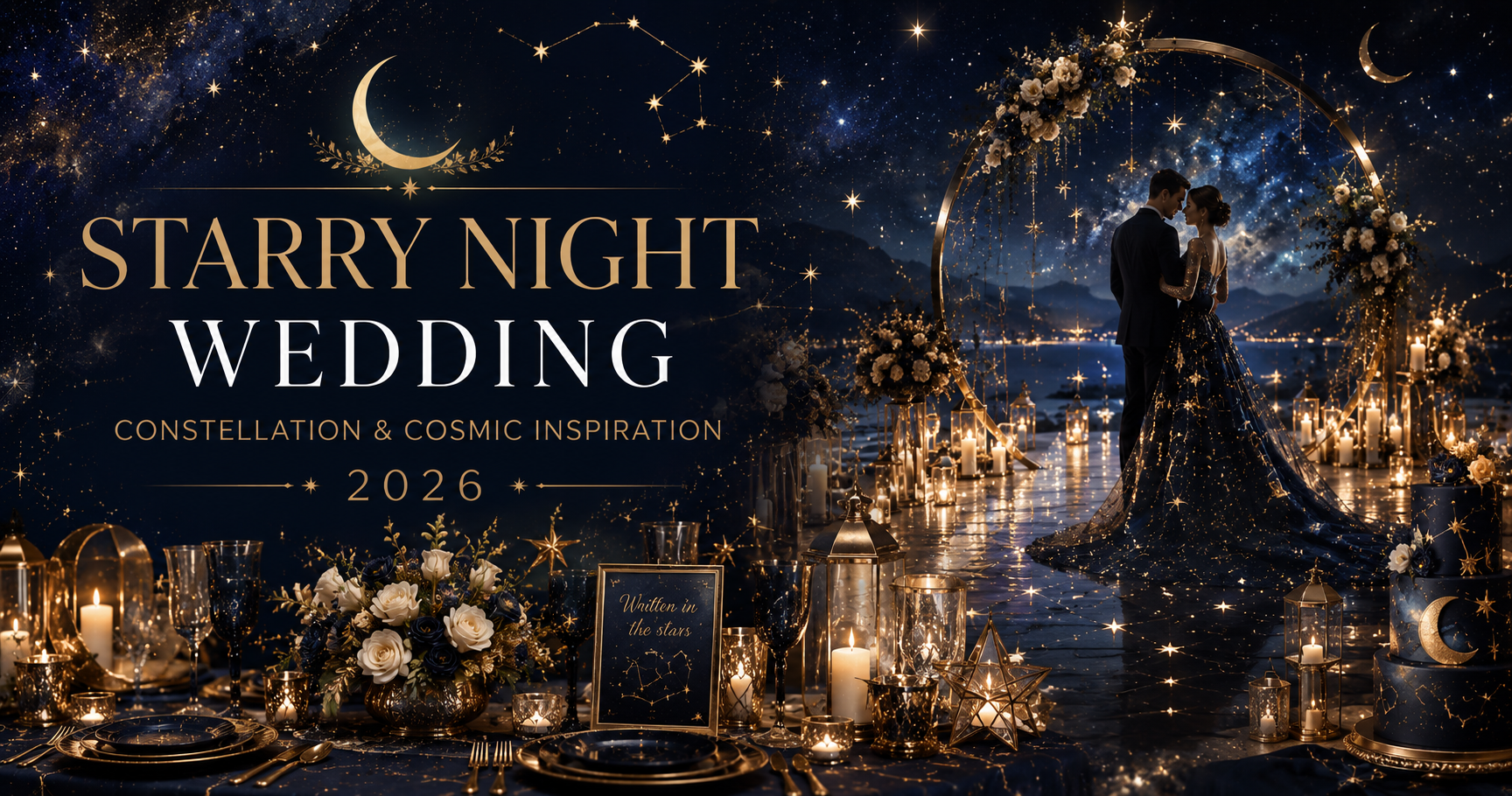
Starry Night Wedding
Celestial Wedding · 2026
Starry Night Wedding — Constellation & Cosmic Inspiration 2026
Five starry night aesthetics, four sky palettes, ceremony and reception under real and created stars, photography guidance, and the stationery that holds the first constellation the guest receives.
The starry night wedding is one of the oldest and the most emotionally immediate of all wedding aesthetics — because the experience of looking up at a sky full of stars and feeling the specific combination of smallness and significance that the night sky produces is among the most universally shared human experiences. Every culture, every era, every couple who has ever celebrated a wedding outdoors on a clear night has had this experience, which is why the starry night wedding theme feels simultaneously timeless and immediately personal.
This guide covers five distinct starry night aesthetics, from the most classic to the most dramatically cosmic, with the colour palettes, ceremony and reception details, photography approach, and stationery collections that complete each one into a fully designed celebration under the stars.

“They have been witnesses to every wedding that has ever taken place — the stars. Ancient, indifferent, and yet somehow the most intimate audience imaginable: the night sky does not watch, it simply continues, which is why it feels like the most honest witness a celebration can have.”
Section 01 The Starry Night Wedding Aesthetic
The starry night wedding aesthetic is the most experientially direct of all the celestial wedding directions — because its central aspiration is not to evoke the night sky through decoration but to place the celebration actually within the night sky, or to create a space that feels so specifically and so completely as if it is within the night sky that the distinction between the real and the created becomes irrelevant. Where the broader celestial wedding aesthetic uses the sky as inspiration for a palette and a motif vocabulary, the starry night wedding uses the sky as venue — as the actual space in which the celebration takes place, or the specific experience that the decoration is designed to reproduce with maximum fidelity.
The visual distinction between the starry night wedding and a general celestial wedding is primarily one of emphasis and scale. A celestial wedding uses star and moon motifs decoratively, building an atmosphere that references the night sky through palette and embellishment choices. A starry night wedding attempts to recreate the actual experience of the night sky — the depth, the vastness, the specific quality of scattered light against total darkness — at architectural scale. This means the ceiling is the primary canvas rather than the table; the lighting design is the primary decoration rather than the centrepieces; and the goal is immersive atmosphere rather than beautiful detail.
The Van Gogh ‘Starry Night’ visual reference comes naturally to this aesthetic — not because the painting is the inspiration but because both the painting and the starry night wedding are attempting the same thing: to render the specific quality of the night sky as a swirling, dynamic, emotionally overwhelming field of light rather than as a static backdrop. The swirling star aesthetic (galaxy-effect painting, swirling fairy light installations, flowing midnight blue fabric that moves and creates the impression of stars in motion) is the most artistic and most visually distinctive execution of the starry night wedding, and it differs significantly from the flat star scatter that generic celestial decoration produces. The specific quality of Van Gogh’s night sky — the sense that the stars are not points of light but living, moving things — is what the best starry night wedding decoration attempts to capture.
The under the stars wedding search has surged in 2026 alongside the broader celestial aesthetic growth, and for a specific reason: couples are not only interested in the visual language of the night sky but in the actual experience of being underneath it during the most significant moment of their lives. Dark sky venues — places with minimal light pollution where the Milky Way is visible — have become one of the most sought-after wedding venue categories precisely because they offer something no amount of decoration can reproduce: the actual night sky in its full, unmediated beauty, directly above the ceremony. This is the aspiration that the starry night wedding is built around, whether it achieves it through access to the real sky or through the most faithful possible recreation of it indoors.

Section 02 Five Starry Night Wedding Aesthetics
Five distinct registers of the starry night wedding, each with a different relationship to the sky — from the most classically romantic to the most dramatically cosmic. Each includes the specific stationery that carries the same visual world into every printed element of the day.
2.1 The Classic Starry Night
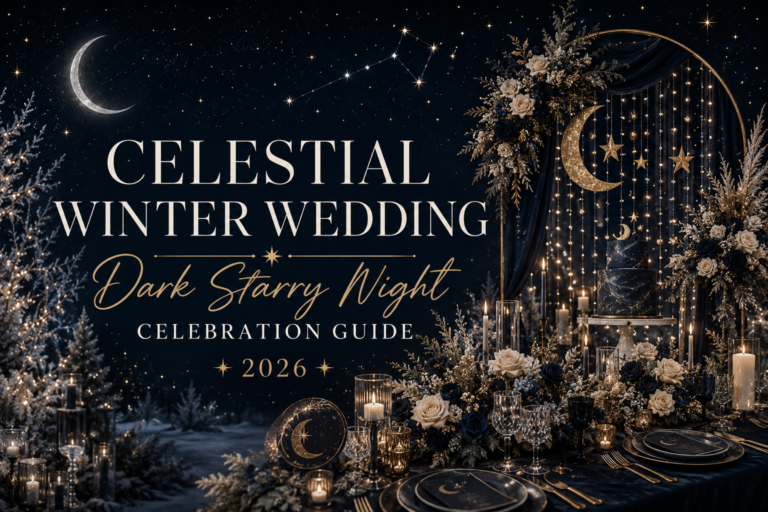
The Classic Starry Night aesthetic is the most immediately recognisable and the most broadly beautiful of the five directions — midnight blue as the base, warm antique gold as the primary star and constellation detail, and the specific quality of a clear night sky at its most romantic: the kind that appears in every love poem that has ever referenced the stars, the kind that appears in the background of every night scene in every classic film, the kind that made every person who has ever lain on their back in the dark feel both entirely alone and entirely connected. This is the aesthetic that most people picture when they imagine a starry night wedding, and it is the direction with the widest possible appeal because the visual experience it references is so universally shared.
The execution decisions that define the Classic Starry Night: midnight navy as the primary fabric tone for linen, draping, and the ceremony arch backdrop; warm antique gold as the metallic accent in flatware, votives, centrepiece detail, and the stationery suite; star scatter on every dark surface in a constellation distribution rather than a uniform one; deep blue delphinium and dark floral elements with white garden roses as the light accent; and the specific quality of fairy lights at star density — sparse, warm-toned, and irregular — as the primary ceiling treatment. The cake, if a wedding cake is planned, carries the same palette: midnight fondant with warm gold constellation piping and a gold star scatter applied individually across each tier.
The Classic Starry Night is the direction that photographs with the greatest consistency across all lighting conditions and all photography styles — because its palette (deep, warm, high-contrast) is the palette that digital cameras and film cameras alike render most beautifully in low-light conditions. The specific combination of midnight blue and warm gold at the scale of a reception room, under low warm ambient lighting with candlelight as the primary table-level source, produces images that are among the most consistently beautiful in wedding photography — which is one of the reasons the Classic Starry Night aesthetic has surged so significantly on Pinterest.

The Celestial Starry Nights collection and Mystical Black Gold Celestial suite carry the Classic Starry Night palette into every printed element — the most romantic and most broadly beautiful stationery direction for this most iconic of the five starry night aesthetics.

2.2 The Dark Cosmic Night
The Dark Cosmic Night aesthetic is the most dramatically atmospheric of the five directions — it pushes the palette from midnight blue to near-black, from warm romantic to deeply moody, from the classic starry night that everyone recognises to the specific experience of being outside on the darkest and clearest night you have ever seen, when the sky is so dark that the stars are not points of light against a blue background but diamonds against absolute black. This is the aesthetic for the couple who wants the reception room to feel genuinely other — a space outside the ordinary world, inside the cosmos itself, where the normal rules of social occasion have been temporarily suspended and replaced by something older and larger.
The execution of the Dark Cosmic Night aesthetic requires the most disciplined lighting approach of the five directions: the overhead ambient must be set lower than for any other aesthetic, the table-level candlelight must be denser to compensate, and every single light source must be warm (2700K or below) — because in the near-black palette, any cool light source reads as a mistake rather than as a decorative element. The star scatter must be applied more sparingly than in the Classic Starry Night, not more abundantly: the near-black palette makes each point of light more luminous than it would be against midnight blue, which means fewer, better-placed stars produce a more genuinely cosmic effect than an abundant scatter would.
The florals for the Dark Cosmic Night: near-black dahlias, deep burgundy ranunculus, black calla lily, and the absolute minimum of white or cream floral accent — just enough to suggest the most distant stars rather than to create visible light sources within the arrangement. The specific quality of the Dark Cosmic Night floral is that it provides visual texture and depth within the dark rather than contrast against it — the flowers are chosen to enrich the darkness rather than to illuminate it. The Dark Cosmic Night aesthetic is the one most associated with the whimsigoth and night court aesthetics that have been growing on Pinterest in 2025–2026, and it is the most dramatically different from conventional wedding decoration of any direction in this guide.
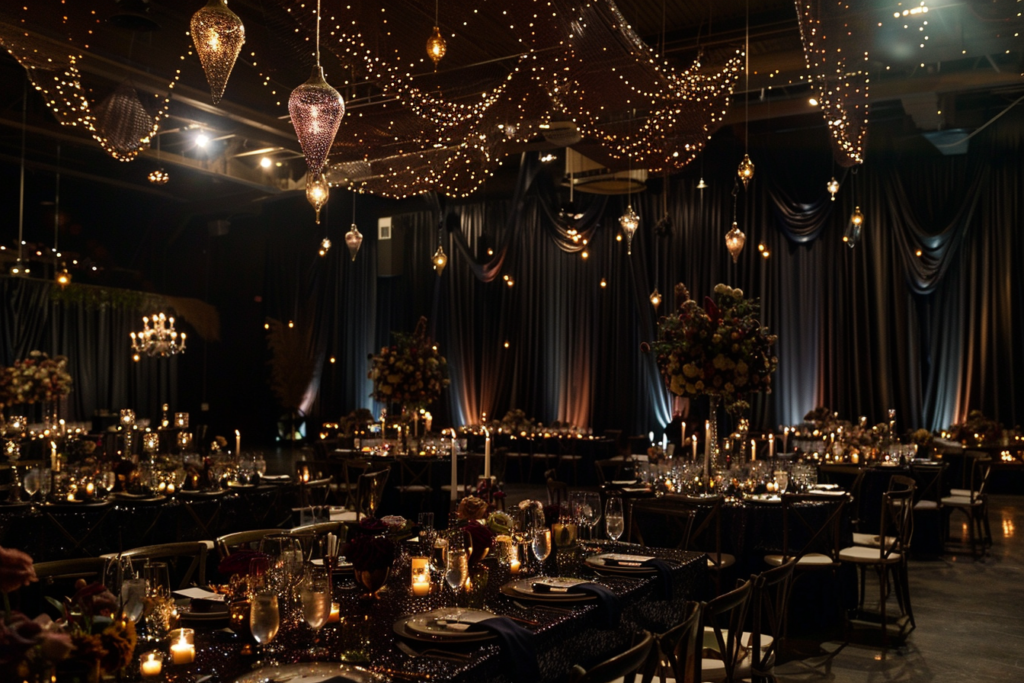
The Celestial Dark collection and Black Gold Celestial suite carry the Dark Cosmic Night into stationery — near-black with warm antique gold, the most atmospheric printed elements for the most atmospheric of the five starry night aesthetics.
2.3 The Constellation Wedding
The Constellation Wedding aesthetic is the most personally specific of the five directions — it uses the actual geometric patterns of specific, named constellations as the primary visual motif rather than a generic star scatter, and it is the direction in which the celestial decoration most completely becomes a personal record of the couple and the celebration. The constellation wedding builds its visual world around specific stars: the couple’s birth constellations (the specific patterns of stars that were overhead on their respective birthdays), the constellation visible above the venue on the wedding night, or the personal constellation that has meaning in the couple’s own story — the one they saw together on the night of the proposal, the one whose mythology mirrors their own relationship.
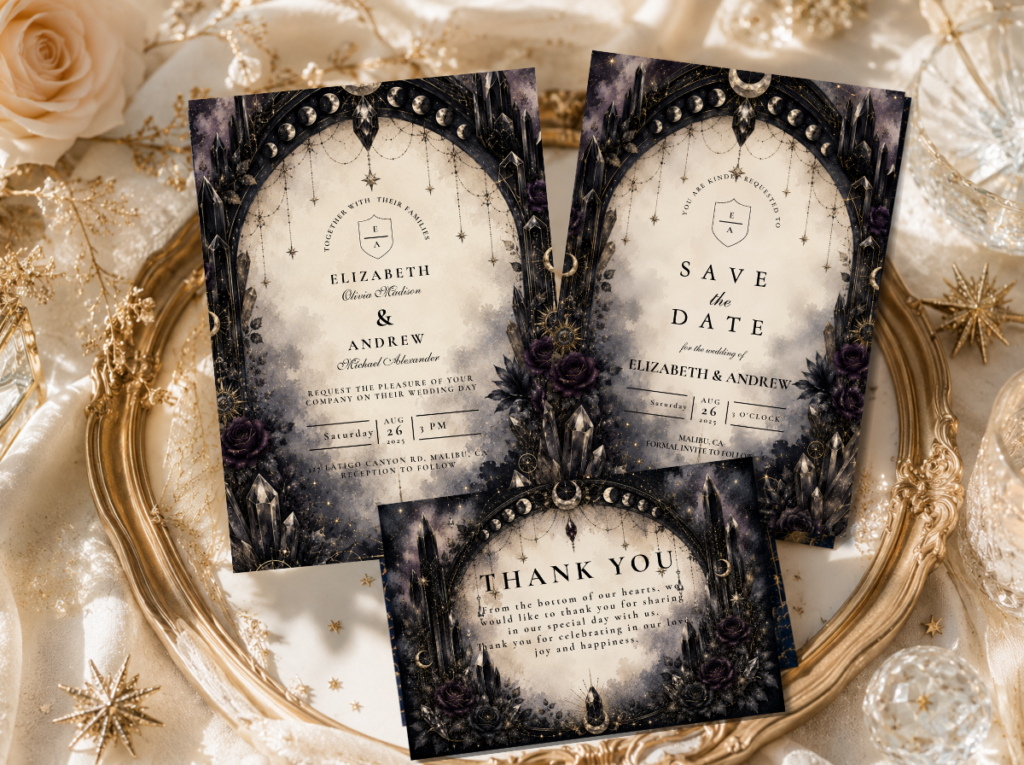
The visual quality that distinguishes a constellation wedding from a general starry night wedding is the precision and intentionality of the star placement. A constellation wedding invitation features a specific constellation map — not a decorative scatter of star shapes but the actual geometric diagram of a named constellation, with the connecting lines in gold and the star positions marked precisely — rather than a generic night sky background with stars. The ceremony arch carries a specific constellation in its floral arrangement (the star positions indicated by white roses among deep blue delphinium, the connecting lines suggested by gold wire). The seating chart is organised as a star map, with each table named for and illustrated with its specific assigned constellation. The aisle lanterns are placed in the specific geometric pattern of a constellation rather than in a uniform series.
The Constellation Wedding aesthetic is the most intellectually engaging of the five directions for guests — because it gives them a specific thing to look at, to identify, to think about, and to connect to the couple. A guest who recognises Cassiopeia in the table centrepiece wire work, or who notices that the constellation on their place card is the same as the one on the seating chart and traces the connection from the ceremony program to the table stationery, has experienced the wedding as a coherent designed world in a way that guests at a generically beautiful wedding do not. This level of engagement is what the best wedding design achieves, and the constellation wedding is particularly well suited to producing it.
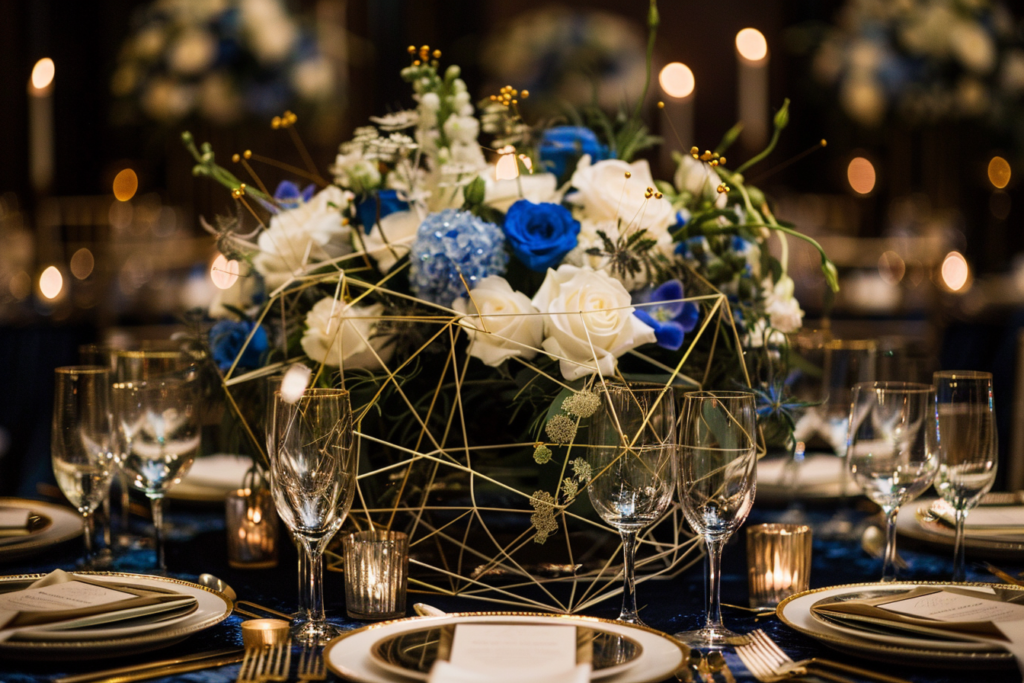
The Cosmic Vintage Constellation collection is the most specifically appropriate stationery suite for the Constellation Wedding aesthetic — it brings the precision and historical quality of real celestial cartography into the invitation, place card, and menu, so that every printed element at the constellation wedding reads as a page from the star atlas the entire celebration is based on.

2.4 The Purple Galaxy Night
The Purple Galaxy Night aesthetic is the most painterly and the most artistically ambitious of the five directions — it takes the starry night as visual experience and pushes it toward the quality of a nebula: the deep purple and violet tones of cosmic gas clouds, the swirling quality of galactic arms seen from a distance, the specific combination of deep amethyst and warm gold that reads as a section of deep space rather than as the night sky directly above. This is the starry night wedding for the couple who wants their celebration to feel not like being under the sky but like being inside the cosmos — deep space made immediate, the universe at intimate scale.
The visual technique that defines the Purple Galaxy Night aesthetic is the galaxy painting approach applied not just to individual elements (the cake, the invitation background, the centrepiece vessel) but to every major surface — the ceremony backdrop, the ceiling fabric draping, the table runners, the paper stock of every printed element — so that the galaxy colour is the continuous visual environment of the entire celebration rather than a decorative detail within it. The palette: deep amethyst, midnight purple, soft lilac as the galaxy base tones, with warm antique gold as the star scatter and cool silver as the secondary metallic accent that references the specific blue-white quality of the most distant and brightest stars.
The Purple Galaxy Night is the most explicitly artistic of the five directions and the one most associated with the mystical and occult celestial aesthetics — the tradition in which the purple colour has been connected to mystery, magic, and the cosmos across cultures for millennia. The whimsigoth aesthetic, in its most directly celestial expression, arrives at something very close to the Purple Galaxy Night: deep purple, cosmic swirl, gold star scatter, and the specific quality of a space that feels genuinely enchanted rather than simply decorated. For the couple who wants their wedding to feel as if they designed it in the specific tradition of beautiful strangeness — of celebration as an act of genuinely making something extraordinary — the Purple Galaxy Night is the starry night direction most specifically suited to this ambition.
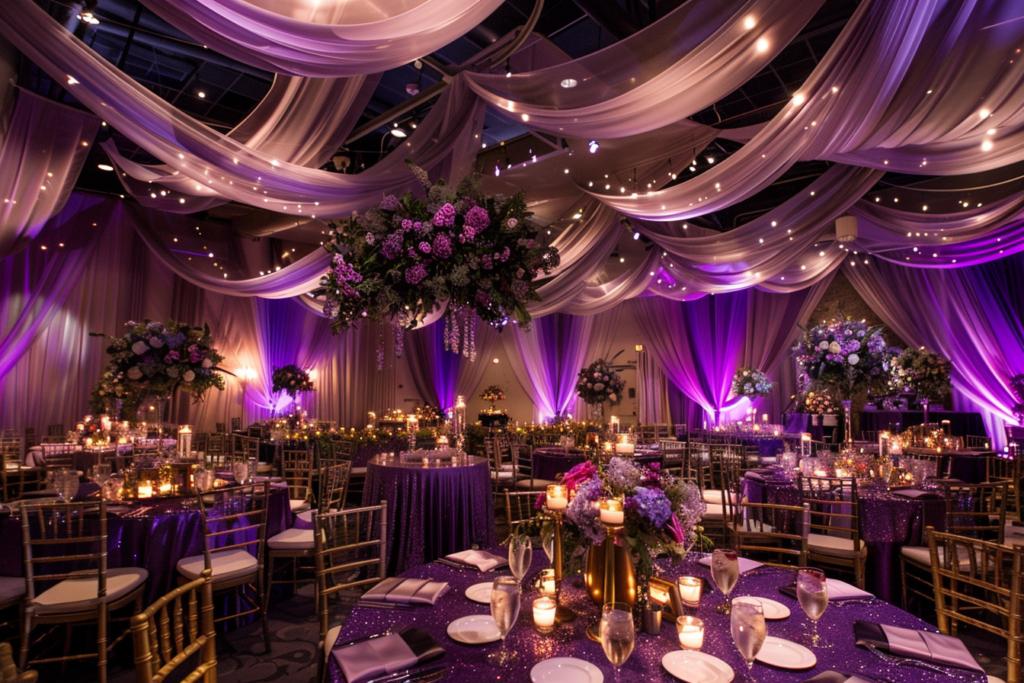
The Celestial Purple collection carries the purple galaxy aesthetic into stationery — deep amethyst and antique gold with nebula-quality illustration, completing the purple cosmic world in every printed element from invitation to place card.

2.5 The Winter Starry Night
The Winter Starry Night aesthetic is the most specific in its relationship to a particular quality of the actual night sky: the winter sky is, measurably and visibly, the clearest and the most densely starred of any season in the northern hemisphere, because the cold dry air of winter refracts less light than the humid air of summer, making the stars appear brighter, crisper, and more numerous than at any other time of year. The Winter Starry Night wedding celebrates this specific quality of the winter sky — its clarity, its coldness, its specific combination of spectacular starfield and biting darkness — and carries it into the aesthetic of the celebration.
The palette of the Winter Starry Night is the coolest of the five directions: midnight blue deepened toward true blue-black, with cool silver as the primary metallic rather than warm gold, and the specific crisp white of frost and snow as the neutral accent rather than the warm cream of the other starry night aesthetics. Ice silver, crystalline white, and the very pale blue of a clear winter midnight: these are the palette components that make the Winter Starry Night distinguishable from the Classic Starry Night even at first glance. The gold, when used, should be a slightly cooler gold — closer to champagne than to amber — so that it reads as starlight in a cold sky rather than as warmth in a dark one.
The decoration details most specific to the Winter Starry Night: frosted glass votives and candleholders (which scatter candlelight in a crystalline rather than a warm way, producing light that reads as cool and precise rather than warm and diffuse); silver and ice-blue ribbon and fabric elements alongside the midnight draping; white and pale blue floral elements (white anemone, white astrantia, pale blue delphinium, silver dusty miller, white freesia) as the dominant floral palette, with near-black or deep midnight blue accents; and, for outdoor winter ceremonies, the actual frost on the ground and the actual stars visible in the cold clear sky above — the decoration that winter itself provides at no cost and in no catalogue.
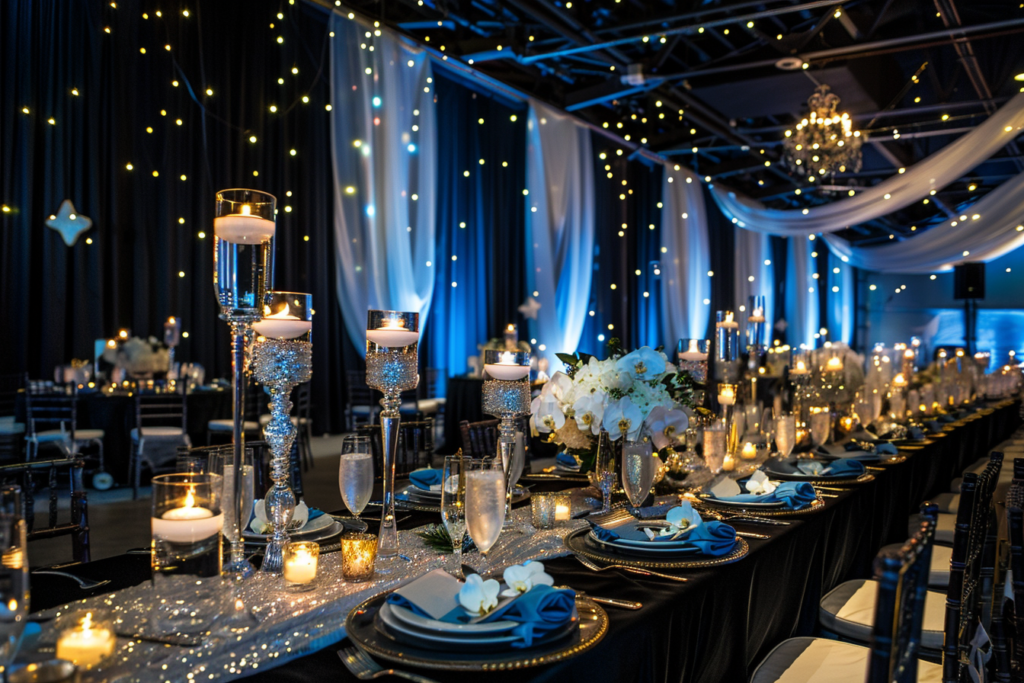
The Celestial Winter collection carries the winter starry night aesthetic into stationery — cool blue-silver and crisp midnight tones that match the Winter Starry Night’s specific palette of cold clarity and brilliant stars.
Section 03 Starry Night Wedding Color Palettes
Four palette directions covering the full range of the starry night wedding — from the warmly romantic to the dramatically cosmic to the crystalline cold.
Palette 01
Midnight Blue & Scattered Gold
Midnight Navy · Warm Antique Gold · Silver Stars · Deep Cream
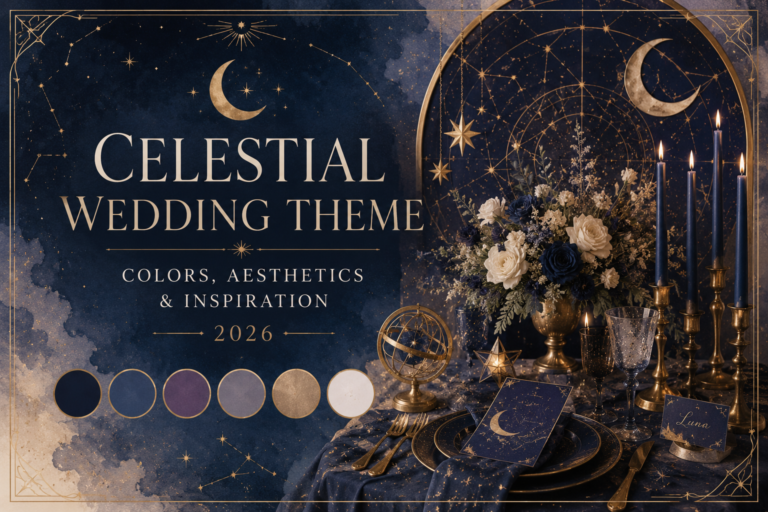
The most romantic and most consistently beautiful of the four palettes. Midnight navy as the sky colour, warm antique gold as the star scatter and constellation metallic, silver as the secondary starlight accent, and warm cream or ivory as the neutral base that prevents the palette from reading as cold. The most photographically reliable palette in low-light conditions and the most broadly beautiful across all wedding aesthetic preferences. For: Classic Starry Night and Constellation Wedding aesthetics.
Palette 02
Deep Black & Silver Stars
Near-Black · Cool Silver · Antique Gold · Midnight
The most dramatically atmospheric of the four. Near-black or deep charcoal as the complete base colour, cool silver as the primary star scatter, and warm antique gold as the secondary accent that prevents the palette from reading as cold. No warm cream, no softening neutral — this palette is committed to depth and requires disciplined lighting design to prevent it from reading as simply dark rather than specifically celestial. For: Dark Cosmic Night and Purple Galaxy Night aesthetics.
Palette 03
Purple Nebula & Antique Gold
Deep Amethyst · Midnight Purple · Warm Gold · Cool Silver
The most artistically distinctive of the four palettes — deep amethyst and midnight purple create the nebula base, with warm antique gold as the star scatter and cool silver as the edge-of-star accent. The temperature contrast between the warm gold and cool silver against the purple base is what produces the galaxy quality that defines the Purple Galaxy Night aesthetic. The specific amethyst should be a deep jewel tone (not a pale lavender) for the palette to read as cosmic rather than as purple wedding. For: Purple Galaxy Night aesthetic.
Palette 04
Winter Night & Ice Silver
Blue-Black · Ice Silver · Cool Champagne · Frost White
The coolest and most specifically seasonal of the four palettes — midnight deepened toward blue-black, cool silver as the primary metallic (not warm gold), frost white and crystalline cream as the neutral accent. The gold, when used, should be champagne rather than amber, so that it reads as starlight in a cold sky rather than as warmth in a dark one. The most appropriate palette for winter and early spring weddings, and the only direction in which cool silver is the dominant rather than secondary metallic. For: Winter Starry Night aesthetic.
Section 04 Creating the Starry Night Ceremony
Timing for Actual Star Visibility
For an outdoor starry night ceremony where the actual sky is the backdrop, the timing decision is the most important single planning decision of the entire event — more important than the venue choice, the decoration budget, or the guest list. The ceremony should be timed to begin at or after astronomical twilight, which is the specific moment when the sky is dark enough for the faintest stars to be visible to the naked eye. This moment varies significantly by season and location: in northern Europe in midsummer, astronomical twilight may not occur until after 11pm; in winter, it may arrive as early as 6pm. Checking the specific astronomical twilight time for the wedding date and location should be the first step in planning a genuine under-the-stars ceremony, and the ceremony timing should be built backward from this reference point rather than set first and checked against it afterward.
The quality of star visibility also depends on the moon phase: the full moon is so bright that it significantly reduces the visibility of fainter stars, while a new moon or a thin crescent leaves the sky at its darkest and most star-rich. Couples who want the maximum possible number of visible stars in the sky above their ceremony should check both the astronomical twilight time and the moon phase for their wedding date, and factor both into their timing and venue decisions. A clear-sky new moon evening in a dark sky location is the best possible condition for an under-the-stars ceremony and worth significant logistical effort to achieve.
Indoor Starry Night Creation
For indoor venues or venues without sky access, the ceiling is the entire creative challenge and the entire creative opportunity. The three most effective indoor starry night techniques, in order of visual authenticity: (1) Professional projection using a star field projector calibrated to show the actual night sky of the wedding date and location — the most authentic and the most adjustable, producing a genuine constellation map rather than a decorative star scatter, but requiring professional equipment and installation. (2) Pin-spot LED lights in a deep dark ceiling surface, calibrated to the density and distribution of a specific star field from a reference chart — the most permanent of the options and the most appropriate for a venue that will be used for the entire evening. (3) Fairy lights at star density sewn or clipped to deep midnight fabric ceiling draping — the most accessible and most cost-effective, producing a good approximation of the starry night when calibrated correctly (20% light, 80% darkness; warm temperature; irregular spacing from a constellation reference).
The galaxy drape backdrop for the ceremony space is the most immersive of the available options for the indoor starry night: a large section of deep midnight blue velvet or chiffon, draping from a high point behind the ceremony position, with fairy lights integrated directly into the fabric in the pattern of a chosen constellation. The fabric should move slightly during the ceremony — it should be hung with enough looseness to catch any air movement from doors or HVAC — because the movement of the fabric is what produces the swirling quality of the Van Gogh night sky aesthetic. A static drape reads as a backdrop; a moving drape reads as the actual sky.
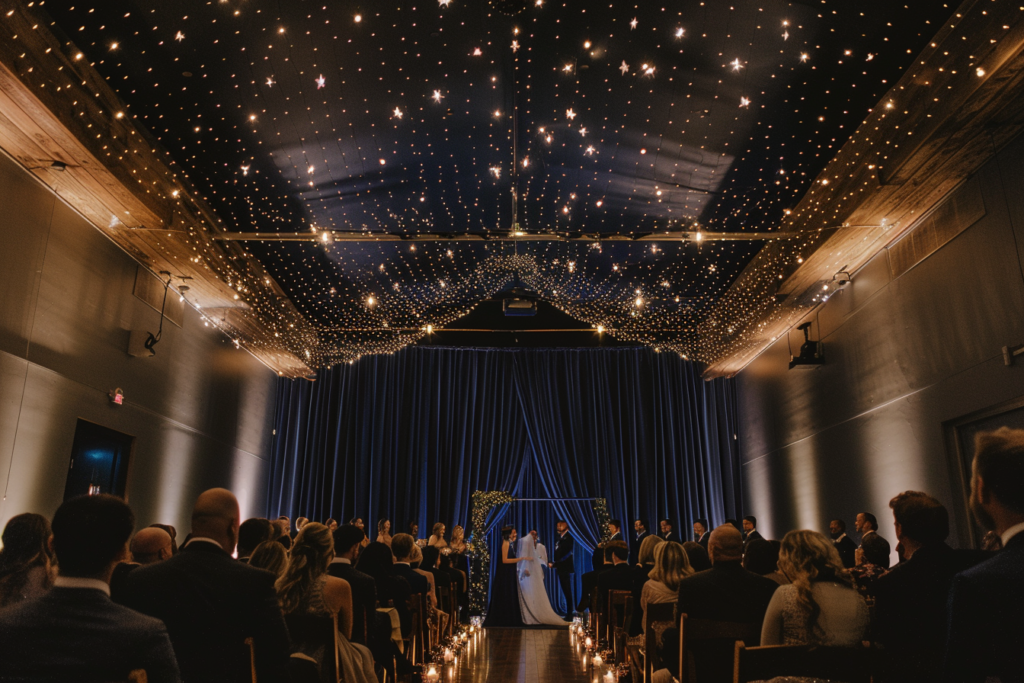
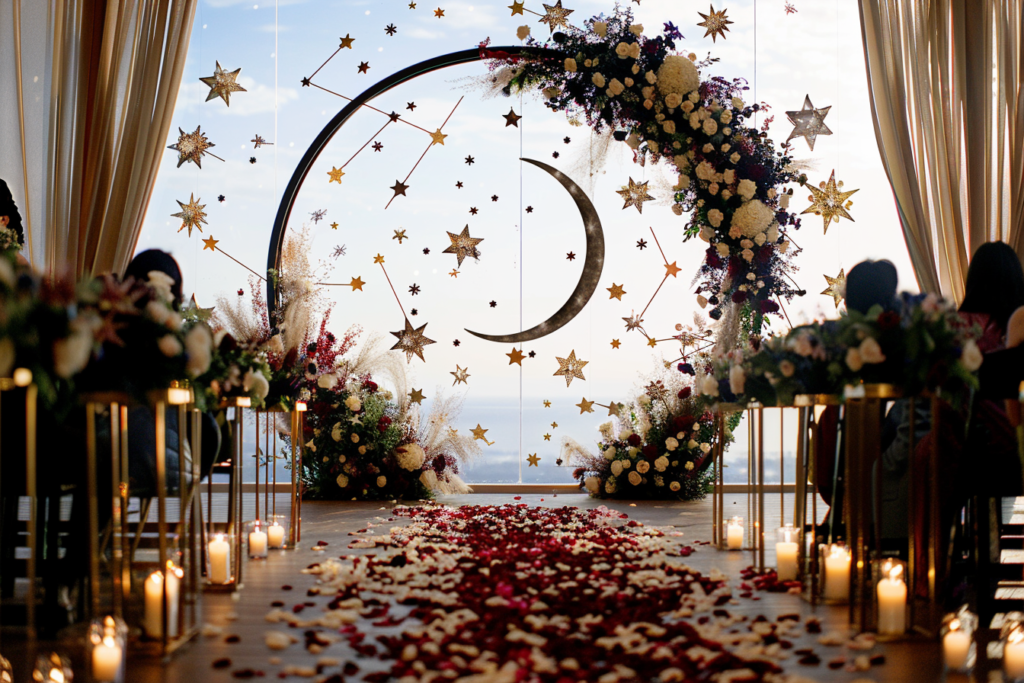
Ceremony Arch & Aisle for the Starry Night
The starry night ceremony arch should frame the sky rather than replace it — its most effective format is the circular moon arch (which creates a literal frame for the night sky or the starry night backdrop behind it), with the floral arrangement concentrated at the lower portion and the top portion left clear or very lightly dressed so that the sky (real or created) is visible through the circular frame. For the Constellation Wedding aesthetic, specific constellation wire forms in antique gold should be embedded in the floral material at the arch’s side panels — the specific constellation of the wedding date or the couple’s personal constellation, rendered in fine gold wire at the scale of a large hand.
The starry night aisle: star-scattered petal path using deep burgundy or midnight blue petals as the primary scatter and white or cream petals placed in the specific geometric pattern of a constellation along the centre of the path. Small lanterns or votives in blackened metal holders placed along the aisle at the positions of the brightest stars in that constellation pattern, so that the aisle is literally a constellation map that guests sit beside and the couple walks through. This is the most specifically celestial aisle format available — it requires a constellation chart reference for the setup but produces a result that reads as genuinely designed rather than as decoratively scattered.
The Mystical Black Gold Wedding collection brings the ceremony’s midnight palette into the program and invitation — the most dramatic and most specifically celestial stationery option for the starry night ceremony, designed to be held in guests’ hands at the very moment they are surrounded by the decorated night sky.

Section 05 Starry Night Wedding Reception
The reception is the peak moment of the starry night wedding — the ceremony is the declaration, but the reception is where guests spend the most time inside the created celestial world, and where the decoration has the most time to work its effect on everyone present. The starry night wedding reception should be designed to feel like the inside of the night sky rather than like a room decorated with night sky motifs, and this distinction comes from the layered quality of the decoration: the ceiling treatment first, the lighting design second, and the surface decoration third.
Table Styling for the Starry Night Reception
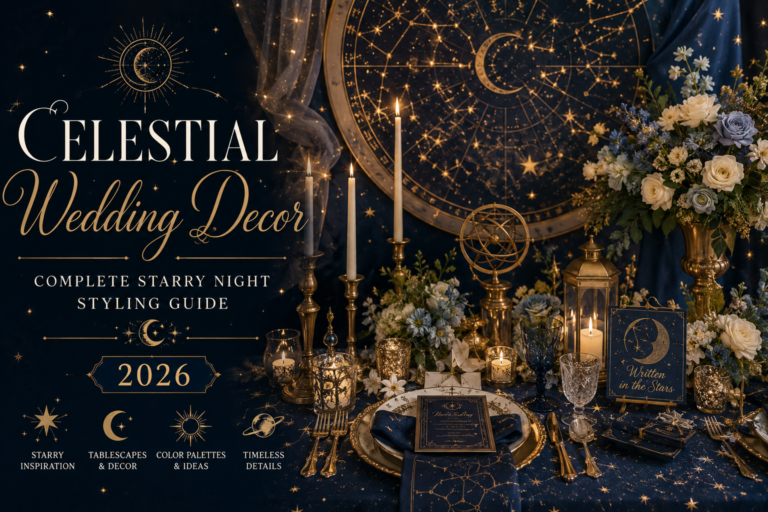
Galaxy tablecloths — dark linen with star scatter applied in a constellation pattern rather than a random scatter — are the foundation of the starry night reception table. The linen should be deep midnight navy or near-black, and the star scatter should be applied from a constellation reference so that each table carries a specific celestial identity rather than a generic decorative pattern. A table name card in the format of a mini star chart — the specific constellation the table is named after, with the guest list below it — connects the table’s visual identity to the seating plan in a way that makes the entire organisational structure of the reception feel as if it belongs to the same starry night world.
Moon phase candle holders — a series of votives or cylindrical candle vessels decorated with the progression of moon phases — should be placed on the table in the progression from new moon to full moon as a narrative structure that guests can read while seated. The progression should run from the guest’s left to their right (following the reading direction) so that it reads as a story across the table surface. The centrepiece should anchor this progression: a galaxy globe terrarium, a constellation candle arrangement, or a dark floral centrepiece in the starry night palette, lit from within or surrounded by sufficient candlelight to produce the luminous-against-dark quality that is the fundamental visual experience of the starry night aesthetic.
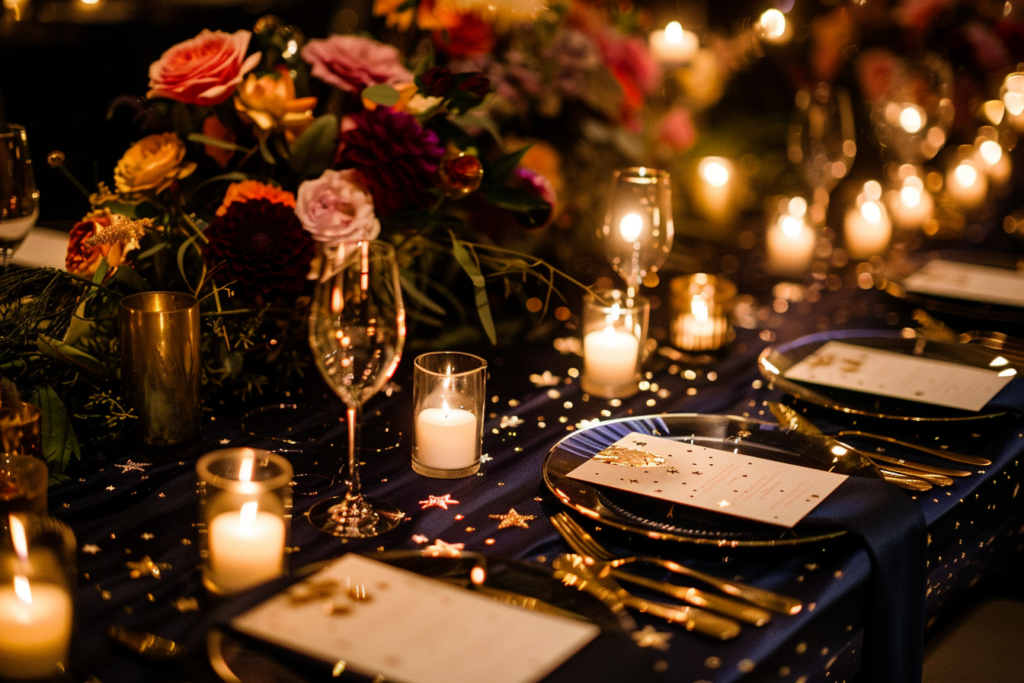
The Fairy Light Moment
The fairy light turn-on — the moment during the reception when the ambient overhead lighting dims and the fairy light starfield illuminates simultaneously — is one of the most photographed and most emotionally memorable moments of the starry night wedding reception. This moment should be planned and staged rather than allowed to happen organically: the timing (typically at dusk for outdoor venues, or at a specific planned moment for indoor venues), the music playing at the moment of the transition, and the camera position that captures the reaction of guests and the couple are all worth explicit advance planning. The best starry night wedding photograph is often taken at this specific moment — the room or the sky going from ambient light to starfield in a single transition, with guests’ faces turned upward and the couple looking at each other rather than at the sky.
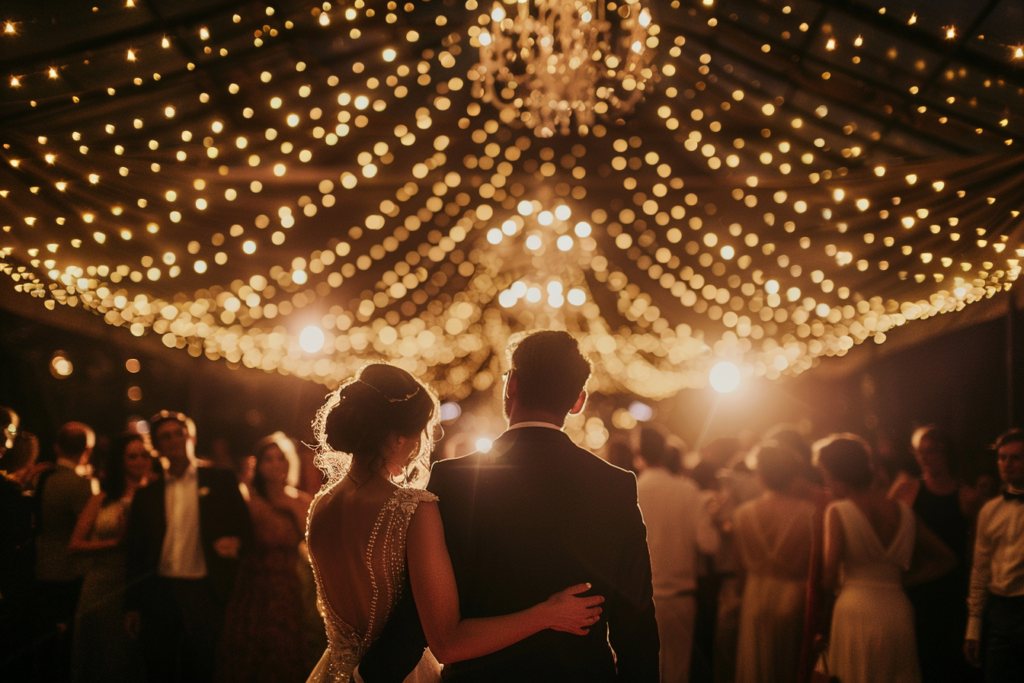
Section 06 Starry Night Wedding Photography
The starry night wedding creates the most beautiful photographic conditions of any wedding aesthetic — but only if the photography approach is calibrated for the specific challenges and opportunities the aesthetic presents. The fundamental challenge: the starry night aesthetic is defined by low-light conditions, which require different camera settings, different shooting approaches, and different post-processing decisions than daytime or conventionally lit wedding photography. Discussing the starry night aesthetic explicitly with the chosen photographer before the wedding — not just describing the decoration but explaining the specific visual experience the couple wants to capture — is the most important photography planning decision for this aesthetic.
Long exposure star photography: if the wedding includes outdoor time under an actual night sky, long exposure photography (exposures of 15–30 seconds or longer) can capture the stars themselves as visible points of light in the images. This requires a stationary camera (tripod), specific discussion with the photographer about exposure settings, and ideally a period of the evening when guests are in a different location so that the ceremony or reception space can be photographed without subject movement. A single long-exposure image of the ceremony space under a genuine starry sky, with the tent or arch and floral elements in the foreground and the actual Milky Way in the background, is among the most extraordinary wedding photographs available in any aesthetic.
The Detail Shots That Perform Best on Pinterest
The starry night wedding detail photograph — the close-up image of a single element that captures the aesthetic’s quality at the scale of an object rather than a room — is the photograph most frequently shared and most frequently saved on Pinterest from starry night weddings. The five detail shots that perform most consistently: (1) Stationery beside star scatter — the invitation suite placed on a surface with fine star scatter (gold glitter or iridescent micro-stars) around it, photographed from directly above with warm candlelight nearby. (2) Rings on a constellation map — the wedding rings placed on the specific constellation that represents the couple’s wedding date or personal significance, photographed in close-up. (3) The fairy light ceiling detail — the ceiling fabric and fairy light installation photographed from directly below, looking upward, with no other elements in the frame. (4) The centrepiece close-up — the galaxy globe or constellation candle arrangement photographed at close range with warm candlelight as the only light source. (5) The table as landscape — the full table photographed from slightly above and to the side, showing the full starry night table composition: dark linen, star scatter, centrepiece, stationery elements, candlelight.
The Mystical Black Gold Celestial collection produces the most Pinterest-performing stationery detail shot for the starry night wedding — the deep midnight invitation with warm gold constellation work, photographed beside star scatter and candlelight, is one of the most saved wedding photography images in the celestial category.

Section 07 Starry Night Wedding Stationery
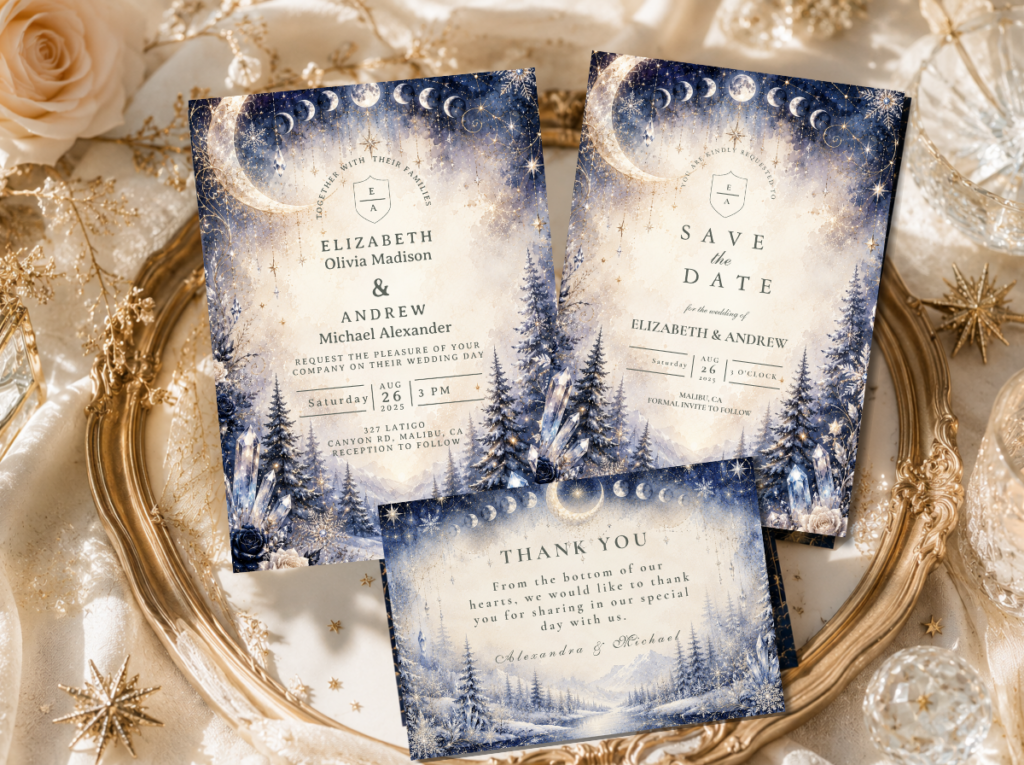
The starry night wedding invitation is the first piece of the night sky that guests receive — the first object in the physical world of the celebration that carries the aesthetic’s specific visual language, before any venue is entered, before any centrepiece is seen, before any fairy light turns on. For a starry night wedding more than any other aesthetic, the stationery creates the expectation and the standard for everything that follows: an invitation in deep midnight with warm gold constellation work sets a specific quality expectation that every subsequent decoration element will be measured against, consciously or not. An invitation that fails to carry the starry night aesthetic at full quality undermines the world that the decoration is building, even if the guests cannot articulate why.
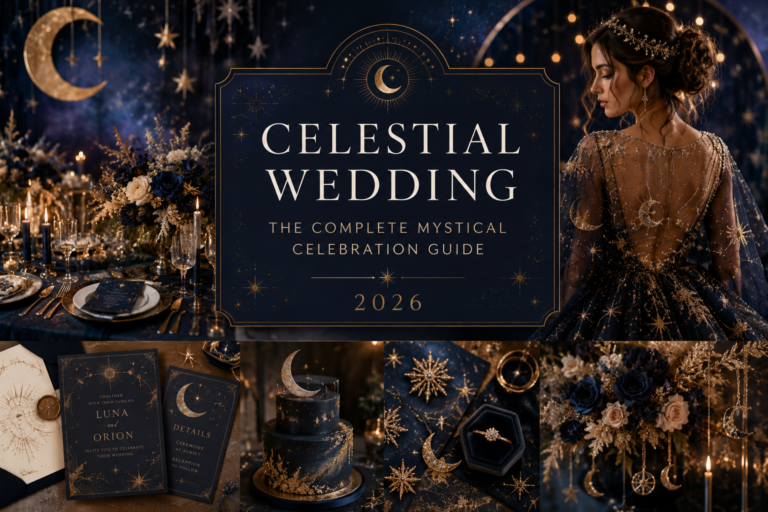
The constellation map invitation — an invitation designed with the actual star chart of the wedding date and location as its primary visual element, with the event details integrated into the map in the style of a historical celestial atlas annotation — is the most specifically starry night of all invitation formats available to this aesthetic. The map should show the actual sky configuration of the specific date and geographic location of the wedding: the stars as they appeared at the venue on the night of the wedding. This level of specificity transforms the invitation from a beautiful object into a personal record, which is the quality that most distinguishes a designed starry night wedding from one that simply uses a generic night sky palette.
The star scatter save-the-date is among the most shareable and most immediately understood elements of the starry night wedding aesthetic: a simple card on deep midnight or near-black stock with a fine gold star scatter on the front and the wedding date set within it in warm cream or pale gold typography. The gold star scatter should be placed from a constellation reference rather than scattered randomly — even in the simplest and most minimal format, the intentionality of a designed constellation reads as more beautiful than a random scatter at close examination. The back of the card, or the inside of an enclosure, can carry the full constellation map of the wedding night.
The photography connection between the stationery and the starry night decoration is the most important practical argument for investing in high-quality stationery for this specific aesthetic: the stationery is the decoration element that photographs most consistently beautifully as a detail shot, and the detail photograph of midnight invitation beside star scatter beside wedding rings is among the most saved images on Pinterest in the entire celestial wedding category. A stationery suite that has been designed with the same intention, the same palette calibration, and the same illustration quality as the rest of the wedding decoration produces detail photographs that are genuinely extraordinary — and that continue to be saved, shared, and used as inspiration for other couples long after the wedding itself is over.
Frequently Asked Questions
What is a starry night wedding theme?
A starry night wedding theme uses the actual experience of the night sky — the depth, the scattered starlight, the specific quality of darkness that makes individual lights so luminous — as its primary aesthetic inspiration and, ideally, as its actual venue. The five aesthetic directions in this guide range from the most classically romantic (Classic Starry Night: midnight blue, warm gold constellation detail, fairy lights at star density) to the most dramatically atmospheric (Dark Cosmic Night: near-black, antique gold, maximum depth and minimum ambient light), from the most personally specific (Constellation Wedding: named constellations used as primary visual motifs, the star map of the wedding night as the seating chart) to the most artistically distinctive (Purple Galaxy Night: nebula-inspired amethyst and gold) and the most seasonally specific (Winter Starry Night: cool silver, frost white, the clarity of winter sky). What all five directions share is the aspiration to make guests feel as if they are inside the night sky rather than inside a decorated room.
How do I have a wedding under the stars?
A genuine under-the-stars wedding requires three things: a venue with sky access (outdoor ceremony space, glass conservatory, open-sided tent, or rooftop), a ceremony timed after astronomical twilight (the specific moment when the sky is dark enough for stars to be visible, which varies by season and latitude — check astronomical data for the specific date and location), and a moon phase that does not wash out the starfield (new moon or very thin crescent provides the darkest sky; full moon reduces star visibility significantly). Dark sky venues — places with minimal light pollution where the Milky Way is visible — are the ideal category for an under-the-stars wedding. For indoor venues without sky access, the three most effective indoor starry night techniques are professional star field projection, pin-spot LED lights calibrated to an actual star chart, and fairy lights at star density (20% light, 80% darkness) on deep midnight ceiling draping. The lighting design is always the most consequential decoration decision for the starry night wedding — more important than any other single element.
What is a constellation wedding?
A constellation wedding uses the actual geometric patterns of specific, named constellations as the primary visual motif rather than a generic star scatter — it is the most personally specific of the five starry night aesthetics, because it builds every visual element around constellations that have personal meaning for the couple. The couple’s birth constellations, the constellation visible above the venue on the wedding night, the constellation that was overhead when they first met or were engaged: any of these can serve as the central motif, carried through the invitation (as a specific constellation map rather than a generic night sky), the seating chart (each table named for and illustrated with its assigned constellation), the aisle decoration (lanterns placed at the star positions of a chosen constellation), and the centrepiece wire work (specific constellation forms in fine gold wire embedded in the floral arrangement). The Cosmic Vintage Constellation stationery collection is the most specifically appropriate for the Constellation Wedding because it brings the precision and historical quality of real celestial cartography into every printed element.
What stationery works for a starry night wedding?
The starry night wedding stationery should function as the first piece of the night sky that guests receive — carrying the specific palette, the specific illustration quality, and the specific celestial motif vocabulary of the aesthetic in its most portable and most personal form. The most effective starry night stationery options are: the constellation map invitation (the actual star chart of the wedding night, with event details integrated as atlas annotations); the deep midnight invitation with warm gold constellation piping (the most broadly beautiful and most photographically effective format); and the star scatter save-the-date (deep midnight stock with gold star scatter placed from a constellation reference). The six collections in the showcase above cover every starry night aesthetic direction — Classic, Dark Cosmic, Constellation, Purple Galaxy, and Winter Night — each calibrated to the specific palette temperature of its direction. Choose the collection that matches the specific aesthetic direction planned for the wedding, and use the suite’s illustration quality and palette as the reference for every subsequent decoration decision: the tablecloth linen, the centrepiece vessel colour, the ceiling draping tone, and the flatware metallic should all be calibrated against the stationery suite to ensure the entire visual world of the starry night wedding reads as a single, complete, designed thing.
Begin with the First Star
Find the Stationery That Holds Your Night Sky
The invitation is the first piece of the starry night that guests hold in their hands — choose the collection that carries the same sky as the decoration, and let the printed night set the expectation for everything that follows.