Sun and Moon Wedding
Celestial Wedding · 2026
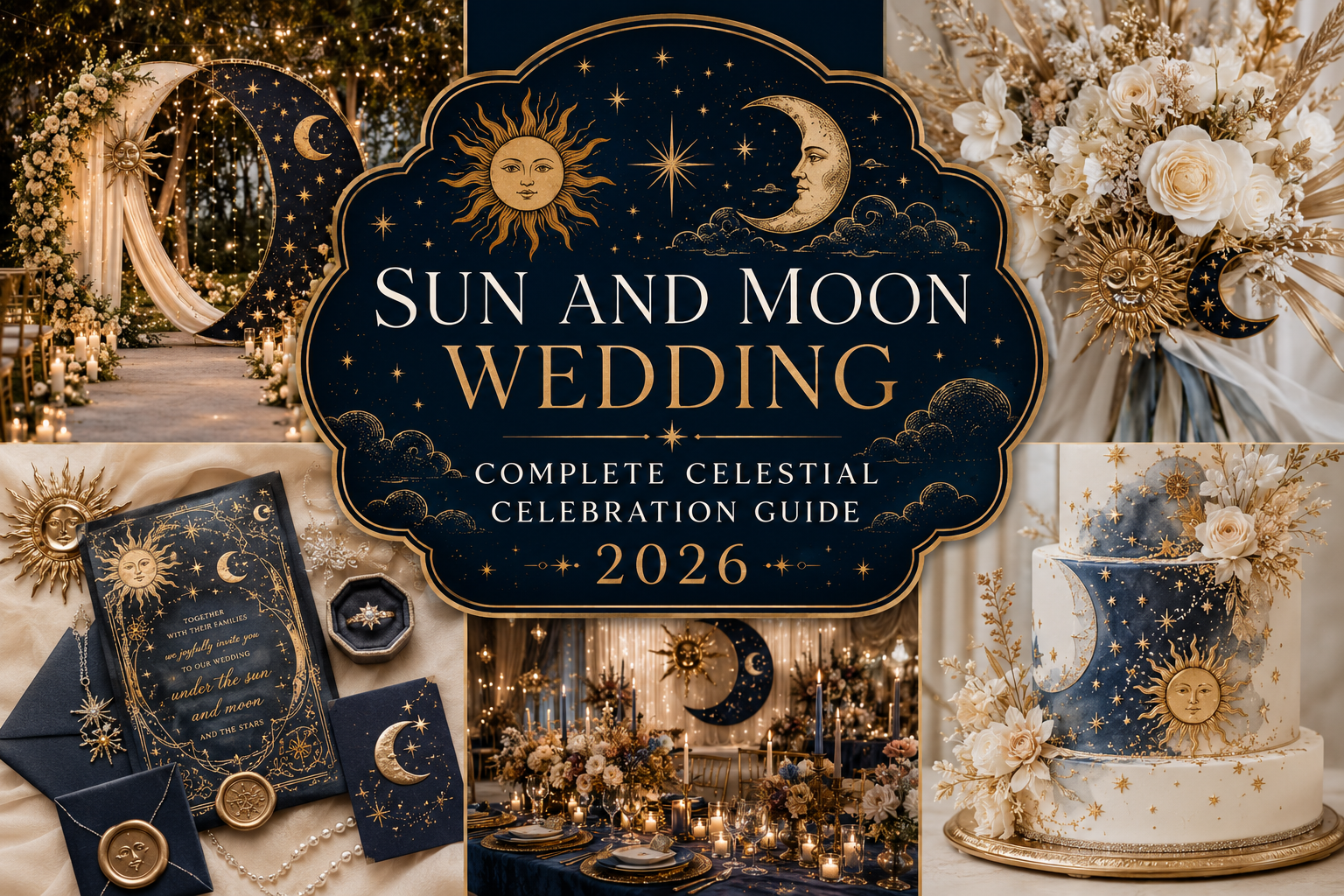
Sun and Moon Wedding — Complete Celestial Celebration Guide 2026
Four sun and moon aesthetics, the palettes that carry the duality, ceremony and reception design, florals for each side of the sky, and the stationery that begins the symbolism before the day arrives.
The sun and moon have been the most universal symbols of complementary love across every culture that has ever had a mythology — the two great lights of the sky, each complete in itself, each defining the other, meeting at the edge of every dawn and every dusk in the specific moment that is neither fully one nor fully the other. A sun and moon wedding uses this ancient symbolism not as decoration but as structure: the sun and moon are the two people, the wedding is the eclipse, and every design decision follows from this understanding of what the day actually means.
This guide covers four sun and moon wedding aesthetics in full, with their specific palette directions, ceremony and reception design, the florals for each celestial body, and the stationery that carries the duality from the first invitation through every printed detail of the day.

“In every culture that has ever named the sun and the moon, they have been understood as the two great complementary forces of the sky — one burning and certain, one cool and changing. The wedding is the moment they share the same horizon.”
Section 01 The Sun & Moon Wedding Aesthetic
The sun and moon wedding aesthetic is distinct from the broader celestial wedding in one specific and important way: it has a structure that the general celestial aesthetic does not. Where a celestial wedding takes the night sky as its inspiration in a general sense — stars, constellations, the overall atmosphere of the cosmos — a sun and moon wedding takes two specific celestial bodies and uses the duality between them as the organising principle of the entire celebration. Every design decision is informed by this duality: warm gold for the sun, cool silver or pale cream for the moon; active and radiant elements for the solar aesthetic, reflective and changing elements for the lunar one; the ceremony as the moment of alignment between the two.
The symbolism resonates as a wedding theme with such consistency across cultures and across history because it maps so naturally onto what a wedding actually is: the union of two distinct and complementary forces into a single celebration. It is not a coincidence that virtually every culture with a sun and moon mythology has understood these bodies as paired rather than as separate — the Egyptian Ra and Khonsu, the Japanese Amaterasu and Tsukuyomi, the Aztec Tonatiuh and Metztli, the Greco-Roman Apollo and Artemis/Diana: in each tradition, the sun and moon are not independent bodies but a relationship, defined by their difference and by their dependence on each other for meaning. A sun and moon wedding borrows this structural depth whether the couple is aware of the specific mythological tradition or not, because the symbolism is so deeply embedded in human visual culture that it communicates without explanation.
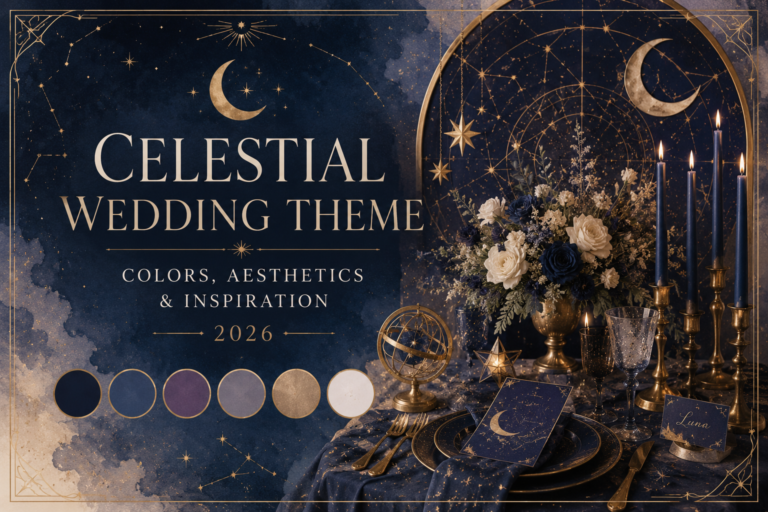
The palette challenge of the sun and moon wedding is the only genuinely difficult design decision the aesthetic presents: balancing the warmth of the gold sun palette with the cool quality of the silver moon palette without allowing either to dominate or to compromise the other. The most successful sun and moon weddings achieve this balance by assigning each palette temperature to a specific design layer rather than blending them throughout: warm gold as the primary metallic (the sun) and cool silver or pale cream as the accent (the moon), on a base that reads as the sky at the transitional hour — neither fully warm nor fully cool, but the specific quality of the sky at dawn or dusk when both the sun and the moon are briefly visible simultaneously.

Section 02 Four Sun & Moon Wedding Aesthetics
Four distinct registers of the sun and moon wedding — each with its own palette temperature, material vocabulary, and emotional quality. Choose the one that most closely matches the couple’s own visual sensibility.
2.1 The Classic Sun & Moon
The Classic Sun and Moon aesthetic is the most immediately recognisable of the four directions — it uses the solar and lunar symbols in their most direct and most broadly understood form: the sun as a disc with radiating rays in warm gold, the moon as a crescent in cool silver or pale cream, balanced against each other across the designed surfaces of the wedding with a deliberate symmetry that references the actual visual relationship between the two celestial bodies in the sky. The palette is the most straightforwardly balanced of the four: warm antique gold as the primary metallic, cool silver as the secondary, and a warm ivory or pale gold as the neutral base that holds both metallics without favouring either.
The visual quality that distinguishes the Classic Sun and Moon from a generic celestial decoration is the intentionality of the duality — every element comes in both a sun version and a moon version, or carries both symbols simultaneously in a composition that reads as a relationship rather than as a list. A place card with a sun on one side and a moon on the other; a ceremony program with the sun symbol at the header and the moon symbol at the footer; a centrepiece arrangement with warm gold dahlias on one side and cool white roses on the other; a two-tier wedding cake with the sun face on the front tier and the moon face on the back: these are the specific design decisions that make the Classic Sun and Moon aesthetic function as a coherent visual argument about duality rather than as celestial decoration with two motifs.
The Classic Sun and Moon works at every formality level — from the most formal traditional wedding (where the gold and silver duality provides the metallic language of formal occasions while carrying a personal symbolic layer) to the most casual celebration (where the sun and moon symbols read as warm and personal rather than as formal). It is the most broadly accessible of the four aesthetics and the most likely to be understood and appreciated by guests across every aesthetic preference — because the sun and moon are among the most universally recognisable and universally beloved symbols in human visual culture.
The Celestial Gold collection and Mystical Black Gold Celestial suite together carry both sides of the Classic Sun and Moon aesthetic into stationery — warm gold sun tones in the Celestial Gold collection and the deeper gold-on-midnight quality of the Mystical Black Gold for the more dramatic moments of the day.

2.2 The Vintage Celestial Duality
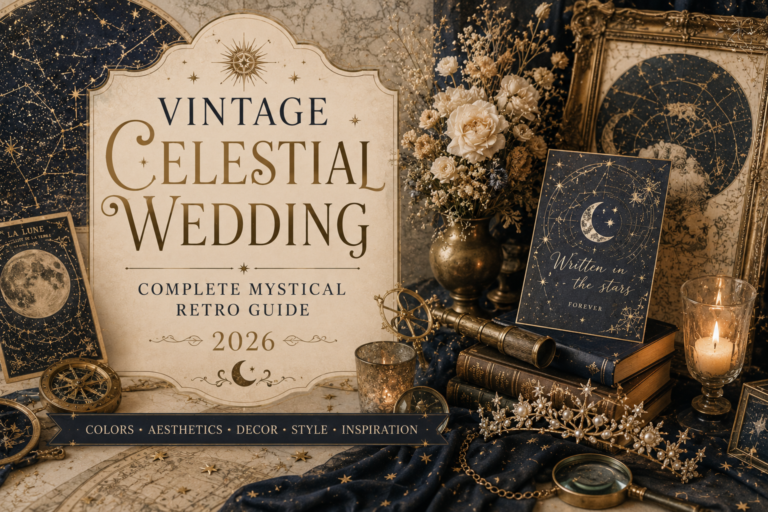
The Vintage Celestial Duality aesthetic takes the sun and moon symbolism into the register of historical and alchemical imagery — the tradition in which the sun (Sol) and moon (Luna) were understood not only as astronomical bodies but as the foundational symbols of all complementary principles: masculine and feminine, gold and silver, active and receptive, known and mysterious. The alchemical tradition, in particular, represented the sun as gold (the most precious metal, incorruptible and permanent) and the moon as silver (the most reflective metal, changeable and mysterious), and a sun and moon wedding in the vintage duality register draws on this specific symbolic richness rather than on the more familiar decorative celestial vocabulary.
The palette of the Vintage Celestial Duality is the warmest of the four directions: aged parchment as the neutral base, burnished antique gold as the solar metallic, and aged or dulled silver (not bright modern silver but the specific grey-silver of old silverware or antique coin) as the lunar metallic. The visual sources are Renaissance alchemical manuscripts, medieval celestial diagrams, antique cosmological prints — the kind of objects in which the sun and moon appear not as decorative motifs but as the fundamental structural symbols of a complete system of understanding about how the world is organised. A Vintage Celestial Duality wedding looks like a celebration designed by someone who owns old books about the history of knowledge, and who finds in the sun and moon not just beautiful symbols but specifically meaningful ones.
The specific details that most effectively communicate the Vintage Celestial Duality: alchemical sun and moon symbols (the circle with a dot for the sun, the crescent for the moon) as repeated motifs throughout all printed elements; stationery on aged parchment or warm ivory stock; aged brass for all metallic decor elements; a ceremony program or menu card printed to read as an alchemical diagram as well as a functional wedding document; and the specific combination of deep blue-black ink and antique gold that characterises historical alchemical printing, applied to every surface from the invitation envelope to the wedding cake.
The Vintage Celestial Renaissance collection and Cosmic Vintage Constellation suite carry the alchemical sun and moon aesthetic into stationery — aged parchment tones, burnished antique gold, and the historical celestial illustration quality that gives the Vintage Celestial Duality its specific intellectual authority.

2.3 The Boho Sun & Moon
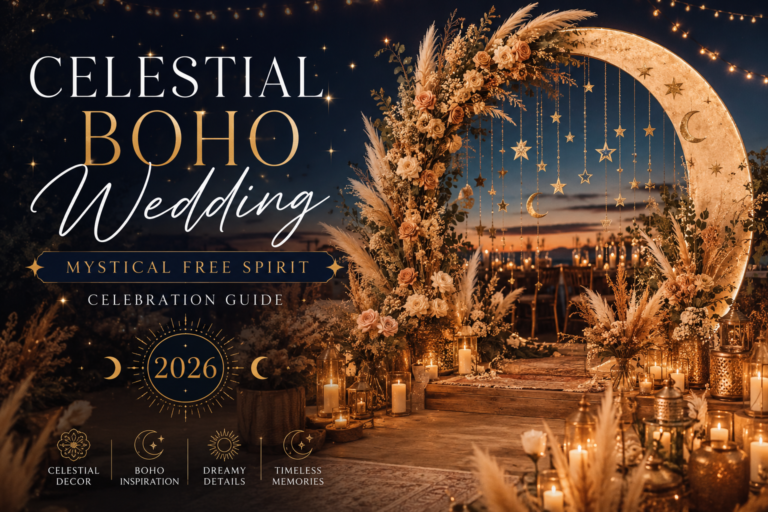
The Boho Sun and Moon aesthetic is the most free-spirited and the most organically personal of the four directions — it brings the ancient duality symbolism of the sun and moon into the earthy, textured, natural-material world of the boho aesthetic, producing a combination that feels simultaneously deeply traditional (the symbolism is as old as human civilisation) and entirely contemporary (the visual execution is relaxed, personal, and organic rather than formal or composed). The palette: warm rust and terracotta for the solar side, deep indigo and night blue for the lunar side, with antique gold connecting the two and a warm parchment or undyed linen as the base that holds the warmth of both tones.
The Boho Sun and Moon aesthetic is where pampas grass becomes the solar plume (its warm golden-cream tone and the radiant spread of its head read as sun-like when arranged at height) and dried lunaria seed pods become the lunar botanical (their translucent silver-cream discs are named for the moon and read as genuinely lunar when arranged in the cooler parts of the centrepiece or arch). The moon phase element is most naturally present in the boho direction — a moon phase garland of successive crescent-to-full forms in aged gold wire or antique brass above the ceremony arch, or a progression of moon phase candle holders along the aisle — because the organic, handmade quality of these elements suits the boho material vocabulary better than it suits the more graphic quality of the classic or vintage directions.
The Boho Sun and Moon aesthetic is the direction most suited to outdoor and semi-outdoor celebrations — the warmth of the palette (rust, terracotta, deep indigo) reads as grounded in the natural world in a way that the other three directions do not, and the sun and moon symbolism feels genuinely appropriate in an outdoor setting where both bodies are actually present in the sky above the ceremony. A boho sun and moon wedding under the actual stars, with the actual moon visible above the pampas arch and the actual sun still warm on the horizon: this is the moment where the aesthetic and the reality are the same thing, and the symbolism is not borrowed but directly present.
The Celestial Boho collection brings the earthy cosmic duality into stationery — organic celestial motifs in warm rust and indigo tones, with brushed gold sun and moon detail that carries the boho aesthetic’s organic quality into every printed element.

2.4 The Botanical Sun & Moon
The Botanical Sun and Moon aesthetic is the most visually complex and the most Art Nouveau-adjacent of the four directions — it brings the sun and moon into dialogue with the botanical world in the specific visual tradition where flowers and celestial bodies are understood as belonging to the same organic system rather than as separate categories of nature. In Art Nouveau illustration, the sun is not a disc with rays but a sphere of light around which petals and vines spiral; the moon is not a crescent but the illuminated edge of a leaf form; and the border between the garden and the sky dissolves into a single continuous pattern of growing things reaching toward light. The Botanical Sun and Moon aesthetic applies this visual logic to the wedding’s decorative surfaces.
The palette of the Botanical Sun and Moon introduces the coolest tones of the four directions: deep teal and midnight blue alongside the warm gold of the solar aesthetic, with a cool moonlit cream rather than a warm ivory as the base. The botanical elements are chosen for their specific connection to the sun or moon: sunflowers, calendula, marigold, and golden rod for the solar side; moonflower, white cosmos, white jasmine, and night-blooming cereus for the lunar side. The Art Nouveau line-work quality — sinuous, flowing, organic, combining botanical and celestial forms in the same continuous curve — is the specific visual register that defines this direction and separates it from a simple floral-and-celestial combination.
The Botanical Sun and Moon is the direction most appropriate for couples who love botanical illustration, who find beauty in the specific forms of flowers and plants rather than in flowers as generic decoration, and who want their wedding to read as genuinely artistic rather than thematically decorated. It is also the direction most specifically suited to venues with botanical or garden qualities — a Victorian glasshouse, a botanical garden, a walled garden with a glass ceiling — where the organic celestial aesthetic of the decoration is contextually appropriate to the organic natural environment of the space.
The Celestial Art Nouveau Blue Gold suite and Celestial Floral collection bring the botanical sun and moon aesthetic into stationery — flowing organic line-work combining botanical and celestial forms in deep teal and warm gold, exactly the Art Nouveau quality the Botanical Sun and Moon aesthetic requires.

Section 03 Sun & Moon Wedding Color Palettes
Four named palette directions — each balanced to carry the specific duality of sun and moon. The temperature relationship between the solar and lunar tones is the most consequential palette decision in a sun and moon wedding.
Palette 01
Gold Sun & Silver Moon
Warm Antique Gold · Cool Silver · Warm Ivory · Near-White
The most classic and most balanced sun and moon palette. Warm antique gold carries the solar quality; cool silver or very pale grey carries the lunar quality; warm ivory is the neutral that holds both without favouring either. The most versatile palette across all formality levels and all venue types. The gold must be warm (yellow-amber undertone) and the silver must be slightly cool (blue-grey undertone) for the temperature duality to read correctly.
Palette 02
Warm Amber & Midnight Blue
Deep Amber · Midnight Navy · Warm Gold · Silver Stars
The most dramatically beautiful of the four palettes — the deep amber of the sunset sun meeting the midnight blue of the moonlit sky at the specific moment of their coexistence. This palette places the two bodies at the transitional hour and gives the wedding the quality of a permanent dusk or dawn. The amber should be warm and rich (not orange); the midnight navy should be deep and cool (not slate or grey-blue). The most appropriate for evening ceremonies and candlelit receptions.
Palette 03
Vintage Gold & Aged Ivory
Burnished Gold · Aged Ivory · Deep Sepia · Antique Silver
The warmest of the four palettes — aged parchment as the base, burnished antique gold as the solar metallic, and aged or dulled silver as the lunar metallic. The most historically grounded direction, associated with alchemical and Renaissance celestial imagery. The vintage palette reads as the most romantic and most specifically literary of the four — the palette of someone who finds the sun and moon beautiful because of their history as much as their appearance.
Palette 04
Earthy Rust & Deep Indigo
Warm Rust · Deep Indigo · Antique Gold · Parchment
The most organic and earthy of the four — the solar side in warm rust and terracotta, the lunar side in deep indigo and midnight blue, with antique gold as the connecting metallic and parchment as the warm neutral base. The palette of the Boho Sun and Moon direction, most suited to outdoor and natural settings where the warmth of the earth tones reads as contextually appropriate. The most gender-neutral of the four palettes and the most accessible for couples who want the symbolism without the formality.
Section 04 Sun & Moon Ceremony Design
The Ceremony Arch
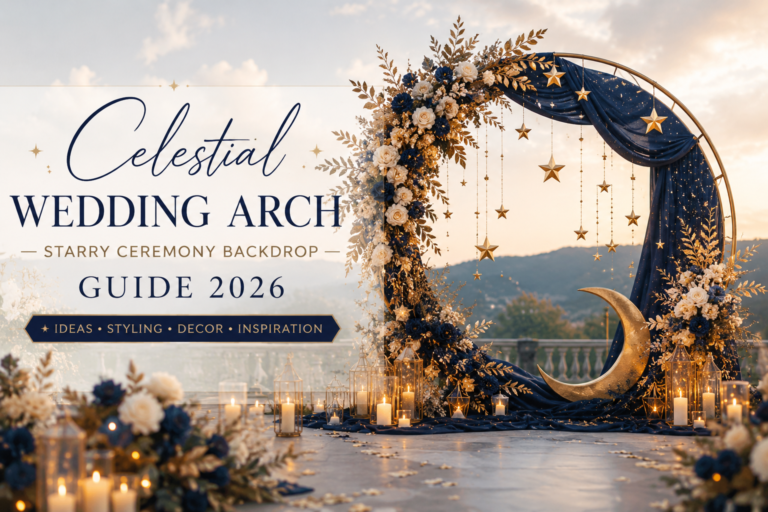
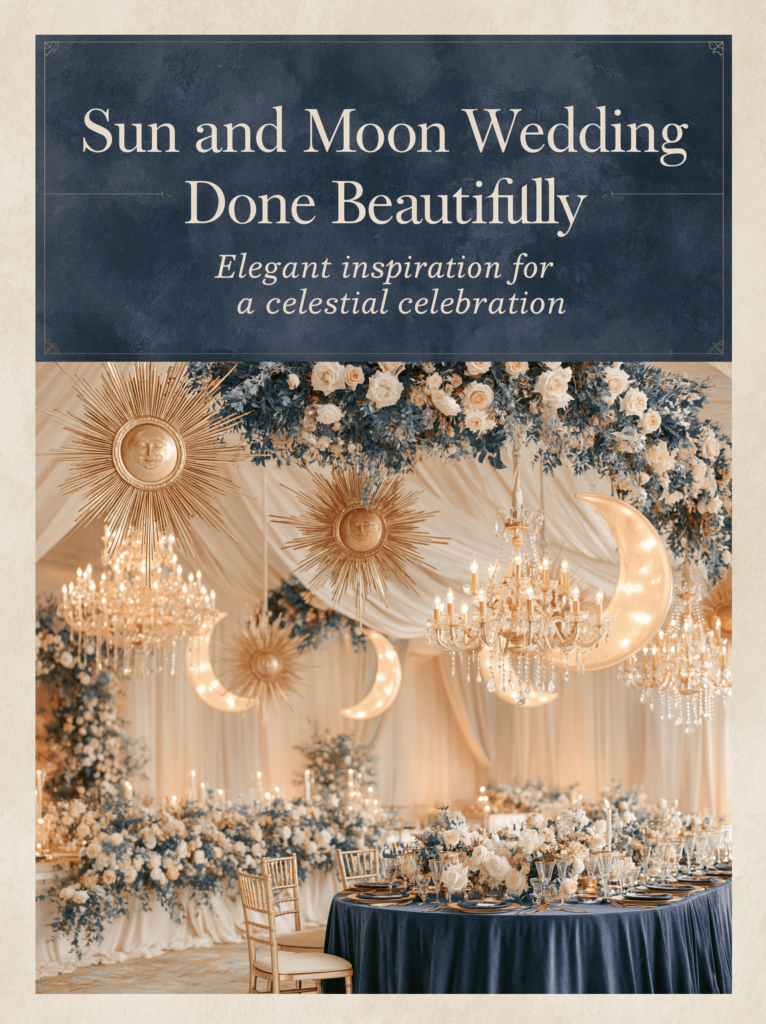
The ceremony arch for a sun and moon wedding should express the duality in its structure — not as two arches side by side, but as a single arch that carries both celestial bodies simultaneously. The most successful format: a circular moon arch in blackened or antique gold metal, with the sun disc element positioned at the top of the circle (as if the sun is rising through the moon’s frame) and the floral arrangement divided asymmetrically — warm-toned florals (golden dahlias, amber ranunculus, warm roses) on one side representing the solar element, and cool-toned florals (white anemones, silver dusty miller, pale cosmos, white garden roses) on the other side representing the lunar element. The two sides meet at the top of the arch in a single mixed arrangement that reads as the moment of their overlap — the eclipse, the alignment, the wedding.
The specific sun and moon arch motifs that work most effectively as architectural elements: a large sun disc in hammered antique gold positioned at the apex of the arch, from which rays extend inward toward the ceremony space (the sun as the light of the celebration); a crescent moon in antique silver or aged brass positioned at a lower point on the arch opposite the sun disc, curved to cradle the ceremony space (the moon as the protective and witnessing element). These two elements together, in the same arch, reproduce the specific celestial relationship that the wedding is invoking.
Aisle Styling
Alternating sun and moon lanterns along the aisle — solar lanterns in warm gold glass or amber-toned glass alternating with lunar lanterns in pale silver glass or near-white frosted glass — create the most direct and most visually clear expression of the sun and moon duality in the ceremony space. The alternating pattern should not be perfectly uniform (which reads as a pattern rather than as a relationship); instead, the lanterns should be placed in groups of three or five, with the solar and lunar lanterns at slightly different heights within each group, so that the alternating quality reads as dynamic rather than mechanical.
Sun and moon petal scatter: warm golden and apricot petals (from marigold, calendula, or warm dahlia) scattered on the solar side of the aisle, and white and pale cream petals (from white rose, white anemone, or white cosmos) scattered on the lunar side, meeting at the centre of the aisle in a mixed zone that reads as the alignment of the two. Guests seated on each side of the aisle are subtly positioned as witnesses to the solar or lunar half of the celestial duality, which gives the traditional ‘bride’s side and groom’s side’ arrangement a specific and beautiful symbolic meaning.
Vow Exchange: The Sun and Moon Unity Element
The unity ceremony — the moment during the vow exchange in which the couple performs a symbolic act of joining — has a specific and beautiful form available to the sun and moon wedding that no other celestial aesthetic provides: the solar and lunar candle or liquid element. In the unity candle version, the couple lights two candles (one in warm gold or amber, one in cool silver or pale cream — the sun and the moon candles) and uses both to light a single central candle together — the eclipse candle, which should be a large pillar in warm ivory that, when lit, appears to glow with both the warmth of the sun and the coolness of the moon simultaneously. In the sand or liquid version, warm golden sand or liquid and cool silver or pale blue sand or liquid are poured simultaneously into a single vessel, creating a swirled pattern that shows both elements without fully merging them — the specific image of a permanent eclipse.
The ceremony program for a sun and moon wedding is the most symbolically rich of all the printed celestial wedding elements — because it can carry the sun and moon duality in its own design while also fulfilling its functional role as a ceremony guide. A program with the sun symbol and the solar palette on the front cover and the moon symbol and the lunar palette on the back; the order of service as a journey from sunrise (the opening of the ceremony) to moonrise (the pronouncement and first kiss); the couple’s names written within the sun and moon symbols respectively: this is the program that transforms a functional document into a designed artefact of the celebration’s specific meaning.
The Vintage Celestial Renaissance collection produces the most beautiful ceremony program for a sun and moon wedding — the sun and moon symbols rendered in the quality of historical celestial illustration, on parchment-toned stock, with the specific antique gold that makes every printed element feel like a genuine artefact of the day.
Section 05 Sun & Moon Reception Styling
Table Styling & Centrepieces
The sun and moon reception table works most effectively when the duality is expressed at the table level rather than across the room — so that each table contains both the solar and lunar elements in visible balance, rather than half the tables being solar-themed and half lunar-themed. The most elegant format: a centrepiece arrangement with warm-toned florals (golden dahlias, amber ranunculus, warm sunflowers in small cultivars) on one side of the vessel and cool-toned florals (white anemones, pale cosmos, silver dusty miller, white garden roses) on the other, with the centre of the arrangement mixing both in a zone that reads as the alignment point. The sun element is heavier and more open at the solar side; the moon element is more delicate and more reflective (silver dusty miller, translucent lunaria pods) at the lunar side.
The table linen should carry the sun and moon duality in a more subtle way than the centrepiece: a warm ivory or parchment tablecloth with a warm gold table runner on the solar side and a cool silver or pale grey satin runner on the lunar side, meeting at the centre of the table in a crossing pattern. The place settings can alternate — a solar place setting (warm gold charger, amber or warm cream napkin) and a lunar place setting (cool silver or white charger, pale cream or cool grey napkin) — so that each pair of guests at the table has one solar and one lunar place, which is both visually interesting and symbolically resonant in the context of a wedding about duality.
Celestial Duality Seating Chart
The sun and moon seating chart provides one of the most specifically beautiful format options available in the celestial wedding category: a dual-panel seating chart in which all the solar tables (named for sun-related things: Sol, Dawn, Solstice, Apollo, Ra, Sunrise) are listed on the warm-toned left panel with warm gold typography on an amber or parchment background, and all the lunar tables (named for moon-related things: Luna, Crescent, Selene, Lunaria, Moonrise, Dusk) are listed on the cool-toned right panel with silver or pale cream typography on a midnight or deep blue-grey background. The two panels are displayed side by side, creating a seating chart that is also a visual representation of the sun and moon duality — and that immediately communicates to every arriving guest whether they are a solar or a lunar guest, which is a categorisation that guests find genuinely delightful rather than arbitrary.
Sun & Moon Wedding Cake
The sun and moon wedding cake is the centrepiece decoration of the reception table and the most photographed single object of the day. The most coherent sun and moon cake design for this aesthetic: a two or three tier cake with the sun face motif on the front of the lower tier (in warm antique gold fondant or gold leaf application, in the specific circular-with-rays form of historical celestial illustration) and the moon face motif on the front of the upper tier (in pale cream or very light silver, in the crescent or full-face form of the same illustration tradition). A third tier can carry both symbols in a composition that reads as their union — a celestial eclipse, the golden sun partially obscuring the silver moon, or the moon’s silver crescent resting within the sun’s golden rays. The flavour should match the palette: dark chocolate and amber caramel for the solar tier, earl grey and elderflower for the lunar tier.
Section 06 Sun & Moon Wedding Florals
The floral palette for a sun and moon wedding is one of the most specifically structured of all wedding floral vocabularies, because the flowers are not chosen simply for their beauty or their palette compatibility but for their specific connection to the solar or lunar world. Each flower is a solar flower or a lunar flower — either by colour (warm golden and amber tones for the sun, cool white and silver for the moon), by name (marigold is from Mary’s gold, a solar flower in the religious tradition; cosmos is named for the universe; lunaria is named for the moon), or by behaviour (sunflowers are heliotropic, following the sun; moonflowers open only at night).
Solar Flowers
Sunflowers in their smaller cultivars (the large commercial sunflower reads as a garden or countryside flower rather than a wedding flower; the smaller lemon queen or teddy bear sunflower reads as a deliberately chosen floral element with the same visual quality); marigold and calendula in warm orange-gold (the most specifically solar of all common flowers, associated with the sun in every culture that has cultivated them); golden ranunculus (whose multiple-layer petal structure reads as radiant when fully open, like the sun’s rays in miniature); amber or golden dahlia in medium and large varieties; golden rod as a filler element in warm yellow-gold; dried wheat and dried corn flowers as the harvest element that connects the sun to its terrestrial meaning as the source of all warmth and growth.
Lunar Flowers
White anemone with dark centres (whose visual quality — white glow against dark centre — directly references the experience of seeing the moon against the night sky); white cosmos (celestially named, star-form, and delicate — the lunar flower most directly connected to the celestial vocabulary); silver dusty miller foliage (whose pale silver-grey surface reads as moonlit at close range and provides the cool metallic accent of the lunar palette); white garden roses fully open (the fullness of the open rose as a reference to the full moon); dried silver lunaria seed pods (named for the moon, translucent and silver-white, the most specifically lunar botanical element available); and white or very pale lavender pampas grass as the flowing lunar element that catches and reflects light in the specific way the moon’s surface does.
Combining Solar and Lunar Florals
The most successful sun and moon floral arrangements keep the solar and lunar florals in visible tension rather than fully blending them — the arrangement should read as a conversation between two distinct palettes rather than as a single mixed palette. The specific technique: the warm tones at the lower and outer edges of the arrangement (the sun below and around), the cool tones at the upper and central elements (the moon above and within), and the mixing zone at the mid-point of the arrangement where the two meet in a narrow band of transitional elements — warm cream, pale gold, very light ivory — that bridges the two without dissolving either. This is the arrangement as eclipse: the two bodies in proximity, each retaining its own character, but touching at their edges in a specific and significant way.
Section 07 Sun & Moon Wedding Stationery
The sun and moon wedding invitation is the first physical expression of the celebration’s duality — the first object in which the two celestial bodies appear together, each with their own visual language, in the same printed piece. For a sun and moon wedding, the invitation is not merely the functional announcement of date and venue; it is the first symbolic statement of what the day means. When the sun and moon symbols on the invitation carry the same specific quality as the rest of the wedding’s visual language — the same illustration style, the same palette temperature, the same relationship between the warm gold sun and the cool silver moon — guests receive the full meaning of the celebration before they attend it.
The duality in stationery design: the most complete sun and moon stationery suite carries the two celestial bodies in a balanced relationship across every element, with neither dominating. An invitation that places the sun symbol in the upper left corner in warm gold and the moon symbol in the lower right corner in cool silver, with the couple’s names positioned between them in the specific space where the two symbols’ implied territories overlap — this is the invitation that communicates the wedding’s meaning in visual as well as typographic terms. The envelope liner carries the same compositional logic: the solar palette on one panel, the lunar palette on the other, meeting at the fold.
The specific stationery elements that carry the sun and moon duality most powerfully: the ceremony program (where the entire ceremony can be structured around the solar-to-lunar journey, with the program’s visual design tracking the progression from sunrise to moonrise); the place card (where each guest’s name sits beneath their personal celestial body symbol — the guest’s sun sign or moon sign, or simply the sun or moon symbol chosen for aesthetic reasons); and the menu card, which can carry both symbols in its header and list the dishes in a progression that references the warmth of the solar courses and the coolness or delicacy of the lunar ones — not literally but in the spirit of designing every element of the day as part of the same symbolic world.
Browse all six collections below before making a stationery selection — each represents a distinct register of the sun and moon aesthetic, from the warmly luminous to the historically grounded to the organically botanical. The right collection is the one whose illustration quality and palette temperature most closely matches the specific sun and moon aesthetic direction the couple has chosen: the Classic Sun and Moon requires the warmest and most balanced collection; the Vintage Duality requires the most historically specific; the Boho Sun and Moon requires the most organic; and the Botanical direction requires the most Art Nouveau in line quality. The stationery chosen first sets the palette reference for every subsequent decoration decision — which makes it the most consequential single design choice in the entire sun and moon wedding.
Classic Duality
Celestial Gold
Warm sun and moon gold — the stationery for Classic Sun & Moon and Golden palette directions.
Starry Night
Celestial Starry Nights
Midnight blue and warm gold — for the dramatic Amber & Midnight palette and the most atmospheric sun and moon table.
Vintage Duality
Vintage Celestial Renaissance
Parchment and antique gold — the most historically specific stationery for the Vintage Celestial Duality aesthetic.
Alchemical Suite
Cosmic Vintage Constellation
Warm sepia and antique gold — the alchemical celestial suite for the most intellectually grounded sun and moon aesthetic.
Earthy Cosmic
Celestial Boho
Organic celestial motifs in warm rust and indigo — the stationery for the Boho Sun & Moon aesthetic.
Art Nouveau
Celestial Art Nouveau Blue Gold
Botanical-celestial line-work — the most artistically sophisticated suite for the Botanical Sun & Moon direction.
Frequently Asked Questions
What is a sun and moon wedding theme?
A sun and moon wedding theme uses the duality of the sun and moon as the organising symbolic principle of the entire celebration — not as decoration but as structure. The sun and moon are understood as two complementary celestial forces whose alignment (the eclipse) is the metaphor for the wedding itself: two distinct beings, each complete in themselves, briefly and permanently united. The visual expression of this theme balances warm solar tones (gold, amber, warm cream) with cool lunar tones (silver, pale cream, moonlit white), and carries both symbols — the sun disc with rays and the crescent or full moon — through every decorated surface of the day. The four aesthetic directions in this guide (Classic, Vintage Duality, Boho, Botanical) each express the same symbolism in a different visual register, from the most formally balanced to the most organically earthy.
What colors work for a sun and moon wedding?
Four named palette directions cover the full range of the sun and moon aesthetic: Gold Sun and Silver Moon (the most classic and balanced — warm antique gold, cool silver, warm ivory base); Warm Amber and Midnight Blue (the most dramatically beautiful — deep amber meeting midnight navy at the transitional hour of dusk or dawn); Vintage Gold and Aged Ivory (the warmest and most historically grounded — burnished antique gold, aged parchment, dulled antique silver); and Earthy Rust and Deep Indigo (the most organic and gender-neutral — warm rust and terracotta meeting deep indigo and midnight, connected by antique gold). The critical palette decision across all four directions is the temperature relationship between the solar and lunar metallics: warm antique gold for the sun, and either cool silver or pale aged silver for the moon, so that the temperature duality between the two bodies is visible in the metallic choices.
What flowers work for a sun and moon wedding?
The flower palette for a sun and moon wedding is divided between solar flowers (chosen for their warm tones, sun association, or heliotropic behaviour) and lunar flowers (chosen for their cool tones, lunar association, or nocturnal behaviour). Solar flowers: small cultivar sunflowers, marigold, calendula, golden ranunculus, amber dahlia, golden rod, dried wheat. Lunar flowers: white anemone with dark centre, white cosmos, silver dusty miller, white garden roses, dried silver lunaria seed pods, white or very pale lavender pampas. The most effective sun and moon arrangements keep the solar and lunar florals in visible tension rather than blending them — the warm-toned flowers on one side of the arrangement, the cool-toned flowers on the other, meeting in a narrow transitional zone at the centre. This is the arrangement as eclipse: the two bodies in proximity, each retaining its own character, but touching at their edges.
What stationery works for a sun and moon wedding?
The sun and moon wedding invitation should be the first physical expression of the celebration’s duality — carrying both celestial bodies in a balanced visual relationship, with the sun symbol in warm antique gold and the moon symbol in cool silver or pale cream, and the couple’s names positioned between them in the overlapping zone. The most effective stationery suites for the sun and moon wedding are those that carry the duality throughout: solar and lunar elements balanced on the invitation, the ceremony program structured as a journey from sunrise to moonrise, place cards with each guest’s sun or moon symbol, and menu cards that carry both symbols in the header. The six collections in the stationery showcase above cover every aesthetic register of the sun and moon wedding, from the warmly luminous Celestial Gold collection (most suited to the Classic and Vintage directions) to the organic Celestial Boho collection (most suited to the Boho direction) to the Art Nouveau Celestial collection (most suited to the Botanical direction). Choose the collection that matches the specific palette direction and illustration register of the sun and moon aesthetic chosen for the wedding, and let it set every subsequent decoration decision.
Begin with the Stationery
Find the Collection That Carries Your Sun & Moon Duality
The invitation is the first moment the sun and moon appear together — choose the collection that holds both in the right balance, and let every subsequent decision follow from that first alignment.