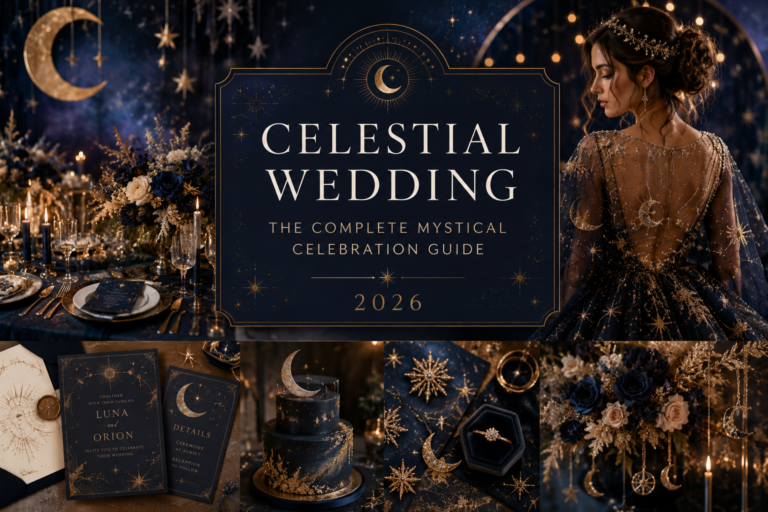
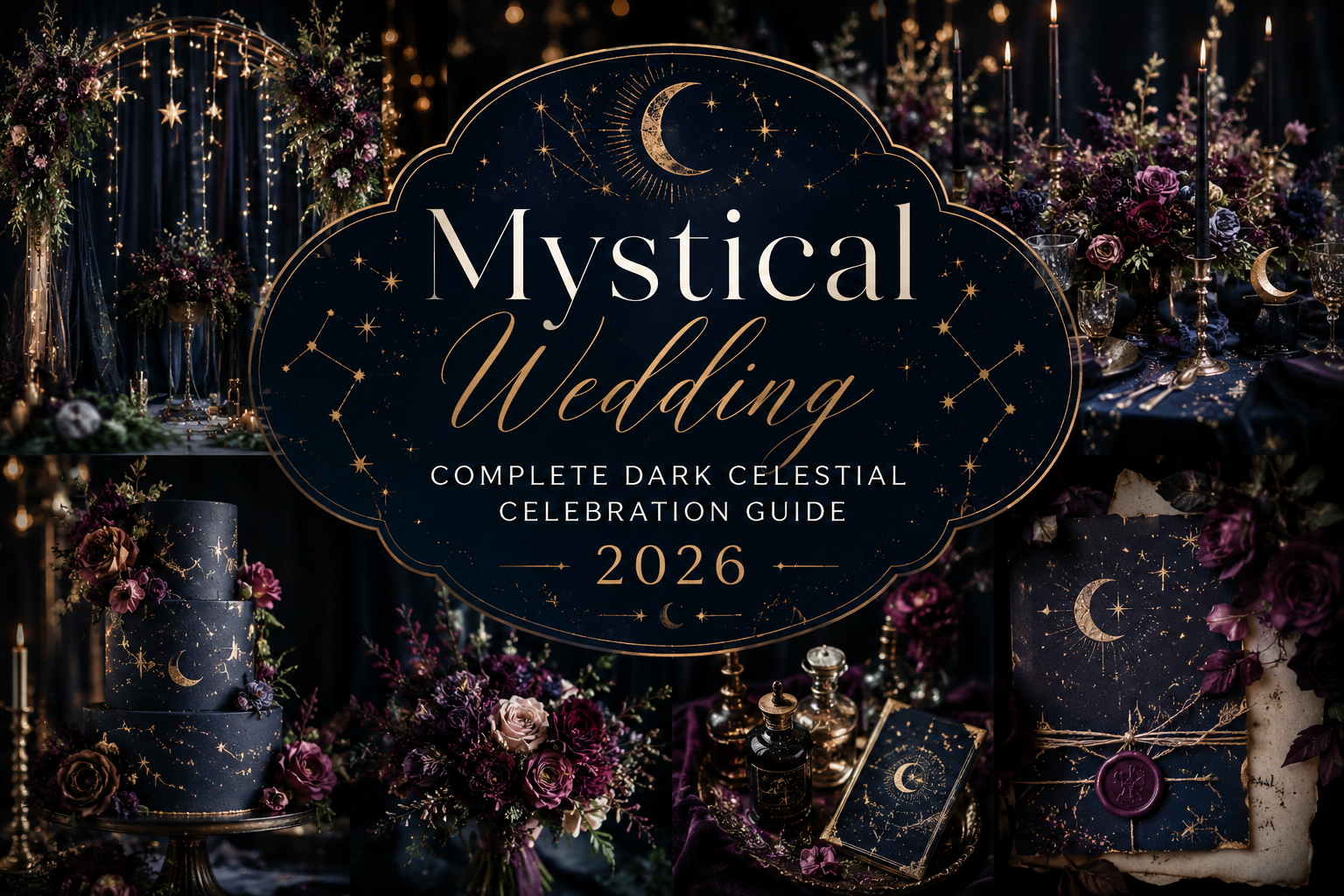
Mystical Wedding — Complete Dark Celestial Celebration Guide 2026
Celestial Wedding · 2026
Mystical Wedding — Complete Dark Celestial Celebration Guide 2026
Five mystical aesthetics, four atmospheric palettes, venues and ceremonies for the ancient and the otherworldly, and the stationery that makes the first impression feel like a ritual object.
The mystical wedding aesthetic is the most atmospherically powerful of all the dark wedding directions — because it reaches beyond visual style into the specific quality of emotional experience that the word “mystical” actually describes: the sensation of being present at something that feels larger and older than the occasion itself, in a space where the ordinary has been temporarily suspended and replaced by something ancient, ceremonial, and genuinely significant. The mystical wedding is for the couple who wants their celebration to feel as if it belongs to a different order of reality from a conventional wedding — not because they want to make a statement but because they find this quality of atmosphere genuinely more romantic than any alternative.
This guide covers five distinct mystical wedding aesthetics and what distinguishes each one, four atmospheric colour palettes, the venues and ceremony details most appropriate to the mystical aesthetic, decoration and fashion guidance, and the stationery that makes every printed element feel like it belongs to a deliberate, ancient, and deeply considered celebration.

“Every wedding is a ritual — a moment set apart from ordinary time in which two people make a declaration before witnesses under the open sky. The mystical wedding simply acknowledges this quality directly rather than covering it with convention.”
Section 01 What Is a Mystical Wedding?
A mystical wedding is not a witchcraft-themed event, not a Halloween-adjacent gothic party, and not a celebration in which the couple is claiming any specific spiritual tradition. It is a wedding that deliberately cultivates the quality of atmosphere that the word ‘mystical’ actually describes: the quality of being present at something that feels ancient, ceremonial, and larger than the immediate occasion — the specific emotional experience of standing in a space where the ordinary has been suspended and something older and more significant has been allowed in. Every wedding has this quality in potential; the mystical wedding makes it the explicit and central design ambition.
The distinction between mystical, gothic, and celestial is important to understand before choosing the direction. Gothic emphasises darkness as aesthetic: architectural shadows, dramatic contrasts, the beauty of decay and mortality. Celestial emphasises the cosmos as inspiration: the night sky, the stars, the scale of the universe as a romantic backdrop. Mystical sits at the intersection of both and extends beyond either: it emphasises the experience of ceremony itself as a form of magic — the specific quality of a moment set apart from ordinary time, conducted in a space that communicates the significance of what is happening through every design decision simultaneously. A mystical wedding can be celestially inspired (and the celestial aesthetics in this guide are among the most natural expressions of the mystical), or architecturally gothic, or botanically ancient, or intellectually dark-academic — what makes it mystical rather than simply dark or simply celestial is the quality of atmosphere it achieves.
The visual language that most reliably produces the mystical quality: deep darkness used not as background but as substance (the darkness itself as a presence rather than an absence); gold as the only source of warm light within that darkness (candlelight, gold metallic detail, warm star scatter); ancient and learned motifs rather than contemporary decorative ones (constellation maps, alchemical symbols, botanical arcana, historical astronomical illustration); the specific quality of ritual objects — things that have been chosen for meaning as well as beauty, arranged with intention rather than abundance. The whimsigoth aesthetic, which has been growing consistently as a named aesthetic category since 2023, is perhaps the most accurate contemporary label for the mystical wedding in its most broadly accessible form: it combines the darkness and ancient symbolism of the gothic tradition with the warmth, romance, and cosmic quality of the celestial aesthetic, producing something that reads as deeply atmospheric without being alienating.
The tarot aesthetic — the visual language of ornate illustrated frames, arcane symbolic imagery, rich jewel tones, and ceremonial gold detail — is a natural reference for mystical wedding aesthetics because it draws from the same tradition of beautiful, intentional, symbolically loaded visual art that makes mystical aesthetics distinctive. A mystical wedding that uses tarot-inspired table numbers (each table named for a major arcana figure, with its associated symbolism incorporated into the card design) or tarot-inspired escort cards is using the aesthetic language of the tarot tradition rather than claiming any relationship with divination practice — the same distinction that applies to the entire mystical wedding aesthetic: the symbolism is used as beautiful and meaningful visual language, not as literal ritual claim.
Section 02 Five Mystical Wedding Aesthetics
Five distinct expressions of the mystical wedding aesthetic — each with a different visual emphasis, a different emotional register, and a different stationery direction. Find the one that most closely matches the specific quality of atmosphere the couple wants to create.
2.1 The Dark Celestial Mystical
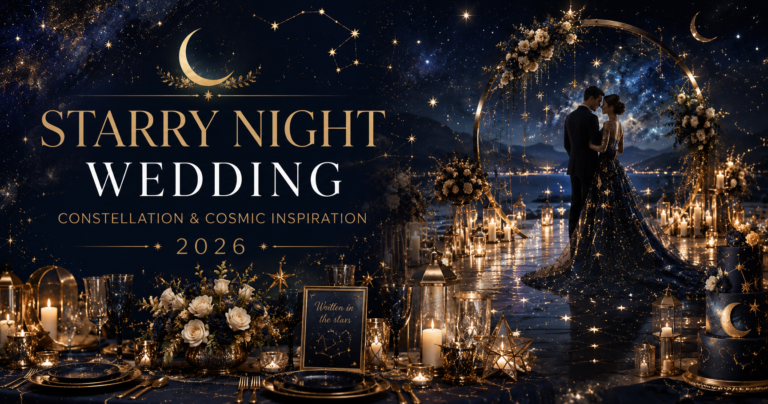
The Dark Celestial Mystical is the most natural convergence of the celestial and mystical aesthetics — it uses the cosmos as its primary symbol of the ancient and the vast, and places the wedding ceremony within the framework of the night sky as the oldest and most universal context for human ritual. This is the mystical aesthetic most closely connected to the experience of looking up at the stars and feeling the specific combination of smallness and significance that the night sky has always produced — the experience that every human culture has interpreted as the presence of something larger than individual human experience, whether understood in spiritual, philosophical, or purely experiential terms.
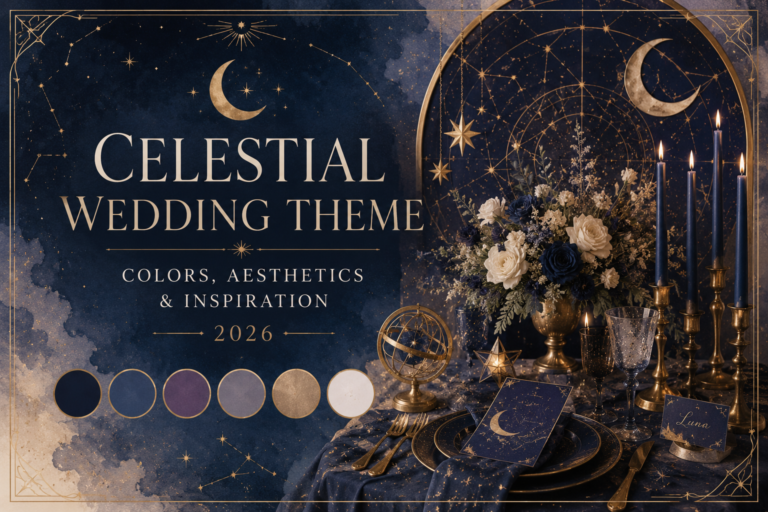
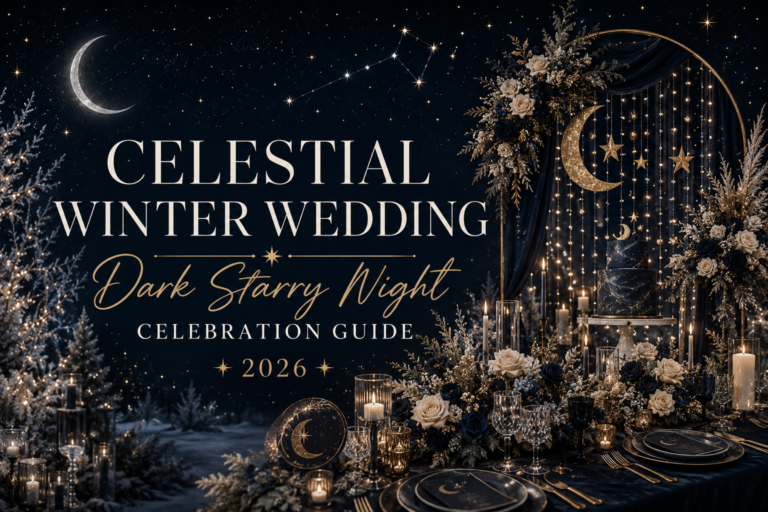
The visual vocabulary of the Dark Celestial Mystical is the most recognisable of the five directions: midnight navy or near-black base, warm antique gold as the only metallic accent, constellation and moon motifs rendered in historical illustration quality rather than in contemporary graphic design style, and the quality of darkness as a positive presence rather than a mere absence of light. The specific details that make the Dark Celestial Mystical feel genuinely mystical rather than simply dark and beautiful: candles as the dominant light source, positioned in significant groupings (in the pattern of a specific constellation, at specific ritual numbers — three, five, seven, thirteen) rather than as scattered decoration; altar-quality botanical arrangements that feel chosen and assembled rather than designed and purchased; and the quality of intentionality throughout every element, so that the decoration reads as having been composed by someone who knows what they believe rather than by someone following a trend.
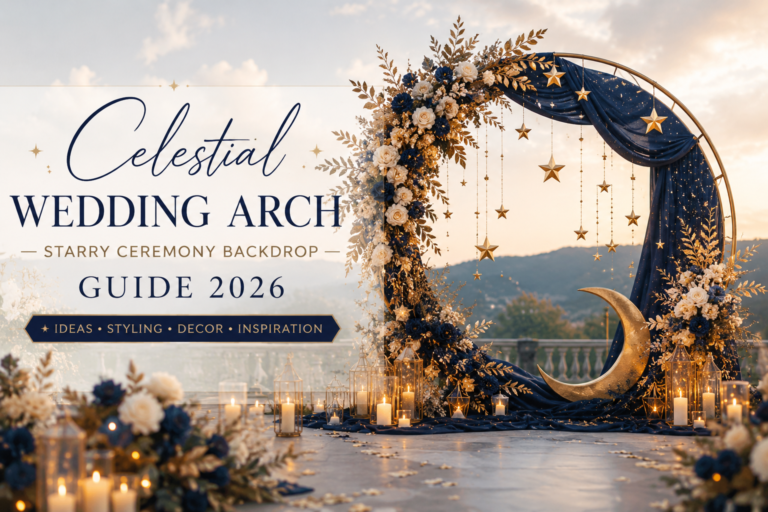
The ceremony arch for the Dark Celestial Mystical: a circular form (the most ancient ceremonial shape, referencing the full moon, the cosmic cycle, and the symbol of unity that the ring itself invokes) in blackened metal, with deep botanical elements that read as gathered rather than purchased — dark ferns, deep burgundy roses, dried silver lunaria — and a single large crescent moon or constellation wire form positioned at the apex. The aisle in candles, placed in the pattern of a specific constellation. The officiant positioned under the arch at the specific moment the first star becomes visible. These are the ceremony details that produce the Dark Celestial Mystical atmosphere at its most genuinely powerful.
The Celestial Dark collection and Mystical Black Gold Celestial suite carry the Dark Celestial Mystical into stationery — near-black and warm antique gold at maximum atmospheric quality, so that every printed element feels as intentional and as specifically beautiful as the rest of the mystical ceremony design.
2.2 The Whimsigoth Mystical
The Whimsigoth Mystical is the aesthetic that has grown most rapidly on Pinterest and in wedding photography in 2025–2026 — it represents the convergence of the gothic visual tradition (deep tones, mystical symbolism, architectural drama) with a warmer, more romantically optimistic sensibility that prevents it from reading as purely dark or purely serious. The name captures the quality precisely: whimsical in its warmth, colour, and the sense that this celebration is genuinely joyful; gothic in its atmosphere, symbolism, and its comfortable relationship with darkness. The night court wedding aesthetic — which has grown from the visual vocabulary of contemporary dark fantasy fiction — sits squarely within the whimsigoth aesthetic and shares all its core visual qualities.
The palette of the Whimsigoth Mystical is the most visually distinctive of the five directions: deep amethyst, midnight purple, and rich plum as the primary tones, with warm antique gold as the metallic accent that prevents the palette from reading as cold, and deep burgundy-rose as the secondary colour that brings warmth and romance into the composition. The specific combination of purple, gold, and deep red-wine tones is the palette most associated with the night court aesthetic in the fantasy visual tradition, and its appearance in wedding photography immediately communicates the whimsigoth quality — recognisable to anyone familiar with the aesthetic and genuinely beautiful to everyone else.
The whimsigoth celebration is the most appropriate of the five mystical aesthetics for couples who want the mystical atmosphere without any of the solemnity or austerity that the term ‘mystical’ might suggest — who want a celebration that feels genuinely enchanted rather than ceremonially serious, that has the darkness and the depth of the mystical aesthetic without the weight. The decoration: deep purple and gold floral installations alongside dark gothic architectural elements; moon phase garlands in antique gold alongside dried botanical arrangements in warm jewel tones; crystal and gemstone details that catch candlelight in the specific way that suggests magic without stating it. The reception room for a whimsigoth mystical wedding should feel like a place where something extraordinary is about to happen — and does.
The Celestial Purple collection and Mystical Black Gold Wedding suite carry the Whimsigoth Mystical palette into stationery — deep amethyst and antique gold in the most distinctively whimsigoth visual register, complete across every printed element of the day.

2.3 The Dark Academia Mystical
The Dark Academia Mystical is the most intellectually grounded of the five directions — it takes the visual world of the dark academia aesthetic (old libraries, leather-bound books, antique brass instruments, the quality of learning conducted in beautiful old buildings) and infuses it with the specifically mystical quality that ancient knowledge has always carried: the sense that understanding the universe is itself a form of magic, that the scholar’s contemplation of the stars and the mystic’s contemplation of meaning are two forms of the same fundamentally human act of reaching toward something larger than the individual self.
The ceremony space for the Dark Academia Mystical should feel as if it is inhabited by centuries of accumulated knowledge and ceremony: a university chapel or hall, an old stone building whose architecture already communicates permanence and significance, a library with high shelves and candlelit galleries. The ceremony itself should have the quality of a deliberate, well-considered act — the vows written with the care of someone who finds language beautiful; the readings chosen for their specific resonance with the couple’s intellectual and emotional world; the music (live, if possible, in the acoustic space of the chosen venue) filling the specific silence that only old stone buildings create. The decoration: aged celestial prints in ornate frames, old books open to relevant pages, astronomical instruments and celestial globes, candles in deliberate arrangements. The mystical quality of the Dark Academia aesthetic arrives through the accumulation of beautiful, specific, chosen things rather than through dramatic visual statement.
The Dark Academia Mystical wedding is the most appropriate of the five directions for couples who find meaning in the intellectual tradition — who love old books and the history of ideas, who are drawn to the specific romance of understanding as a form of wonder. It is also the most coherent with the dark academia crossover explained in the vintage celestial wedding guide, and couples who have identified with that aesthetic will find this direction the most natural expression of their sensibility in a wedding context.
The Vintage Celestial Renaissance collection carries the Dark Academia Mystical into stationery — the illuminated manuscript quality of Renaissance star atlas illustration on parchment-toned stock, so that every printed element reads as a beautiful artefact from the tradition of learned celestial wonder that the Dark Academia Mystical aesthetic draws from.

2.4 The Tarot & Ritual Mystical
The Tarot and Ritual Mystical aesthetic draws from the visual tradition of illustrated divination cards — not as a claim about spiritual practice but as a source of extraordinary visual richness: the specific quality of ornate illustrated frames, the deep jewel tones and ceremonial gold of the major arcana cards, the symbolism-loaded imagery of celestial bodies and earthly elements combined in a single deliberately composed visual field. Tarot card illustration, at its finest, is among the most beautiful small-format decorative art produced in the Western tradition, and its visual vocabulary — rich jewel tones, gold ornamental frames, allegorical imagery combining celestial and earthly elements — is a natural language for the mystical wedding.
The specific decoration elements that invoke the Tarot and Ritual Mystical aesthetic most effectively: table numbers or escort cards designed in the format of major arcana cards (each table assigned a card — The Star, The Moon, The Sun, The World, The Lovers — with the table’s guests listed on the back of a card designed in the aesthetic quality of tarot illustration); ceremony altar arrangements that combine the four symbolic elements (candle for fire, botanical for earth, incense or feather for air, water vessel or crystal for water) in a deliberate arrangement that references the structure of ritual without claiming any specific tradition; gold ritual objects (chalices, candlesticks, celestial globes) arranged on the ceremony altar with the same deliberate intention.
The Tarot and Ritual Mystical palette is the most jewel-toned and the most richly coloured of the five directions: deep burgundy and ruby alongside midnight navy, rich emerald alongside deep amethyst, and ceremonial gold throughout as the unifying metallic. The visual quality should feel like looking into the interior of something beautiful and old — the specific experience of examining a well-made tarot card closely, where every element has been placed for a reason and every colour belongs to a symbolic system. The most important quality decision for this aesthetic is intentionality rather than abundance: each element chosen because it means something, not because it fills space.
The Black Gold Celestial suite carries the Tarot and Ritual Mystical into stationery — the specific combination of deep black and warm ceremonial gold that reads as tarot-adjacent in its quality of deliberate, frame-quality beauty, across every printed element from invitation to place card.

2.5 The Boho Mystical
The Boho Mystical is the most organically personal and the most accessible of the five directions — it brings the mystical quality into the free-spirited, natural, and deeply individual aesthetic of the boho wedding, producing a combination that feels both ancient and entirely contemporary, both atmospheric and genuinely relaxed. The Boho Mystical is the mystical aesthetic for the couple who finds magic in the natural world — in crystals, in herbs and dried botanicals, in the specific quality of a clear night sky seen from a field rather than from an observatory — rather than in the architectural drama or intellectual tradition of the other four directions.
The crystal and celestial detail vocabulary of the Boho Mystical: raw crystal clusters used as centrepiece anchors (amethyst, clear quartz, smoky quartz, black tourmaline — chosen for their specific qualities rather than for generic decorative appeal); dried botanical elements from the herbs and plants associated with the mystical tradition (dried sage, dried lavender, dried mugwort, dried rosemary — each with its own specific history of ceremonial use, which gives the arrangement a layer of meaning beyond visual beauty); celestial motifs in organic, hand-drawn quality rather than in the precise geometric quality of the constellation map tradition. The Boho Mystical altar is assembled rather than designed — it reads as gathered from a specific place by someone who knows what they are gathering, rather than ordered from a supplier.
The Boho Mystical is the most appropriate of the five directions for outdoor celebrations — because its mystical quality comes most naturally in settings where the natural world is directly present: open fields under stars, ancient woodland clearings, wild coastal spaces, gardens where the plants are old enough to feel as if they have witnessed many ceremonies before this one. The boho mystical outdoor ceremony, at dusk, with dried botanical and crystal altar elements, a macrame moon arch, and the actual stars becoming visible overhead as the vows are exchanged: this is the specific moment where the aesthetic and the experience are the same thing, and the mystical quality arrives without any effort at all.
The Celestial Boho collection carries the Boho Mystical aesthetic into stationery — organic celestial motifs in warm earthy tones, with the handmade quality that matches the gathered, assembled quality of the Boho Mystical decoration vocabulary.
Section 03 Mystical Wedding Color Palettes
Four atmospheric palette directions — each calibrated to produce a specific emotional register within the mystical aesthetic. The darkness is always intentional; the warmth is always necessary.
Palette 01
Midnight Black & Ritual Gold
Near-Black · Warm Antique Gold · Silver Stars · Deep Midnight
The most dramatically atmospheric palette and the most central to the mystical aesthetic. Near-black as the complete base; warm antique gold as the only metallic and the only warm accent — functioning as candlelight functions in a dark room, as the source of all warmth in a cold space. No silver primary, no warm cream base — this palette is committed to depth. Requires the most rigorous lighting design of the four but produces the most genuinely mystical atmosphere. For: Dark Celestial Mystical and Tarot & Ritual aesthetics.
Palette 02
Deep Amethyst & Silver Moon
Deep Amethyst · Midnight Purple · Silver · Antique Gold
The most magical and the most visually distinctive of the four palettes — deep amethyst and midnight purple as the base, silver as the lunar metallic and antique gold as the solar, producing the specific palette of the whimsigoth and night court aesthetics. The temperature contrast between warm gold and cool silver against the purple base creates the galaxy quality that distinguishes this palette from generic purple wedding decoration. For: Whimsigoth Mystical and Purple Galaxy Night aesthetics.
Palette 03
Dark Academia Navy & Aged Gold
Deep Navy · Aged Leather · Burnished Gold · Parchment
The warmest and most historically grounded of the four palettes — deep navy as the sky colour, aged leather-tone brown as the earth colour, burnished antique gold as the metallic connecting the two, and parchment as the warm base that prevents the palette from reading as cold. The palette of the scholarly and the learned mystical: the colour of old books and antique brass and the candlelit study in a building that has been used for centuries. For: Dark Academia Mystical aesthetic.
Palette 04
Earthy Indigo & Copper Crystal
Deep Indigo · Warm Rust · Copper · Raw Crystal White
The most organic and most naturally unconventional of the four — deep indigo as the cosmic element, warm rust and terracotta as the earth element, copper as the warm metallic that bridges the two (cooler than gold, warmer than silver, with the specific quality of something found rather than purchased), and raw crystal white as the inclusion of natural mineral beauty. The palette of the Boho Mystical aesthetic, most appropriate for outdoor and natural venue settings. For: Boho Mystical aesthetic.
Section 04 Mystical Wedding Venue & Ceremony
Venues That Carry the Mystical Quality
The mystical wedding venue should possess the quality of having existed long before the wedding and of being likely to continue existing long after it — the specific atmosphere of a place that has witnessed many human ceremonies and carries the accumulated weight of that witnessing in its stones or soil or root systems. Ancient churches and stone chapels, even those deconsecrated or repurposed, carry this quality more reliably than any amount of decoration can produce in a neutral venue. Ruins and archaeological sites — where the evidence of previous human ceremony is literally visible in the architecture — are the most specifically mystical venue category available, though they require the most logistical creativity to make work as wedding venues.
Old woodland venues — particularly those with ancient trees (oaks, yews, and rowans have the longest associations with human ceremony in the Northern European tradition) — carry a natural mystical quality that requires almost no decoration investment because the trees themselves create the atmosphere. The specific quality of an old yew tree, which may have been growing in the same spot for a thousand years, or an oak grove, which may have been considered sacred long before any written record was kept: these are the natural architecture of the mystical ceremony. Ancient botanical gardens, Victorian glasshouses with their combination of the natural and the cultivated, and university buildings whose age and institutional authority create a specific kind of architectural gravitas: all of these suit the mystical aesthetic in ways that modern or neutral venues can only approximate through decoration.
For indoor venues without inherent mystical atmosphere: the decoration philosophy is to create the quality of accumulated intentionality rather than decorative abundance. Fewer, more specifically chosen and more deliberately placed elements produce the mystical atmosphere more effectively than more, more abundant, more conventionally beautiful decoration. A single large installation of dark botanicals, crystals, and astronomical objects at the altar reads as more genuinely mystical than the same elements distributed across the entire room. The specific quality of the mystical altar — the ceremonial focus of the space — is more important than the decoration of any other area, and it deserves the most concentrated design attention.
Ceremony Elements for the Mystical Wedding
The unity ceremony element for the mystical wedding should be chosen for its specific symbolic resonance rather than for its visual appeal alone. A ritual candle lighting in which each partner lights a taper from a central flame (representing the shared source from which both draw their individual life), and then both tapers are used to light a single large pillar candle together, is the most ancient and most symbolically resonant unity ceremony format and belongs naturally to the mystical aesthetic. A handfasting-adjacent element — the joining of hands with a cord, ribbon, or botanical wreath that the officiant places over the joined hands at the moment of the vow exchange — is the mystical ceremony detail most specifically connected to the very oldest wedding tradition in the Northern European cultural heritage.
The ancient botanical altar arrangement: a gathered assembly of botanicals with specific symbolism (rosemary for remembrance, lavender for love and loyalty, myrtle for fertility and marriage, ivy for fidelity, mistletoe for life and continuity in the Celtic tradition, sage for wisdom, oak leaves for strength) arranged in a vessel or directly on a stone or wooden surface at the ceremony focal point. Each plant chosen for its meaning, each placement considered: the botanical altar is the mystical ceremony detail that most clearly communicates that this wedding was designed by someone who believes in the significance of symbols as more than decoration.
The Mystical Black Gold Celestial collection produces the ceremony program that most completely matches the mystical ceremony aesthetic — a program that feels like an artefact rather than a document, held in guests’ hands at the moment they are surrounded by the mystical ceremony design.
Section 05 Mystical Wedding Decor
Dark Floral Installations & Crystal Detail
The dark floral installation for the mystical wedding is the most distinctive and the most atmospherically powerful of all the decoration elements — because it uses flowers not as celebration or as beauty-for-its-own-sake but as participants in the ceremony, chosen for their specific qualities and assembled with the deliberate intentionality of a ritual arrangement. Dark dahlias in near-black and deep burgundy, dark roses in the deepest available cultivars, black calla lily, dark anemone with their star-like white glow against dark centres, deep purple lisianthus, and dried botanical elements with specific ceremonial associations (dried sage, dried lavender, dried mugwort, dried rosemary): these are the elements of the mystical floral installation.
Crystal and gemstone details are the most specifically mystical of all the non-floral decoration elements available to the mystical wedding: raw crystal clusters used as centrepiece anchors (amethyst for wisdom and tranquillity, clear quartz for clarity and amplification of intention, smoky quartz for grounding, black tourmaline for protection, moonstone for the lunar quality of change and mystery); crystal points suspended on fine thread from ceiling or arch elements to catch candlelight; geode slices used as card holders or as decorative elements within the centrepiece arrangements. The specific quality of raw, uncut crystal — the sense that it has been found rather than manufactured — is the quality most aligned with the mystical aesthetic’s emphasis on the ancient and the naturally occurring.
Candlelight & Atmospheric Lighting
Candles are the primary light source of the mystical wedding reception — not as accent detail but as the almost exclusive source of table-level illumination. The specific number of candles matters: groupings of three, seven, nine, or thirteen carry associations with ritual and ceremony that generic even-numbered groupings do not, and while guests may not consciously notice the specific numbers, the slightly irregular quality that results from ritual-number groupings reads as more intentional and more specifically designed than the uniform taper arrangement of the conventional formal table.
The celestial seating chart for the mystical wedding is its most specifically magical organisational element: a large-format display in which the tables are named for mystical celestial bodies (The Moon, The Sun, Sirius, Orion, Vega, Cassiopeia, The Pleiades, The Southern Cross), and each guest finds their name positioned in the specific section of the celestial map that corresponds to their table. The display should be designed in the same visual register as the stationery suite — the same palette, the same illustration quality, the same sense of something deliberately and beautifully made — so that the first decoration element guests interact with on arrival communicates the same world as the invitation they received weeks before.
The Black Gold Celestial suite produces the celestial seating chart most aligned with the mystical wedding aesthetic — deep black and warm gold in a quality that reads as deliberate and significant rather than as generic dark wedding decoration.
Section 06 Mystical Wedding Fashion
The mystical bridal aesthetic draws from the same visual vocabulary as the rest of the mystical wedding direction: deep tones, velvet and richly textured fabrics, celestial embroidery and moon and star motifs, and the specific quality of a dressed-with-intention aesthetic that reads as chosen rather than as conventional. The most natural dress direction for the mystical wedding is one of the darker celestial styles described in the celestial wedding dress guide — the Starry Night Gown (dark velvet with crystal star scatter), the Mystical Purple Gown (deep amethyst with silver detail), or the Vintage Celestial Gown (Renaissance embroidery in antique gold on champagne silk) — each of which expresses the mystical aesthetic through the specific visual vocabulary of historical or cosmic symbolism rather than through generic darkness.
The mystical crown and headpiece is the accessory that most immediately and most completely communicates the aesthetic to every guest in the room: a celestial crown in antique gold or silver, with moon and star forms rendered in a quality that reads as deliberately chosen rather than as generic fashion accessory, is the single decoration element that makes the bridal aesthetic unmistakably mystical. The celestial crown is also the most frequently searched bridal accessory in the mystical and celestial wedding categories — it is the element that guests most associate with the aesthetic when they describe the wedding afterward, which makes the quality of the crown decision the most consequential single accessory choice available.
For a complete guide to celestial dress styles, fabrics, embellishments, and accessories for the mystical bride — including detailed guidance on the six dress styles, the specific embellishment decisions that make each one work, and the accessory vocabulary for each aesthetic direction — see the Celestial Wedding Dress guide in this series.
Section 07 Mystical Wedding Stationery
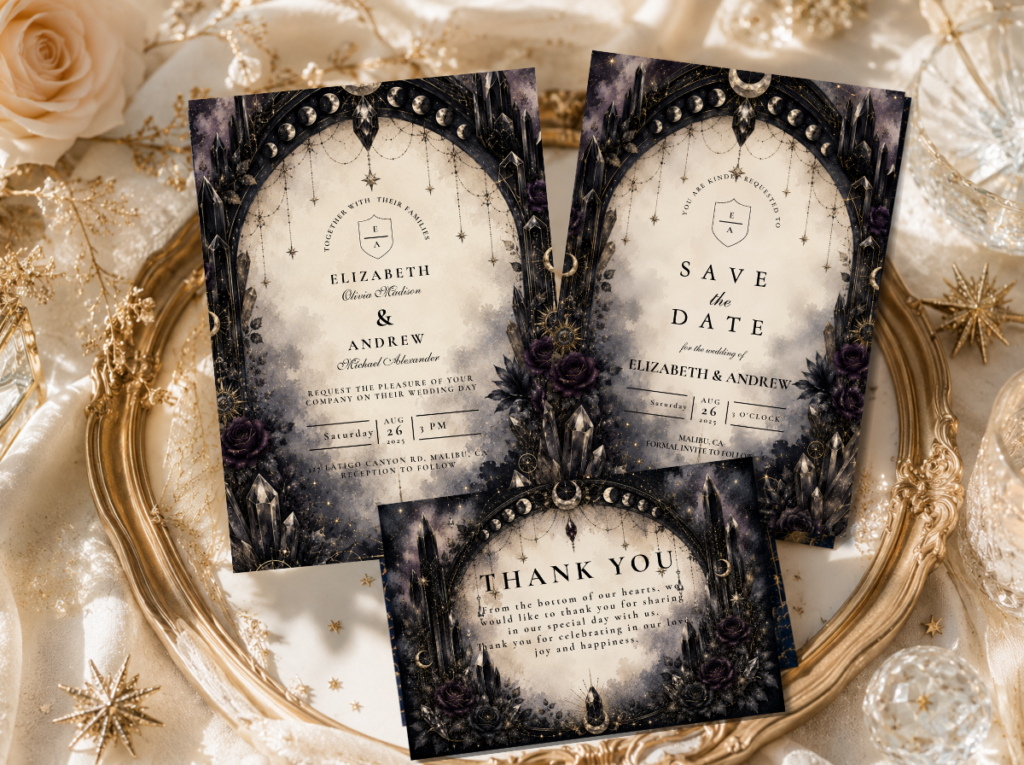
For the mystical wedding, the stationery is not merely the invitation — it is the first ritual object of the celebration. The guest who receives a near-black envelope with a wax seal in the form of a crescent moon, opens it to find an invitation whose visual quality reads as an artefact rather than as a printed piece, and sets it beside their other objects because it is too beautiful to put in a drawer: this guest has already begun to participate in the mystical world of the celebration before attending it. The mystical wedding invitation should feel as if it was chosen and sealed by someone who understands the significance of what is being sent — not as a formal notice or a design exercise but as the opening gesture of a ceremony that has already begun.
The specific qualities that make a stationery piece feel mystical rather than simply dark and beautiful: the choice of motif (celestial bodies, alchemical symbols, botanical arcana, constellation maps — all read as mystical; generic stars and moons in a graphic design style do not); the quality of the illustration (hand-drawn or hand-drawn quality, with the specific irregularity of human-made marks rather than the perfect uniformity of digital design); the palette temperature (warm antique gold rather than bright metallic gold; near-black or deep midnight rather than generic dark; the specific depth of colour that reads as chosen with intention rather than as defaulted to from a template); and the material quality of the stock (weight and texture communicate intention before the guest has read a single word).
The photography connection between the stationery and the mystical decoration is among the most productive in any wedding aesthetic: the mystical invitation beside raw crystals, beside a dark botanical arrangement, beside wedding rings on a dark velvet surface, beside a single candle flame — these are the detail photographs that communicate the entire aesthetic of the mystical wedding in a single composed image. When the stationery belongs to the same visual world as the crystals and the dark florals and the candlelight, the detail photograph reads as a fully designed world rather than as separate elements placed together for a photograph, which is the quality that produces the most saved and most shared images in this aesthetic category.
The six collections below cover the full range of the mystical wedding stationery aesthetic — from the most dramatically dark to the most warmly vintage, from the most specifically whimsigoth to the most organically boho. Browse all six before choosing; the most important decision is which collection most closely matches the specific mystical aesthetic direction planned for the wedding, because the stationery suite chosen first becomes the palette reference for every decoration decision that follows.
Signature Mystical
Mystical Black Gold Celestial
The most atmospherically complete suite — near-black and warm gold for the Dark Celestial and Tarot & Ritual mystical aesthetics.
Dark Celestial
Celestial Dark
Deep midnight and antique gold across the full dark celestial category — for the most dramatically atmospheric mystical table settings.
Whimsigoth & Purple
Celestial Purple
Deep amethyst and gold — the stationery most specifically aligned with the Whimsigoth Mystical and Night Court aesthetics.
Ritual & Classic
Black Gold Celestial
Clean black and gold — the Tarot & Ritual Mystical stationery direction, deliberately beautiful and ceremonially legible.
Dark Academia
Vintage Celestial Renaissance
Renaissance star atlas on parchment — the most scholarly and historically grounded stationery for the Dark Academia Mystical.
Complete Day Suite
Mystical Black Gold Wedding
The complete mystical wedding suite across every day element — for maximum visual identity coherence across all printed moments.
Frequently Asked Questions
What is a mystical wedding theme?
A mystical wedding theme creates the specific quality of atmosphere that the word ‘mystical’ actually describes: the sensation of being present at something that feels ancient, ceremonial, and larger than the immediate occasion — not through literal claims of spiritual practice but through deliberate design choices that cultivate this quality of atmosphere. The visual language that most reliably produces the mystical quality: deep darkness used as a positive presence rather than mere background; warm antique gold as the only metallic light source within that darkness; ancient and learned symbolism (constellation maps, alchemical imagery, botanical arcana, historical celestial illustration) rather than contemporary decorative motifs; and the quality of ritual intentionality in every arrangement — things that have been chosen for meaning as well as beauty. The five aesthetics in this guide represent the full range of the mystical wedding, from the most celestially cosmic to the most organically earthy, from the most dramatically dark to the most whimsically enchanted.
What is a whimsigoth wedding?
Whimsigoth is an aesthetic category that combines the visual vocabulary of gothic tradition (deep tones, mystical symbolism, architectural drama, dark romanticism) with a warmer, more joyful, and less severe sensibility that prevents it from reading as purely dark or austere. The term captures the quality precisely: whimsical in its warmth and colour, gothic in its atmosphere and symbolism. In wedding terms, a whimsigoth wedding uses deep jewel tones (deep amethyst, midnight purple, rich burgundy), antique gold as the warm metallic, celestial and mystical motifs in their most romantic rather than most severe form, and a celebration atmosphere that feels genuinely enchanted and joyful rather than solemnly ceremonial. The night court wedding aesthetic — which has grown significantly in 2025–2026 from the visual vocabulary of dark fantasy fiction — sits squarely within the whimsigoth category and adds the specific qualities of fantasy architecture, cosmic darkness, and jewel-toned drama that make it among the most visually distinctive of the contemporary wedding aesthetics.
What is a night court wedding aesthetic?
The night court wedding aesthetic draws from the visual vocabulary of dark fantasy fiction — particularly the specific aesthetic of courts and courts’ ceremonies depicted in contemporary fantasy literature and their associated visual culture: deep jewel tones against midnight darkness, gold and silver metallic detail, a quality of ancient ceremony and deliberate symbolism, and the specific combination of beauty and power that the ‘court’ setting in fantasy fiction typically embodies. In wedding terms, the night court aesthetic produces a celebration with the same qualities: deep midnight to near-black as the base colour, rich jewel tones (deep amethyst, midnight blue, dark emerald, deep burgundy) as the secondary palette, warm ceremonial gold as the metallic throughout, and a quality of deliberate theatrical beauty that reads as designed by someone with a specific and confident aesthetic sensibility. The Whimsigoth Mystical direction in this guide is the celestial stationery aesthetic most directly aligned with the night court wedding aesthetic.
What stationery suits a mystical wedding?
The mystical wedding stationery should feel like a ritual object rather than a printed piece — chosen and sealed with intention, carrying the visual language of the mystical aesthetic in its motif vocabulary (celestial bodies, constellation maps, alchemical symbols, botanical arcana rather than generic star shapes), its palette temperature (warm antique gold, near-black or deep midnight, the specific depth of colour that reads as intentional rather than decorative), and its material quality (weight and texture of the card stock communicating significance before a word is read). The six collections in the stationery showcase above cover every direction of the mystical wedding aesthetic: the Mystical Black Gold Celestial suite for the Dark Celestial and Tarot aesthetics; the Celestial Purple collection for the Whimsigoth aesthetic; the Vintage Celestial Renaissance collection for the Dark Academia aesthetic; the Black Gold Celestial for the Ritual aesthetic; and the Mystical Black Gold Wedding suite for couples who want maximum visual identity coherence across every printed moment of the day. Choose the collection that most closely matches the specific mystical aesthetic direction planned, and let the stationery palette serve as the reference for every subsequent decoration decision.
Begin the Ceremony
Find the Stationery That Makes the First Impression Feel Like a Ritual
The invitation is the opening gesture of the ceremony — choose the collection that matches the specific mystical world being built, and let every decoration decision that follows be calibrated against it.