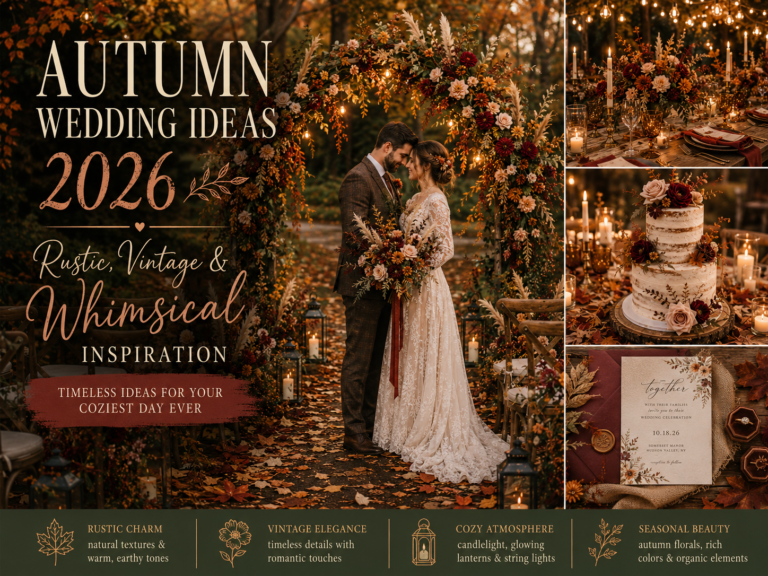
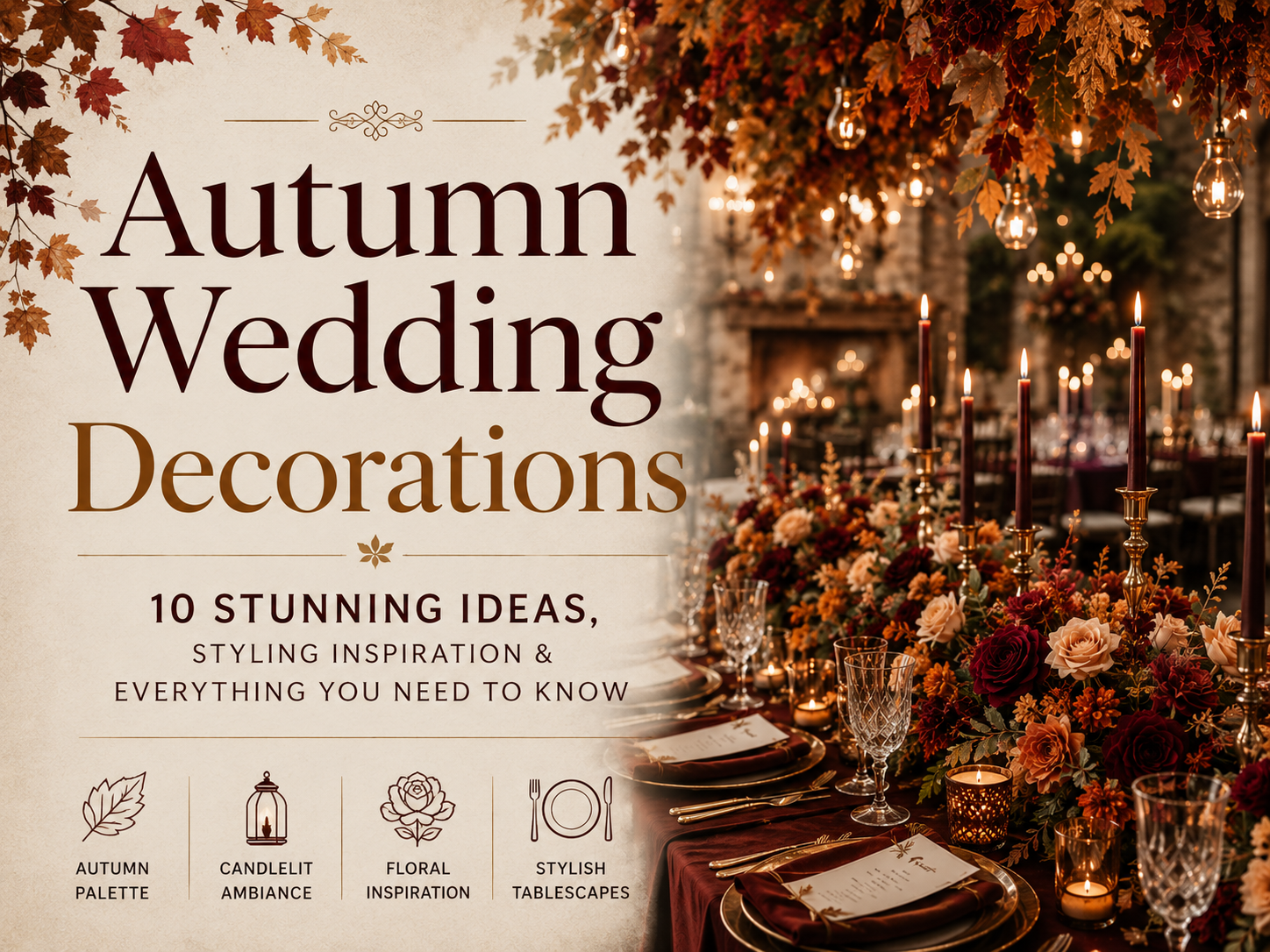
Autumn Wedding Decorations – 10 Stunning Ideas, Styling Inspiration & Everything You Need to Know
The Autumn Décor Edit · 2026
Autumn Wedding Decorations
10 Stunning Ideas, Styling Inspiration & Everything You Need to Know
From candlelit centrepieces and foliage-draped arches to copper lantern trails, harvest tablescapes, and dried botanical installations — your complete guide to autumn wedding decorations in 2026.
Autumn wedding decorations do not impose beauty onto a space — they reveal it. The season has already done the most extraordinary work. The decorator’s role is simply to bring it indoors, arrange it with intention, and light it well.
Introduction
Why Autumn Wedding Decorations Are the Most Richly Creative Brief in All of Event Design
No other season hands the wedding decorator a brief as rich, as generous, or as naturally spectacular as autumn. The materials available in September, October, and November — the turning foliage, the dark jewel-toned blooms, the dried grasses and seed heads, the berried branches and vine — form a palette of extraordinary visual complexity and depth that a summer wedding, however beautifully styled, simply cannot replicate. And the quality of autumn light — warm, low-angled, amber in tone — means that even the most modestly decorated space acquires a quality of atmosphere that would require significant technical lighting investment to achieve at any other time of year.
Autumn wedding decorations in 2026 have reached a creative maturity that reflects everything the season offers. The trend that began years ago — toward naturalistic, abundant, season-specific styling rather than the generic white-and-green aesthetic that dominated wedding tables for the previous decade — is now fully, confidently established. Copper candelabras and foxed antique mirrors. Foliage ceiling installations that recreate the experience of dining beneath an October canopy. Tables dressed with loose, spilling arrangements of dahlias, rosehips, and smoke bush rather than tight, controlled centrepieces. Dried botanical wreaths on venue doors. Lantern trails along stone pathways. These are the visual signatures of the autumn wedding decoration aesthetic in 2026, and each of them is more beautiful, more photogenic, and more genuinely of the season than anything a stylist working from a generic seasonal palette could produce.
In this guide we present ten of the most beautiful and creatively distinctive autumn wedding decoration ideas for 2026 — each a fully formed concept with its own aesthetic direction and practical application. We also cover the key categories of wedding decoration in depth: tablescapes, ceremony styling, entrance design, lighting, and the essential practical considerations that will ensure your autumn wedding decorations are executed as beautifully as they are imagined.
The Edit
10 Autumn Wedding Decoration Ideas That Will Transform Your Venue
Each of these ten decoration ideas represents a complete creative direction — a concept that can anchor the entire visual language of your autumn wedding, from ceremony through to the final hour of the reception. Read each as a distinct aesthetic world and notice which one feels instinctively, completely right for your day.
01
The Foliage Ceiling Canopy
A suspended installation of autumn foliage — turning copper beech, oak branches, dried pampas grass, hanging seed pods, and trailing rosehip vine — built above the main reception table and lit from within by warm Edison bulb strings or suspended tea lights. The effect is one of dining beneath an October forest canopy, and in the right venue — a barn, a stone hall, a marquee — it is without question the single most visually spectacular autumn wedding decoration available. It requires a florist and installation team with experience in large-scale construction and a venue that can accommodate roof fixings, but the result justifies every element of the investment. Every photograph taken beneath it will be extraordinary.
02
The Antique Mirror Arrangement
Foxed, gilded, and ornately framed antique mirrors placed at intervals around the reception room — propped against walls, positioned behind centrepieces, arranged as a gallery along a venue corridor — serve a double decorative function: they contribute their own aged, patinated beauty to the space, and they double the candlelight that flickers before them, filling the room with warmth and depth without requiring additional lighting infrastructure. The antique mirror is the most cost-effective atmospheric upgrade available to any autumn wedding decoration scheme, and the one that produces the greatest photographic impact per pound of investment. Source them from prop hire companies specialising in vintage and period styling.

03
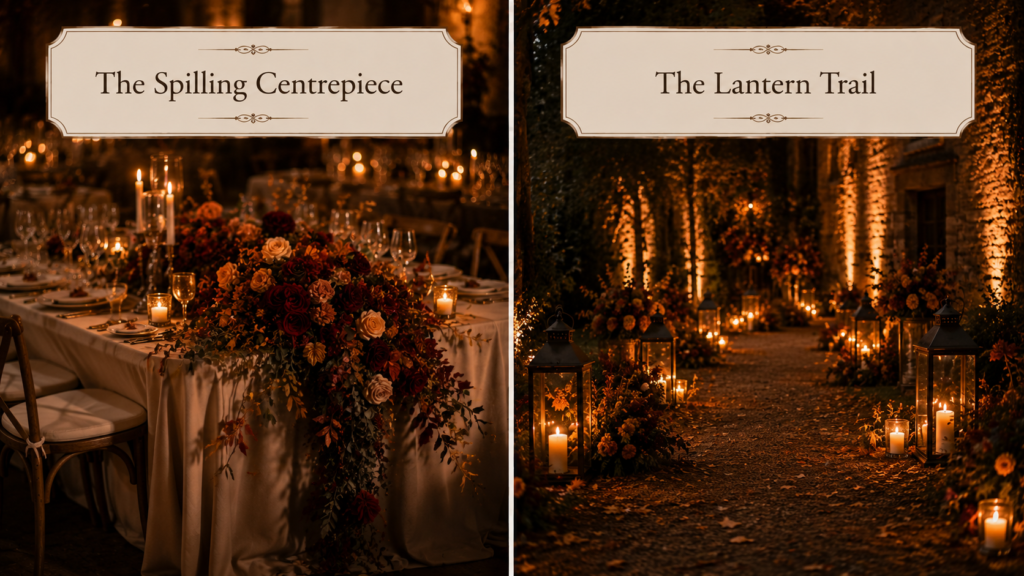
The Spilling Centrepiece
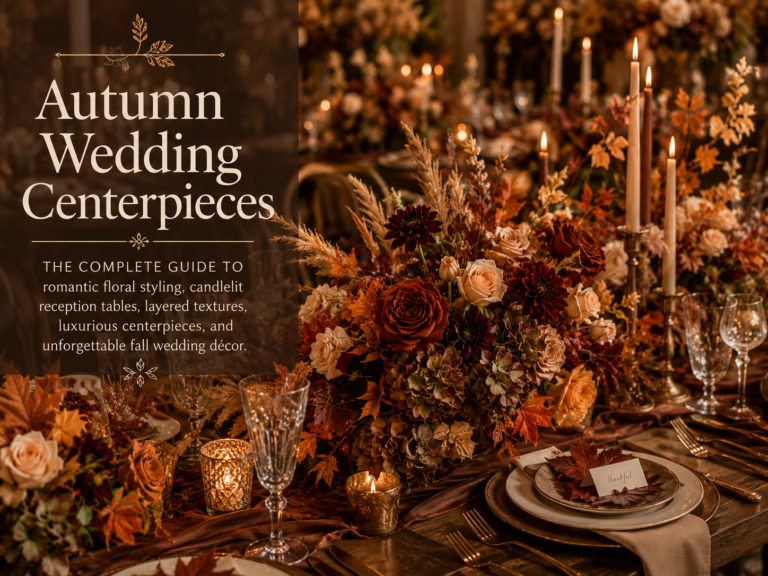
A table centrepiece that does not sit within its vessel but spills over and beyond it — dark dahlias, trailing rosehip vine, copper foliage, and dried botanicals cascading across the table surface as though the arrangement had been gathered from the garden and set down with deliberate carelessness. This approach to centrepiece design is both the most beautiful and the most distinctively autumnal, because it uses the season’s abundant materials in a way that feels true to how they grow and how they look in the wild rather than how they would look in a florist’s shop window. Surrounded by a cluster of varying-height pillar candles, a spilling centrepiece photographed on a dark table surface is one of the most immediately and consistently beautiful images in all of autumn wedding photography.
04
The Lantern Trail
A pathway of copper or antique iron lanterns — floor-standing, hung from shepherd’s hooks, or placed on reclaimed stone steps — containing real pillar candles and interspersed with seasonal foliage, dried grasses, and scattered autumn leaves. Used to line a driveway entrance, the path from the ceremony to the reception space, or the route from the venue door to the outdoor fire pit, a lantern trail creates one of the most romantically beautiful and atmospherically powerful autumn wedding decoration moments of the entire day. When guests walk through it at dusk — the candles lit, the copper gleaming, the leaves catching the flame — the effect is completely and genuinely magical.
05
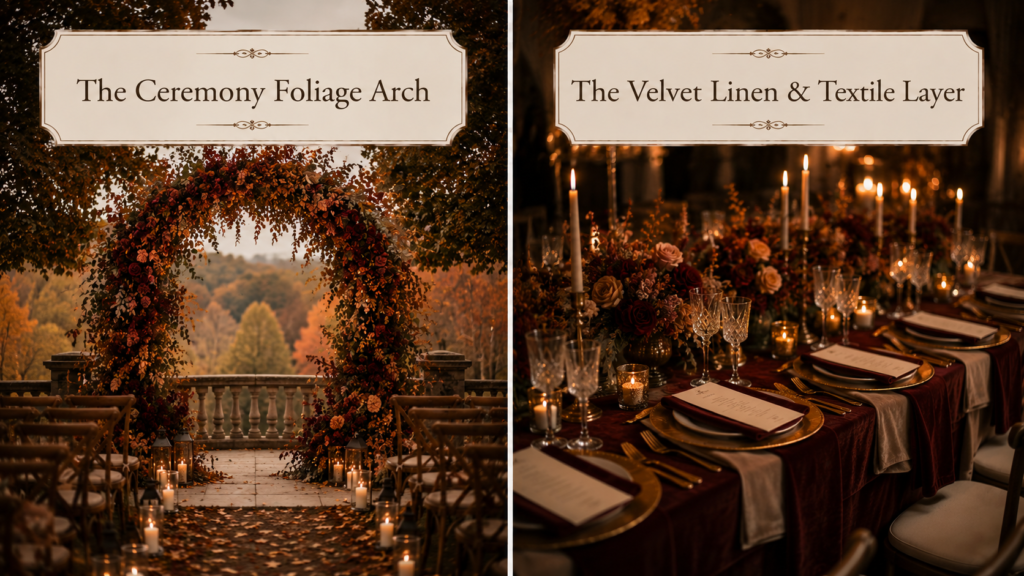
The Ceremony Foliage Arch
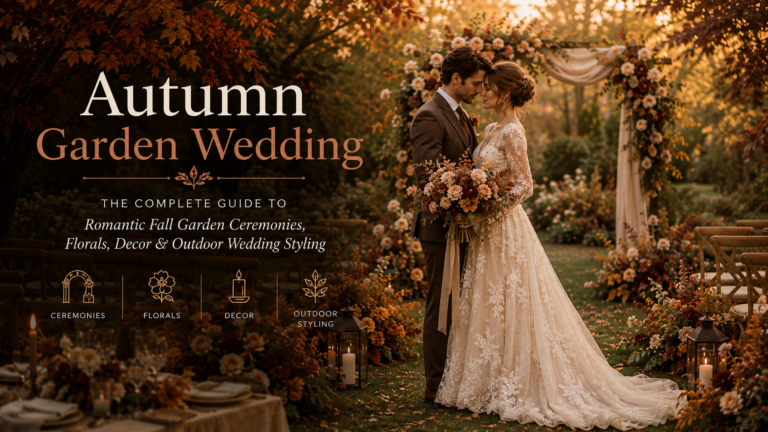
A freestanding arch or doorway frame constructed from twisted willow, oak, or birch branches and dressed with abundant autumn seasonal material — turning foliage, dark dahlias, rosehips, dried pampas, and trailing botanical elements — that frames the couple during their ceremony and appears in every photograph taken from the congregation. The ceremony arch is the most photographed single piece of autumn wedding decoration and the one that sets the visual tone of the entire day most immediately and completely. It should be designed in direct conversation with the bridal bouquet and the wider floral scheme — using the same blooms, the same foliage, the same overall colour language — so that the arch and the bride in front of it read as a single, coherent image.
06
The Velvet Linen & Textile Layer
One of the most transformative and underused autumn wedding decoration techniques: the deliberate layering of rich, textured textiles across every surface of the reception space. Deep jewel-toned velvet table runners in oxblood, forest green, or midnight plum. Aged linen napkins in warm ivory or champagne tied with twine and dried herb sprigs. Chair backs dressed with loose velvet bows or natural wool throws. Blanket baskets at the venue entrance for guests stepping outdoors. Textiles warm a space in a way that flowers and candles alone cannot — they add a tactile, sensory depth to the decoration scheme that guests feel as well as see, and they photograph with a richness and luxury that reinforces every other element of the autumn aesthetic around them.
07
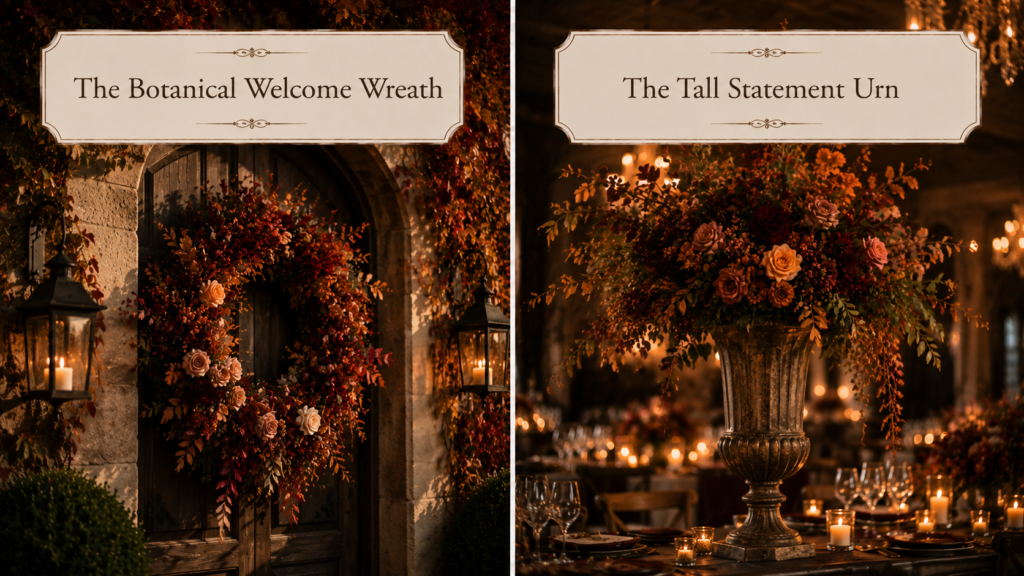
The Botanical Welcome Wreath
A generously scaled dried botanical wreath on the venue’s entrance door — constructed from a willow or wire base and built up with pampas grass, dried eucalyptus, dark dahlias or preserved roses, rosehip stems, lunaria seed discs, and trailing seasonal foliage — is the first autumn wedding decoration a guest encounters and the one that establishes every expectation for what lies within. In 2026 the oversized welcome wreath has become a signature piece of autumn wedding styling — photographed extensively by arriving guests and used as the establishing shot in many wedding films. Commission it from your florist as a keepsake piece built primarily from dried materials, so it can be taken home and enjoyed for months after the wedding.
08
The Tall Statement Urn
Tall stone, antique bronze, or aged terracotta urns — positioned at venue entrances, beside ceremony aisles, flanking fireplaces, and at the ends of reception tables — filled with architectural arrangements of branches, pampas grass, tall dried botanicals, and seasonal blooms. The tall urn provides vertical drama that no low centrepiece can match, drawing the eye upward and creating a sense of scale and grandeur that transforms the proportion of any space it occupies. Autumn is the season in which the tall urn arrangement is most naturally and gloriously justified — the materials available for this format in October are richer, more visually complex, and more dramatically beautiful than at any other time of year.
09
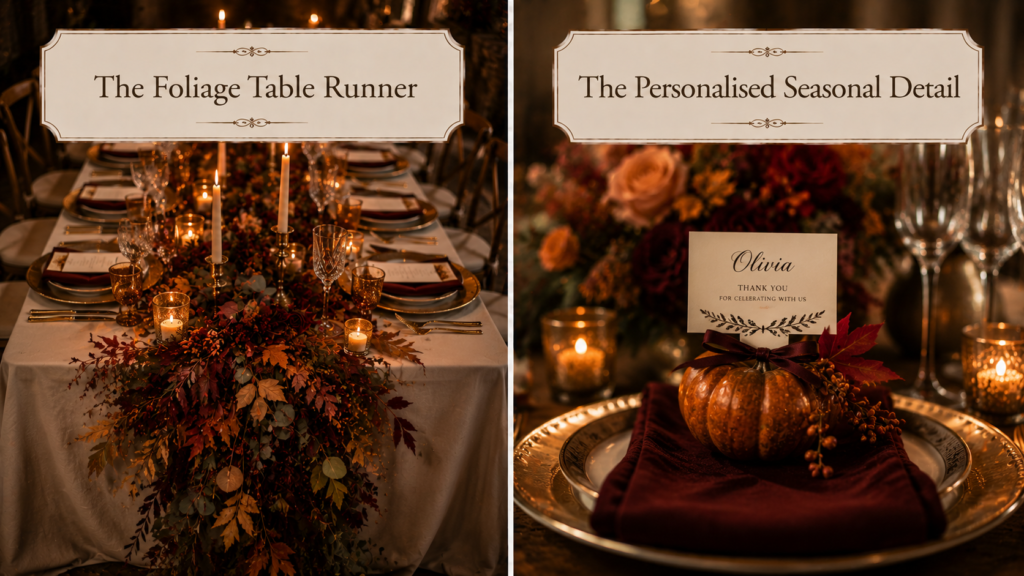
The Foliage Table Runner
A long, loosely constructed table runner of natural autumn foliage — copper beech, olive branches, rosehip vine, trailing ivy, and scattered seasonal blooms — running the entire length of the reception table and interspersed with pillar candles, antique brass candlesticks, and foraged botanical details. The foliage runner is the most versatile and budget-conscious of all autumn wedding decoration approaches for the dining table: it uses primarily natural, seasonal, and often locally sourced material, requires minimal floristry time to construct, and produces an effect of extraordinary organic richness that elevated arrangements in vases cannot replicate. On a dark-toned table surface with candlelight playing across it, a well-constructed autumn foliage runner is one of the most beautiful things in any reception room.
10
The Personalised Seasonal Detail
The autumn wedding decoration that guests notice last and remember longest is rarely the most spectacular or the most expensive. It is the personal one — the detail that could only belong to this couple on this particular day in this particular season. A place card written on a dried magnolia leaf. A favour of local honey in a jar sealed with wax in the wedding colour. A table name system using species of turning trees rather than numbers — the Oak table, the Beech table, the Rowan table. A dried botanical wreath at each chair back made with foliage from the couple’s own garden. These details require thought, time, and a genuine relationship with the season — and they produce a depth of warmth and personal connection in guests that no amount of elaborate styling can manufacture.
“The finest autumn wedding decorations are not those that cost the most or take the longest to install. They are the ones that make guests feel, the moment they step into the space, that they are somewhere entirely particular — somewhere that could only ever have been built from October.”
— The Autumn Décor Edit
Table Styling
Autumn Wedding Table Styling: Layers, Texture, and the Art of the Tablescape
The reception table is the canvas upon which the full richness of the autumn wedding decoration scheme is expressed most intimately — the space where guests spend the largest proportion of the evening, where the photography is most consistently close-up and detailed, and where the quality of the design is most directly and personally experienced. A well-styled autumn wedding table does not simply look beautiful from a distance. It reveals new details at every scale — the texture of the linen, the patina of the candleholder, the specific blooms in the centrepiece, the calligraphy on the place card — that reward the guest who looks closely.
Layering the Table
- Base: Dark linen tablecloth or raw wood surface as the foundation
- Runner: Velvet, aged linen, or loose foliage runner down the centre
- Centrepiece: Spilling arrangement or candle cluster with blooms
- Candlelight: Varying heights — tapers, pillars, and tea lights combined
- Place setting: Aged-edge plates, linen napkins, and seasonal favour
- Detail: Place cards on dried leaves, name cards tucked into sprigs of rosemary
Materials to Use
- Aged brass and copper candleholders — never chrome or silver
- Antique or raw terracotta vessels for flower arrangements
- Raw slate or reclaimed wood slices as individual place risers
- Foxed or aged glass hurricane lanterns for candle enclosures
- Natural twine, wax seals, and kraft card for stationery elements
- Locally foraged moss, acorns, and seed heads as scatter details
The Rule of Odd Numbers in Autumn Wedding Decoration
Every professional decorator working in the autumn wedding space applies the same foundational principle to candle groupings, urn arrangements, and table vignettes: always use odd numbers. Three pillar candles of varying height read as a composed arrangement; two or four read as symmetrical and lifeless. Five mismatched vessels in a centrepiece vignette appear curated; four or six appear mechanical. The odd number creates the eye movement and visual interest that makes the difference between a decoration that looks styled and one that looks arranged — and in autumn’s naturally abundant, slightly wild aesthetic, that distinction matters enormously.
Key Decoration Zones
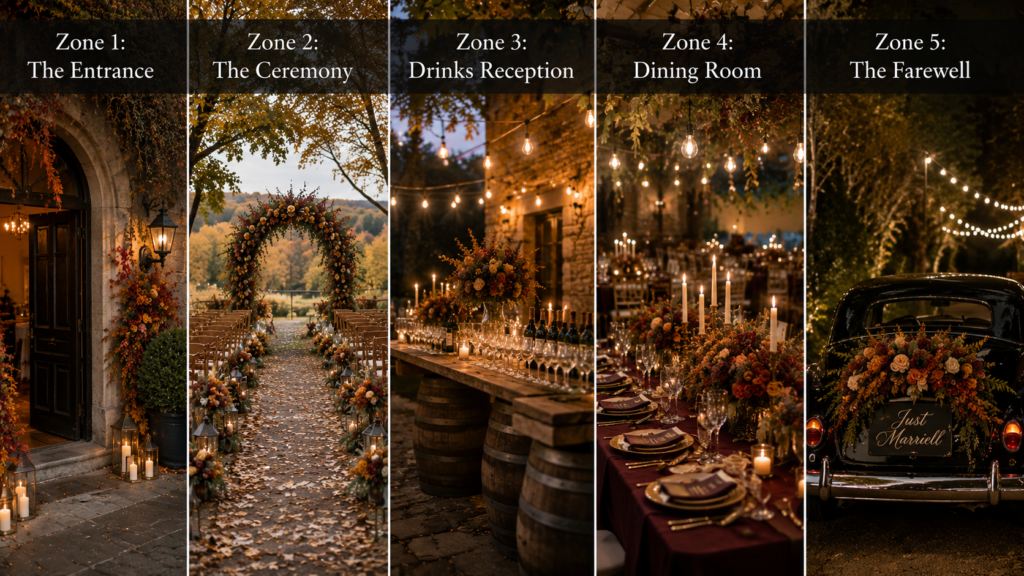
The Five Zones Every Autumn Wedding Decoration Scheme Must Address
A coherent autumn wedding decoration scheme is not a collection of beautiful individual pieces — it is a visual narrative that flows consistently from the moment a guest arrives to the moment they depart. Every zone of the venue experience contributes to or detracts from that narrative, and each requires specific creative consideration. The five zones below represent the complete spatial journey of the wedding guest and the points at which autumn wedding decorations have the greatest impact on the overall experience of the day.
🚪
Zone 1: The Entrance
Welcome wreath, lantern trail, statement urn flanking the door. The arrival decoration sets every expectation — invest in it accordingly. The entrance shot appears in more guest photographs than almost any other location.
💒
Zone 2: The Ceremony
Ceremony arch or altar arrangement, aisle markers, pew end decorations. These appear in every ceremony photograph and set the visual language of the entire day. They must be in direct conversation with the bouquet and the wider palette.
🥂
Zone 3: Drinks Reception
Antique mirrors, styled drinks table, fireplace mantel arrangement, and the table plan display. This transitional space is where guests spend the first hour and form their initial impression of the reception aesthetic.
🍽️
Zone 4: Dining Room
Tablescapes, ceiling installations, tall urns, uplighting. The space where guests spend the greatest time and where the decoration is most intimately experienced. Every detail from candle height to napkin fold is noticed and remembered.
🌙
Zone 5: The Farewell
Lantern trail back to the car park, outdoor fire pit with blankets and final candles, a return to the welcome wreath on the way out. The last impression of the decoration is the one guests carry home — give it the same creative attention as the first.
Dried & Foraged Materials
Dried and Foraged Materials: The Backbone of Autumn Wedding Decoration
No other category of material contributes as much to the visual character of autumn wedding decorations as the dried and foraged botanical. Pampas grass, lunaria, teasel heads, dried cotton, poppy seed pods, bunny tail grasses, twisted willow, preserved oak leaves — these materials bring a textural complexity, a visual depth, and a distinctly seasonal quality that fresh flowers alone cannot achieve. They are also practical: they can be installed days or even weeks before the wedding without any deterioration, they do not require water, and they can be repurposed and taken home after the celebration as lasting decorative objects.
Dried Materials to Use
- Pampas grass — from blush pink to natural cream, any scale
- Dried lunaria — translucent silver seed discs of extraordinary beauty
- Bunny tail grass — soft, delicate, in warm cream tones
- Dried cotton stems — white bolls on bare, architectural branches
- Teasel heads — spiky, textural, and unmistakably autumnal
- Dried wheat and oat stems — harvest gold and deeply seasonal
Foraged Materials to Source
- Turning copper beech and oak branches with leaves
- Rosehips on the stem — orange-red and abundantly beautiful
- Sloe and blackberry branches with berries intact
- Acorns, conkers, and seed pods from the woodland floor
- Moss and lichen-covered branches for texture and age
- Twisted willow stems for architectural structure
Practical Planning
Ten Things Every Couple Should Know When Planning Autumn Wedding Decorations
- Begin with the venue architecture, not the decoration brief. The most successful autumn wedding decoration schemes are those built in response to the specific character of the space — its walls, its light, its existing tones of stone or wood or plaster. Visit the venue in October at the time of day your reception will take place, and let what you see in the actual conditions of the season guide every decoration decision that follows.
- Confirm the candle policy before designing the lighting scheme. Many historic, listed, and licensed venues restrict or prohibit naked flame entirely. This single venue characteristic should significantly influence your decoration approach — if real candles are not permitted, the entire atmospheric strategy shifts, and the sooner you know this the more effectively you can plan around it with high-quality LED alternatives and other warmth-creating decorative choices.
- Brief your florist and decorator together, not separately. The autumn wedding decoration scheme and the floral design are not independent disciplines — they are a single, unified visual project. A scheme where the decorator and florist have not communicated will almost always produce incoherence between the floral and non-floral elements. Ensure all your creative suppliers have seen the same mood board, the same color references, and the same venue before any work begins.
- Allow significantly more installation time than you expect. Autumn wedding decorations — particularly ceiling installations, tall urn arrangements, lantern trails, and textured tablescapes — take considerably longer to install than their finished appearance suggests. Confirm the venue’s access schedule well in advance and build in a realistic time buffer between the end of decoration setup and the arrival of the first guest. A rushed installation is never invisible in the photographs.
- Invest in the decoration of transitional spaces. The corridor between the ceremony and the reception room. The staircase. The cloakroom corridor. The path to the outdoor fire pit. These in-between spaces are where guests form their impressions of the venue between the main event areas, and a lantern or a foliage arrangement in a transitional space creates a feeling of complete immersion in the aesthetic that contributes enormously to the overall atmosphere of the day.
- Use odd numbers for every grouping of objects. Three candles, five vessels, seven foliage stems — the rule of odd numbers produces visual energy and apparent casualness that even numbers, however beautifully arranged, cannot replicate. Apply it to every candle cluster, every botanical vignette, and every table composition in your autumn wedding decoration scheme.
- Source dried botanical materials well in advance of the wedding date. The most beautiful dried botanicals — large statement pampas grass, well-formed lunaria seed heads, perfect dried cotton stems — sell out quickly in the months approaching the autumn wedding season. Begin sourcing dried materials at least three to four months before the wedding, and store them carefully in a cool, dry space until they are needed for installation.
- Design for photography as well as physical experience. The most photogenic autumn wedding decorations are those with strong contrast — dark florals against pale linen, warm candlelight against shadowed stone, copper metallic against deep green foliage. Understand how your chosen materials and color combinations will photograph in the specific light conditions of your venue, and make decoration decisions that serve both the physical guest experience and the photographic record that will represent the day for the rest of your lives.
- Plan a coordination strategy for the morning-after collection of hired items. Significant autumn wedding decoration schemes typically include a substantial number of hired pieces — candelabras, urn stands, lanterns, mirrors, linen. Confirm the collection schedule with every hire company before the wedding and ensure someone in your planning team is responsible for coordinating the return of every item. Hire deposit losses are one of the most preventable post-wedding expenses.
- The decoration detail guests remember longest is always the personal one. Not the most expensive installation or the most elaborate centrepiece — the detail that carries meaning. The table named after the village where the couple met. The favour that reflects the couple’s shared hobby or history. The botanical element that comes from their own garden. These moments of personal meaning cost almost nothing to create and produce a depth of warmth and connection in guests that no amount of professional styling can manufacture. Build at least one into every zone of your autumn wedding decoration scheme.
“Autumn wedding decorations planned with genuine intention do not feel like decorations at all. They feel like the season itself, arranged — as though October walked into the venue ahead of the guests and simply made itself at home.”
— Autumn Décor Planning Notes
Closing Thoughts
Autumn Wedding Decorations Are a Collaboration With the Season Itself
There is a particular quality that the very best autumn wedding decorations share — one that has nothing to do with budget, or scale, or the technical skill of the decorator, though all of these contribute to it. It is the quality of inevitability. Of looking as though no other arrangement of these materials in this space on this day could ever have been possible. The lantern trail that leads guests along a path already scattered with fallen leaves. The foliage runner on the table that uses the same copper beech visible through the venue windows. The welcome wreath built from dried botanicals that will still be beautiful in the couple’s hallway in December, January, and February — long after the wedding day itself has become a memory.
Plan every zone of your decoration scheme with the season’s specific materials and light in mind. Brief your florist and decorator together. Invest in the arrival and the farewell as well as the dining room. Use dried botanicals as creative equals to fresh flowers. And build at least one detail of genuine personal meaning into every space your guests will occupy.
Then light the candles, open the doors, and let October do what it does in every well-decorated space it is invited into. It will finish the work more beautifully than any stylist ever could.