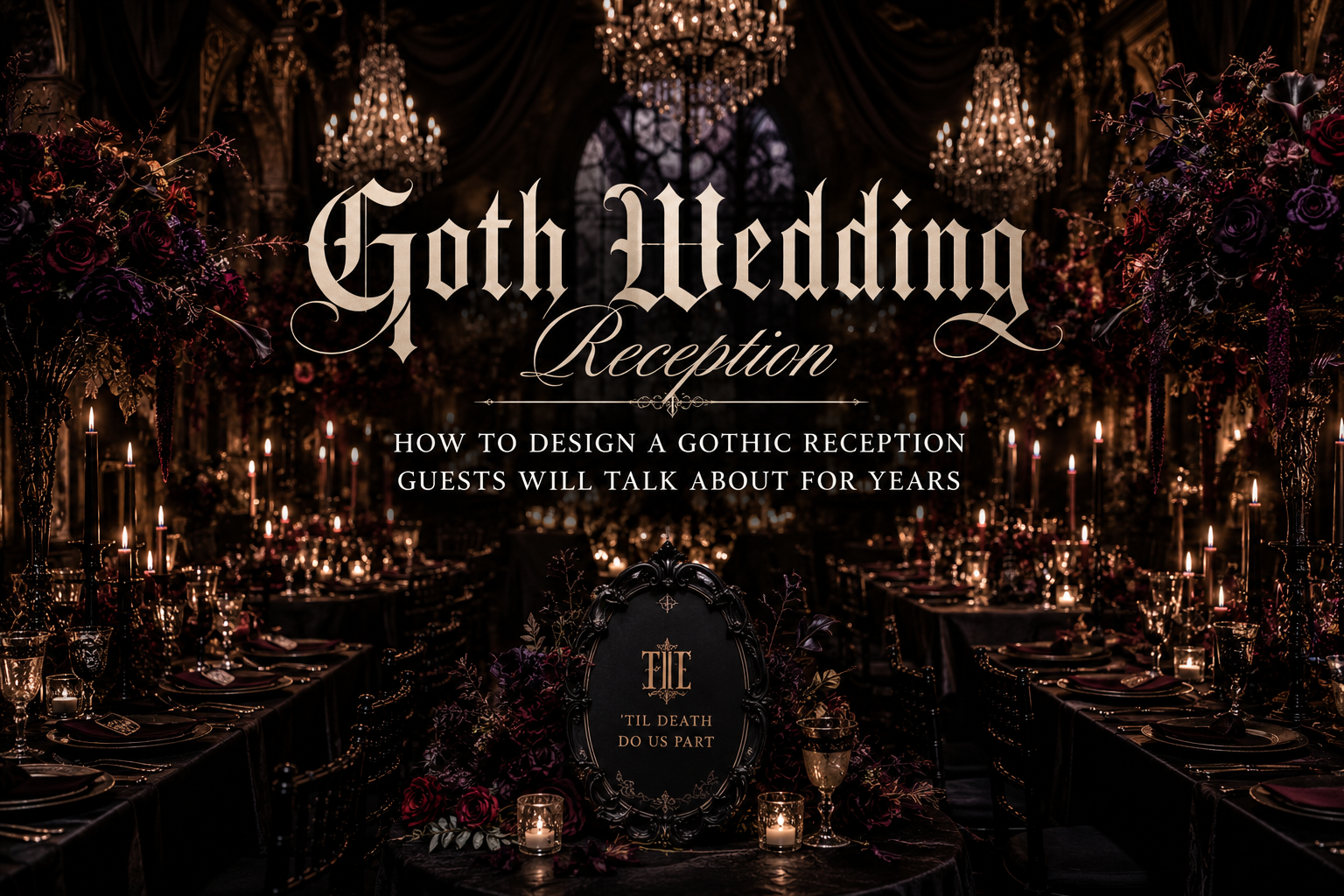
Goth Wedding Reception – How to Design a Gothic Reception Guests Will Talk About for Years
The Gothic Wedding Edit · 2026
Goth Wedding Reception
How to Design a Gothic Reception Guests Will Talk About for Years
From the first impression at the entrance to the final moonlit portrait at midnight — a complete guide to designing a dark, atmospheric, and deeply immersive goth wedding reception that feels like stepping inside a world guests did not know they had been waiting their whole lives to enter.
The goth wedding reception that guests remember for years is not the one with the most dramatic decoration or the most expensive flowers. It is the one where they walked through the door and felt — immediately, completely, without any conscious decision on their part — that they had stepped inside a world. A world that was beautiful in a way they had not encountered before, and that felt, inexplicably, as though it had been made specifically for them to inhabit.
Part One
Create a Dramatic First Impression
The first impression of a goth wedding reception is made before a single guest sees the tables, the flowers, the cake, or the dance floor. It is made in the ten seconds that begin when the invitation is opened and end when the guest passes through the entrance of the reception space for the first time — and it determines, more completely than any subsequent detail, whether the world being built feels like a genuinely extraordinary place or like a conventionally decorated event with a dark colour palette. The couple who understands this builds the first impression with the same seriousness and the same creative intelligence as every other element of the reception, because they understand that every subsequent detail will be experienced through the frame established by the first.
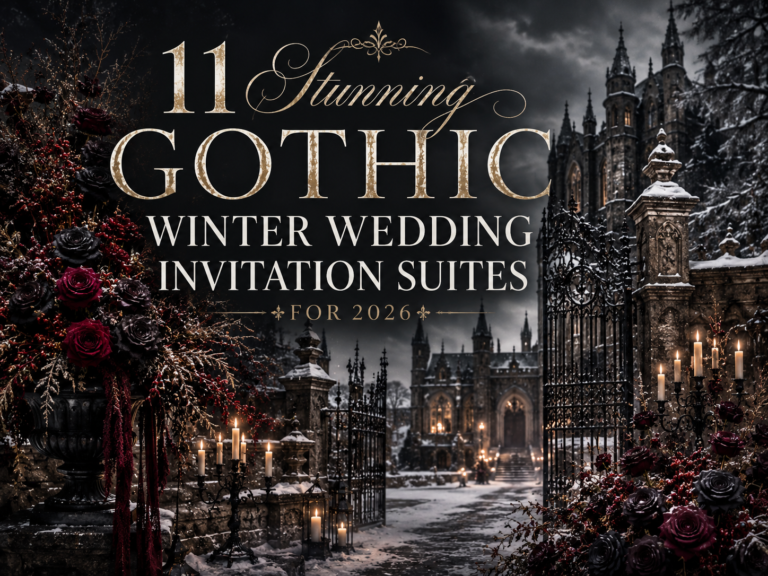
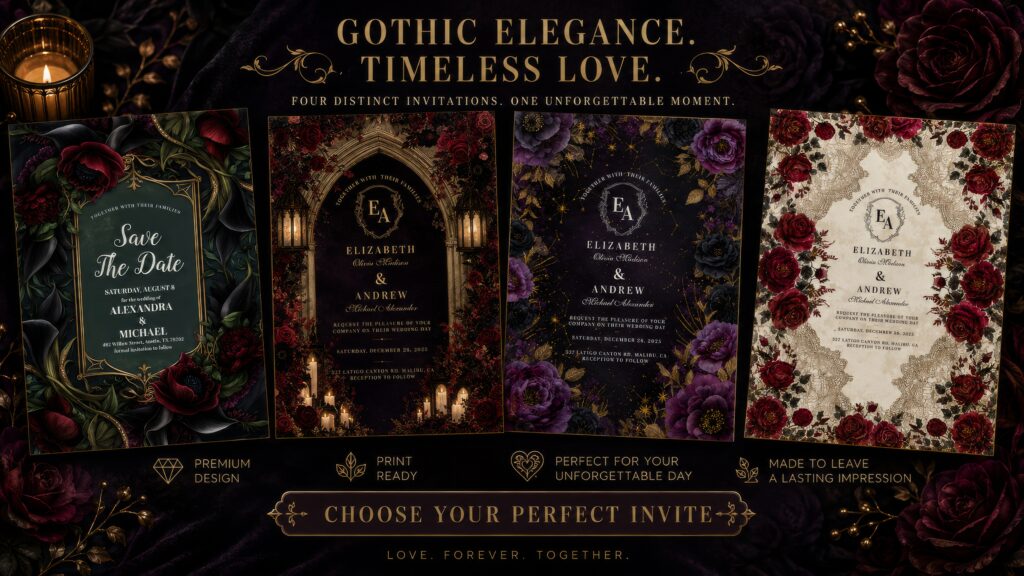
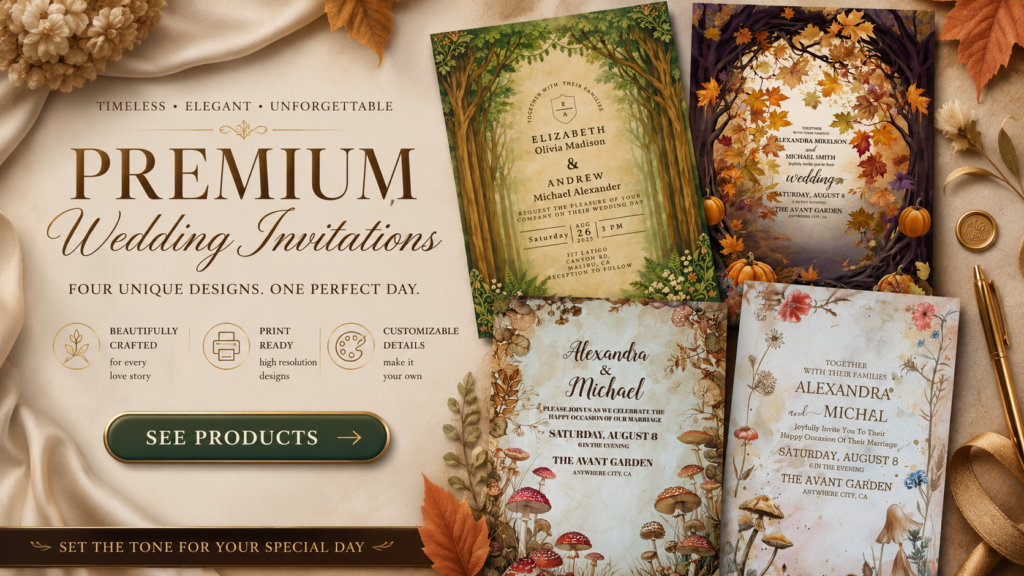
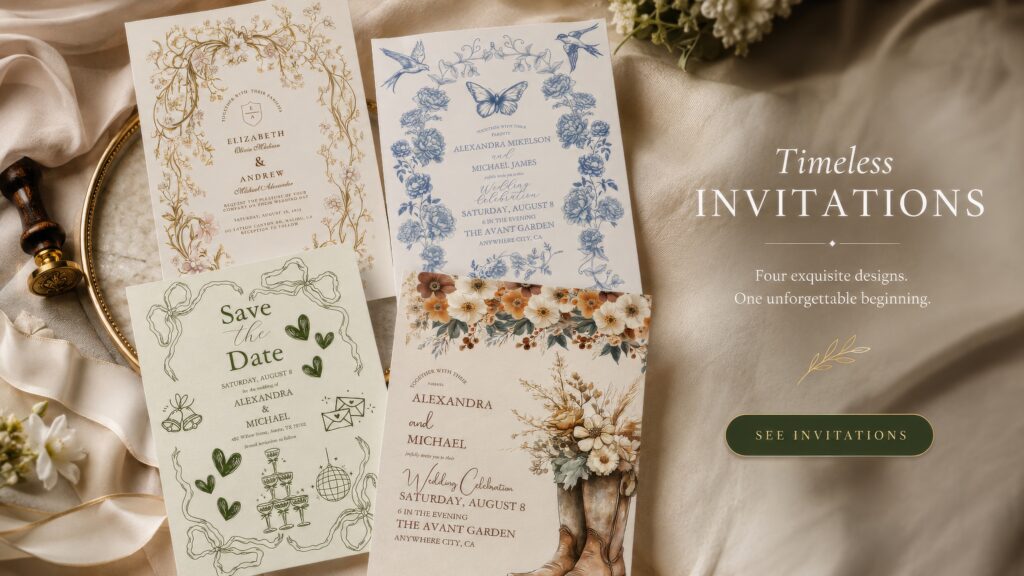
The invitation suite is the beginning of the first impression — the physical object that every guest holds before they arrive, that sets the aesthetic register of the celebration, and that communicates through its material quality, its typographic choices, and its specific design language whether this is a celebration of genuine creative intention or a conventional event with a dark theme. A letterpress invitation on heavy stock in near-black with silver or gold ink, sealed with a custom wax seal bearing the couple’s gothic monogram, and wrapped in dark tissue within a black-lined envelope, communicates everything a guest needs to know about the world they are being invited into before they have read a single word. It tells them: this will be extraordinary. Come prepared to be genuinely transported.
The Invitation Suite
Letterpress on heavy dark stock, custom wax seal, gothic monogram, black-lined envelope. The invitation is not administrative information about the event — it is the first page of the world being built, and it should read as one. Every element of the suite — the save-the-date, the invitation, the details card, the envelope liner — should communicate the aesthetic of the reception with the same seriousness as the reception itself.
The Venue Entrance
The physical threshold between the ordinary world and the reception world — framed, decorated, and lit with specific intention so that the act of crossing it feels like a meaningful transition. Dark floral installations, iron or velvet drapery, a single dramatic overhead chandelier, or a natural element — a stone archway, the doors of an ancient barn — that communicates arrival at somewhere genuinely extraordinary.
Candlelit Pathways
Iron lanterns or votives lining the path from arrival to entrance — not strung everywhere, but placed at specific intervals so that each one draws the guest forward into the world rather than illuminating the totality of the space. The path that is partially dark is more atmospheric and more powerful than one that is fully lit. Let guests move through pools of warm amber light separated by brief shadow.
Welcome Signage
A seating chart or welcome sign in a gothic typeface on dark stock or a dark mirror — the first piece of text guests read upon arrival, and an opportunity to establish the tone of the world through word choice as much as through typography. A quote from the couple’s favourite dark novel as the epigraph of the seating chart. A welcome message written as the opening paragraph of the love story. Small words that carry great weight.

Part Two
Use Lighting Instead of Decorations
The single most important and the most consistently underestimated creative decision in goth wedding reception design is the lighting plan — because light is not simply the means by which guests see the decorations. It is itself the primary decorative element, and it is the element that most completely determines the atmosphere of the space. A reception with extraordinary flowers and table decor in flat, uniform, overhead artificial light communicates nothing gothic regardless of how dark its colour palette is. The same reception under warm, multi-source, low-key candlelight with specific dramatic highlights communicates the gothic aesthetic immediately and completely, even if every other decorative element is modest. Light is not the last decision. It is the first.
The gothic lighting scheme operates on a principle that is directly opposite to conventional event lighting: where conventional event lighting aims for uniform visibility, gothic lighting aims for deliberate variation — bright in specific places, completely dark in others, with the contrast between those lit and unlit areas being where the atmosphere lives. Guests should not be able to see the entire reception space from any single vantage point. They should discover it progressively, moving from one pool of warm light to the next, with darkness between them that suggests depth and complexity rather than absence. The room should feel larger than it is, more layered than any single photograph of it can convey, and full of a quality of mystery that is produced not by any individual decorative element but by the specific relationship between light and shadow that the lighting plan has created.
🕯️
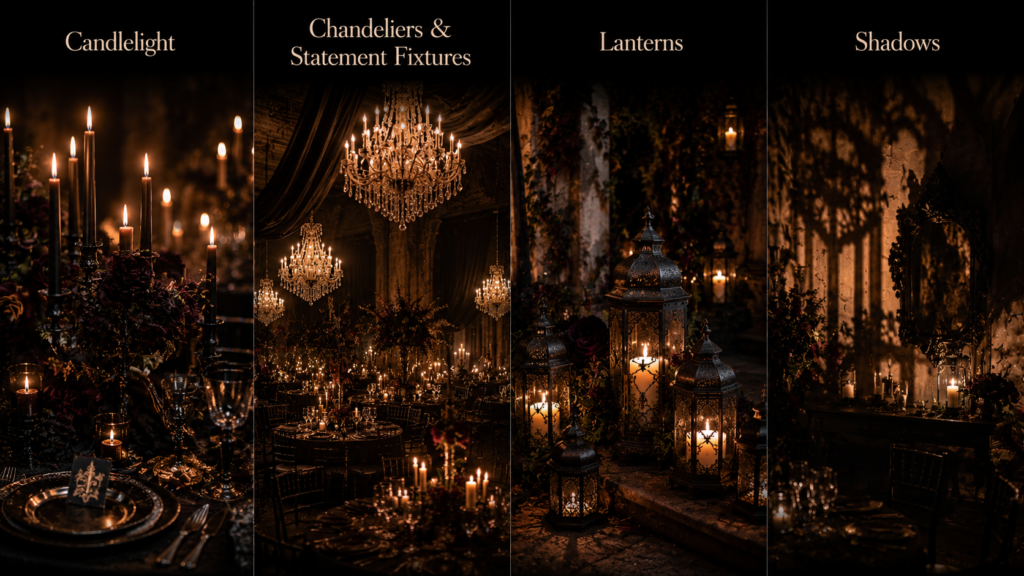
Candlelight
The most important single light source in any goth wedding reception — warm, multi-directional, constantly moving, and impossible to replicate with artificial alternatives. Real flame at varying heights on every table, in every corner, and along every surface produces a quality of living, breathing illumination that transforms even a plain space into something genuinely atmospheric. Tapers, pillars, and votives in odd-number groupings at every height from five centimetres to sixty.
💡
Chandeliers & Statement Fixtures
A dramatic chandelier — iron and crystal, dark metal with amber bulbs, or a candle-arm style with real or LED tapers — hung at the appropriate height above the primary reception space provides the architectural focal point that the gothic aesthetic requires. It should be visible from the entrance, large enough to dominate the overhead space, and lit at a level that creates spectacle without eliminating shadow.
🏮
Lanterns
Iron lanterns at floor level, on pedestals, and hung at varying heights create the most layered and the most atmospheric of all gothic lighting effects — multiple sources at multiple heights, each casting its own circle of warm light against the surrounding shadow. Hung from ceiling beams, they transform the overhead space into something architectural and dramatic rather than merely decorative.
🌑
Shadows
The deliberate preservation of shadow is as important as the placement of light sources — because the gothic atmosphere lives in the relationship between the two. Turn off the venue’s overhead fluorescent or LED lighting completely. Reduce any ambient lighting to the minimum. Let the darkness work. A guest who cannot immediately see everything in the room will lean toward what they can see, and that quality of orientation toward warmth and light is the fundamental emotional experience of the goth reception.
The Lighting Brief: What to Tell Your Venue
Give your venue coordinator a lighting brief in writing before the reception, not verbal instructions on the day. Specify: all overhead fluorescent or daylight-temperature lighting to be switched off completely. All ambient architectural lighting to be set to minimum. Warm amber uplighting at 10–15% capacity along walls and in corners — never overhead. Candles to be lit at full count one hour before guest arrival and maintained throughout. One dramatic focal-point fixture — chandelier, iron candelabra array, or hanging lantern installation — positioned at the primary visual axis of the room. Describe the room as it should feel: warm in specific places, genuinely dark in others, with the darkness understood as a design element rather than a deficiency.
Part Three
Make the Reception Feel Like Another World
The most powerful goth wedding receptions are not simply decorated events — they are complete, immersive environments that guests enter and inhabit for the duration of the celebration, and that produce in the people within them the specific quality of experience that only genuinely immersive environments can provide: the feeling of being somewhere entirely other than the ordinary world, somewhere that has its own rules of beauty and its own quality of time, somewhere that will be remembered not as a pleasant occasion but as an experience. This quality of immersion cannot be achieved by decoration alone. It requires the right venue, a coherent aesthetic vision applied at every scale simultaneously, and a lighting environment that transforms the space from a room into a world.
Gothic Manor
Historic Venues With Architectural Character
A historic manor, castle, library, or theatre provides the architectural grandeur and the genuine accumulated history that the gothic aesthetic requires as its primary setting. These venues communicate their own atmosphere before a single decoration has been placed — the stone walls, the vaulted ceilings, the original fireplaces, the specific quality of light in rooms that have been receiving it for centuries. The decoration scheme for a historic venue should enhance and honour its existing character rather than transforming or competing with it. Use dark florals, velvet runners, and candlelight to deepen what is already there, not to replace it with something different.
Enchanted Forest
Outdoor & Nature-Immersed Settings
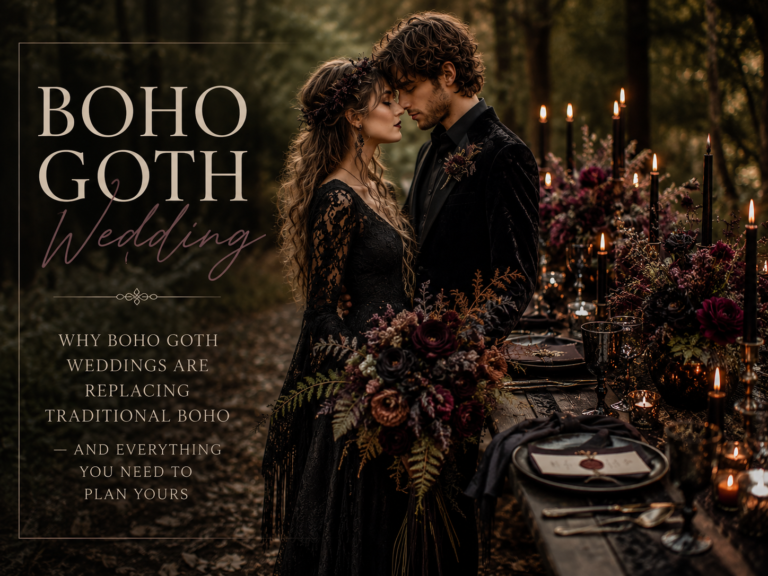
A forest clearing, a garden after dark, or a glasshouse filled with botanical abundance provides the most organically immersive of all goth reception environments — the sense of being inside a living world rather than a decorated room. Lanterns hung from trees, candles on moss-covered surfaces, dark florals trailing from branch installations overhead, and the sound of the forest or garden itself as ambient background music that no playlist can replicate. The outdoor gothic reception requires more logistics than the indoor version but produces an atmosphere of unmatched depth and authenticity.
Part Four
Give Guests Unexpected Details
The details that guests remember and talk about for years are almost never the largest or the most expensive. They are the unexpected ones — the small, specific, completely considered choices that communicate genuine creative intelligence and genuine care for the guest’s experience rather than compliance with a decoration checklist. The unexpected detail is the one that a guest discovers rather than notices, that prompts a specific emotional response rather than general aesthetic appreciation, and that communicates something personal and true about the couple who designed the world around it. These are the details that make a reception feel like it was made for specifically this occasion rather than assembled from available options — and they are, in almost every case, more achievable and less expensive than the large decorative gestures that most couples invest in first.
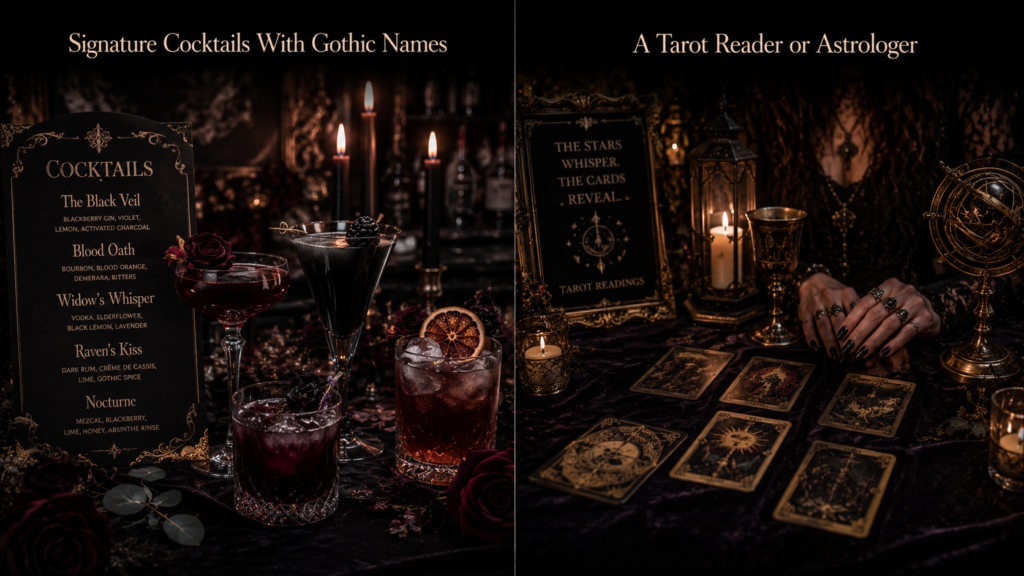
Signature Cocktails With Gothic Names
A cocktail menu of two or three signature drinks named for elements of the couple’s aesthetic world — a dark purple gin and blackberry cocktail called “The Witching Hour,” a deep red rose and cranberry champagne called “The Last Rose,” a smoky mezcal and dark chocolate drink called “After Midnight” — served from the bar in dark glassware with botanical garnishes and presented on a menu card in gothic typography. Guests remember the drink names, photograph the menu card, and discuss the cocktails for the rest of the evening. The signature cocktail is the cheapest and the most consistently effective unexpected detail available, because it transforms a functional element of the reception into an aesthetic one.
A Tarot Reader or Astrologer
A tarot reader or astrologer stationed at a velvet-draped table in a corner of the reception space — available to guests throughout the evening for private readings — is the most consistently memorable of all interactive goth wedding reception elements. It is unexpected, personal, genuinely interesting, and directly aligned with the symbolic and mystical aesthetic of the gothic wedding. Guests who receive a reading discuss it with other guests, drawing more people toward the table, and the readings themselves create private, meaningful moments within the celebration that guests carry home as specific memories rather than as general impressions of a beautiful event.
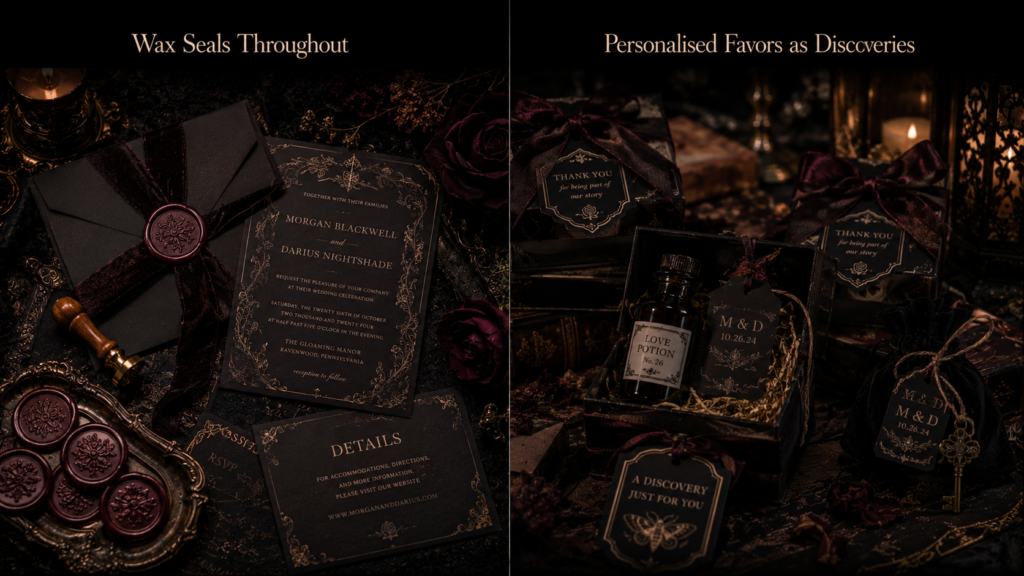
Wax Seals Throughout
A custom wax seal applied consistently throughout the reception — on the menu cards, the place cards, the favor packaging, the small handwritten notes tucked into each guest’s napkin fold, and the envelope containing the end-of-evening thank you card — creates a quality of unified, considered identity that generic decorations cannot provide. The wax seal is a small thing, but its repetition throughout the space creates the sense of a world that has been built with extraordinary attention to detail at every scale. Guests notice it, comment on it, and take the sealed objects home as the most specifically beautiful small things they encountered all evening.
Personalised Favors as Discoveries
The most memorable goth wedding favor is not placed visibly at the table setting but discovered within it — tucked beneath the napkin, concealed inside a small velvet pouch beside the place card, or hidden within a small box that requires opening to reveal its contents. The act of discovery transforms the favor from a gift received into a treasure found, and that quality of finding rather than receiving is one of the most specifically gothic of all experiential gestures available at a wedding reception. The favor should feel like something from the cabinet of curiosities of the world that has been built for the evening — a relic of the celebration that belongs to the aesthetic world rather than the administrative one.
Part Five
Design the Reception Around a Story
The most immersive goth wedding receptions are those built around a specific, internally coherent narrative world rather than a general dark aesthetic. A narrative world provides the creative constraint that prevents the decoration scheme from becoming a collection of individually gothic elements that do not add up to a complete aesthetic experience. It gives every decision — the cocktail names, the table names, the music, the favour, the welcome sign — a single referential framework from which to draw, and it produces a quality of consistency and depth that a theme-free collection of dark beautiful objects cannot approach. Choose a specific world and inhabit it completely. Every decision made within the framework of that world, however small, contributes to the total atmosphere. Every decision made outside it, however beautiful in isolation, weakens it.
01
The Vampire Ball
A formal gathering of dark aristocracy — all guests invited to dress to the level of the occasion, the reception space designed as the ballroom of an ancient estate, and the evening structured around the specific pleasures of the vampire social tradition: extraordinary food and drink, formal dancing, private conversation in candlelit corners, and the quality of heightened, performative elegance that belongs to a gathering of people who understand beauty as a serious matter. Tables named for famous literary vampires or for the rooms of the estate. A cocktail menu with the darkest and most luxurious available options. A dress code request on the invitation. The entire evening conducted at a level of formal dark glamour that most guests will never have encountered before and will not be able to stop thinking about afterward.
02
The Enchanted Forest
An outdoor or indoor reception space transformed into a living, atmospheric woodland — branch installations overhead from which lanterns and dark florals hang, moss runners along every table surface, a ceremony arch of twisted willow and botanical abundance, and the specific quality of green and amber and shadow that belongs to a forest at its most enchanting. Tables named for woodland creatures, trees, or elements of dark folklore. Cocktails named for forest botanicals and woodland potions. A tarot reader or herbalist stationed in a corner surrounded by apothecary bottles and dried specimens. The world of the dark fairy tale translated directly into the guest’s evening.
03
The Dark Fairy Tale
The original fairy tale — before the twentieth century removed the teeth from it — was a genuinely dark, genuinely strange, and genuinely beautiful narrative tradition, and the dark fairy tale wedding reception draws on this original rather than its sanitised descendants. A crescent moon arch at the entrance. Tables named for the characters or locations of the couple’s favourite dark tales. A welcome sign written as the opening of a story: “Once there were two people who found each other in the dark, and decided to stay.” Favors that feel found rather than given. An overall atmosphere of enchantment that is gorgeous and slightly uncanny in equal measure.
04
The Victorian Manor
A formal Victorian gathering in a historic interior — the specific aesthetic of the Victorian upper-class reception, with its elaborate table settings, its abundance of flowers and candles, its velvet and lace and dark wood and iron, and its quality of accumulated material beauty that communicates centuries of serious attention to the art of the beautiful. Tables named for Victorian novelists, poets, or scientists. A cocktail menu presented on aged-look card stock with a Victorian illustration. A dress code that encourages Victorian-inspired dark formal wear. The entire aesthetic operating within the most historically specific and the most materially rich of all gothic sub-traditions.
“The narrative world is not a theme in the event-planning sense — not a set of matching decorations purchased from a single supplier. It is a complete creative vision that determines every decision from the invitation wording to the final exit music, and that communicates itself not through the accumulation of themed objects but through the quality of total consistency that guests experience as immersion.”
— The Gothic Wedding Edit
Part Six
The Reception Table: Every Surface, Every Detail
The dining table is the element of the reception that every guest inhabits most intimately and for the longest sustained period of the evening — two, three, sometimes four hours in direct proximity to every object on its surface. It is the space that determines more than any other single element whether the world being built feels complete and deeply considered or whether it reveals its limits under close examination. A magnificent entrance and a dramatic overhead installation will be forgotten if the table the guest sits at for three hours fails to reward the attention they give it. The table must be as extraordinary at thirty centimetres of distance as the room is from across the space — and that requires the same creative intelligence applied at the smallest scale as at the largest.
The Surface
- Deep jewel-toned velvet tablecloth — oxblood, midnight plum, or near-black — the single most impactful single table decision available; velvet in candlelight produces a depth of colour that no other fabric approaches
- Lace runner over dark linen — the Victorian combination that communicates historical resonance and gothic femininity simultaneously
- Dark charger plates and aged brass or oxidised silver cutlery — never polished chrome or stainless; the metallic quality of the table setting communicates the aesthetic through the most practical objects on the surface
- Dark-stemmed or smoked glassware — deep purple, midnight blue, or smoke grey wine glasses that catch and colour the candlelight as well as the wine
- Botanical scatter elements — dried lunaria discs, scattered rose petals in near-black, individual seed pods, or a few dark crystals — the small organic details that reward close examination at the table level
The Centrepiece
- Tall iron candelabra with trailing dark florals — the most dramatically atmospheric option; the candelabra provides vertical scale and multiple flame sources while the floral arrangement at its base spills across the table surface
- Dark floral abundance in stone or aged metal vessels — black Baccara roses, dark dahlias, anemones, and botanical trailing elements in a stone urn or oxidised iron bowl; the Flemish still-life tradition applied to the gothic wedding table
- Victorian glass dome display — a pressed botanical or small memento mori composition under a cloche; the most intimate and most specifically Victorian of all gothic centrepiece formats
- Candle forest — no flowers at all; simply a dense cluster of real pillar and taper candles in dark and ivory, at multiple heights, on a mirrored surface or a moss base; pure atmosphere, pure gothic, deeply effective
Part Seven
The Music, The Atmosphere, and The Arc of the Evening
The goth wedding reception that guests remember for years is not simply a beautiful static environment — it is a complete experience that has a beginning, a middle, and an end, and that moves through distinct emotional registers during the course of the evening. The entrance is atmospheric and slightly hushed, drawing guests into the world. The dinner is intimate and conversational, the candlelight at its most intense and the music at its most understated. The dancing is dramatic, the music opening into something larger and darker and more energetic, the room transformed by movement and sound from a beautiful dining space into something closer to the specific excitement of the vampire ball or the enchanted forest gathering. And the close of the evening is quiet again — the last candles, the last slow song, and then the exit into the night.
Arrival & Cocktail Hour
Quiet, atmospheric, slightly theatrical. Chamber music, dark neo-classical, or deeply ambient electronic — something that sets the tone of the world without demanding attention. The volume low enough for conversation, the register dark enough to communicate that this is not an ordinary evening. Guests discovering the space for the first time, finding their seats, examining the table details, and beginning to understand the world they are in.
Dinner
Intimate and conversational. The music quieter still — perhaps a live string duo, a solo cellist, or a curated playlist of dark romantic instrumentals. The candlelight at its most complete, with the full count of flames contributing to the table-level warmth that makes a candlelit dinner the most beautiful and most atmospheric of all meal formats. Speeches that feel like chapters of the love story rather than administrative tributes.
The First Dance
The pivot point of the evening — the moment when the intimate and the atmospheric give way to the dramatic and the celebratory. The song chosen specifically for its ability to communicate the couple’s particular quality of dark romance to the people who know them best, in a room that has been building toward this moment all evening. Followed, not immediately, by the first genuinely dark and energetic track that opens the dance floor.
The Dancing
The dark dance floor at its most alive — the gothic playlist curated across the full breadth of the aesthetic tradition, from dark post-punk and goth rock through dark electronic and neo-classical, with the specific track selection communicating the sub-aesthetic of the wedding as clearly as every other element of the decoration scheme. The dance floor is the space where the world being built reveals its full emotional register.
Part Eight
The Goth Wedding Cake as a Statement
The wedding cake is the most photographed and the most discussed single decorative object in any reception — not because it is necessarily the most beautiful, but because it is the object that concentrates the couple’s aesthetic identity most completely into a single physical form, and that is presented to the room with deliberate ceremonial emphasis at a specific moment in the evening. The goth wedding cake that guests remember for years is not simply a dark cake. It is an object of extraordinary visual complexity and material beauty that communicates the specific world of the reception — the narrative, the aesthetic, the symbolism — through the craft and intention applied to every detail of its construction and decoration.
The Dark Floral Masterpiece
A tiered cake in near-black or deep burgundy fondant, covered with hand-crafted sugar flowers in dark tones — black roses, anemones, dahlias, and botanical trailing elements — constructed with the same visual language as the reception’s floral scheme. The most labour-intensive and the most immediately recognisable of all gothic cake formats, and the one that most powerfully communicates the couple’s dark floral aesthetic through the medium of sugar and cake.
The Celestial Cake
Deep midnight blue or near-black fondant with hand-painted constellation details in gold and silver, crescent moon sugar decorations, and edible star scatter — the defining cake for celestial and moonlit goth reception worlds, and consistently among the most Pinterest-shared of all gothic wedding cake formats. Photographed at the reception table against the candlelit backdrop, it produces images of extraordinary visual depth.
The Victorian Architectural Cake
A formally tiered cake with clean dark fondant surfaces and Victorian decorative details in gold or silver — lace impressions, cameo reliefs, architectural moulding patterns, and the specific quality of formal restraint that the Victorian aesthetic applies to its objects of display. The most quietly magnificent of all gothic cake options, and the one that communicates the highest level of formal aesthetic intelligence through the absence of excess rather than the presence of it.
Part Nine
End With a Memorable Exit
The exit from a goth wedding reception is as important as the entrance — because it is the final impression, the last moment of the world, the experience that every guest carries with them as they return to the ordinary one. A magnificent entrance that is followed by an anti-climactic departure communicates, in its final moments, that the world being built was not completely thought through. A magnificent entrance followed by a magnificent exit communicates the opposite: that the couple who built this world cared about the quality of every guest’s experience from the first threshold to the last, and that they understood the narrative structure of a celebration well enough to give it a conclusion as powerful as its opening.
The Lantern Send-Off
Guests lining the exit pathway with small iron lanterns or votives that they have been given earlier in the evening, lighting the couple’s departure with a corridor of warm amber flame — the most atmospherically consistent exit available for a reception built on candlelight, and the one that produces images of extraordinary beauty when photographed from behind the departing couple, looking back through the tunnel of light toward the guests beyond. The lantern send-off requires coordination with guests, which itself becomes a moment of collective participation and shared intention that the couple and every person present will remember as a specific, meaningful act.
Moonlit Portraits at Midnight
The final portrait session — planned in advance, timed to coincide with the first appearance of the moon or the deepest point of the evening’s darkness — conducted after the formal reception has concluded with the couple in their full wedding styling against the exterior of the venue or in an outdoor setting. Lit by a single external source against a night sky, these are the most dramatically beautiful and the most completely gothic images in the entire album — the couple at the end of the day they built, completely themselves, lit from one side against the darkness they have inhabited all evening.
The Vintage Getaway Car
A dark vintage car — a 1960s black Lincoln Continental, an aged Rolls Royce in near-black or deep burgundy, a restored dark classic that communicates the same quality of beautiful, aged, specific character as the best elements of the reception — waiting at the exit for the couple’s departure. Photographed at night with the venue lit behind it and the couple in the doorway or at the car, it produces the most cinematically complete final image of the entire wedding day, communicating exactly the quality of dark, elegant, timeless romance that the goth wedding has always been built to express.
The Planning Brief
Ten Things That Make a Goth Wedding Reception Extraordinary
- Build the lighting plan before the decoration plan. Lighting is not the finishing touch on the goth wedding reception. It is the primary creative medium through which every other element is experienced. A poorly lit reception with extraordinary flowers is a poorly lit reception. A simply decorated reception with extraordinary lighting is an extraordinary reception. Establish the lighting brief first, give it to the venue coordinator in writing weeks before the event, and make no decoration decisions without reference to how they will look in the planned lighting conditions.
- Choose a narrative world and apply it consistently at every scale. The goth reception that guests remember for years is built around a specific, coherent creative vision — not a general dark aesthetic but a particular world with its own internal logic, applied from the invitation wording through the exit music. Choose the world — Victorian manor, enchanted forest, vampire ball, dark fairy tale — and make every decision within its framework, from the cocktail names to the table number format to the font on the menu card.
- Invest more in the unexpected detail than in the large gesture. A tarot reader, a wax seal applied consistently throughout, a cocktail named for a favourite dark novel, a handwritten note beneath each napkin — these are the details that guests discuss and remember, and they are almost always more affordable than the large decorative gestures that most couples prioritise. Ask yourself: what will a guest discover tonight that they were not expecting? Build the answer into the planning deliberately.
- The table is more important than the room. Guests spend three hours at the table and thirty seconds at the entrance. The effort invested in these two elements should reflect that ratio. Every detail on the table surface — the cloth, the cutlery, the glassware, the centrepiece, the scatter elements, the place card, the menu, the favour — should be as fully considered and as beautifully executed as the most impressive element of the room decoration. The table that rewards close examination at thirty centimetres is the table guests remember.
- Confirm the venue’s candle policy and act on it immediately. A goth reception without real flame is a reception without its primary atmospheric tool. Confirm the venue’s candle policy at the first site visit — not the week before the wedding — and if the policy prohibits or significantly restricts naked flame, make an immediate decision about whether to change venues, negotiate an exception, or redesign the lighting scheme around safe LED alternatives of sufficient quality. This single piece of information has more impact on the final atmosphere of the reception than any other logistical detail.
- The music plan is the atmospheric plan. The music at a goth wedding reception is not background entertainment. It is the primary non-visual element of the world being built, and it must be as carefully and as specifically chosen as any visual element. Build a playlist that moves through the emotional arc of the evening — atmospheric and quiet at arrival, intimate during dinner, dramatically expanding into the dance floor — and that communicates the specific sub-aesthetic of the reception through its track selection. Brief the DJ or band on the world being built, not just the genre.
- Brief every supplier on the world, not just their specific service. The florist who understands they are creating the atmosphere of an enchanted forest makes different decisions from the florist who has been asked for “dark flowers.” The caterer who understands the Victorian manor aesthetic plates the food differently from the caterer who has been asked for “gothic-themed canapés.” Brief every supplier with the complete aesthetic vision — the colour palette, the narrative world, the specific atmosphere being built — not just the deliverables they have been contracted to provide. The reception that reads as a single complete world is always the one whose suppliers were briefed on the whole rather than the parts.
- Build a sample table and photograph it in the venue lighting before confirming any decoration decisions. A centrepiece, tablecloth, and candle arrangement that looks extraordinary in a showroom or in natural light may look completely different in the warm amber candlelight of the actual reception space. Build a complete sample table — with the actual cloth, the actual centrepiece, the actual candles — in the actual venue at least six weeks before the wedding, photograph it from multiple angles in the planned lighting conditions, and use the results to confirm or adjust every element before committing to the full-scale execution.
- Plan the exit as carefully as the entrance. The exit is the last impression, the final moment of the world, the experience that every guest carries away as they return to ordinary life. Plan it with the same deliberateness as the entrance — choose the exit format, confirm it with the venue, brief the photographer on the specific shots required, and ensure every guest knows their role in it. The lantern send-off that produces the most beautiful photograph of the evening requires thirty seconds of coordination at the right moment. Plan for those thirty seconds specifically.
- The goth wedding reception that guests talk about for years is the one that made them feel something specific and true. Not the most expensive, not the most dramatically decorated, not the one with the most impressive individual elements. The one where they walked through the door and felt, immediately and completely, that they had stepped inside a world that was made with genuine love and genuine creative intelligence — a world that belonged to the two people who built it, and that communicated, in every detail and at every scale simultaneously, exactly who those people are and exactly what their love is made of. That is the standard. Everything else is simply working toward it.
“The goth wedding reception guests talk about for years is not the most spectacular one they attended. It is the one that felt, from the first candlelit lantern on the path to the last moonlit portrait at midnight, like it was built specifically for them to inhabit — like the couple who designed every detail understood, without being told, exactly what kind of beauty they had been waiting their whole lives to walk through the door and find waiting for them on the other side.”
— The Gothic Wedding Edit
Final Thoughts
Build the World Completely. Then Invite Everyone You Love Into It.
The goth wedding reception that guests talk about for years begins with a single creative decision: to build a world rather than decorate an event. Not to choose a dark colour palette and apply it to a conventional reception format. Not to add gothic elements to a standard wedding dinner. But to identify the specific world — the vampire ball, the enchanted forest, the dark fairy tale, the Victorian manor — that belongs most completely to the couple’s own aesthetic sensibility, and to build it with the same total creative commitment that a novelist brings to the world of a book, or a filmmaker to the world of a film. Every detail serving the world. Every decision made within its framework. Every guest given the experience of stepping inside a place that was built specifically for them to inhabit, and that they will carry with them — in specific, sensory, completely vivid detail — for years after the candles have been extinguished and the world has been taken down and the ordinary one has resumed.
Light it first. Build the narrative world with complete intention. Apply it consistently at every scale from the invitation envelope to the exit car. Invest in the unexpected detail over the large gesture. Make the table as beautiful at thirty centimetres as the room is from thirty metres. Give the evening an arc — a beginning that draws guests in, a middle that feeds and dances and surprises them, and an end that sends them back into the night carrying a specific feeling and a specific memory that the world being built was designed, from its very first decision, to produce. That is the standard. That is the goth wedding reception that guests will talk about for years. Build it exactly that well.