Fairy Goth Wedding
The Dark Wedding Edit · 2026
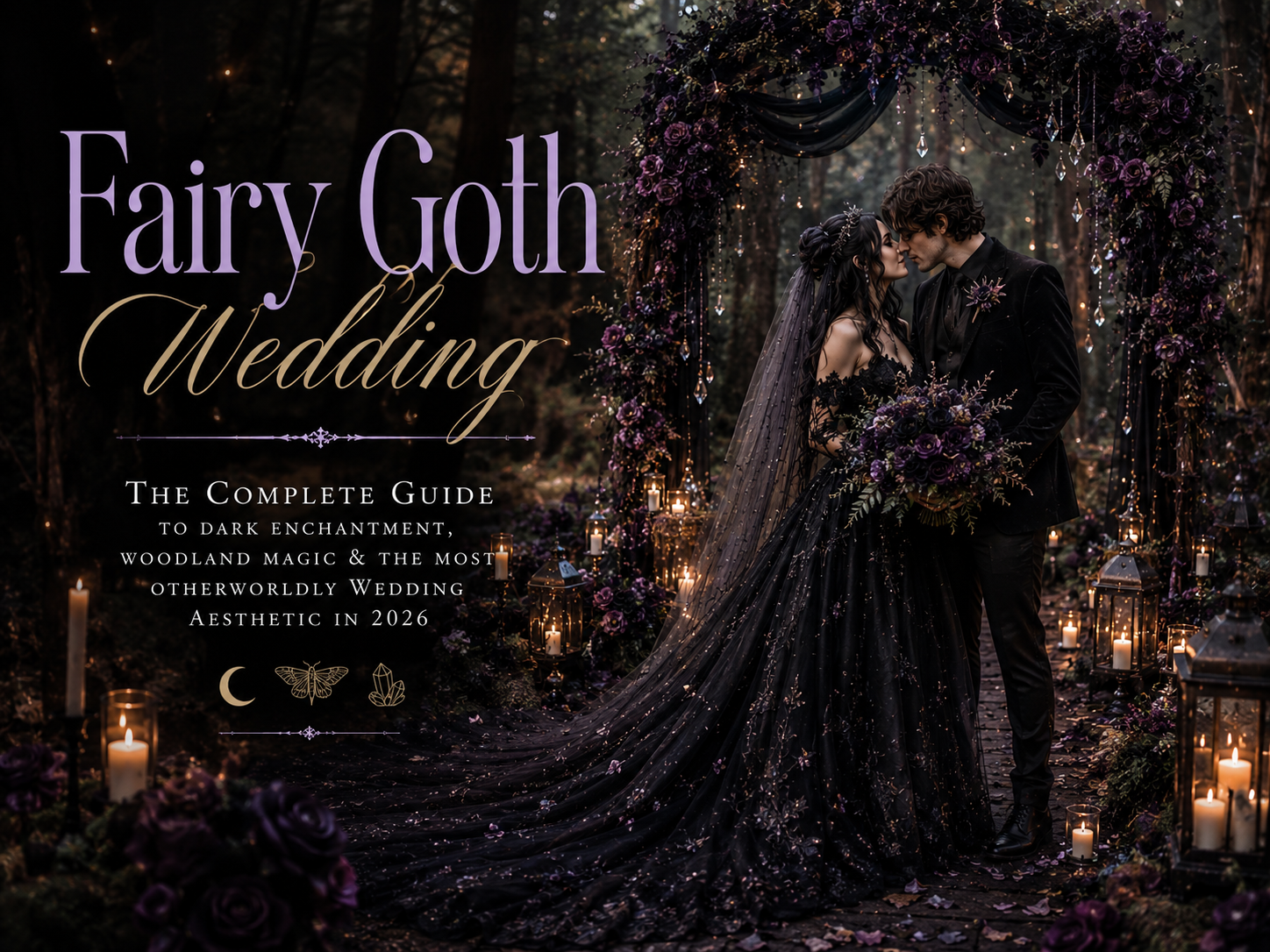
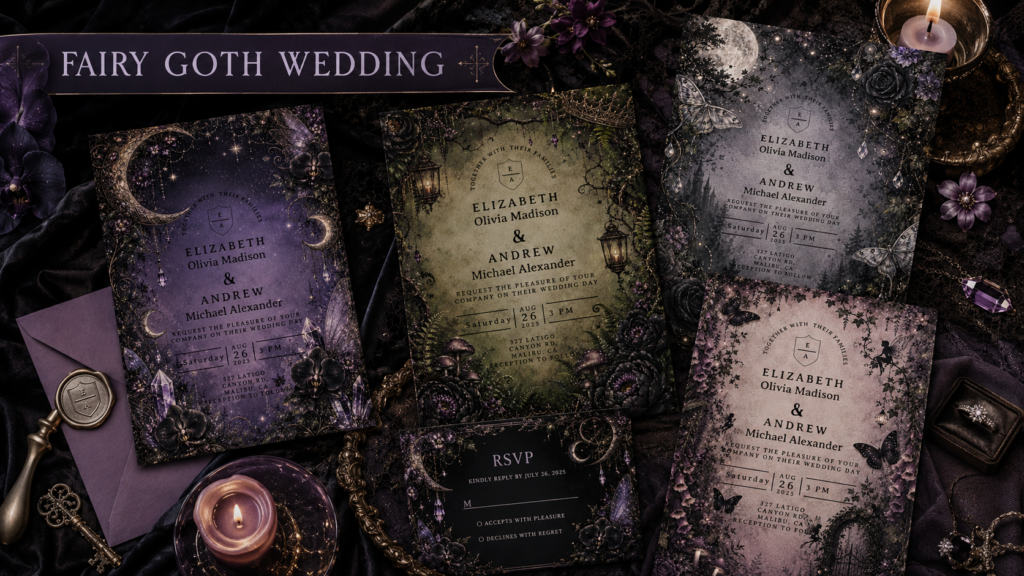
Fairy Goth Wedding
The Complete Guide to Dark Enchantment, Woodland Magic & the Most Otherworldly Wedding Aesthetic in 2026
From moonlit forest ceremonies and dark floral crowns to mushroom-scattered tablescapes, hanging lantern canopies, and the specific visual world where ancient fairy tale darkness and gothic romanticism discover they have always been describing the same place — your complete guide to the fairy goth wedding.
The fairy tale was never about the happy ending. It was always about the forest you had to pass through to reach it — the specific quality of beautiful darkness that exists in the old stories before they were softened, the world of ancient woods and fey creatures and the particular terror of genuinely magical things. The fairy goth wedding inhabits that original darkness and calls it home.
Section One
What Is a Fairy Goth Wedding?
The fairy goth wedding draws on the oldest and the darkest layer of the fairy tale tradition — not the sanitised Victorian nursery version of fairy tales or the Disney animated adaptation, but the pre-Grimm folk stories and the Celtic and Norse mythological traditions in which the fairy world is genuinely, seriously dangerous and genuinely, seriously beautiful simultaneously. In these older stories, the fairy realm is not a safe place of sparkle and glamour but a place of profound ambiguity: a world of extraordinary beauty that operates by different rules from the human world, that offers gifts with costs attached, that makes promises that bind irrevocably, and that communicates, through every element of its specific sensory world, the specific quality of enchantment that is the most powerful form of beauty — the beauty that is also a kind of captivity, the attraction that is also a kind of threat.
The fairy goth wedding inhabits this older, darker fairy tradition and uses it as the primary creative material of a genuinely extraordinary celebration. It is not a fairy wedding made gothic by adding dark colours to a whimsical brief. It is a gothic wedding whose specific aesthetic direction is the ancient fairy tale — whose venue is the enchanted forest rather than the castle, whose botanical language is the wild and slightly dangerous beauty of ferns and foxgloves and mushrooms and moss rather than the cultivated luxury of dark roses and formal botanical abundance, whose atmosphere is one of wild, moonlit, barely controlled enchantment rather than formal ceremony. It belongs to the couples whose imagination was shaped by Angela Carter and A Midsummer Night’s Dream and the original Grimm Brothers and the Celtic tradition of the fair folk — who have always known that the most beautiful things in the old stories are also the most dangerous, and who want their wedding to communicate that specific, irreducible quality of dark wonder.
From the Fairy Tale Tradition
- The enchanted forest as the primary setting — ancient, wild, ambiguous
- Ferns, foxgloves, mushrooms, and moss as the botanical vocabulary
- The fairy ring, the hollow tree, the moonlit clearing as sacred spaces
- Wings, ethereal fabric, the quality of something not quite of this world
- The moon and the stars as the light sources — not the sun
- Mushrooms, toadstools, and fungi as the fairy realm’s most characteristic objects
- Wildness, unpredictability, and the specific beauty of untamed things
From the Gothic Tradition
- Darkness as a creative tool rather than a problem to overcome
- Atmospheric depth — the cultivation of specific, immersive sensory experience
- Dark florals and deep, jewel-toned colour against forest green and deep shadow
- Symbolic richness — the use of objects that carry ancient meaning
- Candlelight and lantern light as atmospheric rather than merely practical illumination
- The romantic tradition of the beautiful and dangerous coexisting in the same moment
- The forest as a genuinely sacred space rather than a decorative backdrop
Section Two
Five Fairy Goth Directions
The fairy goth wedding encompasses several distinct aesthetic directions, each drawing on a different aspect of the dark fairy tradition and producing a completely different visual world. Identifying which direction belongs to your specific imagination is the most important creative decision in fairy goth wedding planning.
01
Dark Enchanted Forest
The most completely immersive and the most photogenically powerful of all fairy goth directions — a celebration built entirely within the atmosphere of a genuinely ancient forest at its most enchanted: moss-covered trees with roots that look like they are walking, a canopy so dense and complete that the light beneath it is always green-filtered and mysterious, clearings where rings of mushrooms and ferns suggest the recent presence of something that is not quite visible. The dark enchanted forest direction uses the forest’s own atmospheric qualities as its primary creative material, adding lanterns and dark florals and the couple’s dark and otherworldly fashion as the human elements within a setting that is already, by itself, doing most of the creative work. It is the most demanding of all fairy goth directions to find the right venue for — genuinely ancient, genuinely atmospheric woodland is not everywhere — but the least demanding to decorate, because the right forest requires almost nothing added to communicate its specific quality of dark enchantment.
02
The Unseelie Court
In Scottish fairy mythology, the fairy realm is divided into the Seelie Court — the benevolent, light-aspected fairy nobility — and the Unseelie Court — the darker, more dangerous, and considerably more interesting half of the fairy world. The Unseelie Court wedding is the fairy goth direction at its most specifically mythologically grounded: deep, dark, richly coloured, and fully committed to the understanding that the most powerful fairy magic is always the kind that comes with a cost. The palette is midnight blue, deep plum, and forest green rather than the lighter, dewier tones of the conventional fairy aesthetic. The fashion is elaborate, structured, and otherworldly. The decorative language reaches for the specific imagery of Celtic fairy mythology — iron and silver as protective metals, thistle and rowan as boundary plants, the fairy ring and the hollow hill as sacred geographies.

03
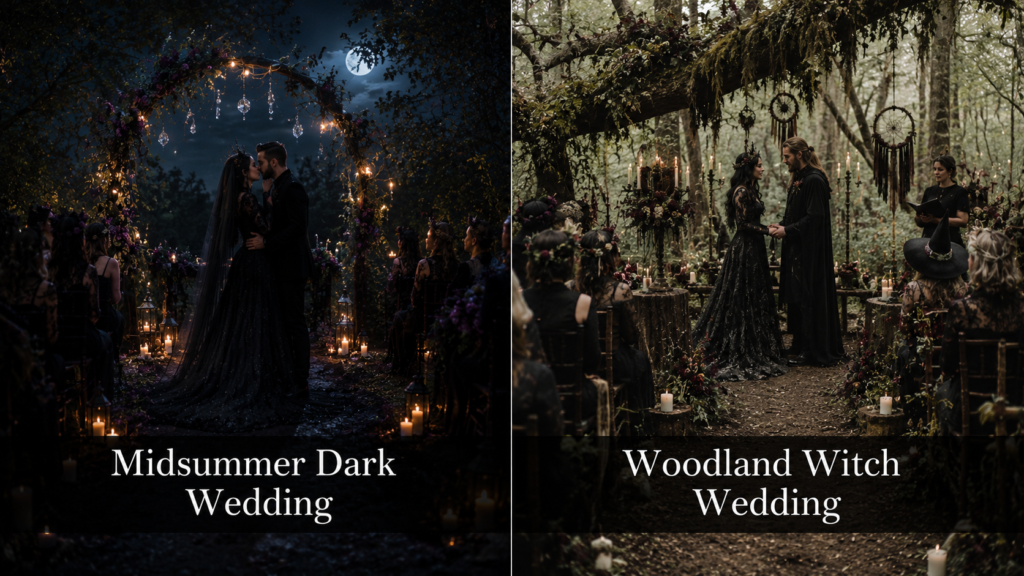
Midsummer Dark
Shakespeare’s A Midsummer Night’s Dream is the most widely referenced fairy narrative in Western culture, and the Midsummer Dark direction draws on its specific world — the enchanted forest outside Athens where the fairy court holds its revels, where the rules of the human world do not apply, and where the boundary between love and enchantment, between desire and magic, is deliberately and beautifully unclear. This direction is warmer and more playful than the pure Unseelie aesthetic — it allows more colour, more whimsy, more flowers, and a quality of dark celebration rather than dark ceremony. The palette draws on the night-flowering garden: pale moonflowers, dark roses, silvery ferns, and the specific quality of the forest at midsummer night when it is never entirely dark. The most broadly appealing and the most accessible of all fairy goth directions.
04
Woodland Witch
The intersection of the fairy goth and the witchy wedding aesthetics — a celebration that draws on the specific visual world of the hedge witch, the herbalist, the woman of the wood who knows the names and uses of every plant that grows within a day’s walk of her door. The woodland witch direction is more botanical and more earth-grounded than the other fairy goth directions — its magic is herbcraft and plant knowledge rather than fairy glamour — but it shares with the rest of the aesthetic the understanding that the forest is the place where power lives, that wild things are beautiful precisely because they are wild, and that the most serious and the most personally meaningful of all ceremonies are those conducted with genuine knowledge of and genuine respect for the natural world they inhabit.
05
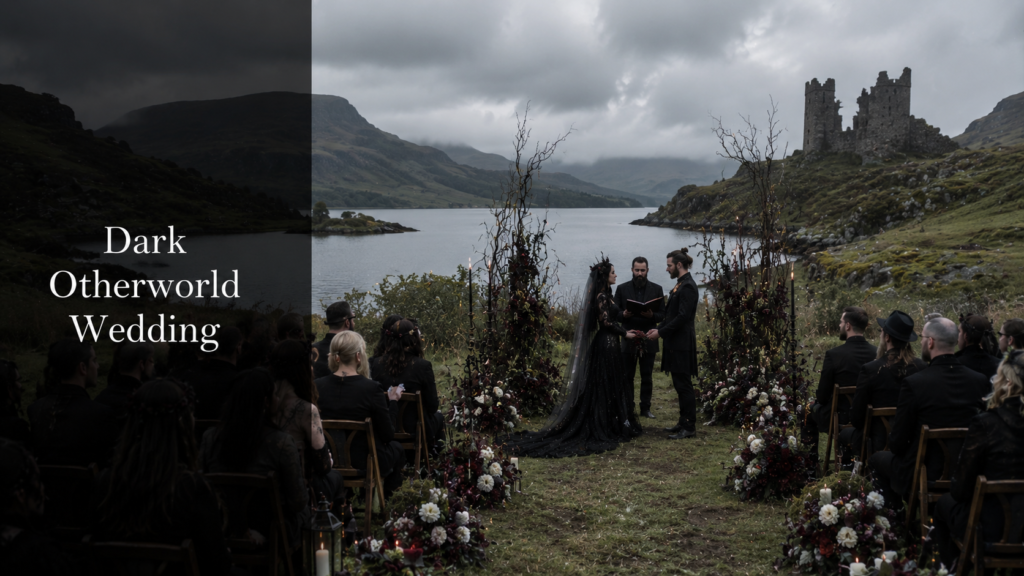
Dark Otherworld
The most aesthetically ambitious of all fairy goth directions — a celebration that reaches for the quality of being genuinely other: not of this world, operating by different rules, creating the specific impression that the guests have been transported somewhere that cannot quite be located in any geography they recognise. The dark otherworld direction uses every available aesthetic tool to create this effect — elaborate costume rather than conventional fashion, a venue transformed beyond recognition through light and botanical installation, food and drink of startling strangeness and beauty, rituals and ceremony structures drawn from mythology rather than convention. It is the most demanding of all fairy goth directions to execute and the most completely unforgettable when it succeeds.
Section Three
The Fairy Goth Colour Palette
The fairy goth palette draws from the forest at night rather than the forest in daylight — the specific tonal world of deep green, deep shadow, the silver of moonlight on wet leaves, the specific amber of a single lantern against deep darkness, the pale luminescence of mushrooms and bioluminescent moss, the brief vivid colour of night-flowering plants that reserve their bloom for after dark. It is a palette in which green — deep forest green, mossy grey-green, the cold blue-green of lichen — plays a more central role than in any other gothic palette, and in which the contrast between deep organic darkness and small, specific points of warm or cool light creates the primary visual drama rather than the contrast between a dark ground and lighter tonal elements across a broader surface.
Forest Midnight
The darkest possible green-black — the forest floor at 2am
Midnight Indigo
The night sky between the canopy — deep blue-black
Deep Forest Green
The defining fairy goth tone — alive, deep, ancient
Moss & Lichen
The textured grey-green covering every ancient surface
Dark Violet
Foxglove and nightshade — the fairy realm’s signature flowers
Amber Lantern
The warmth of a single flame in total darkness
Pale Moonlight
The silver-green of moonlight on forest leaves
Mushroom & Earth
The warm brown-pink of woodland fungi
Bone & Antler
The pale organic matter of forest floor bones
Silver & Cold Light
Moonlight and silver — the fey metallic
Section Four
Fairy Goth Wedding Fashion
Fairy goth bridal fashion is the most imaginatively ambitious and the most genuinely costume-adjacent of all dark wedding fashion directions — because the fairy goth aesthetic demands not simply a beautiful dark dress but a garment that communicates a quality of otherness, of belonging to a world that is not quite this one. The fairy goth bride is not someone who has dressed beautifully for a wedding. She is someone who has arrived from somewhere else, trailing the specific quality of the enchanted world she inhabits — the forest floor in her train, the moonlight in her fabric, the flowers of the otherworld in her crown. The most powerful fairy goth bridal looks are those that make the viewer uncertain, for just a moment, whether the person wearing them is entirely human — and the means of achieving this effect is a combination of the most beautifully otherworldly silhouettes, the most organically botanical surface decoration, and the specific accessories that communicate the fairy tradition through its own material symbols.
Bridal Looks
- Flowing dark green velvet or silk gown — deep forest green is the fairy goth bride’s most completely characteristic colour; a flowing, long-trained velvet or silk gown in forest midnight or deep moss green communicates the fairy tradition through the colour itself rather than through decorative addition, and photographs with the specific quality of a figure that belongs to the woodland setting rather than merely visiting it
- Draped ethereal dark organza or chiffon with botanical layers — multiple sheer layers in deep green, midnight indigo, or near-black, each slightly different in tone, creating the specific quality of depth and translucency that the fairy goth aesthetic requires; botanical embroidery or appliqué in the layers visible at different depths as the fabric moves
- Dark fern and moss embroidered lace — lace with a specifically woodland botanical pattern: fern fronds, spiralling fiddlehead ferns, ivy trails, and the occasional mushroom cap embroidered or woven into the lace structure rather than conventional floral motifs
- Fairy wings — the most immediately recognisable fairy goth bridal accessory: structured wings in dark organza, black lace, or iridescent insect-wing patterns attached to the back of the gown; worn for the ceremony and portraits and removed for the reception; communicating the aesthetic’s fundamental quality of otherness in the single most visually dramatic way available
- Twig and mushroom crown — a handmade crown incorporating real or replica mushroom caps, twisted twigs, dark botanical elements, moss, and small dark flowers; the most completely fairy goth of all bridal headpieces and the one that most directly references the forest floor aesthetic of the tradition
- Bare feet or dark leather wrapped sandals — for genuine forest ceremonies; the contact between foot and forest floor communicating the fairy goth aesthetic’s fundamental quality of belonging to the land rather than standing above it
Groom Looks
- Dark forest green velvet jacket — the groom’s garment that most completely communicates the fairy goth aesthetic through colour and material simultaneously; forest green velvet in a fitted, slightly old-fashioned silhouette communicates the fairy court aesthetic with complete immediacy
- Dark moss or ivy-patterned waistcoat — botanical pattern in dark thread on a dark ground, visible at close range as a living, growing thing in a garment that might otherwise read as merely dark and formal
- Antler crown or circlet — the most dramatically mythological of all fairy goth groom accessories; a crown of real or replica antler communicates the specific quality of the wild woodland lord, the horned consort of the forest queen, with a directness and a visual power that no other groom accessory approaches
- Dark linen or velvet trousers with forest leather boots — trousers and boots that communicate the quality of someone who is actually dressed for a forest rather than performing being in one; worn leather, dark linen, natural fibre
- Forest botanical buttonhole — ferns, moss, a small mushroom cap, dark berries, and a single foxglove bell; the specific botanical world of the fairy goth aesthetic communicated through the groom’s most visible botanical detail
Section Five
The Fairy Goth Botanical World: Plants of the Enchanted Forest
The botanical vocabulary of the fairy goth wedding is the most specifically ecological and the most mythologically loaded of all dark wedding floral directions — because every plant that grows in the genuine fairy goth botanical world carries a specific folk tradition of magical significance that is as old as the settlement of the landscapes where these plants grow. Foxglove — whose folk name is literally Fairy Gloves in most European traditions — is poisonous, beautiful, and specifically associated with fairy magic in every culture that knows it. Mushrooms and fungi, growing overnight in circles where fairies are said to have danced, carry the most directly fairy-associated symbolism available in the entire botanical world. These are not flowers chosen because they are dark or because they belong to a gothic colour palette. They are plants chosen because they genuinely belong to the specific world the celebration is inhabiting.
🌿 Foxglove
The defining fairy goth botanical — its folk name (Fairy Gloves, Fairy Fingers, Fairy Bells in different European languages) making it the most directly named plant of the fairy tradition available in the wedding flora. Its tall, dramatic spike of descending bells in dusty rose, purple, and white-spotted interior communicates beauty and danger simultaneously — it is one of the most beautiful wildflowers and one of the most poisonous European plants. A single foxglove spike rising above a forest floor arrangement communicates the fairy goth aesthetic with complete botanical authority.
🍄 Mushrooms & Fungi
The most completely fairy-specific of all decorative elements — fairy rings of mushrooms are the oldest and the most cross-culturally consistent symbol of fairy presence in the natural world. Dried or replica mushroom caps used as table decoration, crown elements, and bouquet additions communicate the fairy goth aesthetic with a specificity that no flower can match. Fly agaric (the red-and-white-spotted toadstool of fairy tale illustration) is the most immediately recognisable; dried porcini, oyster, and other edible varieties provide a more organic and less cartoonish fairy ring aesthetic.
🌿 Ferns & Fiddleheads
The prehistoric quality of ferns — species that were ancient before the first flower evolved — communicates a depth of time that no flowering plant can approach, and this quality of being both alive and ancient is one of the most fundamental qualities of the fairy goth aesthetic. Fiddlehead ferns, not yet unfurled, have the specific curling spiral form that most directly references the uncanny quality of the forest floor as it appears in the old stories — a world of coiled potential and growing things that are not yet what they will become.
🌿 Ivy & Trailing Vine
Ivy is the most persistent and the most symbolically complex of all the woodland climbing plants — it covers everything eventually, communicating both the persistence of the natural world and the specific quality of things that have been abandoned to nature’s reclamation. In the fairy goth context, trailing ivy communicates the specific quality of a world that is growing over and through the human-built environment, claiming it back for the woodland. Long trails of dark ivy extending from table arrangements, from arches, and from the bride’s bouquet communicate this quality directly and beautifully.
🍃 Moss & Lichen
Preserved sheet moss as the primary ground surface for all table decoration — replacing tablecloths and floral runners with the actual living surface of the forest floor, creating a table that looks as though the forest has simply grown up through it. Lichen-covered branches for structural elements. Cushion moss around candle bases. The texture and the specific grey-green of moss is the fairy goth aesthetic’s most characteristic surface quality, communicating the enchanted world through touch and sight simultaneously in a way that no flower can.
🌸 Dark Flowers of the Forest
Anemones in dark purple and near-black, wood violets, dark sweet peas, hellebores, and the specific dark small flowers of the forest floor — not the large-headed cultivated flowers of the formal floral tradition but the smaller, wilder, more botanically specific flowers that actually grow in woodland settings. Dark anemones are the most dramatically beautiful of the woodland flower species; hellebores are the most specifically winter-appropriate and the most gothic in their tendency to face downward, concealing rather than displaying their beauty.
Section Six
The Fairy Goth Ceremony
The fairy goth ceremony is the most theatrically ambitious and the most completely immersive of all dark wedding ceremony formats — because the fairy tale tradition demands not simply a beautiful setting but a genuinely otherworldly experience: the specific quality of having passed through a boundary into a place that operates by different rules. The ceremony space should feel like a discovery rather than a construction — as though the guests have wandered into a clearing that was already there, already decorated by something that pre-dates their arrival, already waiting for this specific ceremony.
The Enchanted Clearing
A ceremony conducted in a natural forest clearing, with the ceremony space marked by a circle of lanterns and mushroom clusters rather than a constructed arch — as though the clearing itself is the ceremony space and the couple is the most recent of many ceremonies held within it. A twig-and-moss arch at the head of the clearing, or no arch at all — just the treeline and the specific quality of filtered light entering the clearing from above.
The Hanging Lantern Canopy
Hundreds of iron lanterns and glass baubles hung from the trees above the ceremony space at varying heights — creating a canopy of amber and silver light above the forest floor that transforms the ceremony space into the fairy court’s own realm. Best at dusk or in the specific window between natural light and full darkness when the lanterns and the remaining daylight are in balance, creating the specific quality of liminal lighting that the fairy goth aesthetic requires.
The Fairy Ring Ceremony
A ceremony conducted within a circle of mushrooms — real or decorative, arranged in the traditional fairy ring formation on the forest floor — with the couple, the officiant, and the essential witnesses within the circle and the other guests arranged outside it. The fairy ring as ceremony boundary is the most mythologically direct gesture available in the fairy goth aesthetic, and it creates a ceremony space whose meaning is immediately legible to everyone who has ever encountered the old stories.
Dusk Timing
The fairy goth ceremony belongs at dusk — the liminal hour when the rules of the day world no longer fully apply and the rules of the night world have not yet fully taken over. The specific quality of the forest at dusk, when the canopy absorbs the last light and the first lanterns come into their own against the gathering darkness, creates the most completely fairy goth atmospheric moment available in any outdoor ceremony context. Plan the ceremony to begin at the earliest moment that the lanterns are visible as warm light against the surrounding darkness.
Section Seven
The Fairy Goth Reception: The Forest Feast
The fairy goth reception is the forest feast of the old stories — the legendary banquets of the fairy court that are described in the folk traditions as simultaneously the most beautiful and the most dangerous meals anyone could attend, where the food is extraordinary and the cost of eating it is to belong to the fairy realm forever. The fairy goth reception table should communicate this quality of abundant, almost excessive beauty — a table that looks as though it was set by something that has no practical constraints, that gathered everything from the forest and arranged it with the same lavish, slightly unnerving generosity that the fairy tradition always associates with the otherworld’s hospitality.
The Forest Floor Table
- Full moss surface runner replacing any conventional table covering — preserved sheet moss laid the full length of the table, with all botanical arrangements, candles, and objects placed directly within it as though growing from it
- Mushroom and toadstool clusters at intervals along the moss surface — dried or high-quality replica mushrooms in natural woodland species, communicating the fairy ring aesthetic at the intimate scale of the table
- Twisted branch and twig candleholders — naturally fallen branches from the forest floor incorporated into the table arrangement, their irregular forms providing structure without manufactured regularity
- Iron and aged copper lanterns rather than conventional candleholders, their warm amber light creating pools of illumination within the darker surrounding moss surface
- Place cards on leaves or bark slices — each guest’s name written on a large fallen leaf or a slice of naturally fallen branch, pressed into the moss at their setting
The Fairy Feast Details
- Wild and foraged food elements — blackberries, sloes, dark plums, wild mushrooms, elderflower cordials, and foraging-inspired dishes that communicate the forest’s abundance through the food itself
- Fairy ring cocktails — signature drinks with mushroom tinctures, elderflower, dark forest berry cordials, and the specific quality of forest botanical flavour that distinguishes them from conventional cocktails
- Dark forest berry favors — small jars of wild berry preserve or elderflower cordial from the specific botanical world of the celebration, labeled with dark fairy tale typography
- Crystal and mineral table scatter — raw crystal, quartz points, obsidian, and dark tourmaline placed among the moss as the gemstone world of the forest floor
- Living plant elements — small ferns and mosses in dark ceramic pots as the centrepiece base, communicating the living forest through genuinely living plants rather than purely through cut flowers
Section Eight
Fairy Goth Wedding Cakes
The fairy goth wedding cake is the most fantastical and the most completely world-building of all alternative wedding cake directions — because the fairy cake at its best is an object that communicates a genuinely otherworldly visual world, something that could not exist in ordinary circumstances and that makes the guest receiving a slice feel that they are participating in something rather more significant than a conventional celebration dessert. The most powerful fairy goth cakes are those that look as though they were made in the forest rather than brought to it — as though the baker used the specific ingredients of the fairy realm and decorated the surface with objects gathered from the forest floor that morning.
The Enchanted Forest Cake
A dark-toned cake in forest green, near-black, or deep moss with sugar mushrooms, edible moss, fern impressions, and the full botanical vocabulary of the fairy goth world covering its surface. Sugar foxgloves and anemones as the primary floral elements. Preserved or sugar mushroom clusters at the base, appearing to grow from the cake stand surface into the bottom tier. The most completely world-communicating of all fairy goth cake formats — a cake that looks as though it emerged from the forest floor rather than having been placed upon it.
Moonlit Watercolour Cake
A smooth buttercream cake with a watercolour wash in midnight blue, forest green, and silver — the colours of the forest at night, the moonlit clearing, the specific quality of light that exists in the fairy goth world between full darkness and the first hint of dawn. Painted silhouettes of bare trees and flying creatures at the boundaries between colour areas. Small silver and crystal accents at the tier edges communicating moonlight and frost. The most painterly and the most atmospherically subtle of all fairy goth cake formats.
The Mushroom Tower Cake
An unconventional structure — not a tiered cake in the conventional format but a cluster of individual cakes at varying heights, each decorated as a different mushroom species with the specific colours, gills, and surface textures of the toadstool world. Fly agaric, porcini, oyster, chanterelle — each individual element botanically specific. The most dramatically fairy-specific of all cake formats and the one that most directly communicates the aesthetic through the three-dimensional form of the cake itself rather than through its surface decoration.
Section Nine
Fairy Goth Photography
Fairy goth wedding photography is defined by the specific quality of light that exists in the forest at dusk — the transitional moment when the canopy has absorbed the last of the day’s direct light and the lanterns are beginning to compete with rather than supplement the ambient, when the forest floor takes on the specific quality of deep, blue-green shadow in which the warm points of flame light appear to float rather than to illuminate. This is the light that the fairy goth aesthetic exists in, and the photographer who understands how to work within it — who knows how to expose the warmth of the lanterns without losing the cool depth of the surrounding forest, how to use the layering of the woodland’s depth as a compositional structure, and how to render the specific otherworldly quality of dark green velvet or trailing dark wings against moss-covered roots — will produce images of genuinely extraordinary power.
The Lantern Canopy Portrait
The couple photographed from below with the full hanging lantern installation visible above them — hundreds of amber lights against the dark canopy, the forest floor below deep with shadow and moss, the couple within a pool of warm light that appears to come from every direction simultaneously. The most completely fairy court atmospheric image available in wedding photography and the one that most directly communicates the specific quality of the enchanted realm through a single frame.
Wings in the Forest
The bride in dark wings photographed from behind in a forest setting — her wings, her train, and the forest’s own botanical abundance all visible simultaneously, the human figure and the fairy tradition and the natural world existing in the same frame with complete compositional unity. One of the most immediately distinctive and the most widely saved fairy goth wedding images available, communicating the aesthetic’s fundamental quality — the human who is also something more — in a single portrait.
Fairy Ring Aerial
A drone or elevated photograph of the fairy ring ceremony space — the circle of mushrooms or lanterns visible from above, the couple within it, the forest floor surrounding them covered in moss and fern. The aerial perspective communicates the geometry of the fairy ring in a way that ground-level photography cannot and provides a specifically magical quality of seeing the ceremony space as though from the perspective of the fairy court itself — looking down from the canopy at the human ritual being conducted below.
Mushroom Crown Close-Up
A close portrait of the twig and mushroom crown in detail — the specific textures of the dried mushroom caps, the lichen-covered twigs, the small dark flowers and moss elements photographed in raking natural light that reveals every botanical detail. The most materially specific of all fairy goth bridal accessory images and the one that most powerfully communicates the aesthetic’s specific relationship with the botanical world of the forest floor.
Forest Mist at Dawn or Dusk
Morning or evening forest mist — when the specific quality of ground-level vapour transforms every tree and path into something existing at a different depth of focus, making the forest look genuinely otherworldly — produces the most atmospheric and the most directly fairy-communicating natural photographic condition available. A portrait in forest mist in dark clothing communicates the quality of having stepped out of the fog from somewhere else with immediate and irreplaceable visual power.
Train on the Forest Floor
The dark-trained gown photographed from behind with the train spread across the moss and fern-covered forest floor — the fabric gathering botanical material as it trails, the boundary between the dress and the forest becoming deliberately unclear. The bride’s wings, if present, visible above the train. The most completely fairy goth bridal portrait available and the one that most directly communicates the aesthetic’s defining quality: the human who belongs to the forest.
Bonus — Highly Shareable
10 Fairy Goth Wedding Images Everyone Saves on Pinterest
The photographs and design decisions that consistently drive the highest saves, shares, and inquiries across all wedding platforms in the dark enchantment niche.
01
Dark Winged Bride in Ancient Forest
A bride in dark wings and forest green velvet photographed from behind in ancient woodland — the wings, the train, and the forest visible in a single frame that makes the viewer genuinely uncertain whether the figure is arriving or departing, human or fey. The defining fairy goth wedding image and the most widely saved in the alternative bridal space.
02
Hanging Lantern Canopy at Dusk
Hundreds of iron lanterns hanging from forest branches at dusk — the moment when the amber of the flames competes with the remaining blue of the darkening sky, the forest below the canopy in deep shadow with the couple illuminated at its centre. The most atmospheric fairy goth ceremony image available and one of the most powerful in all of alternative wedding photography.
03
Mushroom Tower Cake on Moss Surface
The mushroom tower cake or enchanted forest cake photographed on a moss-covered surface with the forest floor visible around its base — toadstool clusters, fern fronds, and small dark flowers surrounding it, the cake appearing to have grown from the same ecological world as the botanical matter around it. The most completely fairy goth cake image and the most immediately distinctive from any conventional wedding cake photograph.
04
Fairy Ring Ceremony From Above
Aerial photograph of the fairy ring ceremony — the circle of mushrooms or lanterns visible from above, the couple within it, the forest floor’s botanical complexity visible in all directions. The aerial perspective communicates the fairy ring’s geometry with a clarity impossible from ground level and provides one of the most distinctive ceremony photographs in all of alternative bridal imagery.
05
Forest Floor Table Detail
The reception table with its full moss surface, mushroom clusters, twig candleholders, iron lanterns, and the complete fairy goth botanical world — photographed from the end of the table so the full length of the moss runner and botanical abundance is visible, with the forest itself visible in the background beyond the table. The most completely world-communicating fairy goth table image.
06
Twig and Mushroom Crown Detail
Close portrait showing the full detail of the twig and mushroom crown — dried mushroom caps, lichen-covered twigs, small dark flowers and moss elements in raking natural light. The most materially specific fairy goth bridal accessory image and the one that most directly communicates the aesthetic’s relationship with the botanical world.
07
Couple in Morning Forest Mist
The couple photographed in morning or dusk forest mist — the vapour turning every tree and path into a different depth of focus, the human figures the most solid and the most present elements in a landscape that seems to be only partially materialised. The most completely otherworldly natural photographic condition available, and the one that most directly communicates the fairy goth aesthetic without a single decorative element added.
08
Dark Train on Moss and Fern
The dark-trained gown photographed from behind, train spread across moss and fern-covered forest floor — the fabric and the botanical matter merging at the edges, the boundary between the dress and the forest deliberately unclear. With wings visible above if present. Among the most consistently saved fairy goth bridal portrait formats across all alternative wedding platforms.
09
Groom in Antler Crown With Forest Green
The groom in antler crown and forest green velvet photographed against ancient woodland — the antler communicating the horned consort of old mythology, the forest green communicating belonging to the woodland world rather than visiting it. One of the most completely fairy goth groom portrait formats and the one that most powerfully communicates the male aesthetic of the tradition.
10
Foxglove Bouquet Detail
A close portrait showing a foxglove spike rising above the bouquet — its descending bells, its spotted interior, its specific quality of beautiful-and-poisonous communicating the fairy goth aesthetic’s defining paradox in the most directly named botanical form available. The single species that most completely, in its folk name alone, belongs to the world being celebrated.
“The old stories were not wrong to be afraid of the fairy world. They were afraid of it for the same reason they were drawn to it — because the place where the most extraordinary beauty exists is always also the place where the ordinary rules stop applying, and that is both the most dangerous thing imaginable and the only place where a genuine celebration can occur.”
— The Dark Wedding Edit
Final Thoughts
Find the Ancient Forest. Enter at Dusk. Trust the Darkness to Know What It Is Doing.
The fairy goth wedding succeeds when the couple stops treating the fairy tale as a theme to apply to a conventional celebration and starts treating it as the literal world they are building for the day — when the forest is not a backdrop but the primary location and the primary creative force, when the botanicals are not decorations but named species with specific folk histories, when the dusk timing is not a preference but a necessity, and when the darkness is not a problem to be managed with enough candles but the specific quality of atmosphere that makes the whole experience what it needs to be. The fairy realm of the old stories was always available to those who were prepared to enter it on its own terms rather than on the visitor’s terms — who were willing to accept its rules, to eat its food, to stay past the point where the safe path back was clearly visible. The fairy goth wedding is the celebration for the couple who is willing to do exactly that.
Choose the direction that belongs to your specific relationship with the old stories. Find the woodland — genuinely ancient, genuinely atmospheric, genuinely the kind of place where the rules might be different — and visit it at the time of day and the season you intend to use it. Choose fashion that communicates otherness rather than merely beauty. Build the botanical world from named species that carry the specific folk history of the fairy tradition. Time the ceremony for dusk. Hang the lanterns high enough and in sufficient number that the canopy of light above the ceremony space has the specific quality of a sky that belongs to a different world. And when the last of the day’s light has left the forest and the lanterns are the only thing between the ceremony and the genuine darkness of the ancient woodland — allow the forest to do what it has always done, which is to make the human celebration occurring within it feel, in the specific and entirely accurate terms of the old stories, genuinely enchanted.