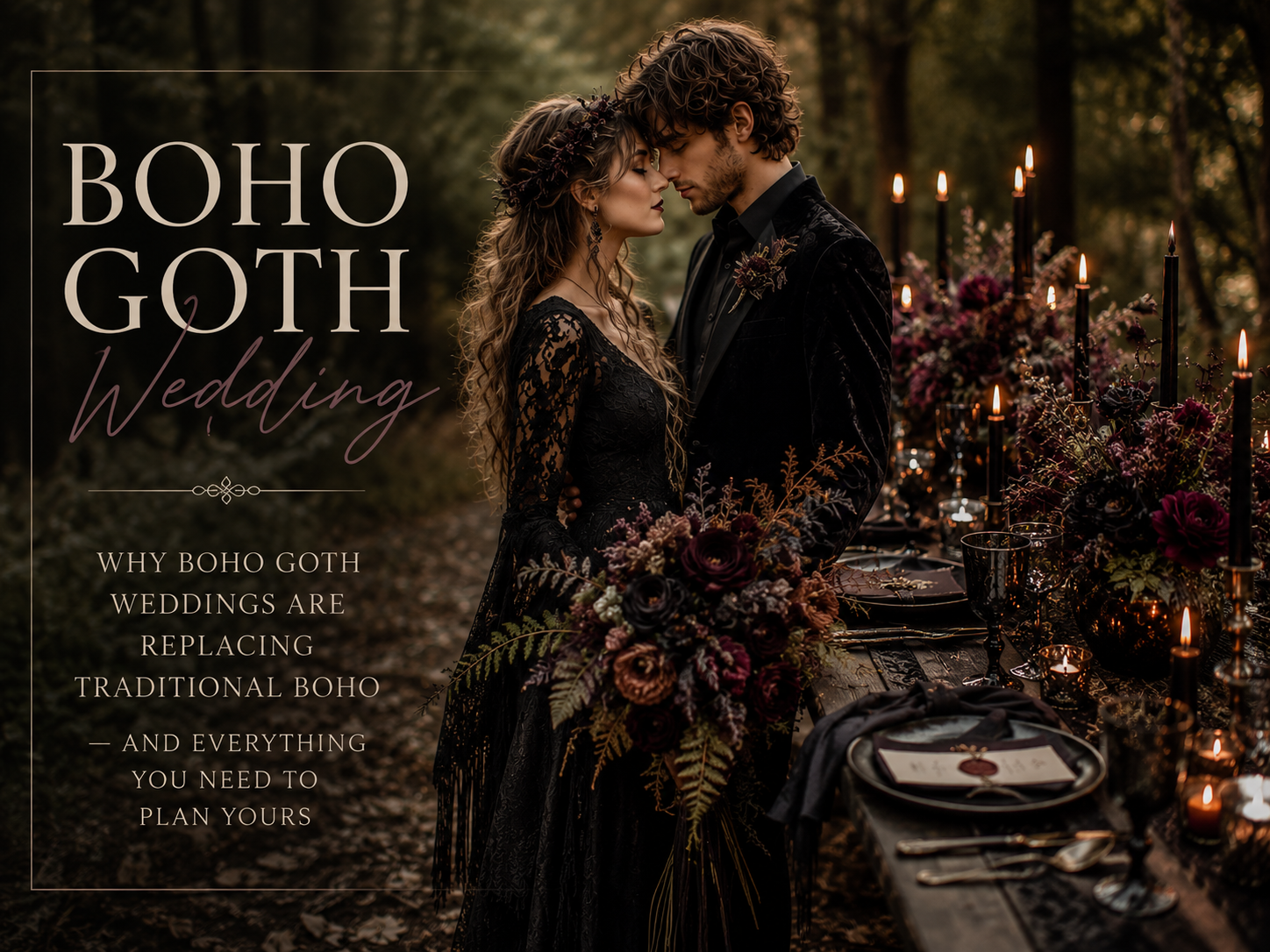
Boho Goth Wedding
The Dark Boho Wedding Edit · 2026
Boho Goth Wedding
Why Boho Goth Weddings Are Replacing Traditional Boho — and Everything You Need to Plan Yours
From dark florals and moody palettes to the specific fashion, venues, photography, and styling decisions that make the boho goth wedding the most visually powerful and the most personally expressive direction in alternative bridal design in 2026.
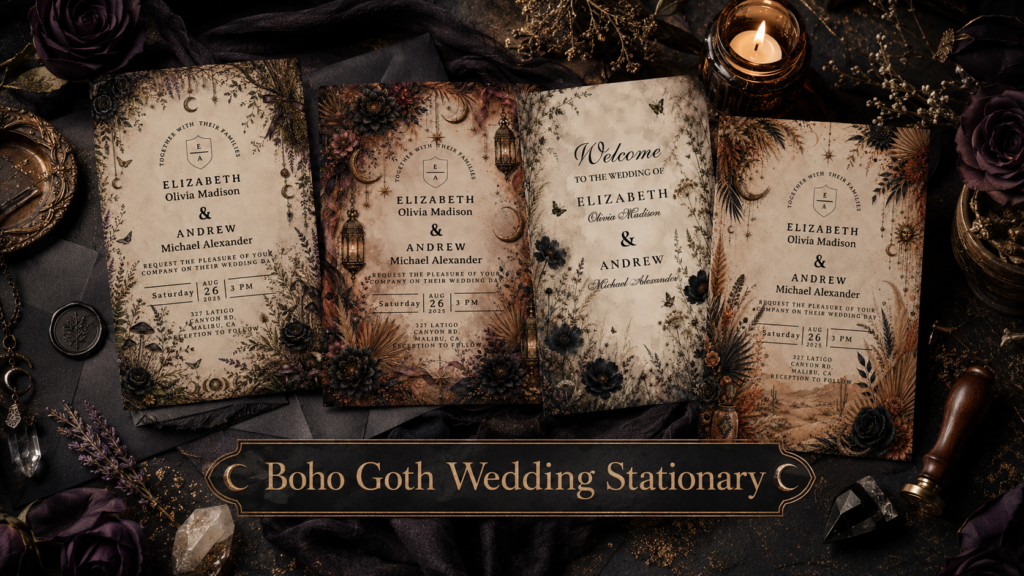
The boho goth wedding is not a boho wedding that has been made darker, and it is not a goth wedding that has been made lighter. It is the specific place where the wild freedom of the bohemian tradition and the deep, symbolically rich darkness of the gothic one meet and discover, to the surprise of couples who find them there, that they have always had far more in common than anyone thought.
The Evolution
Why Boho Goth Weddings Are Replacing Traditional Boho
Something has been happening quietly in bridal design for the past several years, and it has now become impossible to ignore: the traditional boho wedding — the aesthetic that defined alternative bridal fashion for the better part of a decade — has reached the end of its creative life cycle. Not because it was ever not beautiful, but because it became, through sheer repetition and commercial saturation, entirely predictable. You know what it looks like before you see it. Beige pampas grass in identical arrangements. A neutral palette of cream and sand and dried nothing. A macramé backdrop that is present at every fourth wedding in any given venue’s portfolio. A flowing white dress on a bride who wanted to be different and ended up looking like the photograph she was trying to recreate. The traditional boho wedding became, ironically, the most conventional of all the alternative wedding aesthetics — and couples who wanted genuine individuality, genuine emotional atmosphere, and genuine creative surprise began looking for what came next.
What came next is the boho goth wedding — and it is replacing the traditional boho not by discarding everything the boho tradition built but by deepening it, enriching it, and giving it back the quality of genuine creative surprise and genuine emotional depth that repetition had eroded. The wildflowers are still there, but they are dark dahlias and chocolate cosmos alongside the pampas. The organic, untamed quality of the floral aesthetic is still there, but it has acquired a gothic depth of colour and symbolic richness that the beige-and-neutral palette never possessed. The flowing, free-spirited fashion is still there, but it is in deep plum and midnight and near-black as readily as in ivory and white. The result is a wedding aesthetic that is simultaneously familiar and surprising, simultaneously relaxed and profound — and that produces photographs of a visual complexity and emotional depth that the traditional boho wedding, for all its genuine beauty, was never able to achieve.
Traditional Boho Has Become Predictable
- Beige pampas in identical arrangements at every venue
- Neutral palettes of cream, sand, and dried nothing
- Macramé backdrops that appear in every third wedding portfolio
- White dresses on brides who wanted to look different
- A visual language so widely replicated it has lost its ability to surprise
Boho Goth Adds What Was Missing
- Dark accents and rich jewel-toned colour that communicate genuine depth
- Moody, symbolically rich florals with genuine visual complexity
- Textures that reward close examination — velvet, lace, aged metal
- A quality of dark romance and emotional atmosphere that neutral palettes cannot produce
- Photographic contrast that makes every portrait genuinely memorable
It Photographs Better
Why Boho Goth Weddings Photograph More Powerfully
This is the point that most wedding content avoids making explicitly, because it implies a criticism of the traditional boho aesthetic that feels uncomfortable — but it is, among wedding photographers, almost universally agreed upon: the boho goth wedding photographs dramatically better than the traditional boho wedding. The reason is photographic first principles: contrast creates visual depth, and the traditional boho palette of beige, cream, and neutral dried botanicals provides almost no contrast at all. A portrait of a bride in a white dress against a background of cream pampas and pale dried grasses is a portrait in which every element occupies the same narrow tonal range — which means it produces flat, shallow images in which the subject does not separate from the background with any visual force.
The boho goth wedding solves this problem at the most fundamental photographic level: dark fashion and dark florals against the warm organic tones of a wildflower meadow, a rustic venue, or a golden-hour landscape creates exactly the tonal contrast that produces images of genuine visual depth and power. Dark velvet against pale skin against a warm amber background. Near-black flowers against dried grasses. A deep plum crown against the light-filled canopy of an outdoor ceremony space. These contrasts exist at every scale, and they translate directly into photographs that have the quality of narrative depth and emotional resonance that the most compelling wedding images always possess. This is not a stylistic preference. It is a consequence of how light, contrast, and photography work — and it is one of the most practically compelling reasons that so many couples who care about the quality of their wedding photographs are moving toward the boho goth aesthetic.
Traditional Boho Portrait
White dress, cream florals, beige pampas background. Every element in the same narrow tonal range. The subject does not separate from the background. The image is pleasant but flat — it has no visual depth and no point of genuine contrast for the eye to move between.
Boho Goth Portrait
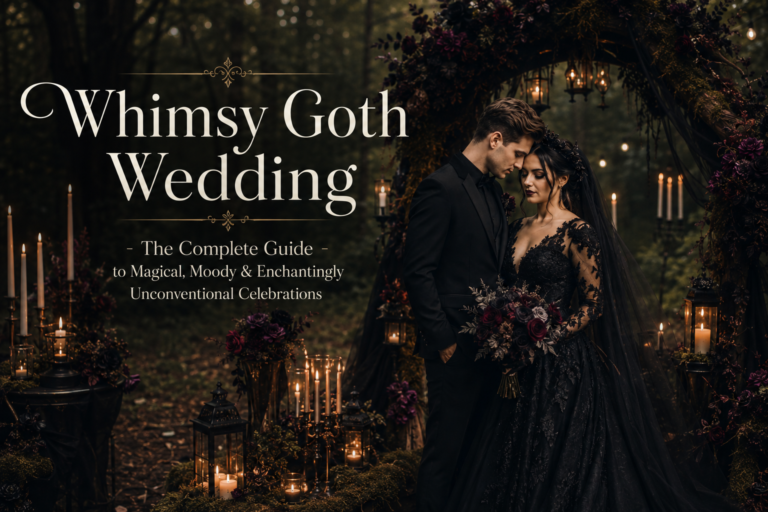
Dark velvet gown, black dahlias, golden-hour meadow background. Dark against warm organic light against deep shadow. Three distinct tonal registers in a single frame, creating depth, visual movement, and the specific quality of narrative that makes a photograph impossible to forget.
The Photographer’s Perspective
Wedding photographers consistently report that the boho goth brief produces images of superior visual complexity to the traditional boho brief — because the dark elements provide the contrast, drama, and visual interest that the human eye instinctively seeks and that the camera captures with its full power.
It Works Year-Round
Boho Goth Works in Every Season
The traditional boho wedding is one of the most seasonally restricted aesthetics in all of bridal design. Its visual language — the pampas, the dried grasses, the wildflower abundance, the golden outdoor light — belongs almost exclusively to late summer and early autumn. A traditional boho wedding in winter is a conceptual contradiction that requires either a synthetic approximation of summer botanical abundance or an acknowledgement that the aesthetic has simply been transplanted out of its natural season. The boho goth wedding has no such limitation — because its darker palette, its richer textures, and its relationship with shadow and candlelight make it not only compatible with every season but actively enhanced by the specific qualities each season provides.
Spring
Dark Florals Against Fresh Growth
The most striking of all seasonal contrasts for the boho goth aesthetic — the deep, saturated darkness of near-black flowers against the insistently living green of new spring growth. Dark dahlias and chocolate cosmos against fresh fern fronds and the specific pale green of new leaves. The overcast skies of early spring provide the soft, diffused light that most flatters dark fabrics, and the botanical abundance of spring wildflowers gives the floral scheme its wild, gathered quality without requiring the late-summer species that traditional boho depends on.
Summer
Golden Hour Against Deep Darkness
The traditional boho’s strongest season — and the one where the boho goth aesthetic most dramatically outperforms its conventional counterpart. The golden amber light of a summer evening is at its most photographic when it plays against dark fabrics and dark florals rather than against pale ones, creating the contrast and depth that flat summer light against white and beige cannot achieve. Dark velvet in summer golden hour is one of the most photographically extraordinary combinations available in outdoor wedding photography.
Autumn
The Boho Goth’s Natural Season
The season in which the boho goth aesthetic reaches its most completely natural expression — the deep burgundy and amber of autumn foliage providing a palette of extraordinary richness against which dark fashion and dark florals exist in a state of complete chromatic harmony. Dried pampas at its most textural, berries and dark seed heads in the botanical arrangements, the low amber light of autumn afternoons that turns everything it touches into something worth photographing. No other season requires as little creative work to achieve as much atmospheric depth.
Winter
Velvet, Candlelight, and Snow
The season that is impossible for the traditional boho wedding becomes the boho goth’s most dramatically beautiful option — velvet against snow, dark dried botanical arrangements in candlelit interiors, the specific quality of low winter light that makes every surface it touches look like a painting. Where the traditional boho wedding cannot survive winter without conceptual contradiction, the boho goth wedding inhabits it completely, finding in the season’s darkness and cold a quality of romantic atmosphere that no other time of year can provide.

Section One
What Is a Boho Goth Wedding?
The boho goth wedding is built on the recognition that the bohemian and the gothic traditions share a set of fundamental values that their surface aesthetics conceal: both traditions value individuality over conformity, depth over superficiality, personal symbolism over generic convention, and the beauty of organic, uncontrolled natural abundance over the ordered perfection of formal decoration. The bohemian tradition finds this depth in the wildness and freedom of the natural world — in flowers that look gathered rather than arranged, in venues that feel discovered rather than designed, in fashion that moves with the body and the wind rather than holding a static form. The gothic tradition finds it in shadow, in symbolism, in historical resonance, and in the specific quality of dark romance that comes from understanding beauty and darkness as inseparable rather than opposed.
The boho goth wedding combines both, producing an aesthetic that is wild and dark simultaneously — deeply organic but richly shadowed, free-spirited but symbolically loaded, relaxed and romantic but with a quality of emotional depth and visual complexity that neither tradition alone can achieve. A dark wildflower bouquet that spills rather than stands. A flowing gown in deep plum or near-black with a silhouette that moves with the same quality of organic freedom as the palest boho dress. A ceremony in a wildflower meadow at dusk, when the last light gives the landscape the specific quality of warm, golden darkness that belongs equally to both traditions. This is what the boho goth wedding looks and feels like — and it is why couples who discovered it stopped looking at anything else.
Section Two
The Boho Goth Colour Palette
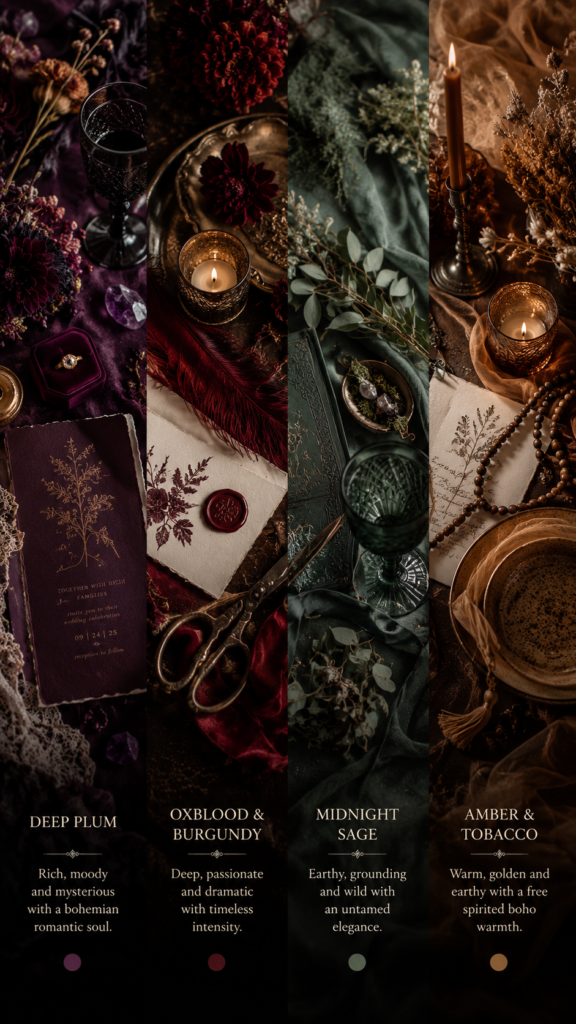
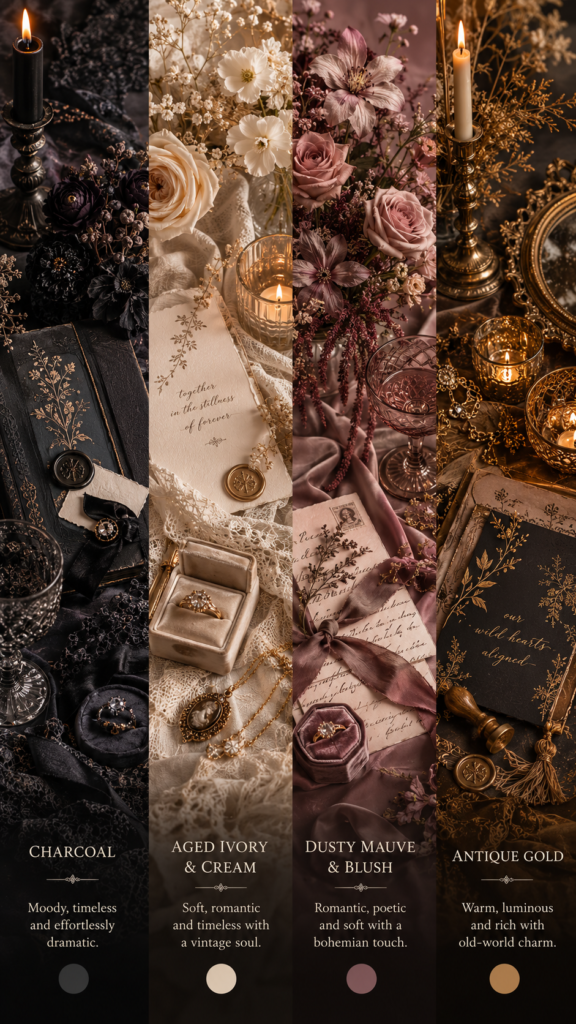
The boho goth palette is the most immediately visible distinction between the traditional boho wedding and its darker successor — and it is also the point at which most couples approaching the aesthetic for the first time discover that the transition from conventional boho to boho goth is less extreme than they expected. The warm, organic tones of the traditional boho palette do not disappear. They deepen. Cream becomes ivory becomes aged linen. Beige becomes tobacco and warm mushroom. Pale dried grass becomes dark amber and deep ochre. And into this deepened and warmed version of the boho palette, the specifically gothic tones arrive: deep plum, near-black, midnight sage, oxblood, charcoal, and the dark warm brown of aged wood and dried botanical matter. The result is a palette that reads as organically connected to the natural world rather than imposed upon it — because every colour in it can be found in the landscape at its most saturated and most atmospheric, specifically at the transitional hours of late afternoon and early evening when the light gives everything it touches the quality of deep, warm darkness.
Deep Plum
The defining boho goth colour — rich, dark, and organic; present in dahlias, elderberries, and the specific quality of late dusk light
Oxblood & Burgundy
The warmest of the dark palette — the colour of dark roses, autumn berries, and velvet in candlelight
Midnight Sage
The boho botanical given gothic depth — the grey-green of sage and eucalyptus in deep shadow
Amber & Tobacco
The warm bridge between boho and goth — the organic warmth that prevents the dark palette from reading as cold
Charcoal
The neutral dark that grounds the palette and allows every warmer colour to read at full saturation
Aged Ivory & Cream
The boho tradition’s own tones, retained as the light element against which the dark palette reads with maximum depth and contrast
Dusty Mauve & Blush
The softened entry point — for couples who want a subtle dark accent rather than a deep gothic depth
Antique Gold
The metallic accent that warms every dark palette and communicates the same quality of aged organic beauty as dried botanical abundance
Section Three
Boho Goth Wedding Fashion
Boho goth wedding fashion is the most personal and the most creative of all the dark bridal aesthetics — because it places the emphasis on movement, on the organic quality of the silhouette, and on the specific relationship between the dark elements of the dress and the light of the outdoor or organic environment it will be photographed in, rather than on the architectural precision and structural formality that gothic fashion typically prioritises. The boho goth bridal look is flowing rather than structured, organic rather than formal, and wild rather than restrained — but it achieves all of this within a dark palette and with specific gothic details that give it the depth and symbolic richness that the traditional boho look lacks.
Bridal Looks
- Dark velvet with bohemian silhouette — the most directly boho goth bridal option: a flowing, unstructured velvet dress in deep plum, oxblood, or near-black that moves with the same organic quality as the palest boho gown while communicating a completely different aesthetic depth
- Black lace with flowing sleeves — lace is the material that most completely belongs to both traditions simultaneously; the flowing bishop sleeve or trumpet sleeve in black lace is the single most boho goth garment available in bridal fashion
- Dark floral embroidery on flowing chiffon — botanical motifs embroidered in dark thread on a flowing chiffon base, moving between the bohemian and the gothic through the dual quality of the organic silhouette and the dark decorative language
- Mixed-fabric layering — a dark velvet bodice over layers of dark or dusty chiffon or organza, combining the material richness of gothic fashion with the light, flowing movement quality of bohemian silhouettes
- Dark wildflower crown — the most defining boho goth bridal accessory: thistles, dark cosmos, pampas, eucalyptus, and near-black blooms assembled with the organic wildness of a boho crown but in a palette that communicates the gothic tradition immediately
- Barefoot or dark suede ankle boots — the footwear choices that most authentically communicate the boho tradition; dark suede or leather is the gothic upgrade that maintains the grounded, earthy quality of boho footwear while deepening its aesthetic register
Groom Looks
- Dark linen suit in charcoal or deep forest green — linen communicates the relaxed, organic quality of the boho tradition while the dark colour maintains the depth of the gothic aesthetic; one of the most authentically boho goth garments available for grooms
- Velvet jacket over dark shirt and trousers — the velvet jacket as the primary statement piece, in deep plum, midnight sage, or charcoal, worn with dark trousers and boots rather than formal shoes
- Open collar with botanical buttonhole — the open collar is the boho tradition’s most authentic groom detail; paired with a buttonhole of dark wildflowers, thistles, and dried botanicals, it communicates the boho goth hybrid through the most practical and most visible detail of the groom’s look
- Dark leather accessories throughout — a dark leather belt, watch strap, and boot communicating the organic, natural quality of dark leather as a material that belongs equally to the bohemian and the gothic traditions
- Dark boots rather than formal shoes — Chelsea boots in dark leather or suede, or dark leather work boots, are the footwear that most completely grounds the groom’s look in the organic, earthy quality of the boho tradition while maintaining the dark aesthetic of the reception
Section Four
Dark Boho Florals: The Heart of the Aesthetic
The florals are where the boho goth aesthetic is most visibly and most powerfully expressed, and they are the element that most clearly distinguishes the boho goth wedding from both the traditional boho wedding and the traditional gothic wedding. Boho goth florals are not the tightly controlled, formally composed dark arrangements of the gothic tradition — they are wild, abundant, spilling, and organic, assembled with the same quality of untamed natural beauty as the most beautiful boho arrangements. But they are dark. The pampas grass is present but joined by thistles and dried blackberry branches. The wildflowers are present but alongside dark chocolate cosmos, near-black anemones, and deep burgundy ranunculus. The eucalyptus and sage are present but in a palette that has been deepened and enriched beyond the conventional boho aesthetic’s capacity to absorb.
Dark Gothic Species
Black dahlias and chocolate cosmos as the chromatic anchors — the dark flowers that give the arrangement its gothic depth without requiring the formal composition that dark roses demand in conventional gothic arrangements. Near-black anemones with their white centres providing contrast within the darkest compositions. Deep burgundy ranunculus, dark sweet peas, and near-black violas scattered through the composition with the organic looseness that defines the boho aesthetic.
Boho Botanical Backbone
Dark pampas grass and dried ornamental grasses for the wild, textural abundance that the boho tradition requires. Eucalyptus and midnight sage in their deepest green tones. Thistles — the single most boho goth botanical available, simultaneously spiky and beautiful, dark and organic, gothic in its form and entirely natural in its provenance. Dried seed heads, dark berries, and trailing botanical elements that extend the composition beyond its vessel with the quality of natural growth.
The Dried Element
Dried botanicals are the element that most completely unifies the boho and gothic traditions — because the dried flower carries both the organic, wild quality of the natural world and the specific quality of preserved, aged beauty that the gothic tradition has always prized. Lunaria seed discs, dried lavender, preserved dark roses, dried cotton stems, and smoke bush dried at its darkest — these elements give the arrangement its temporal depth, its quality of things that have been beautiful for longer than the event they are decorating.
Section Five
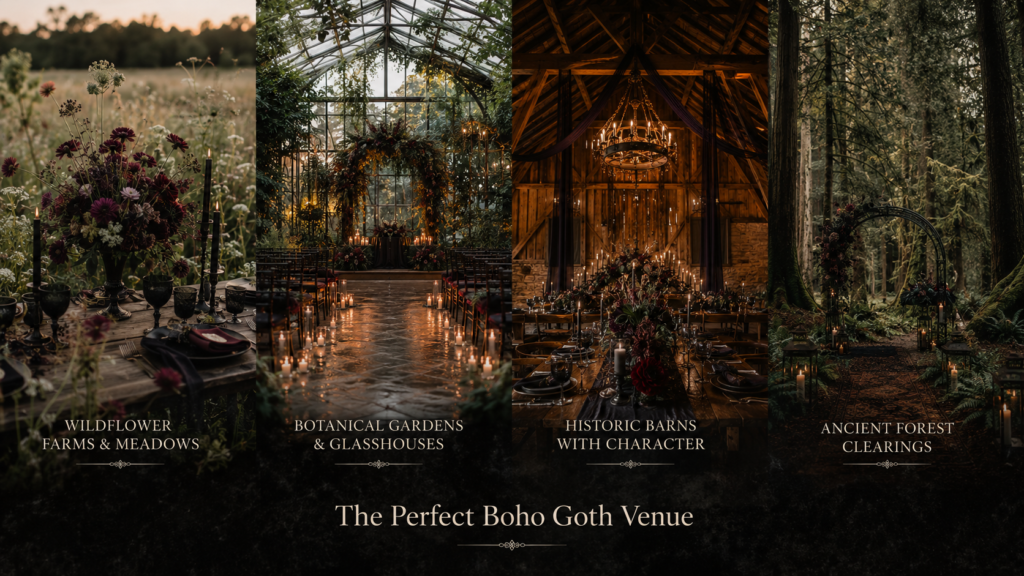
The Perfect Boho Goth Venue
The boho goth venue is the setting that most naturally accommodates both the organic, free-spirited quality of the bohemian tradition and the atmospheric depth and historical resonance of the gothic one. Like the boho tradition, it prioritises the natural and the discovered over the artificially constructed — venues with genuine character, organic textures, and the specific quality of places that have been somewhere before. Like the gothic tradition, it requires the right relationship with light and shadow, the right quality of architectural or natural depth, and the right atmospheric register to support the full weight of the aesthetic being built within it.
🌿
Wildflower Farms & Meadows
The most authentically boho of all venue types given its full gothic expression — dark fashion and dark florals against a field of wildflowers in bloom creates the defining boho goth image, the one that most consistently appears in the highest-performing content across every alternative wedding platform.
🌺
Botanical Gardens & Glasshouses
A Victorian-era glasshouse filled with botanical abundance provides the most completely unified boho goth setting — the organic wildness of the plant life and the aged iron and glass architecture combining to create a space that communicates both traditions simultaneously without any additional decoration.
🏚️
Historic Barns With Character
Aged timber, organic textures, the specific quality of light filtering through old wood — the barn is the venue that most effortlessly communicates both the country-boho quality of organic, unforced beauty and the gothic quality of genuine age and accumulated human story.
🌲
Ancient Forest Clearings
The forest clearing at dusk — with the canopy overhead filtering the last of the afternoon light and the first mist gathering between the roots — is the most completely boho goth of all natural ceremony spaces, communicating organic wildness, atmospheric darkness, and ancient natural depth simultaneously.
Section Six
Boho Goth Reception Styling
The boho goth reception table is built on the same organic, abundant, layered aesthetic as the traditional boho table — but with the palette deepened, the textures enriched, and the overall atmosphere given the quality of warm, candlelit darkness that distinguishes the boho goth celebration from its paler predecessor. Bare wood or aged linen beneath dark velvet runners. Dark florals in organic, spilling arrangements alongside the dried botanical abundance that the boho tradition contributes. Candlelight in iron and aged brass holders of varying heights. Dark fruit, dark glass, and the specific quality of material richness that comes from combining the organic textures of the bohemian world with the darker, more historically resonant materials of the gothic one.
The Boho Goth Table
- Bare wood or aged linen base — the boho tradition’s most authentic table surface, retained as the foundation because its organic warmth is exactly what prevents the dark palette from reading as cold or austere
- Dark velvet runner over the linen or directly on the wood — the gothic upgrade that adds material luxury and chromatic depth without eliminating the organic quality of the boho base
- Wild and spilling dark floral centrepieces — in aged terracotta, dark ceramic, or oxidised iron vessels; the arrangement spilling over the vessel’s edge with the organic abundance of the boho tradition but in the dark, symbolically rich palette of the gothic one
- Mixed dried and fresh elements — pampas and dried grasses alongside fresh dark dahlias; dried seed heads and preserved botanicals alongside living dark blooms, combining the temporal registers of the two traditions in a single arrangement
- Candlelight in iron and aged brass — pillar candles and votives at varying heights in holders that communicate the dark warmth of the aesthetic without the theatrical heaviness of full gothic candelabras
- Dark fruit and organic scatter — blackberries, figs, dark grapes, and pomegranates placed along the botanical runner as both decorative and edible elements in the boho harvest tradition
Section Seven
Boho Goth Ceremony Ideas
The boho goth ceremony prioritises the outdoor and the discovered over the indoor and the constructed — drawing on the bohemian tradition’s deep preference for natural settings and organic ceremony spaces, and giving those settings the atmospheric depth and symbolic richness that the gothic tradition contributes. The ceremony arch, which is perhaps the most Pinterest-saturated element of the traditional boho wedding, finds its most powerful boho goth expression in versions that combine the wild botanical abundance of the boho arch with the dark florals, dried organic matter, and aged structural materials of the gothic tradition.
The Dark Botanical Arch
A wildly abundant arch in dark florals, dried grasses, pampas, thistles, and trailing botanical elements — spilling with the same organic generosity as the most beautiful traditional boho arch, but in a palette that reads as deeply and distinctly boho goth. The arch structure itself in twisted willow or dark-stained wood rather than the white metal hoops of the conventional boho arch, communicating the aesthetic through the structure as much as through the botanical decoration upon it.
Wildflower Field at Dusk
A ceremony in an open wildflower field deliberately timed for the dusk transition — when the golden light of late afternoon begins to give way to the cooler blue of early evening and the wildflowers around the couple take on the specific quality of saturated, glowing colour that only occurs in that forty-minute window. The boho goth ceremony at its most atmospherically powerful and its most completely natural.
Handfasting in the Forest
The handfasting ceremony — in which the couple’s hands are bound with cords of dark ribbon, silk, or botanical material during the ceremony as a symbol of their union — is the ritual element most completely aligned with both traditions simultaneously: the bohemian tradition’s preference for meaningful personal ritual over formal ceremony convention, and the gothic tradition’s preference for symbolic depth and material resonance over ceremonial neutrality.
Section Eight
Boho Goth Photography: The Portraits That Define the Aesthetic
The defining creative opportunity of boho goth wedding photography is the contrast between the dark aesthetic of the fashion and florals and the warm, light-filled, organically abundant quality of the natural settings the boho tradition provides. This contrast — not a problem to be managed but the most powerful photographic tool available — produces images of extraordinary visual depth, narrative quality, and emotional resonance that represent the boho goth aesthetic’s most compelling and most immediately shareable creative output. Brief the photographer specifically on this contrast as the primary creative goal: not to make the dark elements less dark in order to match the natural setting, but to celebrate the specific visual beauty that occurs when they exist together in the same frame.
Dark Dress in Wildflower Field
The most definitive boho goth image — the most photographically powerful contrast available in the aesthetic: dark fabric against the saturated colour of a wildflower meadow in full bloom. No amount of post-processing on a conventional boho portrait can achieve the depth and visual interest this contrast produces in a single raw frame.
Golden Hour Movement Shots
Dark velvet or lace in motion at golden hour — the skirt moving through tall grass, the veil extended by the warm afternoon wind, the dark floral crown catching the amber light from the side. The movement shots that the boho tradition has always prized, given the depth and visual complexity of dark fabrics that respond to light and movement in ways that pale fabrics do not.
Candlelit Ceremony Portraits
The boho tradition’s preference for intimate, close, natural-light portraits given the gothic upgrade of candlelight — warm amber flame against dark fabric and skin, in an organic venue interior, producing images of extraordinary warmth and depth that are simultaneously more boho and more gothic than either tradition alone could produce.
Dusk Forest Portraits
The couple in a forest clearing at dusk — the last of the light filtering through the canopy in shafts of amber gold, the forest darkness beginning to gather at the edges of the frame — is the boho goth’s most completely realised photographic setting: the organic wildness of the boho tradition combined with the atmospheric darkness of the gothic one in perfect, achieved equilibrium.
Section Nine
It Feels More Personal: Individuality in the Boho Goth Wedding
The most important reason that the boho goth wedding is replacing the traditional boho wedding — more important than its photographic superiority, more important than its seasonal versatility, more important than the pure visual excitement of the dark-and-organic contrast — is that it feels more personal. The traditional boho wedding became, through commercial replication and aesthetic saturation, a style that couples adopted rather than a world they built. Its visual language was so widely available, so easily sourced, and so completely pre-interpreted by the industry that couples could assemble a fully realised traditional boho wedding without making a single genuinely original creative decision. Which is why, increasingly, they recognised themselves less in the photographs than they hoped to.
The boho goth wedding requires genuine creative decision-making at every point — because the combination of the organic and the dark is not pre-packaged and pre-interpreted by the market in the way that the traditional boho is. Each couple who builds a boho goth wedding builds it from their own specific combination of the two traditions: their specific dark palette, their specific botanical choices, their specific degree of gothic depth and bohemian freedom, their specific symbolic references. The result is a celebration that looks and feels like them — not like a reference photograph they are trying to recreate — and that produces photographs in which they recognise themselves completely, because every element of the world in the images was chosen by them for reasons that are theirs.
How Dark Do You Go? Finding Your Specific Point on the Boho-Goth Spectrum
The boho goth spectrum runs from a very gentle dark accent on an essentially traditional boho aesthetic — a single dark floral species in an otherwise pale arrangement, a dusty mauve dress rather than ivory, a dark velvet ribbon on an otherwise conventional crown — all the way to a fully realised dark botanical gothic aesthetic that retains the organic, wild quality of the boho tradition in its silhouettes and settings while committing completely to a deep, saturated dark palette in every material choice. Neither extreme is more correct than the other. The right point on the spectrum is the one that makes the couple feel, when they see the first photograph, that they are looking at themselves — not at the traditional boho wedding they decided against, and not at a gothic wedding in a wildflower field, but at the specific world they built that belongs to exactly them and to no one else.
Section Ten
Boho Goth Wedding Favors & Details
The boho goth wedding favor bridges the two traditions most completely in the botanical and the natural — objects that carry the organic quality and the personal, handmade character of the bohemian tradition alongside the symbolic depth and dark aesthetic of the gothic one. The most powerful boho goth favors are those that feel gathered from the natural world rather than manufactured for an occasion — a seed packet of dark wildflowers, an apothecary bottle of a custom botanical blend, a pressed flower bookmark from a species that bloomed in the ceremony meadow, or a small raw crystal that carries both the organic wildness of the earth and the symbolic resonance of the gothic aesthetic within it.
Dark Wildflower Seed Packets
The most completely boho goth of all favor options — black cosmos, dark poppies, deep violet sweet peas — in handmade paper envelopes with botanical labels. The favor that grows into dark wildflowers in every guest’s garden through the seasons following the wedding, producing a living annual reminder of the celebration.
Botanical Herbal Blends
Custom loose leaf tea blends assembled from the botanical species of the wedding’s floral scheme — lavender, rosemary, hibiscus, rose — in dark glass apothecary bottles with hand-labelled Gothic typography. The favor that communicates the botanical world of the celebration through scent and flavour rather than visual display alone.
Raw Crystals in Velvet Pouches
A rough amethyst, labradorite, or smoky quartz in a small dark velvet pouch — the favor that most completely communicates both the organic, natural beauty of the bohemian tradition and the symbolic depth of the gothic one. Presented with a card explaining the crystal’s properties and the couple’s reason for choosing it.
Pressed Flower Bookmarks
A botanical bookmark with a pressed flower or fern from the ceremony setting preserved in resin on a dark card — simultaneously the most boho and the most gothic of all favor formats: the organic wildflower preserved in perpetuity, the living world captured as a relic and given to each guest to carry in the books they read for the rest of their lives.
“The boho goth wedding is the proof that these two traditions were not opposites pretending to coexist. They were always reaching toward the same thing — toward beauty that is wild and free and deeply felt, toward celebrations that communicate the full emotional complexity of a love that is not simple, and toward photographs that will look extraordinary in fifty years because they were made with genuine creative intelligence rather than in faithful replication of what everyone else was already doing.”
— The Dark Boho Wedding Edit
Final Thoughts
Build the Wedding That Is Unmistakably Yours. Find It at the Meeting Point of Wild and Dark.
The boho goth wedding is replacing the traditional boho wedding not because the traditional boho was wrong but because it was finished — it had been replicated and reproduced and commercially packaged until its power to communicate genuine individuality had been exhausted. The couples who are building boho goth weddings in 2026 are not simply following a new trend. They are doing what the original boho couples were doing when that tradition was fresh and vital: looking at what was available to them, finding the conventional options inadequate, and building something of their own from the elements that resonated most deeply with who they actually are.
Choose the point on the boho-goth spectrum that belongs specifically to you and your relationship — not the most dramatic point available, not the most commercially recognised point, but the specific degree of darkness and wildness and organic depth that makes you feel, when you see the first photograph, that you are looking at yourselves in the world you actually inhabit. Find the palette in the landscape you love. Find the florals in the botanical species that have always seemed most beautiful to you. Find the venue in the place with the right quality of organic character and atmospheric depth. And then build the celebration — wild and dark and completely, unmistakably yours — in that specific, irreplaceable meeting point between the two traditions that have always been reaching, from their different directions, toward the same quality of profound, complex, and genuinely extraordinary beauty.