Woodland Wedding Cake Ideas
Woodland Wedding · 2026
Woodland Wedding Cake Ideas 2026 — Forest & Botanical Designs
From fairy ring mushroom tiers and botanical pressed flower cakes to rustic bark-effect designs and enchanted forest woodland creations — the complete guide to woodland wedding cakes in 2026.
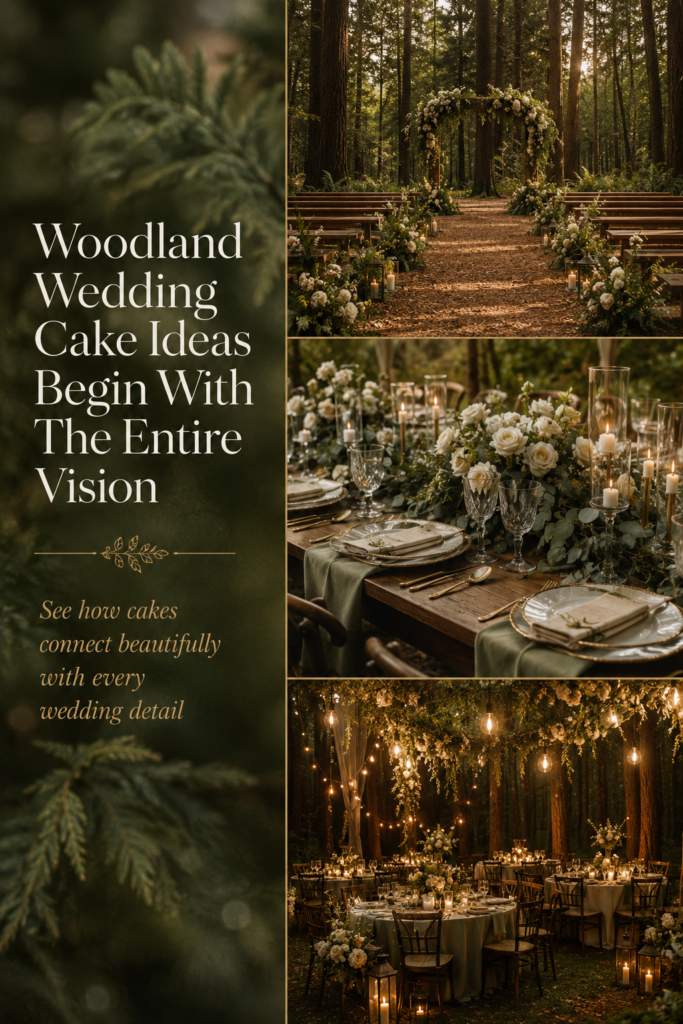
Of all the photographed elements of a woodland wedding, the cake is consistently the one that creates the strongest visual argument for the entire aesthetic — because a woodland cake, done well, can express in a single edible object everything the venue, the florals, and the stationery have been building toward. A tier of meringue mushrooms against warm ivory buttercream says the same thing as a forest floor arrangement of real moss and dried botanicals. A pressed flower cake in pale wildflower tones says the same thing as a wildflower meadow ceremony in June. The woodland wedding cake is not a separate design decision from the rest of the celebration — it is the moment where the aesthetic is made most entirely, most deliciously, and most photographically concrete. This guide covers seven distinct woodland cake styles for 2026, the flavour choices that suit each one, the topper options that complete the visual story, and the stationery collections that ensure the cake’s aesthetic language runs through every other detail of the day.
A woodland wedding cake is not a decoration. It is an argument in sugar and flour for the same thing the ancient trees and the wildflowers and the dappled light are arguing — that this specific world, today, is the most beautiful one available.

Section 01
Why Woodland Wedding Cakes Are Different
The visual language of a woodland wedding cake is different from a rustic cake, a boho cake, or a vintage cake in the same way the woodland wedding aesthetic differs from those adjacent aesthetics: it is more specifically connected to the forest. A rustic cake uses rough textures and natural-seeming details without necessarily referencing any particular natural environment. A woodland cake is more precise — it references specific things that actually exist in and around a forest: bark, moss, mushrooms, wildflowers growing from the forest floor, the branching structures of old trees, the woodland creatures that live in them. The best woodland cakes are identifiable as belonging to a specific environment, not just a general aesthetic register.
The visual elements that define woodland cake aesthetics in 2026 are: bark-effect textures in buttercream or fondant that reference real tree bark rather than simply rough texture; botanical illustration elements — painted, applied in fondant, or created in sugar — that reference real forest floor plants; mushroom details, either meringue, fondant, or sculpted, as the most immediately identifiable woodland motif; pressed flower decoration using real edible dried flowers; forest creature details in fondant or as physical toppers; and fairy light details within or around the cake that reference the fairy light aesthetic of the woodland reception. Each of these elements, used thoughtfully and with genuine editorial intention, places the cake firmly within the woodland aesthetic rather than simply adjacent to it.
Woodland cakes photograph exceptionally well for several reasons. The natural textures of bark effect, pressed flowers, and meringue mushroom surfaces interact with the same quality of light that makes woodland settings so photographically rich — warm and slightly diffuse, with shadows that reveal rather than flatten surface detail. A pressed flower tier in afternoon light in a woodland reception has a depth and luminosity that a smooth fondant cake in the same setting does not, because the botanical material responds to the light the way real botanical material does. The most saved woodland wedding cake images on Pinterest are consistently the ones where the cake and its setting are in genuine conversation — where the bark effect on the cake responds to the real bark of the trees visible through the window behind it, or the wildflowers pressed into the tiers echo the centrepiece arrangement three feet away.
The 2026 trends within the woodland cake category are clear: mushroom wedding cakes have moved from a niche Pinterest category to a mainstream request, driven by the cottagecore movement’s normalisation of the forest floor as a source of genuine beauty. Pressed flower cakes have emerged as technically sophisticated alternatives to fresh flower decoration, with the advantage that every flower on a pressed flower cake is precisely where it was placed and responds consistently to light throughout the day. Textured buttercream in bark-effect, forest green, and earthy-toned finishes continues to grow, and the painted cake tier — with scenes from a woodland painted directly onto smooth fondant or buttercream — has moved from specialist to broadly available. In 2026, any of these can be requested and executed beautifully by a skilled cake designer.
Section 02
Seven Woodland Wedding Cake Styles
Seven distinct woodland cake aesthetics, each expressing a different aspect of what makes a forest beautiful. Find the one that belongs to your celebration.
Cake Style 2.1
The Mushroom Forest Cake
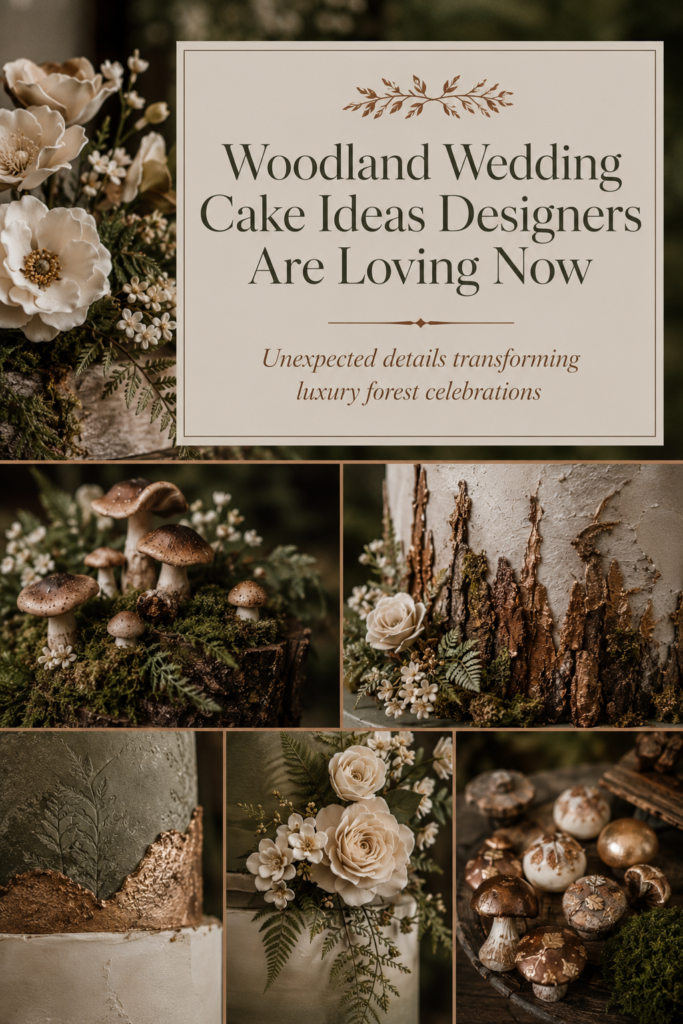
The mushroom wedding cake is the single most on-trend woodland cake design for 2026, and the speed at which it has moved from a niche Pinterest category to a mainstream wedding request says something significant about how quickly the woodland aesthetic has evolved. There are three distinct approaches to mushroom cake design, and they produce very different results. The first — meringue mushroom clusters applied to buttercream tiers — is the most technique-intensive and, done well, the most beautiful: small piped meringue mushrooms with ivory stems and brown-dusted caps, applied in clusters to the sides and top of a lightly textured buttercream cake, create an effect that photographs as genuinely extraordinary in candlelight. The meringue surface catches and scatters light the way real mushroom caps do, with a slight translucency in the thinner parts of each cap that adds depth.
The second approach — sculpted fondant mushrooms — allows more dimensional and more colourful interpretations: fly agaric in deep red and white, oyster mushrooms in silvery blue-grey, shiitake in warm brown and cream. These can be scattered across the base tier of a cake, clustered among real or sugar moss elements, and combined with fondant botanical details to create the specific impression of a forest floor arrangement made edible. The third approach — painted botanical mushroom illustration on smooth fondant tiers — belongs to the most editorial and art-forward end of the woodland cake aesthetic, producing cakes that look as though a botanical illustrator painted them with food colouring on cream-coloured panels.
The difference between a mushroom cake that photographs as genuinely beautiful and one that reads as a craft-fair project is almost entirely in the quality of the botanical context surrounding the mushroom elements. Meringue mushrooms clustered among real dried botanical materials at the cake’s base, surrounded by real moss and a small scatter of edible pressed flowers, become part of the forest floor arrangement the cake is sitting in. Meringue mushrooms applied to a bare tiered cake with no surrounding botanical context read as a decoration rather than a world. The cake table is part of the cake design for a woodland mushroom cake — they must be considered together.
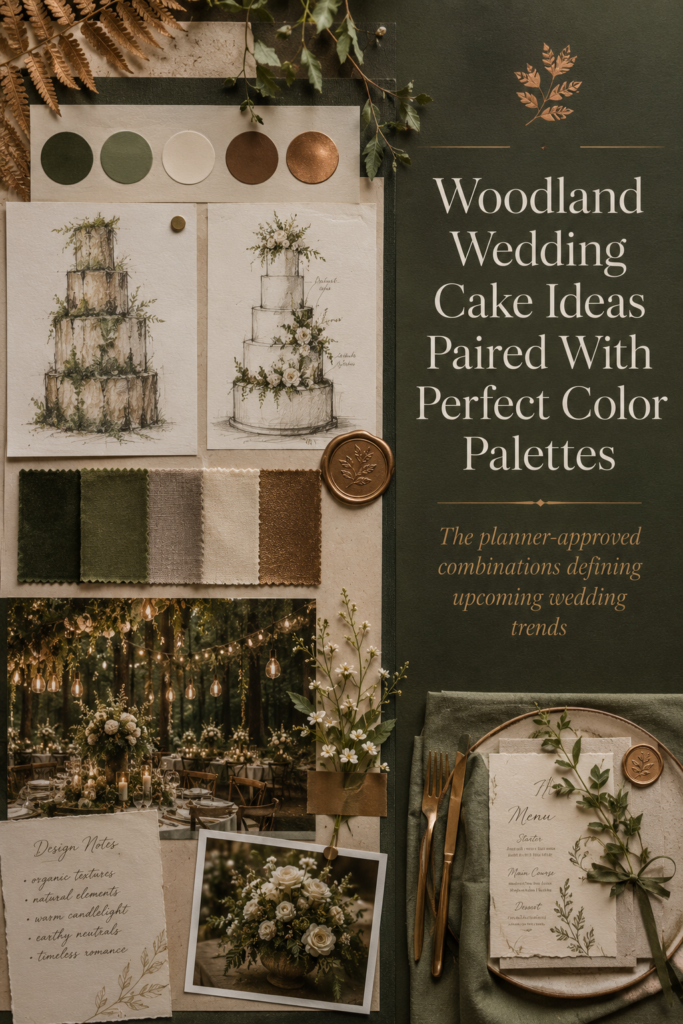
The colour palette for a mushroom forest cake is the most earthy of the seven styles: warm cream and ivory for the base tones, mushroom brown and warm copper for the cap details, deep moss green for any botanical foliage elements, and the occasional note of pale dusty rose or terracotta for warmth. This palette belongs to the autumn forest floor — and it also, not coincidentally, belongs to the autumn tablescaping that surrounds the cake in a cottagecore or woodland reception.
Complete the Visual Story
A mushroom forest cake is the centrepiece of a visual world — and that world begins with the invitation suite, months before the cake is baked. The Mushroom Woodland Wedding collection — fully customizable with your names, date, and wedding details.
Cake Style 2.2
The Botanical Pressed Flower Cake
Pressed flower cake decoration — using real edible flowers that have been dried and pressed flat — is one of the most technically sophisticated and visually beautiful cake techniques available in 2026, and it photographs with a quality that no other wedding cake decoration style quite matches in natural light. The edible pressed flower sits flat on the buttercream or fondant surface of the cake, its original colours preserved but slightly changed by the drying process into something with more warmth and depth than the fresh flower would have had. In afternoon light, pressed flowers on a cream buttercream cake have the specific beauty of an old botanical print come to life in three dimensions: each petal distinct, the veining visible, the colour slightly transparent where the flower is thinnest.
The flowers that work best for pressing as cake decoration are those with naturally flat or single-layer structures: pansies in their full colour range, which press to a depth of only a few millimetres and retain extraordinary colour; violets in deep purple and soft lavender; ferns and delicate foliage in various greens that add structural interest and shape alongside the floral elements; cosmos petals and small wildflower blooms including chamomile, tiny rose varieties, and the flat faces of marigolds. These all hold their visual quality through the pressing and drying process in a way that multi-petalled complex flowers do not. The arrangement of pressed flowers on a cake should reference a botanical illustration: considered and intentional in placement, with the full face of each flower visible rather than overlapping, with variation in size and type creating rhythm and movement across the tier surface.
A pressed flower cake photographs best in diffuse natural light — the same light that makes a forest clearing beautiful at three in the afternoon. The botanical illustration quality of the pressed flowers becomes most apparent in this light, with the delicate vein structures and colour gradations within each petal clearly visible. In contrast, the flat surfaces of a pressed flower cake can lose some visual impact under the direct flash photography that is sometimes used at indoor receptions; natural or warm artificial light consistently produces better results for this style. If the reception moves indoors for the evening, positioning the cake near a source of warm candlelight rather than overhead electric light will maintain the quality of the detail shots throughout the day.
Flavours that pair particularly well with the visual delicacy of a pressed flower cake: elderflower and lemon, which connects the botanical aesthetic of the decoration to the taste; violet sponge with honey buttercream; and the classic combination of vanilla bean sponge with a light lemon curd filling that allows the cake’s primary flavour to be light and floral. The pressed flower cake tends toward the more delicate and ethereal end of the woodland cake spectrum — it suits wildflower meadow celebrations and fairy forest aesthetics most naturally, and pairs with any wedding whose florals lean toward the botanical and abundant.
Complete the Visual Story
Pressed flower cakes belong to the wildflower woodland world — botanical illustration on the invitation suite that echoes the real pressed florals on the cake creates a visual coherence guests notice even when they couldn’t articulate the source of it. The Wildflower Woodland Wedding collection — fully customizable with your names, date, and wedding details.
Cake Style 2.3
The Bark Effect Woodland Cake
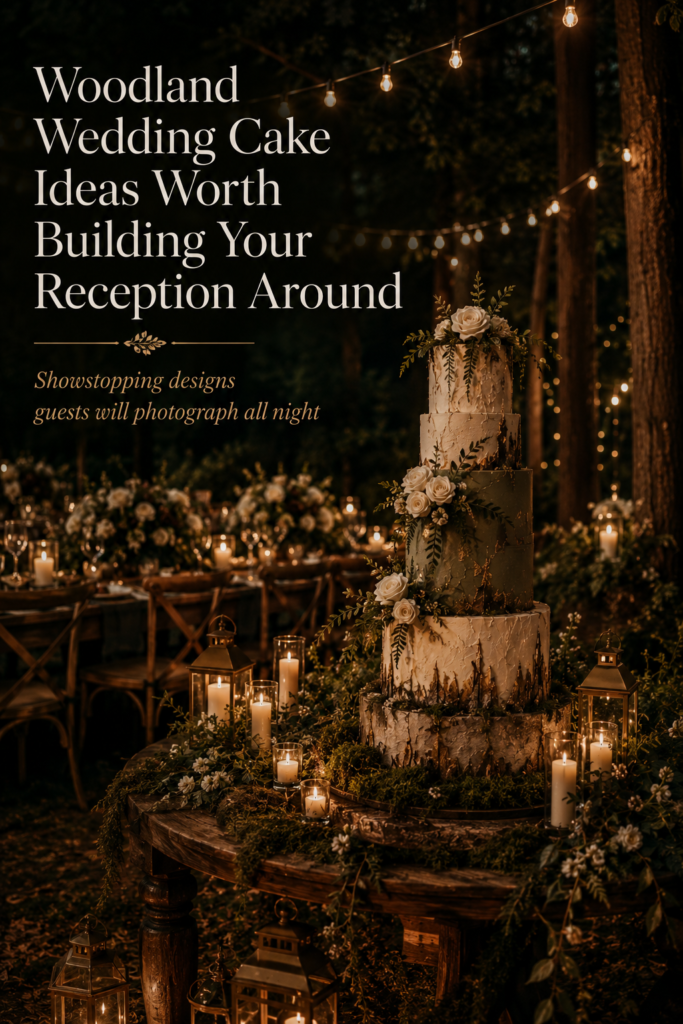
The bark effect cake is the most directly forest-connected of the seven styles — a cake that makes no attempt to look like anything other than what the forest is actually made of. Buttercream or fondant textured to replicate the specific visual quality of tree bark: vertical grooves, horizontal fissures, occasional raised ridges where the bark has split and reformed over decades. Done at its best, a bark effect rustic woodland wedding cake is not immediately obvious as a cake — it reads, for the first moment, as a section of ancient tree, and then the moss at its base and the wildflowers tucked against it reveal the full picture. That moment of revelation is one of the most delightful photographic effects available in woodland wedding styling.
Achieving the bark texture at a genuinely beautiful level requires specific technique rather than simply rough handling of the buttercream. The most effective approach uses a palette knife or textured scraper to create vertical lines in stiffened buttercream, varying the depth and width to replicate the natural variation of real bark rather than a uniform pattern. The colour is built in layers: a base of warm grey-brown, dry-brushed with slightly lighter and slightly darker tones to create the specific tonal variation of real bark, with a very light dry brush of near-white highlighting the raised surfaces. The result, at its most considered, is a cake surface with genuine visual depth — the kind of depth that natural materials have and manufactured surfaces do not.
The details that elevate a bark effect cake from interesting to genuinely extraordinary are the botanical elements that treat it as though it were a real piece of woodland. Fresh or dried moss applied at the base of each tier, where a section of bark on a real tree would be closest to the forest floor. Small wildflower stems inserted between the base of one tier and the surface of the next, as though they had found a way to grow in the gap. A scatter of tiny edible mushroom details, or real dried botanical elements treated as non-edible but visually integrated decoration, at the base of the lowest tier, where the cake meets the wooden board or forest floor elements of the cake table itself.
The bark effect cake suits autumn and winter woodland weddings most naturally, where the palette of the cake — warm greys, earthy browns, occasional deep green moss tones — belongs to the season. In summer, the same technique in lighter tones (silver birch bark effect in near-white with grey detailing) produces a fresher and more delicate version of the same concept. The bark effect cake pairs excellently with antler and wildlife motifs in the broader wedding aesthetic, and suits barn and deep woodland venues better than open garden or meadow settings.
Complete the Visual Story
A bark effect cake speaks the same visual language as antler and woodland wildlife stationery — honest, natural, and deeply connected to the specific materials of the forest. The Antler Woodland Wedding collection — fully customizable with your names, date, and wedding details.
Cake Style 2.4
The Enchanted Forest Cake
The enchanted forest wedding cake is the most ambitious and most editorial of the seven styles — a multi-tiered celebration of the forest as a source of genuine magic, expressed through the most technically demanding techniques available to a skilled cake designer. The defining element of this style is the painted tier: smooth fondant surfaces treated as a canvas for hand-painted woodland scenes, with ancient trees, deer in forest clearings, stars or fairy lights in a night sky above a canopy line, or abstract botanical patterns that suggest the forest without representing it literally. These paintings are typically done with food-safe gel colours diluted to watercolour consistency, which creates a translucent, layered quality rather than the flat opacity of non-diluted food colouring.
The most dramatic versions of the enchanted forest cake use a dark base — deep forest green, midnight navy, or rich plum fondant — with lighter painted details that create the specific quality of a forest scene in moonlight: the trees visible as dark forms with lighter edges where the moon catches them, the stars painted in silver or gold lustre dust applied with a fine brush. At the base of the tiers, real or sugar botanical elements in deep colours complete the forest floor effect, so the cake reads as a complete scene from bottom to top rather than a series of decorated tiers. The whole object, in the right lighting conditions, looks less like a cake than a piece of art that someone has also made edible, which is — obviously — the goal.
Fairy light inclusions around or within the enchanted forest cake deserve specific mention because they create a uniquely beautiful effect when the reception moves into its evening phase. A ring of tiny battery-powered fairy lights buried within the base tier, visible through a semi-transparent fondant, creates the impression that the cake is lit from within — a genuinely extraordinary visual that no photograph entirely captures but that every guest present remembers. The same effect at a lower technical level can be achieved by positioning the cake on a base with integrated lighting or simply by placing small glass vessels with fairy lights immediately behind the cake display, so the light appears to radiate from the cake itself.
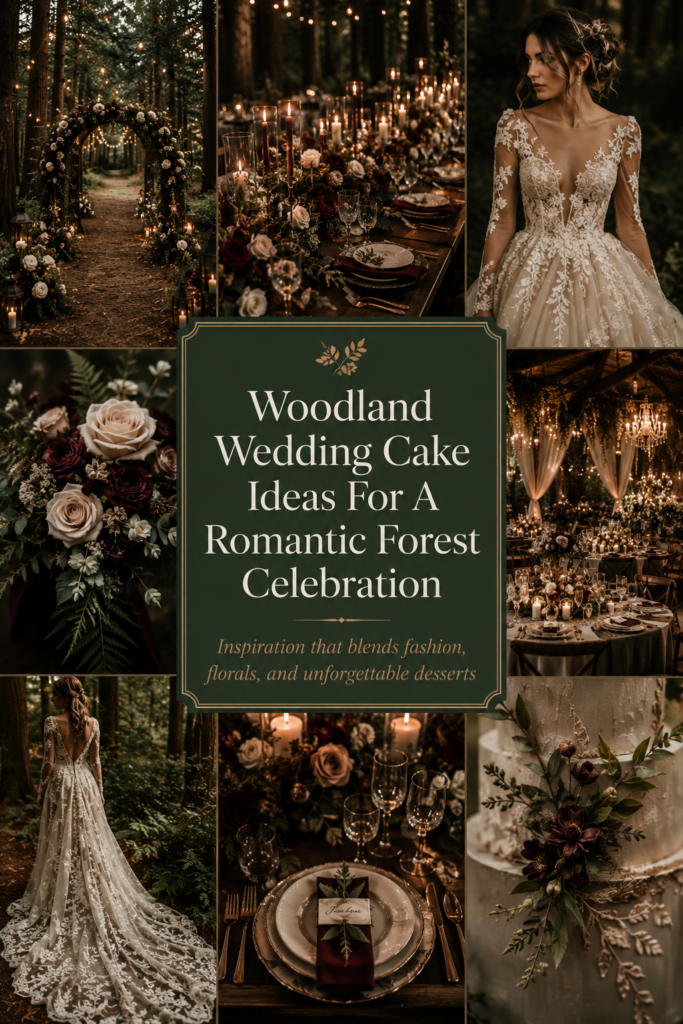
The enchanted forest cake suits evening receptions and celebrations that lean toward the magical rather than the rustic. It is at its best in candlelight rather than artificial overhead lighting, and the painted details on the tiers respond most beautifully to the warm, moving quality of a flame nearby. This style pairs naturally with fairy forest bridal aesthetics, enchanted woodland ceremony spaces, and any woodland wedding whose overall visual register leans toward the otherworldly rather than the earthily natural.
Complete the Visual Story
The enchanted forest cake inhabits the same world as enchanted woodland stationery — botanical magic and forest enchantment that carry the same atmospheric register from the first invitation to the final detail shot. The Enchanted Woodland Wedding collection — fully customizable with your names, date, and wedding details.
Cake Style 2.5
The Cottagecore Botanical Cake
The cottagecore woodland cake aesthetic is the most romantically abundant of the seven — loose botanical arrangements cascading down tiered surfaces, fresh flowers applied in the generously unstructured way of a wildflower bouquet, the specific feeling of a celebration that belongs to a warm September kitchen as much as to an outdoor woodland venue. Where the botanical pressed flower cake is precise and considered, the cottagecore botanical cake is abundant and slightly unruly: more flowers than are strictly necessary, arranged with deliberate apparent artlessness, in colours that belong to the late summer hedgerow rather than to a florist’s curated palette.
Seasonal wildflowers are the primary decorative element, applied fresh on the day of the wedding directly to softened buttercream surfaces. Chamomile clusters, cosmos in soft pink and white, sweet Williams, and small rose varieties all suit this approach and are robust enough to hold their form across a full wedding day in reasonably cool conditions. The skill in applying them is the anti-skill of not trying too hard: flowers placed with their stems slightly visible, overlapping in the way they would in a real gathered arrangement rather than individually positioned, with trailing stems and leaves allowed to drape rather than being tucked away. The finished effect should look like someone arranged a wildflower bouquet around a cake and then stepped back without tidying it up.
The buttercream finish for a cottagecore cake is almost always textured rather than smooth: a gentle rustic palette-knife finish in warm ivory or soft sage, occasionally with a dried botanical element worked into the surface texture itself. The tiers can be graduated in size in the traditional way or arranged off-centre on different-sized boards for the more deliberately imperfect cottagecore aesthetic. The overall impression should be of abundance rather than precision, generosity rather than restraint — the opposite of the sleek fondant-covered cakes that dominated wedding aesthetics for the previous decade.
This cake style connects more naturally to the whimsical and wildflower woodland aesthetics than to the darker or more architectural variations. It suits meadow-edge ceremonies, walled garden receptions, and any woodland celebration where the overall visual register is warm, generously botanical, and uncomplicated. The flavours that pair best are the floral ones: elderflower, violet, rose, and honey-lavender, which align the taste of the cake with its visual character. A cottagecore botanical cake that tastes of elderflower and lemon, decorated with cosmos and chamomile, and surrounded by the same flowers in the centrepieces on the tables around it, is one of the most entirely self-consistent aesthetic statements available to a woodland bride.
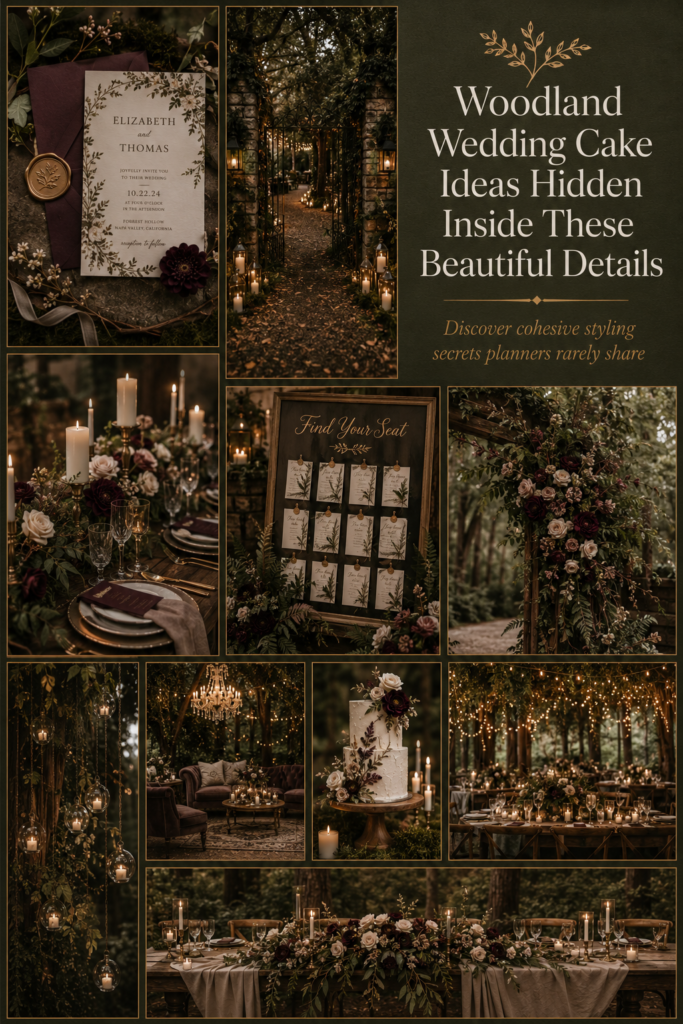
Complete the Visual Story
The whimsical woodland bride who chooses a cottagecore botanical cake will find her stationery match in playful botanical illustration — the same wildflower spirit, the same warmth, the same deliberate abundance of natural detail. The Whimsical Woodland Wedding collection — fully customizable with your names, date, and wedding details.
Cake Style 2.6
The Dark Forest Cake
For the woodland bride who wants her celebration to lean into the older, stranger, more atmospheric aspects of forest mythology — the forest at dusk rather than at noon, the ancient rather than the charming — the dark forest wedding cake is the most dramatically distinctive option available. Deep charcoal fondant with silver botanical detail, forest green with gold tree outlines, richest plum with dark burgundy rose accents, or near-black with white flower motifs: the specific colour combination matters less than the quality of darkness the palette achieves. This is a cake that should look as though it belongs on a table in a candlelit woodland reception where the fairy lights are barely competing with the night around them.
The botanical details on a dark forest cake achieve their most striking effect when they contrast with rather than blend into the dark base: pale silver ferns painted on deep charcoal, ivory botanical blooms against forest green, gold-lustre mushroom caps on near-black fondant. The contrast between the darkness of the background and the lightness of the botanical details creates the specific visual quality of moonlight on a forest floor — everything pale or reflective catching the light, everything dark absorbing it, the eye moving between the two in the way it does in a real woodland at night. Metallic lustre dust applied to the raised elements of fondant botanical details creates small areas of genuine reflectivity that shift as the candlelight around the cake moves.
How dark forest cakes photograph against candlelit woodland receptions is one of their specific strengths: the same quality of light that makes the cake’s dark surface most beautiful is also the quality of light that makes a woodland reception most atmospheric. A dark fondant cake in flat daylight is less interesting than it is in candlelight, where the surface reflects individual flame sources and the light botanical details catch and glow. This means the photography timing matters — the most beautiful dark forest cake photographs are taken as the evening advances rather than in the bright light of the afternoon.
This style pairs naturally with deep woodland venues, barn receptions that become intimate and candlelit as the evening progresses, and any woodland wedding whose overall aesthetic register is closer to the ancient and mysterious than to the whimsical and light. Flavour choices that suit: dark chocolate with salted caramel, which creates a cake as deeply flavoured as it is darkly coloured; coffee and dark cherry; or spiced chocolate with orange peel for autumn and winter woodland weddings. The dark forest cake is not for every woodland wedding, but for the weddings it suits, it is the most memorable cake any guest is likely to encounter at any celebration that year.
Complete the Visual Story
The deep forest cake speaks the same language as ancient woodland stationery — deep botanical illustration with genuine grandeur, for couples who want every detail of the day to feel as significant as the trees they’re married among. The Forest Woodland Wedding collection — fully customizable with your names, date, and wedding details.
Cake Style 2.7
The Fairy Woodland Cake
The fairy forest wedding cake is the most magical and otherworldly of the seven — the cake for the celebration that leans fully into the fairy forest aesthetic, where the line between the real and the imagined has been deliberately and beautifully blurred. Iridescent fondant that shifts colour in the light, delicate sugar flowers so detailed they could be mistaken for real ones, edible shimmer dust applied across tiers so that the entire cake catches the light the way a clearing in an enchanted forest catches it, fairy lights embedded within or placed immediately behind the structure: all of these techniques can be combined or chosen individually to create a cake that reads, in the specific way that the best fairy forest aesthetics always read, as genuinely from elsewhere.
Iridescent fondant is the foundational technique for this style: a fondant base coloured in pearl or pale pastel tones — soft lavender, blush pink, icy blue, or warm ivory — coated with edible lustre dust or pearl shimmer so that it shifts between colours as the viewing angle and light source change. The specific quality of iridescence that works best for a fairy aesthetic is subtle rather than dramatic: the effect should make the cake appear to glow from within rather than to sparkle from without, which means a fine, even application of shimmer rather than a heavy or coarsely applied one. Sugar flowers for this style are the most technically demanding option: individual petals shaped by hand, veined with fine tools, coloured in shades that reference real wildflowers rather than reproducing them, and assembled into arrangements that look more living than manufactured.
The fairy woodland cake suits the ceremony and reception that ends after dark, when the fairy lights in the canopy overhead and the candlelight at ground level create the same quality of warm, scattered illumination that makes the cake most extraordinary. In full daylight, the iridescent quality of the fondant and the shimmer of the lustre dust are visible but subtle; as the light falls and candles become primary, the same surface begins to catch individual flame sources and scatter them across the tier in a way that reads, in photographs, as genuinely magical. Timing the most formal cake photographs for the early evening rather than the afternoon is the single best decision for this cake style.
Flavour for a fairy woodland cake should feel as magical as it looks: violet sponge with buttercream infused with real lavender; elderflower with edible silver leaf in the buttercream layers; a light champagne cake with fresh raspberry jam filling. These flavours belong to the specific world the fairy cake is creating — light, floral, slightly otherworldly, and genuinely delicious. The fairy woodland cake is the celebration of the forest as a place of genuine enchantment rather than merely beautiful nature, and every detail of its design — from the iridescent fondant to the sugar flowers to the flavours inside each tier — should make the same argument.
Complete the Visual Story
The fairy woodland cake deserves stationery that carries the same enchantment from the first invitation — botanical illustration with the depth and magic of a world that is more beautiful than the ordinary one. The Enchanted Woodland Wedding collection — fully customizable with your names, date, and wedding details.
Section 03
Woodland Wedding Cake Flavors
3.1 — Flavors That Match the Woodland Aesthetic
Elderflower and lemon remains the most popular botanical cake flavour and is well-suited to the pressed flower, cottagecore, and fairy woodland cake styles. The elderflower connects the flavour directly to the wildflower aesthetic of the woodland setting — guests who have smelled elderflower growing in a hedgerow will find the cake completing the sensory experience of the celebration in a way that a more generic flavour cannot. Honey and lavender is the second most naturally suited botanical pairing: warm, slightly floral, earthy in the way of something gathered rather than manufactured. It suits the earthy boho and cottagecore woodland aesthetics and pairs beautifully with a softly textured buttercream finish.
Dark chocolate and salted caramel suits the dark forest, bark effect, and deep woodland cake aesthetics most naturally — the richness and slight bitterness of the dark chocolate belongs to the same register as a deep charcoal fondant or a forest green palette, and the salted caramel adds the warmth that keeps the flavour from reading as heavy. Lemon and wildflower with a fresh wildflower filling suits summer woodland weddings and the wildflower meadow aesthetic: light, bright, and unambiguously botanical. Spiced apple and cinnamon is the most specifically autumnal woodland flavour — unmistakably of the season, warming, and perfectly suited to an October barn or forest clearing reception. When the smell of warm spice joins the smell of real botanical florals on the tables, the sensory experience of the celebration becomes more complete than any single element can account for.
3.2 — Buttercream vs Fondant for Woodland Cakes
The choice between buttercream and fondant for a woodland cake is largely a question of which cake style is being pursued. Buttercream suits the textured approaches — bark effect, cottagecore botanical, rustic wildflower — because it can be worked to create surface texture that fondant cannot replicate without visible seam lines. It also tastes better to most guests, which is not an irrelevant consideration for a wedding cake. Fondant suits the smooth painted tiers of the enchanted forest style and the precision detail work required for the dark forest and fairy woodland aesthetics, where a smooth, consistent surface is necessary for the painted or metallic details to achieve their intended visual quality. For pressed flower cakes, either medium works: the flowers adhere well to both buttercream and fondant, and the choice becomes entirely about surface texture preference and flavour.
Section 04
Woodland Wedding Cake Toppers
4.1 — Woodland Creature Toppers
A woodland creature wedding cake topper — a fox, a deer, two owls, a rabbit — is one of the most consistently requested elements of the woodland wildlife wedding aesthetic, and the quality of execution varies enormously between a topper that looks genuinely beautiful and one that reads as a novelty. The key is the same quality that applies to all woodland wedding styling: the creature should look as though it belongs rather than as though it was placed. A fondant or ceramic fox topper with genuine character in its expression and posture, positioned on a small forest floor detail of moss and leaves at the top of the cake, is an image that guests photograph and remember. The same fox in a cruder execution on a plain cake top reads as a decoration rather than a moment.
Hand-sculpted fondant creatures in the specific colours and proportions of the real animals they represent are the most beautiful option: the fox in genuine fox colours (rather than generic orange), with a realistically shaped face and a posture that belongs to the way a real fox actually sits. Ceramic or resin toppers are an alternative for couples who want to keep the topper after the wedding, and some of the most beautifully made woodland creature toppers available in 2026 are custom-made ceramic pieces with genuine artistic quality. The creature topper pairs naturally with the animals woodland stationery aesthetic — where the same fox or deer that appears on the cake topper also appears in the botanical illustration on the place cards at every table.
For the Woodland Wildlife Cake
The Animals Woodland Wedding collection — fully customizable with your names, date, and wedding details — carries deer, fox and woodland creatures through every piece of stationery, connecting the cake topper to the table setting and the invitation suite in one consistent visual story.
4.2 — Botanical & Floral Toppers
Fresh flower arrangements on the top tier of a woodland cake are the most popular botanical topper option and the easiest to execute to a high standard: a loose arrangement of the same wildflowers used in the centrepieces, positioned to trail slightly over the edge of the top tier rather than sitting formally centred. Dried botanical and wildflower toppers offer the advantage of being prepared in advance and remaining consistent in appearance throughout the day — dried pampas grasses, seed head clusters, dried wildflowers in warm earthy tones — and suit the earthy boho and cottagecore aesthetics particularly well. Mushroom cluster toppers, whether meringue, fondant, or dried ceramic, are the most specifically woodland option and suit any of the cake styles described in Section 02 where mushroom elements are present in the tiers as well as the topper.
4.3 — Personalised Woodland Toppers
Personalised woodland toppers — acorn details with the couple’s initials, leaf monograms in fondant or ceramic, botanical initial designs that incorporate the same leaf and flower motifs as the stationery suite — create a strong visual connection between the cake and the other printed details of the day. A botanical initial design that shares the same illustration style as the monogram on the invitation suite, appearing on the cake topper, on the programmes, on the menus, and on the place cards, creates the kind of visual coherence that guests experience as genuine thoughtfulness in the planning. The topper, in this context, is not a separate decision from the stationery — it is the final expression of the same visual language the invitation established months earlier.
Section 05
Styling the Cake Table
5.1 — The Cake Table in a Woodland Setting
The cake table for a woodland wedding is as much part of the cake design as the tiers themselves. Natural materials that reference the forest floor: a wooden slice or section of log as the cake stand, fresh or dried moss arranged at the base of the stand and around the immediate edges of the display area, a botanical garland of seasonal foliage trailing along the table surface. Small details that tell the same story as the cake: a scatter of acorns or dried seed heads, a ceramic mushroom or two at the base of the stand, a lantern with a candle placed beside the cake so its light falls across the cake surface at the precise angle the camera is most likely to occupy.
Positioning the cake for photography is a consideration too often left to the last moment. The ideal position for a woodland wedding cake is near a natural light source — a window or doorway through which daylight enters at an angle across the cake surface, creating the gentle side-lighting that reveals surface texture most beautifully. If the cake is positioned against a wall with only overhead lighting, it will be photographed less beautifully than the same cake in a position with any natural or warm directional light. This consideration applies particularly to the bark effect, meringue mushroom, and pressed flower cake styles, where the surface texture is the primary visual element and requires directional light to be fully visible in photographs.
5.2 — The Detail Shots
The most saved woodland wedding cake images on Pinterest are almost never the full-cake overview shots. They are the detail shots — the meringue mushroom cluster photographed close enough to show the individual brown-dusted caps; the pressed flower tier with a single pansy sharp in focus and the tiers behind it softly blurred; the bark-effect surface with a wildflower stem leaning against it, caught at the angle that makes the texture most readable. These are the images that communicate the aesthetic register of the cake most completely, and they require specific photographer attention rather than simply happening as part of the general wedding coverage.
Among the most saved detail images of all: the cake beside a wildflower arrangement, the invitation suite leaning against the cake stand, a place card resting against a cake tier. Your stationery and your cake are in conversation whether you plan it or not — and the photographers who understand this will create the photographs that demonstrate it most beautifully. Brief your photographer specifically on the detail shots you want: the cake with the invitation suite, the close-up of the mushroom tier, the bark texture in the window light. These are the images that will be saved and shared most widely, and they do not happen without specific direction.
Section 06
From Cake to Complete Woodland Wedding
The most beautiful woodland weddings are not the ones with the best individual elements — they are the ones where every element speaks the same aesthetic language. The cake, the florals, the venue, and the stationery all tell the same story, and that story is most legible and most beautiful when every detail has been chosen to reinforce rather than contradict the others. Visual coherence is the term, but the experience of it is simpler than that: a guest at a woodland wedding where every element has been chosen as part of the same visual world feels, without being able to articulate why, that they are in a celebration that has been genuinely thought about rather than assembled. That feeling is what every couple planning this kind of wedding is trying to achieve, and it is what the stationery suite, more than any other single element, has the power to establish or undermine.
Matching stationery to cake aesthetic is, once the principle is understood, largely instinctive. A mushroom forest cake — warm earthy tones, forest floor magic, the specific beauty of things that grow in the dark — calls for mushroom woodland stationery in exactly the same palette and with the same botanical spirit. A botanical pressed flower cake calls for wildflower illustration: the same botanical abundance the cake expresses in edible flowers, the stationery expresses in printed ones. A dark forest cake, with its deep palette and dramatic atmospheric quality, calls for deep forest stationery that carries the same grandeur and ancient-woodland gravity. An enchanted fairy cake calls for enchanted woodland designs: the same magic, the same depth of botanical detail, the same feeling of having arrived at a celebration that took place first somewhere more beautiful than the ordinary world and has only now been made visible to human guests.
Wedding photographers consistently report that the most requested detail shots in a woodland setting are the cake photographs — and among those, the ones where the cake and the stationery appear together in the same frame are the most saved and shared. The botanical illustration on a mushroom woodland invitation suite, photographed beside a mushroom forest cake, creates an image that shows the entire aesthetic in miniature: the visual world the couple created, in two objects that speak to each other across the gap between paper and sugar. These are not photographs that happen accidentally. They happen because the couple chose the same visual language for both, and the photographer was briefed to find it.
The seven woodland stationery collections below were designed to pair with the seven woodland cake aesthetics described in this guide. Each is fully customizable with your names, date, and wedding details, and each carries its own register of forest beauty — from mushroom forest magic through botanical wildflower abundance to enchanted woodland drama and deep ancient forest grandeur.
Shop the Collections
Seven Collections, Matched to Seven Cake Aesthetics
Mushroom Woodland Wedding
The perfect pairing for mushroom forest and cottagecore botanical cake brides — botanical mushroom illustrations that speak the same visual language as meringue mushroom tiers.
Wildflower Woodland Wedding
For pressed flower and botanical cake brides — wildflower illustration that echoes the edible florals on every tier.
Enchanted Woodland Wedding
For enchanted forest and fairy woodland cake brides — botanical magic in every detail, from the invitation through to the last place card.
Whimsical Woodland Wedding
For cottagecore and wildflower cake brides — playful botanical charm that belongs to the same world as a wildflower-covered buttercream tier.
Antler Woodland Wedding
For bark effect and rustic woodland cake brides — honest, natural and beautifully rustic, in the same register as bark-textured buttercream against real timber.
Forest Woodland Wedding
For dark forest and deep woodland cake brides — ancient, dramatic and deeply beautiful, in a palette that belongs to the forest at its most significant.
Animals Woodland Wedding
For woodland creature topper brides — deer, fox and forest wildlife in botanical illustration that connects the cake topper to every other detail of the day.
Frequently Asked Questions
Common Questions
What is the most popular woodland wedding cake style for 2026?
The mushroom wedding cake — particularly the meringue mushroom cluster style applied to textured buttercream — is the fastest-growing woodland cake request in 2026, driven by the cottagecore movement’s normalisation of the forest floor as a source of genuine beauty. The pressed flower cake is a close second, and the bark effect continues to hold strong as a reliably popular choice for rustic woodland aesthetics. Among the more dramatic styles, the painted enchanted forest tier has seen the most significant growth as the technique has become more widely available.
What flavors work best for a woodland wedding cake?
The five flavors that suit the woodland aesthetic most naturally: elderflower and lemon (the most popular botanical pairing), honey and lavender (earthy and wildflower-adjacent), dark chocolate and salted caramel (for darker woodland aesthetics), lemon and wildflower (light and summery), and spiced apple and cinnamon (perfect for autumn woodland weddings). The principle is that the flavor should belong to the same world as the design: a pressed flower cake in wildflower tones tastes best when it also tastes of elderflower; a bark effect cake in earthy browns pairs most naturally with the warmth and richness of dark chocolate and salted caramel.
How do I style the cake table for a woodland wedding?
Natural materials are the foundation: a wooden slice or log section as the cake stand, fresh or dried moss at the base, a botanical garland of seasonal foliage trailing along the table surface. Position the cake near a natural light source so the surface texture is visible in photographs — side lighting from a window or doorway is consistently more flattering for textured woodland cakes than overhead lighting. Add detail elements that match the cake aesthetic: a scatter of acorns or mushroom details for the mushroom forest style, pressed flowers beside the stand for the botanical style, dried botanical elements for the earthy boho and bark effect styles. Then brief your photographer to capture the cake alongside the invitation suite for the detail shot that will be most saved and shared.
How do I match my wedding cake to my woodland stationery?
Match by aesthetic register rather than by trying to replicate specific design elements. A mushroom forest cake pairs with the Mushroom Woodland Wedding collection. A pressed flower cake pairs with the Wildflower Woodland Wedding collection. A dark forest cake pairs with the Forest Woodland Wedding collection. An enchanted forest or fairy woodland cake pairs with the Enchanted Woodland Wedding collection. A woodland creature topper pairs with the Animals Woodland Wedding collection. The matching is instinctive once you see both together.
Woodland Wedding Stationery · 2026
Complete Your Woodland Wedding — From Cake to Stationery
Seven woodland stationery collections matched to every cake aesthetic — fully customizable with your names, date and wedding details.