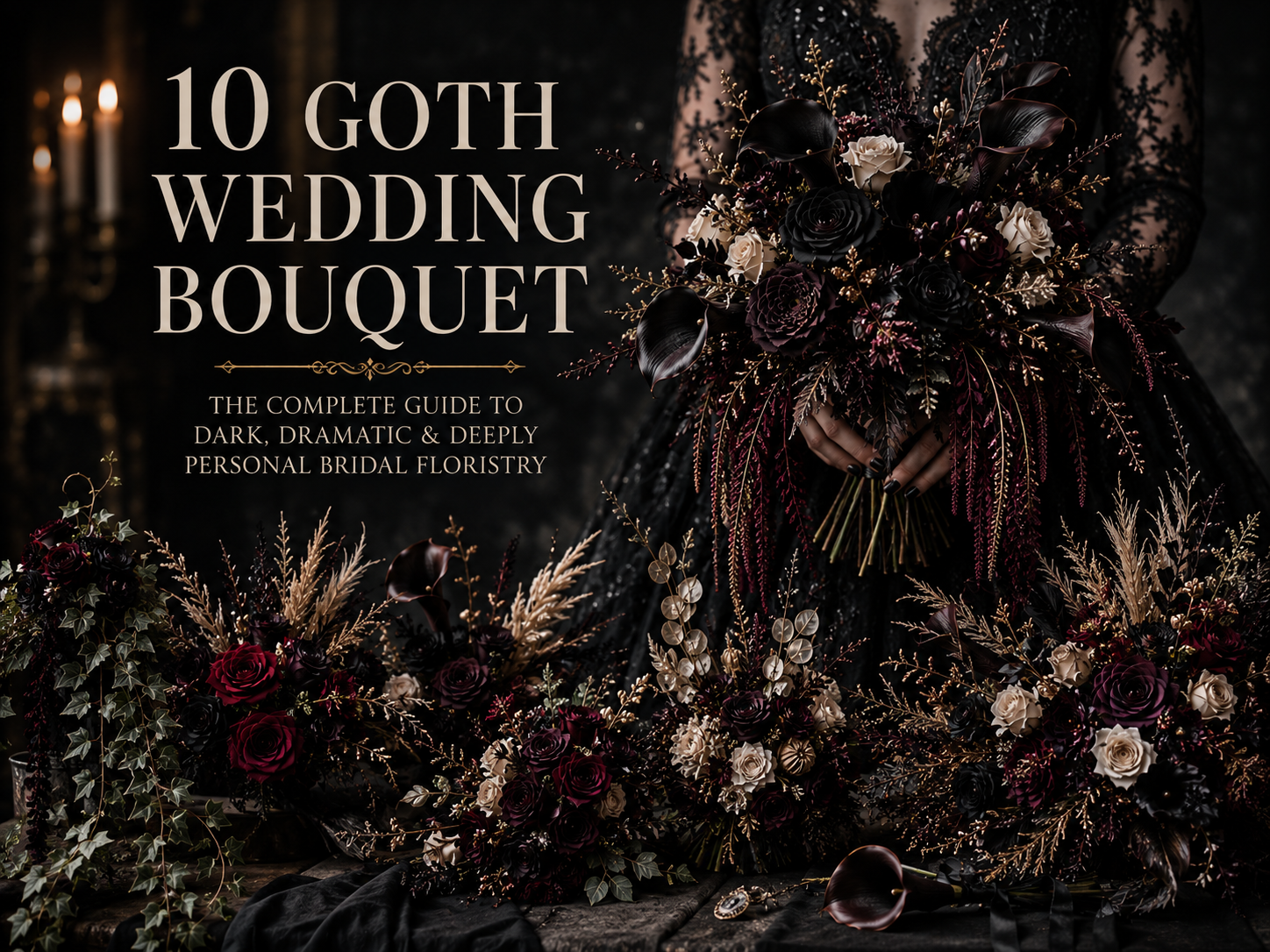
10 Goth Wedding Bouquet – The Complete Guide to Dark, Dramatic & Deeply Personal Bridal Floristry
The Gothic Bridal Edit · 2026
Goth Wedding Bouquet
The Complete Guide to Dark, Dramatic & Deeply Personal Bridal Floristry
From near-black rose cascades and dark anemone arrangements to dried botanical constructions, single-stem statements, and everything in between — your definitive guide to the goth wedding bouquet in 2026.
Introduction
Why the Goth Wedding Bouquet Is the Most Intimate Creative Decision in Dark Bridal Planning
The bridal bouquet is the one decorative element of the entire wedding that never leaves the bride’s hands — or sight — throughout the most photographed hours of the celebration. It appears in every processional photograph, in every ceremony portrait, in every formal couple image, and in the majority of reception photographs. It is held against the body and the dress for hours at a time, which means it must not only look extraordinary but must feel right — the right weight, the right scale, the right texture against the specific fabric of the gown it accompanies. And because it is held rather than worn or placed, it is the most personal object in the entire dark bridal composition: the thing that is most completely in the bride’s own hands, in the most literal sense possible.
The goth wedding bouquet in 2026 is as creatively diverse and as aesthetically sophisticated as the wider dark bridal movement of which it is a part. It encompasses everything from the single perfect stem of a black Baccara rose carried with absolute minimalist conviction, through the generously overflowing cascade of dark dahlias, deep burgundy garden roses, near-black anemones, and trailing dark botanical elements, to the entirely dried and preserved construction of dark botanicals, lunaria seed discs, dried cotton, and twisted willow that carries the gothic aesthetic in a completely different register from any fresh flower arrangement. Each approach is entirely valid, and each rewards a different set of creative priorities and a different kind of aesthetic vision.
This guide covers the complete landscape of the goth wedding bouquet in 2026 — from the ten defining bouquet styles and the specific flowers and botanicals that build them, through shape and scale considerations, the dried botanical alternative, how to brief a florist on a dark gothic brief, coordination with the wider floral scheme, and the practical planning knowledge that ensures the bouquet in the hands of the goth bride is as completely, deliberately, and beautifully intentional as every other element of the dark world she has built around her wedding day.
The Edit
10 Goth Wedding Bouquet Styles for 2026
Each of these ten bouquet styles represents a complete creative direction — a specific approach to the goth wedding bouquet that can be adapted to different dress silhouettes, venue contexts, and levels of floral ambition. Read each as a starting brief for a conversation with your florist, and notice which one you can already feel in your hands.
01
The Dark Abundance Cascade
A generously overflowing cascade bouquet of dark florals — black Baccara roses, deep burgundy dahlias, near-black anemones, chocolate cosmos, dark hellebores, and trailing botanical elements — that spills downward from the hands in the Flemish still-life tradition, with individual stems and foliage trails extending beyond the main body of the arrangement in deliberate, asymmetric organic abundance. The dark abundance cascade is the most visually commanding and the most photographically extraordinary of all goth wedding bouquet styles — it creates an immediate, powerful statement of dark floral richness that reads as both completely romantic and completely, unmistakably gothic. Against a black velvet gown or a Victorian white lace column, this bouquet is simply one of the most beautiful objects in all of contemporary bridal floristry.
02
The Single Stem Statement
A single perfect stem — one black Baccara rose at full bloom, one dark anemone on a long stem, one chocolate cosmos with a length of trailing dark foliage — carried with complete minimalist confidence. The single stem statement is the most quietly powerful of all goth wedding bouquet choices and the one that requires the most aesthetic conviction to carry off: it makes no concession to the conventional expectation of a bridal bouquet, it offers no supporting elements, and it places the entire visual and emotional weight of the bouquet on the quality and beauty of a single chosen bloom. When it is right — when the flower is absolutely perfect and the choice is absolutely personal — it is one of the most striking bridal images available. It photographs with extraordinary intimacy and directness against any gown.

03
The Dried Botanical Construction
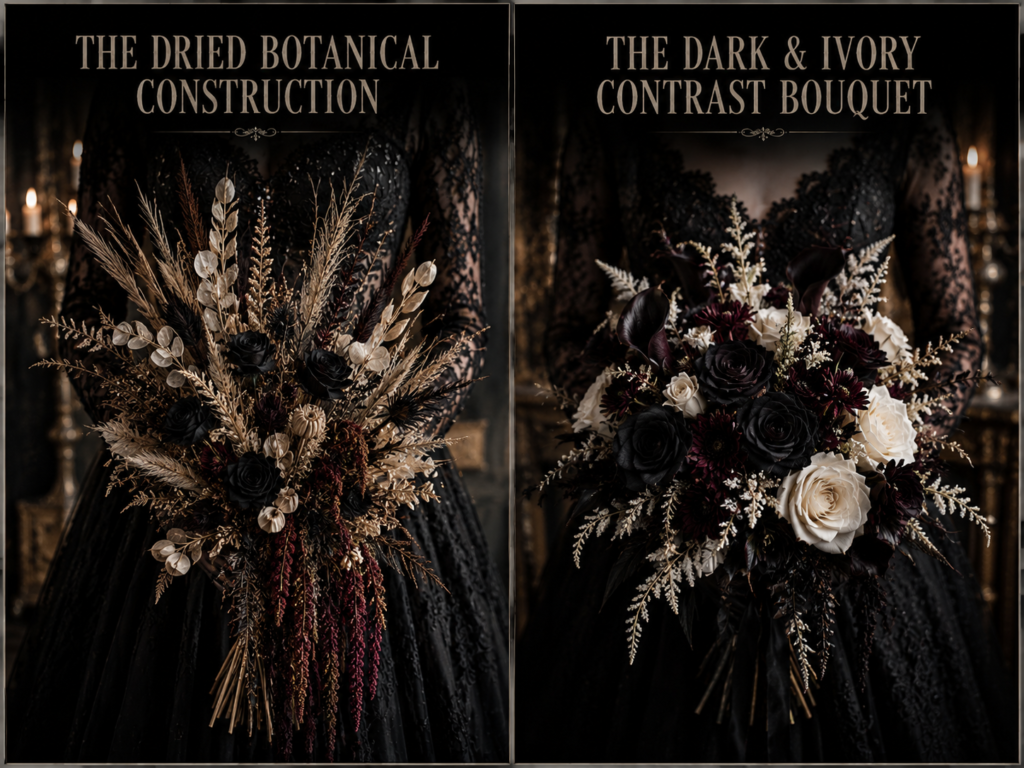
A bouquet constructed entirely from dried and preserved botanical material — dark pampas grass, lunaria seed discs with their translucent silver-grey faces, dried cotton stems, twisted willow, dried dark roses preserved at the moment of their most deeply coloured bloom, seed pods, and dark dried botanical elements — bound with dark ribbon and finished with oxidised silver wire or black twine. The dried botanical bouquet is the most tactilely unique and the most genuinely lasting of all goth wedding bouquet styles: it can be made weeks in advance, it does not wilt during the ceremony, it carries a specific quality of aged, organic darkness that no fresh arrangement can replicate, and it can be preserved indefinitely after the wedding as a permanent keepsake of the aesthetic world that was built for the day. It is also the most sustainable of all the bouquet options — contributing nothing to the cut flower waste that conventional wedding floristry consistently produces.
04
The Dark & Ivory Contrast Bouquet
A bouquet that uses the contrast between very dark blooms and ivory or bone-white flowers as its defining visual language — near-black anemones with their white centres against ivory peonies, black Baccara roses interspersed with champagne garden roses, chocolate cosmos beside ivory ranunculus. The dark and ivory contrast bouquet is the most photographically complex and the most visually rich of all goth bouquet formats — the interplay between the dark and pale elements creates depth, movement, and a quality of visual tension that a monochromatic dark bouquet cannot achieve. It works with particular power against a white goth wedding dress, where it echoes and extends the dress’s own dark and pale design language. Against a black gown, the ivory elements appear luminous in a way that creates one of the most beautiful bridal image contrasts available.
05
The Dark Rose Posy
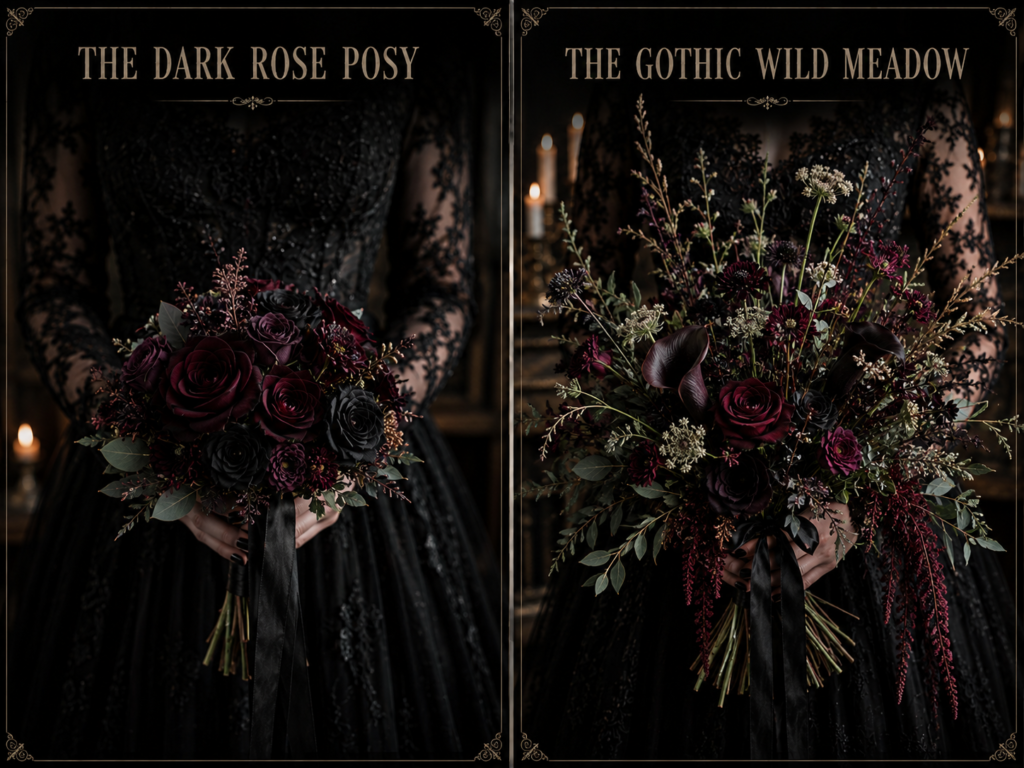
A tightly gathered, rounded posy of dark roses — black Baccara, deep burgundy, or dark wine garden roses — in a single colour or a closely related range of dark tones, with very little foliage and a clean, precise circular silhouette. The dark rose posy is the most classically bridal of all goth bouquet formats and the most immediately comprehensible to the widest audience: it takes the most universally recognised bridal bouquet form and executes it in the darkest possible colour language. It is dignified, formal, and deeply beautiful — the goth bouquet choice for the bride whose wedding context calls for restraint and whose aesthetic confidence lies in the quality of the specific rather than the drama of the spectacular. Against a Victorian lace gown or a structured black column dress, a tight dark rose posy is one of the most perfectly composed bridal images available.
06
The Gothic Wild Meadow
A loose, wild, asymmetric arrangement of dark botanicals gathered as though from a gothic hedgerow — dark anemones, scabiosa in deep plum, dark chocolate cosmos, trailing rosehip stems, twisted willow, dark smoke bush, and scattered dried seed heads — bound loosely with dark ribbon and finished with a length of trailing stem below the binding. The gothic wild meadow bouquet is the most organically beautiful and the most distinctively alternative of all the goth bouquet styles: it looks as though it was gathered from the specific landscape surrounding the venue on the morning of the wedding rather than designed and constructed by a professional florist, and that quality of apparent naturalness — achieved through a great deal of florist skill — is one of its most powerful aesthetic qualities. It suits rustic, woodland, or gothic outdoor settings with particular power.
07
The Architectural Dark Bouquet
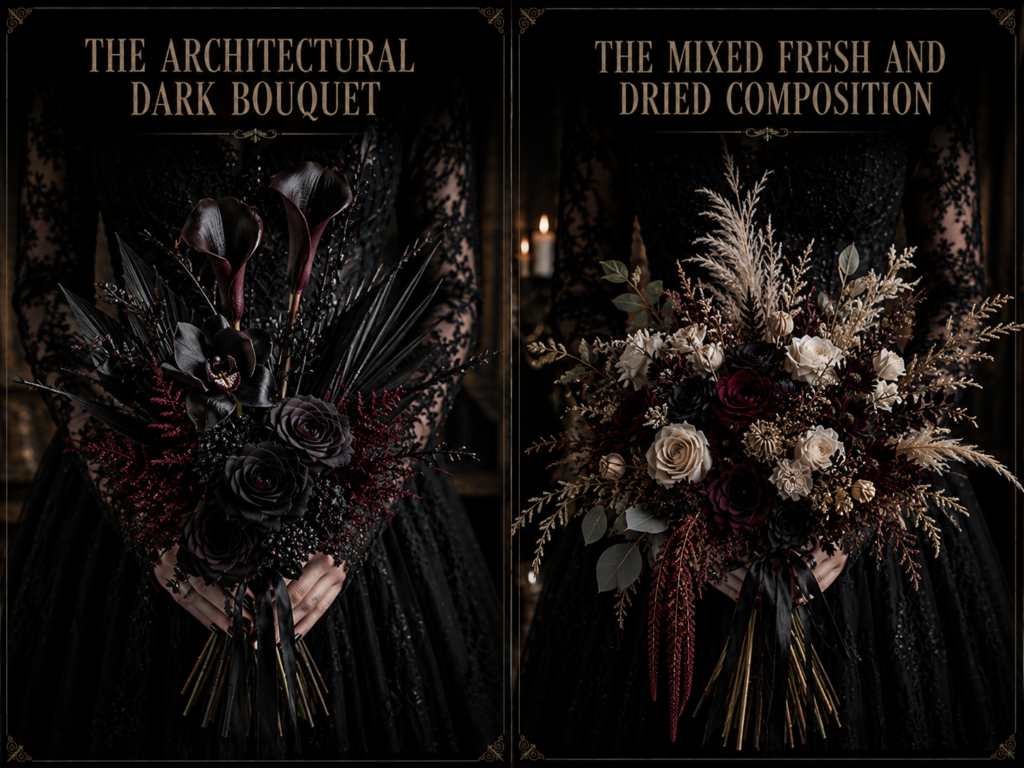
A deliberately structured, almost graphic bouquet — dark branches of copper beech or dark foliage providing the architectural skeleton, with individual dark blooms placed with precision at specific points rather than gathered in organic abundance. The overall silhouette is asymmetric and strongly vertical, with height and line as the dominant visual qualities rather than volume or density. This is the most contemporary and the most design-led of all goth bouquet formats — it references the graphic, structural approach of editorial floral design rather than the abundance of traditional bridal floristry, and it pairs with particular power beside the most architectural and most structurally dramatic gown silhouettes: the sleek black minimalist column, the corseted ballgown, the military-inspired dark suit. It is also the most technically demanding brief for a florist and requires a maker whose portfolio demonstrates genuine structural floral work.
08
The Mixed Fresh and Dried Composition
A bouquet that combines fresh dark blooms — black Baccara roses, dark anemones, chocolate cosmos — with dried botanical elements: lunaria seed discs, dried cotton stems, dark preserved leaves, pampas grass tips, and twisted dried willow woven through the fresh flowers. This combination produces a visual and textural complexity that neither fresh flowers alone nor dried botanicals alone can achieve — the softness and fragrance of the fresh blooms against the papery texture and aged quality of the dried elements creates a composition that reads simultaneously as living and ancient, romantic and gothic. It is one of the most creatively interesting and most personally expressive of all the goth bouquet formats, and it is also one of the most durable: the dried elements maintain their appearance throughout the day while the fresh flowers provide the fragrance and the specific luminous quality that no dried flower can replicate.
09
The Trailing Vine Bouquet
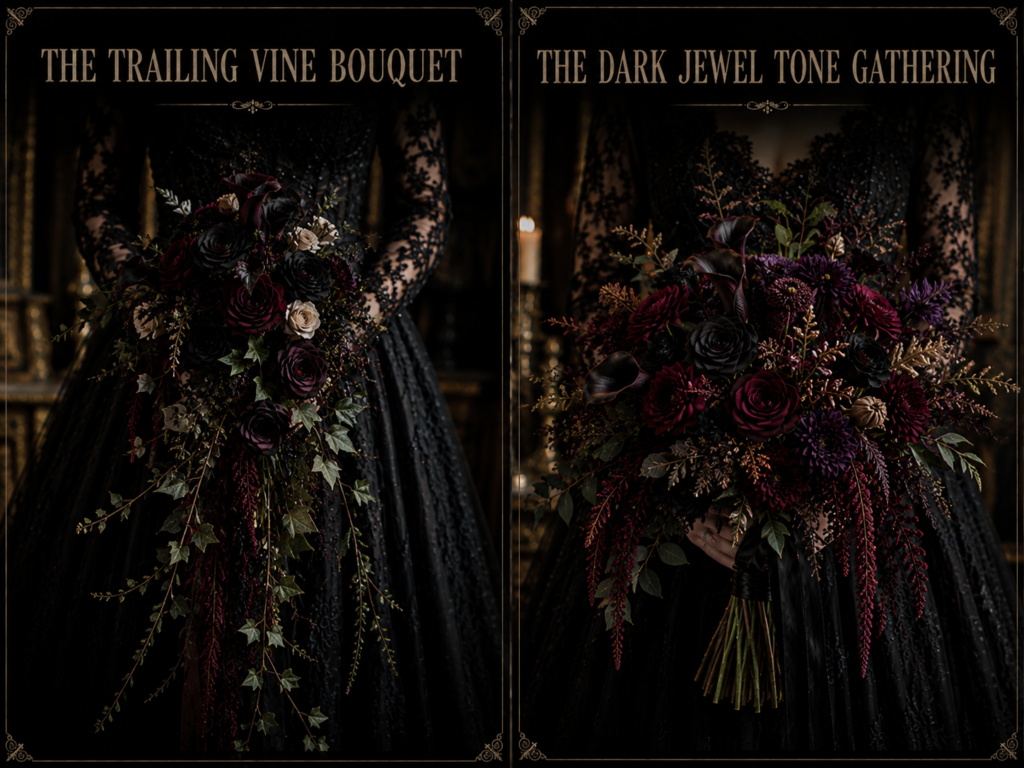
A bouquet constructed around living or preserved trailing vine elements — dark ivy, trailing rosehip stem, black-leafed sweet potato vine, or preserved dark botanical trails — with dark blooms gathered at the top and the vines allowed to cascade dramatically below the hands, potentially to floor level in the most dramatic interpretations. The trailing vine bouquet creates a sense of the bouquet growing downward as well as being held upward — a living, organic quality that no rounded or posy format can achieve. Against a full cathedral-length gown, the trailing elements extend the visual line of the bouquet toward the floor and create the impression of the flowers continuing into the train of the dress in a single unbroken organic movement. This is one of the most breathtakingly beautiful and most theatrical of all goth wedding bouquet formats.
10
The Dark Jewel Tone Gathering
A rounded or loosely gathered bouquet in a range of deeply pigmented jewel tones rather than a single colour — deep burgundy roses alongside midnight plum dahlias, dark forest green foliage beside dark teal scabiosa, deep oxblood ranunculus against dark violet anemones — all sharing the same depth of saturation and the same quality of rich, almost gemstone-like visual density. The dark jewel tone gathering is the most colouristically complex of all goth bouquet formats — it uses the full width of the gothic colour palette within a single composition, creating a bouquet of extraordinary visual richness that rewards close attention while reading as powerfully dark and dramatically beautiful from any distance. It is particularly effective against black or dark velvet gowns where the variety of colour within the bouquet provides welcome contrast with the monochromatic darkness of the fabric.
“The right goth wedding bouquet is the one that looks, when held against the dress, as though it grew there — as though the flowers and the fabric belong to the same organic world and were never going to be separated. That naturalness, achieved through considerable florist skill and complete personal honesty about what the aesthetic requires, is the only standard that matters.”
— The Gothic Bridal Edit
The Dark Flower Palette
The Goth Wedding Bouquet Flower Palette: Dark Blooms, Foliage, and Botanicals
The flower palette of a goth wedding bouquet is one of the richest and most varied in all of bridal floristry — because the gothic aesthetic operates across a range of deeply pigmented, visually complex blooms that produce extraordinary results in every bouquet format. The starting point is always the colour depth: the darkest available versions of each flower family, chosen for the richness and density of their pigmentation rather than for any other quality. But beyond colour, the goth bouquet palette also includes texture — the velvety surface of a dark dahlia, the papery face of a near-black anemone, the fragrant softness of a deeply pigmented garden rose — and the specific quality of age and organic darkness that certain botanicals carry in a way that the brightest and freshest flowers do not.
Essential Dark Blooms
- Black Baccara rose — the defining goth wedding flower; deep velvet red-black, fragrant, and of extraordinary visual depth
- Dark anemones — near-black with a graphic white centre; one of the most immediately gothic flowers available
- Chocolate cosmos — very dark velvety brown-red, intensely fragrant, and uniquely seasonal
- Deep burgundy dahlias — large, richly coloured, with a petal density that creates visual weight and presence
- Dark hellebores — near-black and very deep plum nodding blooms; the most gothic of all garden flowers
- Dark ranunculus — deeply pigmented in dark plum, oxblood, and near-black; papery and extraordinarily beautiful
- Black scabiosa — delicate, floating, dark — adds lightness and movement to denser arrangements
- Deep burgundy garden roses — fragrant, fully petalled, and of the richest possible warm dark tone
Foliage & Dark Botanicals
- Dark smoke bush — deep burgundy-purple cloud foliage that adds both colour and organic texture
- Copper beech branches — rich dark foliage available year-round; deeply architectural in larger bouquets
- Rosehips on the stem — dark red-orange berries with trailing organic movement; deeply seasonal
- Dark ivy — trailing, dark-leafed, and deeply historically gothic; perfect for trailing and cascade bouquets
- Dried lunaria seed discs — translucent silver-grey; adds a papery, aged quality unlike any fresh botanical
- Twisted willow stems — dark, architectural, and deeply atmospheric as structural bouquet elements
- Dried dark pampas tips — soft, feathery, and beautifully contrasting against the density of dark blooms
- Black feathers — the most explicitly gothic of all non-floral bouquet elements; used sparingly and deliberately
Seasonal Availability of Dark Flowers: What to Know Before You Brief Your Florist
The specific dark flowers that make a goth wedding bouquet most extraordinary are not all available year-round, and the seasonality of the dark flower palette is one of the most important practical considerations in goth wedding bouquet planning. Black Baccara roses are available year-round from specialist growers and wholesalers. Chocolate cosmos are a late summer and early autumn flower — available approximately July through October. Dark hellebores are a winter and early spring flower — available approximately December through April. Dark dahlias are a late summer through autumn flower — available approximately August through November. Dark anemones are available most of the year but are most beautiful in late winter and spring. If your wedding date falls outside the natural season of your most-desired flowers, discuss availability and alternatives with your florist at the earliest opportunity — and consider incorporating dried and preserved versions of out-of-season flowers alongside fresh in-season alternatives.
Bouquet Binding & Finishing
Binding and Finishing the Goth Wedding Bouquet: The Details That Complete the Dark Composition
The binding of a goth wedding bouquet — the material that wraps the stems and the way in which it is applied and finished — is a design decision that affects the look of every photograph in which the hands and the bouquet stems are visible. In most close-up bridal portraits and ring photographs, the bouquet is held and the binding is clearly visible. A poorly chosen or poorly executed binding undermines the bouquet above it in the same way that a visible, poorly fitting zip undermines the most beautiful dress. The right binding material completes the bouquet, contributes to its aesthetic character, and in the best examples becomes a design element in its own right.
🖤
Black Velvet Ribbon
The most luxurious and most authentically gothic of all bouquet bindings. A wide black velvet ribbon wrapped in overlapping horizontal bands up the stems, with the end finished in a generous bow or a long trailing tail. The velvet surface echoes the texture of dark velvet fabric and creates a visual connection between the bouquet and any velvet elements in the gown.
🌑
Dark Silk Ribbon
A deep burgundy, midnight plum, or near-black silk ribbon — either wrapped smoothly or twisted and draped — creates a more refined and more formally elegant finish than velvet. Trailing lengths of dark silk ribbon below the stems add movement and a quality of deliberate luxury. Best with the most formally constructed bouquet styles.
🌿
Black Twine
Waxed black twine or black jute wound tightly and repeatedly around the stems creates the most organic and most textural of all goth bouquet finishes — it references the rough, natural materials of the gothic craft tradition directly and suits the wild meadow, dried botanical, and mixed fresh-and-dried bouquet styles with particular authenticity.
⚙️
Oxidised Wire
Dark oxidised or blackened wire wound around the stems in visible, deliberate spirals — creating an industrial-gothic finish that is unlike any other binding material and that pairs with particular power beside the most architecturally structured and most contemporary goth bridal looks. Unexpected, specific, and completely personal.
Coordinating the Scheme
Coordinating the Goth Wedding Bouquet With the Complete Floral Scheme
The bridal bouquet is the most visible and the most intimate piece of the entire goth wedding floral scheme — but it exists within a wider floral narrative that includes the ceremony arch, the table centrepieces, the buttonhole, the bridesmaids’ bouquets, the hair flowers, and any other floral elements deployed throughout the celebration. The most powerful goth wedding floral schemes are those where all of these elements share a consistent visual language — the same colour palette, the same balance of dark blooms and foliage, the same binding materials and finishing details — so that the wedding photographs read as a coherent floral world rather than a collection of separately commissioned pieces.
Bridesmaids’ Bouquets
Bridesmaids’ bouquets at a goth wedding should use a subset of the flowers in the bridal bouquet rather than a completely separate composition — smaller in scale, simpler in construction, but clearly related in palette and material. The visual connection between the bridal bouquet and the bridesmaids’ arrangements is what creates the sense of a coordinated floral world rather than a collection of individual pieces. If the bridal bouquet is a dark abundance cascade, bridesmaids carry smaller, rounded posies in the same dark tones. If the bridal bouquet is a single stem statement, bridesmaids carry a small gathering of two or three stems.
The Buttonhole
The groom’s buttonhole must be made from the same flowers as the bridal bouquet — ideally by the same florist as part of the same floral commission. A single dark bloom from the bouquet palette, with a small sprig of matching foliage and a length of matching binding material, creates a direct visual connection between the bridal and groom’s styling that contributes enormously to the total coherence of the couple’s combined look in every photograph. The dark buttonhole against a dark lapel is a subtly beautiful detail that rewards the close attention of a curious eye.
Hair Flowers
Any fresh or dried botanical elements incorporated into the bridal hair — whether as a crown, individual pins, or stems tucked into an updo — should be commissioned alongside the bouquet from the same florist, using the same flowers and botanicals in the same proportions. The dark flowers in the hair connect the bouquet in the hands to the composition of the head in every photograph, creating a total floral aesthetic that reads as a single, coherent, completely considered creative vision.
Practical Planning
Ten Things Every Goth Bride Should Know Before Briefing Her Florist
- Find a florist whose portfolio contains genuinely dark work — not a florist who can do dark as a special request. The most significant risk in goth wedding bouquet planning is commissioning a florist who is excellent within the conventional bridal floral register but whose understanding of dark, gothic, and alternative floristry is limited to adding a few dark roses to an otherwise conventional arrangement. Search specifically for florists who regularly work with dark, alternative, and gothic bridal clients. Their portfolio will contain the visual evidence of that fluency — and if it does not, they are not the right florist for this brief.
- Brief the florist on the complete aesthetic world of the wedding, not just the bouquet. Bring photographs of the dress, the venue, the rings, the makeup mood board, and the overall aesthetic vision. The florist who understands the total world being built will make better bouquet decisions than the one who has only seen a photograph of the specific flowers requested. The bouquet exists in context — and a great florist uses that context to produce something more specifically and more beautifully right than any client brief alone could specify.
- Commission all floral elements — bouquet, buttonhole, hair flowers, bridesmaids, ceremony, and reception — from the same florist. A coherent goth wedding floral scheme is almost impossible to achieve when different elements are commissioned from different makers. The colour matching, the textural consistency, and the visual language that makes a floral scheme read as a single composed world rather than a collection of individual pieces requires one creative intelligence applied consistently across every element. The additional cost of commissioning everything together is almost always less than the aesthetic cost of dividing the commission.
- Confirm the availability of every specific flower required for the wedding date. The dark flower palette is more seasonally variable than the conventional bridal palette — certain flowers are only available at specific times of year, and the specific dark varieties that produce the most extraordinary goth bouquets are sometimes in shorter supply than their pale equivalents. Have this availability conversation with your florist at the very first consultation, before the booking is confirmed, and identify alternatives for any flower whose availability in your wedding season cannot be guaranteed.
- Request a sample stem of every planned flower variety before confirming the bouquet design. The specific tone of a dark flower varies significantly between different growers and different seasons — the Black Baccara rose from one supplier may be noticeably less dark than from another, and a chocolate cosmos at peak season may be significantly darker than one from late in the season. Before finalising any bouquet design, ask your florist to source and show you actual stems of every key flower in the darkest available grade. Approve the specific colour of each flower, not just the variety name.
- Discuss the bouquet scale in the context of the specific dress silhouette. A small, tight posy looks beautiful held against a slim column or separates but disappears against the scale of a full ballgown. A dramatic cascade or abundance bouquet pairs magnificently with a full gown but can overwhelm a minimal or sleek silhouette. The bouquet and the gown must be sized in conversation with each other — your florist should know the silhouette before proposing a scale, and the scale should be assessed against photographs of the actual gown rather than a generic description.
- Plan the bouquet conditioning and care on the wedding morning carefully. Fresh dark flowers require specific care in the hours before the ceremony — kept cool, in fresh water, away from direct sunlight or heat, and not refrigerated at very low temperatures which can damage certain dark varieties. Brief whoever is responsible for the bouquet on its care requirements from collection to ceremony. Most florists will provide conditioning advice with delivery; if yours does not, ask specifically.
- Consider the practical weight and scale of the bouquet throughout a long day. A very large cascade bouquet or a heavy abundance construction is beautiful but physically demanding to carry through a three-hour ceremony, a drinks reception, a dinner, and several hours of evening celebration. Brief your florist on the full duration and physical demands of your wedding day and ask specifically for a construction that can be carried comfortably throughout that period without causing fatigue or discomfort. The most beautiful bouquet in the world is less beautiful in every photograph taken after the point at which it becomes painful to hold.
- Commission a small alternative arrangement for the reception if the main bouquet is particularly large or delicate. Some goth brides choose to have a smaller, more robust secondary bouquet for the reception — easier to carry on the dance floor, less vulnerable to the wear of a long evening — while displaying the main ceremony bouquet in a statement vessel at the reception table. This approach preserves the main bouquet in its most perfect condition throughout the evening and provides an additional decorative element at the table.
- The most powerful goth wedding bouquet is always the most personally honest one. Not the largest, not the darkest, not the most technically complex, and not the one most closely matching any reference photograph — the one that uses the specific flowers that carry personal meaning, in the specific arrangement that feels most completely like an extension of the wearer’s own aesthetic imagination, in the specific scale that feels right in the hands of the specific person who will carry it. That specificity — that quality of having been made for this one person rather than for a generic brief — is what makes the difference between a dark bouquet that is beautiful and a goth wedding bouquet that is unforgettable.
Final Thoughts
The Flowers in Your Hands Tell the Story of the World You Built
The goth wedding bouquet is the last element of the dark bridal aesthetic to be placed in the bride’s hands on the wedding morning — and the one that will be carried closest to the body throughout every photographed moment of the most important day of her life. It is in the photographs taken at the altar, in the portraits taken in the garden or the stone corridor or the candlelit hall, and in the images that will be looked at every anniversary for decades. It deserves the same genuine, patient, completely personal creative attention that every other element of the dark world has received — and when it is right, when the dark flowers and the trailing vines and the binding material and the scale are all completely, honestly in conversation with the gown and the setting and the person carrying them, it will be simply, exactly, completely the flowers that were always going to be in those hands on that day.
Find the florist who makes dark things beautifully. Brief them on every element of the world you have built. Commission the flowers that carry personal meaning. And then hold them — completely, without self-consciousness, in the hands that are about to exchange rings with the person you have chosen — and know that the dark bouquet in your grasp is as much a part of who you are as the dark dress around you and the dark rings waiting in their box.