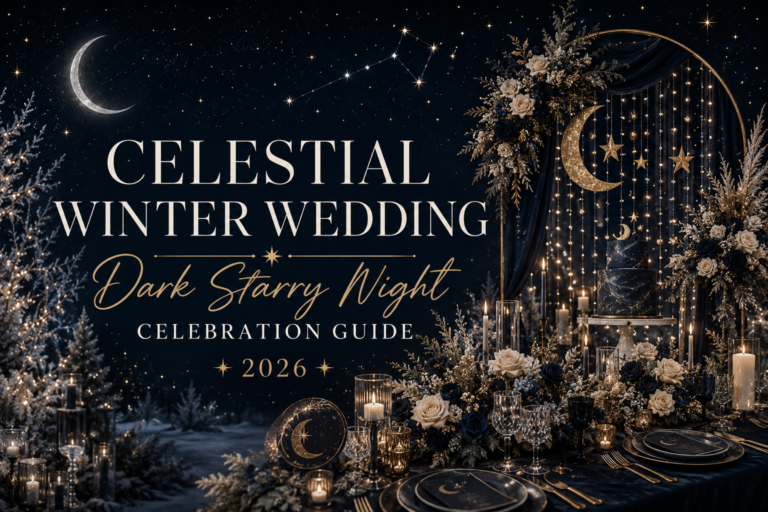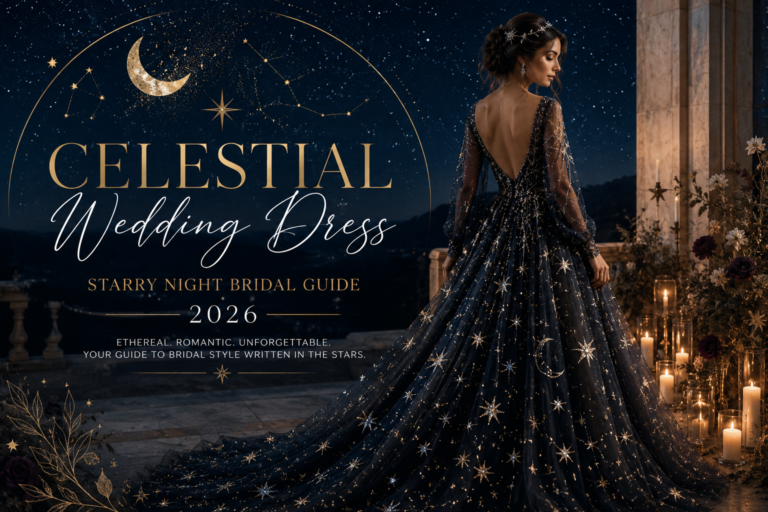
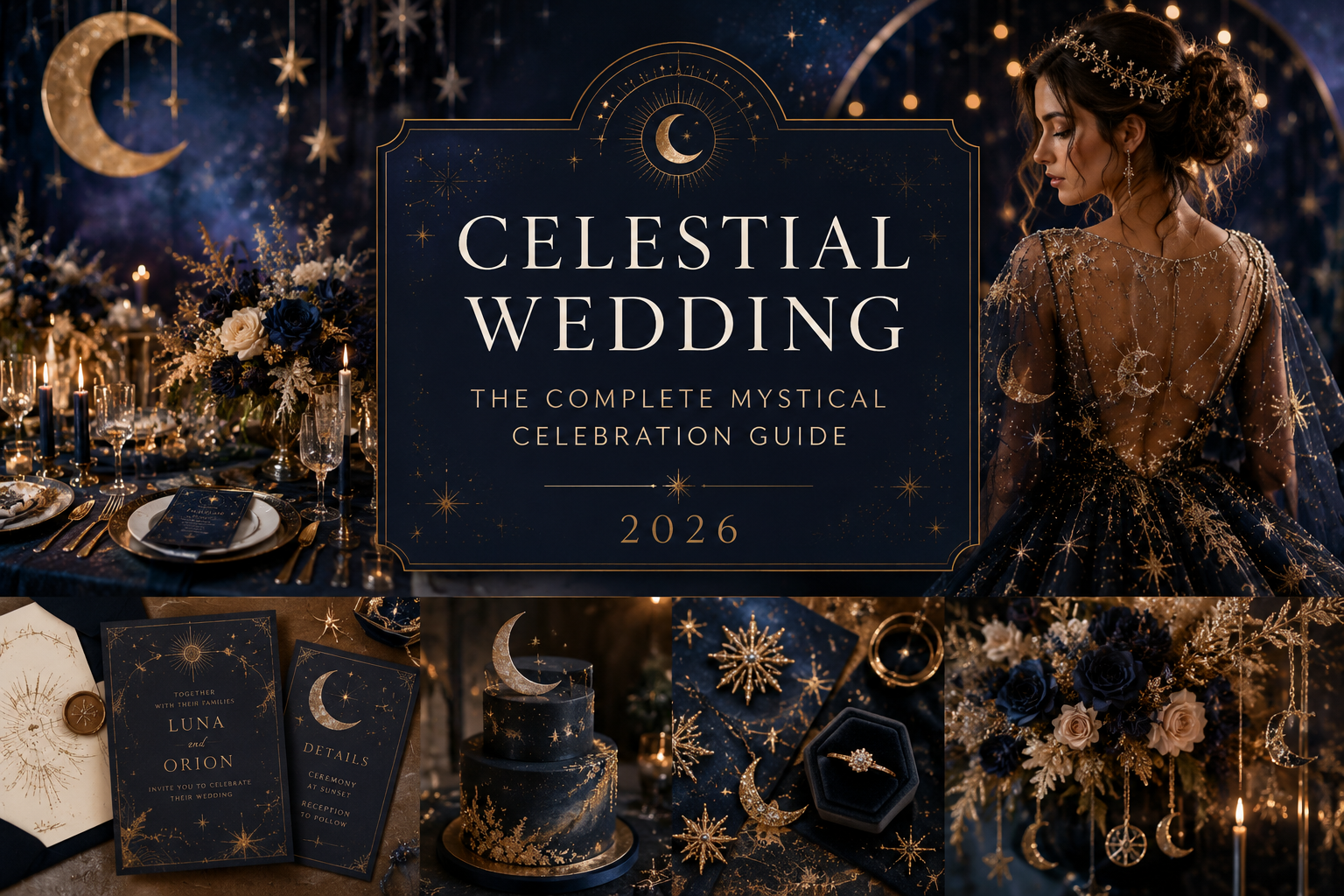
Celestial Wedding — The Complete Mystical Celebration Guide 2026
Celestial Wedding · 2026
Celestial Wedding — The Complete Mystical Celebration Guide 2026
Six celestial aesthetics, four palettes, ceremony and reception design, and the stationery that conjures the night sky before guests arrive.
The night sky is the oldest and most universal setting for human ceremony — the stars have been present at every celebration of love that has ever taken place, which is precisely why a celestial wedding feels simultaneously ancient and personal rather than like a trend. Celestial weddings have surged on Pinterest not because the aesthetic is new but because it answers something real: the desire for a celebration that feels genuinely cosmic in scale, that connects two people to something larger than themselves, and that looks like nothing a conventional wedding planner would propose by default.
This guide covers everything: six distinct celestial aesthetics and what distinguishes them, four named color palettes with practical guidance, venue decisions and ceremony details, reception design for an intimate night sky, and a complete stationery showcase across eight collections that span every register of the celestial world.
“The stars have been witnesses to every act of love since the first — ancient, vast, indifferent to all but the moment itself. To marry beneath them is to place a private ceremony inside the largest story ever told.”
Section 01 What Is a Celestial Wedding?
A celestial wedding is not a space-themed party with rocket ship table decorations and neon planet props. It is a genuinely atmospheric, romantic, and mystical celebration that takes the night sky — the moon, the stars, the constellations, the specific quality of darkness that makes individual lights so luminous — as its primary aesthetic vocabulary. The distinction between celestial and “dark wedding” is important: a dark wedding uses deep tones to create mood; a celestial wedding uses those same deep tones to evoke a specific world. The world of the night sky as it has been understood by every culture that has ever mapped the stars and found stories in them.
The key visual elements that define a celestial wedding across all its aesthetic variations: a palette that grounds itself in midnight tones — navy, deep black, dark purple, rich indigo — with gold as the primary metallic language and silver as a secondary counterpoint. Moon and star motifs in their most poetic and least literal forms: a crescent moon as an architectural element in the floral arrangement, constellation lines in the table linen print rather than cartoon stars on the napkins, a celestial map on the ceremony program that functions as art rather than illustration. The antique quality is central — a celestial wedding draws on the visual language of the historical sky: the Renaissance star atlas, the Art Nouveau celestial illustration, the vintage almanac — rather than on the visual language of contemporary astronomy or science fiction.
What separates a celestial wedding that reads as genuinely mystical from one that reads as theme-party adjacent is the commitment of the palette across every element simultaneously, and the quality of the illustration and material choices. A celestial wedding in which every printed element carries the same constellation illustration quality, the same midnight-and-gold palette temperature, and the same antique celestial visual language will feel like a world that guests have been invited into — complete, self-consistent, and genuinely beautiful in the way that the actual night sky is genuinely beautiful.

Section 02 Six Celestial Wedding Aesthetics
The celestial aesthetic contains more range than most couples realize when they first encounter it. Six distinct registers, each with a different emotional quality and a different palette temperature.
2.1 The Classic Celestial
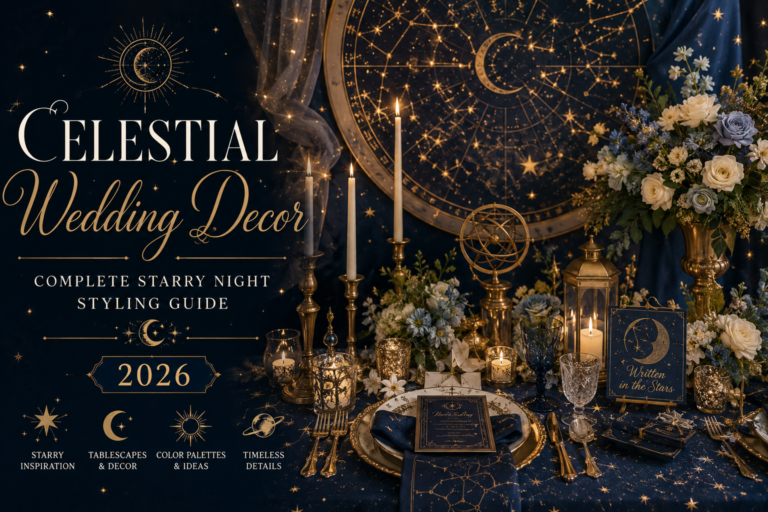
The classic celestial is the register most couples picture when they first describe a celestial wedding: midnight blue, warm gold, and the white-silver of starlight. It is the most romantic of the six aesthetics and the most immediately recognizable — constellations rendered in gold line work against a deep blue field, crescent moons as the recurring motif, and star clusters used as the decorative language in every detail from the invitation envelope liner to the centerpiece lighting. The palette is warm despite its depth because the gold — a warm, antique gold rather than a bright or cool one — brings the temperature up and prevents the midnight blue from reading as cold or formal.
The execution decisions that define the classic celestial: deep midnight navy velvet as the primary textile (table runners, chair sashes, altar fabric), constellation line-work in warm gold on every printed element, candlelight as the primary light source supplemented by fairy lights at very low density — the quality of a clear night rather than a light display. The florals are dark and rich: deep burgundy roses, navy thistles, dark dahlias, with white garden roses as the light accent. The classic celestial photographs most consistently across all lighting conditions, which makes it the most reliable choice for couples whose priority is an extraordinary visual result in every image taken at the wedding.

The Celestial Starry Nights and Mystical Black Gold Celestial collections bring this palette into a complete stationery suite — midnight blue, warm gold constellation work, and the warmth of a romantic night sky.

2.2 The Vintage Celestial
The vintage celestial direction reaches back to the aesthetic of the Renaissance star atlas and the early modern celestial map — the Ptolemaic universe rendered in ink and gold leaf, where the sky was both a scientific document and a work of art. The palette shifts from midnight blue to aged parchment and antique gold: warm sepia tones, the specific brown-cream of aged paper, constellation lines in a warm burnished gold rather than a clean bright one. This is the celestial aesthetic for couples who love the feeling of something old and carefully made — a celebration that looks like it was designed by someone who owned a library.
The vintage celestial is the most literary of the six aesthetics. The specific execution decisions: aged parchment or cream linens with constellation print in antique gold or sepia, invitation suites that carry the hand-drawn quality of an antique map rather than a graphic design sensibility, florals with a dried or pressed quality — lavender, dried rose, wheat, dried herbs — rather than fresh cut flowers. The ceiling treatment for this direction: antique brass chandeliers rather than modern lighting, candlelight at every height from floor votives to tall taper candles. The result is a room that could plausibly exist in a different century — romantic, learned, and specifically beautiful in a way that has nothing to do with current trend.
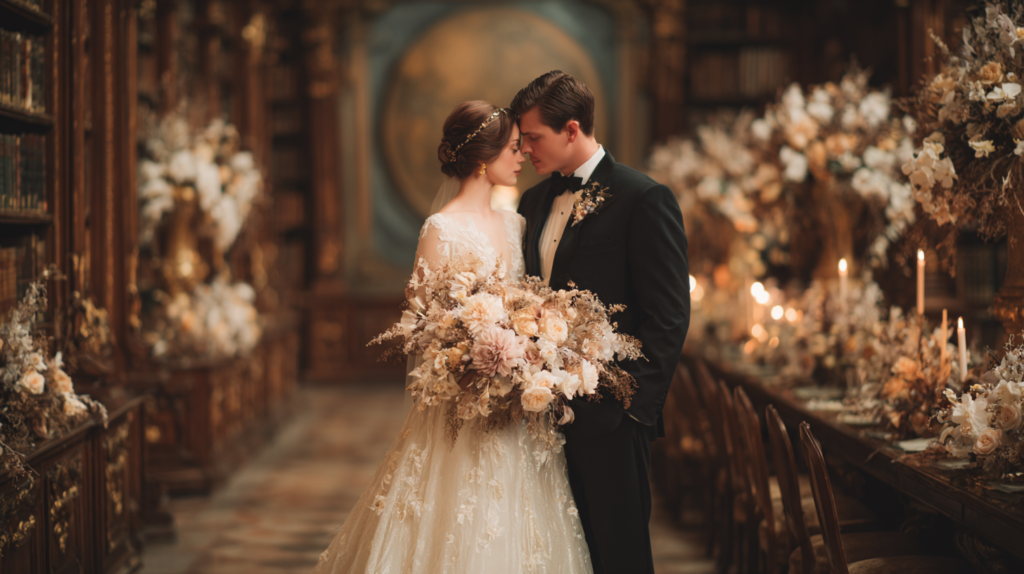
The Celestial Vintage collection and the Vintage Celestial Renaissance suite bring the antique map aesthetic into stationery — parchment, aged gold, and the hand-drawn quality of a Renaissance celestial atlas.

2.3 The Dark Celestial
The dark celestial is the most dramatically atmospheric of the six directions — it leans fully into the depth of midnight, using near-black as the base rather than deep navy, and allowing gold to function as the only light source in the palette. Where the classic celestial is romantic and warmly legible, the dark celestial is moody, intimate, and slightly mysterious: the atmosphere of the night sky between the visible stars, the quality of darkness that is not absence of light but the presence of something vast and felt. This is the direction for couples who want the reception room to feel like somewhere genuinely other — a space outside of ordinary time.
The dark celestial requires the most deliberate lighting design of the six aesthetics — because deep darkness is only beautiful when there are sufficient points of light within it to produce the contrast that makes the darkness feel intentional rather than simply underlit. Candles in significant quantity (not as accent detail but as primary light source, at every table and at the perimeter of the space), pin-spot lighting on centerpieces and key decorative elements, and a ceiling treatment that suggests the night sky are the three decisions that make the dark celestial work. The florals: near-black dahlias, deep burgundy ranunculus, black calla lily, dark plum orchid — flowers that carry the depth of the palette in their pigment and provide visual texture within the darkness rather than contrast against it.
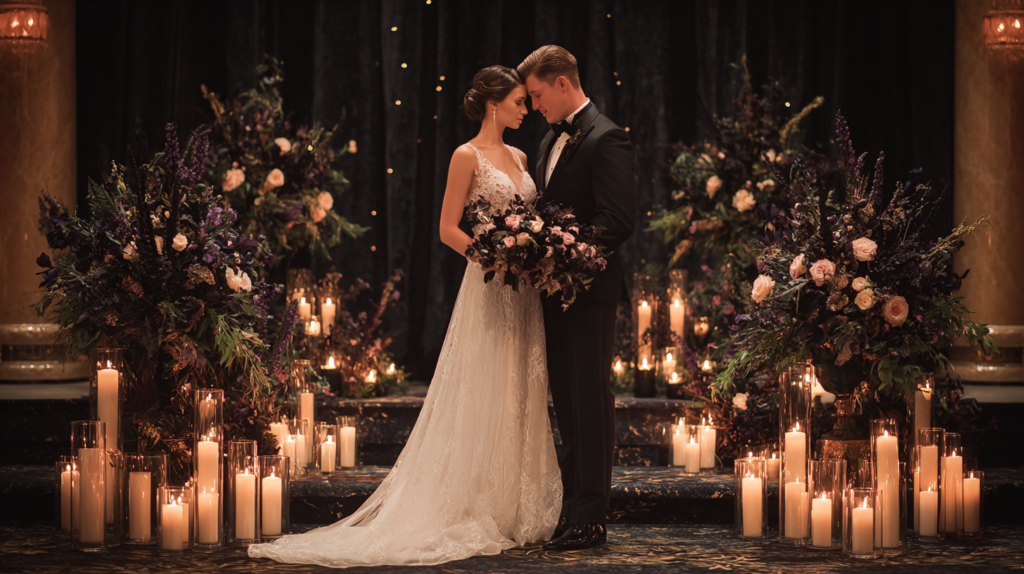
The Celestial Dark category and Black Gold Celestial collection bring the moody, atmospheric register into stationery — deep near-black with warm gold that reads as the luminous quality of starlight against genuine darkness.

2.4 The Gold Celestial
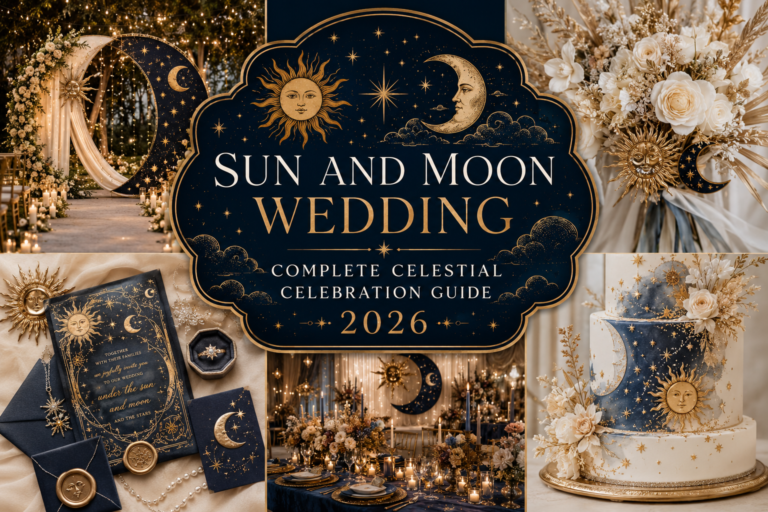
The gold celestial is the warmest of the six directions — it centres the palette on the luminous quality of the sun and moon rather than on the depth of the night sky. Warm amber gold, rich honey, deep sunrise terracotta, and the specific warmth of candlelight: this is the celestial direction for couples who want their celebration to feel like the transitional moments of the sky — dusk and dawn and the full moon at its peak — rather than the darkness of midnight. The sun and moon as a paired motif, the golden warmth of a rising or setting star, the specific amber quality of light at the edge of night: these are the visual languages of the gold celestial direction.
The gold celestial is the most approachable of the six directions for couples who love the celestial aesthetic but want their wedding to feel warm and inviting rather than dramatically atmospheric. It is also the most seasonally flexible — the warm gold palette works as naturally in an autumn or winter setting as in a summer one. The florals: amber-toned sunflowers, golden ranunculus, peach and coral dahlia, marigold, and the specific warmth of dried wheat — a harvest quality that reads as the earth reaching toward the stars.
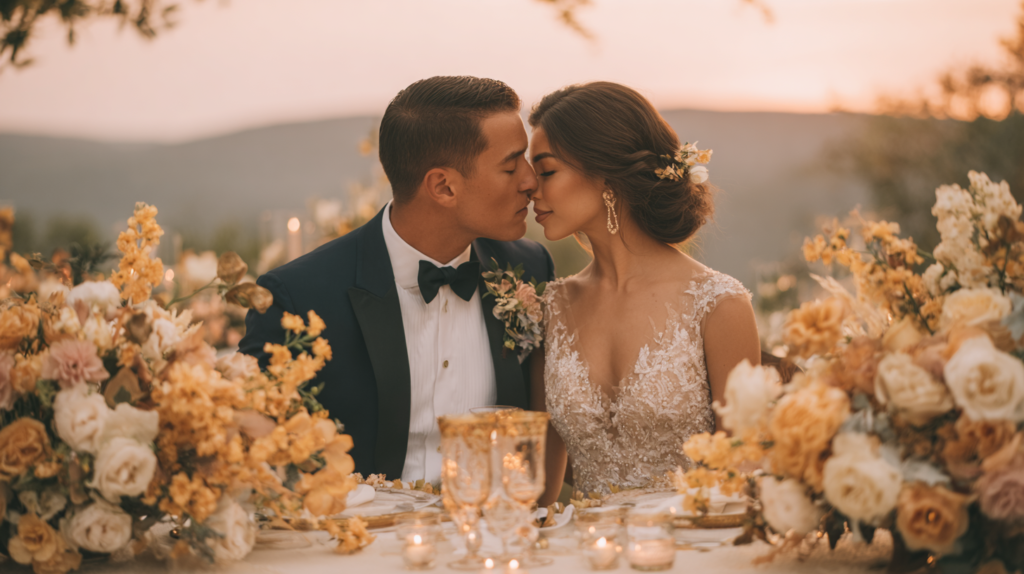
The Celestial Gold collection brings the warm luminous direction into stationery — sun and moon motifs in a rich amber gold palette that feels like the sky at its most beautiful transitional moments.

2.5 The Celestial Boho
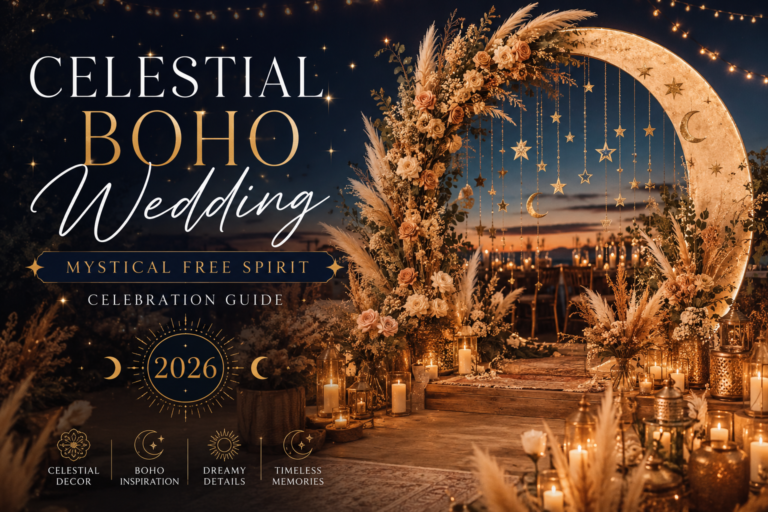
The celestial boho direction is the freest and the most naturally unconventional of the six aesthetics — it brings the mystical quality of celestial symbolism into the organic, textured, and earthy aesthetic of the boho wedding, producing a combination that reads as wildly personal and genuinely beautiful. The palette: warm terracotta and dusty clay alongside deep indigo and brushed gold — the colors of the earth and the sky in the same range, which is precisely the quality that makes this direction feel both grounded and cosmic. Moon and star motifs rendered in a loose, organic illustration style rather than a precise geometric one; constellation forms suggested by botanical arrangements rather than illustrated in clean lines.
The celestial boho is the direction for couples who want a wedding that looks like it happened in a field under stars rather than in a decorated venue — the quality of natural ceremony rather than managed occasion. Macrame moon arches as the ceremony backdrop; dried pampas and eucalyptus woven with dried star-shaped botanicals; terracotta vessels with wildflower arrangements in deep blue and dusty gold; low tables with cushion seating rather than formal chairs. The stationery carries the organic quality of the material choices: hand-drawn or watercolor-quality illustration of the celestial motifs on warm ivory stock, with typography that reads as calligraphic and personal rather than typeset and designed.
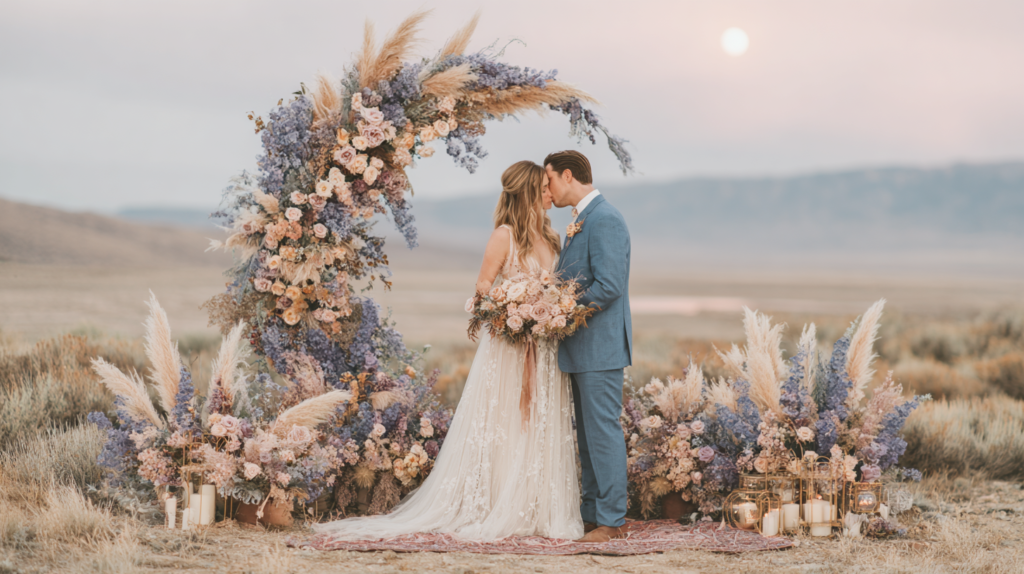
The Celestial Boho collection brings the free-spirited mystical direction into stationery — organic celestial motifs in warm earthy tones that marry the natural world and the cosmic one in the same palette.

2.6 The Celestial Floral
The celestial floral direction is the most visually complex of the six — it brings the night sky into dialogue with the botanical world in the specific register of Art Nouveau illustration, where flowers and celestial motifs coexist in the same organic visual language. The palette: deep teal, indigo blue, dusty lavender, and warm cream with gold as the metallic accent — a slightly cooler gold that suggests moonlight rather than candlelight. Floral elements carry the same graphic quality as the constellation lines: a botanical illustration of deep blue morning glories alongside constellation Aquarius, a midnight dahlia within an armillary sphere, wildflowers traced with the precision of a scientific illustrator at the height of the Art Nouveau movement.
This is the celestial direction most closely connected to the history of botanical illustration and natural history. The stationery is where this direction is most powerful: an invitation with Art Nouveau-quality botanical and celestial illustration communicates immediately that this couple has a specific and sophisticated aesthetic sensibility. The florals must match that quality: architectural arrangements with the specific species and color decisions of a botanical illustrator rather than the generic abundance of a conventional florist. Deep blue delphinium, midnight orchid, dark iris, star-shaped botanical fillers — each chosen for its visual precision as much as its beauty.
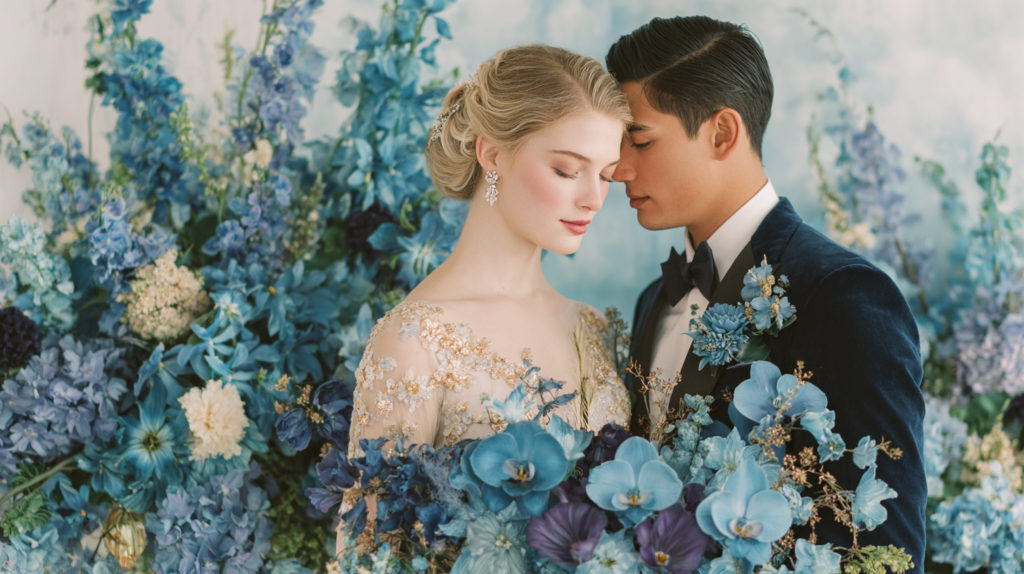
The Celestial Floral collection and Celestial Art Nouveau Blue Gold suite bring botanical and celestial motifs together in a stationery direction that reads as genuinely artistic — deep teal, indigo, and cool gold in an Art Nouveau illustration quality.

Section 03 Celestial Wedding Color Palettes
Four named palettes that cover the full range of the celestial aesthetic — use these as the reference for every decoration, floral, and stationery decision.
Palette 01
Midnight Blue & Gold
The classic celestial palette. Deep midnight navy as the base, warm antique gold as the primary accent, silver-white starlight as the detail. The most consistently beautiful and most photographically reliable palette across all light conditions. For: classic, vintage, and dark celestial aesthetics.
Palette 02
Black & Antique Gold
The dark celestial palette. Near-black as the complete base, warm antique gold as the only light source in the palette. No silver; no cool tones. The most dramatically atmospheric palette — requires careful lighting design but produces the most striking room. For: dark and classic celestial.
Palette 03
Deep Purple & Silver
The mystical celestial palette. Deep plum or grape purple as the base, silver and cool white as accents, with warm lavender as the transitional midtone. The most magical palette — associated with the mystical and poetic history of celestial symbolism. For: celestial purple, boho, and floral aesthetics.
Palette 04
Vintage Parchment & Constellation Gold
The vintage celestial palette. Aged parchment, warm sepia, and antique paper tones as the base, with burnished gold as the constellation accent. The warmest and most literary palette — reads as beautiful in any natural or candlelit setting. For: vintage, gold, and boho celestial aesthetics.
Section 04 Celestial Wedding Venues
The ideal celestial wedding venue has one quality above all others: access to the actual sky. Whether this means outdoor ceremony space with an open horizon, a glass conservatory that makes the night sky the ceiling, a rooftop terrace in a setting with minimal light pollution, or a venue adjacent to a dark sky reserve — the fundamental argument of the celestial wedding is that the natural sky is the primary decoration, and every venue decision should support rather than replace it. The best celestial weddings are the ones where the stars themselves are present as guests.
Architectural drama is the secondary quality that makes a venue work for a celestial aesthetic. High ceilings that allow the installation of chandelier or ceiling textile elements; stone or masonry that reads as ancient and substantial; vaulted interiors that create the quality of a sky made intimate. Historic estate gardens, old stone barns, cathedral ruins or restored ecclesiastical spaces, medieval halls: these venues carry an inherent quality of time and permanence that amplifies the celestial aesthetic rather than competing with it. The celestial world is an ancient one, and venues that feel ancient give it the physical grounding it needs.
For indoor venues without sky access: the ceiling is the entire design challenge and the entire opportunity. A fabric ceiling installation using deep midnight navy velvet drape, with pin-spot lights at varying heights and integrated fairy lighting at very low density — not the dense carpet of lights that produces a generic fairy light wedding, but the specific sparsity of stars in the actual night sky — can transform any interior into a genuinely celestial space. The critical calibration: fewer lights, not more. The night sky is defined as much by the darkness between the stars as by the stars themselves. A ceiling that is 80% dark and 20% light reads as sky; a ceiling that is 80% light reads as a light installation. The darkness is the point.
Planetariums as wedding venues are the most obviously appropriate choice and the most consistently overlooked — a planetarium’s projection system can literally recreate the night sky of any date and location the couple specifies, which is a wedding detail of extraordinary personal specificity. The night sky on their first date, the sky as seen from the location of the proposal, the specific configuration of stars at the moment of their birth on the same day: any of these can be projected as the ceremony backdrop. For couples who have access to this venue category, the celestial wedding argument completes itself without any additional decoration.
Section 05 Celestial Wedding Ceremony
Timing: When the Stars Are Present
For an outdoor celestial ceremony where the actual sky is the backdrop, timing is the single most important planning decision. The ceremony should begin no earlier than civil twilight — the moment when the first stars become visible to the naked eye — and ideally be timed so that complete darkness falls during rather than before or after the vows. This means checking astronomical twilight data for the specific date and location and working backward to determine ceremony start time. In most of the UK and Europe in summer, complete darkness does not fall until 10pm or later; in autumn and winter, this may happen as early as 6pm. The celestial wedding that commits to its premise plans the ceremony around the sky’s schedule rather than convention’s.
The Celestial Arch
The ceremony arch for a celestial wedding should read as a frame for the sky rather than a replacement for it — which means scale and transparency are more important than floral abundance. A circular arch (moon arch) in blackened or midnight-painted metal, with deep botanical elements woven through the lower portion and the top portion left partially open so that the sky is visible through the circular frame: this is the arch format most specific to the celestial aesthetic. The florals at the arch base and sides: deep burgundy, midnight blue, and warm cream, with dried botanical elements in gold and amber. A crescent moon element — in metal or in floral form — positioned above the central circular arch extends the sky metaphor into the architecture of the ceremony space.
The Constellation Aisle & Moon Details
The ceremony aisle styled as a constellation — a pathway of low votives or lanterns in an irregular pattern that suggests star placement rather than uniform spacing — is the most visually striking and most thematically specific ceremony detail available to the celestial wedding. The effect requires darkness or near-darkness to read correctly, which is another argument for evening timing. A pathway of eighty to one hundred small candles in clear glass holders, placed in the irregular clustering pattern of a real constellation (Orion, the Southern Cross, Cassiopeia — the couple’s choice), produces a ceremony walk that guests will describe as among the most beautiful moments they have witnessed at any wedding. The program printed as a celestial map — showing the specific constellation pattern of the aisle, the date and time of the ceremony, and the couple’s names in the style of an antique star atlas — serves as both ceremony guide and lasting keepsake.
Moon-specific ceremony details: a moon phase garland marking the lunar cycle of the month the couple met or became engaged, hung above the ceremony space; a gold-dipped crescent moon as the ring bearer’s pillow centerpiece; a ceremony reading that references the specific phase of the moon on the wedding date; unity ceremony elements conducted under the actual moonlight at the precise moment of the moon’s highest point in the sky that evening. These are details that require research and planning rather than simply purchasing; they are the details that make a celestial wedding genuinely personal rather than celestial-themed.
The Mystical Black Gold Celestial collection brings ceremony stationery into the same world as the aisle and arch — programs designed as celestial maps, in midnight and warm gold, that function as ceremony guide and lasting keepsake simultaneously.

Section 06 Celestial Wedding Reception
Starry Night Table Styling
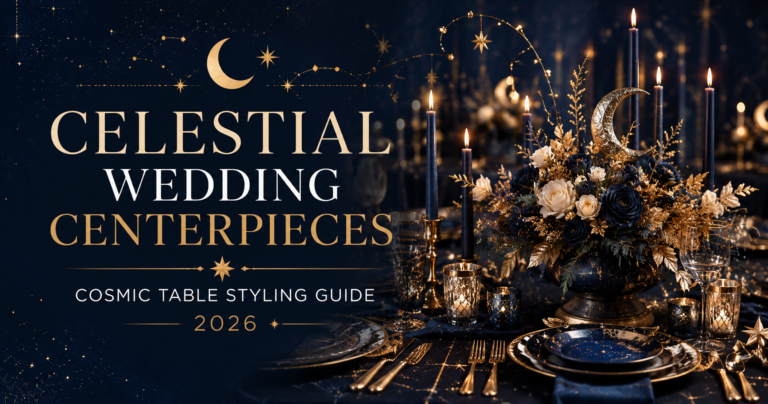
The reception table in a celestial wedding is the night sky made intimate — the scale of the cosmos brought to the size of a shared meal. The table linen is the base: deep midnight navy velvet runner on a warm ivory or parchment-toned cloth, with constellation details in a subtle gold print on the cloth itself. The centerpiece works at three heights: at the low zone, small gold votives with black or navy taper candles in gold holders; at the mid zone, a dark floral cluster in a midnight blue or antique gold vessel — deep burgundy roses, black dahlias, dark blue delphinium, white moonflower; at the tall zone, a tall tapered candlestick in antique brass or blackened metal with a trailing botanical element. The place card should function as a small constellation map — the guest’s name on one side, a hand-lettered constellation on the other. The menu card carries the same celestial map illustration quality as the invitation suite, continuing the designed identity of the celebration from the first invitation to the last printed element on the table.
Celestial Lighting Design
Lighting is the single most consequential design decision in a celestial reception — because the night sky is defined by the quality of its light, not by objects, and the reception room should be designed in the same way. Three lighting layers produce the celestial reception atmosphere: ambient light at very low levels (most of the light should come from table level), accent lighting on the ceiling treatment and any architectural features worth illuminating (stone arches, vaulted ceilings, exposed timber beams), and decorative lighting that serves as the starfield — pin-spot lights at the ceiling level in the specific irregular pattern of a real constellation, rather than a uniform grid. The colour temperature of all lighting should be warm (2700K or below) — the night sky is not white-lit and any cool white light source removes the warmth that prevents the dark palette from reading as cold.
Galaxy Centerpieces & The Celestial Cake
The galaxy centerpiece in its most beautiful form is not a vase of blue flowers with glitter — it is a vessel that suggests the depth and dimensionality of the actual sky: a large glass terrarium or deep-walled vessel partially filled with dark sand or dark river stones, with a botanical arrangement emerging from it that reads as a plant growing from the earth toward the stars. The botanical materials at the base (dark, earthy, grounded) gradually lighten toward the top (white gypsophila, dried star-shaped botanicals, pale eucalyptus tips) so that the arrangement itself describes the movement from earth to sky. The gold accent detail — thin wire constellation forms embedded in the arrangement — provides the metallic language of the celestial palette at a scale that rewards close observation. The celestial cake: deep midnight or galaxy-toned ganache as the base, with gold constellation line work applied by brush in a warm antique gold, and dried botanical elements at the base and at the tier transitions. The cake should read as beautiful before it reads as celestial — a beautifully made object that carries the night sky in its decoration, rather than a themed prop that happens to be edible.
Section 07 Celestial Wedding Stationery
The invitation is the first star in the constellation of the celestial wedding — the single printed element that exists before any venue is decorated, before any floral arrangement is placed, before any candle is lit. For a celestial wedding more than any other aesthetic, the stationery creates the world before guests arrive at it. When a guest receives a midnight navy envelope with gold constellation detail on the back flap, opens it to find an invitation with detailed star atlas illustration in warm gold on deep cream stock, and sets it on their mantelpiece for the weeks before the wedding: the world of the celebration has already begun. The quality of that first impression cannot be recovered from a disappointing invitation, and it cannot be recreated by decoration after the fact.
The stationery suite for a celestial wedding extends from the save-the-date through the invitation, ceremony program, menu card, place card, table number, and thank-you card — and every element should be produced from the same design family, using the same constellation illustration, the same palette temperature, and the same typographic register. The consistency across printed elements is what produces the sense of a complete and coherent designed world rather than a collection of individually sourced details. A guest who receives a gold-detailed invitation and then sits at a table where the place card carries a different star motif in a different palette registers the inconsistency even if they cannot name it.
The illustration quality is the most consequential single variable in celestial wedding stationery. A constellation rendered as a precise geometric network of gold lines on a deep background — in the style of the great star atlases of the 17th and 18th centuries — reads as genuinely beautiful, learned, and personal. The same motif rendered as cartoon stars reads as a birthday card. The celestial aesthetic lives in the quality and register of the illustration before it lives in any other element, which is why choosing the stationery suite is the first and most important design decision of the entire wedding planning process.
The eight collections below span the full range of celestial wedding aesthetics — from the classic romantic to the darkly atmospheric, from the warmly vintage to the botanically Art Nouveau. Browse all eight before choosing; the most important decision is which aesthetic register is most specifically connected to the couple’s own visual sensibility.
Classic
Celestial Starry Nights
Midnight blue & gold stars — the most romantic classic direction.
Luminous
Celestial Gold
Sun and moon warmth — the most approachable direction.
Dark
Celestial Dark
Near-black with warm gold — the most atmospheric direction.
Vintage
Celestial Vintage
Parchment and antique gold — the most literary direction.
Mystical
Celestial Purple
Deep plum and silver — the most magical register.
Earthy Cosmic
Celestial Boho
Terracotta, indigo, brushed gold — the free-spirited mystical direction.
Art Nouveau
Celestial Floral
Deep teal, indigo, cool gold — the most artistically sophisticated direction.
Signature
Mystical Black Gold
The signature suite — constellation gold against deep black, the most complete celestial stationery direction.
Frequently Asked Questions
What is a celestial wedding theme?
A celestial wedding theme uses the night sky — stars, constellations, the moon, the cosmos — as its primary aesthetic inspiration. It is not a science fiction or space exploration theme; it is a romantic, atmospheric, and ancient aesthetic that draws on the visual language of historical star atlases, celestial illustration, and the specific beauty of the night sky as it has been understood across cultures and centuries. The key visual elements are a deep palette (midnight navy, rich black, deep purple, antique gold), constellation and moon motifs in illustrated or line-work form, and a commitment to the atmospheric quality of darkness with points of golden light — candlelight, fairy lights at low density, gold metallic detail — that evokes the actual experience of being under a clear night sky. The distinction between a celestial wedding and a “dark wedding” is that the celestial wedding is specifically connected to the sky and its historical symbolism, rather than defined primarily by its palette without thematic specificity.
What colors work for a celestial wedding?
Four named palettes cover the full range of the celestial aesthetic: Midnight Blue and Gold (the classic, most romantic, most photographically reliable), Black and Antique Gold (the most dramatically atmospheric, requires careful lighting design), Deep Purple and Silver (the most mystical and magical, associated with the occult history of celestial symbolism), and Vintage Parchment and Constellation Gold (the most literary and historically grounded, warm and beautiful in any light). Within each palette, the critical decision is the temperature of the gold — warm antique gold (yellow-amber in tone) keeps the dark palette from feeling cold; cool bright gold or silver-adjacent tones read as graphic rather than romantic. The base palette should always include at least one warm neutral (warm cream, antique parchment, dusty ivory) as the paper stock for stationery and as the light accent in florals, to prevent the dark palette from becoming oppressively heavy at intimate scale.
What venues suit a celestial wedding?
The ideal celestial wedding venue has access to the actual night sky — outdoor ceremony space with an open horizon, a glass conservatory or greenhouse with sky views, a rooftop terrace, or proximity to a dark sky area. Beyond sky access, architectural drama is the quality that amplifies the celestial aesthetic most effectively: high ceilings, historic stone or masonry, vaulted interiors, and the quality of age and permanence that comes from old buildings. Historic estates, renovated ecclesiastical spaces, stone barns, and medieval halls are among the most appropriate venue categories. For indoor venues without sky access, the ceiling is the primary design challenge: a fabric drape installation in deep midnight navy with integrated sparse fairy lighting (at the density of stars, not of a light canopy) can transform any interior. Planetariums are the most specifically appropriate venue category and among the most overlooked — their projection systems can recreate the exact night sky of any date and location specified by the couple.
What stationery works for a celestial wedding?
The stationery for a celestial wedding should be chosen first — before venue decorations, before florals, before any other planning decision — because the invitation is the first element of the wedding that exists and the first argument the theme makes to guests. The illustration quality is the most consequential variable: constellation motifs in the style of a historical star atlas (precise, warm, gold line-work against a deep field) read as genuinely beautiful and genuinely celestial; the same motif rendered as cartoon stars reads as a generic theme rather than a designed world. The complete suite should include invitation, envelope liner, ceremony program, menu card, place card, table number, and thank-you card — all produced from the same design family with the same palette and illustration register. The eight collections in this guide cover every aesthetic register of the celestial wedding, from classic romantic to darkly atmospheric to warmly vintage to botanically Art Nouveau — browse the full range and choose the one most specifically connected to the couple’s own visual sensibility.
Begin with the Stationery · Begin with the Stars
Find the Celestial Collection That Creates Your World
The invitation is the first star in the constellation — choose it before anything else, and let it set every palette decision that follows.