Celestial Wedding Dress
Celestial Wedding · 2026
Celestial Wedding Dress — Starry Night Bridal Guide 2026
Six celestial dress styles, the fabrics and embellishments that make them work, and the stationery that builds the same world from the invitation outward.
The celestial bride wants her dress to feel like she is wearing the night sky itself — not as a costume, not as a theme, but as a genuine expression of the specific beauty she finds in the dark and luminous world of stars and moonlight. The celestial wedding dress aesthetic is one of the most searched bridal directions on Pinterest in 2026, and it is not one thing: it ranges from the dramatic starry night gown scattered with gold crystal stars against midnight velvet to the soft Renaissance bride with aged gold celestial embroidery on champagne silk, from the freely flowing boho celestial dress to the most darkly mystical witchy bridal aesthetic that whimsigoth culture has elevated into genuine fashion territory.
This guide covers six celestial dress styles with the specific fabric, embellishment, and silhouette decisions that make each one work, the accessories that complete each aesthetic, and the stationery connection that brings the printed world of the wedding into dialogue with the dress itself.
“She walked to him in a dress made of midnight and scattered light — each crystal sewn by hand in the pattern of the constellation above them, so that when she moved, the sky moved with her.”
Section 01 The Celestial Bridal Aesthetic
The celestial wedding dress exists at the intersection of several aesthetic traditions that have converged in the 2020s into a distinct and recognizable bridal category. The core tradition is the most ancient: the association of starlight and moonlight with femininity, mystery, and the ritual moment of transformation that a wedding ceremony represents. The more recent traditions are the whimsigoth aesthetic (which brings the romantic qualities of dark and mystical visual culture into contemporary fashion), the cottagecore-adjacent celestial movement (which combines natural and cosmic imagery in an organic, earthy register), and the revival of Renaissance and Art Nouveau illustration aesthetics in bridal embroidery and lace.
What makes a dress celestial rather than simply dark or romantic is a specific combination of qualities. The presence of the sky as an explicit motif: star and moon shapes rendered in crystal, embroidery, appliqué, or lace, rather than abstract decoration. The quality of darkness used as a background rather than a modifier: a celestial dress is midnight, not dark navy; near-black, not charcoal; the specific depth of color that makes scattered light visible rather than decorative. And the quality of shimmer and movement: celestial fabrics are not still — they catch light and release it in the way the actual night sky does, which is to say constantly and differently depending on angle and distance.
The celestial bridal aesthetic surged on Pinterest dramatically in 2025 and has continued its ascent into 2026 for three specific reasons. First, the growth of the whimsigoth and mystical wedding aesthetic, which has legitimized dark and atmospheric bridal choices that would have been considered unconventional a decade earlier. Second, the broader normalisation of colored and non-white wedding dresses, which has expanded the entire possibility space of bridal fashion to include midnight navy, deep black, rich purple, and iridescent neutrals alongside traditional ivory. Third, the influence of fantasy literature and visual culture — particularly the aesthetic vocabulary of dark academia and night court fantasy — which has given a generation of brides a specific visual reference for what a genuinely mystical bridal aesthetic looks like in practice.
The six styles in this guide represent the full range of the celestial bridal aesthetic — from the most classically romantic to the most dramatically atmospheric, from the most freely personal to the most precisely artisanal. Each one is a different relationship with the night sky: wearing it as backdrop, wearing it as story, wearing it as feeling.
Section 02 Six Celestial Wedding Dress Styles
Each style below is a complete aesthetic direction — fabric approach, silhouette, embellishment vocabulary, and the emotional register it produces. Find the one that matches how you want to feel in your dress, not only how you want to look.
2.1 The Starry Night Gown
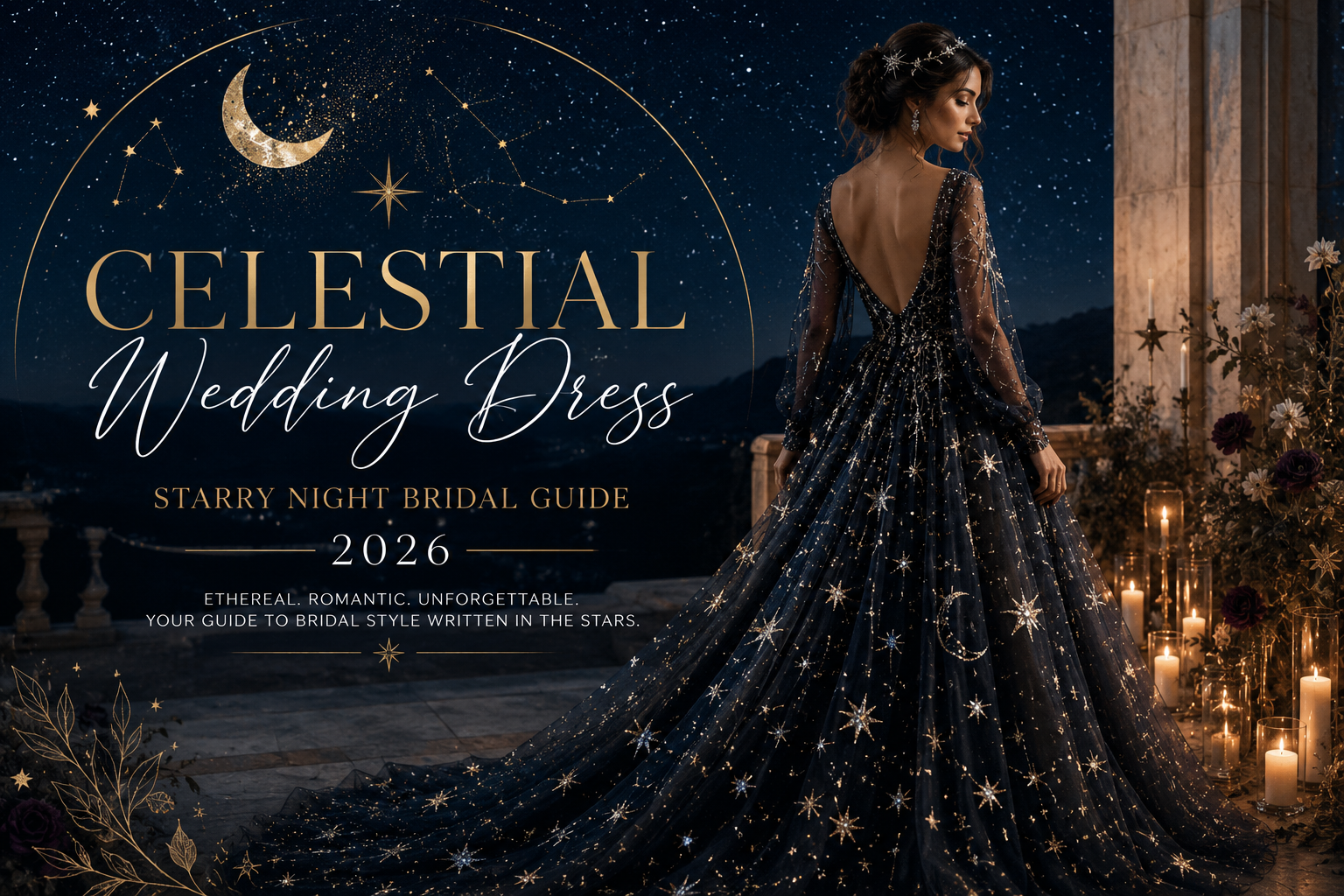
The Starry Night Gown is the most iconic and the most instantly recognizable of the six celestial dress styles — the dress that guests picture when they hear ‘celestial wedding,’ and the one that has been defined by decades of fashion references to the night sky as a fabric. A dark base — midnight navy, deep black, or the specific near-black that reads as dark space rather than as any specific color — scattered with crystal stars in gold, silver, or iridescent white. The crystals are not decoration in the conventional sense: they are the structural point of the dress, the element from which everything else follows, and the quality of their placement — in the irregular clustering pattern of actual constellations rather than in the uniform scatter of generic embellishment — is the quality decision that separates a genuinely celestial Starry Night Gown from one that simply uses star shapes as decoration.
The silhouette for this style ranges widely and the choice is personal rather than prescribed, but the silhouettes that carry the star embellishment most effectively are those that provide the most surface area and the most movement — the ballgown for maximum drama (the full skirt becomes a galaxy in motion when the bride moves), the A-line for balance between drama and practicality, and the flowing column for the most editorial and fashion-forward version of the style. The structured bodice with a dramatic skirt is the format in which the contrast between the solid celestial fabric of the bodice (which reads as sky) and the scattered embellishment on the skirt (which reads as starfield) creates the most striking visual effect.
The fabric decision for the Starry Night Gown is the most consequential single choice: the base must be dark enough that the crystal embellishment reads as luminous against it rather than as decoration applied to an already-decorated surface. Midnight navy silk velvet is the most luxurious and the most dramatically effective base fabric — its pile catches and diffuses candlelight in a way that makes the crystals sewn into it genuinely appear to glow. Deep black tulle layered over dark organza creates a more ethereal and atmospheric base, with the slight transparency of the tulle softening the starfield effect. Iridescent black fabric that shifts between black and midnight blue or violet in different lights is the most distinctive and most photographically interesting base — in daylight it reads as one color, in candlelight another, which means the dress reads differently across every moment of the wedding day.
The Starry Night Gown is the dress most associated with the dark celestial and whimsigoth wedding aesthetics — it is the dress that the night court bride wears, that the mystical wedding reaches toward as the most complete expression of its visual ambition. It is also the dress that requires the most commitment in execution: a half-executed Starry Night Gown (too few crystals, too light a base, embellishment placed in a generic scatter rather than a specific constellation pattern) reads as costume rather than couture. When it is executed fully and specifically, it is among the most beautiful and most memorable wedding dresses in any category.

The Celestial Dark collection and Black Gold Celestial suite bring the Starry Night palette into stationery — deep black with warm gold constellation work, so the invitation and every printed element carry the same midnight-and-gold world as the dress.

2.2 The Iridescent Celestial Gown
The Iridescent Celestial Gown is the most technically distinctive of the six styles — it depends for its effect not on embellishment applied to the fabric but on the quality of the fabric itself. Iridescent organza, galaxy-effect taffeta, colour-shifting silk dupioni, and the newer category of thermochromic or light-reactive bridal fabrics all share the quality that defines this style: the colour changes depending on the angle and quality of light, so the dress reads differently at different moments of the day, in different lighting environments, and from different distances. This is the dress that looks one colour in photographs taken outdoors at golden hour and a completely different colour in the candlelight of the reception — not because the light has changed but because the fabric is designed to carry multiple identities simultaneously.
The galaxy-effect fabric — which produces the visual quality of looking into deep space, with subtle colour gradations from midnight blue to deep purple to black within a single piece of cloth — is the most dramatic version of this style and the one most directly connected to the celestial aesthetic as an explicit motif. The iridescent organza version is the most elegant and the most wearable: in natural light it reads as a sophisticated colour-shifting neutral; in low light it becomes magical. The colour-shifting silk dupioni version is the most romantic and the most historically connected, as iridescent silk has been used in formal and ceremonial fashion for centuries.
The silhouette for the Iridescent Celestial Gown should be as simple as possible — the more complex the construction, the more the seaming and structure compete with the fabric’s inherent visual interest for the eye’s attention. A flowing bias-cut column, a simple A-line with minimal surface detail, or a clean ballgown in the galaxy fabric with an unadorned bodice: these are the silhouettes that allow the fabric to be the dress rather than the container for the dress. Any embellishment should be minimal and tonal — scattered crystals in iridescent white that match the fabric’s shifting quality rather than contrasting with it, or no embellishment at all.
The Iridescent Celestial Gown produces the most photographically varied results of the six styles — it will look different in every photograph taken at different moments under different light, which means the wedding album for a bride in this dress will show the same gown as multiple versions of itself. This quality is either the dress’s greatest asset or its greatest risk depending on the bride’s relationship with consistency: some brides want to look the same in every photograph; this dress ensures they do not. For the bride who finds that quality genuinely exciting — who wants her wedding album to show a dress that was alive — it is the most extraordinary choice available in the celestial category.

The Celestial Starry Nights collection brings the iridescent and shifting-colour register into stationery — midnight blue and gold that shifts in quality across different light conditions, matching the visual character of the iridescent gown.

2.3 The Vintage Celestial Gown
The Vintage Celestial Gown is the most historically grounded and the most artisanal of the six styles — its aesthetic derives not from the contemporary fashion imagination of the night sky but from the specific visual tradition of the Renaissance star atlas, the medieval celestial diagram, and the early modern astronomical illustration. Aged gold celestial embroidery on ivory or champagne silk; star map motifs rendered in antique lace; constellation patterns beaded in seed pearls and gold wire on a cream duchess satin base; the specific texture of embroidered fabric that looks as if it might have been made by a court seamstress who spent her evenings reading Kepler. This is the dress for the bride who owns beautiful old books and finds in the night sky not darkness but knowledge.
The embroidery is the defining element of the Vintage Celestial Gown, and the quality of the embroidery is the quality decision that makes or breaks the style. Machine embroidery that replicates constellation patterns at scale reads as exactly what it is: a pattern applied uniformly. Hand embroidery — or high-quality machine work that mimics the irregularity of hand placement — reads as something made specifically for this dress, which is the quality that connects the gown to the artisanal tradition it references. The motif vocabulary should be specific: not generic star shapes but the precise geometric forms of the actual star atlases — the armillary sphere, the astrolabe, the specific constellation diagrams of Bayer or Flamsteed — rendered in gold thread on the dress with the same authority they appear on the page.
The silhouette that most suits the Vintage Celestial Gown is the one that also reads as historically informed: a structured bodice with modest boning (not corset-level cinching but enough structure to carry the weight of embroidery), a full or semi-full skirt in a fabric with body — duchess satin, silk mikado, or organza — and sleeves in some form, whether full Renaissance sleeves in sheer organza or the more restrained puff sleeve that references the same period without committing to full historical costume. Ivory, champagne, antique white, and very pale gold are the colour range; anything brighter reads as conventional wedding dress with celestial embellishment rather than as Vintage Celestial Gown in its own right.
The Vintage Celestial Gown is the most coherent of the six styles in relation to a specific venue and setting: it is the dress for the historic library, the medieval manor hall, the candlelit stone chapel, the garden of a house that has stood for three centuries. In these settings it reads as genuinely appropriate and specifically beautiful — as if the dress and the venue were designed for each other, which is the highest compliment available to any bridal aesthetic decision.

The Celestial Vintage collection and Vintage Celestial Renaissance suite bring the antique star atlas aesthetic into stationery — aged gold, parchment tones, and hand-drawn celestial quality that matches the embroidery vocabulary of the Vintage Celestial Gown.

2.4 The Mystical Purple Gown
The Mystical Purple Gown is the most directly connected to the whimsigoth and witchy bridal aesthetics that have become genuinely influential in wedding fashion since approximately 2023, and the most explicitly at odds with conventional bridal expectations — which is precisely why it works so completely for the bride for whom it is right. Deep amethyst, midnight plum, rich grape, or the specific dark purple that sits at the edge of black without tipping into it: this is the colour of old magic, of midnight forests, of the specific shade of the sky at the precise moment between the last of the dusk and the first full dark of night. The Mystical Purple Gown is the celestial dress for the bride who finds the conventional bridal palette — ivory, blush, champagne — to be a translation of herself rather than the thing itself.
The moon and star details in silver are the most natural embellishment for this palette, and the most effective: silver reads as moonlight against deep purple in a way that gold does not, because the cool quality of silver and the cool depth of purple belong to the same temperature register rather than contrasting across it. Crescent moon appliqués at the hem or scattered across the skirt, silver constellation beading on the bodice, a star-scattered tulle overlay that catches light in silver as the bride moves — these are the specific celestial embellishment decisions that place this dress in the celestial aesthetic rather than in the broader category of coloured bridal fashion.
The silhouette that reads most powerfully in the Mystical Purple Gown is the one with the most drama and the most floor-level presence — a full ballgown skirt that pools dramatically at the hem, or a fit-and-flare that emphasizes the movement of the fabric as the bride walks. The fabric should have weight and drape: silk velvet, silk satin with a deep pile, or heavy organza. Lighter fabrics in this colour read as bridesmaid adjacent rather than bridal; the Mystical Purple Gown needs the weight of a colour taken seriously to read as the couture-quality celestial dress it aspires to be.
The Mystical Purple Gown is the style most specifically associated with the night court wedding aesthetic and the broader dark fantasy bridal imagination that has emerged from contemporary fantasy literature’s visual culture. For the bride who has a specific connection to this aesthetic — who has always found beauty in the darker end of the romantic spectrum, who finds the night more beautiful than the day, who would choose amethyst over diamond if given the choice — this is the dress that is most specifically and most unrepeatable hers.

The Celestial Purple collection brings the mystical amethyst register into stationery — deep plum and silver with moon and star motifs that match the Mystical Purple Gown’s palette and its witchy, romantic quality.

2.5 The Boho Celestial Gown
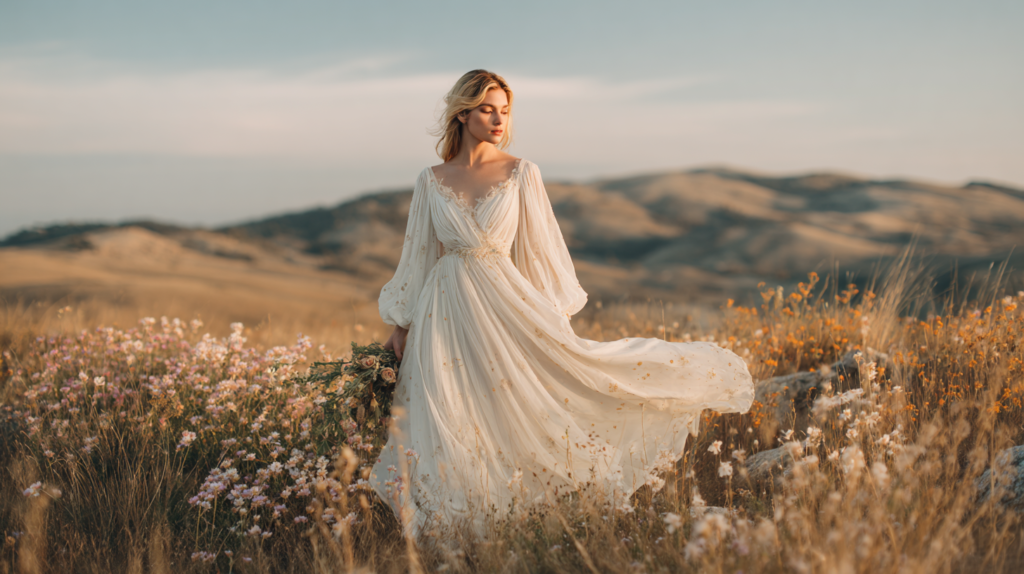
The Boho Celestial Gown is the most free-spirited and the most organically personal of the six styles — it brings the celestial aesthetic into the context of the boho bride without asking her to abandon the natural, earthy, texture-forward quality of her aesthetic in favour of the more formal or structured approaches that the other five styles tend toward. The Boho Celestial Gown is flowing rather than structured, organic rather than architectural, and its celestial elements are woven into the fabric rather than applied on top of it — delicate celestial embroidery on sheer fabric that moves in the wind, moon and star details in warm gold thread on an ivory linen or cotton blend, subtle constellation beading on a relaxed silhouette that reads as effortless rather than composed.
The specific quality that defines the Boho Celestial Gown is the sense that the celestial and the natural exist in the same world rather than one decorating the other. A dress in which the star embroidery sits alongside botanical motifs in the same gold thread is more Boho Celestial than a plain boho dress with a star scattered across it: the coexistence of the cosmic and the earthly in the same designed surface is the characteristic quality of the boho celestial aesthetic, and it is what connects this dress to the broader celestial boho wedding direction rather than simply to boho bridal fashion with a celestial accessory.
The Boho Celestial Gown suits outdoor and natural settings more than any of the other five styles — it is the dress for the field at dusk, the wild garden, the woodland ceremony, the beach at sunset. Its flowing quality and organic celestial detail read as naturally right in these settings in the way that the more structured or heavily embellished celestial styles do not. The fabrics are lighter and more breathable: chiffon, georgette, soft linen blends, lightweight organza — all of which move naturally in outdoor conditions and carry the celestial embellishment without the weight of the more dramatic styles.
The Boho Celestial Gown is the style most accessible to the bride who loves the celestial aesthetic but wants to wear something that feels genuinely comfortable, genuinely her, and genuinely easy to spend an entire day in. It is also the style that lends itself most readily to bare feet, wildflower crowns, and the specific quality of a wedding that feels like a gathering rather than a ceremony — informal in the most beautiful sense, personal in the most direct sense, and celestial in a way that arrives through feeling rather than through display.
The Celestial Boho collection brings the earthy cosmic register into stationery — organic celestial motifs in warm tones that match the Boho Celestial Gown’s natural and flowing quality.

2.6 The Botanical Celestial Gown
The Botanical Celestial Gown is the most artistically sophisticated of the six styles and the most directly connected to the Art Nouveau tradition of treating the natural and cosmic worlds as a single visual system rather than as separate aesthetic categories. In Art Nouveau illustration — which experienced a significant fashion revival in 2024-2025 — botanical motifs and celestial motifs coexist in the same organic, flowing line work: a moonflower and a constellation occupy the same curved space, a night-blooming vine traces the path between star and star, and the border between the garden and the sky disappears entirely. The Botanical Celestial Gown applies this visual logic to bridal fashion: floral and constellation embroidery in the same continuous pattern, botanical forms rendered in celestial colours, the dress as a garden that exists under the stars.
The embroidery on the Botanical Celestial Gown is its most important element and the area where the Art Nouveau connection is most visible. The line work should be flowing and organic rather than geometric: curved stems that trace constellation paths, flowers whose petals take the shape of star clusters, leaves in the deep teal and midnight blue of the night sky rather than in natural green. The most successful Botanical Celestial embroidery is the kind that would work as a print on its own — that has enough visual coherence and enough genuine design intention that it reads as illustration quality, not as embellishment quality.
The colour palette for the Botanical Celestial Gown departs from the darker registers of the other five styles: deep teal, rich forest green, midnight blue on ivory or pale champagne, or the specific cool cream that reads as moonlit rather than warm. The celestial elements are typically in gold or cool silver, and the botanical elements are in the same palette as the celestial rather than in naturalistic botanical colours — which is the design decision that keeps the dress in the celestial aesthetic rather than tipping into botanical bridal with a few star motifs attached.
The Botanical Celestial Gown is the most appropriate for the botanist, the gardener, the naturalist, the bride who finds the night sky beautiful specifically because of its relationship to the natural world — the way certain flowers open only at night, the way some birds navigate by stars, the ancient agricultural knowledge that depended on reading the constellations. For the bride who carries this kind of specific knowledge and feeling about the relationship between the sky and the earth, the Botanical Celestial Gown is the most personally resonant of the six styles available.
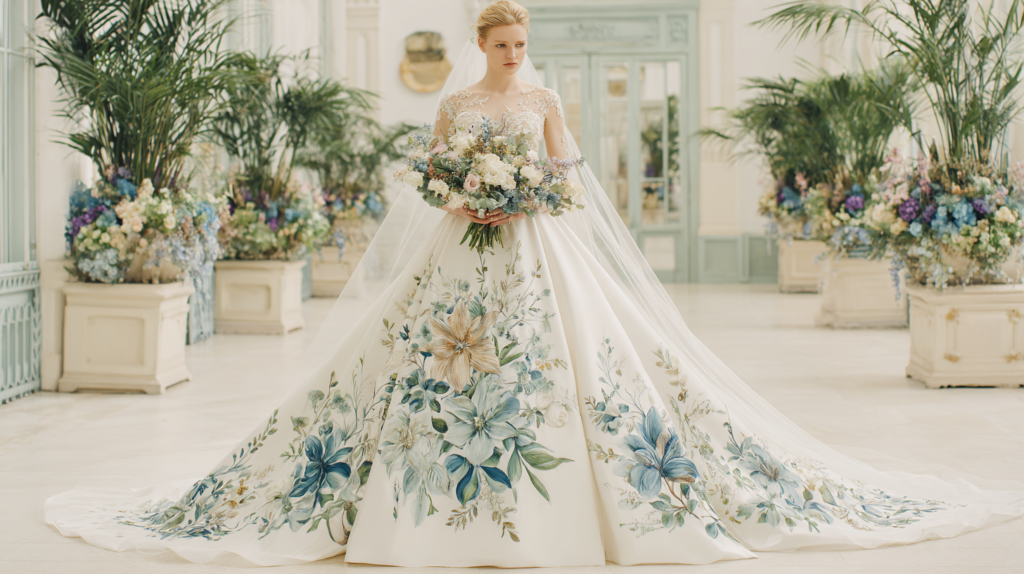
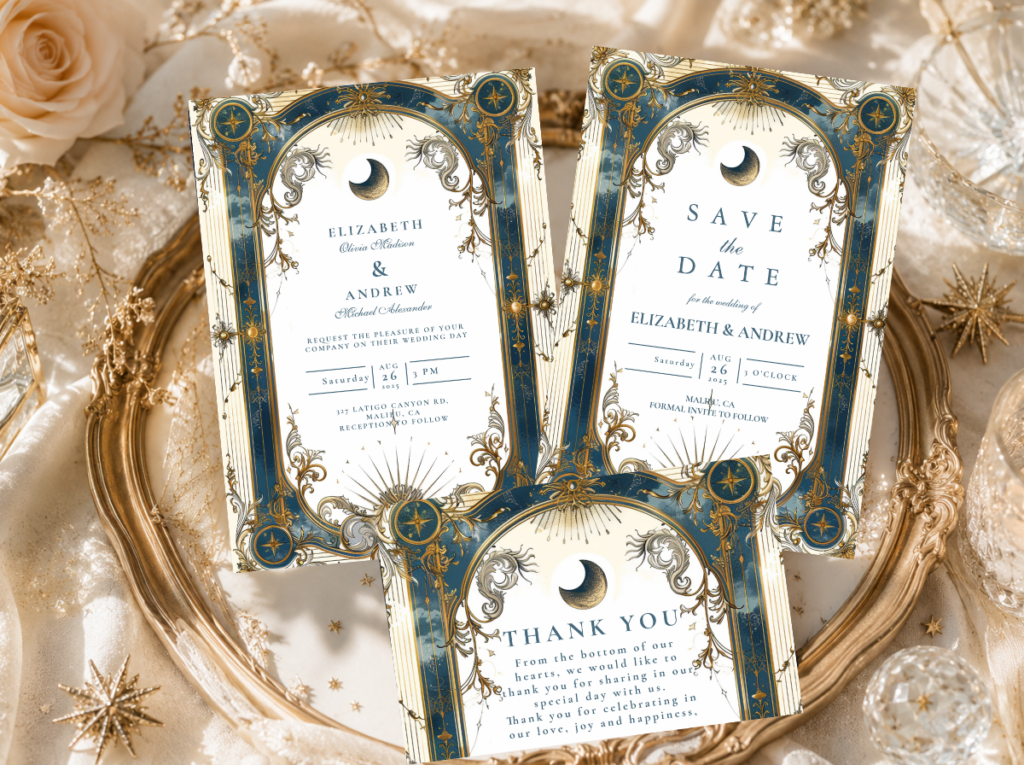
The Celestial Art Nouveau Blue Gold suite brings the botanical and cosmic Art Nouveau register into stationery — flowing organic line work in deep teal and gold that matches the embroidery vocabulary of the Botanical Celestial Gown.
Section 03 Celestial Dress Fabrics & Details
3.1 Best Fabrics for a Celestial Wedding Dress
The fabric is the most important single decision in a celestial wedding dress because it determines whether the dress reads as celestial or as simply dark and decorated. The fabrics that most successfully carry the celestial aesthetic are those that have an inherent relationship with light — that catch it, diffuse it, or shift in quality as the quality of light around them changes.
Silk velvet is the most dramatic and the most luxurious celestial base fabric — its pile absorbs light from some angles and releases it from others, creating a depth of colour that cannot be achieved with any flat-woven fabric. For the Starry Night Gown, midnight navy or near-black silk velvet provides the ideal base against which crystal embellishment reads as genuinely luminous. The weight requires structural support — boning in the bodice, significant underpinning in a full skirt — but the effect in both person and photograph is unmatched.
Tulle in dark or iridescent versions is the most versatile celestial fabric — it can serve as an overlay to soften a heavy base fabric, as a skirt fabric layered over darker underskirts, or as the primary fabric in lighter and more ethereal celestial styles. Star-scattered tulle (with crystal or glitter embellishment sewn directly into the fabric in a constellation pattern) is one of the most frequently saved celestial dress elements on Pinterest and one of the most readily available in both custom and ready-to-order form.
Iridescent organza is the defining fabric of the Iridescent Celestial Gown and one of the most visually distinctive fabrics in any bridal category — its colour-shifting quality makes it genuinely unlike anything else available to the wedding dress designer. Chiffon in midnight or deep jewel tones is the most flowing and most boho-adjacent celestial fabric, carrying its colour in movement as well as at rest. Silk satin in deep colours provides the most fashion-forward and most editorial celestial base — it reads as luxury without the theatricality of velvet, and carries embroidery or embellishment with exceptional clarity.
3.2 Celestial Embellishment: Stars, Moons & Constellations
The embellishment is what places a dress in the celestial category rather than simply in the dark or dramatic bridal category. The quality of the embellishment placement — specifically, whether crystals are scattered in a genuine constellation pattern or in a generic uniform scatter — is the most consequential detail decision available in the celestial dress aesthetic.
Scattered crystals as stars should be placed in the irregular clustering pattern of actual constellations rather than in the uniform scatter of generic star embellishment. The difference is visible at close range: real constellation patterns have specific groupings, specific density variations (some areas of sky are rich with stars, others are sparse), and specific shapes that a viewer familiar with the night sky will recognise. This specificity transforms embellishment into motif, which transforms decoration into meaning.
Gold celestial embroidery — constellation line-work in fine gold thread, armillary sphere and astrolabe details in antique gold, celestial map motifs rendered in chain stitch or satin stitch — is the defining embellishment of the Vintage Celestial and Botanical Celestial styles and the element that most directly connects the dress to the historical tradition of celestial illustration. The quality of the gold thread matters: bright modern gold reads as generic metallic embroidery; burnished antique gold reads as genuinely connected to the historical sources that give this aesthetic its authority.
Moon appliqué — crescent moon forms in fabric, lace, or metal applied directly to the dress — is the most specifically symbolic of the celestial embellishment options and the most associated with the mystical and whimsigoth registers. A single large crescent moon appliqué at the back hem of a flowing skirt, visible only as the bride walks away, is the specific moon detail that has been most saved and most shared on Pinterest in this category. Constellation beading in silver or gold is the most wearable of the celestial embellishments — close enough to conventional beading to read as bridal at any formality level, specific enough in its pattern to communicate the celestial aesthetic clearly.
3.3 Celestial Dress Colours — Including the Case for Non-White
The colour palette for celestial wedding dresses extends well beyond conventional bridal white and ivory, and this extension is one of the most important reasons the aesthetic has grown so rapidly in recent years. Midnight navy, deep black, rich amethyst, deep emerald, and teal are all fully appropriate celestial bridal colours, and each communicates a specific register of the celestial aesthetic.
Midnight navy is the most classic celestial colour — it references the actual colour of the night sky in a way that black cannot (black is the absence of colour; midnight navy is the specific colour of a dark sky that still carries the blue of the atmosphere within it). Deep black is the most dramatic and the most whimsigoth-adjacent, and the most associated with the dark cosmic and night court aesthetics. Rich amethyst and plum are the most mystical and the most specifically connected to the magical and occult traditions that inform the witchy bridal aesthetic.
The case for coloured celestial gowns: a deep-coloured celestial dress communicates the aesthetic more immediately and more completely than a white dress with celestial embellishment, because the colour itself is part of the celestial argument. A midnight blue dress with gold constellation embroidery does not need the embellishment to explain the aesthetic; the colour alone places it in the night sky. A white dress with gold star embroidery explains the aesthetic through decoration rather than through inherent quality — it is a more effortful version of the same intention. The coloured gown is the bolder choice and the more complete one.
Section 04 Celestial Bridal Accessories
4.1 The Celestial Crown & Headpiece
The celestial bridal crown is the most searched celestial bridal accessory on Pinterest and has become a defining visual element of the celestial wedding aesthetic in its own right — searchable as its own category (‘celestial crown wedding’), featured independently of dress style, and recognised as the item that most completely transforms a conventional bridal look into a celestial one without requiring any change to the dress itself. The celestial crown vocabulary ranges from the most delicate wire-work crescent with a single crystal star at its tip to the most elaborate full crown with alternating moon, star, and constellation details in gold or silver, and from the simple star-scattered headband to the architectural starfield crown that covers the entire head in scattered celestial elements.
The most consistently beautiful celestial headpiece design is the asymmetric crescent crown — a single crescent moon form, either left or right of centre, with a scattering of stars or a constellation trail that extends from the crescent across the forehead or toward the ear. This design works across every celestial dress style and every formality level, reads as specifically celestial rather than as a generic embellished headpiece, and photographs exceptionally well in both close-up portrait and full-length shots. The material should match the dress’s primary metallic: antique gold for the Vintage Celestial or Boho Celestial dress, silver for the Mystical Purple dress, either for the Starry Night or Botanical Celestial depending on the specific palette chosen.
For the bride who wants maximum drama, the full celestial crown — a complete circle of stars, moons, and constellation forms in the dress’s metallic — is the highest-impact headpiece available in the category. It reads as genuinely queenly rather than as decorative (the difference is in the scale and confidence of the execution), and it is the headpiece most associated with the night court and whimsigoth wedding aesthetic in its most fully realised form. Paired with the Starry Night Gown or the Mystical Purple Gown, the full celestial crown completes the celestial bridal vision at its most ambitious and most visually extraordinary.
4.2 Celestial Jewelry — Moon, Star & Constellation
Celestial jewelry for the bride should be chosen with the same palette conviction as every other element of the celestial wedding aesthetic: warm antique gold for the vintage and boho registers, bright silver for the mystical purple register, either for the classic and dark celestial registers depending on personal preference. The motif vocabulary is specific — crescent moon, full moon circle, individual star, constellation line, celestial map fragment — and the most successful celestial jewelry is the piece whose motif reads as specifically astronomical rather than as a generic star shape. A crescent moon ring in antique gold that shows the slight irregularity of the moon’s actual surface reads as celestial jewelry; a perfect smooth crescent reads as a fashion accessory with a moon shape.
The most impactful single piece of celestial jewelry for the bride is the statement necklace: a piece that carries a significant celestial element — a large crescent moon pendant in the dress’s metallic, a constellation map on a delicate chain, a moon phase sequence on a horizontal bar necklace. This is the piece most visible in close-up photography and the piece most likely to appear in the flat lay alongside the invitation suite, which makes it the jewelry decision with the most influence on the overall visual coherence of the wedding’s printed and photographic record.
4.3 The Celestial Veil
The celestial veil — star-scattered tulle with crystals or embroidered stars sewn directly into the fabric — is the accessory that most dramatically multiplies the celestial quality of any dress, because it adds the literal quality of wearing the night sky to any silhouette, whether the dress itself is heavily celestial-embellished or relatively simple. A cathedral-length veil in midnight blue or black tulle with scattered crystals in a constellation pattern creates the visual effect, when the bride walks, of being trailed by stars — which is precisely the effect that defines the celestial wedding dress aesthetic at its most powerful.
The veil can also serve as a celestial introduction to a simpler dress: a bride who wants to wear an essentially unadorned ivory gown can choose a star-scattered midnight blue veil that carries the entire celestial argument on its own, creating the celestial moment at the ceremony without requiring the dress itself to be celestial. This approach — simple dress, extraordinary veil — is particularly effective for the bride who wants to preserve a conventional dress silhouette while fully committing to the celestial aesthetic as an overall wedding vision.
The Mystical Black Gold Celestial collection brings the celestial accessory vocabulary into stationery — midnight and warm gold constellation work across the full suite, completing the visual world that the crown, jewelry, and veil begin.

Section 05 Dress & Stationery Coherence
The relationship between the celestial wedding dress and the celestial wedding stationery is the most intimate and the most consequential design relationship in the entire wedding aesthetic — because both the dress and the invitation are singular, unrepeatable objects that carry the entire visual argument of the celestial wedding before any venue is decorated, any floral is arranged, or any table is set. When the dress and the invitation belong to the same celestial world — when the constellation illustration quality on the invitation matches the constellation embroidery quality on the dress, when the palette temperature is consistent between the midnight fabric and the midnight paper stock, when the gold metallic of the embellishment and the gold metallic of the stationery printing share the same warmth — the wedding feels designed from the inside out rather than assembled from separately sourced elements.
The flat lay photograph — the image composed before the ceremony of the dress, the invitation suite, the accessories, the flowers, and the personal objects that belong to the day — is where this coherence becomes most visible and most photographically rewarding. A midnight velvet bodice beside an invitation in deep navy with gold constellation work; a star-scattered veil arranged beside a suite whose envelope liner carries the same star pattern at a different scale; a crescent moon crown beside a save-the-date whose moon motif matches it in style and metallic: these are the images that define the celestial wedding in its most complete form, and they are only possible when the dress and the stationery were designed to belong to the same world.
The specific stationery decision that most powerfully completes the Starry Night Gown is the dark-background invitation: an invitation on deep midnight or near-black paper stock with constellation line-work in warm gold, which mirrors the dress’s dark base and scattered gold embellishment in miniature. For the Vintage Celestial Gown, the stationery should carry the same antique quality as the embroidery — aged parchment stock with burnished gold constellation work, handwritten or calligraphic typography, the specific warmth of a document that looks like it was made rather than printed. For the Mystical Purple Gown, the stationery should share the palette’s specific temperature: deep plum paper with silver star motifs, or midnight paper with both silver and a trace of violet, so that the invitation and the dress read as part of the same emotional world.
Browse all six collections below before committing to any single stationery direction — each represents a distinct register of the celestial aesthetic, and the right collection is the one whose visual quality most closely matches the dress style chosen. The invitation chosen first will then serve as the palette reference for every other decoration decision in the wedding: the table linen, the floral direction, the ceiling treatment, the favour tag, and the thank-you card that arrives in guests’ post weeks after the celebration has ended.
Classic Celestial
Celestial Starry Nights
Midnight blue & warm gold stars — the stationery world that matches the Starry Night Gown.
Dark & Dramatic
Celestial Dark
Near-black with antique gold — the most atmospheric stationery direction for the darkest celestial dresses.
Antique & Literary
Celestial Vintage
Parchment and burnished gold — the stationery that matches the Vintage Celestial Gown’s embroidery register.
Mystical
Celestial Purple
Deep plum and silver — the stationery world that matches the Mystical Purple Gown’s witchy, romantic quality.
Earthy Cosmic
Celestial Boho
Organic celestial motifs in warm tones — the stationery that matches the Boho Celestial Gown’s flowing natural quality.
Signature Suite
Mystical Black Gold
The signature celestial suite — constellation gold against deep black, matching the most dramatic celestial dress direction.
Celestial Wedding Series Explore the Celestial Wedding Series
This dress guide is part of the complete celestial wedding series. Use the guides below as your planning resources for every element of the celestial wedding beyond the dress.
Complete Guide
Celestial Wedding — Complete Celebration Guide 2026
Venue selection, ceremony design, reception styling, and complete stationery showcase for the full celestial wedding.
Color Guide
Celestial Wedding Theme — Colors & Aesthetics 2026
Eight celestial color palettes with swatches, feeling descriptions, and venue guidance — the decision tool for every aesthetic direction.
Coming Soon
Celestial Wedding Flowers Guide
Which florals to choose for each of the eight celestial aesthetics — coming soon.
Frequently Asked Questions
What is a celestial wedding dress?
A celestial wedding dress is any bridal gown that takes the night sky — stars, moons, constellations, and the cosmic world — as its primary aesthetic inspiration. This typically means dark fabrics (midnight navy, deep black, deep purple, teal) with celestial embellishment (crystal stars, gold constellation embroidery, moon appliqué, constellation beading) in silhouettes that range from dramatic ballgowns to flowing boho styles. The celestial wedding dress is distinct from simply a dark or gothic wedding dress in that it specifically invokes the sky and its motifs rather than simply using depth of colour for dramatic effect. The six styles in this guide range from the iconic Starry Night Gown (dark velvet scattered with gold crystal stars) to the Botanical Celestial Gown (Art Nouveau floral-and-constellation embroidery on a lighter base).
Can a wedding dress be black for a celestial wedding?
Yes — and for many celestial brides, near-black is the most correct and the most complete expression of the aesthetic they want to achieve. A deep near-black dress with gold constellation embellishment or crystal stars is one of the most beautiful and most visually powerful celestial wedding dress options available, and it has been normalised by the broader shift toward coloured bridal fashion that has accelerated significantly since 2022. The specific shade of black that works best for the celestial aesthetic is not a flat neutral black but one that has a slight undertone — a trace of midnight blue, a whisper of dark violet — that gives depth without limiting the palette. Vendors who produce celestial wedding dresses often describe this colour as ‘midnight’ or ‘constellation black’ rather than simply black, which captures the specific quality that makes it celestial rather than simply dark.
What is a celestial crown for a wedding?
A celestial crown is a headpiece that incorporates celestial motifs — moon, stars, constellations — as its primary decorative vocabulary. It is the most searched celestial bridal accessory on Pinterest and has become a defining visual element of the celestial wedding aesthetic. Celestial crowns range from the most delicate (a fine wire crescent with a single crystal star at its tip) to the most elaborate (a full crown with alternating moon, star, and constellation details covering the entire circumference). The most consistently beautiful and most versatile celestial crown design is the asymmetric crescent — a single crescent moon form positioned slightly off-centre, with a trail of stars or a constellation extending from it. In gold it suits the vintage, classic, and boho celestial dress styles; in silver it suits the mystical purple and dark cosmic styles. The full celestial crown — a complete circle of celestial forms — is the most dramatic option and the one most associated with the night court and whimsigoth wedding aesthetic.
What is a whimsigoth wedding dress?
Whimsigoth is an aesthetic category that combines the romantic and mystical qualities of gothic visual culture with a warmer, more whimsical, and less severe sensibility than classical gothic fashion — think dark colours and mystical motifs rendered with softness and romance rather than austerity. In wedding dress terms, a whimsigoth bridal gown is typically dark-coloured (midnight, plum, forest green, near-black), romantically silhouetted (flowing, full-skirted, with long sleeves or flowing trains), and decorated with mystical or nature-adjacent motifs rather than strictly gothic or horror-adjacent ones. The celestial wedding dress sits squarely in the whimsigoth aesthetic — stars and moon motifs are among the most classically whimsigoth visual elements available — which is why the two terms often appear together in searches. The Mystical Purple Gown and the Starry Night Gown in this guide are the celestial dress styles most directly aligned with the whimsigoth aesthetic.
Should the celestial wedding dress and the wedding stationery match?
They should belong to the same visual world rather than exactly match — which is a more nuanced and more achievable goal than literal matching. The invitation and the dress share a palette temperature (both warm antique gold, or both cool silver), a darkness register (both midnight, or both in the parchment vintage range), and a motif vocabulary (constellation line-work on both, or moon forms on both). They do not need to be in the same colour — a midnight navy dress can be paired with a near-black invitation — as long as the palette belongs to the same temperature family. The practical benefit of aligning the dress and the stationery is that both appear in the flat lay photograph that most celestial wedding brides now consider a central image of the wedding’s photographic record, and when the dress and the invitation suite belong to the same visual world, this photograph is one of the most beautiful images available in any wedding aesthetic.
Complete Your Celestial Bridal World
Find the Stationery That Belongs to the Same Night Sky as Your Dress
The invitation is the first piece of the celestial world — choose it in the same register as the dress, and let it set the palette for everything that follows.