Celestial Fall Wedding — Autumn Stars & Cosmic Harvest Guide 2026
Celestial Wedding · 2026
Celestial Fall Wedding — Autumn Stars & Cosmic Harvest Guide 2026
Five celestial fall aesthetics, four harvest-and-cosmos palettes, autumn ceremony and reception guidance, the season’s florals in a celestial vocabulary, and stationery where harvest and constellation finally meet.
The autumn celestial wedding is where two of the most searched and most visually compelling wedding aesthetics on Pinterest converge: the celestial aesthetic, with its night sky depth and gold star scatter, and the autumn aesthetic, with its warmth, richness, and the specific quality of a season that is beautiful precisely because it is in the process of becoming something darker and more dramatic. The autumn sky is the sky that is becoming the winter sky — the darkness deepening each night, the stars brightening and sharpening as the air cools, the harvest moon rising fat and amber at the horizon as the first autumn constellations appear above it. No other season offers this specific tension between warmth and darkness, between harvest abundance and cosmic depth.
This guide covers five distinct celestial fall aesthetics and their specific visual vocabularies, four autumn sky palettes, outdoor ceremony and reception guidance for the season, floral direction for the autumn celestial bouquet and table, and the stationery that brings harvest and constellation together in every printed element of the celebration.
“The harvest moon is the most ancient and the most human of all celestial events — the one the cosmos has provided every year, without variation, as the specific light source under which the human gathering of abundance takes place. A celestial autumn wedding borrows the oldest possible lighting arrangement.”
Section 01 Why Autumn Is a Celestial Season
Autumn is the season in which the human relationship to the night sky has historically been most active and most culturally significant — not because the autumn sky is technically the best sky (that distinction belongs to winter) but because autumn is the season in which human activity most requires the sky. The harvest, which throughout human history has been conducted under the available night-time light rather than in darkness, has always taken place under the harvest moon — the full moon closest to the autumnal equinox, which rises at approximately the same time for several consecutive nights and provides an extended period of bright moonlight that historically allowed harvest work to continue after sunset. The harvest moon is the most human of all celestial events, the one that has been directly useful rather than merely beautiful, and the one that has therefore accumulated the most profound and most universal layer of cultural and emotional association in the human relationship to the night sky.
The autumn constellations — and specifically the first rising of Orion above the eastern horizon in autumn evenings — have served as one of the most widely recognised and most universally understood celestial calendar markers in human history. Orion rises in autumn and sets in spring, making its appearance the specific celestial signal of the seasonal transition from the warmth of summer to the cold and darkness of winter. The Pleiades (the Seven Sisters), whose heliacal rising and setting have been used as agricultural calendar markers by cultures across six continents, are at their most visible in autumn evenings when they rise in the east as the sky darkens. An autumn celestial wedding can incorporate these specific constellations — Orion rising, the Pleiades high overhead — as genuinely appropriate and genuinely seasonally specific celestial motifs rather than as generic star imagery.
The aesthetic tension that makes the autumn celestial wedding uniquely compelling — and that no other season can reproduce — is the tension between the warmth of the autumn palette and the coldness of the night sky above it. Autumn is the season of warm colours (amber, rust, burnt orange, deep burgundy) and yet it is also the season in which the sky begins to turn genuinely cold and genuinely dark. A celestial autumn wedding in which warm harvest tones exist at the table level (the rust-coloured linen, the amber candles, the deep-toned autumn florals) while the sky above is cold and dark and full of the first autumn stars creates a visual experience that is unavailable in any other season: the warmth of the human celebration making the coldness of the celestial backdrop more visible, and the coldness of the cosmic backdrop making the warmth of the human gathering more significant.
Section 02 Five Celestial Fall Aesthetics
Five distinct registers of the celestial fall wedding — each taking the autumn sky at a different moment and in a different emotional register. From the most warmly harvest-golden to the most darkly atmospheric, from the most historically specific to the most organically botanical.
2.1 The Harvest Moon Aesthetic
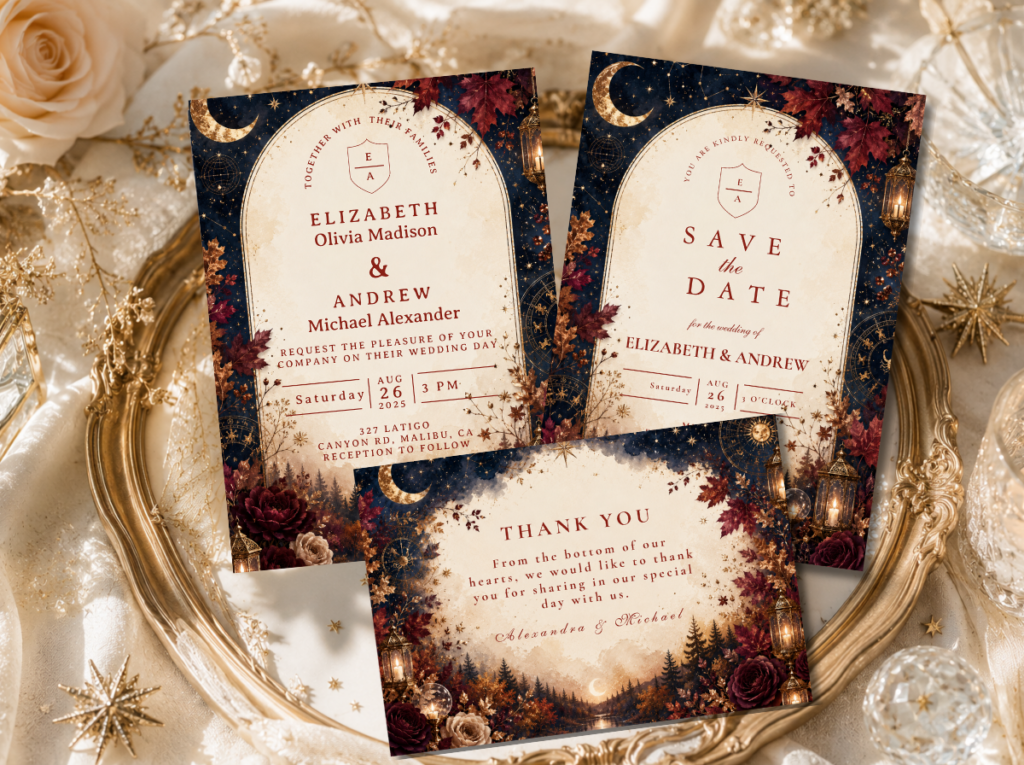
The Harvest Moon Aesthetic is the most distinctively autumnal and the most emotionally immediate of the five celestial fall directions — it centres on the specific visual quality of the harvest moon, which is not the same as the cold white light of the winter full moon but a specific warm amber quality that arises when the full moon is at its closest point in the year to the horizon as it rises, at which point the atmosphere through which its light travels is at its thickest and its amber-filtering most pronounced. The harvest moon rising above a dark autumn horizon is the colour of antique gold — warm, amber, enormous, and specifically associated with the season in a way that no other lunar quality is. The Harvest Moon Aesthetic centres this warm amber lunar quality as the primary visual reference and builds every design decision around it.
The visual vocabulary of the Harvest Moon Aesthetic: warm amber gold as the primary metallic, replacing the cooler antique gold of the standard celestial palette with a gold that reads as genuinely warm and autumnal; deep rust and terracotta as the secondary palette (the colours of the autumn landscape in which the harvest moon most naturally appears); and midnight blue-black as the cosmic depth against which both the warm moon and the warm terrestrial colours appear most luminous. The palette functions as a horizontal gradient: warm rust and terracotta at the ground level (table linen, low floral elements, earthenware and ceramic vessels); warm amber gold at mid level (candles, mid-height floral elements, star scatter); and deep midnight to near-black at the ceiling level (the sky into which the harvest moon has risen). Each level belongs to its own part of the scene — earth, moon, sky — and together they reproduce the specific visual composition of the harvest moon landscape.
The Harvest Moon Aesthetic is the most photographically distinct of the five celestial fall directions on Pinterest — because the warm amber and midnight blue palette combination, which is unusual in both the general autumn wedding category (which tends toward orange and cream without the depth of midnight blue) and the general celestial category (which tends toward midnight blue without the warmth of amber), produces images that are immediately recognisable and immediately associated with the aesthetic rather than with a generic version of either its component traditions. A Harvest Moon Aesthetic flat lay — amber invitation beside autumn botanicals beside a dark indigo surface — is one of the most visually distinctive autumn wedding photographs available.
The Celestial Fall collection and Celestial Gold suite carry the Harvest Moon Aesthetic into stationery — warm amber gold and deep harvest tones across every printed element, from the invitation that begins the celebration to the place card that positions each guest at the harvest table.
2.2 The Autumn Constellation Aesthetic
The Autumn Constellation Aesthetic is the most intellectually specific and the most personally detailed of the five celestial fall directions — it uses the specific autumn constellations not as generic decoration but as the organising visual language of the entire celebration, so that every element reads as part of a star map of the specific sky above the wedding celebration on the specific autumn night of the wedding day. Orion, rising in the east as the ceremony concludes and the reception begins, as the primary constellation; the Pleiades, already high overhead and associated in agricultural tradition with both the harvest and the winter to come, as the secondary; Perseus and Andromeda, whose combined mythology of rescue and union makes them among the most specifically wedding-appropriate constellations in the northern sky, as the narrative backdrop.
The visual quality of the Autumn Constellation Aesthetic: the warm sepia and antique gold tones of the vintage celestial tradition (aged parchment for the stationery stock and signage materials; burnished antique gold for the constellation metallic; warm sepia for the background tones in printed and illustrated elements) combined with the specific warm-and-dark quality of the autumn season (deep burgundy and dark terracotta as the autumn botanical palette; the specific combination of dried botanical elements and constellation line-work that produces the most autumn-specific celestial visual vocabulary available). The result is a celebration that reads as simultaneously historical and seasonal: a star atlas of the autumn sky, rendered in the materials and tones of a season that has its own rich relationship to that same sky.
The Autumn Constellation Aesthetic is most appropriate for couples who want the personal specificity of a named constellation (the constellation visible above the venue on the wedding night, or the couple’s birth constellations in their autumn appearance) as the central visual motif of the celebration, and who want that motif expressed in a warm autumnal register rather than in the cooler register of the classic celestial aesthetic. The decoration: aged celestial atlas prints showing the specific autumn constellations; antique brass vessels with deep autumn botanical arrangements; constellation name place cards connecting each guest to a specific star or group of stars; and the autumnal botanical arch that frames the ceremony under the specific constellation of the season.
The Cosmic Vintage Constellation suite and Vintage Celestial Renaissance collection carry the Autumn Constellation Aesthetic into stationery — historical star atlas illustration quality in warm sepia and antique gold, the most specifically appropriate printed elements for the most intellectually grounded of the five celestial fall aesthetics.

2.3 The Dark Autumn Celestial Aesthetic
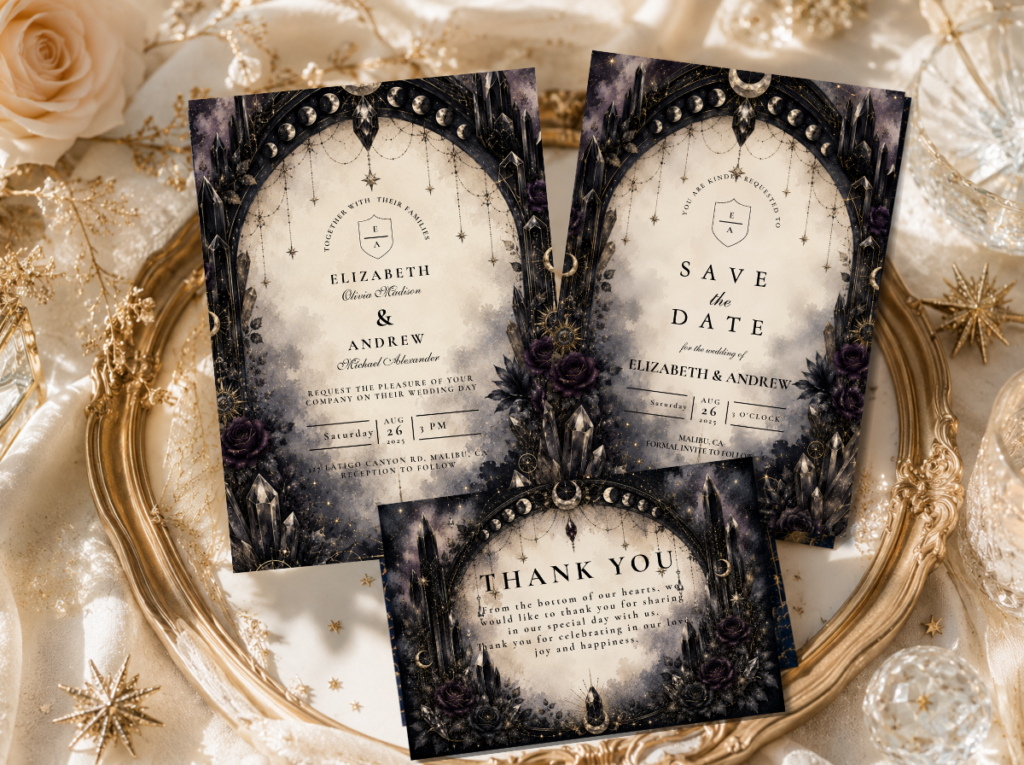
The Dark Autumn Celestial Aesthetic is the most dramatically atmospheric of the five celestial fall directions — it takes the darkening quality of the autumn sky (the specific process by which each night is measurably longer and measurably darker than the last through October and November) and uses it as the primary aesthetic driver of the celebration. The palette: deep midnight to near-black as the base colour, with deep burgundy as the specifically autumnal secondary tone (rather than the purple or navy that defines the darker versions of the non-seasonal celestial aesthetic), and warm antique gold as the primary metallic. The dark autumn colour is not the cold darkness of winter but the rich, deep, textured darkness of late autumn — a darkness that still carries the warmth of the summer just departed, and that has accumulated the specific quality of depth that only a season of gradual transition can produce.
The Dark Autumn Celestial Aesthetic is the most associated with the gothic celestial and mystical autumn wedding categories — the direction most appropriate for couples who want the drama and atmosphere of the darkest celestial aesthetics expressed in a seasonally specific autumn context rather than in a seasonally neutral dark context. The deep burgundy autumn element is the specific seasonal contribution that distinguishes this direction from the general dark celestial aesthetic: burgundy and midnight together produce a quality of dark richness that is uniquely autumnal, belonging neither to the cold clarity of winter nor to the warmth of summer but to the specific moment of transition that autumn occupies.
The decoration vocabulary of the Dark Autumn Celestial Aesthetic: deep burgundy velvet or near-black velvet table linens; dark florals in the deepest available autumn cultivars (near-black dahlias, deep burgundy roses, chocolate cosmos, dark sweet peas); antique gold candleholders at varying heights as the primary table-level light source; star scatter in warm antique gold on the dark velvet surface; and the specific quality of deep burgundy botanical elements within the arch and ceremony installation that positions the arrangement in the autumn season rather than in a generic dark celestial context. The result is a celebration that reads as specifically and atmospherically autumnal in its celestial register — the most fully seasonal of the five aesthetic directions.
The Celestial Dark collection and Mystical Black Gold Celestial suite carry the Dark Autumn Celestial aesthetic into stationery — near-midnight and warm antique gold in the most dramatically atmospheric printed elements for the most dramatically autumnal celestial direction.
2.4 The Rustic Celestial Autumn Aesthetic
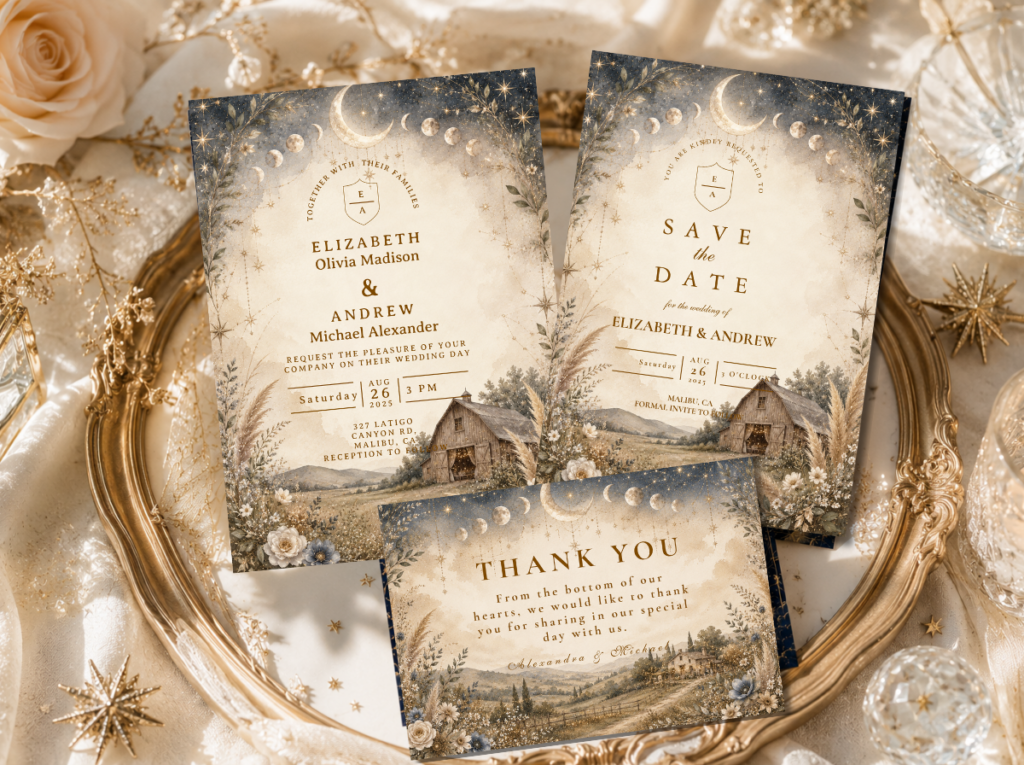
The Rustic Celestial Autumn Aesthetic is the most grounded and the most vernacular of the five celestial fall directions — it brings the night sky into the warm, weathered, naturally beautiful world of the rustic autumn wedding, producing a celebration that reads as belonging entirely to the landscape and season it occupies while also reaching upward toward the cosmos above. This is the celestial fall aesthetic for the barn wedding, the countryside celebration, the farm venue at harvest time — spaces where the agricultural tradition of the harvest has left its specific mark on the architecture and the materials, and where the night sky above is part of the same continuous world as the warm wood and stone and dried botanical material below.
The specific visual magic of the Rustic Celestial Autumn Aesthetic is the tension between its two aesthetic registers — the deeply terrestrial and deeply seasonal quality of rustic autumn decoration (dried flowers, preserved fruits, burnished gourds, warm wood, weathered metal) and the cosmic depth of the night sky above it (the specific autumn constellations, the harvest moon on the horizon, the star scatter as genuine natural phenomenon rather than decoration). When these two registers are in the same space simultaneously — when the harvest table with its dried botanicals and warm candles exists under a ceiling dressed as the autumn night sky — the result is a genuinely beautiful and genuinely unusual aesthetic combination that belongs to neither tradition alone but to both simultaneously.
The Rustic Celestial Autumn Aesthetic is the most photogenic of the five celestial fall directions in natural daytime or golden hour light — because the rustic autumn elements (warm wood, dried botanical, aged metal) photograph most beautifully in the warm amber light of the late afternoon sun, and this is the same light quality that produces the harvest moon’s amber glow in the evening sky. A celebration that begins in golden hour rustic light and transitions into starlit celestial atmosphere as the sun sets and the first autumn stars appear above the barn roof is the most completely and most seamlessly realised version of the Rustic Celestial Autumn Aesthetic.
The Celestial Rustic collection carries the Rustic Celestial Autumn Aesthetic into stationery — warm rustic tones with celestial star and constellation detail in the organic, handmade-quality illustration register that suits the rustic setting and the autumn season.
2.5 The Botanical Celestial Autumn Aesthetic
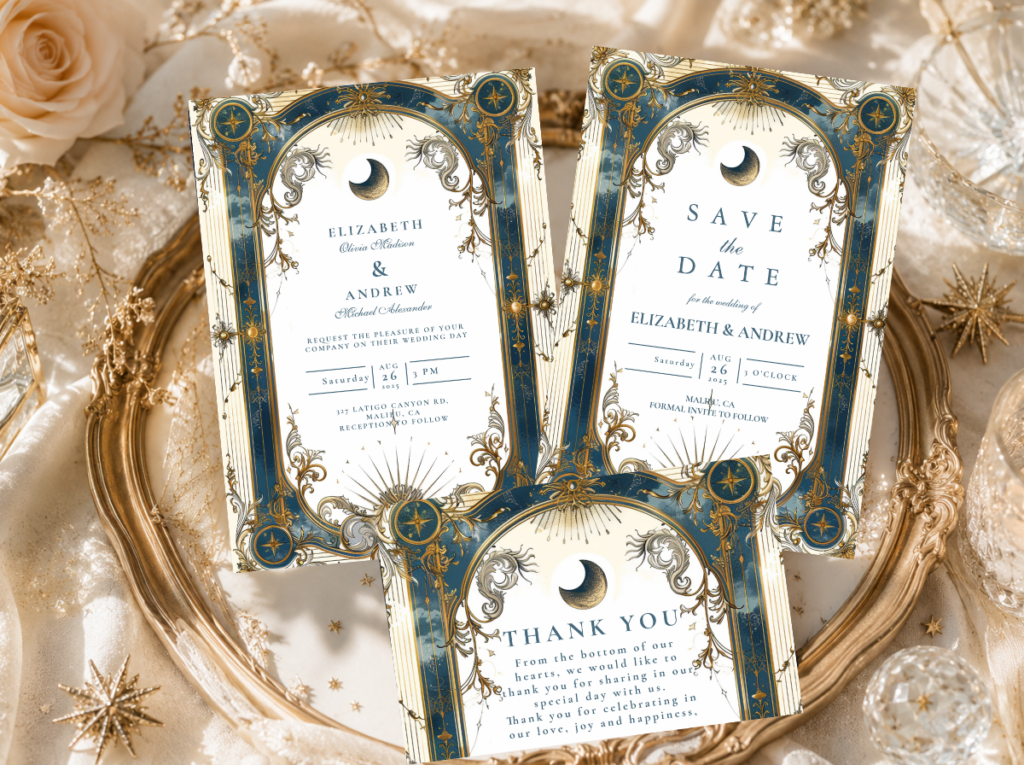
The Botanical Celestial Autumn Aesthetic is the most artistically sophisticated and the most flowing of the five celestial fall directions — it brings the autumn botanical world into dialogue with the celestial aesthetic in the specific visual tradition of Art Nouveau illustration, where the forms of seasonal plants and flowers share the same organic visual language as the curves of constellation maps and the orbital paths of celestial bodies. Autumn leaves with their specific colour progression (green to amber to gold to rust to deep burgundy) are understood in this aesthetic as expressing the same transformation narrative as the autumn sky (summer warmth to autumn chill to winter darkness), making the botanical and the celestial not just visually compatible but thematically unified.
The flower and botanical vocabulary for the Botanical Celestial Autumn Aesthetic: deep dahlias in the warmest available autumn cultivars (caramel, amber, burnt orange, deep copper — the colours of autumn foliage applied to the most architecturally structured of autumn flowers); cosmos in its autumnal dark cultivars (chocolate cosmos and deep wine cosmos for the darkest register; white cosmos for the star-scatter element); dried seasonal botanicals (dried seed heads of alliums and eryngium; dried grasses in warm gold and amber; dried hop vines; dried rosehip branches for their combination of dark stem and warm fruit colour); and gold wire constellation stems woven through autumn floral arrangements as the celestial element that transforms an autumn arrangement into a celestial botanical composition.
The Botanical Celestial Autumn Aesthetic is the most naturally Pinterest-saveable of the five directions for the bouquet flat lay — because the combination of warm autumn botanical material with gold wire geometric constellation detail, photographed beside autumn-calibrated stationery with botanical-celestial illustration, produces one of the most visually complex and most reward-on-examination detail photographs available in the entire autumn celestial wedding category. A deep dahlia and cosmos bouquet with gold wire constellation stems beside Art Nouveau botanical-celestial invitation suite beside dried autumn seed heads and leaves: this is the flat lay that most completely and most beautifully expresses the Botanical Celestial Autumn Aesthetic in a single image.
The Celestial Art Nouveau Blue Gold suite and Celestial Boho collection carry the Botanical Celestial Autumn Aesthetic into stationery — flowing organic botanical-celestial line-work and earthy cosmic motifs in the organic illustration quality that matches the autumn botanical composition’s own aesthetic register.
Section 03 Celestial Fall Color Palettes
Four autumn sky palettes — each warmer and more grounded than the standard celestial palettes, because the autumn celestial aesthetic finds its cosmic depth in the season’s own warmth rather than in the coldness of the winter sky.
Palette 01
Harvest Gold & Midnight Blue
Warm Amber Gold · Deep Midnight Blue · Rust Terracotta · Aged Ivory
The most distinctively autumn-celestial of the four palettes — warm amber gold as the harvest moon colour, deep midnight blue as the autumn sky above it, and rust terracotta as the earthen base from which both rise. The palette functions as a vertical gradient: earth below, moon in the middle, sky above. For: Harvest Moon Aesthetic and the most warmly autumnal celestial directions.
Palette 02
Deep Rust & Constellation Silver
Deep Rust · Warm Terracotta · Constellation Silver · Antique Gold
The most autumnal of the four palettes in its terrestrial register — deep rust and warm terracotta as the autumn leaf palette, with constellation silver as the cool celestial metallic and antique gold as the warm connector between the two temperature zones. Most appropriate for the Rustic Celestial Autumn Aesthetic and barn and countryside settings where the autumn landscape is directly present in the venue character.
Palette 03
Burgundy & Dark Cosmic Gold
Deep Burgundy · Near-Black · Dark Cosmic Gold · Warm Plum
The most dramatically atmospheric of the four — deep burgundy and near-black as the darkening autumn sky meets the deep wine quality of autumn’s botanical world. Dark cosmic gold (a deeper, more amber version of the standard antique gold) connects the two. For: Dark Autumn Celestial and gothic celestial autumn aesthetics where the drama of the autumn darkening is the primary atmospheric quality.
Palette 04
Autumn Botanical & Starlight Gold
Deep Amber · Forest Green · Starlight Gold · Dark Copper
The most organically botanical of the four — deep amber referencing the specific tone of autumn leaves at their peak, forest green from the evergreen elements that persist through the season, starlight gold (brighter and more metallic than antique gold, referencing the specific quality of starlight seen through autumn air) as the celestial metallic, and dark copper as the warm aged metallic accent. For: Botanical Celestial Autumn and autumnal Art Nouveau directions.
Section 04 Celestial Fall Venue & Ceremony
Outdoor Autumn Venues for the Celestial Wedding
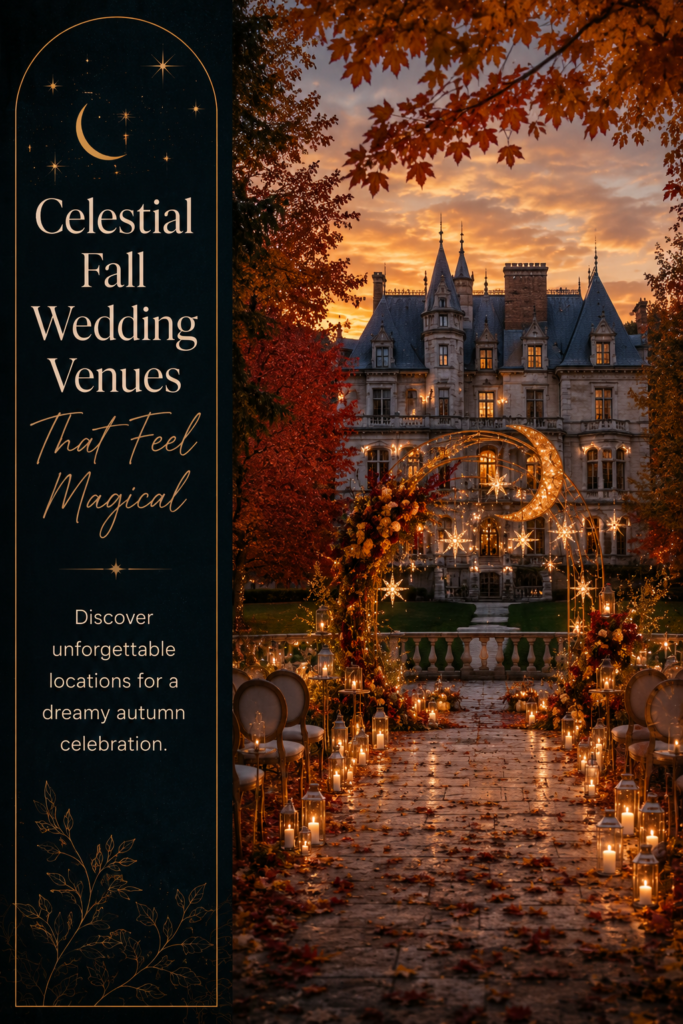
The celestial fall wedding is the most naturally outdoor of all the celestial aesthetic directions — because autumn provides the outdoor setting with the specific combination of warm terrestrial colour (the reds, golds, and ambers of autumn foliage) and darkening sky (the nights becoming longer and the stars becoming more brilliant with each passing week) that makes the outdoor celestial fall setting self-decorating in the most literal sense. A meadow or field venue in October, surrounded by the specific warm tones of autumn foliage and with the harvest moon visible above the treeline: this is the celestial fall setting at its most completely itself, requiring no artificial decoration to communicate the aesthetic because the season has already provided it.
Orchards, vineyards, and farm venues are the most specifically appropriate of the outdoor autumn celestial venue categories — because they carry within their architecture and landscape the specific language of the harvest (the fruit tree, the vine, the barn, the dried botanical material of the season) that gives the celestial fall aesthetic its most grounded and most personally significant terrestrial layer. The night sky above an orchard in October, when the harvest is complete and the trees are beginning their autumnal transformation, is the most genuinely harvest-moon appropriate celestial setting available.
Woodland and forest venues in autumn provide the most dramatic visual contrast available to the outdoor celestial fall wedding — the deep orange and amber canopy overhead (the specific colours of autumn foliage at peak colour) against the night sky visible through the gaps in the canopy (the midnight blue and constellation-scattered darkness that is the autumn sky at its best) creates a visual composition in which the terrestrial and the celestial are directly visible simultaneously, without mediation or decoration. A ceremony held in a forest clearing in late October, with the canopy overhead in full autumn colour and the first stars visible through the gaps in the foliage, is among the most beautiful outdoor ceremony settings available in the entire calendar year.
Autumn Celestial Ceremony Details
The timing of the outdoor autumn ceremony around the harvest moon: the harvest moon rises at approximately sunset on the night of its occurrence (and rises only slightly later for the several nights surrounding it), which means that a ceremony timed to begin as the sun sets in the west and conclude as the harvest moon rises in the east provides the specific visual experience of watching the celestial changing of the guard — the sun surrendering the sky to the moon as the ceremony ends and the evening begins. This timing is not reliably available every autumn, as the harvest moon date varies from year to year, but for a couple planning in advance it is worth checking the specific full moon dates for the chosen wedding year to see whether this timing can be achieved.
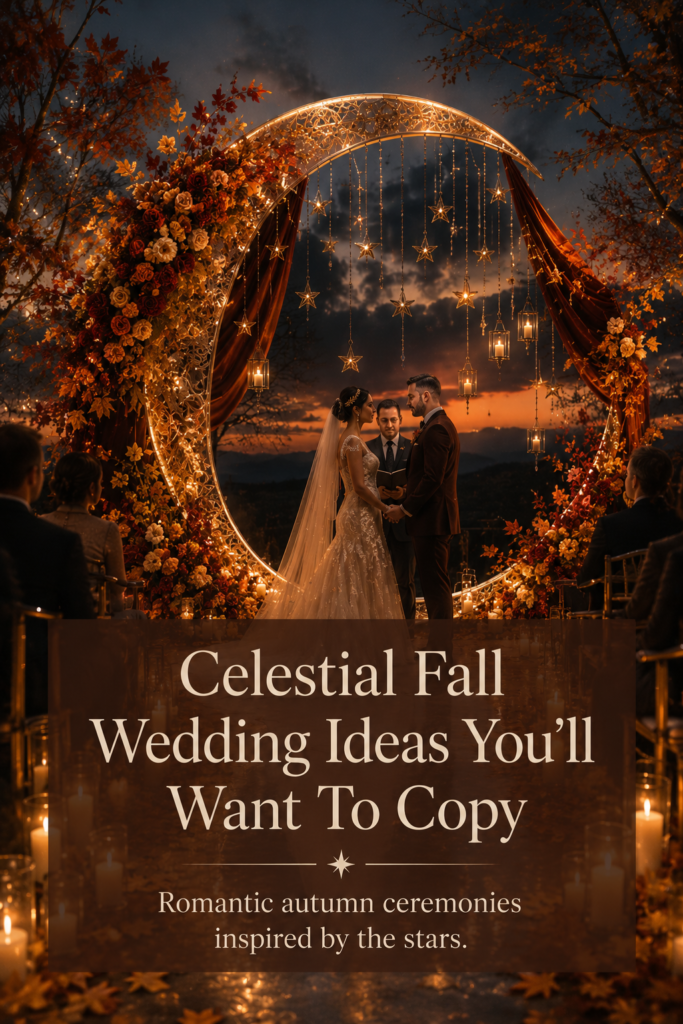
The autumn celestial ceremony arch: a structure of autumn botanical material (dried pampas, dried seed heads, preserved autumn foliage, deep dahlia and late rose heads in autumn colours) combined with specific celestial elements (fine gold star scatter embedded in the floral material, a constellation wire form in antique gold positioned at the arch’s apex, small gold moon picks woven through the botanical material at intervals) produces the autumn celestial arch at its most seasonally specific. The combination of warm autumn botanical material with the specific celestial detail creates an arch that reads as genuinely belonging to both its aesthetic traditions simultaneously.
The constellation aisle with fallen leaf detail: autumn fallen leaves placed in the specific geometric pattern of the chosen autumn constellation alongside the conventional aisle elements (candles in amber glass holders, small seasonal botanical elements) creates the most seasonally specific of all constellation aisle formats. The leaves should be of mixed autumn colours (amber, rust, deep burgundy, some still-green) placed at the star positions of the constellation rather than scattered randomly — their irregular distribution across the aisle imitating the irregular distribution of stars in the actual constellation map.
The Vintage Celestial Renaissance collection produces the ceremony program most aligned with the autumn celestial ceremony — warm parchment and antique gold in the illustration register that suits the most seasonal and historically specific of the autumn celestial aesthetics.

Section 05 Celestial Fall Reception Styling
The celestial fall reception is where the harvest table and the starry night meet at the most intimate scale — the point at which the season’s abundance and the cosmos’s depth are both present on a single surface that guests will examine closely for several hours. The autumn celestial table is more texturally rich than any other celestial table direction because it has access to the specific range of autumn botanical material (dried seed heads, autumn foliage, preserved fruit, dried vines and grasses) in addition to the standard celestial decoration vocabulary of dark vessels, star scatter, and candlelight.
The Harvest Celestial Table
The harvest celestial table runner: a length of mixed autumn botanical material — dried pampas, dried rosehip branches, dried allium seed heads, preserved autumn leaves, dried cosmos and dried dahlia heads in autumn tones — running along the centre of the table, with fine gold star scatter in an autumn constellation pattern applied through and around the botanical material, and small antique gold taper candles in dark metal holders positioned at the brightest star positions of the constellation. The result: a table surface that reads as a harvest arrangement at arm’s length and as a constellation map at close examination — the specific reward-on-examination quality that the best celestial autumn decoration achieves.
Autumn botanical celestial centrepieces: deep dahlias in autumn tones (copper, amber, burnt orange, deep burgundy) combined with dark star-centre flowers (chocolate cosmos, dark sweet peas, deep burgundy ranunculus) and silver-grey botanical elements (silver eucalyptus, dried dusty miller, dried artemisia) in dark vessels that read as night-sky coloured at table level. The specific choice of vessel matters as much as the floral content: an antique brass vessel reads as warm and harvest-appropriate; a dark ceramic vessel reads as cosmic and autumnal; a mercury glass vessel with warm-amber backlighting provides the specific quality of warmth-within-darkness that the harvest moon aesthetic is built around.
Celestial harvest signage and place cards: the most specifically autumn celestial design approach for signage and table stationery is the vintage atlas quality — welcome signs and table number cards in the style of antique star charts, with the tables named for the autumn constellations (Orion, Perseus, Andromeda, Cassiopeia, Taurus, Auriga) and the place cards carrying individual star names from those constellations. The combination of the autumn botanical table decoration with the vintage constellation-named stationery creates a design coherence that reads as genuinely designed rather than assembled from separate sources.
The Celestial Starry Nights collection carries the most classically romantic celestial autumn palette into the table stationery — midnight blue and warm gold that sits naturally on an autumn harvest table and reads as the specific quality of the autumn night sky above the harvest gathering.

Section 06 Celestial Fall Florals & Bouquet
The autumn celestial floral vocabulary is the richest and most diverse of any celestial season — because autumn provides more specific botanical material with direct celestial associations (by name, form, or behaviour) than any other season, and because the specific colour palette of autumn florals (from warm amber through deep copper to burgundy and near-black) maps so naturally onto the celestial aesthetic’s dark-and-warm palette that the two traditions are immediately compatible at the floral level.
Deep Autumn Dahlias
Deep autumn dahlias — in cafe au lait (warm caramel-cream), copper, amber, burnt orange, deep burgundy, and near-black cultivars — are the primary autumn celestial flower. Their large, multi-layered petal structure reads as architecturally significant at the scale of a bouquet or centrepiece; their autumn colour palette maps directly onto the harvest celestial palette; and their season (late summer through frost) makes them the most available and the most seasonally appropriate of all dark celestial flowers. The near-black dahlia cultivars (the darkest available, in deep wine and near-chocolate tones) provide the dark space element within the arrangement from which the lighter amber and copper dahlias read as stellar.
Cosmos in Autumn Colours
Cosmos — the flower most directly connected to the celestial by name — is also one of the most specifically autumnal of common flowers, flowering through the entire autumn season and available in both the star-scatter white cosmos (most specifically celestial in form) and the deep wine, chocolate, and dark red cosmos cultivars that belong to the autumn colour palette. Chocolate cosmos (Cosmos atrosanguineus) carries the double association of its celestial name and its near-black autumnal colour, making it the most specifically autumn-celestial flower available in the entire bouquet vocabulary.
Dried Autumn Botanicals
Dried autumn botanical elements provide the harvest quality that distinguishes the autumn celestial bouquet from any other season’s celestial arrangements: dried allium seed heads (spherical, star-cluster form, available in warm beige through deep purple); dried seed heads of poppies, nigella, and honesty in their autumn-dried form (the honesty seed pods being the same lunaria that is also the most specifically lunar botanical); dried autumn grasses and oats in warm gold and amber; and dried hop vines, which carry the specific warmth and the specific association with harvest abundance that makes them the most quintessentially autumnal of all dried botanical elements.
The Harvest Moon Bouquet
The harvest moon bouquet brings together the most specifically autumn-celestial flower combination: warm amber and copper dahlias as the primary elements (the harvest moon itself, warm and large and golden); chocolate cosmos and dark sweet peas as the deep sky elements within the arrangement (the darkness of the night sky against which the harvest moon appears); silver dusty miller and silver eucalyptus as the cool metallic foliage that provides the star-scatter equivalent in foliage form; dried lunaria pods for the lunar reference; and gold wire stems in a crescent moon form positioned as the only geometric celestial element among the organic botanical material — the crescent moon visible beside the full harvest moon, the geometry of the actual celestial event reproduced at the scale of a held arrangement.
The Celestial Boho collection carries the Harvest Moon Bouquet aesthetic into stationery — organic celestial motifs in warm autumn earthy tones, so that the printed element beside the harvest moon bouquet in the flat lay reads as part of the same organic, warm, and cosmically grounded visual world.

Section 07 Celestial Fall Stationery
The autumn celestial wedding invitation is where two of the most Pinterest-searched and most widely loved wedding aesthetic categories converge in a single printed object — and the result, when the combination is executed with the right palette temperature and the right illustration quality, is one of the most immediately visually distinctive and most widely shared invitation formats in the entire wedding stationery category. The autumn celestial invitation should carry the specific tension that defines the aesthetic — warm harvest tones and cosmic depth simultaneously present — in its palette (warm amber gold alongside deep midnight), its illustration (autumn botanical elements alongside constellation line-work or moon motifs), and its stock (warm parchment or aged ivory rather than the cooler cream of the standard celestial aesthetic or the stark white of conventional invitation stock).
The illustration quality most appropriate for the autumn celestial stationery: botanical celestial illustration in the Art Nouveau tradition — where autumn leaves and flower forms exist in the same flowing organic line-work as constellation maps and moon phase sequences — produces the most complete expression of the Botanical Celestial Autumn Aesthetic in a printed element. For the Harvest Moon Aesthetic, the most appropriate illustration quality is the warm amber and deep midnight colour field of the harvest moon itself, with star scatter applied in antique gold and autumn silhouettes (leaf forms, dried botanical shapes) at the borders; for the Autumn Constellation Aesthetic, the historical star chart quality of the Cosmic Vintage Constellation suite is the most precise match.
The autumn celestial flat lay photograph — the image that most completely communicates the aesthetic in a single composed photograph — requires the stationery to belong to the same temperature zone as the autumn botanical elements it is photographed beside. An autumn celestial invitation in a cool palette beside warm autumn botanicals looks like a temperature mismatch; the same invitation in a warm amber and antique gold palette beside dried dahlias and autumn foliage produces a flat lay that is immediately recognisable as a coherent aesthetic world. The stationery must carry the autumn warmth — not the cold dramatic darkness of the winter celestial palette — to complete the autumn celestial flat lay most effectively.
Browse all six collections below before choosing — the warmest collections (Celestial Fall, Celestial Gold, Celestial Rustic) suit the Harvest Moon, Rustic Celestial, and Botanical Celestial Autumn aesthetics most naturally; the historically calibrated collections (Cosmic Vintage Constellation, Vintage Celestial Renaissance) suit the Autumn Constellation Aesthetic; and the most dramatically dark collection (Mystical Black Gold) suits the Dark Autumn Celestial direction. All six are presented below with their specific autumn celestial application.
Harvest Celestial
Celestial Fall
The most specifically autumn-calibrated celestial stationery — warm harvest tones with constellation detail for the Harvest Moon and Rustic Celestial Autumn aesthetics.
Warm Stellar
Celestial Gold
Warm amber gold and ivory — the harvest moon warmth in stationery form, most aligned with the Harvest Moon and Golden Autumn Celestial aesthetics.
Rustic Starry
Celestial Rustic
Warm rustic tones with celestial detail — the most naturally aligned stationery for barn and countryside autumn celestial venues.
Autumn Star Atlas
Cosmic Vintage Constellation
Historical astronomical cartography in warm sepia — the Autumn Constellation Aesthetic in its most intellectually specific and most historically appropriate stationery form.
Botanical Autumn
Art Nouveau Blue Gold
Flowing organic botanical-celestial line-work — the Botanical Celestial Autumn Aesthetic’s most naturally aligned stationery direction.
Dark Autumn
Mystical Black Gold Celestial
The most dramatically atmospheric autumn stationery — for the Dark Autumn Celestial and gothic autumn celestial aesthetics.
Frequently Asked Questions
What is a celestial fall wedding?
A celestial fall wedding is where the celestial aesthetic — with its night sky depth, gold star scatter, and constellation motifs — meets the specific warmth and richness of the autumn season. The aesthetic tension at the heart of the celestial fall wedding is the contrast between the warm harvest palette (amber, rust, deep burgundy, dried botanicals) and the cold cosmic depth of the darkening autumn sky above it — and it is this tension, unavailable in any other season, that makes the celestial fall aesthetic so visually compelling and so specifically beautiful. The five aesthetic directions in this guide range from the most warmly harvest-golden (Harvest Moon Aesthetic) to the most dramatically dark (Dark Autumn Celestial), from the most historically specific (Autumn Constellation Aesthetic with named autumn constellations as motifs) to the most organically botanical (Botanical Celestial Autumn with Art Nouveau-adjacent botanical and celestial line-work combined).
What are the best flowers for a celestial fall wedding?
The celestial fall wedding floral vocabulary is the richest of any celestial season: deep autumn dahlias in amber, copper, and near-black cultivars (the primary autumn celestial flower — their colour palette maps directly onto the harvest celestial palette); cosmos in both white star-form and dark autumn cultivars including chocolate cosmos; dried autumn botanicals (dried allium seed heads for their star-cluster form, dried honesty pods for their lunar reference, dried grasses in warm gold and amber, dried hop vines); and the harvest moon bouquet combination of warm copper and amber dahlias alongside dark cosmos and sweet peas with silver dusty miller foliage and dried lunaria pods. The key quality that distinguishes the autumn celestial bouquet from a generic autumn arrangement: the inclusion of specific celestial references (gold wire constellation stems, dried lunaria pods, star-scatter picks in antique gold) that position the arrangement in the celestial aesthetic rather than simply in the autumn botanical tradition.
What is the harvest moon and how does it work in an autumn celestial wedding?
The harvest moon is the full moon closest to the autumnal equinox (which falls around September 22nd-23rd each year). It rises at approximately sunset on the night of its occurrence and rises only slightly later for the several nights surrounding it — historically providing an extended period of bright moonlight that allowed harvest work to continue after sunset. In autumn celestial wedding terms, the harvest moon is used as an aesthetic inspiration rather than an event planning requirement: its specific warm amber quality (produced when the full moon rises near the horizon and its light travels through the maximum thickness of atmosphere, filtering the cooler wavelengths) is the reference for the warm amber gold palette of the Harvest Moon Aesthetic. A ceremony timed to begin as the sun sets and conclude as the harvest moon rises in the east provides the specific visual experience of watching the celestial transition of the autumn sky, but this requires advance planning based on the specific full moon dates of the chosen wedding year.
What stationery suits a celestial fall wedding?
The autumn celestial stationery should carry the warmth of the harvest palette alongside the depth of the celestial aesthetic — warm amber gold (not cool antique gold), parchment or aged ivory stock (not cool cream or near-black), and illustration in organic, flowing, or historically warm quality rather than in the cooler register of the standard celestial aesthetic. The six collections in the showcase above cover every autumn celestial direction: the Celestial Fall collection for the Harvest Moon and Rustic Celestial Autumn aesthetics; the Celestial Gold collection for the warmest harvest moon warmth; the Celestial Rustic collection for barn and countryside autumn settings; the Cosmic Vintage Constellation for the Autumn Constellation Aesthetic; the Celestial Art Nouveau Blue Gold for the Botanical Celestial Autumn direction; and the Mystical Black Gold Celestial for the Dark Autumn Celestial aesthetic. The most important stationery decision for the celestial fall wedding is palette temperature: warm amber gold rather than cool metallic, because the autumn warmth must be present in the printed elements for them to belong to the autumn celestial world rather than to the general celestial or winter celestial aesthetic.
Harvest & Cosmos
Find the Stationery Where Autumn and the Stars Finally Meet
The invitation is the first harvest moon the guest holds — choose the collection that carries the same warm golden depth as the autumn sky above the celebration.