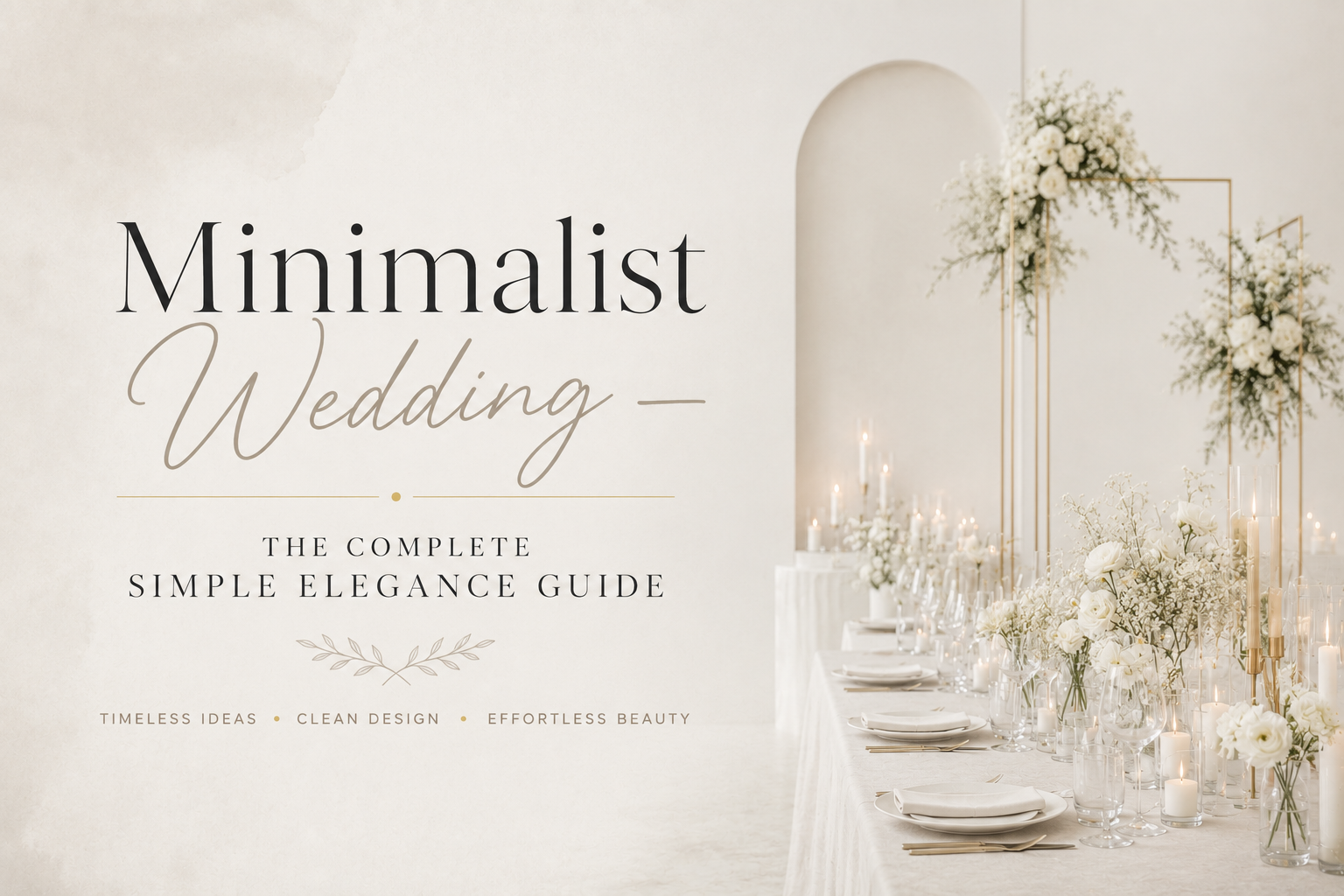
Minimalist Wedding — The Complete Simple Elegance Guide
Minimalist Wedding · 2026
Minimalist Wedding — The Complete Simple Elegance Guide
Five minimalist aesthetics, five restrained palettes, venue and ceremony guidance, table styling where negative space is the decoration, and stationery where every element earns its place.
The minimalist wedding is not a trend — it is a philosophy. It is the recognition that the most powerful design statement is made not by adding more but by being ruthlessly selective about what remains: that a single perfect flower says more than a hundred average ones, that white space is not emptiness but the breathing room that allows what is present to be seen, and that the quietest celebrations are often the most deeply remembered. In 2026, the minimalist wedding has overtaken the maximalist aesthetic on Pinterest not because brides want less beauty but because they want more intentionality.
This guide covers five minimalist wedding aesthetics and their specific design vocabularies, five restrained palettes, venue and ceremony guidance for a celebration where the space itself is as intentional as any decoration within it, the minimalist table and its specific approach to decor, florals, and stationery where every element must earn its inclusion.
“Elegance is refusal. The most sophisticated design is always the one that resisted adding more — that trusted the one thing left to be enough.”
Section 01 What Is a Minimalist Wedding?
A minimalist wedding is not a wedding that has had things removed until it looks bare — it is a wedding that has been designed from the beginning with restraint as the primary aesthetic principle. The distinction between minimalist and simply undecorated is the distinction between a conscious design decision and a lack of one: the minimalist table has one stem in one bud vase on clean white linen because this specific choice produces the specific visual experience the couple wants, not because they ran out of budget or ideas. Minimalism in wedding design is an act of confidence — the confidence to resist the anxiety of more, to trust that what is chosen carefully enough speaks for itself.
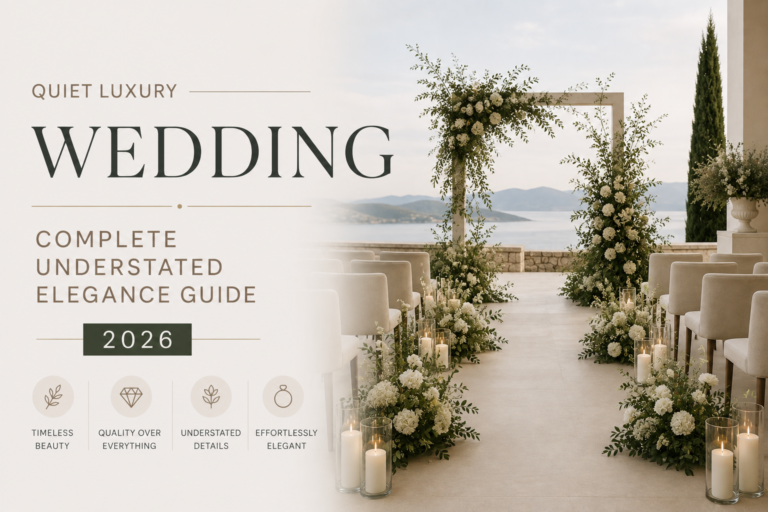
The connection to quiet luxury — one of 2026’s most significant wedding trends — is not incidental. Quiet luxury is the aesthetic philosophy of understated wealth: quality materials over visible logos, craftsmanship over decoration, things that are beautiful because of what they are rather than because of what they announce themselves to be. The minimalist wedding and the quiet luxury wedding share the same fundamental value: that intentionality and quality are more impressive than abundance and display. Both are, at their core, about restraint as a form of sophistication.
The reason minimalist weddings photograph so magnificently is rooted in basic visual principle: the camera, like the eye, needs somewhere to rest. A maximally decorated space is visually busy in photographs — the eye moves constantly, never settling, never fully absorbing any individual element because all elements are competing simultaneously. A minimally decorated space gives the camera a composed visual field with a clear hierarchy: the couple is the subject, the setting is the context, and the few chosen decoration elements frame rather than compete. Every professional wedding photograph that has made a viewer catch their breath at its calm beauty is, almost certainly, a minimalist or near-minimalist composition.
Section 02 Five Minimalist Wedding Aesthetics
Five distinct expressions of the minimalist wedding philosophy — each finding its restraint in a different register and through a different visual vocabulary. One of these will be the right one.
2.1 The Modern Minimalist
The Modern Minimalist is the most architecturally specific and the most editorial of the five directions — it takes the visual language of contemporary interior design (clean geometry, white and neutral walls, materials that are honest about their own texture and weight, furniture that is functional and beautiful simultaneously) and applies it to a wedding celebration. The venue for the Modern Minimalist wedding is as important as any decoration within it: a purpose-built contemporary events space, a gallery, an industrial loft, or a modern house with significant glazing and clean architectural lines. The building itself is the primary design statement; the decoration is there to enhance rather than obscure its character.
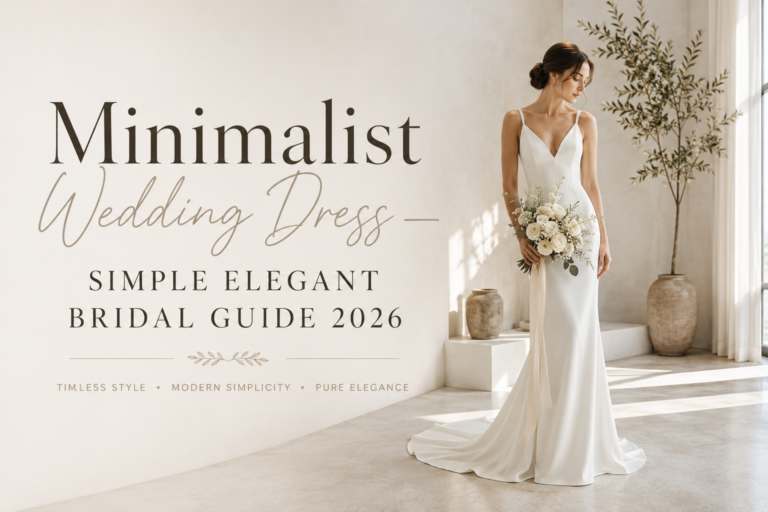
The visual vocabulary of the Modern Minimalist is the most restrained of the five directions: white, warm ivory, and pale grey as the complete palette; geometric rather than organic forms in any decoration elements; typography-led stationery with minimal or no illustration; and the absolute avoidance of anything that reads as fussy, decorative, or period-specific. The wedding details — the rings on the clean marble surface, the single stem in a narrow glass vessel, the clean-lined ceremony program — are the photographs that most completely represent the Modern Minimalist aesthetic: still life compositions that belong to the same visual world as contemporary architectural photography.
The Modern Minimalist is most appropriate for couples who have a strong personal aesthetic in their own home and want the wedding to feel like an extension of that aesthetic rather than a departure from it — couples who live with clean architecture, who own things they love rather than things that fill space, and who want their celebration to reflect the same values. It is also the most photogenic of the five directions in the flat lay photograph: a clean-lined stationery suite on a marble or concrete surface, with a single stem beside it, is one of the most saved wedding flat lay photographs on Pinterest.
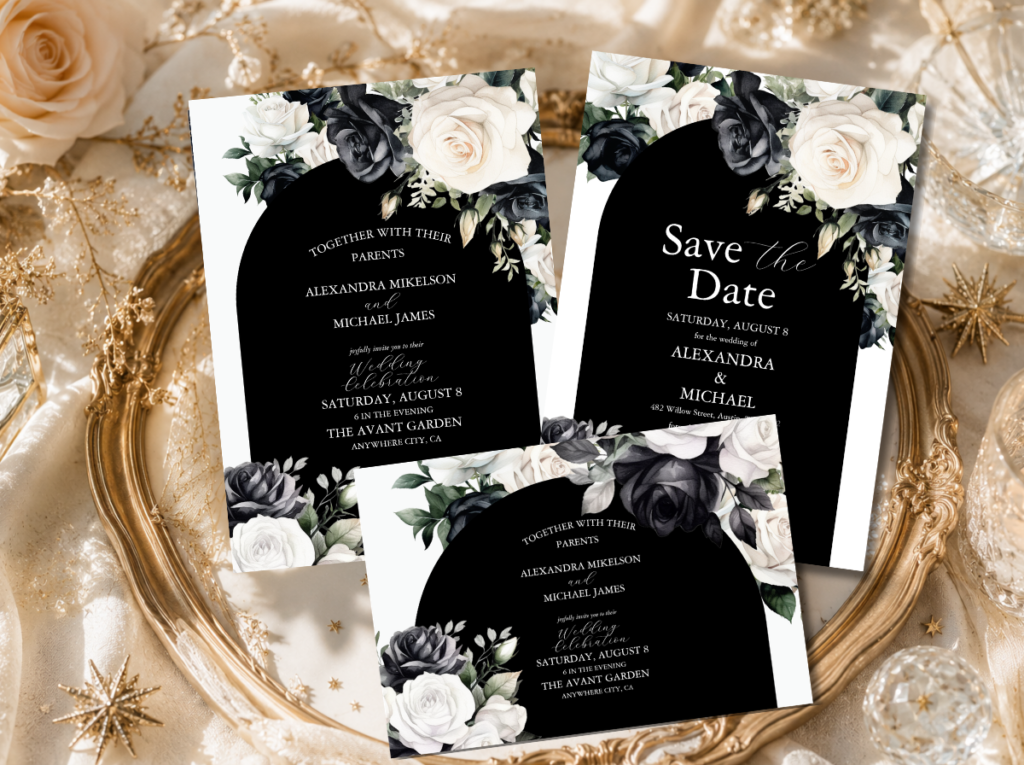
The Minimalist Wedding category carries the Modern Minimalist aesthetic into stationery — clean typography and restrained design across every suite piece, for the wedding where the invitation is as carefully considered as the architecture.
2.2 The Botanical Minimalist
The Botanical Minimalist is the most organically beautiful and the most immediately accessible of the five directions — it uses the restrained botanical world as the primary aesthetic reference, finding its minimalism not in the elimination of natural material but in the curation of it. Where maximalist botanical weddings use flowers in overwhelming abundance (the arch covered entirely in blooms, the table runner a continuous river of petals), the Botanical Minimalist uses exactly one flower variety in exactly one vessel per table, or a single trailing eucalyptus stem on clean white linen. The restraint is not the absence of the botanical world but the most intentional possible engagement with it.
The specific botanical vocabulary of the Botanical Minimalist: single stems of the most architectural flowers (calla lily, anemone, tulip, single rose) rather than clusters or mixed arrangements; eucalyptus or olive branches as the foliage element, used alone rather than as a supporting element in a larger arrangement; pampas grass in a single, large-scale stem as the statement botanical element for the boho-minimalist direction; and dried botanicals (lunaria pods, dried grasses, dried allium seed heads) where the organic quality of dried material is part of the aesthetic. The botanical elements should be chosen for their individual character — one extraordinary flower rather than ten good ones.
The Botanical Minimalist is the most versatile of the five directions in terms of venue — because restrained botanical styling is contextually appropriate in almost any setting. It works as naturally in a modern architectural venue (where a single stem reads as a deliberate design choice against the clean architecture) as in a garden venue (where the same stem reads as belonging to the same organic world as the surrounding landscape). The Botanical Minimalist is also the most seasonal of the five directions, because the curation of one perfect botanical element requires knowledge of what is genuinely at its best in each season.
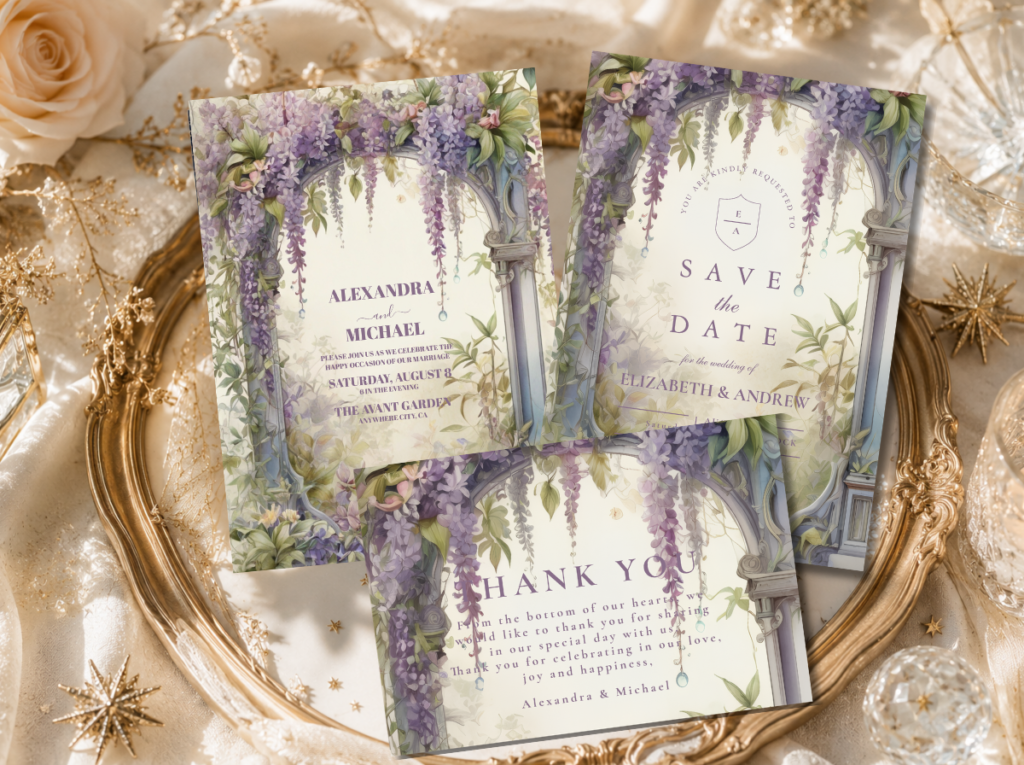
The Wisteria Arch Botanical collection carries the Botanical Minimalist into stationery — cascading wisteria and restrained botanical detail in the most organically beautiful register, each printed element as carefully considered as the single stem on the table beside it.
2.3 The Quiet Luxury Minimalist
The Quiet Luxury Minimalist is the 2026 aesthetic — the direction that has arrived at the intersection of the minimalist philosophy and the specific cultural moment of the quiet luxury trend. Quiet luxury, as a design and lifestyle philosophy, is defined by the same values as minimalism but at a specific quality level: it is not just about using fewer things but about using fewer things of extraordinary quality. The quiet luxury wedding table has one candle holder — but it is a piece of hand-blown glass. The linen is white — but it is heavy, washed Belgian linen whose texture is its own decoration. The flowers are minimal — but the one stem is the most perfect stem of the most beautiful flower of the season.
The visual language of the Quiet Luxury Minimalist is the one most difficult to communicate through a brief description and most immediately recognisable in person: it is the quality of materials that makes the impression, not the design of the decoration. A warm ivory tablecloth in polyester and a warm ivory tablecloth in heavy linen look similar in a general description and entirely different at a reception table. The quiet luxury minimalist wedding invests its budget in the quality of materials at every touchpoint — the weight of the invitation card, the texture of the linen napkin, the quality of the glassware — rather than in the quantity of decoration.
The Quiet Luxury Minimalist is the direction most closely associated with the concept of restraint as the highest form of elegance — the wedding that leaves guests feeling that they have been in the presence of something truly refined without being able to point to any single spectacular element as the reason. Everything worked; nothing was excessive; every detail was exactly right. This is the hardest quality to achieve and the most deeply impressive when achieved.
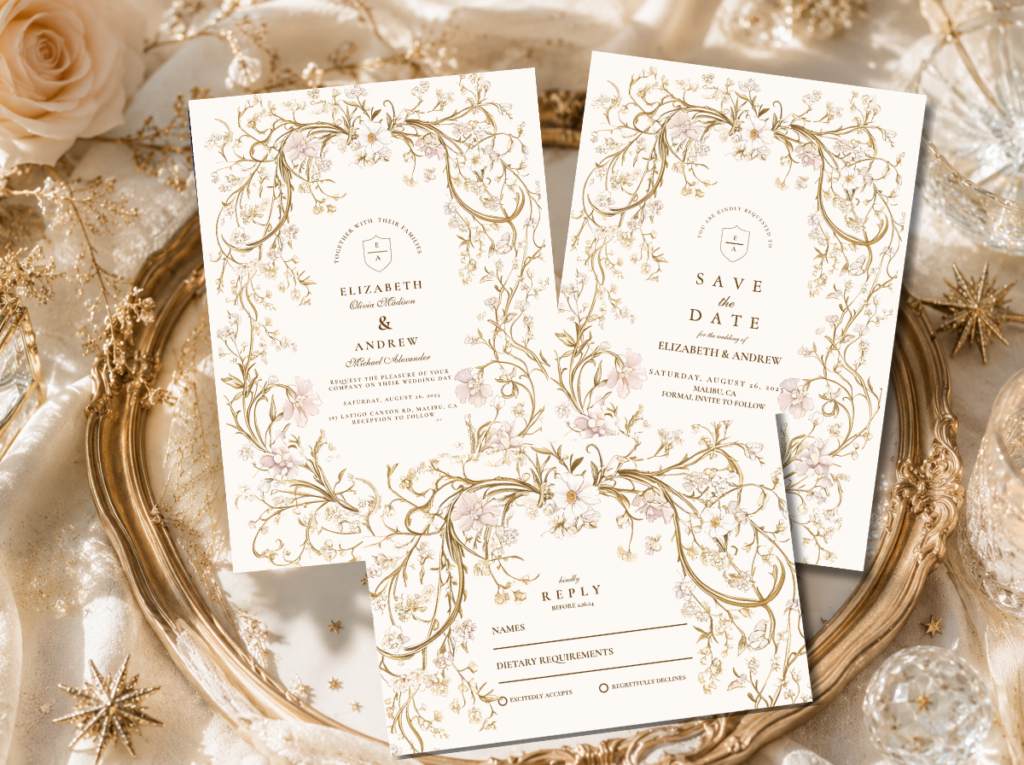
The Romantic Vintage Gold Floral Frame collection carries the Quiet Luxury Minimalist into stationery — ornate gold frame and vintage botanical detail on warm cream stock, the invitation that whispers quality before a word is read.
2.4 The Woodland Minimalist
The Woodland Minimalist is the most profoundly restrained of the five directions — it takes the philosophy of the venue-as-decoration to its most complete expression, trusting the natural world of the woodland setting to provide everything that the interior decorator provides in other aesthetic directions. An ancient woodland in full leaf, with the light filtering through the canopy at the specific angle of the time of day and season, is a more beautiful backdrop than any designed decoration. The Woodland Minimalist wedding brings nothing into this space that competes with it — only what serves and frames the human ceremony taking place within it.
The decoration vocabulary of the Woodland Minimalist is the most organic and the most materials-specific of the five directions: wooden furniture in natural finish or plain white folding chairs (the chair as functional object rather than decorative element); ceremony arches of living or cut branches rather than constructed frames with applied botanical material; table runners of moss, fallen leaves, or flat green foliage (material gathered from the woodland itself, or from the same biological world); and stationery in warm natural tones that reads as belonging to the same visual register as the paper bark and aged wood of the forest. The Woodland Minimalist is most completely itself when the line between the designed decoration and the natural setting is invisible.
The photographic quality of the Woodland Minimalist is the most distinctive of the five directions — because the dappled light of the woodland canopy, which cannot be replicated by artificial lighting, produces the specific quality of pattern and warmth that makes woodland wedding photographs immediately recognisable and immediately beautiful. The restraint of the decoration means that the light is the visual dominant in every photograph, which is the most powerful single element available to any wedding photographer.
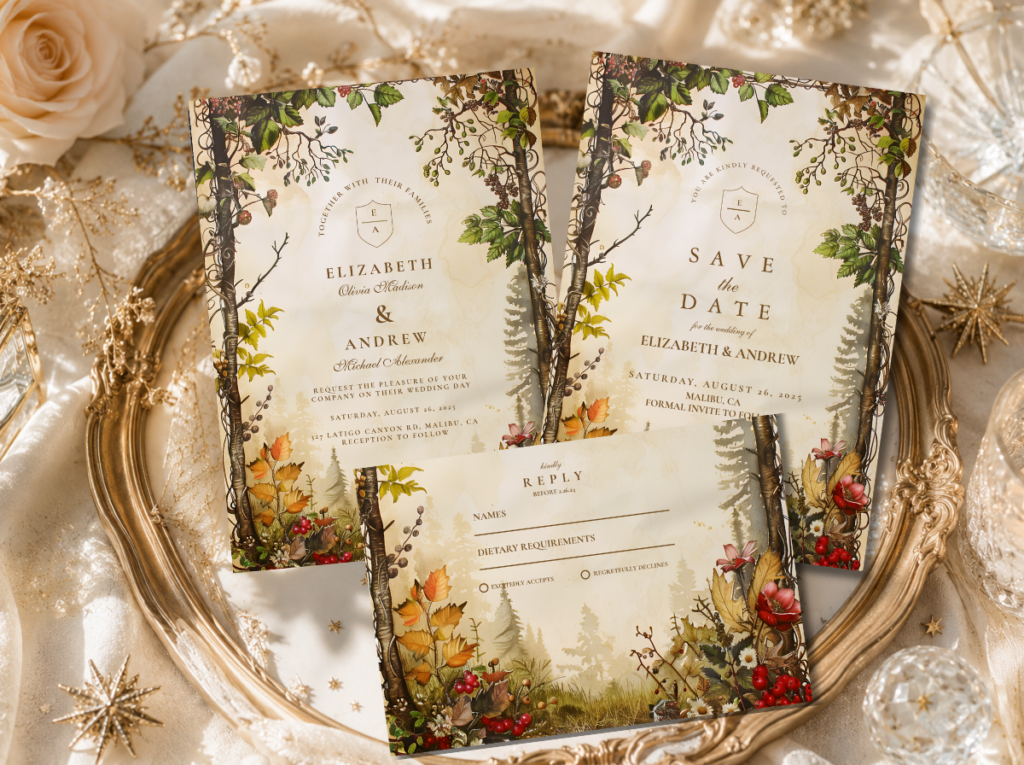
The Woodland Fall Forest collection carries the Woodland Minimalist into stationery — natural woodland illustration in autumn forest tones, so that the invitation belongs to the same organic world as the forest in which the ceremony takes place.
2.5 The Vintage Minimalist
The Vintage Minimalist is the most unexpected and the most intellectually sophisticated of the five directions — it uses vintage and antique elements not in the maximalist way (rooms full of mismatched vintage furniture, tables covered in eclectic vintage objects) but in the minimalist way: one extraordinary antique object, one perfect vintage detail, everything else clean and restrained so that the vintage element has the visual space to be seen. A single antique gold frame on a white wall, containing a botanical illustration, is the Vintage Minimalist’s most complete statement: the frame is specific and beautiful and old, and its singularity makes it more present than fifty such frames would be.
The Vintage Minimalist approach requires the vintage element to be genuinely beautiful — because when it is the only decoration in a clean space, it is directly visible in a way that an element within a crowded display is not. This makes the Vintage Minimalist the most demanding of the five directions to execute well: the single thing chosen must be worth the trust placed in it. The art nouveau botanical illustration on one table card; the single antique brass candleholder at the ceremony; the aged gold frame at the venue entrance with the couple’s name in clean modern typography — these are the choices that define the Vintage Minimalist at its most completely realised.
The palette of the Vintage Minimalist is the warmest of the five directions: olive green and warm antique gold as the signature combination, with warm ivory rather than bright white as the base neutral. The olive quality is the specific vintage colour that connects to the aged quality of antique botanical illustration — the faded sage and olive of a pressed botanical print, the specific yellowed green of a Victorian herbarium specimen — and it produces a palette that reads as both vintage and contemporary simultaneously, which is the specific quality the Vintage Minimalist aesthetic seeks.
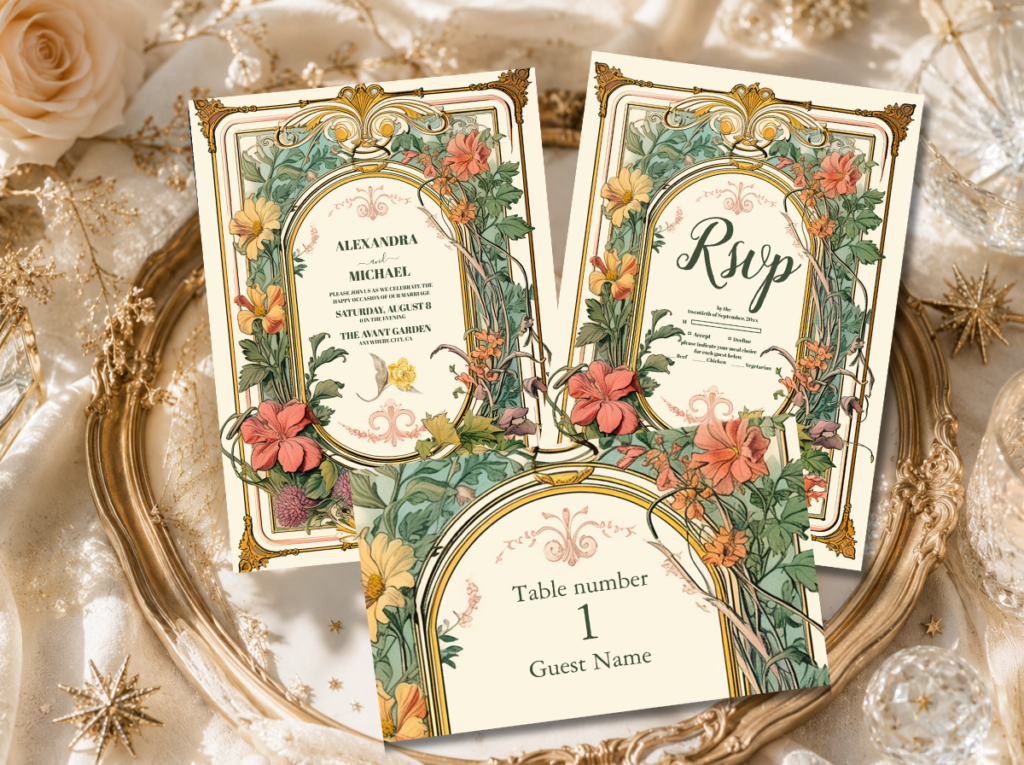
The Olive Green Vintage Floral Art Nouveau collection carries the Vintage Minimalist into stationery — a distinctive olive green palette with antique gold Art Nouveau botanical detail, the most unexpected and most sophisticated of the minimalist stationery directions.
Section 03 Minimalist Wedding Color Palettes
Five restrained palettes — each with a different temperature and a different emotional register. The minimalist palette is never dull; it is disciplined.
Palette 01
White & Warm Ivory
Bright White · Warm Ivory · Pale Cream · Soft Shadow
The purist minimalist palette — the one that is most demanding to execute and most beautiful when executed well. No colour at all: only the variations between white and warm cream that exist in nature (the white of a calla lily, the ivory of aged linen, the warm cream of beeswax candles). The stationery should be in the warmest available ivory rather than paper white; the flowers should be white varieties chosen for their specific quality of whiteness. For: Modern Minimalist and the most editorial minimalist directions.
Palette 02
Sage Green & White
Sage Green · Pale Green · Clean White · Soft Silver
The most botanical of the five minimalist palettes — the specific grey-green of sage and eucalyptus as the single colour note against an otherwise white and neutral ground. The sage quality is warm enough to prevent the palette from feeling cold and restrained enough to feel genuinely minimalist rather than decoratively botanical. For: Botanical Minimalist and garden-adjacent minimalist celebrations.
Palette 03
Warm Beige & Antique Gold
Warm Beige · Sand · Antique Gold · Ivory
The palette of quiet luxury — the specific warm neutral of undyed linen with the single metallic note of antique gold, which reads as richly warm rather than brightly decorative. The beige and antique gold combination is the palette that most reads as naturally expensive: both tones are costly in their material equivalents (undyed linen, aged metal) and the combination produces the quiet warmth of materials that have genuine quality. For: Quiet Luxury Minimalist.
Palette 04
Forest Green & Ivory
Deep Forest Green · Warm Ivory · Natural Wood · Antique Gold
The most naturally grounded of the five palettes — deep forest green as the primary colour note (the colour of the living woodland, darker and more specific than sage) against warm ivory as the neutral ground, with natural wood tones and antique gold as the supporting elements. The forest green and ivory combination reads as simultaneously organic and refined: earthy enough to suit outdoor and woodland settings, clean enough to read as genuinely minimalist rather than rustic. For: Woodland Minimalist.
Palette 05
Olive & Warm Gold
Olive Green · Aged Gold · Warm Ivory · Warm Sage
The most distinctive and most vintage of the five palettes — olive green as the specific vintage colour (warmer and more yellow than sage, referencing the aged quality of antique botanical illustration) with warm antique gold as the metallic, and warm ivory as the base. The olive and warm gold combination is immediately sophisticated and immediately distinctive: it belongs to neither the cool contemporary minimalist vocabulary nor to the warm rustic vocabulary, but to its own specific register. For: Vintage Minimalist.
Section 04 Minimalist Wedding Venue & Ceremony
Venue Selection for the Minimalist Wedding
The venue is more important for the minimalist wedding than for any other aesthetic direction — because minimalism relies on the space itself to do a significant portion of the aesthetic work. A maximalist wedding can be executed in an indifferent venue (because enough decoration will override the venue’s own character); a minimalist wedding cannot, because the space between and around the decoration elements is as important as the elements themselves, and that space will read as either beautiful or indifferent depending entirely on the quality of the venue. The first question for the minimalist bride is not “what will I decorate?” but “what space is beautiful enough that I don’t need to?”
Modern architectural venues — glass-walled buildings, contemporary event spaces, spaces with significant height and clean architectural lines — are the most natural home for the Modern Minimalist and Quiet Luxury directions. The architecture provides the visual statement; the decoration provides only the warmth and intimacy that human scale requires. Glasshouses and botanical gardens provide the most complete version of the Botanical Minimalist setting: the plant material of the setting is the decoration, and any additional botanical elements within it read as belonging to the same world rather than as applied ornament. Ancient woodland and mature formal gardens are the venue categories most aligned with the Woodland Minimalist philosophy: the setting is more beautiful than anything that could be added to it.
For indoor venues without significant inherent character, the minimalist approach requires a different strategy: rather than filling the space with decoration to create character, the minimalist approach creates zones of deliberate beauty (the ceremony space, the dining tables, the entrance) within the overall space and accepts the rest as neutral backdrop. This zone-based approach — where the areas guests occupy most closely are the most carefully considered and the surrounding space is left entirely undecorated — produces the most genuinely minimalist indoor wedding in a venue without inherent architectural character.
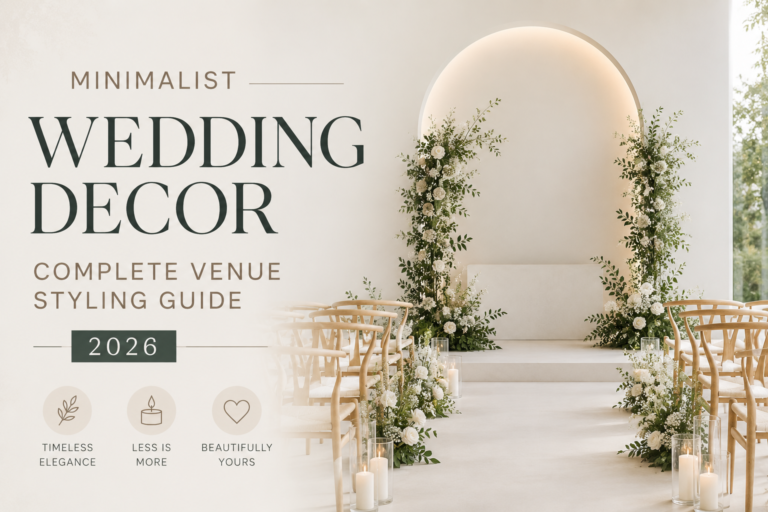
Minimalist Ceremony Design
The minimalist ceremony arch is one of the most searched and most specifically minimalist-appropriate ceremony elements — because an arch with minimal material makes the case for restraint more powerfully than any amount of description. The most specifically minimalist arch: a circular metal frame (the circle as pure form, the metal as honest material) with no floral material at all — only the structure itself, standing against the venue backdrop or the outdoor landscape. This is the architectural arch: it reads as a geometric frame for the ceremony, and the couple within it is the composition.
Where botanical material is desired on the arch, the minimalist approach is the same as for the table: one variety, placed asymmetrically (concentrated on one side or at one quadrant of the circle rather than distributed evenly), with the remainder of the arch structure deliberately left bare so that the botanical material reads as specifically placed rather than as covering. A greenery-only arch — eucalyptus or olive branches wound loosely around one section of the circular frame — is the most specifically botanical-minimalist arch available and the one that most rewards the wide ceremonial photograph.
The minimalist aisle: single-stem markers in narrow bud vases or minimal metal spike holders at regular intervals along the aisle edges, with clean narrow ribbon ties on the chairs (if chairs are used) rather than floral clusters. The aisle markers should all be the same variety and the same height — the repetition producing the architectural quality that minimalist ceremony design is seeking. A single variety of white flower in fifteen identical narrow vases along a clean white aisle is more powerful than a complex mixed arrangement in each position because the repetition is itself a design statement.
Section 05 Minimalist Wedding Table Decor
The minimalist table is where the philosophy is most tested and most beautifully expressed. Every element on the table must earn its place; everything that is there must be there for a reason.
The Minimalist Table Setting
The minimalist table setting is built on linen quality first: a tablecloth or runner in the best available linen, in the palette’s primary neutral (white, warm ivory, warm beige), clean and pressed to the specific quality of a surface that has been attended to with care. On this base, the ceramics: simple, round, in white or a warm neutral, with no pattern and no edge detail. Glassware that is clean-lined and either clear or in a single warm amber tone. Cutlery in a single metallic (warm brushed gold for the Quiet Luxury and Vintage Minimalist directions; cool brushed silver for the Modern Minimalist direction). The complete table setting, before any decoration element is added, should already read as beautiful — because each material is genuinely good and because nothing on the surface is competing with anything else.
Minimalist Centrepieces
The minimalist centrepiece is one of two things: a single large statement element (one large branch of blossom in a tall narrow vessel, or one large sphere of greenery in a heavy ceramic pot) or a collection of the same small element repeated (ten bud vases, each containing one stem of the same flower, spaced along the table at regular intervals). The first creates visual impact through scale and singularity; the second creates visual impact through repetition and rhythm. Both are more effective minimalist solutions than a conventional centrepiece arrangement, because both make the design intention visible rather than hiding it behind floral complexity.
Materials for minimalist centrepiece vessels: hand-thrown ceramic in white or warm earth tones (the irregular quality of hand-thrown ceramics reads as human and warm against the clean table surface); clear glass of various heights (which references the element within it rather than competing with it); and for the Quiet Luxury direction, hand-blown glass in warm amber or champagne tones (the specific quality of hand-blown glass — slightly irregular, entirely beautiful — is the quiet luxury material par excellence at the table scale).
The Minimalist Tablescape
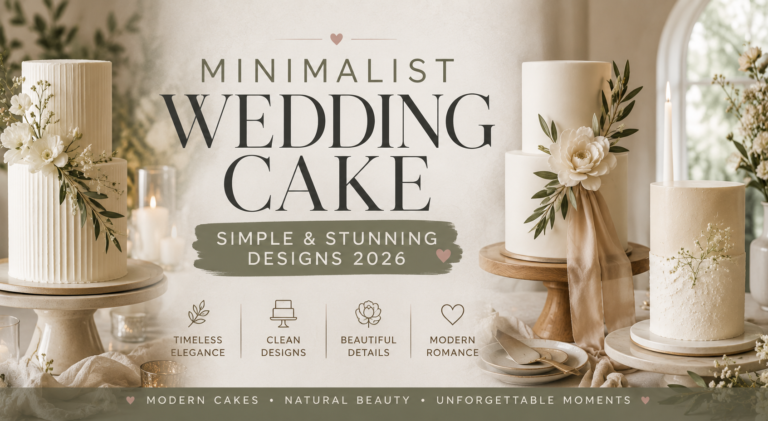
The minimalist tablescape’s most important element is the one that costs nothing and takes the most confidence to commit to: negative space. The table surface that is not covered is as much a part of the tablescape as the surface that is. A centrepiece that occupies 20% of the table surface and 80% white linen is a minimalist table; the same centrepiece surrounded by additional elements filling the remaining space is not. The negative space on a minimalist table should be intentional — clean, pressed linen that reads as chosen rather than empty. This is the quality most difficult to achieve and most immediately apparent when present: the minimalist table that has been fully committed to looks extraordinarily calm and beautiful; the minimalist table that has been filled because the negative space felt wrong does not.
Stationery on the Minimalist Table
The menu card and place card on the minimalist table should be in the same restrained register as every other element: clean typography on warm ivory or natural card stock, with minimal illustration — at most, one small botanical element, one thin gold rule, or one small geometric detail. Nothing that reads as decorative for decoration’s own sake. The stationery on the minimalist table is the detail that guests pick up and hold most closely, which means it is the element they will examine most carefully — and the quality of the paper, the precision of the printing, and the refinement of the typography are all visible at the close range of a held menu card in a way they are not at the distance of a viewed table.
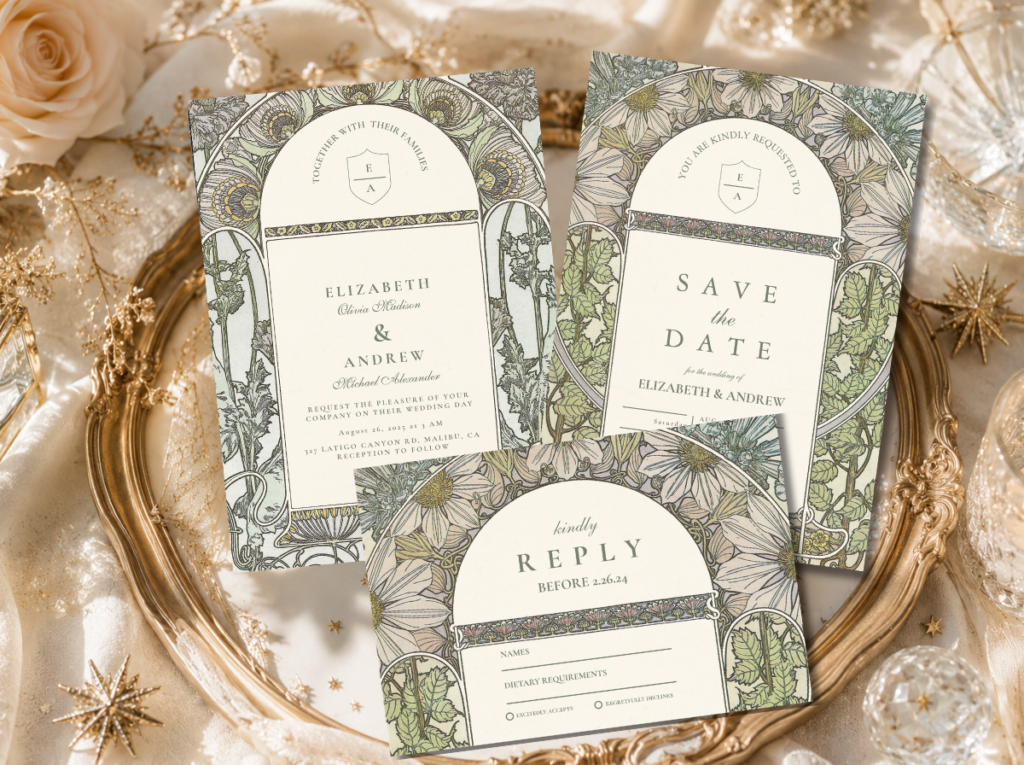
The Vintage Garden Arch collection produces the table stationery most aligned with the Botanical Minimalist table — clean composition, warm palette, restrained botanical arch illustration in the organic quality that the minimalist table requires of every element it holds.
Section 06 Minimalist Wedding Florals
The minimalist bouquet is defined by the same principle as the minimalist table: restraint as a design decision rather than a resource constraint. The most powerful minimalist bouquets are single-variety arrangements — twenty garden roses of one variety and one tone, or thirty white anemones in one stem cluster, or a single large stem of white anthurium held without any additional material. The single variety produces a visual impact that the mixed bouquet cannot achieve, because the repetition of one perfect thing is more powerful than the combination of many good ones.
The specific flowers most aligned with the minimalist aesthetic are those most architectural and most beautiful individually: white anemones (whose dark centre produces the most graphic flower form available in the white palette); calla lily (the most architectural of all common wedding flowers, whose clean curves and minimal petal structure photograph magnificently against a clean background); single garden roses in their most open, fully blown form (which shows the complexity of a single bloom at its most fully expressed); white tulip (the most clean-lined of spring flowers, whose graduated colour from base to tip produces the specific quality of a single flower that rewards close examination); and pampas grass as a singular, large-scale statement piece that provides volume through organic texture rather than through floral density.
For greenery-forward or completely foliage-based bouquets: eucalyptus in its most sculptural round-leaf variety (Eucalyptus cinerea) held at medium density produces a bouquet that is clean, aromatic, and specifically minimalist; olive branches in a small, informal cluster read as both botanical and minimal; and for the Woodland Minimalist direction, ferns and forest foliage in their simplest forms — one or two varieties, held loosely — are the most contextually appropriate minimal bouquet available. The guidance for any minimalist floral brief is the same: choose one thing and commit to it fully, rather than choosing several things and hedging.
Section 07 Minimalist Wedding Stationery
Stationery matters more for the minimalist wedding than for any other aesthetic direction — and the reason is precisely the wedding’s restraint. When a wedding’s decoration is minimal by design, the invitation becomes the single most important design statement of the entire event: it arrives before anything else, it travels in an envelope the guest must open, and it is held and read rather than simply seen. A maximally decorated wedding can absorb a mediocre invitation without significant impact; a minimalist wedding, where every element is supposed to be intentional and every detail worthy of attention, cannot. The invitation must carry the aesthetic weight that decoration is not there to carry.
What minimalist stationery looks like is not the same as what minimal stationery looks like. A minimal invitation has very little on it because nothing has been considered; a minimalist invitation has very little on it because everything has been considered and only the essential has been allowed to remain. The difference is visible immediately: the minimalist invitation has typography that is correct in scale, proportion, and spacing; it has negative space that is precisely calculated rather than accidentally occurring; it has one design element — one botanical detail, one gold rule, one small illustration — that has been chosen for a reason and positioned with intention. Everything else has been removed.
The quiet luxury invitation — the highest expression of the Quiet Luxury Minimalist aesthetic in stationery form — whispers rather than announces. The card stock has significant weight and a surface texture that communicates quality before the typography is read. The single gold detail (a thin frame, a small botanical illustration, a monogram in antique gold) is restrained but present, chosen because it adds warmth without adding noise. The typography is clean and precisely sized — large enough to read comfortably, small enough to leave significant white space around it. Picking this invitation up and holding it in the hand communicates the same quality as picking up the hand-blown glass at the table: something carefully made, by someone who understood what they were doing.
The minimalist stationery suite should be consistent across every piece: the same restrained quality on the ceremony program held in guests’ hands at the ceremony, the same clean typography on the place card at the table, the same one design element on the thank you card sent afterwards. Inconsistency within a minimalist suite — one piece with a botanical illustration and another without, one piece in warm ivory and another in cool white — reads as a mistake rather than a variation. The suite’s restraint must be consistent because restraint is most powerful as a commitment rather than as a general tendency.
Minimalist Suite
Minimalist Wedding
Minimalist Elegant
Clean typography and restrained design — the full minimalist stationery category across every suite piece.
Quiet Luxury
Romantic Vintage Gold Floral Frame
Vintage Gold Elegant
Ornate gold frame and vintage botanical detail — the quiet luxury invitation that whispers quality before a word is read.
Botanical Arch
Wisteria Arch Botanical
Botanical Minimalist
Cascading wisteria and restrained botanical line-work — the most romantically organic minimalist stationery direction.
Garden Arch
Vintage Garden Arch
Garden Elegant
A sweeping botanical arch in warm vintage tones — romantic, restrained, and completely timeless.
Woodland
Woodland Fall Forest
Woodland Minimalist
Natural woodland illustration in autumn forest tones — for the wedding where the setting is the decoration.
Vintage Olive
Olive Green Vintage Floral Art Nouveau
Vintage Minimalist
Distinctive olive green and antique gold Art Nouveau botanical detail — the most unexpected and most sophisticated minimalist direction.
Floral Elegant
Floral Wedding
Botanical Floral
The full floral stationery category — botanical illustration across every wedding aesthetic in warm natural tones.
Art Nouveau
Art Nouveau Wedding
Art Nouveau Elegant
Sinuous organic Art Nouveau line-work — the most artistically distinctive of the botanical-elegant stationery directions.
Planning Guides for Your Wedding Stationery
These planning guides answer the practical stationery questions before you browse.
Stationery Guide
Elegant Wedding Invitations — Complete Style Guide
Six elegant invitation styles, five colour palettes, and the full commercial showcase — the complete guide to choosing stationery that reads as genuinely intentional.
Planning Guide
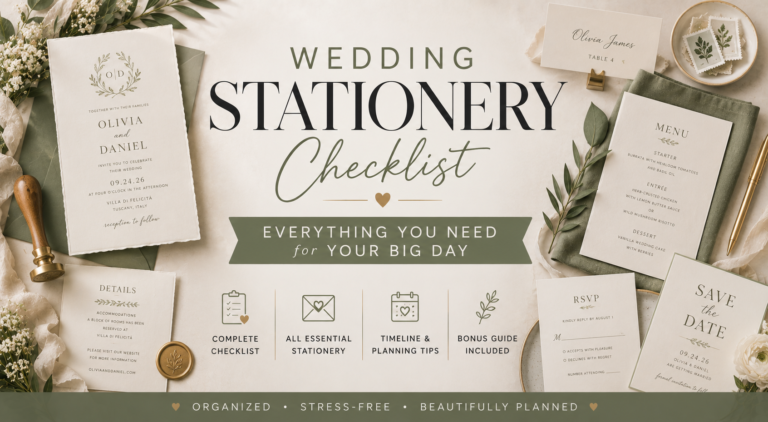
Wedding Stationery Checklist — Everything You Need
15 stationery pieces explained with what to include, when to order, and what is essential vs optional for the minimalist wedding.
Buyer’s Guide
How to Choose Wedding Invitations
The five-step decision framework for choosing the right invitation — aesthetic, venue match, quantity, timeline, and format.
Frequently Asked Questions
What is a minimalist wedding theme?
A minimalist wedding theme is a celebration designed around the principle of intentional restraint — where every decoration element has been chosen for a specific reason and everything that does not contribute has been removed. The minimalist wedding is not a wedding with a small budget or limited decoration; it is a wedding where the design philosophy is one of editing rather than accumulation. The five aesthetic directions in this guide range from the most architecturally editorial (Modern Minimalist, with clean geometry and pure white and neutral palette) to the most organically beautiful (Botanical Minimalist, with single-variety restrained florals), from the most materially luxurious (Quiet Luxury Minimalist, where the quality of materials makes the statement) to the most grounded in the natural world (Woodland Minimalist, where the venue is the decoration). What all five share is the conviction that the single most powerful design statement is made by choosing one thing and trusting it completely.
What colors work for a minimalist wedding?
The minimalist wedding palette is restrained by definition — typically one, two, or at most three colours, with one neutral and one or two accent tones rather than the complex multi-colour palettes of more decorative aesthetic directions. The five palettes in this guide cover the main minimalist colour directions: White and Warm Ivory (the purist palette, no colour at all); Sage Green and White (the most botanical, one green note against a white ground); Warm Beige and Antique Gold (the quiet luxury palette, warm neutral with one metallic note); Forest Green and Ivory (the woodland palette, deep green and warm neutral); and Olive and Warm Gold (the vintage minimalist palette, the most distinctive). The selection principle is the same as the decoration principle: choose one thing and let it be the thing, rather than adding additional colour to hedge against the possibility that one thing is not enough.
How do I decorate for a minimalist wedding?
The key decisions for minimalist wedding decoration are about editing rather than selecting: start with a full list of everything that might be in the space, and remove each element that is not contributing something specific and necessary. The practical approach: choose the venue first (minimalist decoration relies on the venue being beautiful enough to allow restrained decoration); decide what the single most important decoration element will be (the ceremony arch, the centrepiece, the welcome installation) and give it the most attention; repeat that element at the table level (one variety, one vessel, one quality of material); and resist adding to fill space. Negative space — the table surface visible around the centrepiece, the venue wall without anything hung on it — is decoration in the minimalist aesthetic. Trusting it requires confidence; executing it well is one of the most sophisticated things available in wedding design.
What flowers suit a minimalist wedding?
The flowers most aligned with the minimalist aesthetic are those that are most architectural and most beautiful individually — because minimalist florals are typically single-variety or even single-stem arrangements where each flower is individually visible rather than part of an overall massed effect. White anemones (dark centre, graphic form); calla lily (architectural curve, minimal petal structure); single garden roses in their most fully blown form; white tulips; and pampas grass as a large-scale statement element are the most specifically minimalist floral choices. Eucalyptus, olive branches, and ferns provide the greenery-only or foliage-led minimalist bouquet direction. The brief for any minimalist floral element is the same: choose one variety and commit to it fully, rather than choosing several varieties and combining them. Repetition of one perfect thing is more powerful than combination of many good ones.
What stationery works for a minimalist wedding?
The stationery for a minimalist wedding should carry the same principle as the decoration: one design element, precisely executed, with deliberate negative space around it. Clean serif or script typography on warm ivory stock; one small botanical illustration or one thin gold rule or one small ornamental detail — and nothing more. The quality of the paper stock matters more for the minimalist wedding than for any other aesthetic direction, because the invitation is one of the most important design statements of the entire celebration and will be held and examined closely. The seven stationery options in the showcase above cover every minimalist aesthetic direction: the Minimalist Wedding category for the most cleanly edited direction; the Romantic Vintage Gold Floral Frame for the quiet luxury direction; the Wisteria Arch Botanical and Vintage Garden Arch for the botanical minimalist; the Woodland Fall Forest for the woodland direction; and the Olive Green Vintage Floral Art Nouveau for the most distinctive vintage minimalist direction.
Less, and More Intentional
Complete Your Minimalist Wedding — Shop Our Collections
Restrained botanical elegance — fully customisable with your names, date, and wedding details.