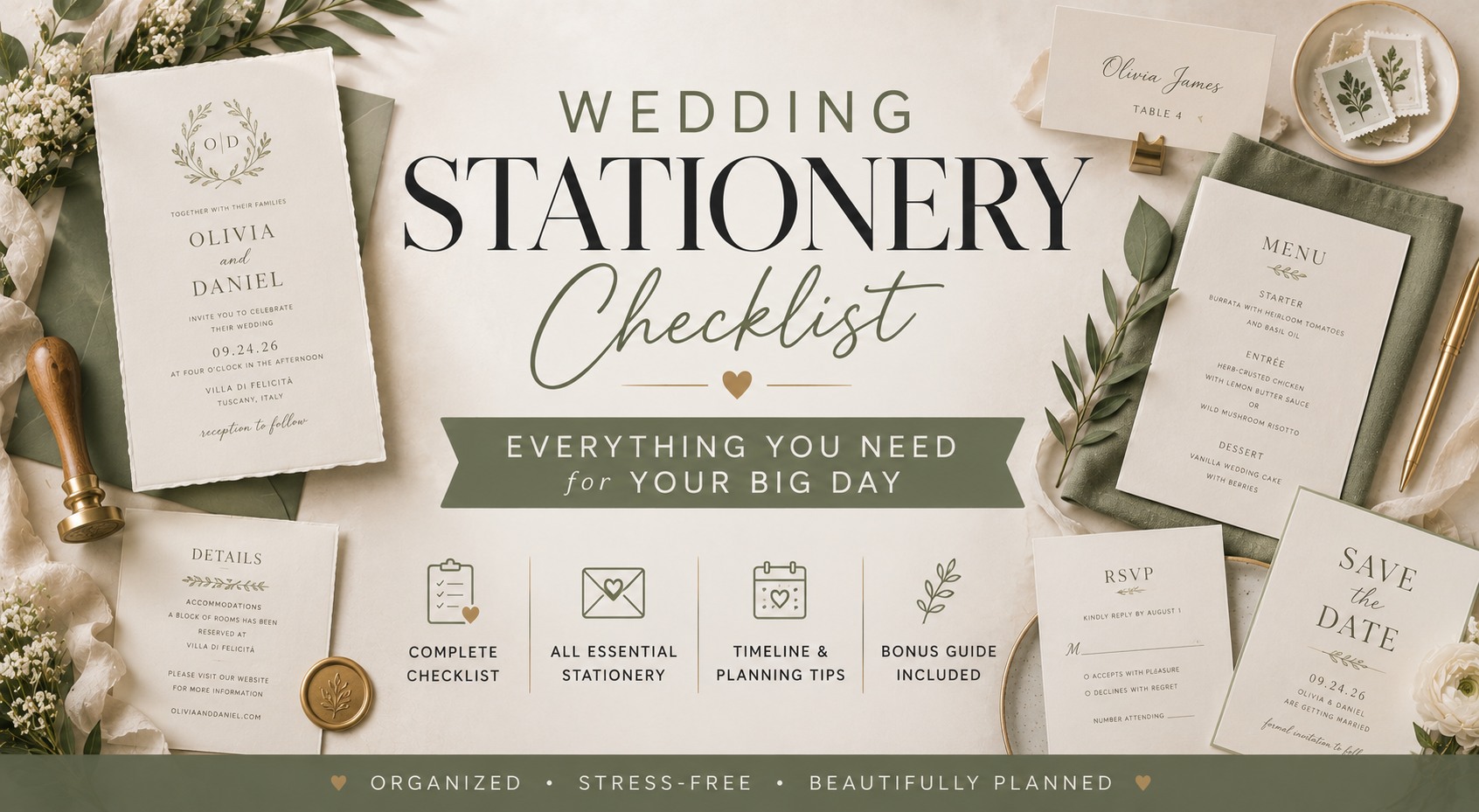
Wedding Stationery Checklist — Everything You Need for Your Big Day
Wedding Planning · 2026
Wedding Stationery Checklist — Everything You Need for Your Big Day
From save the dates to thank you cards — the complete reference guide for every piece of paper your wedding needs, in the order you need it.
Wedding stationery doesn’t need to be stressful — but it does help to have a clear picture of what exists, what is essential, and what the timing looks like before making any decisions. This guide covers every piece of wedding stationery from the save the date you send a year before the wedding to the thank you cards you send three months after, with practical guidance on what to include in each piece, when to order it, and how to prioritise if you’re working within a budget.
“Your stationery is the paper story of your wedding day — the first chapter arrives in the post months before the day, and the last chapter arrives in guests’ letterboxes as a thank you. It is the frame around the whole experience.”
Why Wedding Stationery Matters
Stationery is the first and the last impression guests have of a wedding. The invitation arrives months before the day and sets the tone, the quality, and the aesthetic expectations for everything that follows. The thank you card arrives weeks or months after the wedding ends and leaves the final impression — the last moment of the celebration that guests experience. Everything in between — the ceremony program, the place card, the menu card, the welcome sign — is the paper layer of the decorated world, the element that guests handle most closely and most personally throughout the day.
A coordinated suite — in which all stationery pieces share the same design, illustration, and palette — produces a specific quality of visual coherence that guests register even when they cannot name it. The guest who receives a botanical floral invitation, picks up a matching ceremony program, finds a coordinating place card at their seat, and reads a matching menu alongside their dinner has experienced the wedding as a completely designed world rather than as a collection of separately sourced beautiful things. The difference in impression is significant, and it is one of the most cost-effective design decisions available — because a complete suite typically costs less than sourcing equivalent quality pieces individually.
The practical value of a stationery checklist is simple: wedding stationery involves more pieces than most couples initially expect, many of them with significant lead times, and running out of any piece on the day or forgetting to order something crucial creates unnecessary stress. This checklist is organised chronologically so that every piece can be identified, ordered at the right time, and personalised with the correct information at the right stage of wedding planning.
The Complete Wedding Stationery Checklist
Organised by timeline: pre-wedding stationery, day-of stationery, and post-wedding stationery.
Pre-Wedding Stationery
Item 01
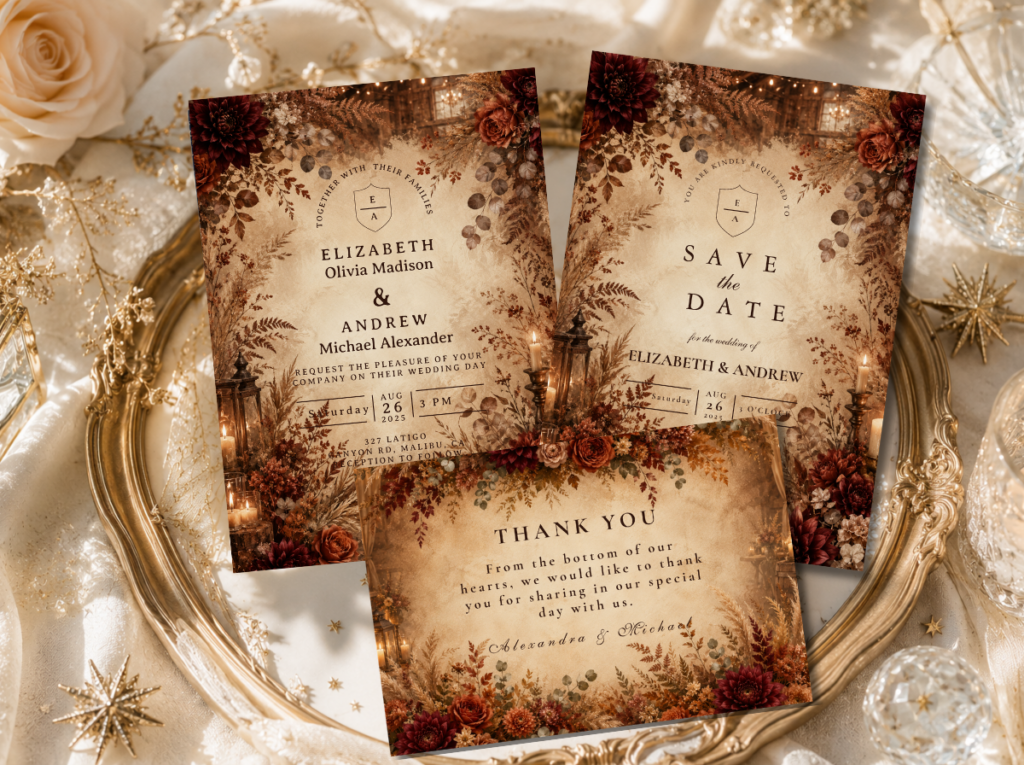
Save the Date
The save the date is the first printed piece guests receive — it announces the wedding date and location so guests can make travel and accommodation arrangements before the formal invitation arrives. It should include: the couple’s names, the wedding date, the city or region (not necessarily the full venue address), and a note that the formal invitation will follow. Send save the dates 8–12 months before the wedding (12 months or more for destination weddings or holiday dates). A digital save the date is a cost-effective alternative for budget-conscious couples, though a printed card has significantly more lasting impact and is more likely to be displayed or kept.
Item 02
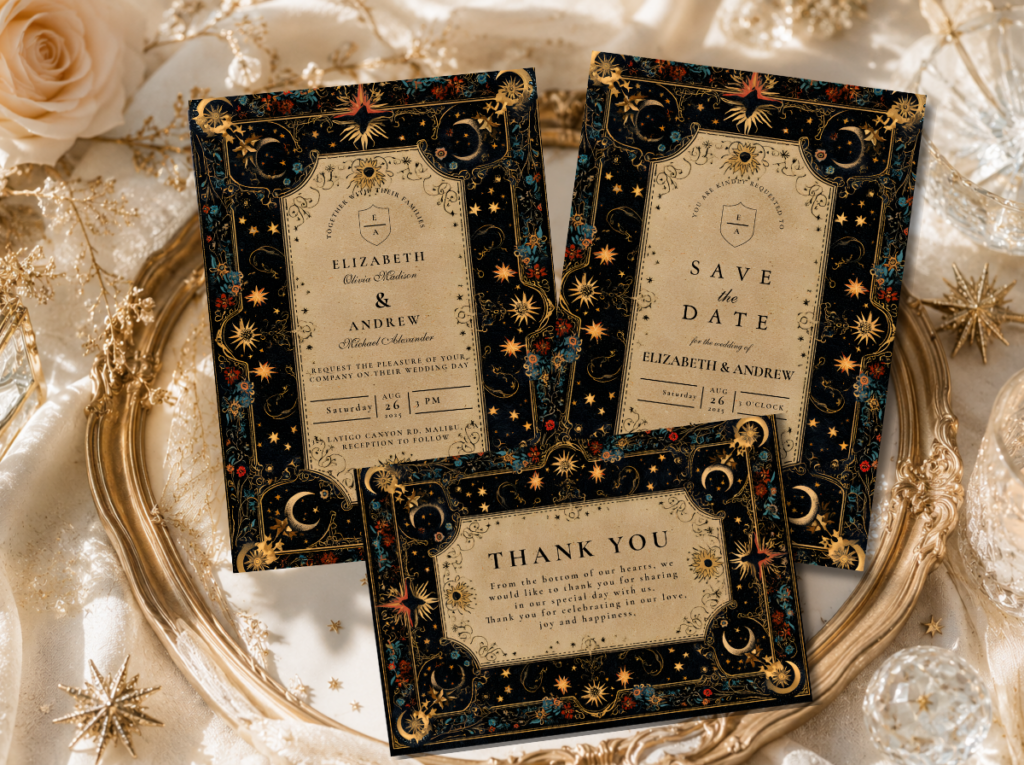
Wedding Invitation
The wedding invitation is the most important piece in the entire stationery suite — it is the formal announcement of the wedding and the primary communication between the couple and their guests. It should include: the full names of both partners (and hosts, if the invitation is hosted by parents), the date and day of the week, the ceremony start time, the full venue name and address, the dress code (if specified), and the RSVP instructions. Send wedding invitations 6–8 weeks before the wedding (10–12 weeks for destination weddings). Order at least 10% more than the total household count to allow for last-minute additions and keepsakes.
Item 03
RSVP Card
The RSVP card is the companion piece to the invitation — it is returned by guests to confirm attendance. It should include: the RSVP deadline (typically 4–6 weeks before the wedding, to allow time for finalising catering numbers), a space for the guest’s name (helpful when handwriting is unclear), a response option (attending / not attending), and the number of seats reserved (printed by the couple for each specific household). If relevant, the RSVP card can also include a meal choice section, a dietary requirements note, and a space for song requests. A self-addressed stamped envelope should accompany any printed RSVP card, or a QR code can link to a digital RSVP form on the wedding website.
Item 04
Enclosure Cards
Enclosure cards are additional information cards included with the invitation — they provide details that are too lengthy or too practical to include on the invitation itself. Common enclosure cards include: an accommodation card (listing nearby hotels or accommodation options, with any room block details); a directions or transport card (for venues in difficult-to-find locations or for guests without easy access to a smartphone); a wedding website card (a small card with the URL of the couple’s wedding website, where guests can find all additional information); and a dietary requirements card (if meal choice information is being collected separately from the RSVP). Not every wedding needs all of these — most modern couples can replace several enclosure cards with a well-designed wedding website, which reduces printing costs and is more easily updated.
Item 05
Envelope Liners & Addressing
Envelope liners — decorative paper inserts that line the inside of the invitation envelope, visible when the envelope is opened — are an optional but beautiful detail that significantly elevates the unboxing quality of a wedding invitation. They are typically in a complementary design or pattern to the outer invitation, providing a moment of visual delight between the envelope and the invitation itself. Outer and inner envelopes are a formal tradition (the outer envelope addressed to the household, the inner envelope listing the specific guests invited) that has become less common in contemporary weddings but remains appropriate for very formal celebrations. Professional calligraphy addressing adds a further layer of personalisation and visual quality, and is worth the investment for the most formal celebrations.
Day-Of Stationery
Item 06
Ceremony Program / Order of Service
The ceremony program (also called the order of service) guides guests through the ceremony structure and provides the information needed to follow along. It should include: the names of the couple, the ceremony date and venue, the order of the ceremony from processional through to recessional, the names of the officiant and any readers or musicians, and the words of any prayers, hymns, or readings guests are expected to participate in. Print one program per guest (plus 10% extra for latecomers and keepsakes). A folded card (A5 when folded, A4 when open) is the most common format; a single flat card is more minimal and suits contemporary aesthetic directions.
Item 07
Place Cards
Place cards are used at seated receptions to direct each guest to their specific seat at a table. They display the guest’s name and are placed on the table setting at the relevant seat. Note the distinction: an escort card (displayed at the entrance to the reception, one per household, directing guests to their table number) differs from a place card (displayed on the table at the specific seat). Both can be used together for the most formal receptions; for informal or smaller receptions, a seating chart at the entrance combined with table numbers at the table is often sufficient. Order slightly more than the guest count to allow for last-minute replacements and misspellings.
Item 08
Table Numbers
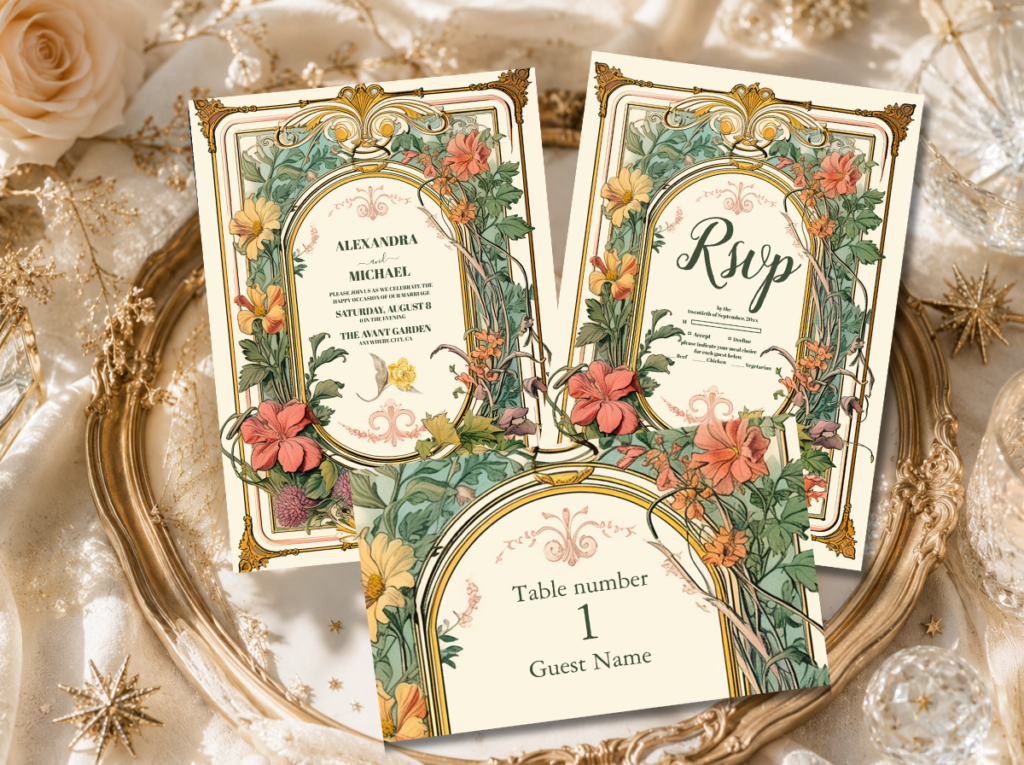
Table numbers identify each table in the reception room and are essential for any reception with assigned seating. Options include: printed number cards in a frame or holder; illustrated cards with each table given a name (constellation name, flower name, place name) rather than a number; or dimensional numbers in a material that matches the decoration aesthetic (acrylic, wood, metal). For botanical weddings, table names drawn from flower varieties — Rose, Peony, Wisteria, Ranunculus — with the relevant botanical illustration on the table card provide the most specific and most personal table name direction. Whatever format is chosen, the table number or name cards should match the overall stationery suite aesthetically.
Item 09
Menu Cards
Menu cards display the meal options being served at the reception. They can be printed per place setting (one per guest, placed on the dinner plate or at the place setting) or per table (one or two cards per table, placed in the centre). Menu cards should include: the meal courses in order, the specific menu items (including allergen information if required), and any wine or drink service information if relevant. For simpler receptions with a single set menu, the menu information can be included on the table number card rather than as a separate piece. Menu cards are a nice-to-have rather than an essential for most receptions.
Item 10
Seating Chart / Table Plan
A seating chart (also called a table plan) is a large-format display positioned at the entrance to the reception room, listing every guest and their assigned table. It is typically needed for any reception with more than about 40 guests, at which point individual escort cards become logistically complex. Seating chart formats: an alphabetical list of all guests with their table number beside their name (the most functional); a table-by-table display with each table’s assigned guests listed under the table name or number (more decorative); or a botanical format in which each table is a named variety and the guests’ names are listed within the floral illustration (the most specifically botanical and the most visually distinctive format available). The seating chart should be in the same aesthetic register as the rest of the stationery suite.
Item 11
Welcome Sign
A welcome sign is typically positioned at the entrance to the ceremony or reception venue, greeting arriving guests and providing any directional or practical information needed before the ceremony begins. It should include: a welcome message personalised to the couple and the day; the names of the couple (and optionally the wedding date); and any practical information (seating instructions, ceremony timing, phone guidance). A ceremony entrance welcome sign and a separate reception entrance sign are both options — most couples choose one or the other rather than both. Welcome signs can be on printed card in a frame, on a large chalkboard, or on a wooden board with vinyl lettering.
Item 12
Bar Menu / Cocktail Sign
A bar menu or cocktail sign lists the drinks being served at the bar — either the full bar selection, a curated list of signature cocktails, or a simple list of the welcome drinks and wine service. Bar menus are increasingly popular at weddings as they add a personal touch (especially when the couple has created a named signature cocktail for the occasion) and reduce the number of questions bar staff receive from guests. They should be in the same aesthetic register as the rest of the printed stationery suite. This is an optional extra rather than an essential — most receptions function perfectly well without one.
Item 13
Gift Table Sign
A gift table sign is a small printed card placed on the gift table (or card box) directing guests to leave their gifts or cards there. It typically says something simple: the couple’s names, the phrase ‘gifts’ or ‘cards’, and optionally a brief personal note. It should match the overall stationery aesthetic. This is a very small piece that most couples print themselves rather than ordering as part of the professional suite — a single printed card in the same design as the rest of the stationery is the most cost-effective approach.
Item 14
Order of Events Sign
An order of events sign (sometimes called a timeline sign or day plan) lists the schedule of the reception for guests — typically: welcome drinks, seating for dinner, first dance, speeches, dancing, evening buffet (if applicable), and end time. It is an optional addition that is most useful at receptions with a complex schedule or at outdoor or marquee venues where guests may be moving between different spaces. For most standard receptions, the order of events information can be communicated verbally or through the MC; a printed sign is a nice addition but not essential.
Post-Wedding Stationery
Item 15
Thank You Cards
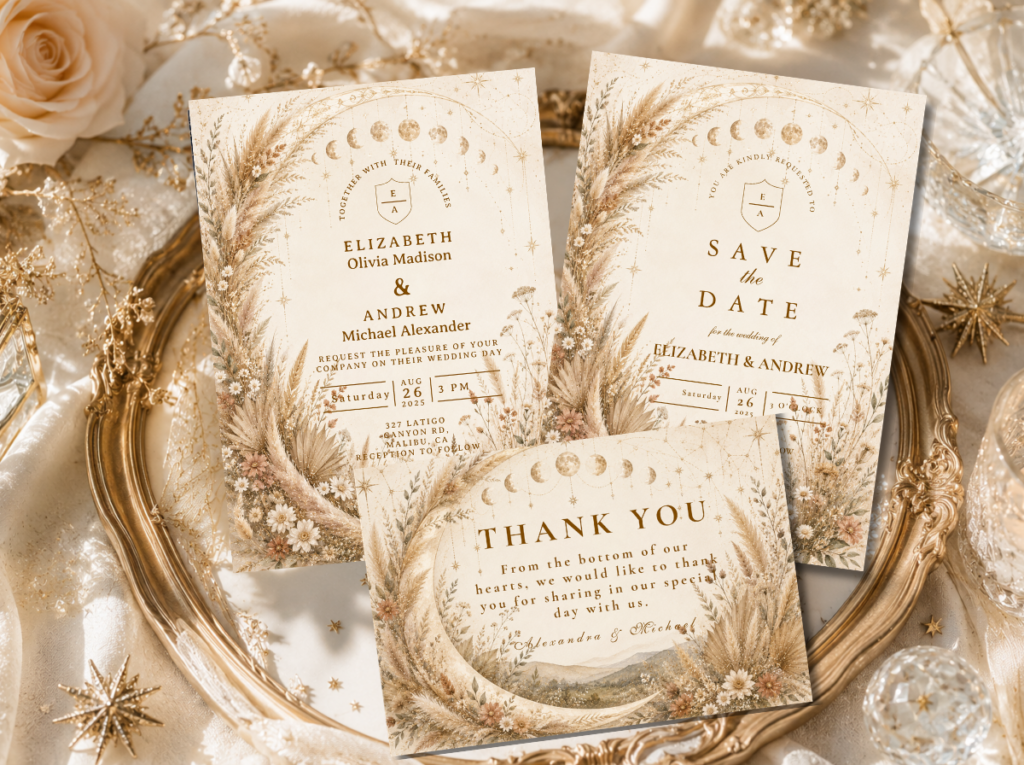
Thank you cards are the final piece of the wedding stationery suite and the last communication guests receive from the couple. They should be sent within three months of the wedding date (ideally within six weeks). Each card should be personalised to the specific guest: mentioning their gift by name, thanking them for travelling if applicable, and including a personal note relevant to the couple’s relationship with that guest. Order thank you cards in advance so that they are ready to send promptly after the wedding — the writing process is much easier when the cards are already prepared and only the personal notes need to be added.
What Stationery Do You Actually Need?
Not every wedding requires every piece on the checklist above. The following breakdown helps identify which pieces are genuinely essential, which are strongly recommended, and which are optional extras that add quality without being necessary.
Essential — Every Wedding Needs These
✓ Wedding Invitation
✓ RSVP Card
✓ Thank You Cards
✓ Welcome Sign (if guests need direction)
✓ Table Numbers or Names
Recommended — Most Weddings Benefit From These
✓ Save the Date (especially for destination or busy-date weddings)
✓ Ceremony Program
✓ Place Cards (for seated receptions over 40 guests)
✓ Seating Chart (for receptions over 40 guests)
✓ Enclosure Cards (accommodation info, directions if needed)
Optional — Beautiful If Budget Allows
✓ Menu Cards
✓ Envelope Liners
✓ Bar Menu / Cocktail Sign
✓ Gift Table Sign
✓ Order of Events Sign
✓ Inner and outer envelopes
Wedding Stationery Timeline
Working backwards from the wedding date, the stationery timeline looks like this:
12–18 months before
Order Save the Dates
For destination weddings or popular dates, go earlier. Choose a design that previews the wedding aesthetic.
9–12 months before
Send Save the Dates
Standard weddings: 10 months is reliable. Destination weddings: 12 months minimum.
6–7 months before
Design & Order Invitations
Allow 4–6 weeks for design approval, printing, and delivery before the send date.
4–5 months before
Send Wedding Invitations
6–8 weeks before the wedding (10–12 weeks for destination). This is the formal announcement.
3–4 months before
RSVP Deadline
Set the RSVP deadline here to allow time to confirm numbers with caterers and other suppliers.
2–3 months before
Order Day-Of Stationery
Ceremony programs, place cards, table numbers, menu cards, welcome sign, seating chart.
1 month before
Finalise Place Cards & Seating Chart
Once the final guest list is confirmed. Allow time for printing and any last-minute changes.
Wedding week
Assemble & Pack Stationery
Count and organise all day-of pieces. Brief the venue coordinator on display requirements.
Within 3 months after
Send Thank You Cards
Write and send within 6 weeks if possible. Personalise each card to the specific guest and gift.
How to Choose a Coordinated Suite
A coordinated stationery suite means that every piece — from the save the date through the thank you card — shares the same design, illustration quality, colour palette, and typography. The visual coherence this produces is the most impactful single quality decision available in wedding stationery, because a guest who handles a consistently designed suite throughout the day experiences the wedding as a complete designed world rather than as a collection of beautiful individual decisions.
When choosing a suite, look for: the same illustration style across all pieces (not just the same colour, but the same quality and register of the design); the same palette temperature across all pieces (the same warmth or coolness in the gold, the same depth in the base tone); and the same typography style across all pieces. A suite that varies in typography between the invitation and the menu card — even slightly — reads as inconsistent.
Print-on-demand stationery platforms — where every piece is printed to order and fully customisable with the couple’s own names, date, and wording — provide the most flexible and most cost-effective access to coordinated suite stationery. They allow couples to order exactly the quantity needed (no minimum order requirements that force over-buying), to customise every text element, and to see the full suite as a coherent visual world before committing to any single piece.
Botanical
Art Nouveau Floral
Organic botanical line-work in sage and warm gold — a coordinated suite across invitation, ceremony program, place cards, and thank you cards.
Celestial
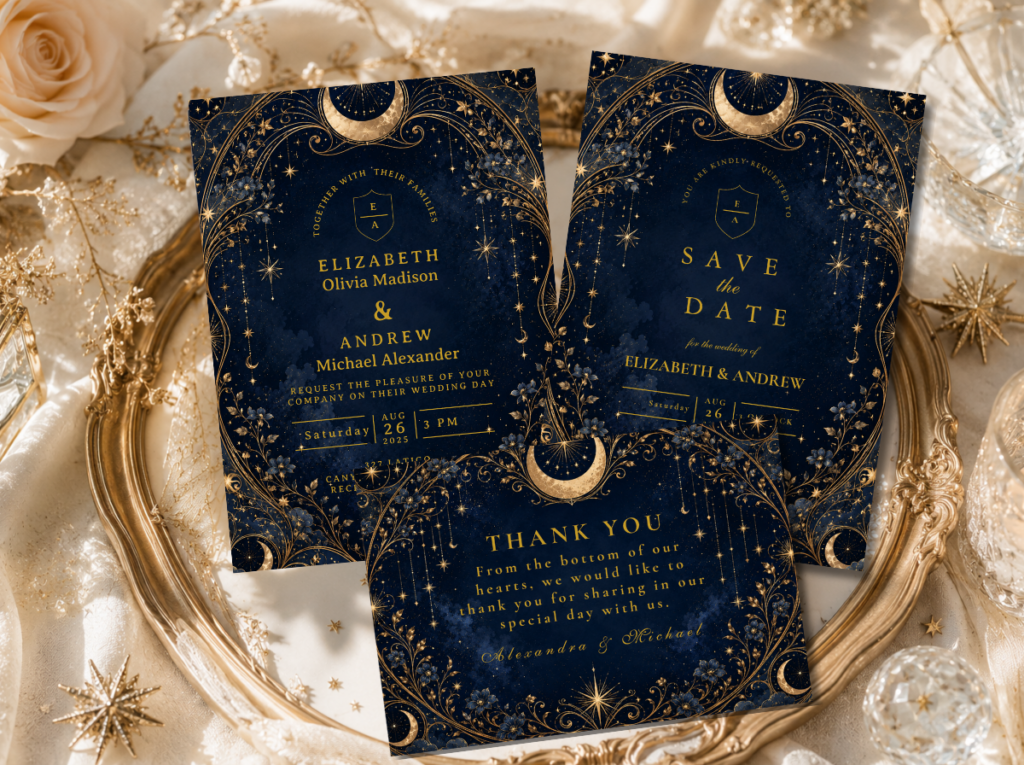
Celestial Starry Nights
Warm gold constellation motifs — a complete celestial suite from save the date through thank you card.
Woodland
Woodland Collection
Natural woodland illustration in warm forest tones — a versatile coordinated suite for outdoor and countryside celebrations.
Vintage Celestial
Vintage Celestial Renaissance
Renaissance star atlas illustration in parchment and antique gold — the most historically specific celestial suite.
Budget Guide for Wedding Stationery
Wedding stationery cost is primarily determined by four factors: quantity (the more pieces printed, the lower the per-piece cost); paper quality (heavier card stock, textured paper, and specialty finishes cost more than standard stock); printing method (digital printing is the most affordable; letterpress, foil, and thermography are more expensive premium methods); and the number of pieces in the suite (more items = more cost, but a complete coordinated suite is typically more cost-effective than individual pieces from different sources).
For couples working within a budget, the most effective prioritisation strategy is: spend on the invitation (it is seen by every guest and sets the entire aesthetic impression); reduce on the optional pieces (digital RSVP instead of printed RSVP card; QR code wedding website card instead of printed enclosures; venue-provided welcome signs instead of custom printed pieces). A beautiful printed invitation with a digital RSVP and a wedding website is a genuinely good combination that balances quality with cost.
Digital save the dates — sent by email or shared via the wedding website — are the most significant single cost saving available in the wedding stationery budget, as they eliminate the cost of one entire piece of printed stationery without removing any functional value. They are most appropriate for weddings with a younger or more tech-comfortable guest list; for weddings with older guests or guests who are less comfortable with digital communication, printed save the dates are still preferable.
Stationery Wording Guide
Getting the wording right is one of the most common points of confusion in wedding stationery. The key principle: the formality of the wording should match the formality of the celebration and the overall aesthetic of the suite.
Formal Invitation Wording (traditional / hosted by parents)
Mr and Mrs James Thornton
request the pleasure of your company
at the marriage of their daughter
Eleanor Rose
to
William James Hart
Son of Mr and Mrs David Hart
Saturday, the fourteenth of June two thousand and twenty-six
at three o’clock in the afternoon
St Mary’s Church, Woodford / Followed by a reception at Thornton Hall
Informal Invitation Wording (contemporary / self-hosted)
Eleanor & William
are getting married
14 June 2026 · 3pm
St Mary’s Church, Woodford
Reception to follow at Thornton Hall
Dress code: Smart casual
For RSVP wording, the most functional format is: “Kindly reply by [date]. [Name/s] __ will __ will not __ be attending. Dietary requirements: __” — including a line for the guest name prevents confusion when handwriting is unclear. For thank you card wording, the key elements are: thanking for attendance, thanking for the specific gift by name, and a personal note relevant to the couple’s relationship with that guest.
Frequently Asked Questions
How far in advance should I order wedding stationery?
Save the dates should be ordered so they can be sent 8–12 months before the wedding (12–18 months for destination weddings or popular holiday dates). Wedding invitations should be ordered 6–7 months before the wedding, allowing 4–6 weeks for design, printing, and delivery before they need to be sent (6–8 weeks before the wedding date). Day-of stationery (ceremony programs, place cards, menu cards, seating chart) should be ordered 2–3 months before the wedding, with final text confirmed at least 4 weeks before the wedding date to allow time for production. Thank you cards can be ordered any time before the wedding and kept ready to send immediately after the celebration.
How many wedding invitations should I order?
Count the number of households being invited (not the number of individual guests), then add 10–15% to allow for addressing errors, last-minute additions, and keepsakes for the couple and their families. A common mistake is to count individual guests rather than households — a couple or family receives one invitation per household, not one per person. For example, 100 guests living in 65 households should receive 65 invitations; order 72–75 to allow for the extra margin. Always order slightly more than needed rather than slightly fewer — reprinting a small quantity of any printed piece typically costs more per unit than the original order.
What is the difference between an RSVP card and an enclosure card?
An RSVP card is returned to the couple to confirm a guest’s attendance — it is a response mechanism. An enclosure card is a one-way information card included with the invitation to provide practical details (accommodation options, directions, wedding website URL, dietary information) that are too lengthy to include on the invitation itself — it is an information tool. Most wedding invitations include both: an RSVP card for guest responses and one or more enclosure cards for additional information. The difference is directional: the RSVP card travels from the guest back to the couple; the enclosure card travels from the couple to the guest and stays with them.
Do I need a seating chart at my wedding?
A seating chart (or table plan) is necessary for any seated reception with more than approximately 40 guests — at this scale, directing each guest to their specific seat by any other means becomes logistically complex. For smaller or more informal receptions with open seating (where guests choose their own seats), no seating chart is needed. For receptions with assigned seating, the choice is between individual escort cards (one per household, displayed at the entrance, directing guests to their table number) and a large-format seating chart display (alphabetical list of all guests with table numbers, or table-by-table display). The seating chart display is typically more practical for larger receptions; escort cards can be a beautiful detail for smaller celebrations.
Where can I find coordinated wedding stationery suites?
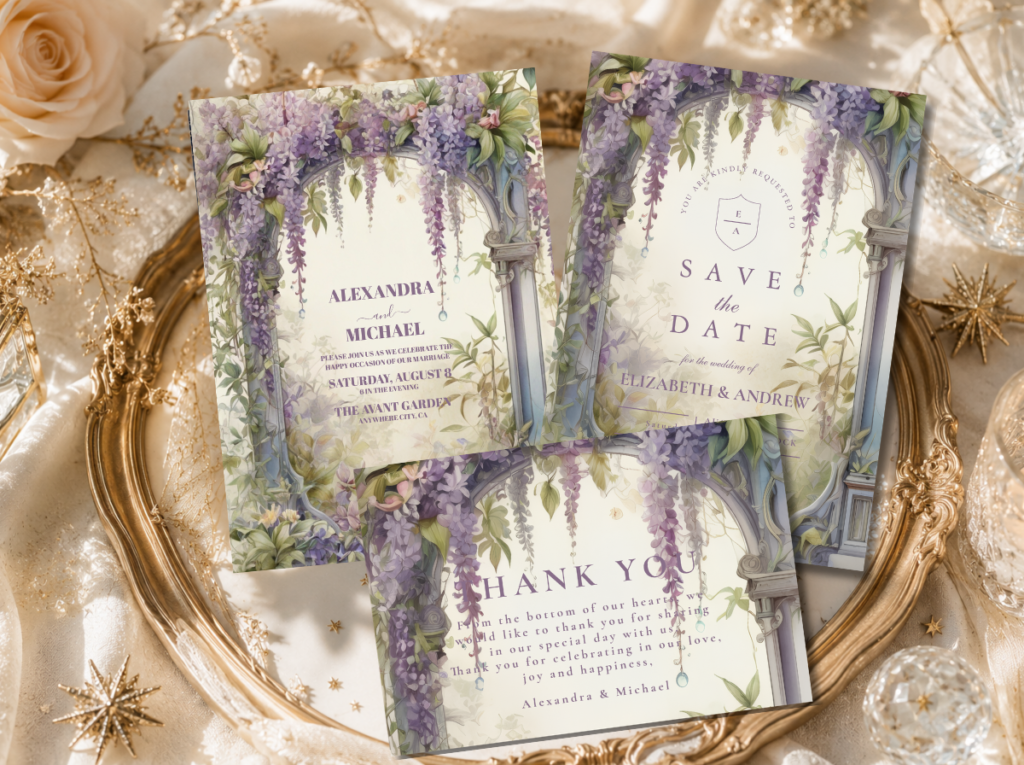
Coordinated wedding stationery suites — where every piece from save the date to thank you card shares the same design and can be personalised with the couple’s names, date, and wording — are available through print-on-demand platforms that offer full customisation at no minimum order quantity. Wedding Avenue Studio carries several complete suites: the Art Nouveau Floral suite for botanical and garden wedding aesthetics; the Celestial Starry Nights suite for starry night and constellation directions; the Vintage Celestial Renaissance collection for the most historically grounded celestial suite; the Wisteria Arch Botanical collection for cascading floral romance; and the Woodland collection for outdoor and natural celebration aesthetics. Browse the collections through the links below to see the full range of coordinated pieces available in each direction.
Every Piece, One Suite
Find Your Complete Wedding Stationery Suite
Fully coordinated suites — invitation to thank you card — all customisable with your names, date, and wedding details.