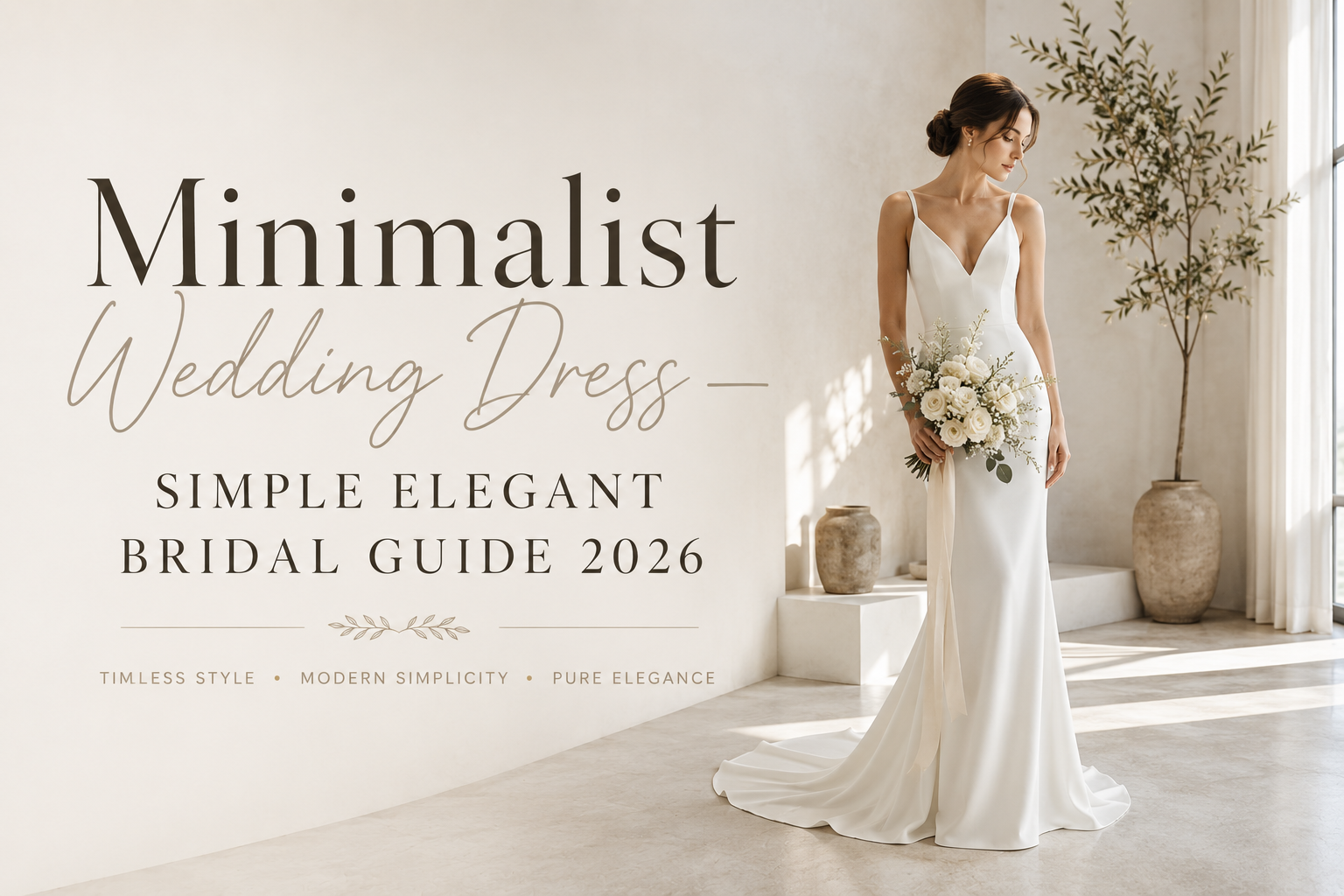
Minimalist Wedding Dress — Simple Elegant Bridal Guide 2026
Minimalist Wedding · 2026
Minimalist Wedding Dress — Simple Elegant Bridal Guide 2026
Six minimalist bridal silhouettes, five fabric directions, accessories and styling guidance, seasonal dress choices, and the stationery that carries the same restrained philosophy into every printed element of the celebration.
The minimalist wedding dress is the most sophisticated bridal choice available in 2026 — and it always has been. The dress that needs nothing added, that derives its beauty entirely from the quality of its fabric and the precision of its silhouette, has always been the choice of the bride who understands what she is doing: that the most powerful statement is made not by adding decoration but by finding the form that needs none. In the quiet luxury moment that defines 2026 bridal fashion, the minimalist gown has arrived as the mainstream choice for the same reason it has always been the most refined choice: because it photographs magnificently, because it suits every setting, and because it will look exactly as beautiful in the photographs taken forty years from now.
This guide covers the six minimalist bridal silhouettes and what makes each one work, the five fabric choices that determine the character of the minimalist gown, accessories for the minimalist bride, seasonal dress guidance, and the stationery that carries the minimalist philosophy into the printed world of the celebration.
“The dress that needs nothing added is the hardest dress to design and the most powerful to wear. Architecture is fashion’s highest ambition: the structure that is its own decoration, the form that needs no embellishment because it is already completely itself.”
Section 01 The Minimalist Bridal Aesthetic
What makes a wedding dress minimalist is not what it lacks but what it commits to. A minimalist bridal gown does not have beading because the fabric does not need beading; it does not have lace overlay because the silhouette does not need softening; it does not have embellishment because the cut is already the statement. The distinction between a minimalist dress and a simply undecorated dress is the distinction between a deliberate architectural choice and the absence of a design decision: the minimalist gown is precisely what it is, in precisely the fabric and silhouette required to make that precise statement, and nothing about it suggests that anything has been omitted. Everything about it suggests that what remains is exactly and only what is needed.
The connection to the quiet luxury movement that defines 2026 bridal fashion is immediate and specific: quiet luxury is the aesthetic philosophy of quality over display, of fabric and form over logo and ornament, of things that announce their value through their inherent quality rather than through their explicit communication of it. The minimalist bridal gown is the quintessential quiet luxury object: a heavy satin column dress, correctly cut, in a fabric that moves with the body’s own movement — this communicates quality more effectively than the same money spent on beading and embroidery, because the quality of the satin and the precision of the cut are visible to every eye in every photograph, while the beading communicates only the presence of beading.
The reason minimalist dresses photograph so magnificently is a matter of visual physics: the camera reads clean lines and quality fabric more clearly than it reads ornament. A heavily decorated dress in a photograph is a document of the decoration; a minimalist dress in a photograph is a document of the dress. The liquid movement of bias-cut satin in a wide-angle shot with natural light; the architectural shoulder line of a structured crepe gown in a portrait taken against a white wall; the effortless fall of a slip dress in a candid taken outdoors at golden hour — these are the photographs that become the most-looked-at images of any wedding, because they capture something genuinely beautiful rather than something specifically documented. The minimalist dress works in every light, in every setting, and from every angle — which is the photographic quality most worth investing in.
Section 02 Six Minimalist Wedding Dress Styles
Six silhouettes, each achieving its beauty through a different commitment to form and fabric. The right one is the one whose specific qualities match the specific qualities of the bride’s body, setting, and vision of herself on the wedding day.
2.1 The Satin Column Gown
The Satin Column Gown is the most iconic and the most immediately recognisable of the six minimalist silhouettes — the dress most associated with the minimalist bridal aesthetic on Pinterest, in editorial photography, and in the collective imagination of what the minimalist wedding dress looks like. It is a gown that falls from the shoulder in a straight or very slightly tapered column to the floor, in liquid satin, with no embellishment and no structural support beyond the weight and drape of the fabric itself. The fabric IS the dress: satin’s specific quality of catching and holding light as the body moves, its specific weight that causes it to fall in the particular way that makes the satin column gown unmistakable, and its specific surface that reflects the ambient light of any environment in the specific warm way that makes every photograph luminous — these are the dress’s entire visual argument.
The satin column gown is available in two distinct silhouette variations: the bias cut (in which the fabric is cut at a 45-degree angle to its grain, producing a dress that clings to and moves with the body’s own movement in the specific liquid way of 1930s Hollywood glamour, conforming precisely to the body’s contours at rest and moving in the specific fluid way of water when the body moves) and the straight cut (in which the fabric is cut on the grain, producing a more structured fall that hangs with the body rather than conforming to it, creating the more architectural of the two column silhouettes). Both are minimalist; both are correct; the choice between them is the choice between sensuality and architecture, between organic movement and geometric precision.
The neckline of the satin column gown is the one decision that most significantly modifies its character: a cowl neck (the draped, softly gathered neckline that falls in the front in the same liquid quality as the dress itself) is the most romantic and the most movement-oriented; a V-neck is the most classic and the most broadly flattering; a straight across or boat neckline is the most architectural and the most specifically editorial. Each of these necklines produces a slightly different version of the same silhouette — and since the neckline is the primary close-up element of any portrait photograph, it is worth considering which neckline produces the most beautiful version of the face and neck in close-up light.
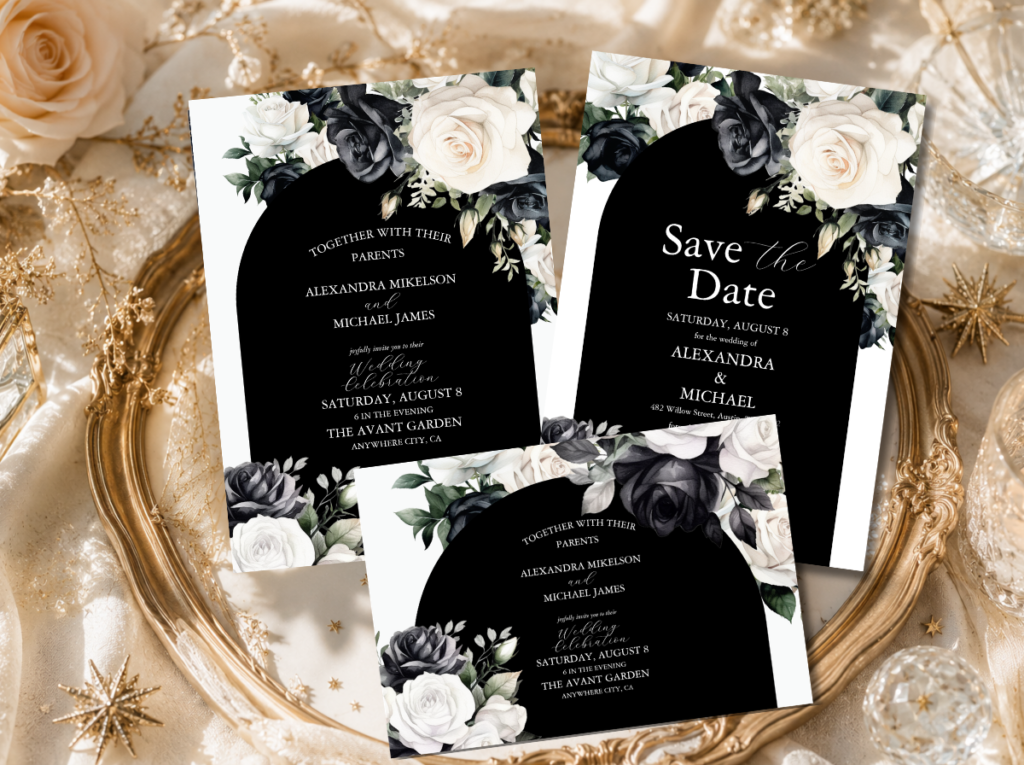
The Minimalist Wedding category carries the satin column gown’s architectural restraint into the stationery suite — clean typography and restrained design for the bride whose dress makes its statement without ornament.
2.2 The Crepe Minimalist Gown
The Crepe Minimalist Gown is the most architectural and the most structurally self-sufficient of the six minimalist silhouettes — crepe is the fabric that does the most work without being seen to do it. Unlike satin, which announces its presence in every light and with every movement, crepe is matte and structured: it holds its shape without boning or internal structure, it resists the body’s movement rather than conforming to it, and it photographs in a specific quality of clean, shadowless matte that is the most editorial of any bridal fabric. The crepe gown reads as modern in a way that satin does not — its structured surface and its refusal of ornamentation belong to the visual language of contemporary architecture and contemporary fashion rather than to the bridal tradition.
The specific structural possibilities of crepe that make it the most interesting minimalist fabric: because it holds its shape without support, crepe can be used in architectural details that other fabrics cannot sustain without internal boning — a structured square neckline that sits perfectly without adjustment; a dramatic off-shoulder line that stays in position without strapless boning; a high-low hem that maintains its geometry through a full day of movement. These structural possibilities are what make crepe the most editorial bridal fabric: its architecture is the dress’s own, and each structural decision is visible and intentional rather than concealed within the construction.
The crepe gown is most appropriate for indoor venues with clean architecture — white gallery spaces, modern event venues, historic stone interiors — where the matte quality of the fabric photographs best in the available light. Crepe in direct outdoor sunlight has a different quality than crepe in the ambient indoor light for which it is most specifically beautiful: the indoor-outdoor decision is worth factoring into the fabric choice if the dress will be photographed significantly in both environments. For a primarily outdoor celebration, liquid satin or chiffon may produce more naturally luminous photographs; for a primarily indoor celebration, crepe’s matte structure is the most specifically beautiful fabric choice.
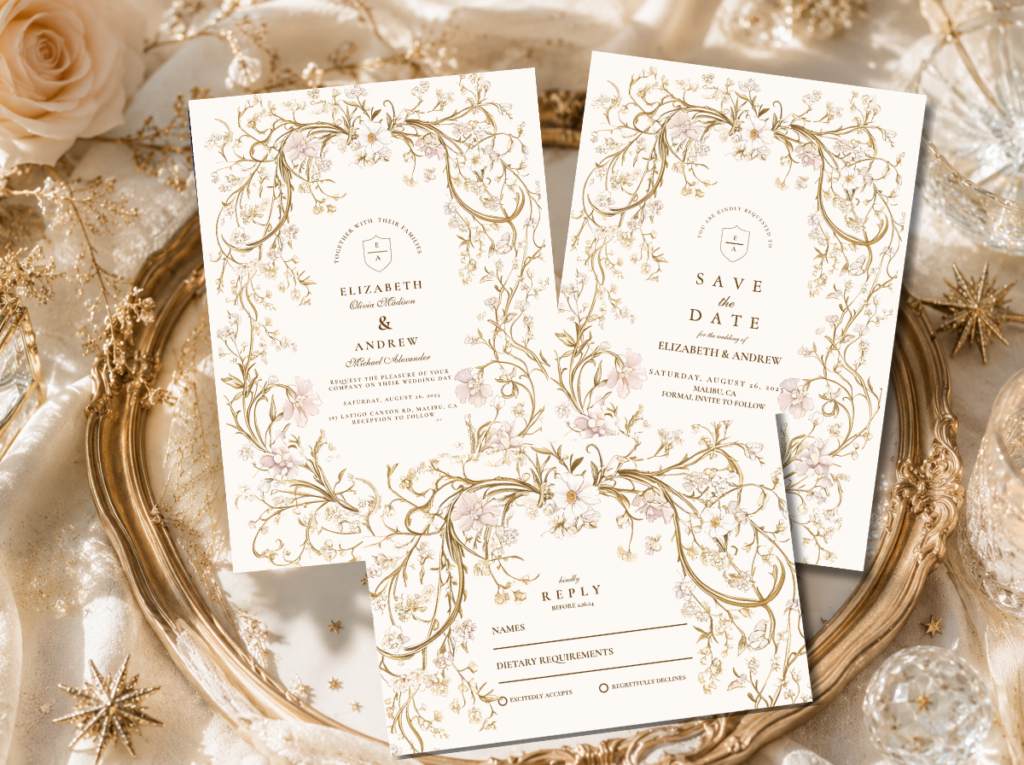
The Romantic Vintage Gold Floral Frame collection pairs with the crepe minimalist gown’s architectural restraint — one carefully chosen ornamental detail (the vintage gold frame) beside the dress that needs only the same: one perfect detail, nothing more.
2.3 The Slip Dress
The Slip Dress is the most effortlessly beautiful and the most specifically zeitgeist-connected of the six minimalist silhouettes — it references the specific aesthetic moment of the mid-to-late 1990s, when the slip dress was the most desirable garment in fashion, and translates that reference into a bridal context with the understanding that what the 1990s valued (the effortless, the unconstructed, the intimate and personal rather than the formally bridal) is exactly what the 2026 quiet luxury bride also values. A bridal slip dress — delicate spaghetti straps, fluid liquid fabric (satin, silk, or charmeuse) falling in the body’s natural line to the floor or the mid-calf, with no structure and no embellishment — is not trying to be a wedding dress: it is trying to be the most beautiful garment the bride has ever worn, and the wedding happens to be the occasion.
The specific qualities of the slip dress that make it the most effortlessly photogenic of the six minimalist silhouettes: it moves constantly with the body’s movement, which means every photograph captures a slightly different version of the same dress — the fabric in a different arrangement, the straps at a slightly different angle, the hem in a different relationship to the floor. This constant movement produces a quality of liveliness in photographs that more structured silhouettes cannot match, and it means the slip dress is never the same dress twice in any sequence of images. The delicacy of the straps against the bare shoulder is one of the most specifically beautiful close-up bridal details available in the minimalist wardrobe.
Styling the slip dress for maximum elegance: the slip dress’s effortlessness is its defining quality and the quality most easily undermined by over-styling. The most elegant version of the slip dress is the least styled: hair sleek and low or simply worn down in its natural state; jewellery at its most minimal (a delicate chain, a single stud, or nothing at all); shoes in the simplest clean-lined format (a barely-there heel or a clean block heel, nothing embellished); and a bouquet of one variety or no bouquet at all. The slip dress is already everything; it requires nothing further to be beautiful.
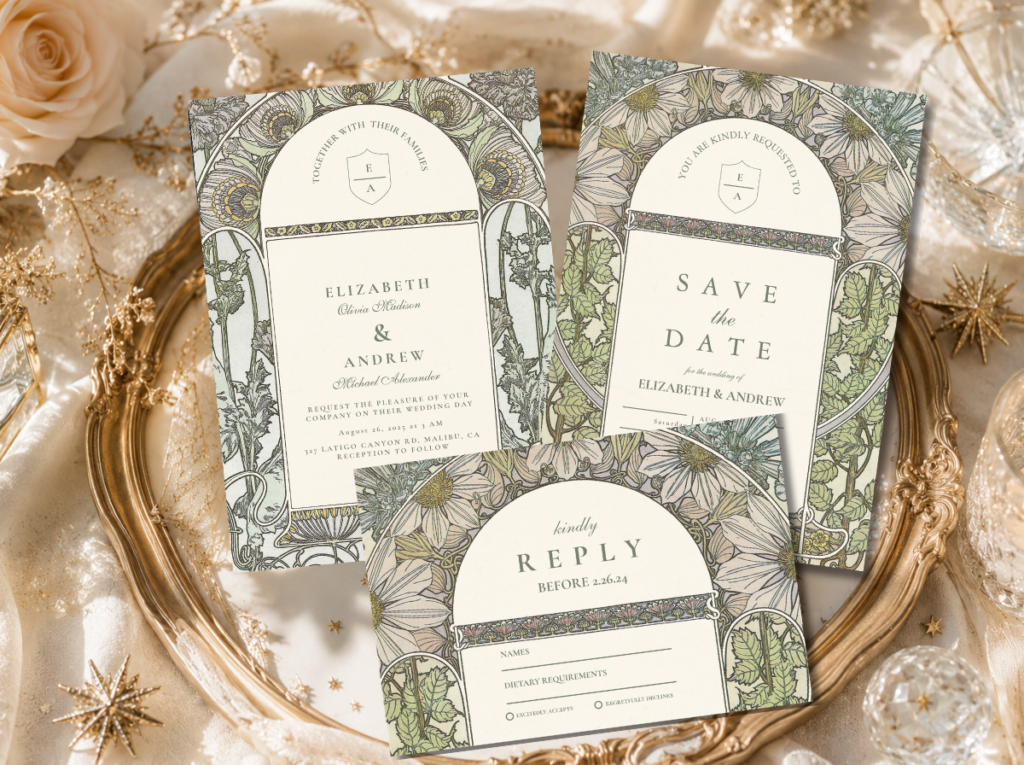
The Vintage Garden Arch collection pairs with the slip dress’s effortless romanticism — the botanical abundance of the arch in the stationery providing the lush, organic backdrop that the slip dress’s fluid simplicity reads against most beautifully.
2.4 The A-Line Minimalist Gown
The A-Line Minimalist Gown is the most universally flattering and the most broadly accessible of the six minimalist silhouettes — it is the dress that works most naturally for the widest range of body types, because the A-line silhouette (fitted through the bodice and waist, flaring gradually from the hips to the hem in a gentle triangular shape) is the most inherently balanced of all bridal silhouettes. The minimalist A-line is an A-line that has been stripped of its conventional ornament: no lace overlay, no beading at the bodice, no tulle underskirt volume, no structured belt — only the clean geometry of the silhouette itself, in a quality fabric that communicates the same restraint through its surface as the silhouette communicates through its form.
The fabric choice for the A-line minimalist gown is the decision that most significantly determines its character: crepe in an A-line produces a structured, architectural dress whose geometry is precise and whose line from waist to hem falls cleanly without movement; satin in an A-line produces a dress with the same geometry but a quality of luminosity and movement that softens the architectural precision; chiffon in an A-line produces the most romantic and the most floaty version of the silhouette, suitable for outdoor and garden settings where the fabric’s movement in any breeze is part of the aesthetic. The same silhouette in three different fabrics produces three different minimalist dresses, and the fabric choice should be the primary decision after the silhouette is confirmed.
The A-line minimalist gown photographs most beautifully in three specific moments: the full-length shot from a slight distance, where the geometry of the silhouette is most visible; the close-up portrait, where the quality of the fabric and the precision of the bodice line dominate; and the candid from behind, where the train or hem creates the most visually dramatic version of the silhouette against the setting. Briefing the photographer to capture these three specific compositions produces the most complete photographic record of the A-line minimalist gown’s specific qualities.
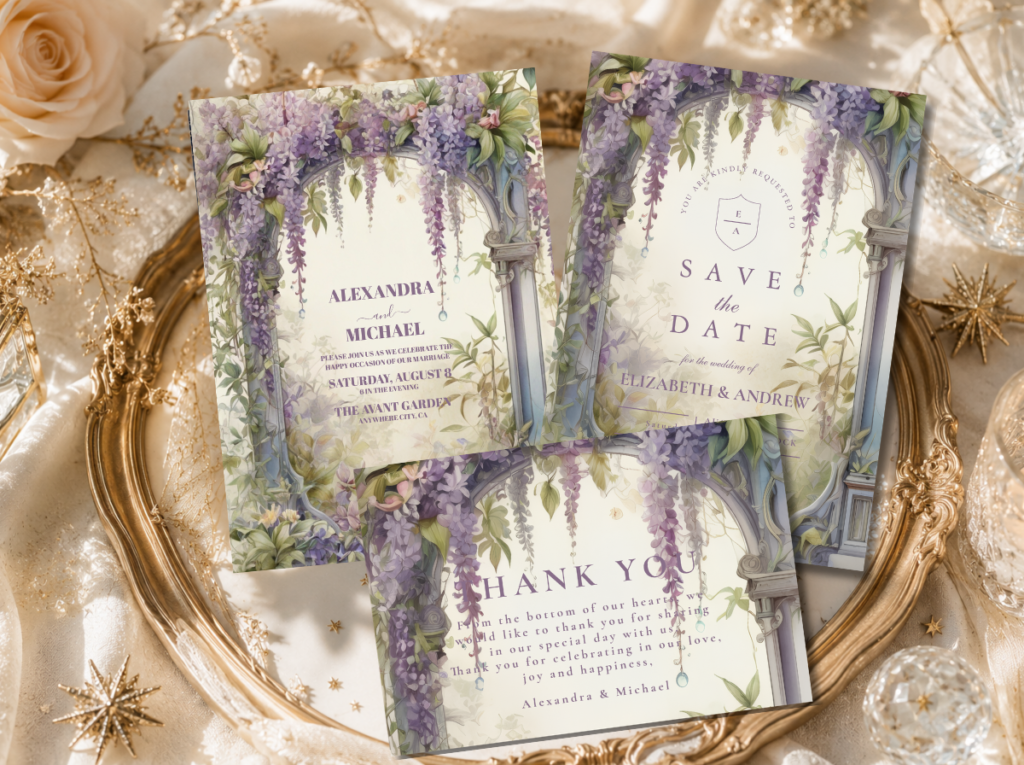
The Wisteria Arch Botanical collection pairs with the A-line minimalist gown’s balanced elegance — the cascading botanical arch of the stationery providing the organic abundance that frames and completes the gown’s clean geometry.
2.5 The Minimalist With One Detail
The Minimalist With One Detail is the most conceptually interesting of the six minimalist silhouettes — it takes the minimalist philosophy and applies it at the level of the single addition: everything about the dress is restrained except for one specific, carefully chosen detail that is allowed to be itself without compromise. The one detail can be structural (a dramatically oversized bow at the back that creates a sculptural element visible only from behind, while the front of the dress is completely plain); neckline-focused (a deeply plunging V-neck that is the dress’s entire statement, with everything else straight, clean, and without embellishment); or subtly textile (a single narrow panel of botanical lace at the hem or the neckline edge — one textile element, not lace overlay, but one strip of genuinely beautiful lace used exactly and only where it is allowed to be seen in its best version).
The principle that governs the Minimalist With One Detail is the principle of the single element earning its inclusion: the detail chosen must be genuinely beautiful, specifically appropriate to the dress’s overall form, and placed where it is most visible and most effective rather than where it is most conventional. A bow at the back of a dress is conventionally placed; a large structural bow at the front waist or at the shoulder, where it is the dress’s primary visual element in every frontal portrait, is less conventional and more specifically minimalist in its willingness to commit entirely to one thing. The detail should be chosen with the same deliberateness as the dress itself: not the most available decoration but the one specific addition that makes this specific dress more completely itself.
The Minimalist With One Detail is the most appropriate of the six silhouettes for brides who want the minimalist aesthetic but whose personal sense of celebration requires one specific element of beauty or sentimentality — a piece of grandmother’s lace, a fabric that references a specific cultural tradition, a structural element that has personal significance. The minimalist dress accommodates one such element with grace, because the surrounding restraint gives it the space to be genuinely seen.
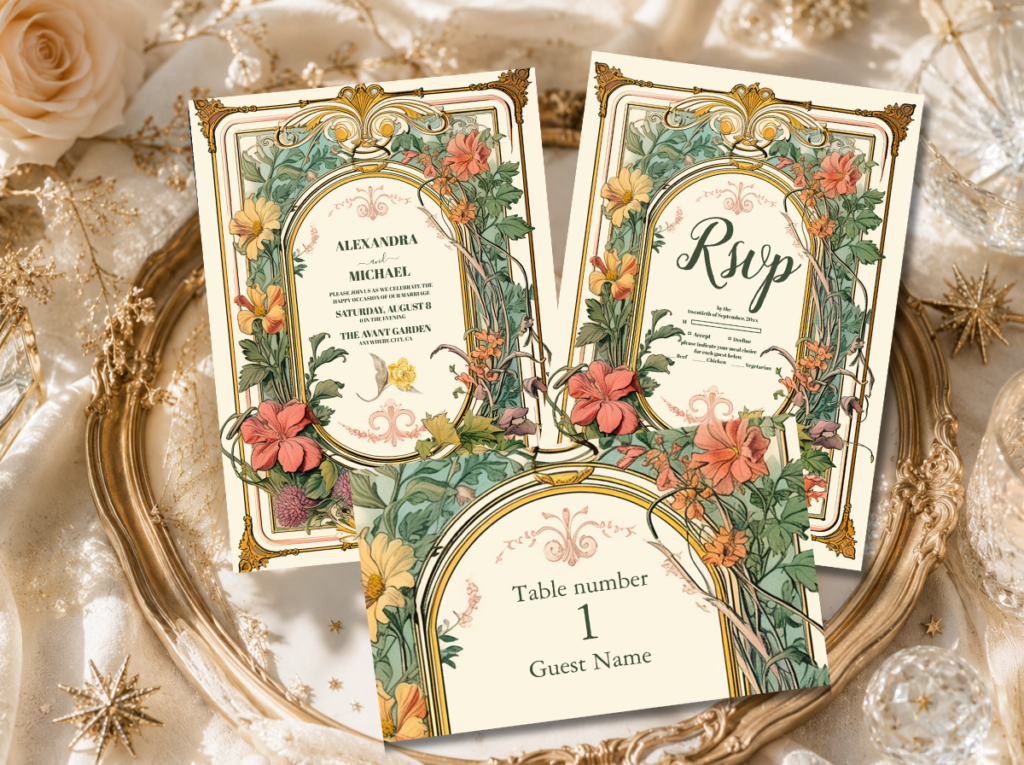
The Olive Green Vintage Floral Art Nouveau collection pairs with the Minimalist With One Detail — the stationery’s own approach is the same: one distinctive botanical detail in Art Nouveau line-work, everything else restrained, the single element given full visual space.
2.6 The Woodland Minimalist Gown
The Woodland Minimalist Gown is the most organically grounded and the most setting-specific of the six minimalist silhouettes — it is the dress that belongs in a forest, on a path through autumn trees, in a clearing where the light comes through the canopy in the specific dappled quality of a woodland midday. The Woodland Minimalist Gown achieves its beauty through the specific relationship between the dress and its setting: a flowing chiffon or soft crepe gown in warm ivory or the specific warm cream of aged linen, moving in any breeze, catching the dappled forest light in the specific way that gauzy organic fabric catches light, and reading as belonging to the natural world rather than as placed within it.
The specific silhouette qualities that make a gown most suited to the woodland setting: flow rather than structure (because the forest is organic and moving, and the dress that belongs in it should share those qualities rather than contrast with them through architectural rigidity); warm ivory or deep cream rather than bright white (because the tonal quality of the forest — warm amber, deep green, the specific warm brown of bark and earth — reads as continuous with warm ivory and as contrasting with bright white in a way that reduces rather than enhances the visual harmony of the setting); and minimal embellishment so that the forest light is the primary visual element of the photograph rather than the dress’s surface decoration.
The Woodland Minimalist Gown is most photogenic at three specific moments of the day: at dusk, when the low warm light of the setting sun filters through the tree canopy and the dress catches it in the specific amber quality of the woodland golden hour; in the specific quality of overcast daylight that woodland settings often have, which is the most flattering and the most completely beautiful of all photography light for gauzy or softly textured fabrics; and at the moment the breeze moves the fabric, which is the Woodland Minimalist Gown’s most specifically beautiful photographic moment.
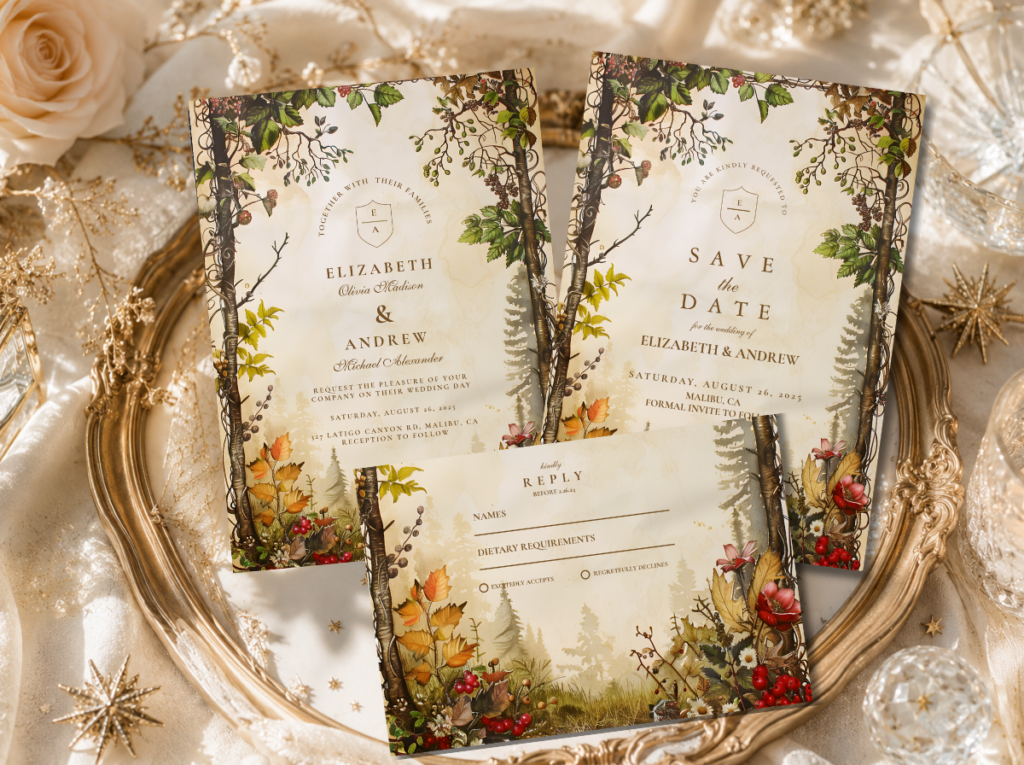
The Woodland Fall Forest collection pairs with the Woodland Minimalist Gown most naturally — natural woodland illustration in autumn forest tones, for the bride and the stationery suite that both belong to the same organic world.
Section 03 Minimalist Wedding Dress Fabrics
The fabric is the most important decision for the minimalist bride — more important than the silhouette, more important than the neckline, more important than any structural detail — because in a minimalist dress the fabric is the primary visual element. A well-cut column gown in a mediocre satin reads as a mediocre dress; the same silhouette in a genuinely beautiful heavy satin reads as a genuinely beautiful dress. The following five fabrics cover the range of minimalist bridal choices.
Satin
Character: Liquid, dramatic, luminous. The most glamorous minimalist fabric.
How it photographs: Exceptionally — catches and reflects light in a specific warm way that makes every photograph luminous. The fabric creates its own ambient warmth.
Best silhouettes: Column gown (bias or straight), slip dress, A-line. Any silhouette that benefits from the fabric’s own movement.
Season: Most effective in autumn and winter when the warm light quality of indoor photography enhances the satin’s luminosity. Beautiful outdoors at golden hour in any season.
Crepe
Character: Structured, matte, architectural. The most modern minimalist fabric.
How it photographs: Cleanly and consistently — the matte surface holds its quality across lighting conditions and does not require the specific warm light that satin needs to look its best.
Best silhouettes: Column gown (straight cut), A-line, any structured form with architectural necklines or shoulder lines.
Season: Works across all seasons but is most specifically beautiful indoors — for outdoor celebrations, crepe’s lack of reflectivity can read as slightly flat in bright daylight.
Chiffon
Character: Flowing, romantic, weightless. The most organic minimalist fabric.
How it photographs: Best in movement and natural light — chiffon is the fabric most transformed by a breeze and most luminous in the specific quality of outdoor natural light.
Best silhouettes: A-line, Woodland Minimalist, slip dress. Any silhouette that benefits from movement and flow.
Season: Spring and summer outdoors for the most naturally beautiful results; also effective indoors with careful lighting.
Silk
Character: The quietest luxury. Silk is the fabric whose quality is most immediately apparent to touch and least immediately apparent to the uninformed eye — which is the definition of quiet luxury.
How it photographs: Like satin with more warmth and more variation — silk has the specific quality of a living surface that responds differently to different light sources.
Best silhouettes: Any — silk in various weights (charmeuse, duchess, habotai) suits every minimalist silhouette.
Season: All seasons; specific weights of silk suit different temperatures — silk charmeuse for summer warmth, duchess satin weight for winter.
Jersey
Character: Modern, body-conscious, effortless. The most contemporary minimalist fabric.
How it photographs: Best in movement and in the specific editorial quality of strong directional light — jersey reads as fashion-forward and modern in every setting.
Best silhouettes: Column gown (body-conscious version), slip dress. Silhouettes that benefit from the fabric’s stretch and body-skimming quality.
Season: Most appropriate for warm weather celebrations and for brides who want maximum ease of movement throughout the day.
Section 04 Minimalist Bridal Accessories
Each accessory decision defines the minimalist bridal aesthetic as much as the dress itself. The principle is constant: one thing, chosen well, given the visual space to be seen.
Jewellery — The One Piece Rule
The minimalist bride wears one piece of jewellery. Not one type — one piece. A single pair of earrings (stud, small drop, or delicate hoop) with no necklace and no bracelet; or a delicate necklace (a single fine chain with or without a pendant, chosen for its specific quality rather than its decorative effect) with no earrings and no bracelet; or a single delicate bracelet or bangle with no other pieces. The one piece rule is not an arbitrary constraint — it is the recognition that jewellery in a minimalist bridal look is the detail that either completes the dress or competes with it, and that more than one piece of jewellery almost always produces competition rather than completion. The single earring trend — one statement earring on one side — is the one exception to the one piece rule that is specifically minimalist rather than simply unconventional.
Veil — Plain or None
The minimalist veil is a plain cathedral or floor-length veil with a simple edge — no lace border, no embroidery, no tier — in the specific weight of tulle that falls cleanly rather than in a stiffened style. The plain cathedral veil in soft tulle is one of the most specifically beautiful minimalist bridal accessories: it adds length, movement, and the specific bridal quality of a veil to a clean dress without adding any decoration that the dress does not already carry. For the most committed minimalist, no veil at all is the most consistent choice — and the bride who wears no veil with a beautifully cut minimalist dress communicates the same confidence as the dress itself: that the form is complete, and nothing is missing.
Shoes — The Clean Heel
The minimalist bridal shoe is defined by its absence of embellishment: no rhinestones, no bow, no floral appliqué, no ankle strap with decorative hardware. A clean pointed-toe court shoe in white, ivory, or warm nude satin or leather; a simple block heel in the same materials; or a clean barely-there sandal with minimal strapping. The shoe should be in the same temperature as the dress — warm ivory with warm ivory satin, cool white with cool white crepe — rather than contrasting with it in tone or in embellishment level. A clean heel with a beautifully made minimalist dress is photographically invisible in the best possible way: it provides the necessary height and proportion without drawing attention from the dress itself.
Hair — The Minimalist Updo
The minimalist bridal hairstyle is the most considered and least effortful-appearing of all bridal styling decisions: the sleek low chignon (hair gathered smoothly at the nape of the neck with no loose pieces and no flyaways, secured with minimal visible pins); the centre-parted smooth low ponytail; or the straight hair worn fully down in its most polished natural state (not blow-dried in waves, not curled at the ends — straight and smooth, with a centre or slightly off-centre part). The defining quality of the minimalist updo is its lack of loose pieces: the tendrils and face-framing pieces that soften most bridal hairstyles are specifically un-minimalist, because they add visual complexity at exactly the facial level where the minimalist aesthetic most requires clarity.
Bouquet — One Variety or None
The minimalist bouquet is one variety of flower, held at medium density without structural framing — twenty white anemones, or thirty white tulips, or a cluster of fully open white garden roses, each one chosen for its specific quality of whiteness or warmth. Alternatively: a single large stem held in one hand (a single white anthurium, a branch of white cherry blossom, a single large peony at its most fully open). Or: no bouquet at all, with the hands free and the dress as the complete visual statement. The decision between these three options should be made based on the specific dress: the satin column gown often photographs most beautifully with no bouquet or a single stem; the A-line minimalist gown is most balanced with a medium-density single variety bouquet; the woodland minimalist gown is most natural with a loose bundle of single-variety greenery or no bouquet.
Every accessory decision in the minimalist bridal look should be echoed in the stationery — the same restraint, the same quality, the same intention. The invitation that arrives before the wedding sets the expectation; the dress that appears on the day fulfils it. Both should communicate the same philosophy.
Section 05 Minimalist Wedding Dress by Season
Spring & Summer Minimalist
Spring and summer are the seasons most aligned with the slip dress and the chiffon minimalist silhouette — because the warmth of these seasons is compatible with the delicacy of light fabrics and bare skin, and because outdoor spring and summer photography provides the natural light quality in which slip dresses and chiffon gowns photograph most beautifully. The spring and summer minimalist dress should be in the lightest fabric appropriate to the silhouette: silk charmeuse for the slip dress (the specific warm quality of charmeuse catches spring and summer golden hour light in a way that heavier satins do not); chiffon for any A-line or flowing silhouette; and the lightest available crepe for any structured silhouette worn in warmer temperatures.
The colour consideration for spring and summer minimalist dresses: bright white photographs cleanly in the high-contrast light of summer but reads as slightly cold in the warmer qualities of spring and golden hour light; warm ivory and cream read as luminous and warm in any natural light quality and are the more versatile choice for outdoor celebrations that will be photographed across a range of light conditions through the day.
Autumn Minimalist
Autumn is the season most aligned with the satin column gown and the A-line minimalist dress in its richest fabric interpretation — because the warm amber light quality of autumn (both natural daylight and the candlelit indoor light of evening autumn celebrations) is the light most specifically beautiful in which satin reads as genuinely luminous. The warm tone of autumn light enhances the warmth of ivory satin in a way that the cool quality of summer daylight does not, and the specific ambient quality of a candlelit autumn reception — warm, rich, directional — is the most specifically flattering light for a liquid satin gown.
The fabric choice for the autumn minimalist dress: heavy duchess satin for the most dramatically luminous autumn photograph; silk charmeuse for the most romantic and warmly liquid autumn silhouette; and structured crepe for the most architecturally specific autumn wedding in an interior venue with carefully designed lighting.
Winter Minimalist
Winter is the season most aligned with the crepe minimalist gown — because the cool, clean quality of crepe’s matte surface reads as specifically appropriate for the cool, clean visual quality of winter celebrations. A structured crepe gown with a square neckline or a dramatic off-shoulder line, photographed in the candlelit quality of a winter indoor celebration or in the specific pale grey quality of winter exterior light, is the most specifically winter minimalist bridal image available. The long sleeves in crepe — a fitted long sleeve that ends at the wrist in the specific clean line of a well-made crepe sleeve — is the most winter-appropriate minimalist bridal detail, adding warmth practically and adding structural interest architecturally without adding decoration.
For the winter outdoor ceremony: a draped crepe coat or a structured long-line blazer in a matching ivory or warm white crepe, worn over the dress for the exterior photographs and removed for the interior reception, is the most specifically minimalist layering solution for cold weather celebrations.
Section 06 Dress & Stationery Coherence
The minimalist bride’s stationery choice is as important as her dress choice — and for the same reason: both communicate the same philosophy. The dress says “I have chosen quality and precision over decoration and display”; the invitation should say exactly the same thing. A minimalist bride who chooses a maximally decorated invitation has created an incoherence in the aesthetic statement of her wedding — not because the invitation is wrong in itself, but because it communicates a different philosophy from the dress, and the inconsistency is visible in every photograph where the two appear together.
The two most photographed minimalist wedding details are the dress and the stationery: the dress in every ceremonial and portrait photograph, the stationery in every flat lay and detail photograph. The flat lay of the minimalist wedding — the invitation suite on a clean surface, beside the dress fabric, beside the single-stem bouquet — is the most specifically edited and the most specifically beautiful of all wedding flat lay photographs when executed correctly, because the restraint of each element gives every other element the visual space it needs to be seen. A botanical invitation suite of the correct temperature and illustration quality beside a section of ivory satin beside a white anemone creates a flat lay that communicates the entire philosophy of the minimalist wedding in a single composed image.
The stationery collection most aligned with the minimalist dress should share the dress’s specific quality register: for the satin column gown in warm ivory, a stationery suite in warm ivory stock with one gold botanical detail — the Romantic Vintage Gold Floral Frame is the most specifically appropriate; for the crepe architectural gown, the Minimalist Wedding category’s clean typographic suites; for the slip dress’s effortless romanticism, the Vintage Garden Arch or Wisteria Arch Botanical botanical arch collections. The matching principle is temperature and illustration register rather than a direct visual correspondence: the stationery and the dress should belong to the same visual world, not reproduce each other.
Browse all seven stationery options below before choosing — the most important selection criterion is that the stationery’s warmth and illustration register should match the dress’s own warmth and the wedding’s specific aesthetic direction. A stationery choice that reads as from the same designed world as the dress is the one that will produce the most complete and the most photographically coherent minimalist wedding.
Satin Column & Slip
Minimalist Wedding
Clean Typographic
Clean typography and deliberate white space — the stationery most aligned with the satin column and crepe gown’s own architectural restraint.
Crepe & One Detail
Romantic Vintage Gold Floral Frame
One Gold Detail
Ornate gold frame as the single decorative element — the stationery equivalent of the Minimalist With One Detail dress philosophy.
Slip & Garden
Vintage Garden Arch
Romantic Botanical
A sweeping botanical arch in warm vintage tones — romantic enough for the slip dress’s effortless romanticism.
A-Line & Botanical
Wisteria Arch Botanical
Cascading Botanical
Cascading wisteria detail — the organic botanical abundance that frames the A-line minimalist gown most beautifully.
Distinctive Detail
Olive Green Vintage Floral Art Nouveau
Art Nouveau Distinctive
One botanical detail in Art Nouveau line-work — for the dress that allows one specific thing its full visual space.
Woodland Gown
Woodland Fall Forest
Woodland Natural
Natural woodland illustration in autumn forest tones — the stationery that belongs to the same organic world as the woodland minimalist gown.
All Florals
Floral Wedding
Botanical Floral
The full botanical floral stationery category — for the minimalist bride who wants one beautiful botanical element in the printed layer of her celebration.
Related Planning Guides
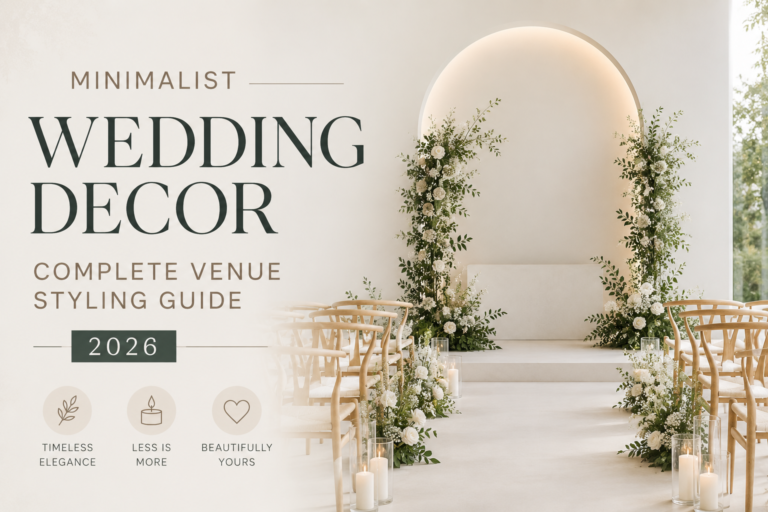
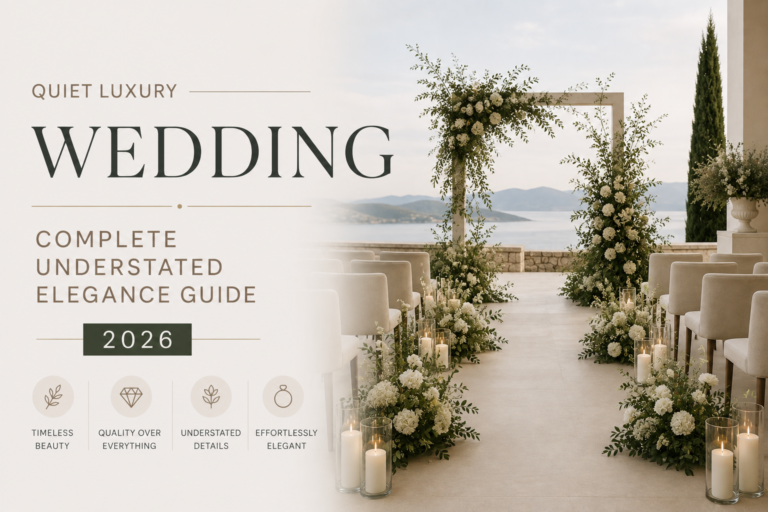
The complete minimalist wedding planning guides — decoration, stationery, and the buying frameworks for both.
Minimalist Guide
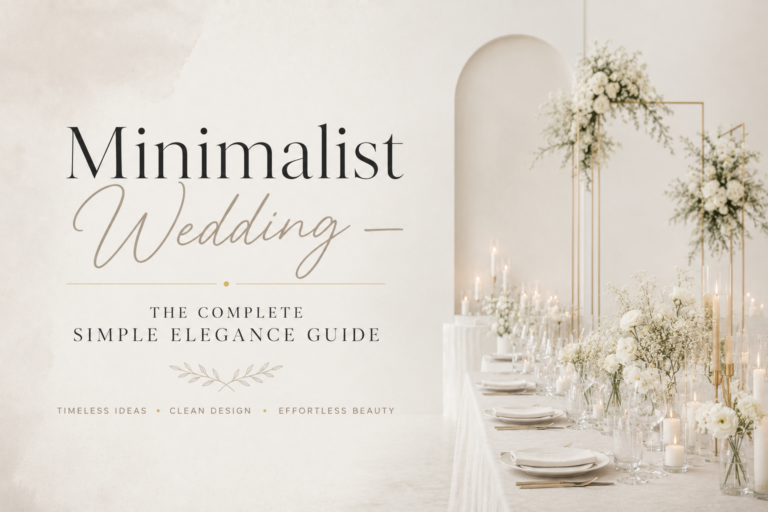
Minimalist Wedding — The Complete Simple Elegance Guide
Five minimalist aesthetics, five palettes, venue and ceremony guidance, table styling, florals, and the complete stationery guide for the minimalist celebration.
Stationery Guide
Elegant Wedding Invitations — Complete Style & Stationery Guide
Six elegant invitation styles and the nine-collection showcase — the complete guide to choosing stationery that reads as genuinely intentional.
Checklist
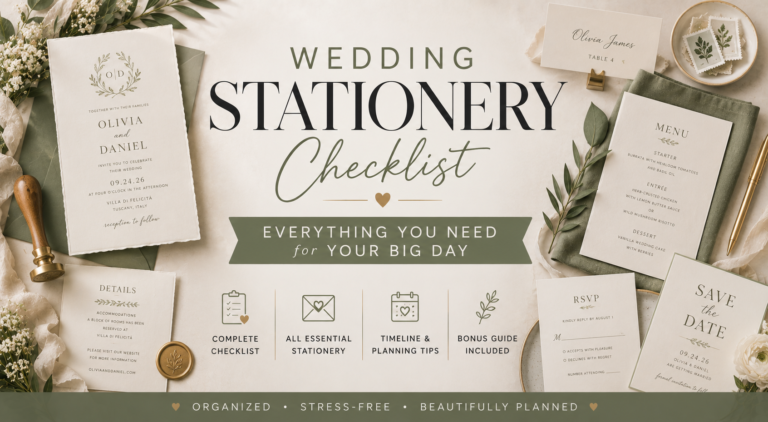
Wedding Stationery Checklist — Everything You Need
15 stationery pieces explained with what to include, when to order, and which are essential vs optional.
Frequently Asked Questions
What fabric is best for a minimalist wedding dress?
The fabric choice is the most important decision for the minimalist bride, because in a minimalist dress the fabric is the primary visual element rather than the decoration. The five main minimalist fabrics each suit a different aesthetic direction: satin is the most glamorous and the most luminous — it catches and returns light in a specific warm way that makes every photograph luminous, and it is the most iconic minimalist bridal fabric; crepe is the most architectural and the most modern — its matte, structured surface holds its shape without boning and reads as specifically contemporary; chiffon is the most flowing and the most romantic — the most organic of the five, best in movement and natural light; silk (in its various weights from charmeuse to duchess) is the quietest luxury fabric — its quality is most immediately apparent to touch and most specifically beautiful in any light; and jersey is the most modern and body-conscious — the most comfortable and the most fashion-forward. The fabric choice should be made alongside the silhouette choice: satin suits column and A-line silhouettes; crepe suits structured architectural forms; chiffon suits flowing A-line and woodland gowns; jersey suits body-conscious column forms.
What accessories suit a minimalist bridal look?
The minimalist bridal accessory approach follows one principle: one piece, chosen well, given the visual space to be seen. For jewellery: one piece only — a single pair of earrings, a delicate necklace, or a simple bracelet, never combined. For the veil: plain cathedral or floor-length in soft tulle with no lace border or embroidery, or no veil at all. For shoes: a clean pointed court shoe or simple block heel in white, ivory, or warm nude satin or leather, with no embellishment. For hair: the sleek low chignon, the straight centre-parted low ponytail, or hair simply worn straight and smooth — with no loose pieces or face-framing tendrils. For the bouquet: one variety of flower at medium density, a single large stem, or no bouquet. The underlying principle: the minimalist bride’s accessories should complete the dress without competing with it, and each accessory decision should be made with the same deliberateness as the dress itself.
Can a minimalist wedding dress have some detail?
Yes — the Minimalist With One Detail silhouette is one of the six minimalist dress styles in this guide, and it is the approach that applies the minimalist philosophy at the level of the single addition: one specific, carefully chosen detail that is allowed to be itself without compromise, with everything else remaining completely restrained. The detail can be structural (an oversized sculptural bow at the back, or a dramatically plunging V-neck), neckline-focused (an off-shoulder line, a cowl drape, a square neckline as the dress’s sole statement), or subtly textile (a single narrow panel of genuinely beautiful lace at the hem edge, not lace overlay but one specific element used exactly where it is most effective). The principle governing the one detail is that it must earn its inclusion: it must be the detail that makes the dress more completely itself rather than the detail that has been added to make the dress more conventionally bridal. One thing, chosen well, given full space to be seen — this is minimalism with a detail, not a departure from minimalism.
What shoes work with a minimalist wedding dress?
The minimalist bridal shoe shares the dress’s defining quality: the complete absence of embellishment. A clean pointed-toe court shoe in white, ivory, or warm nude satin or leather; a simple block heel in the same materials; a clean barely-there strappy sandal with minimal hardware; or a simple pointed kitten heel for the bride who wants modest height with complete elegance. All of these are correct minimalist bridal shoes; the choice between them should be based on practical comfort (the court shoe and block heel are most comfortable for long days; the barely-there sandal is most summer-appropriate; the pointed court shoe is the most formally elegant) and the specific dress silhouette (a very long train benefits from a pointed shoe that visibly extends the leg line in full-length photographs; an above-the-floor hem benefits from the shoe being partially visible, making the shoe’s own form more important). Bright white leather reads as the most modern; warm ivory satin reads as the most romantic; nude leather or satin reads as the most elongating and the most broadly flattering.
How do I match my minimalist dress to my wedding stationery?
The matching principle for minimalist dress and stationery is temperature and illustration register rather than visual correspondence: the stationery should belong to the same visual world as the dress rather than reproduce it. A warm ivory satin column gown reads most naturally beside stationery in warm ivory stock with one warm gold botanical detail — the Romantic Vintage Gold Floral Frame collection is the most specifically aligned. A crepe architectural gown reads most naturally beside clean typographic stationery with minimal illustration — the Minimalist Wedding category. A slip dress’s effortless romanticism reads most naturally beside the Vintage Garden Arch or Wisteria Arch Botanical botanical arch collections. The Woodland Minimalist Gown reads most naturally beside the Woodland Fall Forest collection. The Minimalist With One Detail reads most naturally beside the Olive Green Vintage Floral Art Nouveau collection’s own one-detail approach. In all cases, check that the palette temperature is consistent: warm ivory dress beside warm ivory invitation stock; the gold metallic in the stationery should be the same warmth as the metallic the dress would wear if it wore any. The flat lay photograph of stationery beside dress fabric and single-stem bouquet is the best test of whether the match is correct.
Complete Your Minimalist Bridal Look
Shop the Stationery That Matches Your Dress
Restrained botanical elegance — fully customisable with your names, date, and wedding details.