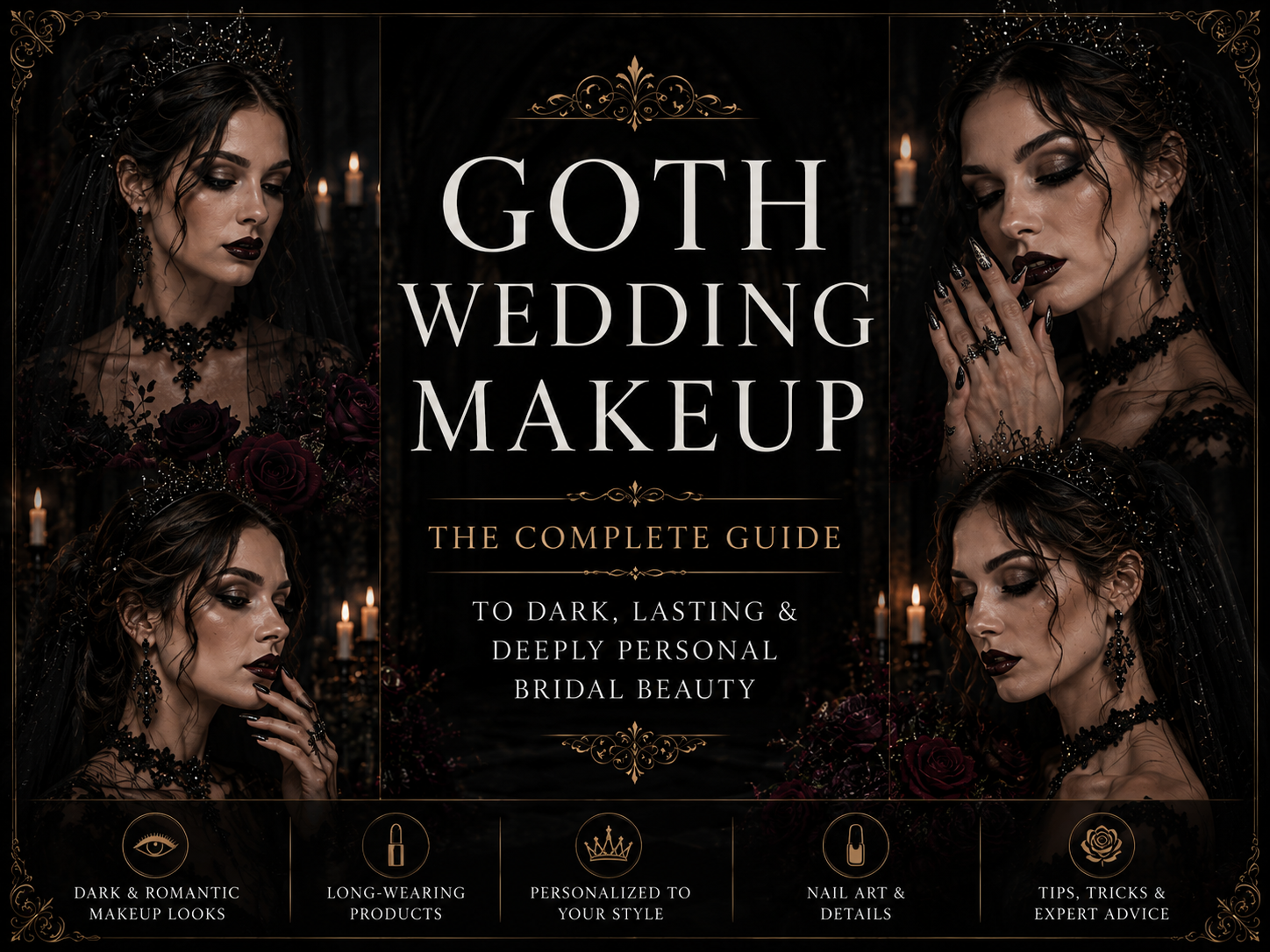
Goth Wedding Makeup – The Complete Guide to Dark, Lasting & Deeply Personal Bridal Beauty
The Gothic Bridal Edit · 2026
Goth Wedding Makeup
The Complete Guide to Dark, Lasting & Deeply Personal Bridal Beauty
From near-black lips and smoky eyes to pale editorial skin and dark romantic looks — your definitive guide to goth wedding makeup in 2026, including how to find the right artist, make it last, and photograph beautifully in dark and candlelit spaces.
Introduction
Why Goth Wedding Makeup Requires a Completely Different Approach From Conventional Bridal Beauty
The conventional bridal makeup brief is well understood and consistently applied across most of the wedding industry: dewy, natural skin, soft flush, defined lashes, a nude or pink lip, and a look that reads as a heightened, polished version of the bride’s everyday face. This brief is not wrong. It produces beautiful results for the brides it is designed for. But it is entirely wrong for the goth bride — and the most common mistake in goth bridal makeup is applying the conventional bridal brief to a dark aesthetic context and hoping the darkness of the dress will compensate for the ordinariness of the face above it. It will not. The goth wedding look is complete only when the face and the gown are speaking exactly the same language.
Goth wedding makeup in 2026 covers an extraordinary range of approaches — from the most classically gothic (pale skin, dark smoky eye, near-black lip) to the more subtly personal (perfect skin in the bride’s natural tone, a single deep berry lip, nothing else). What all of these approaches share is intentionality. A deliberate, considered relationship between the face and the dress. A specific creative vision for how the total bridal look reads — not just in person but in the photographs taken in the specific lighting conditions of a dark, candlelit, gothic celebration. And a makeup artist, or a self-taught skill level, that can execute that vision with the precision and the staying power that a twelve-hour wedding day demands.
This guide covers the full landscape of goth wedding makeup in 2026 — from the ten defining looks and their execution, through skin preparation and base techniques, eye and lip approaches, the specific considerations of dark makeup in low-light photography, finding and briefing the right makeup artist, and everything you need to know to arrive at your wedding morning with complete clarity about exactly what is going to happen to your face and exactly why.
The Edit
10 Goth Wedding Makeup Looks for 2026
Each of these ten looks represents a distinct creative direction — a complete aesthetic approach to goth bridal makeup that can be adapted to different skin tones, face shapes, and levels of makeup experience. Read each as a starting point for a conversation with your makeup artist and for your own planning, and notice which one resonates most instinctively with who you are and how you want to look on your wedding day.
01
The Classic Gothic
The most historically faithful and most immediately recognisable goth bridal makeup look: a flawless, porcelain-pale foundation in the coolest tone the skin can carry, a deeply pigmented smoky eye in black and dark plum blended into the crease and smoked beneath the lower lash line, a bold defined brow, and a near-black or very deep wine lip with a precise edge. The skin should read as luminous rather than flat — a subtle highlighter on the cupid’s bow, the inner corner of the eye, and the highest point of the cheekbone adds dimension without warmth. This look requires the most technical precision of all the options on this list and the most experienced makeup artist — every element must be executed cleanly or the overall effect reads as costume rather than beauty. When it is right, it is extraordinary.
02
The Dark Romantic
A soft, dewy, naturally flushed skin base — in the bride’s actual skin tone, not paled down — with a warmly blended smoky eye in dark burgundy, deep plum, and brown-black. The eye is smoked and blended rather than sharply defined, with the colour concentrated at the outer corner and fading toward the inner corner. The lip is a deep berry or oxblood — highly pigmented but softly applied, blotted to remove any harshness of edge. This is the most romantically flattering of all goth bridal looks and the one that reads most naturally as genuinely bridal to the widest audience — it says dark and beautiful rather than dark and dramatic, and it photographs with extraordinary warmth in candlelight.

03
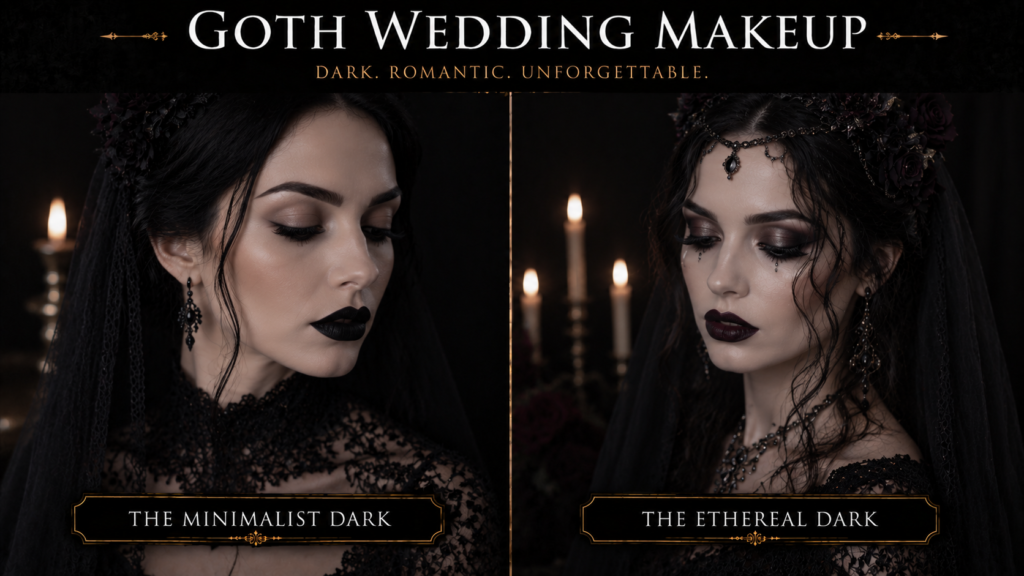
The Minimalist Dark
Perfect, poreless skin in the bride’s natural tone — a flawless base with no obvious colour added, no blush, no warmth, no shimmer. A graphic black liner wing — precise, architectural, either a sharp classic flick or a dramatically elongated point extending toward the temple. A deeply pigmented near-black or dark plum lip with a clean, precise edge. Nothing else. No eyeshadow, no contouring, no complexity beyond what is stated. The minimalist dark look is the most quietly powerful of all goth bridal aesthetics — it relies entirely on the quality of the skin and the precision of two carefully chosen features, and when it is executed correctly it is one of the most striking and most contemporary bridal faces available.
04
The Ethereal Dark
A sheer, skin-like base — applied with fingers or a damp sponge to leave the natural skin texture visible beneath rather than covering it completely. Deliberately blurred kohl at the eye — smudged rather than blended, soft rather than graphic, concentrated at the waterline and lash roots rather than built upward onto the lid. A pale, translucent lip — either barely there or lightly stained with a sheer dark berry. This look is designed to appear as though the face itself belongs to another world — as though the darkness comes from within rather than being applied from without. It is the most atmospheric and the most photographically complex of all the goth bridal looks, and it requires a very specific kind of skill to execute — deliberate imprecision is technically much harder to achieve than precise application.
05
The Victorian Porcelain
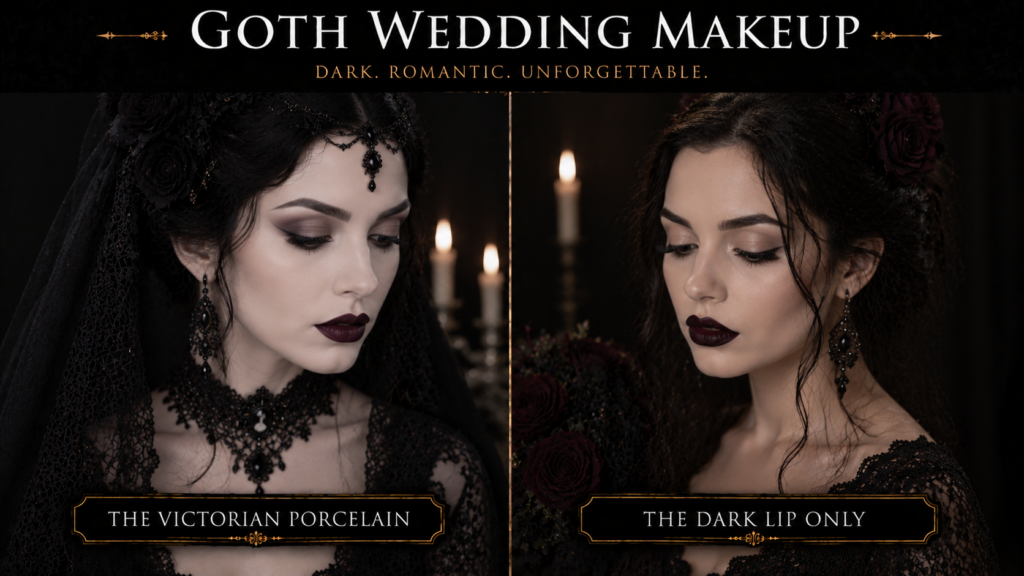
An intensely pale, matte, flawless base — deliberately lighter than the natural skin tone, without any warmth or flush — with a very subtle, cool-toned contour that enhances bone structure without adding colour. Deep, richly pigmented dark eyes — a deep plum or near-black shadow packed onto the lid and blended softly, with kohl smudged at the waterline. A deep berry or dark rose lip — more approachable than near-black, more gothic than neutral. The Victorian porcelain look references portrait miniatures and period funeral photography directly — it is a face constructed for the specific, beautiful quality of light that pre-electric portraiture produced, and in candlelight on a wedding evening it reads as entirely, utterly correct.
06
The Dark Lip Only
Flawless skin — dewy, natural, carefully prepared but not heavily covered — with brushed and defined brows, a coat of lengthening mascara, and a single, completely dominant dark lip. Near-black, deep oxblood, or the darkest plum, applied with a lip liner in a precisely matching shade, blotted once, and reapplied for depth. No eyeshadow, no liner, no contouring. The dark lip only look is a study in confidence — it achieves the maximum impact from the minimum number of decisions, and it places the entire focus of the face on the one element that most directly communicates the gothic aesthetic. For brides who are uncertain about applying extensive eye makeup or who want a look with a more manageable maintenance requirement throughout a long day, this is the most elegant and most personally direct option available.
07
The Smoky Eye Only
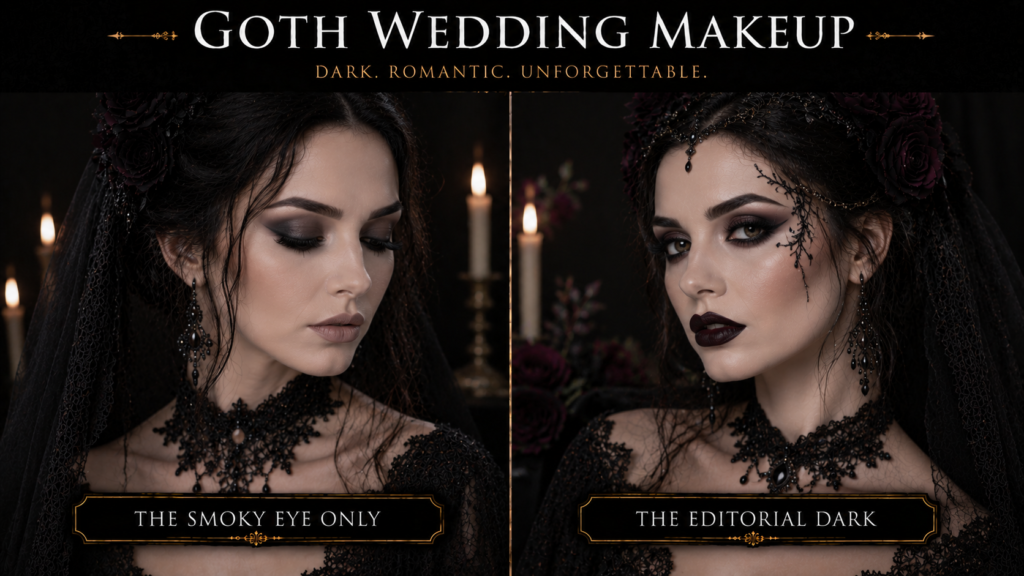
A dramatically smoked and blended eye — deep charcoal, near-black, or dark plum concentrated on the lid and blended into the crease, with kohl smudged beneath the lower lash line and the whole effect softened and deepened until the eye appears to recede into shadow — paired with a nude, barely-there lip in a tone very close to the natural lip colour. The nude-lip, smoky-eye combination is one of the most enduringly beautiful looks in all of occasion makeup, and in its darkest, most gothically executed version it is one of the most powerful bridal faces available. The nude lip keeps the look wearable throughout a long day and removes any risk of the face reading as overly theatrical in photographs from across the room.
08
The Editorial Dark
A highly polished, very precise, fashion-editorial-quality makeup look — flawless matte skin with sculpted contour, graphic or dramatically extended black liner, heavily pigmented dark eyeshadow applied in a specific architectural shape rather than blended conventionally, and a dark lip with a precisely drawn edge. This look is directly informed by the work of high-fashion makeup artists — those whose references are runway shows and editorial shoots rather than bridal magazines — and it produces photographs of extraordinary visual impact when executed by a skilled artist. It is the least conventionally bridal and the most genuinely contemporary of all the looks on this list, and it requires both a very specific aesthetic vision and a makeup artist with the technical range to execute it.
09
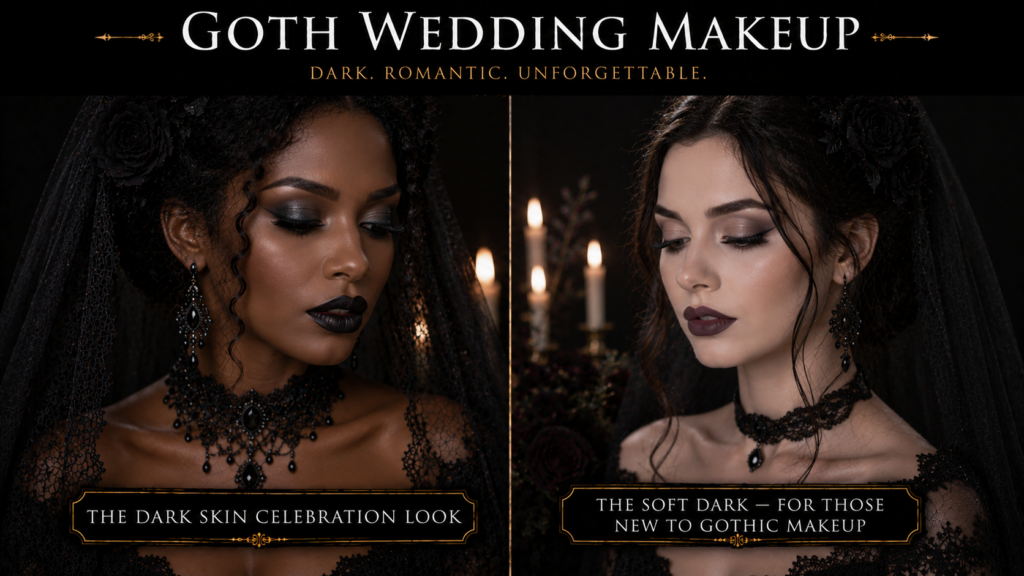
The Dark Skin Celebration Look
For deeper and darker skin tones, the goth bridal makeup brief changes significantly and becomes in many ways even more interesting. The cool-paled skin of the classic gothic look is irrelevant here — the aesthetic comes instead through the depth and drama of the colour choices on the eyes and lips. A very dark, intensely pigmented plum, oxblood, or near-black lip in a richly moisturising formula reads as gloriously dramatic on deep skin tones in a way it cannot quite achieve on lighter ones. Deeply coloured eyeshadow — dark plum, forest green, deep teal — applied with intensity and precision creates eye looks of extraordinary beauty. Gold and bronze metallic details that would read as conventional on pale skin read as deeply luxurious and distinctly gothic on deeper tones. A skilled makeup artist who specialises in darker skin tones and understands alternative aesthetics is essential for this look.
10
The Soft Dark — For Those New to Gothic Makeup
For the bride whose everyday aesthetic leans gothic but whose relationship with dramatic makeup is less established — or who wants a goth bridal look that will feel comfortable and genuine throughout a twelve-hour day — the soft dark approach offers a deeply satisfying solution. A beautifully applied natural-finish base in the skin’s actual tone. A soft, barely-there warm brown or deep taupe smoky eye — more depth than drama, colour gathered at the roots of the lashes and blended gently outward. A deep berry or dark rose lip — not near-black, but unmistakably dark. This look reads as goth to those who know how to read it, and as beautifully elegant to those who do not, and it can be maintained and touched up throughout a long day without specialist skill.
“The goth bridal makeup look that will be remembered is not the most dramatic or the most technically complex. It is the one that made the bride look so completely, obviously, undeniably like herself that everyone who saw her understood immediately — without needing to ask or explain — that this face had always been inevitable.”
— The Gothic Bridal Edit
Skin Preparation
Skin Preparation for Goth Wedding Makeup: The Canvas That Determines Everything
In goth bridal makeup, the skin is not simply a surface to be covered — it is an active aesthetic element. Whether the look calls for a deliberately paled-down porcelain finish, a sheer-coverage skin-like base, or a perfectly flawless editorial foundation, the quality of the skin beneath the makeup determines everything about how the final look performs throughout the day, how it photographs across different lighting conditions, and how it holds up through twelve or more hours of ceremony, celebration, and dancing.
The skin preparation regime for a goth wedding should begin at least three months before the wedding date — not because the face requires fixing but because the skin’s best possible condition requires consistent, patient care to achieve and maintain. A simple routine of reliable daily SPF, consistent hydration, a weekly exfoliation to remove dead skin that would cause any base to sit unevenly, and a prescription retinoid or vitamin C serum introduced at least four months before the wedding will produce a skin quality that dramatically reduces the amount of base product required and significantly extends how long the final makeup look stays fresh.
3–6 Months Before
- Introduce a retinoid or bakuchiol serum — start low, increase slowly
- Establish a consistent SPF routine — non-negotiable for even skin tone
- Book a consultation with a facialist who understands wedding preparation
- Identify and address any specific skin concerns — dryness, congestion, pigmentation
- Test and establish a reliable skincare routine and stick to it without major changes
The Week Before
- A professional facial — no extractions or peels, hydration focus only
- No new products — the week before a wedding is not the time to experiment
- Increase water intake significantly — hydrated skin holds makeup differently
- Consistent sleep — the skin’s appearance on the wedding morning is directly affected
- A gentle enzyme exfoliation 48 hours before — never the night before
Products & Techniques
Products and Techniques: What Works in Dark Goth Bridal Makeup
Dark bridal makeup has specific product requirements that differ significantly from the conventional bridal makeup toolkit. Very dark lip colours require a specific application technique and a specific product formulation to stay on through a ceremony, a dinner, and several hours of dancing without feathering, fading at the centre, or transferring. Heavily pigmented dark eyeshadows require primer and setting in ways that lighter colours do not. And the skin finishes that work best in goth bridal photography — whether matte, dewy, or porcelain-pale — each have specific product requirements that are worth understanding before you sit down with your makeup artist for the trial.
🖤 The Dark Lip
Line first with a matching or slightly darker lip liner — filling in the entire lip, not just the edge. Apply lipstick on top, blot with tissue, dust translucent powder over a single tissue pressed to the lips, then reapply. This three-layer technique dramatically extends wear. Carry the liner and lipstick for touch-ups — dark lips fade at the centre first and require more maintenance than lighter shades throughout a long day.
👁️ The Smoky Eye
Prime the entire lid with an eye primer before any pigment is applied — this is non-negotiable for dark colours, which crease and migrate significantly more than lighter ones without a primed base. Use a setting spray between layers and a loose translucent powder beneath the lower lash line before applying shadow there, to prevent dark pigment from falling onto the face.
🎨 The Base
For a paled-down porcelain look, mix foundation with a small amount of white pigment or a shade significantly lighter than the natural skin — never apply straight white. Setting with a translucent powder and a setting spray seals the base. For a dewy natural look, apply foundation sparingly and avoid powder except in the T-zone and under the eyes.
✨ Setting & Longevity
A professional setting spray applied in a cross-hatch pattern after the complete look is finished significantly extends wear for all products. Carry blotting papers rather than powder for oil management throughout the day — powder dulls dark lip colours and moves delicately blended eyeshadow. Touch up the lips and any eyeliner after the meal.
Dark Makeup and Low-Light Photography: What You Must Know
Goth wedding makeup behaves entirely differently under flash photography and in low-light candlelit conditions from how it looks in natural daylight or studio lighting. A near-black lip that looks perfectly balanced in person can photograph as a void under direct flash — losing all its colour nuance and reading as a flat dark shape. A deeply smoked eye that looks dramatically beautiful in candlelight can appear too heavy under bright daylight photography. The solution is a trial shoot: book a portrait session with your actual photographer in lighting conditions that approximate your wedding venue before the wedding day. Photograph both the full look and close-up face shots. Review the results before finalising any element of the makeup plan. This single step — which costs very little relative to the total wedding photography investment — prevents more goth bridal makeup disappointments than any other piece of planning advice.
Finding Your Artist
Finding and Briefing the Right Makeup Artist for a Goth Wedding
The most common single cause of goth bridal makeup disappointment is not the makeup artist’s technical skill — it is the mismatch between the artist’s aesthetic fluency and the brief they have been given. A makeup artist who is technically excellent within the conventional bridal context may have very limited experience with very dark lip colours, near-black eyeshadow, or the specific requirements of a deliberately paled-down porcelain complexion. And an artist who does not understand the goth aesthetic from the inside — who approaches it as an unusual request rather than as a known and considered creative direction — will default to the safe choices at every decision point rather than the correct ones.
🔍 How to Find the Right Artist
Search specifically for makeup artists who list alternative bridal, gothic bridal, or dark bridal in their portfolio descriptions. Look for artists whose Instagram or portfolio contains dark lip work, editorial smoky eyes, and pale gothic skin as a matter of course rather than as occasional exceptions. Ask directly: have you worked with brides who wanted dark or gothic makeup? Look at the full range of their portfolio, not just the most recent images.
📋 How to Brief Them
Bring photographs — not just of makeup, but of the dress, the venue, the flowers, and the overall aesthetic of the day. The artist needs to understand the total visual context, not just the face. Be specific about what you want and what you do not want. If you do not want to look conventionally bridal, say so explicitly. If there is a specific element you want to retain — a natural skin tone, no false lashes, a wearable rather than dramatic look — state it clearly and early.
✅ The Trial
Book the trial at least three months before the wedding. Wear the trial makeup for the full day after the appointment — into the evening, through a meal, into whatever activities the day holds. Photograph it in different lighting conditions including low light. Assess not just how it looks but how it feels and how it holds at the end of the day. Anything that needs to change should be identified and agreed with the artist before the wedding morning.
Practical Planning
Ten Things Every Goth Bride Should Know Before Her Makeup Trial
- Never let a makeup artist talk you out of your dark lip. The single most consistent piece of advice given to goth brides by conventional makeup artists — and the most consistently wrong — is that a very dark lip will be too much, too heavy, too ageing, or too dramatic for a wedding. For a goth bride in a goth aesthetic context, this is not true. A dark lip is the correct choice. An artist who reflexively discourages it at the consultation is demonstrating that their aesthetic fluency does not extend to the world your wedding inhabits. Find someone else.
- The trial is not optional. For any makeup look involving very dark pigments, pale-down foundation, or extended graphic liner, a trial is not simply recommended — it is essential. The number of interactions between different product formulations, skin types, and lighting conditions that can affect a dark makeup look is too large to manage on the wedding morning without prior testing. Book the trial, wear it all day, photograph it in low light, and arrive at the wedding morning with full certainty about every product and technique being used.
- Brief your photographer specifically on your makeup aesthetic before the wedding day. A photographer who shoots conventional bridal makeup — soft, dewy, natural — will expose and retouch dark makeup differently from the way it looks at its most beautiful. Share your makeup references with your photographer at the planning stage and discuss how to expose for dark lip colours, how much retouching you want applied to the skin, and how to capture the look in the specific low-light conditions of your venue.
- Always apply eye makeup before foundation on the wedding morning. Dark eyeshadow and heavy kohl produce significant fallout during application — dark pigment that falls onto the face beneath. Applying eye makeup first allows any fallout to be cleaned away before the foundation base is applied, rather than having to remove and reapply foundation to clean fallen shadow from an already-finished face. Brief your makeup artist specifically on this order of operations if they do not follow it automatically.
- Waterproof formulas are non-negotiable for the ceremony. Whether the look involves a dark liner, a smoked shadow, or mascara — or all three — waterproof formulas are essential for the ceremony, when emotional responses are most likely to produce tears and the lighting most likely to be bright and unforgiving of smudging. Conventional formulas can be used for the reception if preferred, but the ceremony face must be bulletproof.
- A near-black lip eaten off at the wedding breakfast is one of the most common and most avoidable goth bridal makeup disappointments. Apply the dark lip after the wedding breakfast rather than before it whenever possible, or use a long-wear transfer-proof liquid lipstick formula for the ceremony and switch to a more comfortable conventional formula for the reception. Carry the full lip kit — liner, lipstick, a small mirror, and blotting papers — throughout the entire day and touch up after every meal and significant drink.
- Do not introduce any new skincare or makeup product within six weeks of the wedding. Allergic reactions, unexpected breakouts, and product interactions are all significantly more likely with new products than with established ones. The six-week window before the wedding should be used to refine and perfect the existing routine, not to experiment with new formulations however compelling they appear.
- The makeup artist’s setup time on the wedding morning is a fixed constraint — plan around it. A full goth bridal look — especially one involving a porcelain-paled base, an extensive smoky eye, and a precisely applied dark lip — requires more time than a conventional bridal look. A realistic estimate is sixty to ninety minutes for the bride alone, with additional time for anyone else in the bridal party having makeup done. Build this time into the wedding morning schedule generously and then add a further fifteen-minute buffer.
- Discuss the complete look — makeup, hair, dress, accessories, and flowers — with your makeup artist at the trial. Goth bridal makeup does not exist in isolation. The specific tone of the dark lip should be in conversation with the specific tones of the dress fabric and the flowers. The eye look should complement rather than compete with the hair style. Bring photographs of everything, or attend the trial in the full accessory complement if possible, so the artist can see and respond to the complete picture.
- The most powerful goth wedding makeup is the one you stop noticing within an hour of it being applied. Not because it has faded or failed, but because it feels so completely and naturally like you that you cease to be aware of it as a separate thing. That quality — the quality of makeup that looks inevitable rather than applied — is the benchmark against which every goth bridal look should be measured. If you arrive at the end of the trial and feel, in some quiet way, more completely yourself than you did before it was applied, you have found the right look and the right artist. Everything else is detail.
Final Thoughts
The Face That Belongs to the Dress, the Venue, and the Day
Goth wedding makeup is for brides who understand that the face is not separate from the aesthetic — it is its centre. The dark velvet gown, the candlelit stone hall, the black roses, the oxidised silver rings — all of these are extraordinary on their own terms, and all of them are made more powerful and more complete by a face that is in genuine, considered, fully intentional conversation with everything around it. The near-black lip that echoes the bouquet. The smoked eye that belongs to the same world as the flickering candelabras. The porcelain skin that makes the face appear to glow in the dark like something from another century.
Find the artist who understands this. Brief them with everything — the dress, the venue, the flowers, the light. Do the trial, photograph it in the dark, wear it all day. And then on the wedding morning, sit in the chair and let it happen — knowing that the face being built around you belongs not to a generic bridal ideal but to you specifically, on this specific day, in this specific world you have built. That is what goth wedding makeup is for. And when it is right, nothing else looks quite so completely like the truth.