10 Goth Wedding Decorations
The Gothic Wedding Edit · 2026
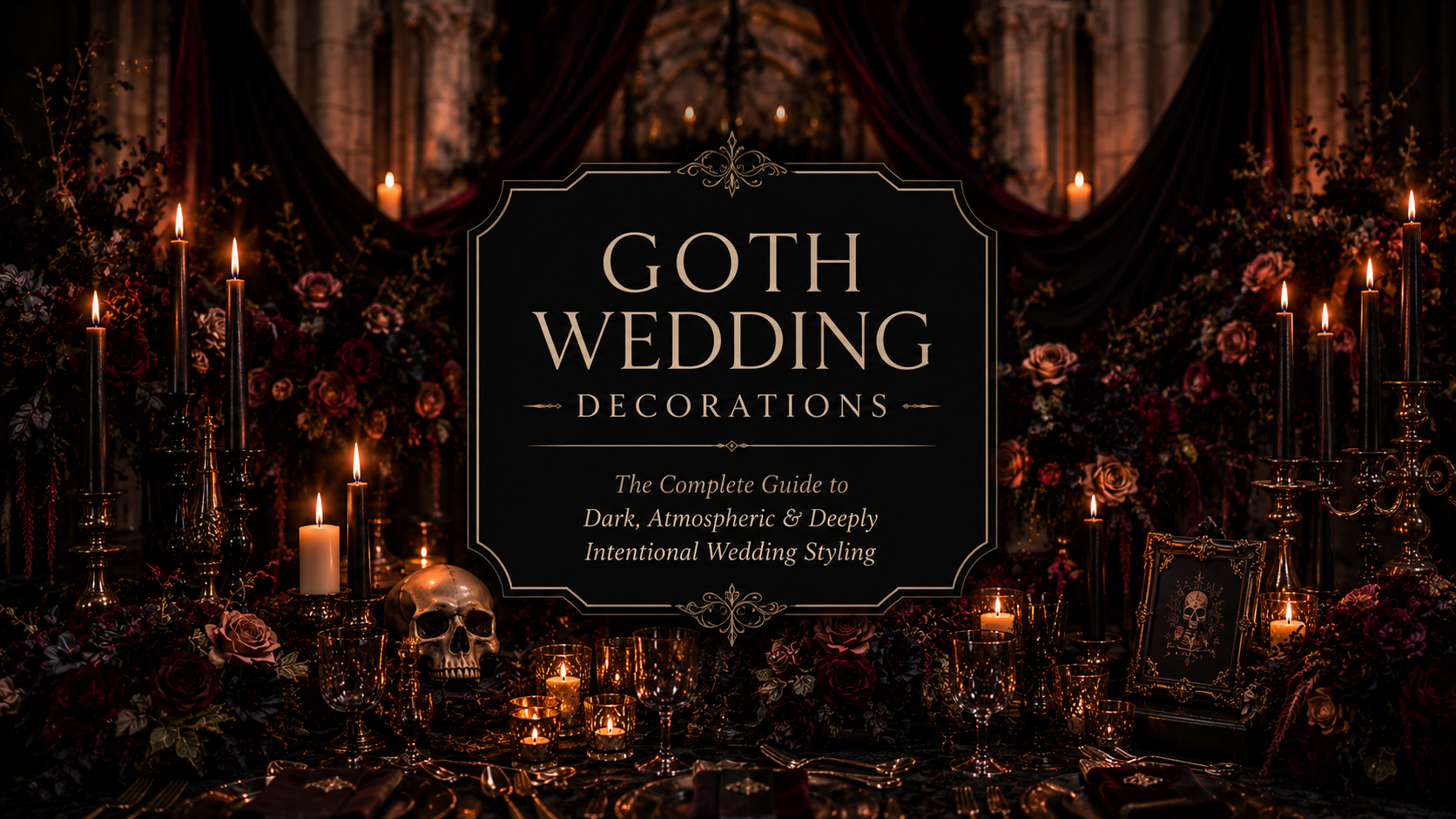
Goth Wedding Decorations
The Complete Guide to Dark, Atmospheric & Deeply Intentional Wedding Styling
From candlelit tablescapes and black floral installations to dark velvet linens, antique mirrors, and the five decoration zones that transform a venue into a world — your definitive guide to goth wedding decorations in 2026.
Introduction
Why Goth Wedding Decorations Require a Different Creative Brief From Any Other Wedding Aesthetic
Most wedding decoration briefs operate on a principle of addition — taking a neutral space and adding beauty to it through flowers, fabric, lighting, and decorative objects until it reaches the level of visual richness the couple wants. The goth wedding decoration brief operates differently. It does not add beauty to a neutral space. It builds a complete world from a very specific aesthetic foundation — one in which darkness and light work together rather than in opposition, in which every surface from the floor to the ceiling is considered, and in which the immersive, atmospheric quality of the whole is more important than any individual decorative element, however extraordinary that element might be on its own.
The goth wedding decoration scheme of 2026 draws on a rich and diverse set of aesthetic influences — Victorian gothic architecture, dark romanticism, Flemish still-life painting, memento mori traditions, Pre-Raphaelite imagery, and the contemporary dark botanical and alternative wedding movements — and synthesises them into something that is simultaneously historically informed and completely contemporary. It is not a themed party. It is not a Halloween event held on an alternative date. It is a fully considered, seriously executed aesthetic direction that asks more of every supplier involved than a conventional wedding decoration scheme — and that produces, when it is done with complete conviction and genuine creative ambition, one of the most visually extraordinary wedding environments in all of contemporary event design.
This guide covers the complete landscape of goth wedding decorations in 2026 — from the ten defining decoration ideas and the key design elements that build the total aesthetic, through the five venue zones that every goth decoration scheme must address, the materials and textures that define the look, lighting design, table styling, and the practical planning knowledge that separates a goth wedding decoration scheme that is merely interesting from one that is genuinely, completely, unforgettably extraordinary.
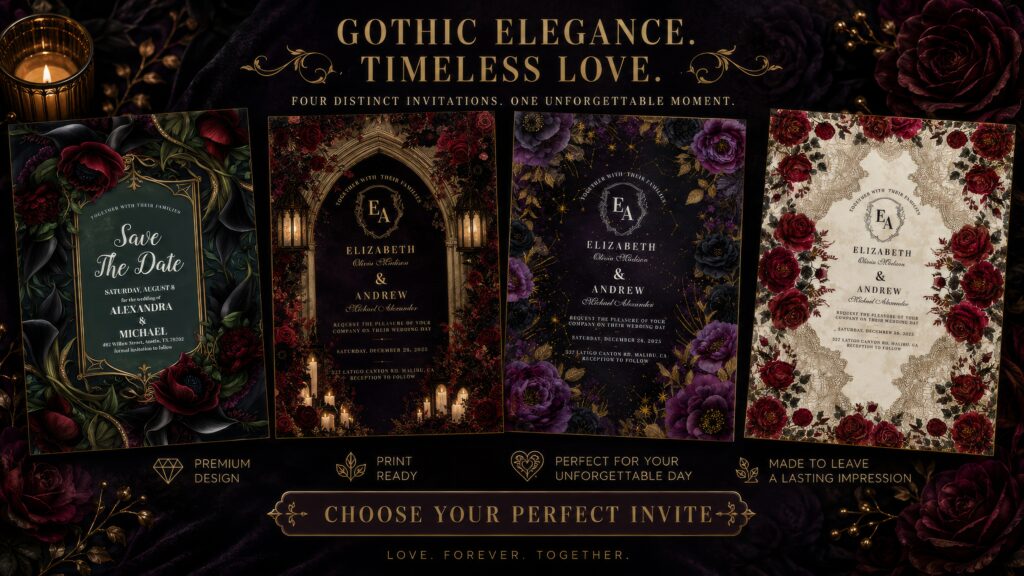
The Edit
10 Goth Wedding Decoration Ideas That Will Define Your Celebration
Each of these ten decoration ideas represents a complete creative direction — a specific design concept that can anchor the entire visual language of a goth wedding celebration, from the ceremony through to the final hour of the reception. Read each as a world to step into rather than a decoration to add, and notice which one makes you feel, instinctively and immediately, that this is the atmosphere you want to build around the most important day of your life.
01
The Dark Floral Abundance Installation
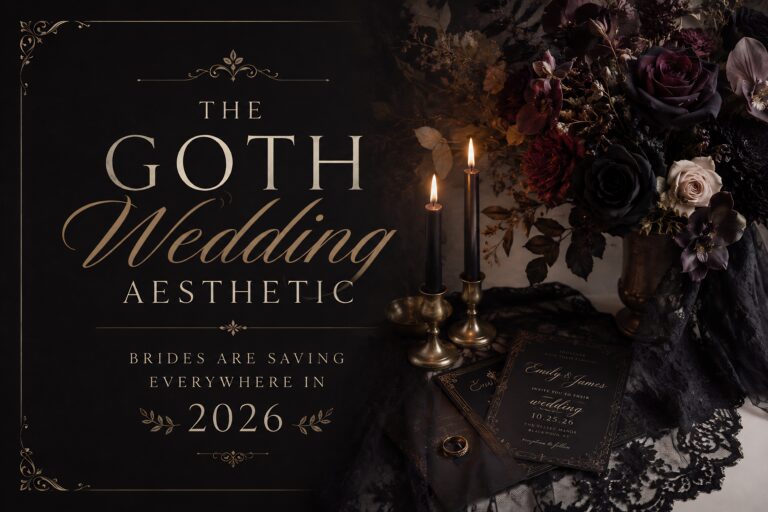
An overflowing, dramatically abundant arrangement of dark florals — black Baccara roses, deep burgundy dahlias, near-black anemones, chocolate cosmos, dark hellebores, and trailing dark botanical elements — constructed as a ceiling installation above the dining table, a ceremony arch of overwhelming scale, or a cascading arrangement spilling from tall stone urns positioned at the venue entrance. The dark floral abundance installation is the most immediately and most powerfully atmospheric of all goth wedding decoration concepts — it transforms any space it inhabits entirely and immediately, and it photographs with an extraordinary visual density and darkness that no other decorative element can replicate. This is the centrepiece of the goth wedding decoration scheme, and every other element should be designed in relationship with it.
02
The Candlelit Cathedral Effect
Hundreds of real pillar candles — at varying heights, in iron and oxidised silver holders, on mirrored surfaces and aged stone plinths, supplemented by hundreds of amber glass votives placed at every available surface throughout the venue — creating a room of such total, warm, flickering candlelight that guests feel, on entering, that they have stepped into a different century entirely. The candlelit cathedral effect is the most atmospherically powerful of all goth wedding decoration approaches because it operates through light rather than through objects — it changes the quality of everything else in the room simultaneously, making the dark florals appear deeper, the dark velvet richer, and every face more beautiful. Real candles are non-negotiable for this effect. No LED alternative produces the same quality of light.

03
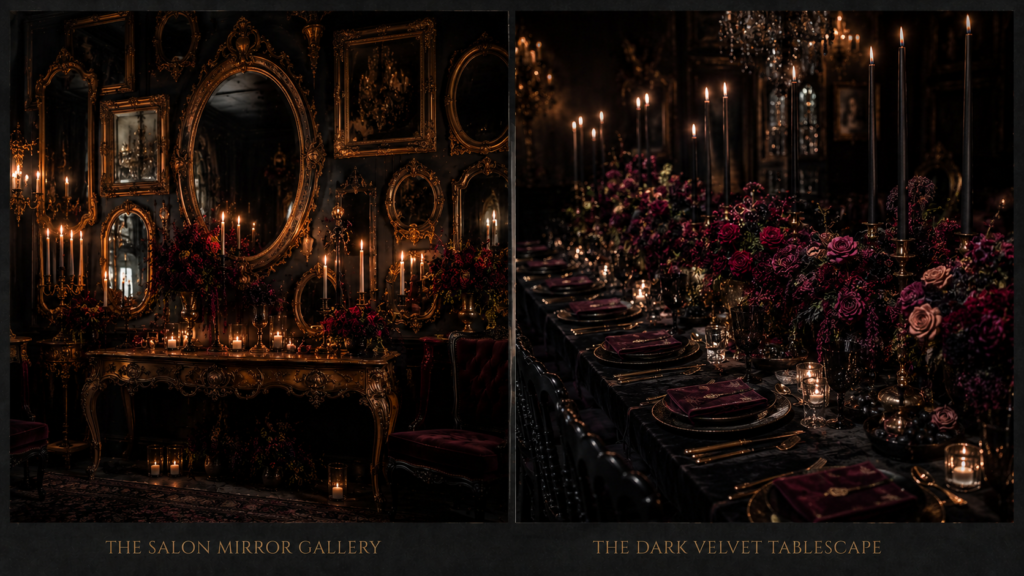
The Salon Mirror Gallery
A wall of antique, foxed, and ornately framed mirrors — in heavily carved dark wood, blackened iron, and aged gilt — arranged salon-style across a key wall of the reception room to multiply the candlelight and create the illusion of infinite depth behind the celebration. The salon mirror gallery is the most cost-effective atmospheric upgrade in the entire goth wedding decoration toolkit — it adds nothing to the lighting budget, requires no electrical infrastructure, and yet doubles the visible warmth and depth of the room simply by reflecting what is already there. Sourced from theatrical prop hire companies and antique dealers who loan for events, a well-assembled collection of period mirrors transforms any stone or panelled room into something that appears to extend beyond its actual walls into the darkness behind the glass.
04
The Dark Velvet Tablescape
Every dining table dressed in deep jewel-toned velvet — near-black, deep plum, oxblood, or midnight navy — over which dark floral arrangements, varying-height iron candelabras, and individually placed votive clusters are positioned. The dark velvet surface absorbs candlelight rather than reflecting it, creating a depth of tone at the table surface that makes every other element placed on it appear to glow with its own internal warmth. Layered with aged gold charger plates, dark linen napkins, and hand-lettered place cards on dark card stock, the dark velvet tablescape is the most intimately and most consistently experienced of all goth wedding decoration elements — the one that every guest sits with for two or three hours and that rewards close attention at every scale from across the room to a centimetre away.
05
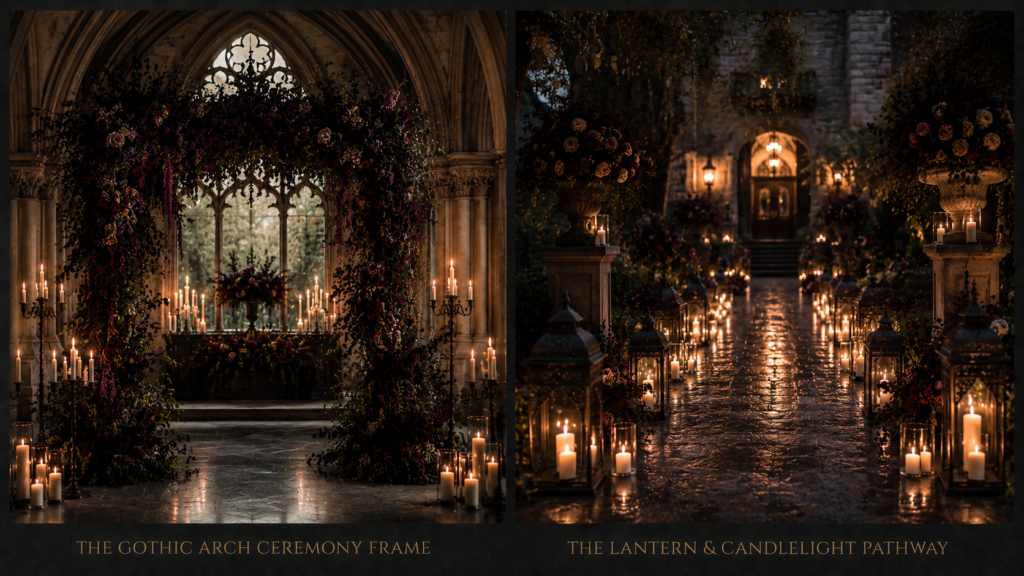
The Gothic Arch Ceremony Frame
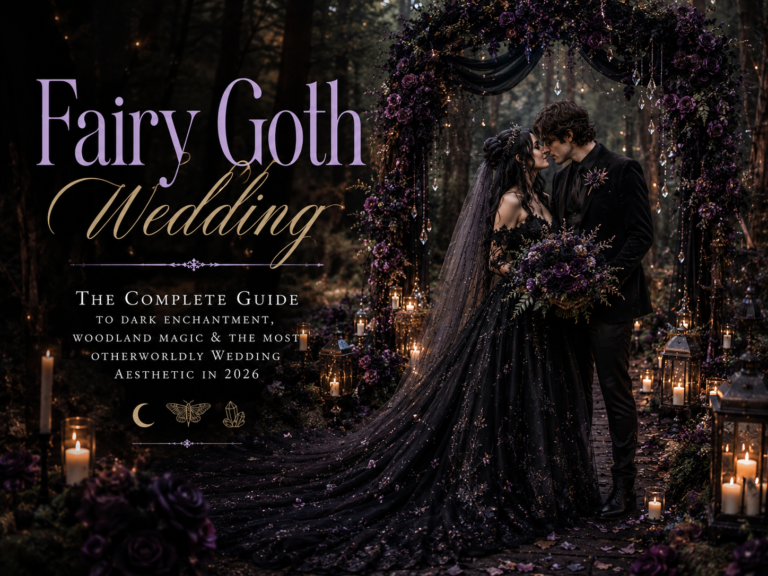
A freestanding arch constructed from twisted dark branches, oxidised iron frame, or carved dark wood — dressed with an abundance of dark florals, trailing black botanical elements, dried seed pods, dark ribbon, and hanging crystal drops — that frames the couple during the ceremony and appears in every photograph taken from the congregation. The ceremony arch at a goth wedding is not a decorative backdrop. It is a threshold — a constructed entrance to the world of the celebration — and it should be designed to read as a genuine piece of dark architecture rather than as flower-draped scaffolding. In stone-walled venues, the arch should reference and amplify the architectural language of the building. In more neutral spaces, it must carry enough visual weight to create its own architectural authority.
06
The Lantern & Candlelight Pathway
Iron lanterns of varying heights — floor-standing, hanging from shepherd’s crooks, placed on stone steps — containing real pillar candles and interspersed with dark botanical arrangements, dried grasses, and scattered dark petals, lining the pathway from the venue entrance to the ceremony space, from the ceremony to the reception room, or from the reception to the outdoor space beyond. The lantern and candlelight pathway is one of the most romantically atmospheric of all goth wedding decoration elements — the act of walking through it at dusk, with every candle lit and the darkness gathering at the edges, is one of the most genuinely memorable sensory experiences a goth wedding can provide. It also requires relatively minimal budget relative to its atmospheric impact.
07
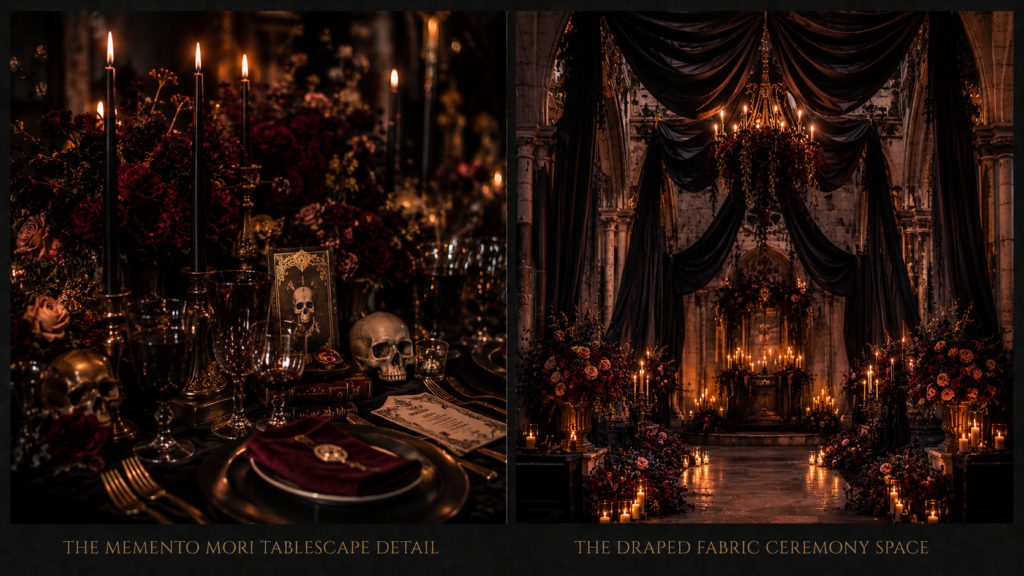
The Memento Mori Tablescape Detail
Small, beautifully crafted memento mori objects distributed through the table decoration — miniature skull candleholders in oxidised silver, individual dried botanical arrangements in tiny dark vessels at each place setting, moss-covered stone or ceramic objects among the floral arrangement, single black feathers placed across dark place cards. These details are the most intimately personal of all goth wedding decoration elements — they are discovered rather than displayed, noticed at close range by guests sitting at the table rather than visible from across the room, and they communicate the couple’s aesthetic depth and creative intelligence more directly and more specifically than any large-scale installation. The memento mori detail says: we thought about this table setting the way we think about everything — completely, and with full awareness of what we are doing and why.
08
The Draped Fabric Ceremony Space
Heavy silk, velvet, or brocade fabric in deep jewel tones or near-black — draped from ceiling fixings, wound around ceremony aisle markers, pooled dramatically at the base of candle stands, or hung as a backdrop behind the ceremony arch — adding warmth, movement, and the specific tactile quality of heavy dark textile to the ceremony space. Draped fabric is one of the most powerful and most immediately atmospheric decoration tools available in any event design context — it softens hard architectural surfaces, creates intimacy within large spaces, and introduces the specific sensory weight of dark material to the visual composition in a way that flowers and candles alone cannot. In a stone church or gothic chapel, dark draped fabric deepens the architectural atmosphere already present. In a more neutral venue, it provides the visual foundation the goth aesthetic requires.
09
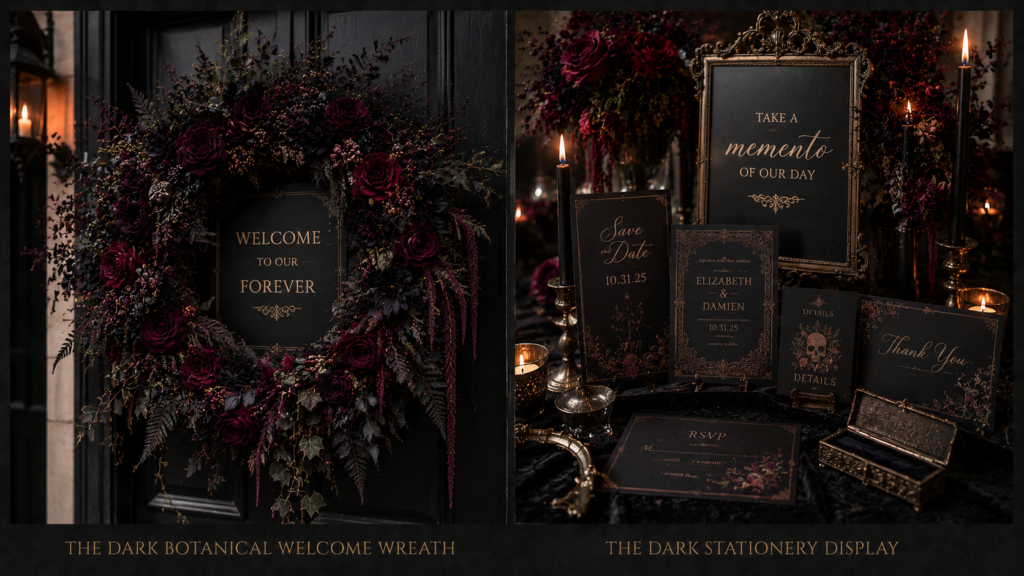
The Dark Botanical Welcome Wreath
A large-scale dried and fresh botanical wreath on the venue entrance door — constructed on a willow or iron wire base and built up with dark anemones, black Baccara roses, dried lunaria seed discs, dark pampas, twisted willow stems, and dried botanical elements in deep dark tones — that functions as the first piece of goth wedding decoration a guest encounters and the one that establishes every expectation for the world inside. The welcome wreath is the establishing shot of the goth wedding decoration narrative — the single image that communicates the aesthetic of the entire day most immediately and most completely to every arriving guest. It should be designed with the same creative ambition as the ceremony arch, and it should be built primarily from dried materials so that it can be taken home and displayed for months after the wedding as a lasting keepsake of the aesthetic world that was built for a single extraordinary day.
10
The Dark Stationery Display
The table plan, escort cards, menus, and place settings displayed as a composed decoration element rather than treated as purely functional information delivery. A table plan on dark aged card in an ornately framed dark mirror, surrounded by a small floral arrangement of dark botanicals and a pair of lit candles. Escort cards sealed individually with oxblood or near-black wax seals and pinned to a velvet-covered board draped with dark foliage. Place cards hand-lettered in gold or silver on black card stock and laid on folded dark linen napkins at each setting. These details — small individually, significant collectively — weave the goth aesthetic through the entire guest experience of the reception space and signal a level of creative intention and attention to detail that guests notice and remember.
“The goth wedding decoration scheme that succeeds completely is not the most elaborately installed or the most extensively budgeted. It is the one where every element — in every room, at every height, from every angle — belongs to the same world. That coherence is the only thing that actually matters.”
— The Gothic Wedding Edit
The Five Decoration Zones
The Five Zones Every Goth Wedding Decoration Scheme Must Address
A complete goth wedding decoration scheme is not a collection of beautiful individual elements — it is a total spatial narrative that flows coherently from the moment a guest arrives to the moment they depart. Each zone of the venue experience contributes to or detracts from that narrative, and the most common failure in goth wedding decoration planning is the over-investment in one or two dramatic focal points — the ceremony arch, the dining table — and the complete neglect of the zones in between. The five zones below represent every space a guest moves through during the course of a goth wedding celebration, and each requires specific creative consideration.
🚪
Zone 1: The Entrance
The dark botanical welcome wreath, the lantern-lined approach path, the table plan display, and the escort card installation. The entrance is the first physical encounter with the decoration scheme — invest in it accordingly. It sets every expectation that follows.
💒
Zone 2: The Ceremony
The ceremony arch, aisle markers, pew or chair end decorations, and any altar or focal point arrangement. These appear in every ceremony photograph. They must be in direct visual conversation with the bridal bouquet and the couple’s overall palette.
🥂
Zone 3: The Drinks Reception
Antique mirrors, fireplace mantel arrangements, drinks table styling, and the transitional atmosphere between ceremony and dinner. This is where guests form their first impression of the reception aesthetic — it must be as considered as the spaces that follow it.
🍽️
Zone 4: The Dining Room
Tablescapes, ceiling installations, tall urns, mirror gallery, uplighting. The space where guests spend the greatest time and where every detail is noticed and remembered. Every element from the candle holder to the place card to the napkin fold deserves specific creative consideration.
🌙
Zone 5: The Farewell
The lantern-lit path back to the car park, the welcome wreath encountered again on the way out, any outdoor fire or final atmospheric moment. The last impression is what guests carry home. Give it the same creative attention as the first.
Materials & Textures
The Materials of Goth Wedding Decoration: Texture, Patina, and Dark Abundance
The material palette of goth wedding decorations is one of the richest in all of event design — because the gothic aesthetic rewards age, texture, darkness, and the evidence of craft and time in a way that few other wedding aesthetics do. Nothing in a goth wedding decoration scheme should look new, bright, or factory-fresh. Everything should carry the visual suggestion of having been somewhere before — of age, use, patina, and the specific beauty of things that have absorbed years of handling and atmosphere. This is not a nostalgic preference. It is the aesthetic logic of the gothic tradition itself, which has always found beauty in the evidence of time rather than in the illusion of permanence.
Essential Decoration Materials
- Oxidised and blackened iron — for candle holders, lanterns, arch frames, and decorative objects
- Dark silk velvet — tablecloths, runners, chair covers, draped fabric elements
- Aged or foxed glass — antique mirrors, mercury glass votives, period hurricane lanterns
- Dark brocade and damask — for fabric backdrops, draped ceremony elements, table detail
- Reclaimed and aged wood — dark oak, weathered timber, carved period furniture pieces
- Stone and slate — as cake stands, place card holders, and decorative surface materials
- Dried and preserved botanicals — pampas, lunaria, twisted willow, seed pods, dark leaves
- Black wax — for seal details on stationery, candle finishes, and decorative objects
Dark Florals to Specify
- Black Baccara roses — the defining goth wedding flower, deep velvet red-black
- Dark anemones — near-black with white centre, graphic and deeply beautiful
- Chocolate cosmos — dark velvety brown-red, intensely fragrant and seasonal
- Deep burgundy dahlias — large, richly coloured, and of extraordinary visual weight
- Dark hellebores — near-black and deep plum, the most gothic of all garden flowers
- Dark smoke bush — deep burgundy-purple foliage cloud for textural density
- Copper beech branches — rich dark foliage for large architectural arrangements
- Rosehips on the stem — dark red berries with trailing, organic movement
Lighting Design
Goth Wedding Lighting: Candlelight, Darkness, and the Atmosphere That Changes Everything
In goth wedding decoration, lighting is not a background consideration — it is the primary atmospheric tool. The quality of light in the room determines how every other element of the decoration scheme reads: how the dark florals appear, how the velvet surfaces feel, how the antique mirrors behave, and how the faces of the guests photograph. And in the goth context, the governing principle of lighting design is not brightness or visibility but atmosphere — the specific, warm, shadow-playing quality of real candlelight in a dark-decorated room that makes everything it touches appear more beautiful, more richly coloured, and more alive than it would under any other light source.
Real candles are non-negotiable in any genuinely atmospheric goth wedding decoration scheme. The specific quality of a real flame — its movement, the shadows it casts, the warmth of its colour temperature, and the complex, multi-directional light it produces — is entirely irreplaceable by any LED technology, however advanced. Where venue restrictions prevent naked flame, the highest-quality flame-effect LED candles available should be used, combined with warm amber uplighting and carefully placed spotlights on the darkest tones in the decoration to prevent the room from reading as merely dim rather than dramatically, atmospherically dark.
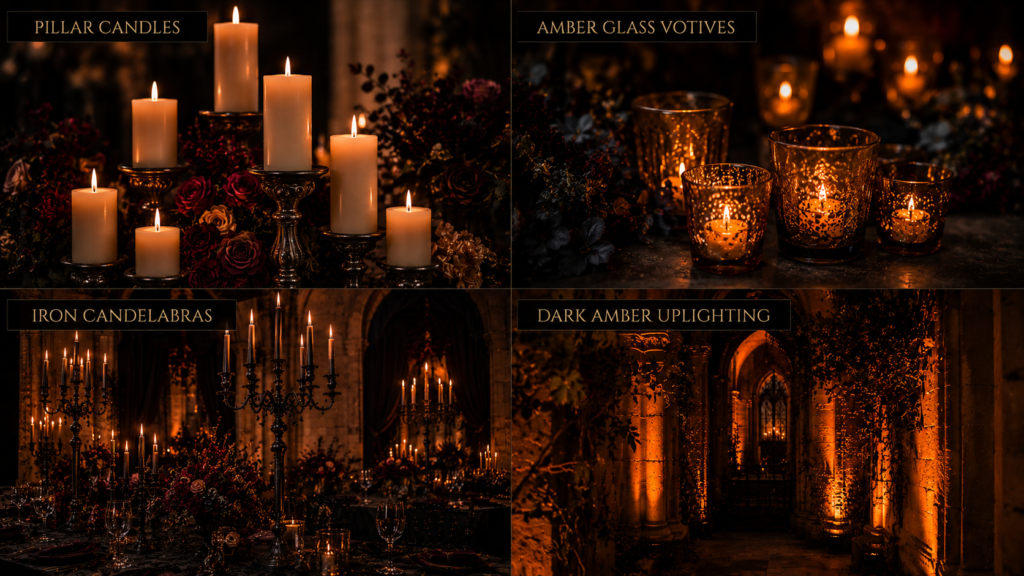
🕯️ Pillar Candles
The foundation of goth wedding lighting. Black, deep burgundy, or unbleached beeswax pillar candles in oxidised iron and dark stone holders at varying heights across every table surface. Grouped in odd numbers — three, five, seven — for visual energy. Unscented at dining tables; lightly scented with dark amber or labdanum at the venue entrance.
🔮 Amber Glass Votives
Hundreds of amber or dark glass votive holders scattered across every table surface, window ledge, stair tread, mantelpiece, and available surface in the venue. The mass of small amber flames creates the general atmosphere from which the larger candle groupings and installations emerge. Quantity here is not excess — it is atmosphere.
🔥 Iron Candelabras
Tall, branching iron candelabras holding multiple taper candles — positioned as the vertical anchors of the dining table decoration scheme. They provide height, movement, and the specific drama of multiple flames at different levels that a flat table surface cannot achieve. The most photographically powerful single lighting element in any goth wedding dining room.
✨ Dark Amber Uplighting
Warm amber or deep gold LED uplighting placed at the perimeter of the room — never cool white, never blue — to extend the warmth of the candlelit tables to the full three-dimensional space of the venue and prevent the dark decoration from appearing simply dimly lit rather than atmospherically dark. Used at low intensity — ambient rather than directional.
The Goth Wedding Decoration Colour Palette
The goth wedding decoration palette operates on the same principle as Caravaggio’s chiaroscuro — the dynamic, emotionally charged contrast of very deep darkness against points of concentrated warm light. Near-black and very deep charcoal as the dominant tone across textiles, vessels, and structural elements. Deep jewel tones — oxblood, midnight plum, dark forest green, midnight navy — as the secondary colour language in florals, velvet, and accent pieces. Aged gold, oxidised silver, and dark bronze as the metallic family throughout — never bright gold, never chrome, never anything that reads as new or industrial. And the specific warm amber of real candlelight as the light source that ties every dark element together into a coherent, deeply atmospheric whole.
Practical Planning
Ten Things Every Couple Should Know Before Planning Goth Wedding Decorations
- The venue is the first and most important decoration decision. Goth wedding decorations reach their maximum power in spaces that already possess the architectural qualities the aesthetic requires — stone walls, high ceilings, existing dark surfaces, working fireplaces, or the gothic geometry of a historic church or chapel. A blank-canvas industrial space or a bright modern hotel ballroom can be decorated gothically, but it requires significantly more investment and produces significantly less atmospheric result than a venue where the architecture is already doing much of the work. Choose the venue with the decoration scheme in mind from the very first site visit.
- Confirm the candle policy before designing the lighting scheme. Many historic and licensed venues prohibit or restrict naked flame for fire safety and insurance reasons. This is the single most important practical question to ask any potential venue, and the answer should significantly influence the venue selection if real candlelight is a priority — which, for a genuinely atmospheric goth wedding, it always is.
- Brief the florist and decorator together, never separately. The dark floral design and the wider decoration scheme are a single, unified visual project — not two separate commissions that happen to exist in the same room. A scheme where the florist and decorator have not been in direct communication will almost always produce incoherence between the floral and non-floral elements. Every creative supplier for the decoration must have seen the same reference imagery, agreed the same palette, and understood the same total aesthetic vision before any work begins.
- Build a coherent and disciplined colour palette and maintain it across every element. The goth wedding decoration scheme that reads as genuinely powerful is one in which every element — from the largest floral installation to the smallest place card detail — operates within the same colour language. A single colour palette applied with absolute consistency across near-black, one or two jewel tones, and one metallic family will always produce a more atmospherically compelling result than a wider range of colours applied more loosely. Discipline is the aesthetic foundation of everything.
- Plan the installation timeline with significantly more buffer than seems necessary. Dark wedding decorations — particularly ceiling installations, large arch constructions, and candle-heavy tablescapes — take considerably longer to install than their finished appearance suggests. The number of candles required for a fully atmospheric goth wedding reception table, multiplied by the number of tables, multiplied by the number of individual votives, lanterns, and candelabra positions, produces a setup time that most couples significantly underestimate. Confirm the venue’s access schedule weeks in advance and build generous buffer time between the end of decoration installation and the arrival of the first guest.
- Invest in the transitional spaces between the main event areas. The corridor between the ceremony and reception room. The staircase. The cloakroom approach. The path to the outdoor space. These in-between zones are where the total immersive quality of the goth decoration world is either maintained or broken — and a single undecorated corridor interrupting an otherwise completely styled venue creates a jarring discontinuity that undermines the experience of both spaces it connects. A lantern, a small floral arrangement, or a dark fabric draped element in every transitional space costs very little relative to the main decoration budget and contributes enormously to the overall coherence of the world.
- The dried and preserved botanical elements are as important as the fresh flowers. Pampas grass, lunaria seed discs, twisted willow, dried cotton stems, and dark preserved foliage are not budget substitutes for fresh flowers — they are aesthetically essential components of the goth wedding decoration palette that fresh flowers alone cannot replicate. They add textural complexity, architectural scale, and a quality of age and organic darkness that fresh flowers in their peak condition specifically lack. Source them at least three months before the wedding, when availability is highest and prices are most reasonable.
- Fragrance is a decoration element and should be planned accordingly. The scent of a goth wedding decoration scheme — beeswax candles burning, dark florals at room temperature, a diffuser of labdanum or dark amber at the entrance — creates an immediate and deeply memorable sensory impression that the visual elements alone cannot produce. Brief every candle supplier on scent: unscented at dining tables (to avoid competing with food), lightly scented in entrance and transitional spaces. Ensure no competing fragrances undermine the intended atmosphere.
- Every hired element must have a clearly planned return logistics process before the wedding day. A substantial goth wedding decoration scheme typically includes a significant number of hired pieces — antique mirrors, iron candelabras, lanterns, stone urns, velvet linens. Each piece from each supplier has its own collection window and its own return condition requirements. Create a complete inventory of every hired item, assign responsibility for its return to a specific person in the planning team, and confirm the collection schedule with every supplier in writing before the wedding takes place.
- The most powerful goth wedding decoration is always the one that feels inevitable rather than assembled. Not the most expensive, not the most extensively installed, not the most dramatically elaborate — the one where every element belongs so completely to the same world that guests feel, on entering, that it could not possibly have been any other way. That quality of inevitability is achieved through absolute consistency of aesthetic vision, disciplined colour palette management, and the willingness to remove anything that does not belong — however beautiful it might be in isolation — rather than compromise the coherence of the whole for the sake of an individual piece. Edit as rigorously as you curate. The world you are building demands it.
“A goth wedding decoration scheme planned with complete creative conviction does not look designed. It looks discovered — as though the candlelight, the dark florals, the oxidised iron, and the velvet were simply what this space wanted to be all along, and the couple were perceptive enough to understand it.”
— The Gothic Wedding Edit
Final Thoughts
Build the World Completely. Every Room. Every Surface. Every Angle.
The goth wedding decoration scheme is for couples who understand that the atmosphere of a celebration is not an afterthought — not something that arrives automatically once the dress is chosen and the flowers are ordered. It is the product of complete, sustained, disciplined creative intention applied to every element of every space that every guest will occupy throughout the entire day. The dark botanical welcome wreath that sets the expectation at the entrance. The lantern path that creates the transition. The ceremony arch that frames the commitment. The velvet tablescape and iron candelabras that hold the dinner. The mirrored wall that doubles the candlelight and makes the room appear to extend into infinite darkness. The lanterns that light the farewell. Each element matters. The coherence between them matters more.
Choose the venue that already speaks the language. Build the palette with absolute discipline. Brief every supplier on the total vision, not just their part of it. Light everything with real candles. And then — when the last votive is placed and the first guests arrive and the room is exactly what you imagined it to be, completely and without compromise — step back and let it do what dark, beautiful, completely considered things always do. Speak for itself. Entirely and without apology.