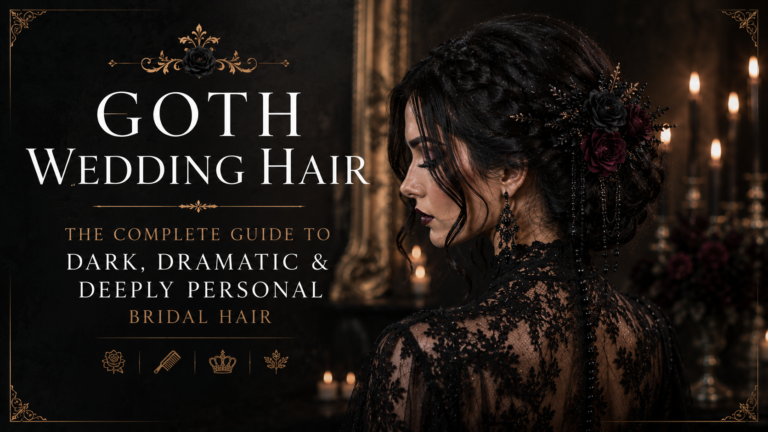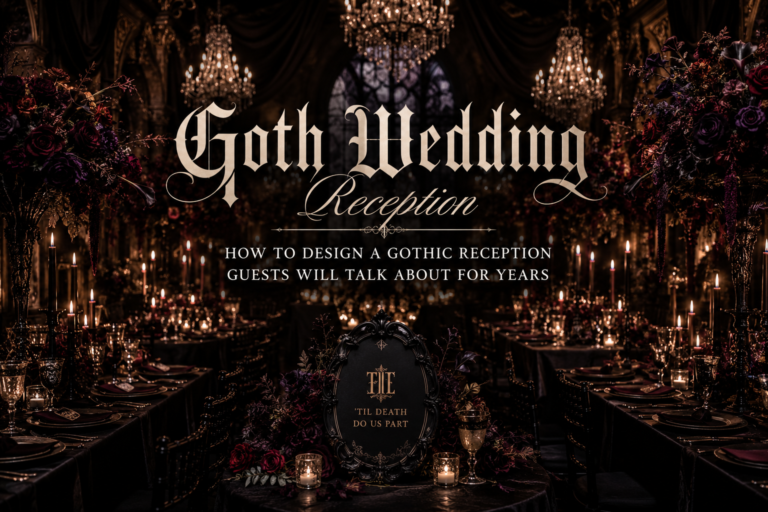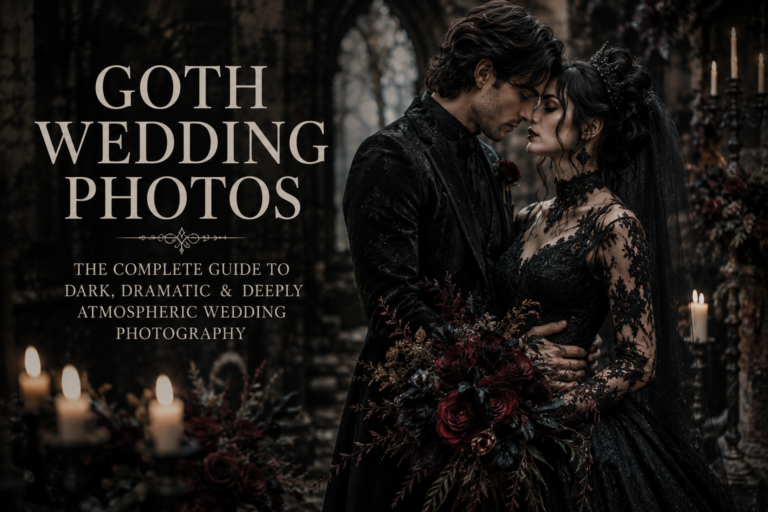
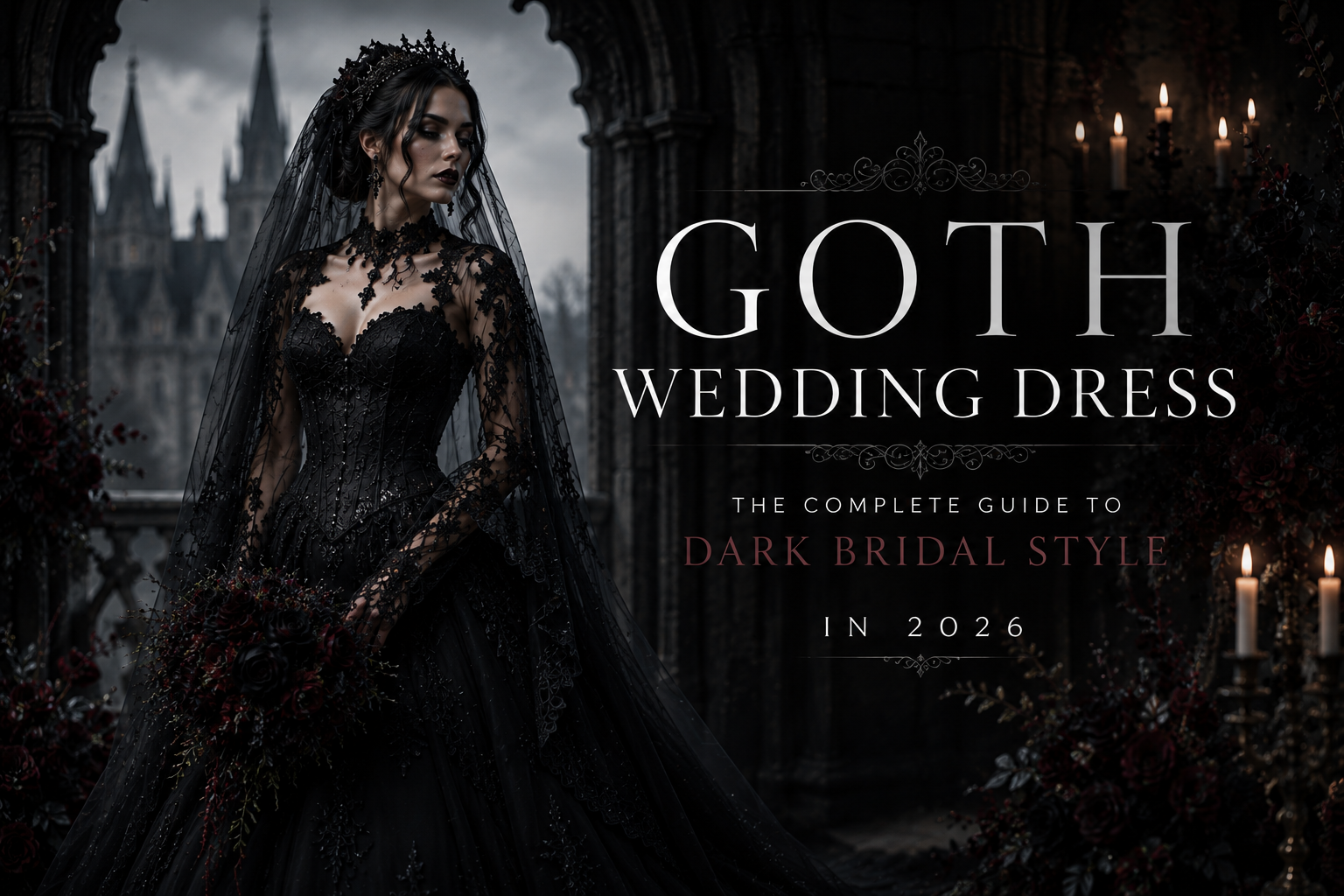
Goth Wedding Dress – The Complete Guide to Dark Bridal Style in 2026
The Gothic Bridal Edit · 2026
Goth Wedding Dress
The Complete Guide to Dark Bridal Style in 2026
From near-black ballgowns and Victorian lace to dramatic capes, blood-red velvet, and the most beautifully dark bridal looks of the year — your definitive guide to the goth wedding dress in 2026.
Introduction
Why the Goth Wedding Dress Is One of the Most Beautiful Bridal Choices You Can Make
There is a particular kind of courage required to choose a goth wedding dress — and it has nothing to do with the darkness of the fabric or the drama of the silhouette. It has to do with the willingness to stand at the altar in a gown that is completely, honestly you — a garment that makes no concession to convention, asks no permission from tradition, and communicates, in the most direct and beautiful way possible, exactly who you are and what you believe a wedding day should feel like. This is the courage that the best goth brides bring to their wedding dress choice, and the photographs they take home are invariably among the most striking, the most personal, and the most enduringly beautiful in the entire genre of wedding photography.
The goth wedding dress in 2026 exists across a richer, more nuanced, and more technically accomplished range than at any previous point in the history of alternative bridal fashion. It is no longer limited to a single silhouette or a single shade of black. Today’s goth bridal aesthetic encompasses the Victorian-influenced long-sleeved lace gown in deep plum or oxblood, the architectural near-black ballgown with a cathedral train and a corset bodice, the sleek column dress in midnight charcoal with a dramatic back detail, the dramatic two-piece in black velvet with a sheer lace panel, and everything in between. The goth wedding dress in 2026 is a category of extraordinary creative richness — as varied and as personal as the brides who choose it.
This guide covers every dimension of the goth wedding dress in full — from the defining silhouettes and fabrics of 2026 to colour choices, accessories, styling, the planning timeline, how to find the right designer, and the ten most important things every goth bride should know before she says yes to the dress that is completely, darkly, perfectly hers.
2026 Silhouettes
10 Goth Wedding Dress Silhouettes That Define Dark Bridal Style
The goth bridal aesthetic in 2026 encompasses a wider range of silhouettes than any previous year — from the dramatically structured and historically referenced to the sleekly contemporary. Each of the following ten represents a fully formed creative direction in its own right, and each can be realised in a range of dark colours, fabrics, and detail treatments that make it entirely personal to the bride who chooses it.
01
The Victorian Lace Gown
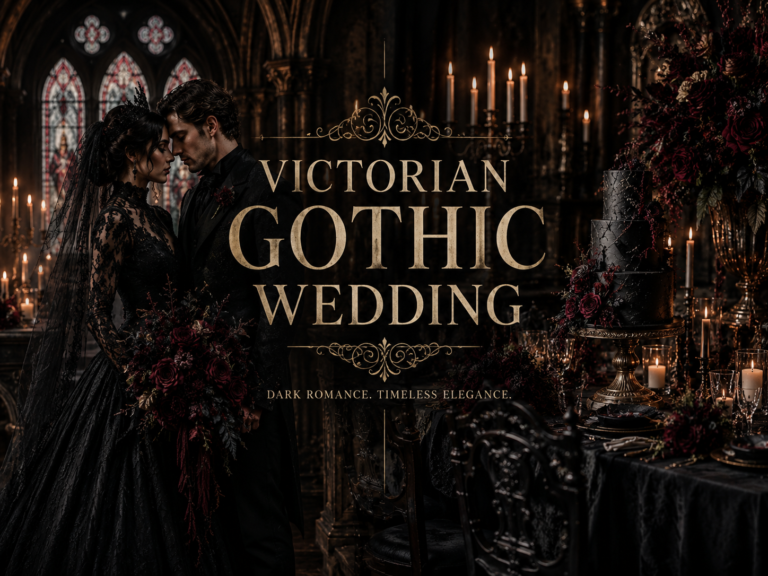
The most historically authentic of all goth wedding dress silhouettes — a high-necked, long-sleeved gown in black, deep plum, or oxblood Chantilly or Guipure lace over a silk lining in the same tone. The Victorian silhouette — fitted bodice, full skirt, long sleeves with lace cuffs, and a high collar — is simultaneously the most period-faithful and the most photographically extraordinary choice available to the goth bride. It reads as both intensely bridal and completely, darkly personal. The row of covered buttons running from neck to hem is the essential finishing detail. Nothing else will do.
02
The Near-Black Ballgown
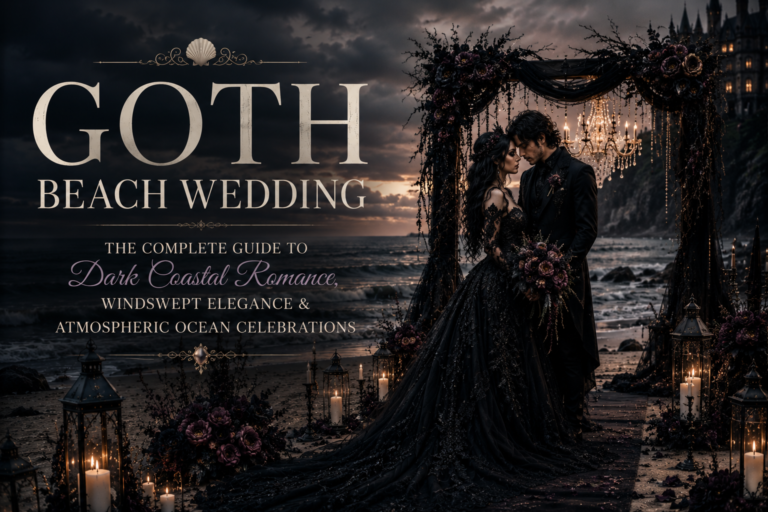
A full-skirted ballgown in very deep charcoal, near-black silk duchess satin, or midnight navy organza — structured, voluminous, and architecturally commanding. With a cathedral train and a corseted bodice, this is the most dramatically beautiful goth wedding dress available and the one that produces the most immediately, viscerally powerful bridal photographs. The train should be long enough to require a train holder. The skirt should be full enough to require multiple petticoats. Scale is not optional here — it is the entire point.

03
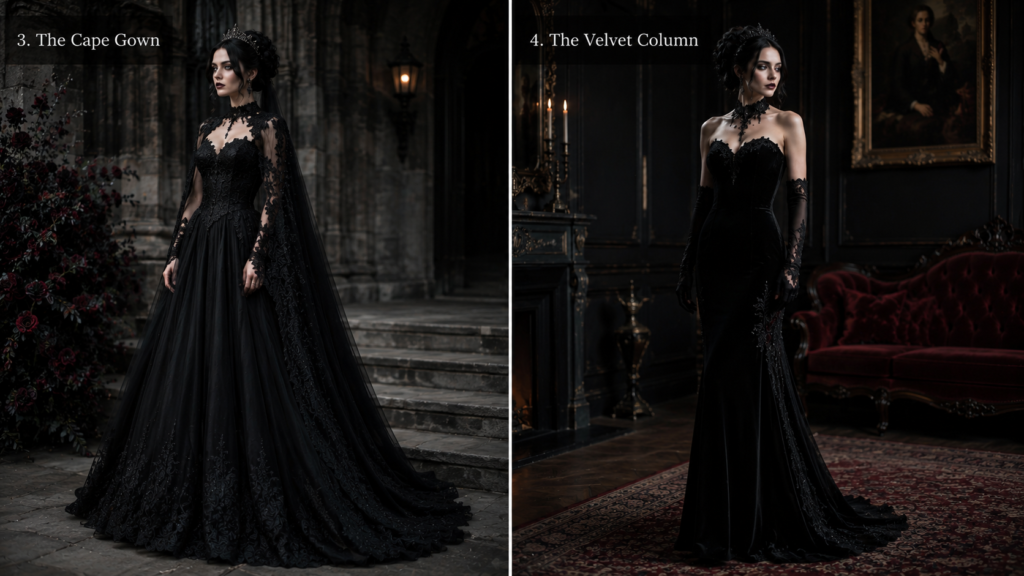
The Cape Gown
A fitted base gown in black crepe or silk velvet worn with a dramatic floor-length or cathedral-length cape in matching or contrasting dark fabric — black lace over midnight velvet, deep plum over near-black silk, or oxblood velvet over ivory with a deep lining. The cape adds movement, drama, and the specifically theatrical quality that the goth aesthetic rewards. It also solves the practical question of covering the shoulders for any religious ceremony setting without sacrificing a single degree of visual impact. The transformation from ceremony to reception by removing the cape is one of the most effective and most photographed styling moments in all of goth bridal fashion.
04
The Velvet Column
A sleek, structured column gown in silk velvet — in near-black, deep forest green, midnight plum, or oxblood — with a long, slightly flared skirt that moves beautifully in motion and a bodice that fits with architectural precision. The velvet column is the most contemporary of the goth wedding dress silhouettes and the one that suits the bride whose aesthetic leans toward the darkly modern rather than the historically gothic. It requires perfect fit above all else — velvet is unforgiving of alterations errors, and this gown should be made to measure wherever the budget allows.
05
The Corset Gown
A structured corset bodice — either as an over-piece worn above a separate skirt or as the architectural foundation of a full gown — in black brocade, dark floral damask, or lace-up leather, paired with a dramatic skirt in any dark colour or texture. The corset is one of the most historically grounded elements of gothic aesthetics, referencing directly the Victorian and Edwardian foundation garments that underpin the whole tradition. Worn as the dominant feature of the gown rather than concealed beneath it, it transforms the wedding dress into something that reads as costume in the most glorious, most genuinely theatrical sense of that word.
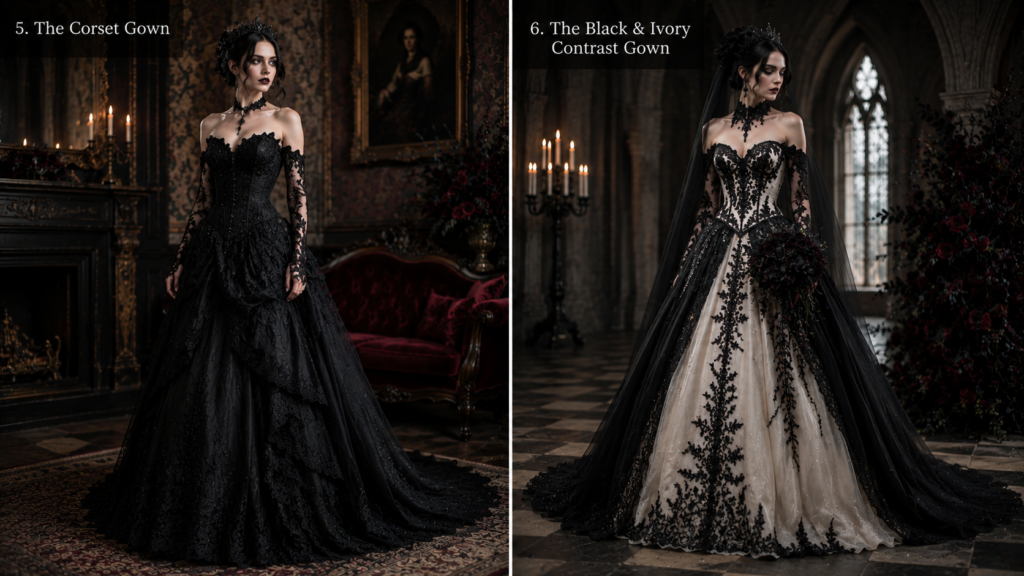
06
The Black & Ivory Contrast Gown
A gown that uses the contrast between black and ivory or white as its defining design language — a black lace bodice over an ivory silk base, a black velvet skirt with ivory silk lining visible at the train, or a ivory gown with a black lace overlay on the bodice and sleeves only. This approach bridges the goth aesthetic and the traditional bridal one in a way that is neither compromise nor confusion — it is the most sophisticated and the most genuinely bridal of all the goth wedding dress options, and the one most likely to produce photographs that read as completely beautiful to guests of every aesthetic persuasion.
07
The Blood Red Gown
One of the most powerful and most photographically arresting of all goth wedding dress choices — a full-length gown in deep oxblood, wine, or crimson silk velvet or duchess satin. Not a coloured accent. The entire gown in a single deep blood-red tone. This choice takes the greatest confidence of any on this list and produces the most immediate, most visceral bridal imagery of any goth wedding dress when executed with complete commitment. The blood red gown in a candlelit stone church or a gothic ruin is one of the most extraordinary images in all of contemporary wedding photography.
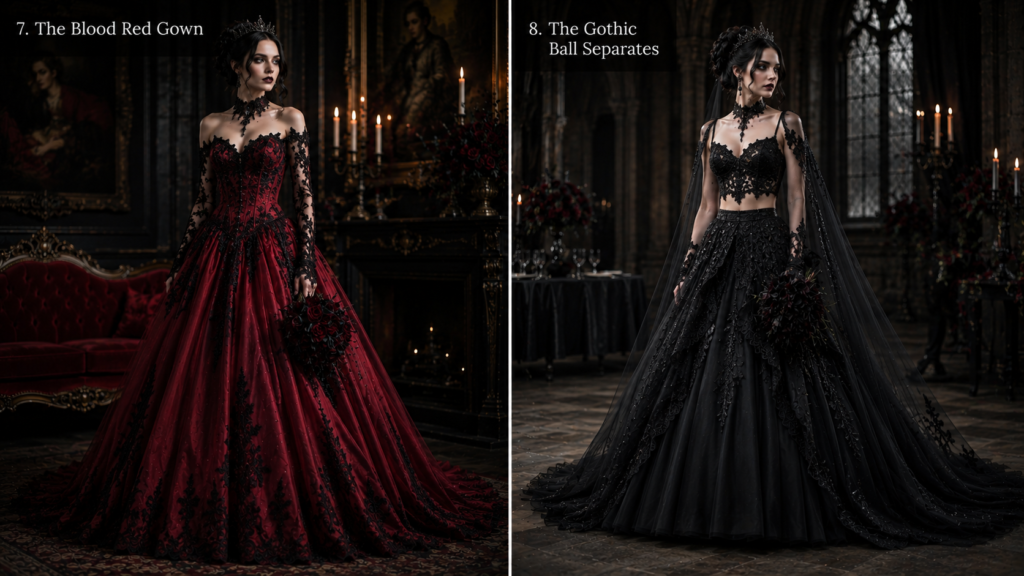
08
The Gothic Ball Separates
A structured corset or fitted bodice top worn with a separate, dramatically full ball skirt — both in coordinating dark tones or in deliberate contrast. Black lace bodice with a plum duchess satin skirt. Oxblood velvet corset with a near-black tulle skirt. The separates format allows for maximum individual expression within the goth aesthetic and for the most practical reception transformation: removing the full skirt to reveal a fitted mini or midi beneath for the dance floor is a theatrical goth bridal moment that always generates a response.
09
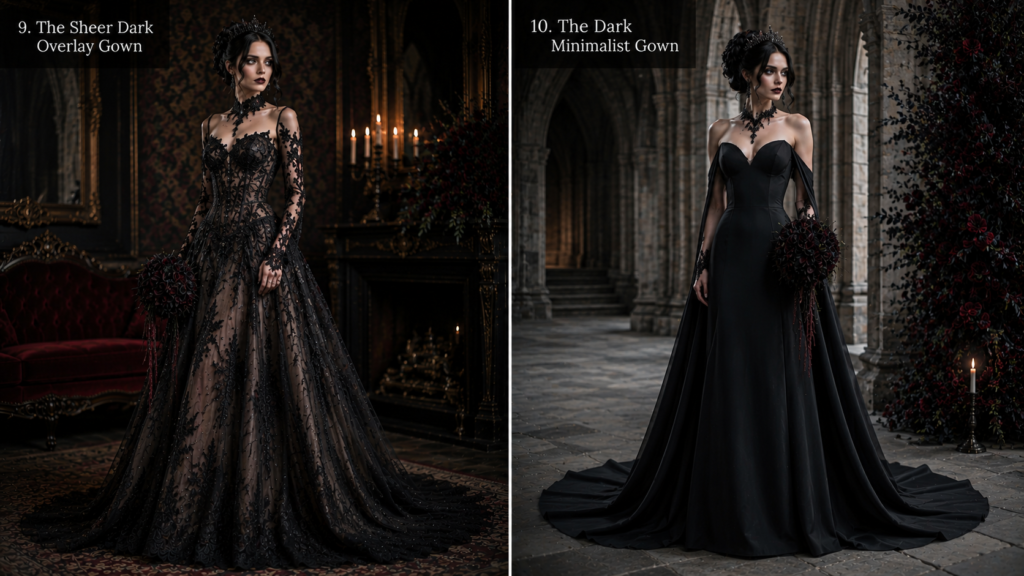
The Sheer Dark Overlay Gown
A gown with a sheer black or dark-toned outer layer — organza, chiffon, or tulle — over a contrasting lining in ivory, bone, or a jewel tone. The sheer overlay creates a floating, ethereal quality that contrasts beautifully with the goth aesthetic’s usual visual density, and when the lining is in a warm tone — ivory, blush, or gold — the effect of dark fabric over pale underlining is one of the most genuinely beautiful and most technically sophisticated options in all of gothic bridal design. It photographs with extraordinary depth and complexity.
10
The Dark Minimalist Gown
For the goth bride whose aesthetic leans toward the sleek, the structured, and the contemporary — a minimal bias-cut or column gown in near-black charcoal, deep slate, or very dark navy crepe. No embellishment. No overlay. No florals. Just the perfect cut, the perfect fabric, and the statement accessories that complete the look. The dark minimalist gown is perhaps the most quietly powerful of all goth wedding dress choices — its confidence lies entirely in what it omits, and when it is executed with genuine precision it is among the most beautiful and most memorable of all bridal looks.
“The goth wedding dress that will be remembered is not the most expensive, the most elaborate, or the darkest. It is the one that looks so completely like the bride wearing it that guests cannot imagine her in anything else. That is always the right dress.”
— The Gothic Bridal Edit
Fabric & Colour
Goth Wedding Dress Fabrics and Colours: The Materials of Dark Bridal Beauty
The fabric of a goth wedding dress is not a background detail — it is a primary creative decision that determines how the gown photographs, how it moves, how it feels against the skin for twelve or more hours, and how it interacts with the specific lighting conditions of the ceremony and reception venue. Different dark fabrics respond to candlelight, flash photography, and natural light in dramatically different ways, and understanding those differences is as important as choosing the silhouette or the colour.
Silk velvet is the supreme fabric of the goth wedding dress — it absorbs light rather than reflecting it, creating a depth and richness that no other textile can replicate in candlelight or low-light photography. It is heavy, luxurious, and completely unforgiving of poor fit, which means it requires the highest quality of construction and the most precise alterations of any fabric on this list. The result, when everything is right, is a gown of genuinely extraordinary visual impact — the kind that stops conversation when the bride enters the room. Black silk duchess satin is the second great goth fabric: structured, with a subtle sheen that catches light beautifully, and heavy enough to support the architectural silhouettes that the aesthetic favours. Chantilly and Guipure lace in black are the defining detail fabrics — used as overlay, sleeves, or bodice panels, they carry the historical depth of the gothic tradition in every intricacy of their pattern.
Premier Goth Fabrics
- Silk velvet — the supreme goth bridal fabric, deep and light-absorbing
- Black Chantilly lace — delicate, historical, and intensely romantic
- Black Guipure lace — more graphic and structural than Chantilly
- Duchess satin in dark colours — structured, with a subtle dark sheen
- Heavy crepe — modern, sculptural, and perfectly minimal
- Black organza — sheer, dramatic, and extraordinarily photogenic
- Dark brocade — richly patterned, historical, and deeply textured
- Sheer black tulle — ethereal and voluminous for skirts and overlays
Goth Wedding Dress Colours
- Near-black — the deepest, most dramatic, and most defining choice
- Oxblood and deep wine — richly romantic and intensely seasonal
- Midnight plum and deep aubergine — jewel-toned and beautifully dark
- Deep forest green — unexpected, striking, and completely distinctive
- Midnight blue and deep navy — sophisticated dark alternatives to black
- Deep charcoal — a lighter alternative that still photographs as dark
- Black and ivory contrast — the most photographically complex combination
- Blood red — the boldest and most theatrically powerful choice of all
The Photography Test for Dark Fabrics
Before finalising any goth wedding dress fabric, ask your boutique or designer to photograph a swatch in three different lighting conditions: daylight, candlelight, and flash photography. Very dark fabrics behave entirely differently across these three conditions — silk velvet that appears one of the most beautiful fabrics available in candlelight can appear flat and texture-less under flash. Near-black charcoal crepe that looks powerful in daylight can disappear into the background in low light. Test before you commit, and brief your photographer specifically on how to expose for dark fabrics in your specific venue’s lighting conditions.
Accessories
Goth Wedding Dress Accessories: The Details That Complete the Dark Look
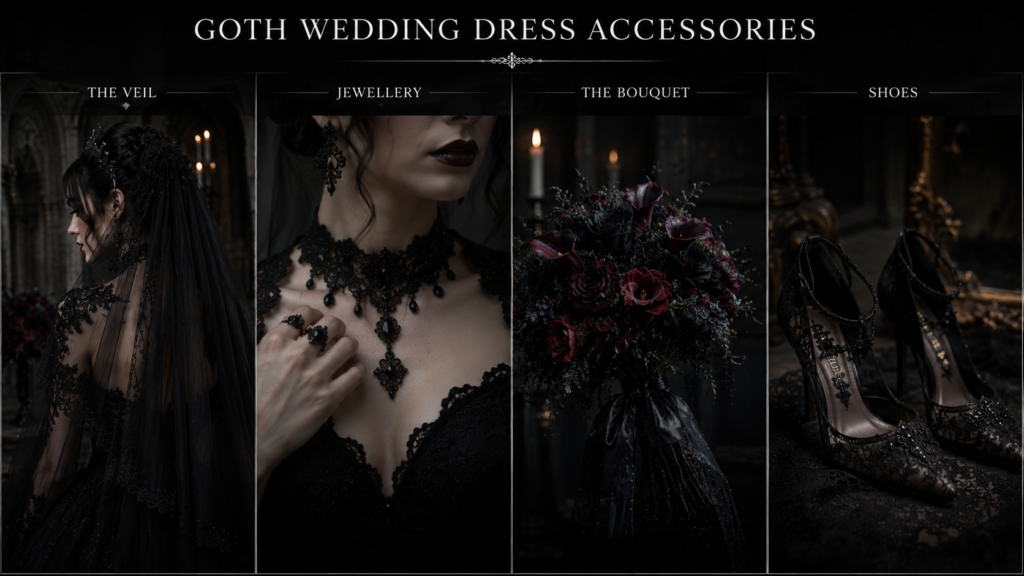
The accessories that complete a goth wedding dress are chosen with a different set of priorities from any other bridal aesthetic. Where conventional bridal accessories aim to complement without competing, goth bridal accessories are often designed to add a second layer of statement — to deepen and extend the visual language of the gown rather than merely support it. The wrong accessories will undermine even the most perfectly chosen goth wedding dress. The right ones will make the whole look feel completely inevitable — as though every element was designed for each other specifically.
👑
The Veil
A black or very deep ivory cathedral-length veil in French silk tulle or black lace is the most dramatically beautiful of all goth bridal accessories. A long black lace mantilla is the most historically gothic option. An ivory veil over a black gown creates a striking visual contrast that photographs magnificently.
💎
Jewellery
Oxidised silver, aged gold, or dark-toned pieces set with garnet, onyx, amethyst, or black diamonds. Statement chokers or layered chains for Victorian or contemporary goth. A single significant ring. Avoid anything that reads as conventional or mainstream bridal.
🌹
The Bouquet
Black Baccara roses, deep burgundy dahlias, near-black hellebores, and dark anemones in a loose, slightly asymmetric arrangement. Dried botanicals including lunaria and dark seed pods. Or a single perfect stem of black rose carried with complete minimalist confidence.
👢
Shoes
Platform heels or block-heeled Victorian boots for maximum gothic drama. Lace-up ankle boots beneath a full-length gown add a discovered detail that rewards close attention. Black satin heels for formal venues. Patent leather for the sleekest contemporary looks.
Hair & Makeup
Goth Bridal Hair and Makeup: The Face That Belongs to the Dress
The goth wedding dress demands a hair and makeup approach that is in active, deliberate conversation with the gown — not softening or contradicting it but extending and deepening its visual language. The most common mistake in goth bridal styling is the application of a conventional, soft, blush-toned makeup look to a goth gown — the aesthetic incongruity between the darkness of the dress and the ordinariness of the face creates a disconnect that makes neither the dress nor the makeup look as powerful as it could. The goth wedding look is complete only when every element — gown, accessories, hair, makeup, and expression — is speaking the same language.
Makeup Approaches
- The Classic Gothic: Pale, flawless foundation — not grey but intensely luminous ivory. Deep, smoky eye in black and dark plum. A deep berry or near-black lip. Bold brow. The most immediately recognisable and most historically rooted goth bridal makeup.
- The Dark Romantic: Dewy, slightly flushed skin with a natural-looking foundation. Deeply pigmented eye — smoked charcoal or dark plum. A deep burgundy or oxblood lip that echoes the gown’s palette. More romantic than gothic, but entirely appropriate.
- The Minimalist Goth: Perfect skin in the bride’s actual tone, not paled down. A graphic black liner wing. A dark, deeply pigmented lip — near-black or deep wine. No eyeshadow. No excess. The most contemporary and most quietly powerful of all the approaches.
- The Ethereal Dark: Sheer, skin-like base with deliberately blurred edges. Deep, smudged kohl at the eyes — no sharp lines. A pale, almost translucent lip. Designed to appear as though the face itself belongs to another world rather than to another aesthetic category.
Hair Directions
- The Victorian Updo: Hair pinned high with deliberate looseness — escaping tendrils, dark flowers or black pins threaded through. The most historically gothic and the most classically bridal simultaneously.
- The Dark Wave: Long, loose waves worn down with a deep side parting — the most romantic and the most moveable goth bridal hair option. Photographs magnificently in both outdoor and low-light conditions.
- The Structured Bun: A low, architectural bun or chignon — clean, severe, and completely deliberate. Leaves the back neckline and any dress back detail completely exposed.
- The Dark Floral Crown: Fresh or dried dark botanicals — black dahlias, dark anemones, dried lunaria — woven into a crown worn over loose hair or an updo. The most visually spectacular of all goth bridal hair choices.
Finding the Right Designer
Where to Find Your Goth Wedding Dress: Designers, Boutiques, and Made-to-Order
Finding the right goth wedding dress requires a different approach from the conventional bridal boutique experience. Most mainstream bridal boutiques — however friendly and however well-intentioned — do not stock the dark colours, the Victorian silhouettes, or the specific alternative fabrics that the goth bridal aesthetic requires. Walking into a conventional bridal shop expecting to find a near-black velvet ballgown will almost always result in disappointment and a well-meaning attempt to steer you toward something ivory and strapless. The goth bride needs to be more specific, more deliberate, and more willing to look beyond the high street bridal experience.
🖤 Alternative Bridal Designers
There is a growing community of bridal designers who specialise specifically in the alternative, dark, and gothic bridal market. Search specifically for alternative bridal designers, gothic wedding dress makers, and dark bridal boutiques. Their portfolios will contain exactly what you are looking for, and their consultations will not require you to justify or explain your aesthetic preferences to someone who is trying to redirect you elsewhere.
✂️ Bespoke and Made-to-Order
A bespoke goth wedding dress — commissioned from a skilled dressmaker who is sympathetic to the aesthetic — is often the best route to exactly the dress you have in your imagination. It allows complete control over every element: the silhouette, the fabric, the colour, the detail treatment, and the fit. It requires the longest lead time (nine to twelve months minimum) but produces the most personal result.
🎨 Customising a Mainstream Gown
Some goth wedding dress looks can be achieved by purchasing a conventional bridal silhouette in ivory or white and having it dyed, overdyed, or reconstructed with dark lace additions and detail changes by a skilled dressmaker. This approach requires significant alterations expertise but can produce extraordinary results at a lower cost than a fully bespoke gown.
Planning Timeline
The Goth Wedding Dress Planning Timeline
The goth wedding dress requires a longer planning lead time than a conventional bridal gown for several specific reasons. Dark fabrics are harder to source in the required quality and weight. Alternative bridal designers have smaller production capacities and longer wait times than mainstream boutiques. Bespoke construction in complex fabrics such as silk velvet requires more skilled fitting appointments. And the dyeing of fabrics to specific dark tones — a route chosen by some goth brides — adds a further variable to the production timeline. Begin the process significantly earlier than you think is necessary, and treat the timeline below as a minimum rather than a guide.
Your Planning Calendar
- 18–24 months out: Begin researching alternative and gothic bridal designers. Commission bespoke work at this stage for the most complex designs in velvet or lace.
- 12–15 months out: Book your designer or boutique. Order placed with full measurements and design brief agreed. Fabric sourcing begins.
- 8 months out: First toile or sample fitting if bespoke. Assess silhouette and proportion before working in the final fabric.
- 5 months out: First fitting in the actual fabric. Major structural alterations addressed at this stage only.
- 3 months out: Second fitting with all accessories present — veil, shoes, headpiece, jewellery. The total look must be assessed together.
- 6 weeks out: Final fitting. Minor adjustments only. Confirm collection date and care instructions.
- 1 week before: Collect and steam. Brief whoever will help you dress on the morning of the wedding on every element of the look.
Goth-Specific Considerations
- Silk velvet requires specialist steaming — confirm this with your dressmaker before collecting
- Dark fabrics show dust and lint significantly — have a lint roller in your emergency kit
- Test every accessory with the dress in motion — heavy capes and trains require rehearsal
- Brief your photographer specifically on exposing for very dark fabrics in your venue
- Have a complete spare of any dark-coloured tights, hosiery, or underlayers
- Test your shoes on the same surface as your venue floor before the wedding day
Practical Planning
Ten Things Every Goth Bride Should Know Before Choosing Her Dress
- Begin your search significantly earlier than mainstream bridal timelines suggest. Alternative and bespoke goth wedding dresses require longer production times, and the most skilled gothic bridal designers fill their calendars faster than you expect. Eighteen months before your wedding date is not too early to begin the process if your chosen designer works in complex fabrics or very high demand.
- Always take your designated photographer for a test shoot before the wedding. Dark fabrics in dark venues are one of the most technically demanding challenges in wedding photography. A goth wedding dress that is not photographed with specific exposure compensation for dark fabric can appear as a featureless black shape in otherwise beautiful images. Book a portrait shoot with your actual photographer in a similar lighting environment to your venue before the wedding day and establish exactly how to capture your dress correctly.
- Trust your instincts and ignore everyone else’s. The goth wedding dress choice will attract more unsolicited opinions from family, friends, and wedding vendors than almost any other bridal decision. Develop your filter early, brief your inner circle on your aesthetic vision clearly and firmly, and remember that you are the one who will be wearing the dress and the one whose photographs will represent the day for the rest of your life. Their comfort with the choice is irrelevant. Yours is everything.
- Always have a toile or sample fitting before working in the final fabric. This applies to all complex bridal gowns but especially to goth wedding dresses in velvet, brocade, or structured dark fabrics. These materials are expensive, difficult to alter, and entirely unforgiving of structural errors. A toile in a cheap fabric of the same weight allows every structural decision to be made and corrected before a single metre of the final cloth is cut.
- Test the complete look together in the specific lighting conditions of your venue. A goth bridal look assembled and tested in a brightly lit dressing room will look entirely different under the candlelight, low-lighting, or natural outdoor light of the actual wedding. Visit your venue and photograph the complete look — dress, accessories, hair, makeup — in the actual lighting conditions you will be married in. This single step prevents more wedding day disappointments than any other.
- Brief every supplier who will see you on the wedding morning. Your hair stylist, your makeup artist, your photographer, and whoever helps you dress should all have seen the complete look in advance and understand exactly what it requires. A makeup artist who has not seen your goth wedding dress before arriving on the wedding morning may default to soft bridal makeup that completely undermines the aesthetic you have spent months building. Visual references, shared mood boards, and advance appointments with all suppliers are non-negotiable.
- Plan the wear test before the wedding day. A dramatic goth wedding dress — particularly one with a long train, a complex cape, a structured corset, or significant volume — will affect how you move, sit, dance, and use stairs in ways you cannot predict until you have worn it for several hours. Do a full wear test of two to three hours at home in the complete outfit before the wedding day. Identify every practical issue — every constriction, every tripping hazard, every place where the construction pinches or pulls — and have it addressed before the final fitting.
- Silk velvet is the most beautiful and the most demanding of all goth wedding dress fabrics. It requires specialist steaming (never ironing), it marks with pressure and moisture, it attracts lint and dust visibly, and it must be stored hanging rather than folded to prevent permanent creasing. If you choose silk velvet, understand its care requirements from the day you order and have a dedicated plan for looking after it on the wedding morning and throughout the day.
- The goth wedding dress exists within a complete aesthetic system. The most powerful goth bridal looks are those where every element — the dress, the accessories, the hair, the makeup, the flowers, the venue, and the overall atmosphere of the day — speaks the same visual language. A near-black velvet ballgown in a bright, modern, white-walled venue will look out of place no matter how beautiful the gown. Choose every element of your wedding day in relationship with the dress, and let the dress be the north star from which all other aesthetic decisions radiate.
- The right goth wedding dress will feel completely inevitable. Not alarming. Not a compromise. Not a statement for other people’s benefit. Completely and simply inevitable — the way the right dress always does when you have found it. The moment of recognition may come in the first boutique or the tenth, in a mainstream bridal shop that happens to have one dark gown on the rail or in a bespoke designer’s studio where they have made exactly what you described. When it happens, trust it completely. That is the dress. That has always been the dress.
“There is a moment in every fitting room — sometimes expected, sometimes completely surprising — when a goth bride stops looking at the dark gown in the mirror and simply becomes it. When the darkness and the beauty and the absolute personal rightness of the thing are all suddenly, completely obvious. That is the dress. The only dress. The one she was always going to wear.”
— The Gothic Bridal Edit
Final Thoughts
The Goth Wedding Dress Is One of the Most Beautiful Things a Bride Can Wear
There is a prevailing cultural assumption that the bridal gown must be white, or very close to white, in order to fulfil its function as a wedding dress — as though the colour itself carries the meaning rather than the person wearing it. The goth bride rejects this assumption completely, and she is right to do so. The meaning of a wedding dress has never resided in its colour. It has always resided in the relationship between the gown and the woman inside it — the specific, unrepeatable, completely personal quality of a dress that was made for or chosen by a particular person for the most important day of her life, and that communicates, in every detail of its construction, something true about who she is.
The goth bride who walks down the aisle in a near-black velvet ballgown with a cathedral lace veil and a bouquet of black roses is not subverting the tradition of the bridal gown. She is fulfilling it — at its most honest, most personal, and most genuinely beautiful level. The tradition was never about the colour. It was always about the commitment. The love. The completely deliberate choice to stand in front of the people who matter most and say: this is who I am, and today I am celebrating it in the most beautiful way I know how.
Find the designer who understands your vision. Commission the fabric that is worthy of the occasion. Wear the dark gown that is completely, unmistakably yours. And walk down the aisle in it with the specific, quiet confidence of someone who made exactly the right choice — and has never for a single moment doubted it.