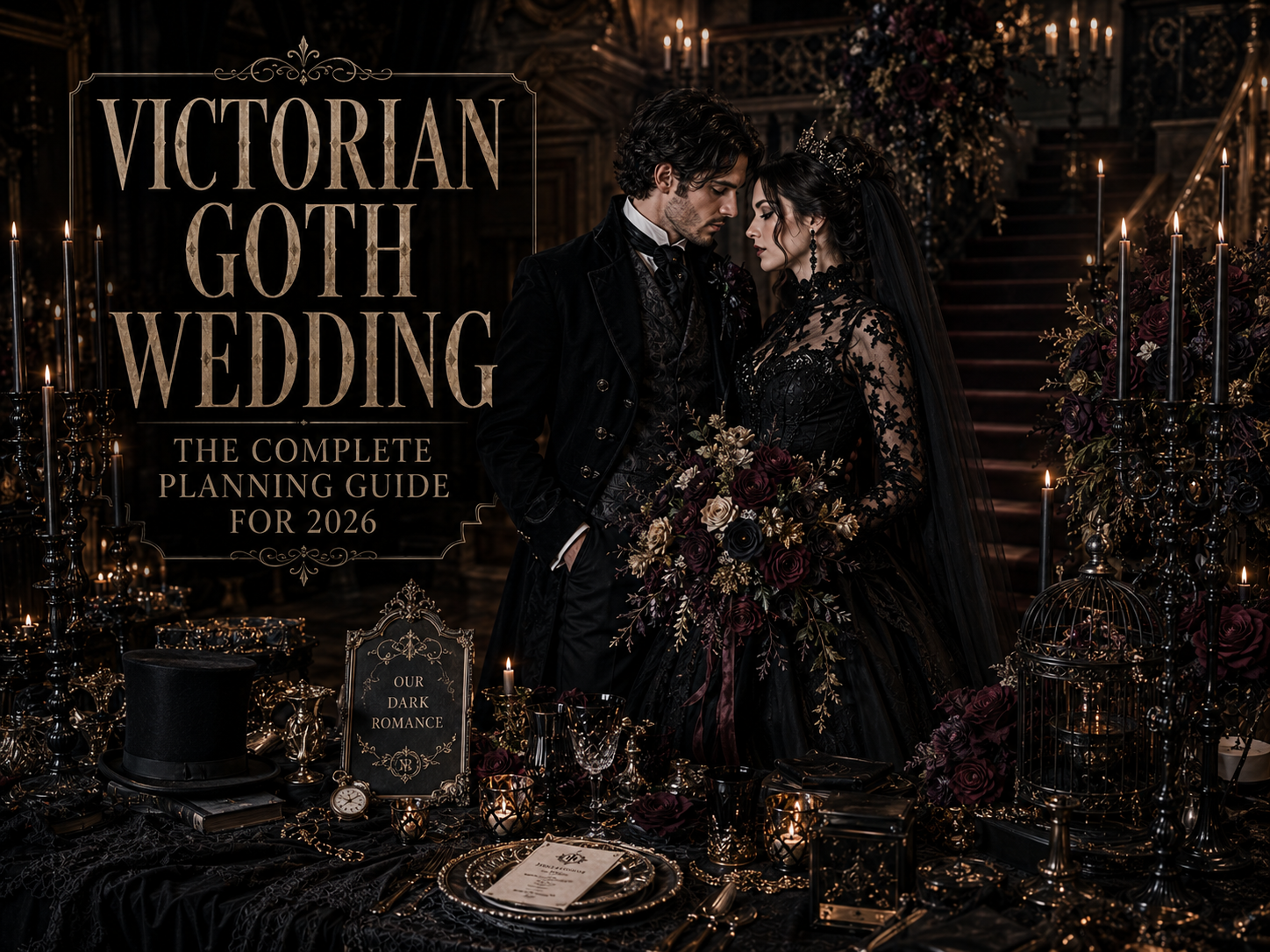
Victorian Goth Wedding – The Complete Planning Guide for 2026
The Gothic Wedding Edit · 2026
Victorian Goth Wedding
The Complete Planning Guide for 2026
Dress, venue, flowers, decor, fashion, stationery, menu, music, guest experience, and everything in between — your definitive guide to planning the perfect Victorian goth wedding in 2026.
A Victorian goth wedding is not a costume drama or a period reconstruction. It is a contemporary celebration built from the specific aesthetic inheritance of the Victorian era — its darkness, its romance, its formal beauty, and its profound, unflinching relationship with mortality — and inhabited with complete personal conviction by two people who genuinely belong to that world.
Introduction
Why the Victorian Goth Wedding Is the Most Historically Rich and Most Personally Demanding of All Dark Bridal Aesthetics
The Victorian era produced the most complete, the most codified, and the most visually extraordinary dark aesthetic in the history of Western culture. Between approximately 1837 and 1901, the period that bears Queen Victoria’s name generated an unprecedented richness of dark material culture — in its architecture, its fashion, its literature, its photography, its mourning traditions, its botanical obsessions, and its deeply ambivalent relationship with mortality, beauty, and the supernatural. This richness is the raw material from which the Victorian goth wedding is built, and it provides a creative brief of extraordinary depth and specificity — far more historically grounded and far more formally detailed than any other dark wedding aesthetic available.
The Victorian goth wedding in 2026 is distinguished from the wider goth wedding aesthetic by its specific, consistent historical literacy — by the deliberate use of Victorian design languages, Victorian floral traditions, Victorian dress codes and their contemporary interpretations, Victorian stationery and typography conventions, and the characteristic Victorian quality of finding beauty in darkness, formality in grief, and romance in mortality. It is the aesthetic of Bram Stoker and Wilkie Collins, of the Pre-Raphaelite Brotherhood and the Arts and Crafts movement, of jet mourning jewellery and cabinet photography, of dark botanical illustration and Gothic Revival architecture. It is also, in 2026, one of the most creatively alive and most personally expressive of all alternative wedding aesthetics — because its historical depth gives every contemporary interpretation a foundation of genuine meaning rather than mere style.
This guide covers every element of the Victorian goth wedding — from the color palette, venue, dress, and flowers to the decor, fashion, stationery, menu, music, and guest experience — with the creative depth and practical specificity needed to plan a celebration that is genuinely, historically, completely extraordinary.
Color Palette
The Victorian Goth Wedding Color Palette: Mourning Black, Jewel Depth, and Aged Gold
The Victorian mourning tradition produced one of the most precisely codified colour systems in the history of Western dress — a formal hierarchy of black, grey, mauve, and white that governed how the bereaved dressed in the months and years following a death, and that generated some of the most visually extraordinary garments in the entire history of fashion. The Victorian goth wedding palette draws on this tradition directly — not to replicate mourning dress but to inhabit its characteristic visual richness: the depth of mourning black against bone-white, the warmth of aged gold against near-black, the specific quality of deep purple and midnight navy as the transitional tones that appear at the edges of the mourning palette. These are the colours of cabinet photography and jet jewellery, of gaslamp interiors and dark botanical illustration — the specific, historically layered colours that make the Victorian goth wedding palette immediately and unmistakably different from any other dark aesthetic.
Mourning Black
The anchor. The primary tone of the Victorian mourning tradition and the foundation of every decision.
Bone White
The luminous contrast. The white of a Victorian calling card, a pressed flower, a mourning glove.
Aged Gold
The warmth. In jewellery, candleholders, stationery ink, and every metallic accent throughout.
Midnight Plum
The transitional jewel. The mourning half-tone — dark but not black, rich with Victorian depth.
Deep Oxblood
The romantic dark. In florals, velvet accents, and the warmest notes of the palette.

Venue
The Victorian Goth Wedding Venue: Gothic Architecture as the First Act of Design
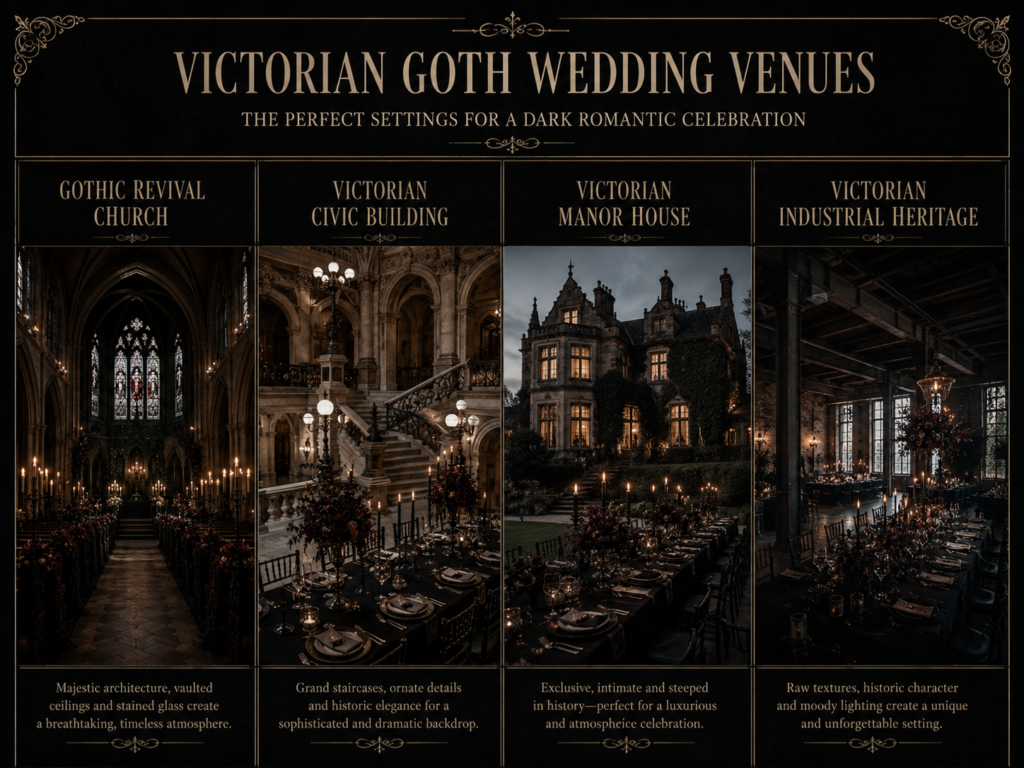
The Victorian goth wedding requires a venue with genuine Victorian or Gothic Revival architectural character — a space where the bones of the building carry the aesthetic before a single decoration has been placed. The Victorian era was one of the greatest periods of architectural production in the history of Britain and Western Europe, and its legacy in stone, brick, and iron provides the goth wedding couple with an extraordinary range of genuinely appropriate venues: Gothic Revival churches with their pointed arches and carved stonework, Victorian manor houses with their gaslit state rooms and patterned tile floors, industrial heritage buildings with their exposed ironwork and brick, and the specific grandeur of Victorian civic buildings — museums, libraries, and assembly rooms — that were built with the explicit intention of impressing and elevating all who entered them.
⛪
Gothic Revival Church
The most authentically Victorian goth venue of all. Pointed arches, carved stonework, stained glass, wooden pews, and the specific quality of ecclesiastical atmosphere that a Victorian Gothic Revival church provides makes it the most completely appropriate ceremony space available. The processional aisle beneath a Victorian gothic vault is simply one of the most extraordinary architectural spaces in all of wedding ceremony photography.
🏛️
Victorian Civic Building
A Victorian town hall, library, museum, or assembly room — with its grand staircases, ornate plasterwork, patterned tile floors, and the specific civic grandeur of a period built to impress. These buildings provide extraordinary spaces for both ceremony and reception and carry the Victorian aesthetic in every surface and proportion of their construction.
🏰
Victorian Manor House
A Victorian country house with original period interiors — patterned wallpaper, ornate fireplaces, heavy curtains, and the specific domestic grandeur of the Victorian upper class. Provides both ceremony and reception spaces of extraordinary atmospheric quality and genuine historical authenticity.
🏗️
Victorian Industrial Heritage
A converted Victorian warehouse, pump house, or mill — with its exposed ironwork, brick arches, and industrial-gothic aesthetic — creates a specific, darker, and more urban interpretation of the Victorian goth wedding that is completely unlike any other venue format. Particularly powerful for couples whose aesthetic leans toward the darker and more industrial edges of the Victorian tradition.
The Dress
The Victorian Goth Wedding Dress: Historical Silhouette, Dark Fabric, and Formal Construction
The Victorian goth wedding dress is the most formally and historically specific of all dark bridal garments — because the Victorian era produced the most precisely codified dress silhouettes in the history of Western fashion, and those silhouettes, translated into contemporary bridal terms, produce some of the most architecturally extraordinary and most personally powerful gowns available. The defining characteristics are consistent across every interpretation: a high collar or a deeply scooped Victorian neckline, long sleeves that end in lace cuffs, a fitted bodice with visible structural detail, a dramatically trained skirt in silk velvet or black lace, and the row of covered buttons from neck to hem that is the single most immediately and completely Victorian detail available in bridal fashion. Whether in near-black, very deep ivory, or a rich jewel tone, the Victorian goth wedding dress is immediately recognisable and historically specific in a way that no other dark bridal silhouette achieves.
Defining Silhouette Elements
- High Victorian collar or deeply structured neckline — the most immediately gothic detail
- Long sleeves ending in pointed cuffs or elaborate lace wrist detail
- Fitted, structured bodice — boned or corseted, with visible construction detail
- Full or trained skirt — in silk velvet, Chantilly lace, or black duchess satin
- Continuous row of covered buttons from neck to hem down the back
- A cathedral or sweep train — never short; the Victorian formal gown always touches the floor
- Black or very dark ivory — the Victorian mourning and formal dress palette
- Minimal embellishment — the Victorian aesthetic is structural, not decorative
Fabrics & Colours
- Black Chantilly lace — the most historically authentic of all Victorian goth dress fabrics
- Black silk velvet — the richest and most atmospherically powerful of all dark bridal fabrics
- Black duchess satin — structured, formally elegant, and deeply photogenic
- Deep ivory or bone white — for the bride whose Victorian reference is formal dress rather than mourning dress
- Midnight plum or deep oxblood silk — jewel-toned alternatives that read as completely Victorian in the right silhouette
- Black brocade — richly patterned and deeply historically resonant for bodice and detail elements
Flowers
Victorian Goth Wedding Flowers: The Flemish Still-Life Tradition in Dark Bloom
The Victorian era was one of the greatest periods of botanical obsession in the history of Western culture — the period that produced the Royal Botanic Gardens at Kew, the wardian case, the fern craze, and the extraordinary tradition of botanical illustration that documented every species collected by the Victorian empire’s explorers with the precision of scientific art. Victorian flower arranging had its own formal language — the language of flowers, or floriography, in which every bloom carried a specific symbolic meaning — and the Victorian goth wedding floristry honours that tradition by choosing flowers not only for their visual beauty but for their specific, historically loaded associations. Dark roses for eternal love and passionate depth. Black anemones, associated with forsaken love and death. Dark hellebores, the flowers of anxiety and melancholy in the Victorian language of flowers. Rosehips for the transience of beauty. Lunaria — honesty — for the commitment being made.
Victorian Dark Blooms
- Black Baccara roses — the defining Victorian goth wedding flower
- Dark anemones — near-black with white centre, historically associated with death
- Dark hellebores — deep plum and near-black; the Victorian flower of melancholy
- Deep burgundy garden roses — fragrant, fully petalled, intensely romantic
- Dark scabiosa — delicate, floating, associated with widowhood in Victorian floriography
- Chocolate cosmos — dark, velvety, and intensely fragrant
Victorian Foliage & Botanicals
- Dark ivy — historically gothic, trailing, and deeply Victorian in its associations
- Lunaria seed discs — honesty; the most symbolically appropriate Victorian botanical
- Rosehips on the stem — the transience of beauty in Victorian botanical language
- Dark ferns — the Victorian fern craze; essential for botanical authenticity
- Copper beech — rich dark foliage that reads as deeply Victorian in any arrangement
- Dried pressed botanicals — the Victorian herbarium tradition; for boutonnieres and hair
Decor
Victorian Goth Wedding Decor: Memento Mori, Dark Abundance, and Gaslit Atmosphere
Victorian interior design was one of the richest and most maximalist in the history of Western domestic culture — every surface covered, every room layered with pattern, texture, and the accumulated objects of a deeply material culture that believed in the moral and aesthetic value of beautiful things. The Victorian goth wedding decoration scheme draws on this tradition directly: dark wallpaper patterns as backdrops, heavy patterned velvet curtains, collections of framed botanical illustrations and cabinet photographs, taxidermy and natural history objects as decoration, the specific quality of Victorian object-accumulation translated into wedding decor. But it also draws on the Victorian memento mori tradition — the practice of using objects associated with mortality and time as decorative elements — which gives Victorian goth wedding decor its most distinctive and most historically specific quality: the skull candleholder, the hourglass, the jet jewellery displayed as decoration, the pressed flower in a dark frame.
🕯️ Lighting & Atmosphere
Real pillar candles in iron and brass holders at every height. Original or period-reproduction gas lamp-style fixtures where available. Amber glass hurricane lanterns. The Victorian celebration was lit by gas and candlelight — no LED, no cool-toned lighting of any kind. The quality of warm, flickering light is the most important atmospheric element of the entire Victorian goth wedding.
🪞 Period Objects
Foxed antique mirrors in ornate dark frames. Framed Victorian botanical illustrations and cabinet photographs. Taxidermy under glass domes. Hourglasses and pocket watches as table decoration. Jet and black glass objects. Collections of Victorian naturalia — pinned insects, mineral specimens, shells — arranged as table vignettes. The Victorian aesthetic rewards accumulation and specificity.
🌿 Textiles & Surfaces
Deep jewel-toned velvet tablecloths and runners. Patterned dark wallpaper panels as ceremony backdrops. Heavy dark curtains draped from ceiling fixtures. Gold-rimmed charger plates and aged brass cutlery. Dark floral brocade napkins. The Victorian table should read as the interior of a Victorian domestic space — layered, richly textured, and deliberately maximalist.
The Victorian Memento Mori Detail
The memento mori tradition — the deliberate use of symbols and objects associated with mortality as reminders of the transience of life and the permanence of what matters — was one of the most richly developed aspects of Victorian material culture. Skull motifs on jewellery, hourglasses on mantelpieces, pressed flowers in dark frames, locks of hair in lockets — these were not morbid eccentricities but mainstream Victorian expressions of a culture that took death seriously as a companion to life and found genuine, formal beauty in that relationship. The Victorian goth wedding that incorporates memento mori details authentically — a skull candleholder here, an hourglass table decoration there, pressed flowers in frames on the welcome table — is not decorating with death. It is honouring the most specifically Victorian of all aesthetic traditions and communicating a depth of cultural literacy that lifts the entire celebration above mere dark aesthetics into something genuinely historically meaningful.
Fashion
Victorian Goth Wedding Fashion: Dressing the Entire Celebration in Period Dark Elegance
The Victorian goth wedding creates a fashion context that extends beyond the bridal gown and the groom’s suit to encompass every person present — inviting guests, through the dress code on the invitation, to engage with the aesthetic and arrive in Victorian-appropriate dark formal dress. This is one of the most distinctive and most genuinely exciting aspects of the Victorian goth wedding: the possibility of creating a celebration where the entire human world of the room — not only the couple but every guest — is dressed within the same visual register, creating a photographic and atmospheric coherence that transcends anything achievable at a more conventionally attired wedding.
The Bride
A black Chantilly lace or silk velvet column gown with a high Victorian collar, long sleeves ending in lace cuffs, and covered buttons from neck to train. Jet or oxidised silver jewellery — a choker, a brooch at the collar, and mourning rings. A black lace mantilla or a cathedral-length black silk tulle veil. Victorian-style button boots in black leather beneath the gown. A cascade bouquet of dark roses, hellebores, and dark ivy with lunaria seed discs, bound in black velvet ribbon. Hair in a Victorian pinned updo with dark botanical pins and oxidised silver hair pieces. Makeup in the pale porcelain style — luminous ivory skin, deeply smoked dark eye, and a deep berry or near-black lip.
The Groom
A near-black Victorian frock coat with matching trousers, a dark brocade waistcoat, a high-collared dark shirt, and a dark silk cravat fastened with an oxidised silver pin. Victorian lace-up Oxford boots in black leather. Jet or black onyx cufflinks. A pocket watch on a dark chain. A dark botanical buttonhole — a single hellebore or dark anemone with a sprig of dark ivy — pinned at the left lapel. The groom at a Victorian goth wedding should read as a figure who has stepped directly from Victorian formal portraiture — correct, dark, historically specific, and completely at ease in the aesthetic world he has chosen to inhabit.
The Wedding Party
Bridesmaids in Victorian-silhouette gowns in deep plum, midnight navy, or very dark forest green — high-necked, long-sleeved, floor-length — with their own jet or dark jewellery and smaller versions of the bridal bouquet. Groomsmen in dark Victorian frock coats or dress coats with matching waistcoats. The wedding party should be dressed as a composed visual group within the same historical period — not as individually styled guests but as a formally coordinated element of the total Victorian aesthetic world.
Stationery
Victorian Goth Wedding Stationery: The Mourning Suite Tradition Applied to Celebration
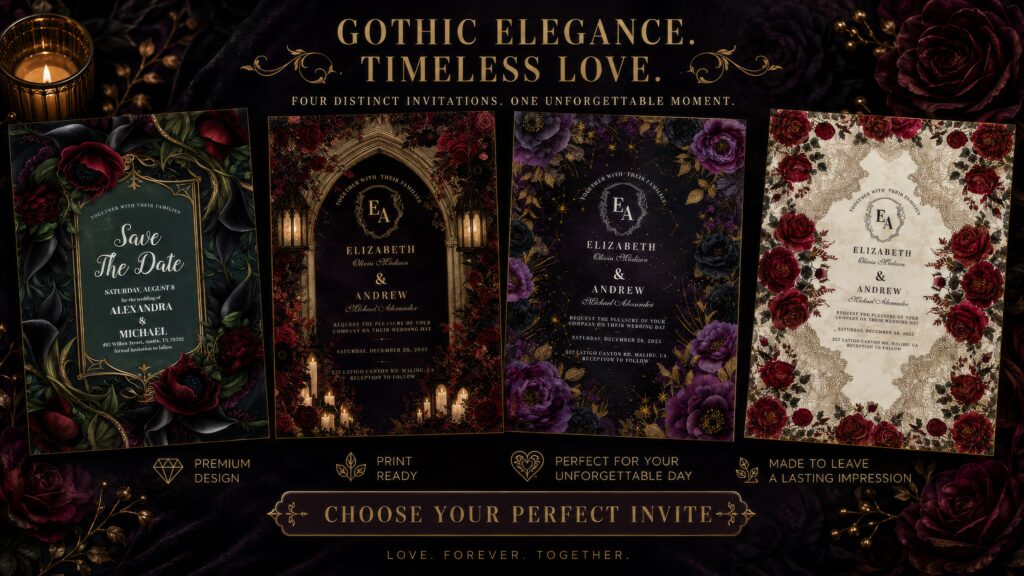
The Victorian era produced the most elaborate stationery culture in the history of printed matter — calling cards, mourning stationery, formal letter paper with specific border widths indicating degrees of grief, wedding announcements with multiple enclosure cards, and invitation suites whose physical complexity communicated the social status of the sender as clearly as the words they contained. The Victorian goth wedding stationery suite draws on this tradition directly — in its material quality, its typographic conventions, and its specific formal elements: the black border of varying width, the ivory or bone-white card stock, the letterpress-printed gothic typography, the large wax seal bearing the couple’s monogram or a specific gothic motif, and the specific phrasing of the invitation text in a Victorian formal register.
Stationery Materials
- Heavy ivory or bone-white cotton rag card stock with deep black mourning border
- Near-black card with ivory or gold letterpress text — the darkest Victorian option
- Letterpress or engraving printing — the only historically appropriate technique
- Gothic typefaces with high contrast and long ascenders throughout
- Black-bordered envelopes with ivory card lining and dark silk ribbon
- Large jet-black or oxblood wax seal bearing the couple’s monogram or gothic motif
- Pressed botanical enclosures — a dried fern or lunaria disc tucked within the suite
On-the-Day Victorian Stationery
- Order of service in a formal folded black-bordered booklet with gothic typography
- Table plan on a large foxed antique mirror with gold hand-lettered calligraphy
- Place cards hand-lettered in gold ink on heavy black-bordered ivory card
- Menus on dark card with gothic botanical illustration header and letterpress text
- Table names using Victorian writers, poets, or locations — not numbers
- Favour cards tied with black velvet ribbon to jet or dark botanical favours
Menu
The Victorian Goth Wedding Menu: The Formal Banquet Tradition in a Dark Key
Victorian formal dining was one of the most elaborately ceremonial experiences in the history of Western social culture — a multi-course ritual of extraordinary complexity and duration, governed by specific rules of service, table arrangement, and course sequence that communicated the social standing of the host as clearly as the quality of the food itself. The Victorian goth wedding menu honours this tradition by approaching the dinner as a formal banquet rather than a contemporary wedding catering exercise — with multiple courses served in sequence, formal service style, wine paired specifically to each course, and food that is genuinely specific to the season and the period’s culinary tradition rather than generically applicable to any occasion at any time of year.
🥂
Arrival & Drinks Reception
Champagne or vintage Crémant. A small selection of Victorian-style canapés — potted shrimp on toast, devilled kidneys on dark bread, smoked salmon blinis, game terrine with port jelly. The arrival drinks at a Victorian goth wedding should feel like entering a Victorian drawing room rather than a contemporary function suite.
🍽️
The Victorian Dinner
A formal multi-course dinner: oysters or a rich soup as the first course. Game — venison, pheasant, or grouse — as the main course, served with dark root vegetables and a rich red wine jus. A Victorian-style syllabub or a dark chocolate and port tart as the dessert. Cheese and port to close the formal dinner before the evening celebration.
🍷
Wine & Spirits
A full-bodied Burgundy or aged Bordeaux with the main course. Sauternes with the dessert. Vintage port with the cheese course — always. A sloe gin or a dark elderberry cordial as an alternative to champagne for the toast. The Victorian dinner was accompanied by wine throughout; the contemporary equivalent should honour that tradition.
🎂
The Wedding Cake
A near-black velvet-finish or dark mirror glaze tiered cake with hand-crafted sugar dark florals and gothic lace detail. Or a deeply traditional Victorian dark fruit cake with black fondant and gold botanical decoration. The Victorian wedding cake was always rich, dark, and heavily spiced — a tradition worth honouring in the most beautiful dark contemporary interpretation.
Music
Victorian Goth Wedding Music: From Chamber Ensemble to the Gothic Romanticism of the Era
The Victorian era was one of the most musically rich in the history of Western culture — the period that produced Brahms, Elgar, Verdi, Fauré, and the full development of the Romantic symphonic tradition. It was also the period of the drawing-room piano, the parlour song, and the chamber recital — intimate, formal musical experiences that were an essential part of Victorian social life. The Victorian goth wedding music programme draws on all of these traditions simultaneously: period chamber music for the ceremony and dinner, Victorian art songs for the drinks reception, and a more contemporary dark music programme for the evening that honours the gothic tradition without abandoning the party.
Ceremony & Dinner Music
- Elgar’s Nimrod from the Enigma Variations for the processional
- Fauré’s Pavane — one of the most beautiful and most atmospheric of all Victorian-era pieces
- Brahms’ Intermezzo in A major, Op. 118 No. 2 played by a solo pianist
- A string quartet playing Victorian parlour music and light Romantic repertoire during dinner
- Verdi arias performed by a trained singer during the drinks reception
- Handel’s Largo as a recessional — timeless, formal, and completely correct
Evening Entertainment
- A dark folk or gothic chamber music ensemble for the early evening transition
- A carefully curated DJ set of gothic and dark wave music for the dance floor
- Nick Cave and the Bad Seeds, Dead Can Dance, and The Sisters of Mercy as the evening reference points
- A Victorian-era dance caller for a formal period dance sequence if the couple and guests have rehearsed
- Live readings from Victorian gothic literature — Poe, Stoker, or Collins — during the dinner or after-dinner hour
Guest Experience
The Victorian Goth Wedding Guest Experience: Immersion in a Complete Historical World
The Victorian goth wedding offers its guests something genuinely rare in contemporary event culture — the experience of stepping completely out of the present and into a different, darker, more formally beautiful world for the duration of a single extraordinary day. The most successful Victorian goth weddings are those where this immersive quality is maintained consistently from the moment guests receive the invitation to the moment they depart the venue — where every element of the experience, from the dress code guidance on the invitation to the favour placed in each guest’s hand at the end of the evening, has been considered as a contribution to the total world rather than as an isolated event detail.
📬 Before the Day
The Victorian mourning-style invitation suite establishes the aesthetic. A specific dress code — Victorian formal dress, dark tones, no pastels or bright colours — communicated clearly and with enough context for guests to understand and engage with it. A small note on Victorian dress for those who want to commit more fully to the period. The experience begins with the object in the letterbox.
🚪 The Arrival
A lantern-lit pathway. A welcome wreath of dark botanicals. Waiting staff in Victorian-appropriate dark formal dress. Champagne or sloe gin pressed into hands immediately. Chamber music audible from within. The arrival should feel like entering a Victorian novel — a transition from the ordinary world into something more formally, more darkly, more beautifully constructed.
🎁 Favours
A small dried botanical wreath. A miniature jar of dark fruit conserve sealed with black wax. A pressed flower in a small dark frame with a Victorian botanical label. A packet of heritage dark flower seeds. A small piece of jet or dark glass jewellery. The Victorian goth wedding favour should be an object of genuine, lasting beauty — the kind of thing a guest will keep on a shelf for years.
Common Mistakes
10 Victorian Goth Wedding Mistakes to Avoid
- Treating the aesthetic as a costume rather than a conviction. A Victorian goth wedding built from genuine historical knowledge and genuine personal identification with the aesthetic produces something of entirely different quality from one built from Halloween prop catalogues and costume hire shops. The difference is immediately and consistently visible in every photograph and in the experience of every guest. Commit fully or reconsider the approach.
- Choosing a venue without genuine Victorian or Gothic Revival architectural character. The Victorian goth aesthetic cannot be constructed from scratch in a blank-canvas space. It requires a foundation of genuine historical architecture — stone, carved wood, stained glass, or period ironwork — that the decoration deepens and completes rather than creates from nothing. The venue is the non-negotiable first decision.
- Using modern or cool-toned lighting. The Victorian era was lit by gas and candlelight — warm, flickering, and deeply atmospheric in a way that no modern electrical fitting can replicate. Every overhead LED, every cool-white spotlight, and every modern floor uplight in a Victorian goth wedding venue is an anachronism that disrupts the aesthetic coherence of the total world. Confirm the candle policy, dim or remove every modern fitting possible, and light the entire celebration by flame and warm amber sources only.
- Neglecting the historical specificity of the dress silhouette. A generic dark gown is not a Victorian goth wedding dress. The Victorian silhouette — the high collar, the covered buttons, the long fitted sleeve, the trained skirt — carries the historical authenticity of the aesthetic in a way that a contemporary dark dress in dark fabric does not. Work with a dressmaker who understands the period and can construct the correct silhouette rather than simply the correct colour.
- Using flowers that have no relationship to the Victorian floral tradition. The Victorian era had a specific and richly developed relationship with flowers — including a formal language of floral symbolism — and the flowers chosen for a Victorian goth wedding should honour that tradition. Tropical blooms, imported varieties with no historical precedent, and flowers chosen purely for their dark colour without regard for their historical associations reduce the botanical authenticity of the total aesthetic significantly.
- Choosing generic dark wedding stationery rather than specifically Victorian stationery. Black card with a dark font is not Victorian stationery. Victorian stationery has specific typographic conventions, specific formal register in its wording, specific material quality, and specific design elements — the black border, the gothic letterform, the formal invitation phrasing — that are entirely absent from generic dark wedding templates. Commission a designer who specifically understands the Victorian stationery tradition.
- Serving a generic contemporary wedding menu in a Victorian goth context. Chicken supreme and chocolate fondant served in a Victorian goth wedding venue is a category error that undermines the total aesthetic immersion of the celebration. The Victorian dining tradition was specific, seasonal, and formally structured. A Victorian goth wedding menu should honour that tradition — with game, oysters, dark fruit, port, and the specific flavour vocabulary of the period — rather than defaulting to whatever the caterer usually serves at any wedding.
- Failing to brief guests on the dress code specifically and in advance. The Victorian goth wedding guest experience is significantly enhanced when guests arrive in appropriate dark formal dress — and significantly diminished when they arrive in bright florals or casual contemporary clothing that has no relationship to the world being built. Brief guests specifically on the dress code, provide enough context for those who want to engage with the period aesthetic to do so, and make it easy rather than mysterious to dress appropriately.
- Mixing anachronistic elements without intention or awareness. A Victorian goth wedding that incorporates genuinely period elements alongside clearly contemporary ones without acknowledging or managing the tension between them produces an incoherence that reduces the total aesthetic impact of both. Every non-Victorian element introduced into the celebration should be either genuinely invisible or deliberately, intentionally, aesthetically justified as a contemporary perspective on the Victorian tradition rather than simply an oversight.
- Underestimating the level of research and supplier coordination required. The Victorian goth wedding is the most demanding and the most historically specific of all dark wedding aesthetics — it requires suppliers who understand the period, materials that are appropriate to the tradition, and a level of creative coordination across every element of the celebration that is significantly greater than any contemporary wedding format. Begin planning earlier, budget more generously for specialist suppliers, and treat the research as part of the creative process rather than a burden to be minimised.
“The Victorian goth wedding that succeeds completely is not one that looks Victorian. It is one that feels Victorian — where the specific quality of warmth, formality, darkness, and romance that the period produced at its most extraordinary is genuinely, completely present in every element of the celebration from the first candle lit to the last glass of port.”
— The Gothic Wedding Edit
Final Thoughts
To Build a Victorian Goth Wedding Is to Honour the Most Beautiful Dark World the Nineteenth Century Made
The Victorian goth wedding is for couples who understand that the most powerful version of any aesthetic is the one most deeply and most specifically inhabited — who know that a celebration built from genuine historical knowledge, genuine personal conviction, and genuine creative ambition produces something qualitatively different from one assembled from dark surface elements without that foundation. The Victorian era offers the goth wedding couple the richest possible source material: a century of formal darkness, romantic melancholy, botanical obsession, material beauty, and a profound cultural seriousness about the things that matter most — love, mortality, beauty, and the human need to make extraordinary objects as witnesses to the most significant moments of a life.
Build it with research and with patience. Find the venue with the pointed arches. Commission the gown with the covered buttons and the high collar. Fill the room with candles and dark roses and the specific scent of beeswax and old books and Victorian formal life. Feed your guests as the Victorians fed their most honoured company. Play Elgar. And then stand in the stone nave or the gaslit drawing room or the candlelit hall — dressed completely in the aesthetic that has always been yours — and celebrate in the world that the nineteenth century made for you, exactly as it was always going to be made.