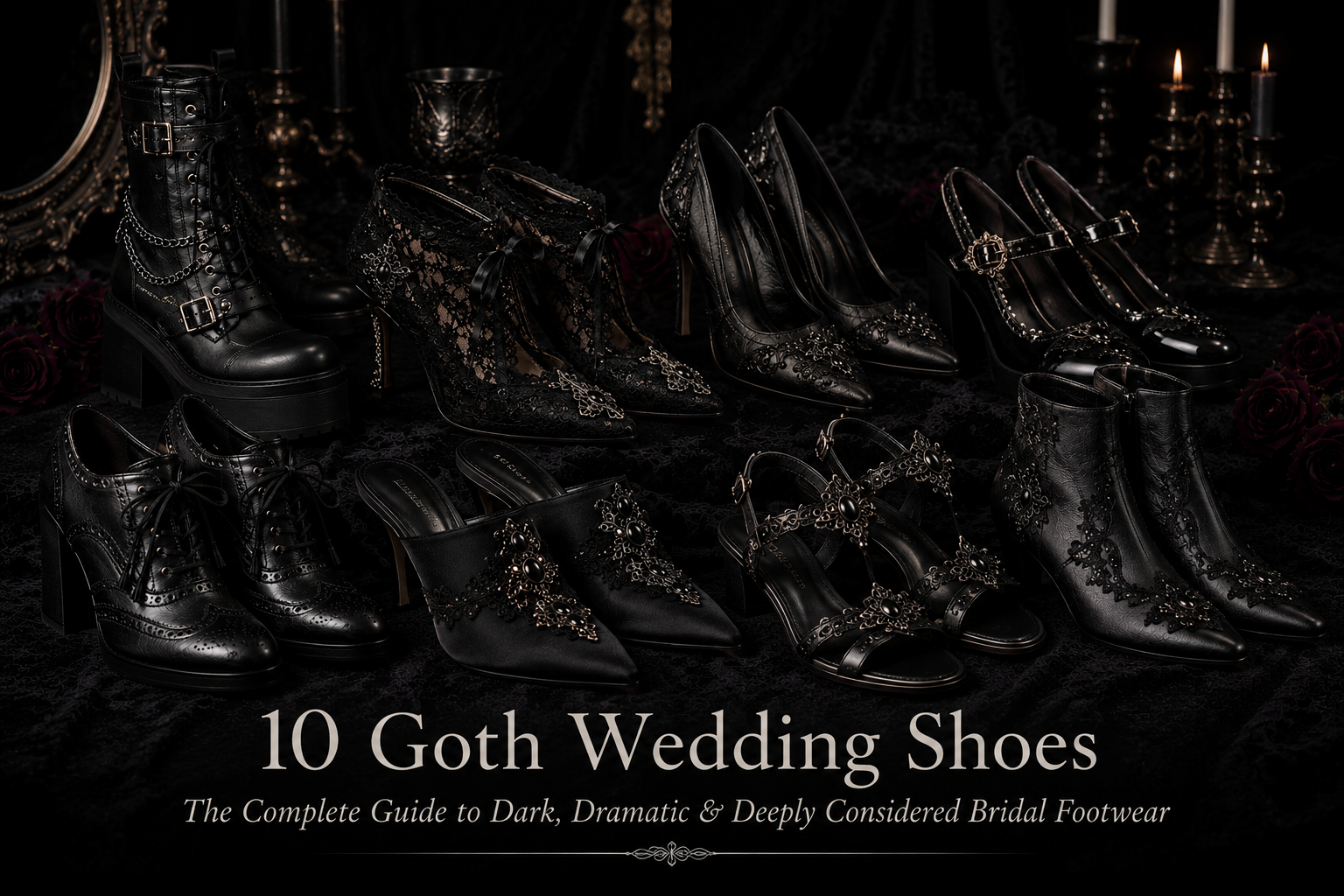
10 Goth Wedding Shoes – The Complete Guide to Dark, Dramatic & Deeply Considered Bridal Footwear
The Gothic Wedding Edit · 2026
Goth Wedding Shoes
The Complete Guide to Dark, Dramatic & Deeply Considered Bridal Footwear
From towering platform boots and Victorian lace heels to velvet mary janes, sculptural block heels, and the hidden footwear choices that complete the gothic bridal look from the ground up — your definitive guide to goth wedding shoes in 2026.
Goth wedding shoes are not an afterthought and they are not hidden. They are the only element of the bridal look that physically connects the wearer to the ground she has chosen to stand on — and in the gothic aesthetic, where intention and specificity govern every decision, the footwear must be chosen with the same seriousness and the same creative intelligence as the dress, the veil, and the flowers.
Introduction
Why Goth Wedding Shoes Deserve More Creative Attention Than Any Other Bridal Accessory
There is a persistent and entirely unhelpful convention in bridal planning that treats shoes as a late-stage decision — something to be finalised once the dress has been confirmed, the venue booked, and the more conspicuous elements of the aesthetic resolved. For the goth wedding, this convention is not merely unhelpful but actively counterproductive. The shoes are the foundation of the entire bridal look — literally and aesthetically — and in a dark, dramatically intentional aesthetic they carry a weight of visual and symbolic significance that no conventional bridal accessory can approach. A pair of towering platform boots beneath a cathedral-length black lace gown communicates something entirely different about the woman wearing it than a pair of pointed stilettos or a low block heel in the same velvet. The heel height, the toe shape, the material, the degree of embellishment, the silhouette of the sole — every one of these decisions contributes to the total meaning of the look, and none of them are made well by leaving them until the last possible moment.
Goth wedding shoes in 2026 span a creative range far broader than their reputation suggests. The platform boot remains the most iconic and the most immediately legible choice — but alongside it are Victorian lace heels of extraordinary delicacy, velvet court shoes in deep jewel tones, sculptural architectural heels that function as miniature objets d’art, mary janes in black patent with an edge of dark whimsy, and entirely flat options that prioritise comfort and grounded presence over height and drama. Each direction has its own aesthetic logic, its own relationship to the dress and to the wider gothic world of the celebration, and its own particular quality of beauty. This guide covers all of them — the ten defining styles, the materials and considerations that should govern the choice, and the practical knowledge that ensures the shoes work as well on a twelve-hour wedding day as they look in the photographs.
The guide also addresses the questions that bridal footwear planning for dark weddings consistently raises: when to show the shoes and when to keep them largely hidden, how to match the footwear to the specific sub-aesthetic of the goth wedding being planned, how heel height interacts with dress length, and what the most experienced gothic brides consistently wish they had known before making their final footwear decision. Read it before you begin looking, not after you have already fallen in love with something that may or may not be right for the day you are building.
The Edit
10 Goth Wedding Shoe Styles That Define the Dark Bridal Aesthetic in 2026
Each of these ten shoe styles represents a complete aesthetic direction — a specific approach to goth wedding footwear that can be adapted to different dress silhouettes, venue types, and sub-aesthetic emphases. Read each as a brief for a conversation with yourself about what kind of gothic bride you intend to be, and notice which one makes you feel, immediately and without qualification, that this is the shoe you want beneath you when you walk toward the person you are marrying.
01
The Platform Boot
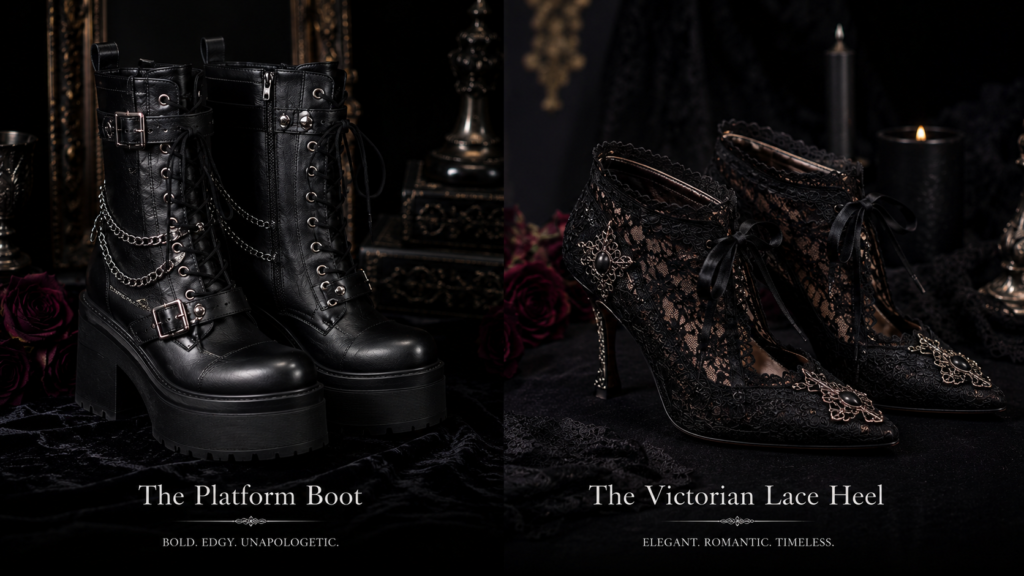
The most iconic and the most immediately recognisable of all goth wedding shoe choices — a tall, lace-up platform boot in black leather, patent, or matte finish, with a chunky platform sole and a block or stacked heel ranging from five to twelve centimetres in height. The platform boot is the shoe that most completely and most unambiguously signals the gothic aesthetic — it communicates subculture membership, aesthetic conviction, and a complete refusal of conventional bridal footwear norms with every step. It works most powerfully beneath shorter hemlines — tea length, midi, or deliberately raised skirts — where the boot can be fully seen and where the visual contrast between the dark, heavy, architectural boot and the softness of the skirt above it creates one of the most aesthetically distinctive silhouettes in all of alternative bridal fashion. For the goth bride who wants every photograph to communicate exactly who she is without ambiguity, the platform boot is the only correct choice.
02
The Victorian Lace Heel
A court shoe or ankle boot constructed with or substantially decorated in black lace — the most directly Victorian of all goth wedding footwear options and the one most closely aligned with the romantic, historically informed sub-aesthetic of the dark bridal tradition. The Victorian lace heel may be a pump with a lace overlay on the upper, a heeled ankle boot with lace panels set into leather or satin, or a low-cut court shoe with a lace bow or substantial lace trim at the vamp. The heel itself is typically a slender stiletto or a modest kitten heel rather than a block — the overall aesthetic of this shoe is delicacy and historic reference rather than mass and structural drama. It works most beautifully with full-length gowns that allow the shoe to appear only briefly, in movement — a flash of black lace beneath a black or ivory skirt — rather than as a constant visual presence. It is the shoe for the goth bride whose aesthetic is the Victorian parlour rather than the Whitby cliff-top.
03
The Velvet Court Shoe
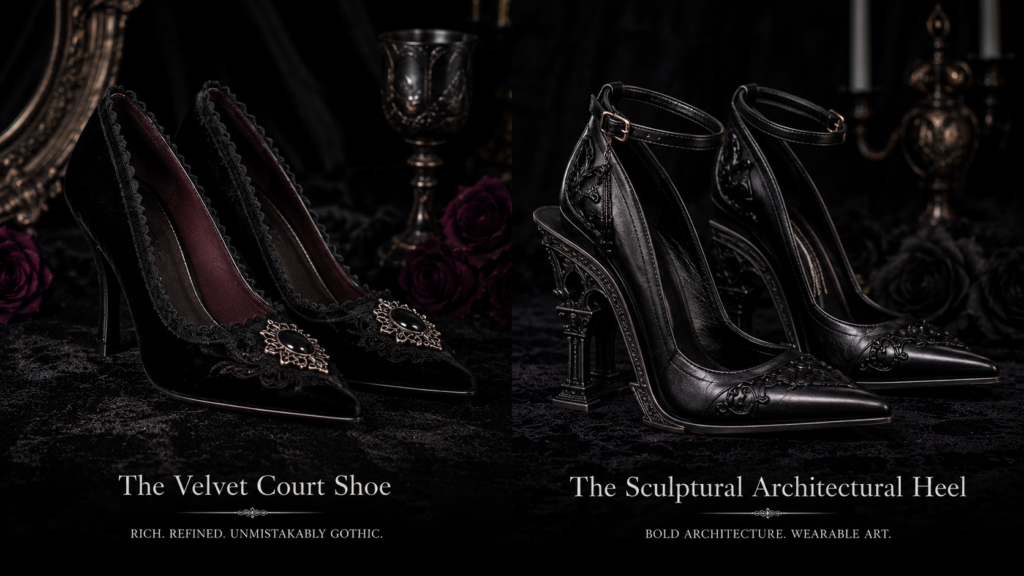
A classic pump silhouette executed in deep jewel-toned or near-black velvet — midnight plum, oxblood, forest green, or pure black — with a modest pointed or slightly rounded toe and a heel ranging from kitten to mid-height block. The velvet court shoe is the most formally elegant and the most broadly sophisticated of all goth wedding footwear options — it belongs to the same visual world as a deep velvet tablecloth or a stone urn filled with dark dahlias: materially luxurious, chromatically dark, and historically resonant without being theatrically dramatic. It is the choice for the goth bride whose aesthetic tends toward the opulent and the refined rather than the subculturally explicit, and it works powerfully with both full-length and tea-length gowns. The texture of velvet under candlelight and in photographs produces an extraordinary depth of colour that no other material approaches, which makes the velvet court shoe one of the most photographically beautiful options on this list.
04
The Sculptural Architectural Heel
A shoe in which the heel itself is the primary aesthetic statement — a deliberately designed structural element in a form that reads as sculpture: a curved blade, a twisted column, a skeletal cage structure, a heel shaped as a crescent or an architectural bracket — executed in matte black, oxidised metal, or resin. The sculptural architectural heel is the most avant-garde and the most purely contemporary of all goth wedding footwear options, and it is the choice that most consistently produces the most extraordinary close-detail photographs when captured well. It suits the goth bride whose aesthetic leans toward the dark contemporary and the art-directed rather than the historically Victorian, and it works most powerfully with minimalist gown silhouettes that allow the shoe to exist as an uncontested visual focal point. The sculptural heel communicates creative intelligence and specific aesthetic knowledge — it is not a shoe that anyone chooses accidentally.
05
The Gothic Mary Jane
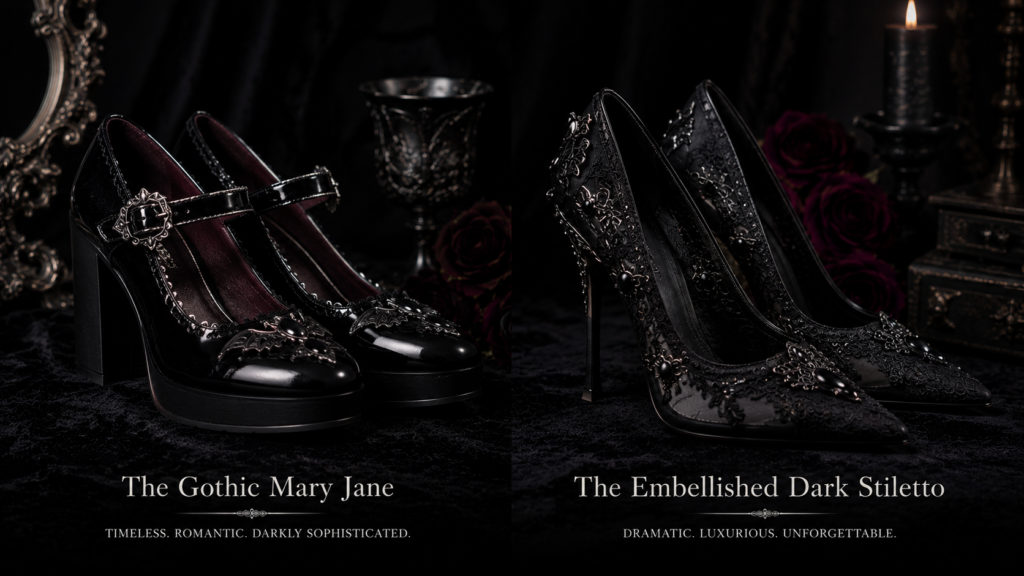
A mary jane silhouette — the single strap across the vamp, the rounded toe, the modest heel — executed in black patent, matte leather, or dark velvet with gothic detailing: a buckle rather than a button, a platform sole that reads as structural rather than delicate, or a heel with deliberate dark hardware. The gothic mary jane occupies the most interesting creative space in all of dark bridal footwear — it sits at the intersection of childhood innocence and gothic darkness in a way that no other shoe shape can approach, and it carries a quality of dark whimsy and deliberately subverted sweetness that is entirely its own. It works particularly powerfully with tea-length and shorter gown silhouettes, with dark lace tights or stockings, and with the kind of goth wedding aesthetic that incorporates the playful and the slightly unsettling alongside the purely dramatic. It is also one of the most comfortable options for a long celebration day.
06
The Embellished Dark Stiletto
A slender stiletto heel in black, deep burgundy, or near-black midnight blue — the base shoe entirely conventional in its elegant, pointed silhouette — elevated into the gothic through a specific programme of dark embellishment: black crystal encrustation across the vamp or heel, dark floral appliqué in black or oxblood satin, baroque dark hardware at the ankle strap, or hand-painted botanical detail in dark ink on a matte leather upper. The embellished dark stiletto is the most formally glamorous of all goth wedding footwear options — it suits the gothic black-tie aesthetic, the grand historic venue, and the gown of extraordinary construction that requires footwear of equivalent formal weight. It is also the most demanding to wear for an extended period, which must be honestly accounted for in planning, and the most dependent on precise, high-quality execution — a poorly applied crystal embellishment reads immediately as a failed attempt at a difficult aesthetic rather than a successful one.
07
The Heeled Oxford or Brogue
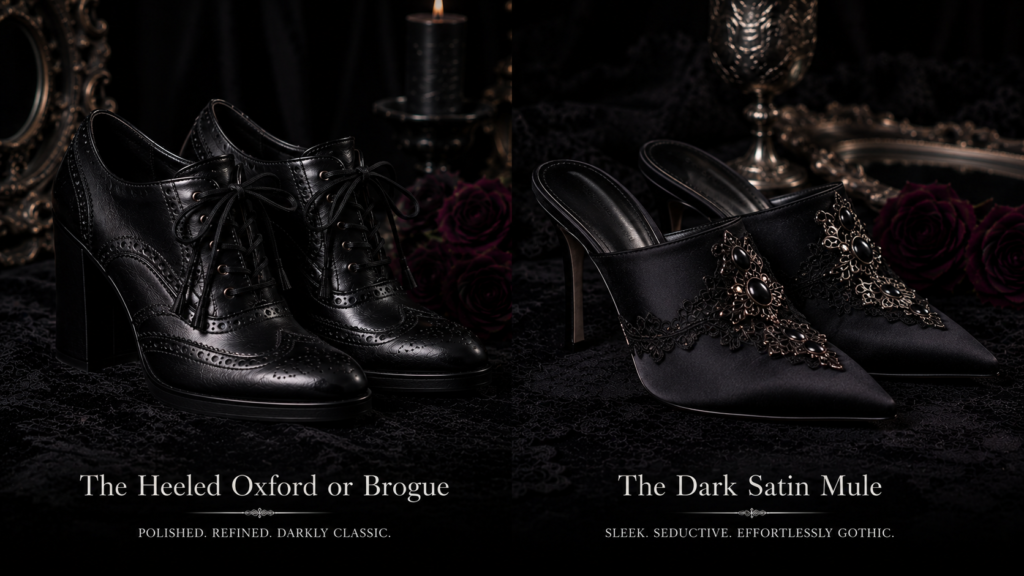
A lace-up oxford or brogue silhouette — historically masculine, traditionally professional, utterly un-bridal in its origins — given feminine proportion through a modest heel of three to five centimetres and elevated into the gothic through material and finish: black patent with heavy broguing, matte black leather with dark hardware eyelets, oxblood leather with a toe cap in near-black. The heeled oxford or brogue is the most gender-subversive of all goth wedding footwear options and the one that most directly references the sartorial history of Victorian and Edwardian dark fashion. It suits every gown length from full floor-length to deliberately short, works powerfully with dark tights in conjunction with shorter hemlines, and communicates a quality of groundedness and aesthetic confidence that no other shoe shape approaches in quite the same way. It is also one of the most comfortable options for extended wearing on a long celebration day, which gives it a practical advantage that must be weighed alongside its aesthetic qualities.
08
The Dark Satin Mule
A backless, square-toed or pointed mule in deep black or near-black satin — the shoe that most directly engages with and subverts the conventional bridal satin shoe tradition, taking the expected material and transforming it through colour and silhouette into something that belongs entirely to the gothic world. The dark satin mule works powerfully as the slightly unexpected choice — the goth bride who does not want to wear boots but equally does not want to wear the pointed stiletto that everyone expects of a dark wedding. Its square toe in particular communicates a very specific aesthetic intelligence, referencing the contemporary dark fashion market rather than the subcultural boot aesthetic, and it suits the goth wedding that incorporates elements of contemporary luxury and directional fashion alongside its more traditional gothic references. Under a long gown, the mule appears as a flash of dark satin and bare ankle — elegant, slightly surprising, and completely intentional.
09
The Flat Gothic Sandal
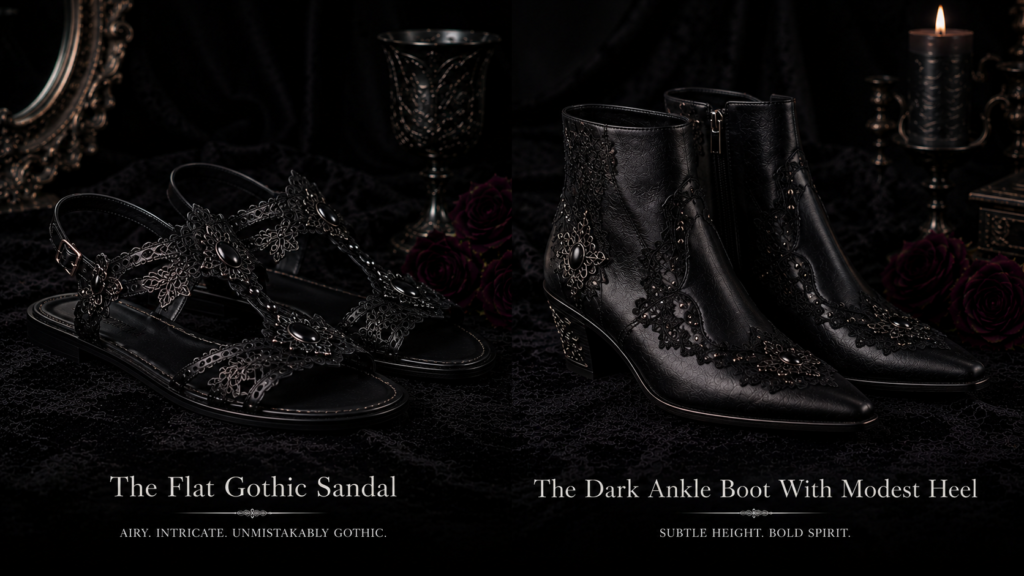
A completely flat sandal in dark leather or metallic — with a strapping structure of genuine visual complexity: multiple dark leather straps, a gladiator construction that climbs the ankle and calf, or a single architectural minimalist strap with heavy dark hardware at the buckle. The flat gothic sandal is the most counterintuitive of all goth wedding footwear choices and, for exactly that reason, potentially the most powerful — it is the shoe that most clearly prioritises comfort, groundedness, and a quality of ancient and elemental presence over height and conventional bridal formality. It works most dramatically with outdoor celebrations, with non-traditional venues, and with gown silhouettes that sit high enough to allow the sandal to be fully seen. A dark gladiator sandal on a gothic bride in a full-length black gown at an outdoor twilight ceremony produces one of the most visually arresting and most memorably distinctive images in all of contemporary dark wedding photography.
10
The Dark Ankle Boot With Modest Heel
A sleek, tailored ankle boot — neither the heavy platform of the gothic boot nor the ornate construction of the Victorian lace heel, but a precisely cut, medium-heeled ankle boot in matte black leather or suede with a pointed or chisel toe and minimal dark hardware — that combines the gothic aesthetic with the kind of wearable, enduring elegance that works across a twelve-hour wedding day without compromise. The dark ankle boot with modest heel is the most practically versatile and the most sartorially intelligent of all goth wedding footwear options — it suits every gown length, every venue type, and every degree of physical activity the celebration demands, and it photographs with equal beauty in both close detail and full-length shots. It is the choice that the most experienced gothic brides — those who have worn the platforms and the lace heels before, at other occasions, and know precisely what they involve — most consistently make for their own wedding days. The right ankle boot in the right material is not a compromise. It is the most complete and most confident gothic footwear choice available.
“The goth wedding shoe that matters is not the one that looks most spectacular in the fitting room at eleven in the morning. It is the one you are still glad you chose at eleven in the evening, when the candles have burned low and you have danced every dance and the world you built for the day has been completely, perfectly inhabited.”
— The Gothic Wedding Edit
Height & Silhouette
Heel Height and Gown Length: The Creative Decision That Changes the Entire Look
The relationship between shoe height and gown length is the most practically consequential aesthetic decision in all of goth wedding footwear planning — because it determines not only what the complete bridal silhouette looks like but whether the shoe can be seen at all, and therefore whether all of the creative and financial investment in the footwear produces any visible return at the celebration itself. A platform boot beneath a full cathedral-length gown is invisible in every photograph taken from above knee height. The same boot beneath a tea-length skirt is the first thing every guest sees when the bride enters the room. These are not minor variations in effect — they are fundamentally different aesthetic experiences — and the decision must be made consciously, with a clear understanding of which effect is being pursued, rather than left to emerge from independent choices made about the dress and the shoes at separate appointments.
🥾
Floor Length
The shoe is hidden in most photographs and visible primarily in movement — a glimpse of dark leather or velvet beneath a moving skirt. The decision here is primarily about how the shoe feels underfoot rather than how it reads visually. Flat or very low shoes may require a hem alteration. Choose the shoe you want to wear, not the one you want to photograph.
🌹
Tea & Midi Length
The most photographically powerful hemline for dramatic footwear. The shoe is fully visible at all times and becomes an equal partner in the visual composition of the look. Platform boots, heeled oxfords, gothic mary janes, and Victorian lace heels all reach their maximum aesthetic impact at this length. Dark tights or stockings should be considered as part of the composition.
🖤
Mini & Short
The shoe is absolutely the dominant visual element of the look — more visible than any other element from below the waist. The entire aesthetic weight of the lower half of the bridal look rests on the footwear choice. Platform boots at this length produce the most dramatic and most subcultural reading of any goth wedding footwear option. Choose accordingly and without ambiguity.
✨
High-Low & Asymmetric
A high-low hemline — shorter at the front, trailing longer at the back — allows the shoe to be fully visible during the ceremony and in forward-facing photographs while still providing the drama of a trained skirt in movement. It is the most photographically versatile gown silhouette for footwear display and the most practically accommodating for dancing.
Materials & Finishes
Materials and Finishes for Goth Wedding Shoes: What the Surface Communicates
The material and surface finish of a goth wedding shoe communicates as much as its silhouette — because the gothic aesthetic has always been as much about the quality and resonance of material surfaces as about shape or colour. Matte black leather communicates something different from patent black leather, which communicates something different from black velvet, which communicates something different from black suede — not in terms of colour or darkness, since all four are equally dark, but in terms of light quality, historical reference, and the specific character of the surface as it reads in photographs and in the candlelit light of the reception room. Choosing the right material is choosing the right quality of darkness for the specific celebration being built.
Materials That Work
- Matte black leather: the most versatile and the most broadly gothic — absorbs light rather than reflecting it, reads as depth rather than surface, and ages beautifully through the day
- Patent leather: reflects candlelight dramatically and photographs with extraordinary visual impact — the most dramatic and the most high-contrast surface available; particularly powerful in close-up photography
- Velvet: the most materially luxurious and historically resonant surface — produces extraordinary depth of colour in both photography and candlelight, and coordinates directly with the velvet elements of the wider decoration scheme
- Dark suede: the softest and most tactilely comfortable of all the dark finishes — slightly less dramatically gothic than leather or patent but warmer and more wearable over an extended day
- Black lace over satin: the most Victorian and most romantically gothic of all material combinations — delicate, historically specific, and uniquely beautiful in close photography
- Dark metallic leather: oxidised silver, dark bronze, or near-black gold — adds a quality of aged luxury and dark glamour that plain black leather cannot approach
What to Avoid
- Bright white or ivory satin: the conventional bridal shoe material and the one that most completely negates the gothic aesthetic regardless of the shoe’s silhouette or construction
- Glitter or rhinestone fabric: reads as costume rather than considered aesthetic choice unless executed with extraordinary precision and restraint in a very specific dark palette
- Synthetic patent with obvious plastic quality: the material must be genuine — patent leather, not PVC — because the quality of the surface communicates the quality of the aesthetic intention
- Pale or pastel-coloured materials in any form: even blush, champagne, or very pale grey disrupts the dark palette of the gothic bridal look regardless of the shoe’s other qualities
- Heavily branded athletic materials: even in black, the athletic shoe sits in a completely different aesthetic category and requires exceptional conceptual intent to function within the gothic bridal look
The Sub-Aesthetic Test: Which Goth Are You Wearing?
The most useful question to ask when choosing goth wedding shoes is not “which shoe is most gothic?” but “which gothic world does this celebration belong to?” A Victorian gothic wedding — stone church, iron candelabras, dark lace gown, dried botanical centerpieces — calls for the Victorian lace heel or the heeled oxford, not the platform boot. A dark contemporary wedding — a converted industrial space, a minimalist black gown with architectural seaming, a sculptural floral installation — calls for the sculptural heel or the dark ankle boot, not the lace heel. A romantic maximalist gothic celebration — a candlelit ballroom, a full black tulle gown, abundant dark floral arrangements — calls for the embellished stiletto or the velvet court shoe. The shoe must belong to the specific world of this specific celebration, not to a generalised idea of gothic style. Choose the sub-aesthetic first. Then choose the shoe that belongs to it most completely and most inevitably.
Practical Planning
Ten Things Every Bride Should Know Before Choosing Goth Wedding Shoes
- Choose the shoes before finalising the gown hemline, not after. The most common and the most consequential mistake in goth wedding footwear planning is treating the gown as fixed and then finding a shoe that works beneath it. If the shoe is genuinely important to the look — and for the goth wedding, it almost always is — begin with the shoe and ensure the gown’s hemline is set at the length that best serves the footwear choice. A one-centimetre hem adjustment costs very little. A shoe choice that is permanently invisible beneath a hem that cannot be altered costs the entire footwear investment in visual terms.
- Wear the shoes for a full day before the wedding, not just a fitting. Every shoe behaves differently over twelve hours than it does over thirty minutes at a fitting appointment. Platform boots that feel architectural and powerful at ten in the morning feel very different at ten in the evening after a ceremony, a drinks reception, a seated dinner, and several hours of dancing. The specific break-in requirements of platform soles, stiff new leather, and unbroken-in heel counters must be addressed weeks before the wedding, not discovered on the day itself. Wear the shoes for a full day at least once — ideally twice — before the celebration, and make any padding or comfort adjustments at the same time.
- Consider the venue surface when choosing heel type. A pointed stiletto heel is the most likely footwear choice to become embedded in historic stone flooring, old wood, or soft lawn grass — all of which are common goth wedding venue surfaces. A block heel or platform sole distributes weight more broadly and is significantly less likely to cause problems on surfaces that were not designed for modern heel construction. If the venue has any outdoor element — a gravel path, a garden ceremony space, a cobbled courtyard — confirm the heel type suits the ground before committing to the purchase.
- Dark tights and stockings are part of the shoe choice, not a separate decision. For any hemline above floor length, the leg covering worn with the shoe is as significant to the visual impact of the footwear as the shoe itself. Dark sheer tights, opaque black tights, seamed stockings in near-black, or dark patterned hosiery each produce a fundamentally different visual result with the same shoe. Decide on the hosiery at the same time as the shoe, photograph both together on the foot, and confirm that the combination reads as you intend it to in natural and in low artificial light.
- Commission or customise if the exact shoe does not exist off the shelf. The most specific and the most powerful goth wedding shoes — a pair of ankle boots in a precise shade of oxblood velvet with a specific heel height and toe shape, a pair of mary janes in dark satin with particular hardware, a platform boot with a custom embossed pattern in the leather — rarely exist exactly as imagined in a standard retail offering. The custom footwear market for dark and alternative bridal shoes is significantly more accessible than most couples realise, and the result of a commissioned pair is invariably worth the additional investment and lead time. Begin enquiries at least six months before the wedding.
- Photograph the complete lower-half look before the wedding day. The shoes, the hosiery, and the gown hem — photographed together, from the angles that the wedding photographer will use, in lighting conditions that closely approximate the venue — should be assessed as a complete composition before the wedding morning. The most common source of footwear regret is a detail noticed in the wedding photographs for the first time: a hemline that sits unevenly, a hosiery shade that photographs differently from how it appears in daylight, a shoe toe that looks proportionally different under a moving skirt than it did at a still fitting.
- Plan for a second pair for the reception, if comfort requires it. The most dramatically beautiful goth wedding shoes are not always the most comfortable for extended wearing — and there is no aesthetic value in wearing shoes that have become painful at the cost of the joy and presence that the celebration demands. Planning a second pair — a more comfortable boot, a flat dark shoe — is not a compromise of the aesthetic. It is an acknowledgement that the wedding exists in time as well as in photographs. Brief the photographer to capture the dramatic shoes in all of the formal shots, and then change when the dancing begins.
- The hardware matters as much as the shoe itself. Buckles, eyelets, heel tips, zip pulls, and toe caps are the details that distinguish a shoe with genuine dark aesthetic intelligence from one that simply happens to be black. Aged brass and oxidised iron read as gothic; bright chrome and polished nickel do not, regardless of how dark the shoe’s primary material is. Examine every piece of hardware on a shortlisted shoe before purchasing, and if the hardware is the wrong finish for the aesthetic being built, enquire whether a custom substitution is available.
- Source through specialist dark and alternative bridal retailers, not general shoe retailers. The shoes that best serve the gothic bridal aesthetic — in silhouette, material, hardware, and construction — are made and stocked by specialist retailers serving the dark fashion and alternative wedding markets, not by the general bridal shoe market. These retailers understand the specific requirements of the aesthetic, carry stock designed for the dark palette, and offer customisation options that general retailers do not. Begin the search in the specialist market and move to general retail only for very specific requirements that the specialist market cannot supply.
- The most powerful goth wedding shoe is the one that makes you walk differently. Not taller, not more carefully, not more self-consciously — but more completely yourself. The platform boot that makes you feel grounded and powerful and exactly as you always imagined you would be on this day. The Victorian lace heel that makes you feel historically beautiful and romantically present. The sculptural heel that makes you feel directional and wholly intentional. The flat oxford that makes you feel settled, certain, and profoundly at ease with the world you have built. Whatever that quality of complete, unambiguous rightness feels like for you — find the shoe that produces it, and let that be the standard. Everything else is negotiable. That quality is not.
“A goth wedding shoe chosen with complete intention does not look selected. It looks inevitable — as though the leather, the heel, the hardware, and the darkness of it were always going to be beneath exactly this woman, on exactly this day, walking toward exactly this life. That inevitability is the hardest thing to manufacture and the only thing that ultimately matters.”
— The Gothic Wedding Edit
Final Thoughts
Choose the Shoe Completely. Then Walk Toward Everything You Have Built.
The goth wedding shoe is the point at which the entire dark world of the celebration meets the ground — the physical connection between the aesthetic vision and the earth it is built on. A platform boot in matte black leather beneath a black lace tea-length gown, walking down a stone aisle in the low light of a hundred candles, with the weight of dark florals in both hands and the complete conviction of someone who has chosen every detail of this day with absolute intention — this is what remains in the memory of every person who witnesses it. Not the height of the heel or the finish of the leather or the specific silhouette of the toe, but the quality of complete presence and complete rightness that comes from a choice made well, worn fully, and inhabited without reservation.
Choose the sub-aesthetic first. Then choose the shoe that belongs to it most completely. Wear it before the day. Confirm the hemline serves it. Photograph the complete look in the right light. And then — when the doors open and the candles are lit and the room is exactly what you imagined it to be — walk into it in the shoes you chose, with the certainty that every step you take is on ground that belongs entirely to you and to the world you have made.