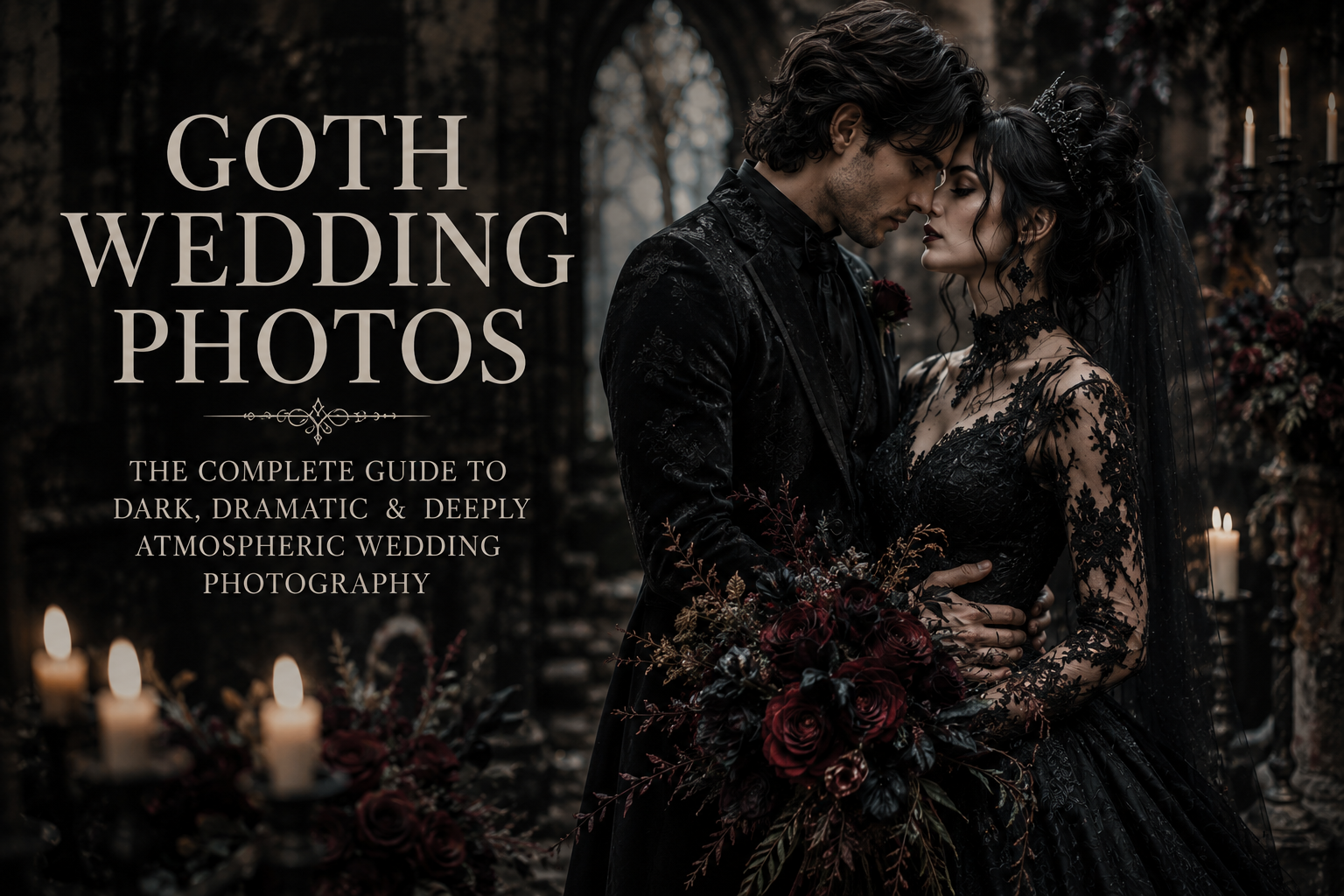
Goth Wedding Photos – The Complete Guide to Dark, Dramatic & Deeply Atmospheric Wedding Photography
The Gothic Wedding Edit · 2026
Goth Wedding Photos
The Complete Guide to Dark, Dramatic & Deeply Atmospheric Wedding Photography
From mood and light to location, detail shots, and the ten photographs every dark couple should take — your definitive guide to goth wedding photography in 2026.
A goth wedding photograph does not document a moment. It constructs a world — a specific, completely intentional world of dark beauty, symbolic depth, and atmospheric intensity that the couple has built deliberately and that the camera’s role is to inhabit fully, not merely to record from a polite distance.
Section One
Why Goth Wedding Photos Feel Completely Different
The difference between a conventional wedding photograph and a goth wedding photograph is not simply a matter of colour palette or post-processing filter. It is a fundamental difference in what the photograph is trying to do. Conventional wedding photography is built around capturing happiness — the bright smile, the sunlit ceremony, the joyful first dance — and its visual language (high key lighting, warm whites, clean backgrounds) serves that purpose efficiently. Goth wedding photography is built around something more complex and more sustaining: storytelling over posing, mood over surface perfection, atmosphere over uncomplicated brightness, and a romance that is deepened rather than simplified by the presence of mystery, shadow, and symbolic weight.
A goth wedding photograph invites the viewer to inhabit its world rather than simply witness an event. The candlelit portrait is not just a photograph of two people — it is a portrait of how those people choose to see themselves, the literary and aesthetic traditions they belong to, and the specific quality of dark beauty they have constructed together for this occasion. That depth of meaning is what makes goth wedding photographs so enduringly powerful as images — they operate on multiple levels simultaneously — and it is what requires a photographer with specific skills and a specific aesthetic understanding, rather than simply a skilled general wedding photographer who is willing to use a dark preset.
Section Two
The Different Types of Goth Wedding Photography
One of the most consistently under-discussed aspects of goth wedding photography is the sheer breadth of distinct aesthetic directions it encompasses — each producing completely different photographs, requiring different locations, different lighting approaches, and different photographic sensibilities. Knowing which sub-aesthetic your wedding belongs to is the most important single piece of information you can give a prospective photographer.
Victorian Goth
Stone churches, iron candelabras, lace veils, and formal portraiture in the tradition of Victorian parlour photography. Every photograph is composed with the deliberateness of a painted miniature.
Dark Romantic
Soft focus, abundant dark florals, candlelight, and an overwhelming sense of intimate emotional depth. The aesthetic of the Pre-Raphaelite painting translated into photography.
Dark Fantasy
Dramatic cloaks, architectural ruins, extreme landscape, and a visual language drawn from dark fairy tale illustration. Photographs that feel as though they belong inside a book.

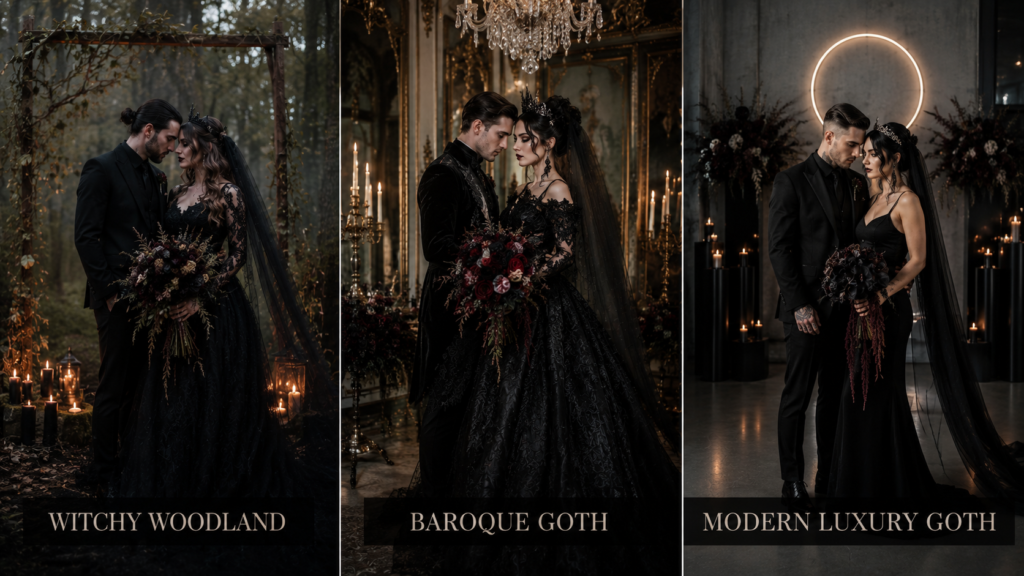
Witchy Woodland
Ancient forest, trailing moss, botanical crowns, and a quality of organic wildness. Photographs made in the deep green half-light of a forest at dusk, with the world feeling very old and very alive.
Baroque Goth
Maximalist abundance, rich jewel tones, gilded architecture, and Caravaggio-quality chiaroscuro lighting. The most formally opulent of all goth wedding photography styles.
Modern Luxury Goth
Clean architectural minimalism, couture-level styling, and a dark palette applied with the precision of a fashion editorial. The gothic aesthetic through the lens of contemporary luxury.
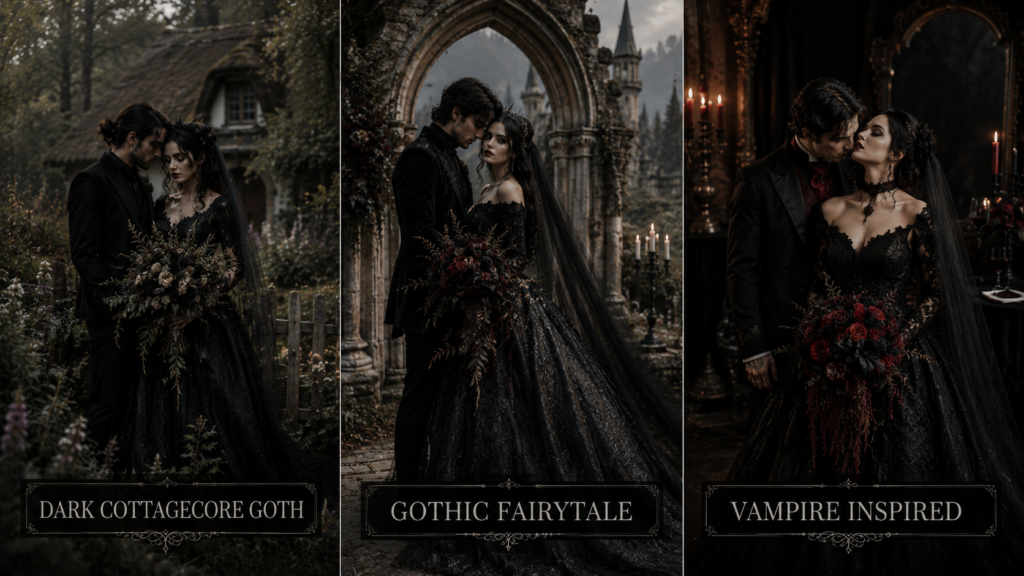
Dark Cottagecore Goth
Crumbling stone walls, wildflower meadows in deep shadow, hand-thrown ceramics, and dried herbs. The quietest and most intimate of all goth wedding photography aesthetics — beautiful at very close range.
Gothic Fairytale
Grand staircases, sweeping cloaks, enchanted forest light, and a narrative quality that makes every photograph feel like an illustration from the original, unedited Brothers Grimm.
Vampire Inspired
Deep crimson accents, antique mirrors, velvet interiors, and a quality of aristocratic, timeless elegance. The most dramatically sensual of all goth wedding photography directions.
Section Three
The Importance of Light: The Secret Most Couples Miss
If there is a single element that separates extraordinary goth wedding photography from competent goth wedding photography, it is the deliberate, intelligent use of light. Not the absence of light — darkness in photography is not achieved by removing light sources but by controlling them precisely, using directional, single-source, or low-key illumination to sculpt the subject and create the depth and shadow that the gothic aesthetic requires. The goth wedding photograph is never simply dark. It is luminous in specific places and dark in others, and the relationship between those lit and unlit areas is where the photograph’s emotional and atmospheric power lives.
🕯️
Candlelight
The warmest and most intimate of all available light sources — it renders skin with extraordinary richness, makes dark fabrics glow with depth, and produces a quality of flickering, breathing light that no artificial studio source can replicate. Brief your photographer on candle placement weeks in advance.
🌫️
Fog and Mist
Natural morning mist in a forest or valley, or professionally deployed fog machines for interior or outdoor shoots — fog softens backgrounds, creates atmospheric depth, and gives photographs the quality of emerging from rather than simply existing within a landscape.
🌘
Blue Hour
The twenty minutes after sunset when the sky holds a deep cool blue that renders the horizon as a dark canvas behind an artificially lit subject. The most dramatic and the most uniquely gothic of all natural light conditions — plan your portrait session specifically around it.
⛪
Cathedral Window Light
Directional daylight entering through tall, narrow stone windows — arguably the most beautiful single light source available for portrait photography, producing a quality of sacred, architectural illumination that has no equivalent in any other setting. Position the subject deliberately in this light.
Section Four
Best Locations for Goth Wedding Photos
The location of a goth wedding photograph is not a backdrop — it is an active participant in the image, contributing its own architectural history, textural character, and atmospheric weight to every frame. The most powerful goth wedding photographs are those in which the location and the couple exist in a state of complete aesthetic dialogue — where the stone archway, the ancient forest, or the candlelit library feels as though it was waiting specifically for this couple to arrive and be photographed within it.
Historic
- Castles and fortifications — battlements, great halls, spiral staircases, and the specific quality of light that only stone walls several centuries old can produce
- Historic mansions and country houses — dark wood panelling, grand staircases, ornate fireplaces, and the patina of genuine age in every surface
- Cathedral and church interiors — soaring arches, stained glass, ancient stone floors, and the most extraordinary available source of directional natural light
- Libraries and archives — dark wood shelves floor to ceiling, the specific warm light of reading lamps, and the immediate symbolic resonance of the couple surrounded by accumulated human knowledge and story
Natural
- Ancient forest — the most organically gothic of all natural settings; the canopy filters light into a green half-darkness that flatters dark fabrics and produces an atmosphere of enormous depth
- Clifftops and dramatic coastal landscapes — stormy skies, wind-movement in veils and cloaks, and the sublime scale of a natural horizon that dwarfs the human figure
- Mountain landscapes in low cloud — the quality of mist and obscured distance that makes a landscape feel ancient and entirely apart from the contemporary world
- Still lakes and dark water — the reflective surface that doubles the couple and the sky above them, creating a symmetry that reads as both beautiful and slightly uncanny
Urban
- Ornate historic theatres — velvet curtains, gilded balconies, and the theatrical quality of a space designed specifically for the art of spectacle
- Industrial buildings with architectural character — exposed brick, iron structures, the textures of genuine industrial heritage repurposed for extraordinary visual effect
- Historic streets at night — gas lamp-style lighting, rain-reflective cobblestones, and the specific cinematic quality of a historic street after dark that no interior can replicate
Section Five
The Most Photogenic Goth Wedding Details
The detail photograph — close, still, and completely focused on a single object — is one of the most important and most underplanned elements of goth wedding photography. These are the images that communicate the depth of thought and the quality of material investment that has gone into the celebration, and they are the photographs that reward close examination in the years after the wedding most richly. Brief your photographer to spend dedicated time on each of the following, and ensure every item is accessible, clean, and in its intended position well before the photography schedule begins.
- Black bouquet — photographed in hands, against the dress, and as a standalone object against stone or dark velvet
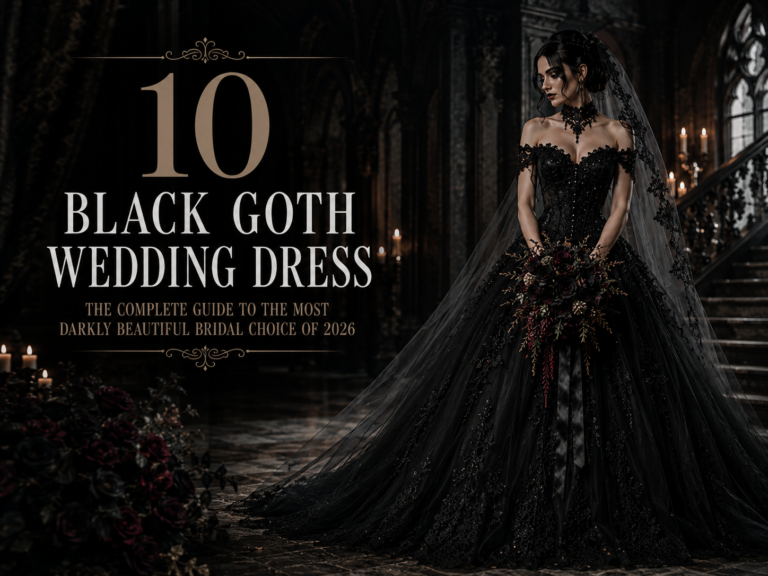
- Dark wedding dress detail — lace, beading, seaming, train — the textile details that the full-length shot cannot reveal
- Veil in movement — shot from behind with the veil lifted by wind or deliberately moved, capturing the quality of motion against the architectural background
- Botanical crown or floral headpiece — close enough to see the individual blooms and the quality of their construction
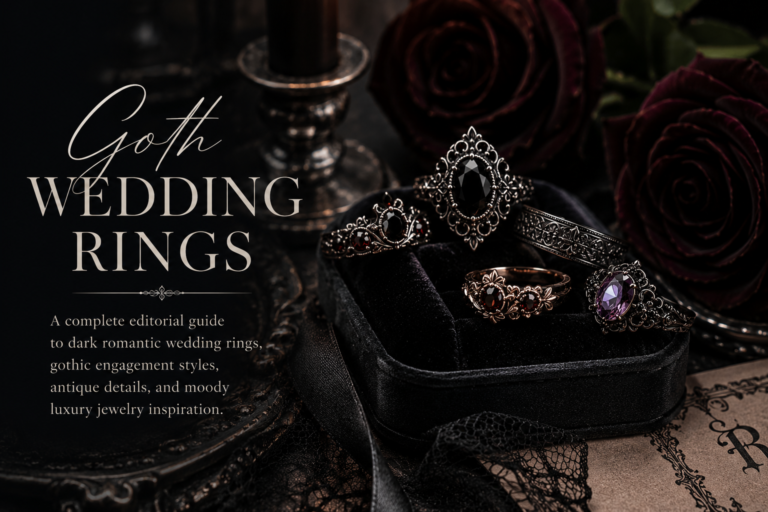
- Rings in velvet box — the dark velvet ring box, shot in candlelight or natural stone window light with maximum textural depth
- Antique books or manuscripts — meaningful texts, first editions, or handwritten vows placed deliberately as part of the detail composition
- Moon accessories and symbolic objects — pendants, brooches, crystals, and personal talismans that carry the couple’s own symbolic language
- Dark wedding cake detail — sugar flowers, fondant texture, or the specific quality of a tiered black or deep red cake in the candlelit reception room
Section Six
Goth Wedding Photo Ideas Guests Never Forget
Beyond the standard schedule of ceremony, portraits, and reception coverage, the most memorable goth wedding photographs are those built around specific, directed creative concepts — shots that have been imagined in advance and executed with the deliberate intentionality that distinguishes a goth wedding photograph from a record of an event.
The candlelit aisle walk — captured from the far end of the aisle looking toward the couple, with candle flames blurring into bokeh on both sides and the subjects moving through a corridor of warm light toward the camera.
Black veil in wind — from behind, the bride standing at a clifftop, stone archway, or forest edge with the veil lifted and extended by wind into the frame, the landscape visible through it as a dark, soft background.
Cathedral arch portrait — the couple centred within the frame of a stone archway, the arch itself forming the compositional boundary and the deep focus through the arch showing the landscape or interior beyond.
Silhouette in fog — the couple photographed against a fogged landscape or interior at sufficient distance that they read as pure silhouette — dark shapes within a soft, luminous, atmospheric grey.
Antique mirror reflection — the couple photographed in the reflection of a large, aged mirror rather than directly, so that the foxed and darkened glass becomes part of the image and the frame of the mirror forms the compositional boundary.
Cloak movement shot — a wide-angle photograph of the subject mid-movement with a cloak or dramatic skirt in full extension, captured at the precise moment the fabric reaches its widest and most architectural spread.
Section Seven
How to Create Dark Photos Without Looking Gloomy
The most common concern that couples bring to their first conversation with a goth wedding photographer is the fear that dark photographs will look sad, gloomy, or depressing rather than atmospheric and beautiful. This is a legitimate concern, and it reflects a real risk that is entirely avoidable with the right creative approach. Dark does not mean joyless. Dark does not mean flat. Dark does not mean featureless. The difference between a dark photograph that reads as atmospheric, romantic, and deeply beautiful and one that reads as muddy, sad, or poorly executed is almost entirely a matter of four technical and creative choices.
Contrast
The single most important technical decision in dark wedding photography. A well-contrasted dark image has genuinely bright areas — lit skin, a candle flame, a white flower — set against genuinely dark shadow. Without this contrast, dark photographs read as flat and grey. With it, they read as luminous and cinematically powerful.
Texture
Rich, varied surface texture — velvet against stone, lace against skin, dried botanical against iron — gives dark photographs visual depth and interest that prevents them from reading as featureless or bleak. Every surface in the frame should have a distinct textural identity.
Warm Highlights
The warmth of candlelight, a fire, or amber gels on artificial lighting prevents dark photographs from reading as cold or clinical. Warm light sources within the frame communicate intimacy, life, and beauty — qualities that prevent even very dark images from feeling depressing.
Layering
Compositional depth — foreground elements, a clearly defined subject plane, and a distinct background — gives dark photographs the sense of a three-dimensional world the viewer could step into, rather than a flat, airless darkness that the eye cannot penetrate or engage with.
Section Eight
Seasonal Goth Wedding Photography
Each season offers a completely distinct palette of natural light, environmental conditions, and atmospheric qualities that interact differently with the gothic aesthetic — producing photographs of genuinely different character rather than simply the same images in different temperatures.
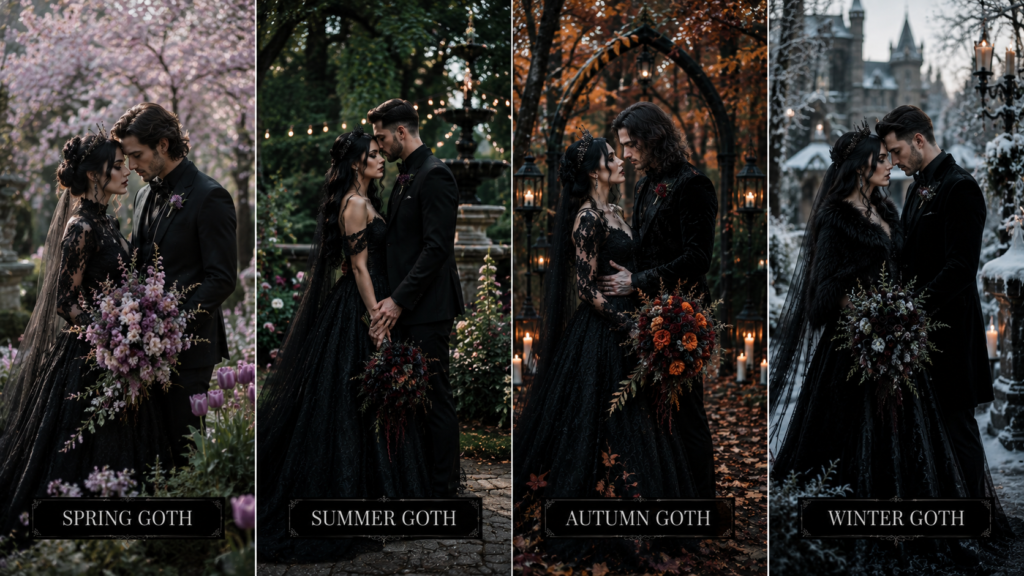
Spring
Spring Goth
Black florals against the fresh, insistently alive greenery of new growth — the most striking seasonal contrast available to the goth wedding photographer. The overcast skies of early spring provide a soft, diffused, shadowless light that flatters dark fabrics particularly well, and the presence of new botanical life against dark clothing creates a tension between the living and the gothic that reads as powerfully symbolic.
Summer
Summer Goth
The moody forest at its most densely canopied — the deep green light of a mature summer forest, where the overhead canopy filters and colours the available light into something entirely other than conventional daylight. Late-afternoon thunderstorm light, with its dramatic cloud formations and extreme contrast, is the most cinematically powerful natural light condition available in the summer months and should be actively sought rather than avoided.
Autumn
Autumn Goth
The season that most naturally aligns with the gothic aesthetic — the combination of deep amber and burgundy foliage with dark clothing creates a palette of extraordinary richness that requires almost no photographic manipulation. Low autumn light produces long shadows and warm colour temperature, and the presence of fallen leaves, bare branches, and the specific melancholy of seasonal transition all contribute to photographs of unusual emotional depth.
Winter
Winter Goth
Snow, velvet, and candlelight — the most formally beautiful and the most starkly contrasted of all seasonal combinations. Snow provides an extraordinary natural reflector that bounces soft, cool light upward onto the subjects while eliminating the background entirely into white. Dark velvet against snow produces the most extreme tonal contrast available in natural light and photographs with dramatic visual power.
Section Nine
The Biggest Mistakes in Goth Wedding Photography
The most useful planning knowledge is often the knowledge of what not to do — and goth wedding photography has a specific set of common errors that appear consistently across the work of photographers who are skilled but insufficiently specific in their aesthetic understanding of what the dark wedding requires.
Too Much Black With No Contrast
When every element in the frame is similarly dark, the image loses definition and reads as flat and undifferentiated. Every goth wedding photograph needs deliberate lighter elements — lit skin, a pale flower, a candleflame — to give the darkness something to define itself against.
Over-Editing
Aggressive desaturation, crushing the shadows to pure black, and adding excessive grain or vignetting in post-processing produces photographs that feel manufactured rather than inhabited. The goal is atmosphere, not effect. Over-processed goth wedding photographs look like Halloween promotional material, not beautiful documentary art.
Fake Props and Hollow Symbols
Plastic skulls, obviously fake cobwebs, and novelty Halloween props destroy the aesthetic intelligence of a goth wedding photograph immediately. Every object in the frame must be genuinely beautiful and genuinely intentional. If a prop would look at home in a fancy dress shop, it has no place in a seriously considered dark wedding image.
Ignoring Venue Architecture
The most consistent missed opportunity in goth wedding photography — treating the venue as a neutral backdrop rather than an active compositional element. A stone archway, a vaulted ceiling, a grand staircase — these are not incidental. They are among the most powerful compositional tools available, and a photographer who does not use them deliberately is wasting the most important creative resource in the room.
No Lighting Plan
Arriving at a dark venue without a specific, pre-agreed lighting strategy is the most consequential planning failure in goth wedding photography. Candle placement, supplementary lighting positions, and the timing of portrait sessions relative to natural light conditions all need to be agreed weeks in advance — not improvised on the day.
Copying Pinterest Exactly
Reference photographs are an invaluable communication tool between a couple and their photographer — but attempting to replicate them exactly produces photographs that read as derivative and lifeless. The reference communicates mood, light quality, and compositional approach. The execution must be completely specific to this couple, this venue, and this day.
Section Ten
How to Make Goth Wedding Photos Feel Personal
The most memorable goth wedding photographs are not those that most faithfully replicate a genre aesthetic — they are those in which the aesthetic serves as the framework for something deeply, irreducibly specific to the two people in the frame. The gothic visual tradition is rich enough and broad enough to contain enormous personal variation, and the most powerful photographs are those that use that tradition as a language in which to say something that could only be said by this couple, about this relationship, on this day.
Favourite Books & Music
The novels, poetry collections, and albums that defined the relationship photographed as objects — placed in the couple’s hands, on the ceremony table, or arranged as part of the detail compositions. These are the most direct possible way to communicate inner life through outer objects.
Family Heirlooms
An antique ring, a grandmother’s brooch, a great-aunt’s lace — objects that carry the weight of family history and that connect the present celebration to a longer line of love and ceremony. These photograph with an extraordinary resonance that no purchased prop can approach.
Symbolic Flowers & Rituals
The specific flowers that carry personal or symbolic meaning — the flower from a significant location, the bloom that appeared in both of your favourite paintings, the species that grew in a garden you both love. And the rituals specific to this couple — handfasting, candle lighting, a shared reading — that belong to no other ceremony.
“The most powerful goth wedding photograph is not the one that most completely fulfils the genre. It is the one that uses the full weight of the gothic visual tradition to say something that no other photograph of any other couple at any other celebration could say — something utterly, irreversibly specific to the two people in the frame and the world they have built together.”
— The Gothic Wedding Edit
Bonus — Highly Shareable
10 Goth Wedding Photos Every Couple Should Take
A complete visual checklist for your photographer brief.
01
The Veil Shot
From behind, veil extended in movement against an architectural or landscape background. The most reproduced image in all of dark wedding photography — because it is consistently one of the most beautiful.
02
The Candlelit Portrait
Close, warm, and lit by a single candle source — the most intimate and the most technically demanding of all goth wedding portrait formats. When executed well, it produces the most emotionally powerful image in the entire album.
03
The Dramatic Staircase
Shot from below with a wide lens, the subject on the upper stairs and the full architectural sweep of the staircase visible in the frame. The most architecturally cinematic image in all of historic venue photography.
04
The Bouquet Close-Up
Macro or near-macro on the individual blooms, shot in the best available natural or candlelight. This is the photograph that communicates the florist’s craft and the specific palette of the dark floral scheme most completely.
05
The Ring Detail
Rings in the dark velvet box, on stone, on a dark floral surface, or on the hand — shot with the maximum available textural contrast between the ring’s material and its surface. The detail photograph that will be examined most closely in the years after the wedding.
06
The Silhouette
Shot against blue hour sky, a fogged window, or a bright doorway — the couple as pure dark form against a luminous background. The most graphic and the most immediately arresting of all dark wedding compositional approaches.
07
The Cathedral Arch Portrait
The couple within the frame of a stone arch — the arch as compositional border, the light source behind them creating a halo quality around the subjects. One of the oldest and most enduring portrait formats in the history of Western art.
08
The Cloak Movement Shot
Wide angle, high shutter speed, subject moving deliberately with the cloak extended — captured at the precise moment the fabric forms its most complete and most architecturally dramatic shape. Plan this shot in advance and allow at least fifteen minutes to execute it well.
09
The First Dance
Shot wide in available candlelight with the rest of the room visible in soft focus behind the couple. The first dance photograph communicates the social world of the celebration — the gathered people, the decorated room, the totality of what has been built — more completely than any other single image.
10
The Final Nighttime Portrait
The last planned photograph of the day — lit by a single external light source against a fully dark background or a night landscape — in which the couple is photographed as themselves at the end of the day they have built: still, certain, completely present, and entirely at home in the dark world they made.
Final Thoughts
Brief the Photographer on the World, Not Just the Shots
The most important single piece of advice for any couple planning a goth wedding photography brief is this: do not give your photographer a shot list. Give them a world. Tell them about the books you both love and the music that means the most to you and the quality of dark beauty you have been reaching toward since you first understood that this is what your wedding would be. Tell them about the light you want and the mood you are building toward and the specific moment — somewhere between the ceremony and midnight — when you want to feel that you have been completely, photographically seen in all of the darkness and beauty and intention of who you are together. Then trust them to find the shots that serve that world. The shot list is the minimum. The world is the everything.
Find the photographer who responds to the world description with recognition rather than with reassurance. Find the one who has already been in rooms like the one you are building and has photographed the light there with genuine skill and genuine love for what dark beauty can be. Look at their portfolio not for shots that match your references, but for evidence that they understand why the light matters and what the atmosphere is for. That understanding is rarer than technical skill, and it is the only thing that produces goth wedding photographs that last — that remain, years after the day, as true and as beautiful and as completely themselves as the marriage they were made to record.