Art Nouveau Wedding Venue
Art Nouveau Wedding · 2026
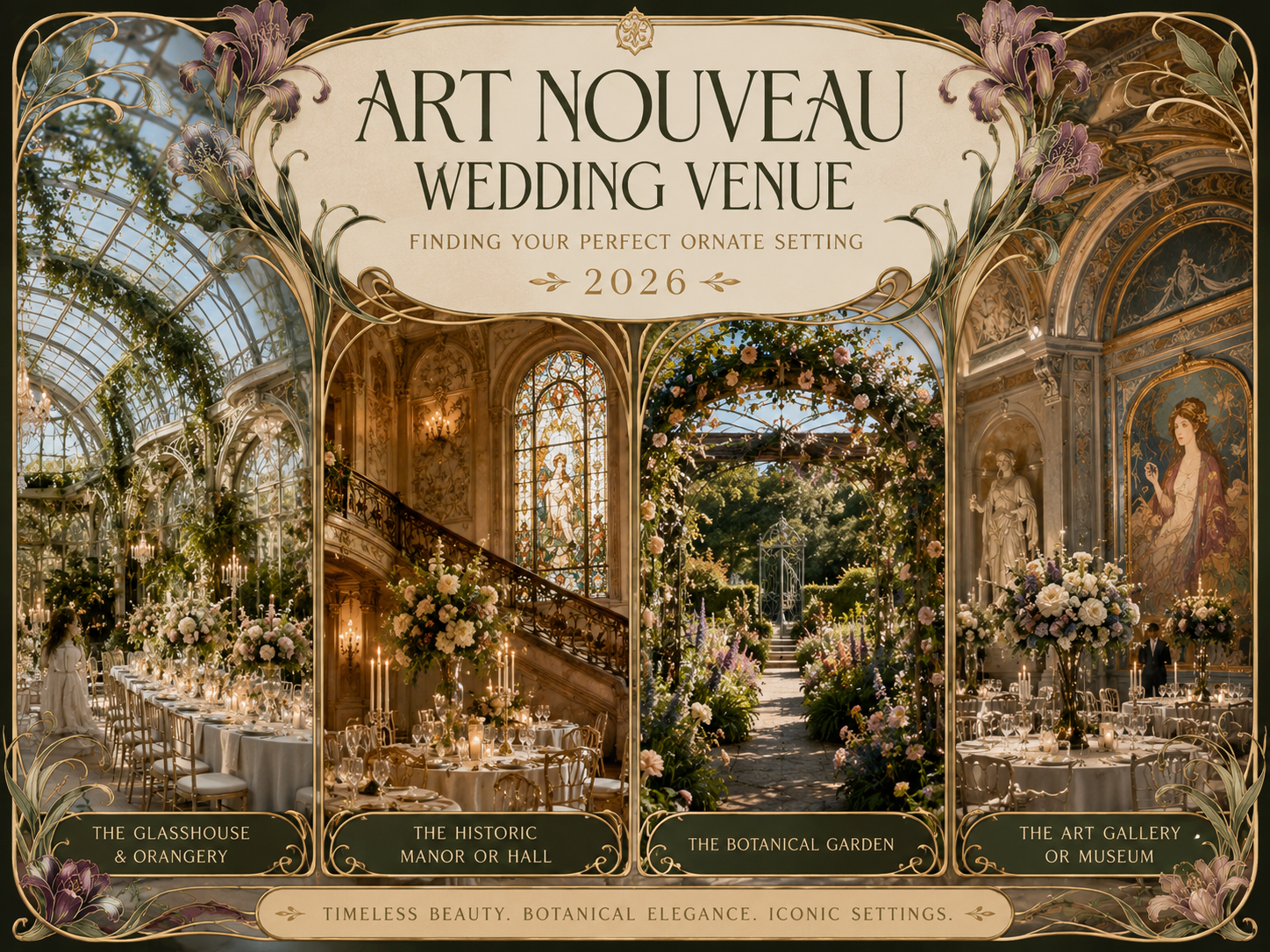
Art Nouveau Wedding Venue — Finding Your Perfect Ornate Setting 2026
From glasshouses and orangeries to ornate historic halls and living botanical gardens — the complete guide to finding an art nouveau wedding venue in 2026.
The venue is the one element of an art nouveau wedding that cannot be fully created from nothing — a botanical lace gown can be made to order, a stationery suite can be designed from a blank page, but architecture already exists or it doesn’t, and the right ornate wedding venue does a portion of the aesthetic’s work before a single flower has been arranged. This guide covers what genuinely makes a venue suited to the art nouveau aesthetic, four distinct venue types worth touring, the practical questions to ask on a site visit, how to transform a venue without period character, and how the venue you choose should inform the stationery your guests receive months in advance. Note: weddingavenuestudio.com is a stationery studio and does not book, manage, or recommend specific venues — this guide offers design criteria to bring to your own venue search.
The movement did not confine its curved lines and stained glass to objects you could carry home. It built them into the walls, the windows, the ironwork of the staircase — architecture as canvas, so that simply standing inside the right building was itself an aesthetic experience.
Section 01
What Makes a Venue Art Nouveau
Curved structural lines are the most fundamental architectural signal of a genuinely art nouveau-appropriate venue — ironwork that flows rather than meets at right angles, archways and window frames with organic, asymmetric curvature rather than uniform geometric arcs, staircases and balustrades where the metalwork follows botanical rather than structural logic. A venue with even one significant curved architectural feature — a single ornate staircase, an entrance archway with genuine sinuous ironwork — has more usable art nouveau character than a venue with extensive but entirely straight-edged, geometric period detail, because the curve is the single most load-bearing visual signal of the entire aesthetic.
Stained glass windows, where they exist, are among the most valuable and most irreplaceable architectural features a venue can offer: the specific quality of warm, jewel-coloured light moving across a room as the day progresses is something no amount of decoration can recreate convincingly, and the movement’s own architectural tradition treated coloured glass as one of its primary creative media. Ornate ironwork — in gates, railings, light fixtures, or structural support elements — with visible botanical or sinuous detail rather than purely functional geometric grillwork, is the second architectural feature worth specifically seeking out. Botanical motifs carved or moulded into plasterwork, cornicing, or ceiling roses add a further layer of period-appropriate detail, particularly when the motifs show genuine botanical specificity (identifiable leaf or flower forms) rather than generic classical scrollwork.
Buildings genuinely constructed during the art nouveau period, roughly 1890 to 1910, offer the highest level of architectural authenticity available, since their structural and decorative details were designed according to the movement’s actual principles rather than referencing them after the fact. These buildings exist in meaningful numbers across several European cities in particular, where the period coincided with significant urban development, and where such buildings operate as wedding venues they represent the most historically grounded choice available. For couples without access to a genuine period building, the practical test is the same regardless of the building’s actual age: does the venue have curved structural lines, coloured or textured glasswork, ornate botanical ironwork, or detailed plasterwork, even if the building itself postdates or predates the movement by decades? A well-chosen contemporary venue with strong curved architectural features will often suit the aesthetic better than a genuinely old building with rigid, geometric period detail from an earlier or later era.
Section 02
Four Art Nouveau Venue Types
Four categories of venue suit the art nouveau aesthetic for genuinely different reasons. Use these as search categories when researching venues in your own area, rather than as a list of specific recommendations.
Venue 2.1
The Glasshouse & Orangery
The most naturally art nouveau venue category available, because it solves the movement’s central aesthetic challenge — placing ornate human design and living botanical material in the same frame — through its basic architectural function rather than through additional decoration. Victorian and Edwardian glasshouse architecture, with its curved cast-iron structural ribs and extensive glazing, is itself a piece of period engineering that frequently predates or directly overlaps the art nouveau period, and the established botanical planting it contains provides genuine living botanical illustration at full scale. An orangery offers the same essential quality in a warmer, more enclosed format, often with stone or brick construction that suits candlelit evening receptions particularly well.
When researching glasshouse and orangery venues, prioritise those with mature, established planting over newly planted or sparse interiors — the depth and variety of decades-old botanical growth is the specific quality that makes this venue category so naturally suited to the aesthetic, and a glasshouse with minimal planting loses much of its inherent advantage. Look also for curved structural ironwork in the glazing frame itself, since the most architecturally distinguished examples of this building type display genuinely sinuous, organic structural lines rather than purely functional straight glazing bars.

Matching Stationery
The Art Nouveau Floral stationery collection carries the same flowing botanical illustration that a glasshouse venue provides in living form — fully customizable with your names, date, and wedding details.

Venue 2.2
The Historic Manor or Hall
Period architecture at its most ornately developed — a historic manor or hall with genuine period plasterwork, original ironwork detail, and ideally some stained glass, provides the architectural grandeur and decorative density that suits the most maximally ornate end of the art nouveau aesthetic. These venues offer the specific quality of rooms that were designed, in their original construction, to be genuinely beautiful rather than merely functional — ornate cornicing, decorative ceiling roses, substantial fireplaces with carved or moulded detail — which gives the art nouveau decoration a base of architectural richness to build upon rather than working against a plain or minimally detailed interior.
When touring manor and hall venues, look specifically for rooms where the original decorative plasterwork or woodwork has been preserved rather than stripped back during later renovation, since this original detail is precisely what allows the art nouveau decoration to feel integrated rather than imposed. Ask directly whether any original stained glass survives in the building, even in secondary rooms or stairwells, since even a small amount of genuine period glasswork adds considerable authentic atmosphere that no rented decoration can replicate.


Matching Stationery
The Fancy Classic Decorative Art Nouveau stationery collection matches the ornate, maximalist character of the best historic manor and hall venues — fully customizable with your names, date, and wedding details.

Venue 2.3
The Botanical Garden
Living art nouveau in its most literal sense — a botanical garden venue offers exactly the source material the movement’s artists and designers worked from directly, at the scale of an actual landscape rather than a single decorated room. Established botanical gardens with genuine horticultural depth, particularly those with formal garden structures, walled sections, or period glasshouses within the wider grounds, provide both the open-air ceremony settings and the architecturally framed reception spaces that a full wedding day requires, all drawn from the same living botanical source material the movement’s entire visual philosophy was built around.
When researching botanical garden venues, ask specifically about which areas of the garden are available for ceremony and reception use and at what time of day, since botanical gardens are often primarily public attractions with wedding hire as a secondary function — access windows and crowd management during the ceremony itself are practical considerations unique to this venue category. Gardens with walled sections, pergolas, or established climbing plant structures (genuine wisteria arches, where they exist, are an exceptional find) offer the most directly art nouveau-appropriate ceremony backdrops within the wider garden.

Matching Stationery
The Vintage Garden Arch stationery collection carries the same romantic garden botanical character that a true botanical garden venue provides — fully customizable with your names, date, and wedding details.

Venue 2.4
The Art Gallery or Museum Venue
The most architecturally dramatic and most curated of the four — an art gallery or museum venue, particularly one housed in a period building with genuine decorative architectural detail, offers a specific combination of grandeur and refined elegance that suits the more sophisticated end of the art nouveau aesthetic. These venues frequently combine impressive ceiling height and architectural scale with the kind of considered, curated atmosphere that comes from a building designed to display beautiful objects, which translates naturally to a wedding celebration that wants to feel similarly considered and visually significant.
When touring gallery and museum venues, ask specifically about restrictions on candle use, botanical installation, and any limitations around existing exhibits or collection items, since these venues often carry more stringent conservation requirements than conventional wedding venues — open flame in particular is frequently restricted or prohibited near collection items, which has direct implications for the candlelit reception atmosphere central to several art nouveau aesthetic registers. Ask also whether the venue offers exclusive use during your event or whether the public galleries remain accessible, since this affects both atmosphere and guest privacy significantly.
Matching Stationery
The Art Nouveau Vintage stationery collection matches the refined, curated elegance of a gallery or museum venue — fully customizable with your names, date, and wedding details.

Section 03
Questions to Ask When Touring an Art Nouveau Venue
A practical checklist to bring to every venue tour, regardless of which of the four categories above the building belongs to.
Architectural Details
Walk every room you will use, not just the ceremony and reception spaces, and look specifically for curved ironwork, stained or coloured glass, botanical plasterwork detail, and any original period features that survive. Ask directly whether any original decorative elements have been removed or covered during past renovations — sometimes original detail exists behind later additions and can be revealed or highlighted for your event.
Lighting Capability
Ask specifically about candle policy: many venues restrict or prohibit open flame, which has direct implications for the candlelit atmosphere central to several art nouveau registers. Confirm whether the venue’s existing electrical lighting can be dimmed or supplemented with warm-toned bulbs, and ask whether external lighting designers are permitted to bring in additional fixtures, since the warm amber lighting this aesthetic depends on is rarely achieved through a venue’s standard lighting alone.
Flexibility for Botanical Decor
Ask what is permitted in terms of structural decoration: can a ceremony arch be freestanding or does it need to attach to existing architecture, are there weight or fixing restrictions for suspended floral installations, and is there a house florist requirement or full flexibility to bring your own. Confirm timing for setup and breakdown, since elaborate asymmetric botanical installations of the kind this aesthetic favours typically require more setup time than conventional centrepiece-only floristry.
Existing Colour Palette
Note the existing wall colour, flooring, and any fixed decorative elements (carpets, curtains, upholstered furniture) that cannot be changed for your event, and consider how these interact with your chosen art nouveau palette. A venue with warm wood panelling and aged stone supports the vintage and classic botanical registers naturally; a venue with cool grey stone or contemporary white walls may suit the dark jewel-toned register better, since the contrast itself becomes part of the atmosphere.
Section 04
Transforming a Non-Period Venue
A genuinely blank, contemporary space — a modern hotel ballroom, a marquee, a converted warehouse with no period architectural character — can still host a beautiful art nouveau wedding, but it requires the celebration’s other elements to do work that an architecturally suited venue would do automatically. Lighting is the single most powerful and most cost-effective transformation tool available: removing or significantly dimming a space’s existing overhead lighting and replacing it with warm candlelight and amber-toned supplementary lighting changes the fundamental character of even the most contemporary room more completely than almost any other single intervention, because it removes the cool, even, shadowless quality that reads as most distinctly un-period and replaces it with the warm, flickering, jewel-catching light the aesthetic depends on.
Botanical installations at architectural scale — not merely table centrepieces but structural floral moments that create their own curved, organic architecture within a space that has none — are the second major transformation tool. A substantial suspended floral installation above the dance floor, an asymmetric botanical arch at the ceremony point even in a space with no natural focal point, or floor-to-ceiling trailing botanical material along key sightlines can supply the curved organic structure a blank room lacks. This requires a greater floristry investment than a venue with existing architectural character, but it is the most direct way to introduce genuine art nouveau structural logic into a space that offers none of its own.
Fabric draping in warm jewel tones or aged ivory can soften the hard edges and flat surfaces of a contemporary space, particularly when used to create curved or swagged lines along walls and ceiling rather than straight, taut panels. Heavy silk or velvet draping, gathered and allowed to fall in soft, irregular folds, introduces a textile equivalent of the sinuous line work that the aesthetic requires elsewhere, and it can be especially effective at concealing modern architectural features — visible ductwork, contemporary window frames, exit signage — that would otherwise undermine the atmosphere being built around them.
In a venue with no inherent period character, the stationery and signage carry a proportionally greater share of the responsibility for establishing the aesthetic, since they are the elements most fully under the couple’s direct creative control. A welcome sign designed as a genuine botanical illustration poster, directional signage with consistent botanical motifs and antique gold detail, and a complete stationery suite that guests encounter from the very first save the date all do real work in a blank venue that they do only supplementary work in an architecturally suited one — in a contemporary space, the printed and decorative elements are not reinforcing the architecture’s existing character but creating the celebration’s entire visual identity from nothing.
Section 05
Venue & Stationery: Setting Guest Expectations
The invitation arrives in a guest’s home weeks or months before they ever see the venue, and for a guest with no prior knowledge of the specific building, the invitation functions as their first and most influential preview of what kind of atmosphere they should expect. A guest who receives an invitation with flowing botanical illustration, sinuous gold line work, and the warm jewel tones of the art nouveau tradition arrives at the venue already primed to notice and appreciate the curved ironwork, the warm candlelight, the botanical abundance — elements they might otherwise simply walk past in a venue they had no advance context for. The invitation is, in this sense, doing genuine perceptual work before the wedding day itself: it tells the guest what to look for.
This effect matters most precisely in the two situations where the venue itself cannot fully establish the aesthetic on its own: in a transformed non-period venue, where the stationery’s consistent botanical visual language compensates for what the architecture does not provide, and in a venue with subtle or easily overlooked period character, where the stationery primes guests to notice details — a small stretch of original ironwork, a single stained glass panel in a stairwell — that they might otherwise miss entirely. In both cases, the stationery functions as an active interpretive guide to the venue rather than simply a coordinated decorative accessory.
Choosing your stationery collection with your specific venue in mind, rather than selecting both independently, produces the most coherent result. A glasshouse or botanical garden venue, rich in living botanical material, pairs naturally with the Art Nouveau Floral or Vintage Garden Arch collections, where the printed botanical illustration echoes what guests will see growing around them. A historic manor or hall with genuine architectural ornament suits the Fancy Classic Decorative collection’s maximalist register, matching the venue’s own decorative density. A gallery, museum, or contemporary transformed venue suits the more curated, refined character of the Art Nouveau Vintage collection, which does not depend on an abundance of surrounding botanical or architectural detail to read as genuinely beautiful.
The four collections below each correspond to one of the venue types described in Section 02. All are fully customizable with your names, date, and wedding details.
Shop the Collections
Stationery Matched to Every Venue Type
Art Nouveau Floral
Flowing botanical illustration and antique gold detail — the natural match for a glasshouse or orangery venue.

Art Nouveau Vintage
Warm nostalgic botanical art nouveau — the refined match for a gallery, museum, or transformed contemporary venue.
Vintage Garden Arch Wedding
Garden arch romantic botanical vintage — the precise visual companion to a botanical garden venue.
Fancy Classic Decorative Art Nouveau
Maximally ornate classical art nouveau — the stationery match for a historic manor or hall venue.
The Art Nouveau Wedding Series
Explore the Full Series
Art Nouveau Wedding — The Complete Aesthetic Guide · Art Nouveau Wedding Invitations · Art Nouveau Wedding Dress · Art Nouveau Wedding Decorations · Art Nouveau Wedding Theme & Colors · Art Nouveau Wedding Ring · Art Nouveau Wedding Cake · Art Nouveau Wedding Flowers
Frequently Asked Questions
Common Questions
Do you recommend specific art nouveau wedding venues?
No — weddingavenuestudio.com is a wedding stationery studio and does not book, manage, or recommend specific venues or venue companies. This guide offers the architectural and design criteria to bring to your own venue search, regardless of your location: curved structural lines, stained or coloured glass, ornate botanical ironwork, and detailed period plasterwork are the features worth prioritising. Use the four venue categories in Section 02 as search terms when researching venues in your own area, and the checklist in Section 03 as a practical guide for site visits.
Can a modern venue work for an art nouveau wedding?
Yes — Section 04 covers this directly. A genuinely blank, contemporary space can host a beautiful art nouveau wedding when the celebration’s other elements compensate for the absence of period architecture: warm candlelit lighting replacing cool overhead lighting, architectural-scale botanical installations introducing curved organic structure, fabric draping softening hard contemporary edges, and a complete stationery suite carrying more of the responsibility for establishing the aesthetic than it would in an architecturally suited venue. The result requires more deliberate design investment but is genuinely achievable.
What architectural features should I prioritise when touring venues?
In priority order: any genuine stained or coloured glass, since this is the single feature decoration cannot replicate; curved structural ironwork in staircases, archways, or window frames; established botanical planting at scale, particularly in glasshouse or garden venues; and detailed botanical plasterwork or cornicing. A venue with even one of these features in genuine quality is worth strong consideration over a venue with extensive but entirely straight-edged, geometric period detail, since the curve and the coloured light are the two most load-bearing visual signals of the entire aesthetic.
How do I match my stationery to my venue choice?
Match by register rather than by exact colour: a glasshouse or botanical garden venue pairs with the Art Nouveau Floral or Vintage Garden Arch collections, where the illustration echoes the living botanical setting; a historic manor or hall suits the Fancy Classic Decorative collection’s maximalist register; a gallery or transformed contemporary venue suits the refined Art Nouveau Vintage collection. Choose your venue first where possible, then select stationery that complements rather than competes with its existing character.
Art Nouveau Wedding Stationery · 2026
Set the Tone Before Guests Arrive
Your invitation is the first preview of your venue’s atmosphere — fully customizable stationery suites matched to every venue type above.