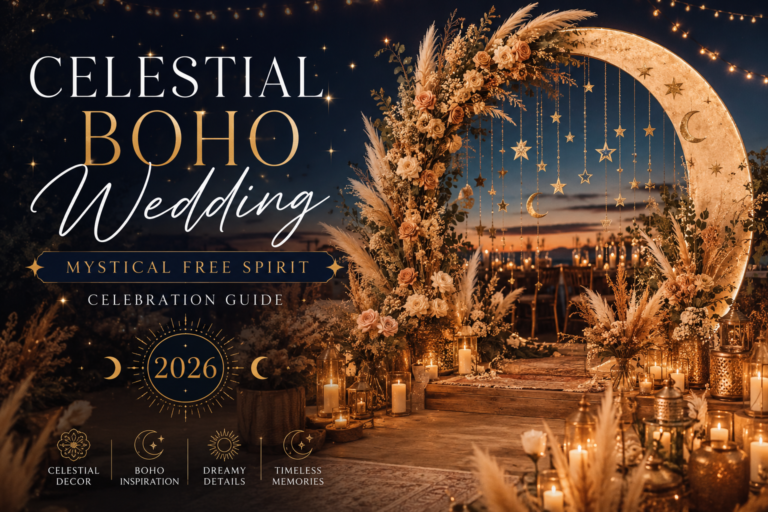
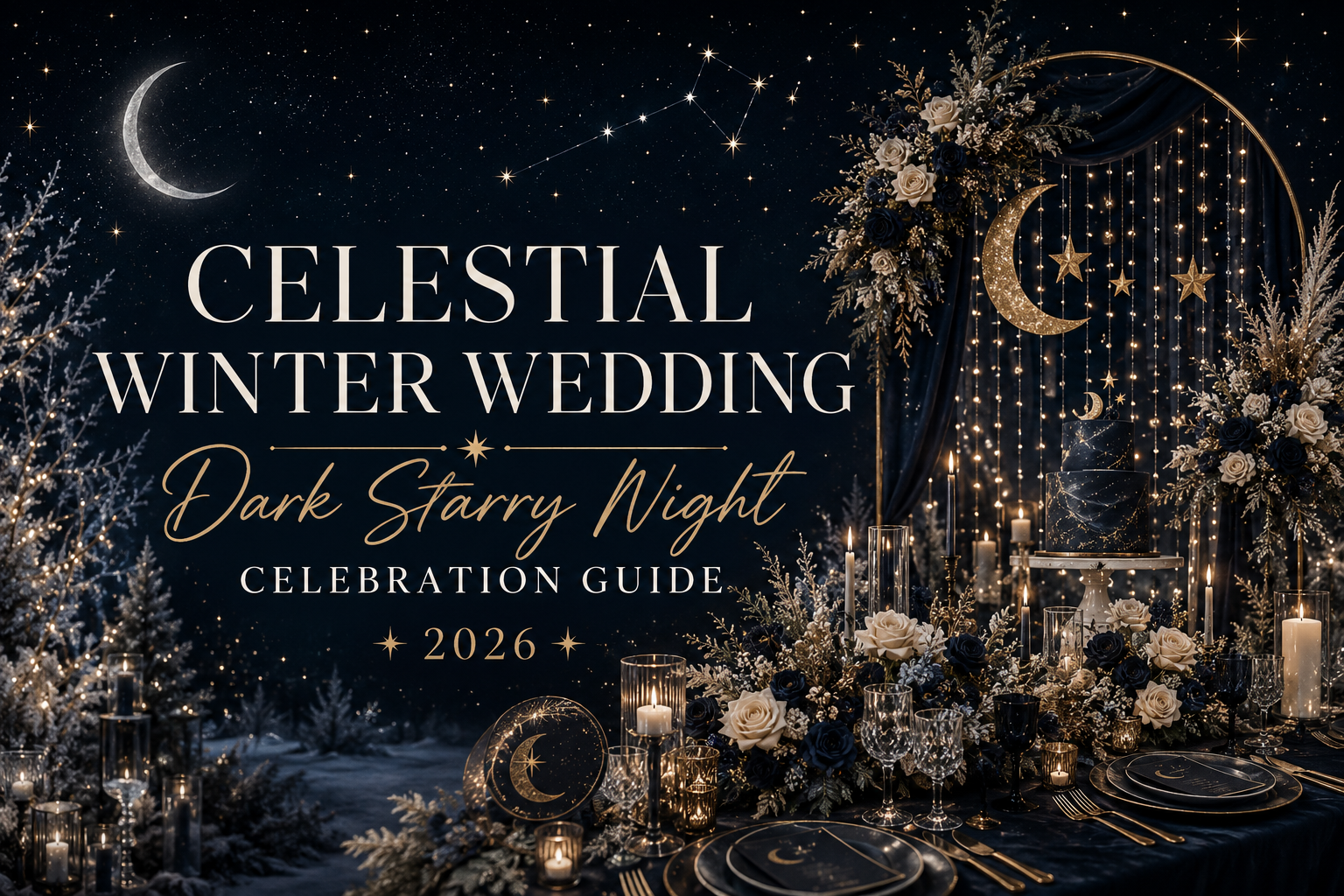
Celestial Winter Wedding — Dark Starry Night Celebration Guide 2026
Celestial Wedding · 2026
Celestial Winter Wedding — Dark Starry Night Celebration Guide 2026
Five celestial winter aesthetics, four winter sky palettes, ceremony and reception under the season’s most brilliant stars, florals and decor for the darkest and most dramatic celestial celebration possible.
Winter is the peak season for the celestial wedding — not because of the holidays or the snow but because of the specific quality of the winter night sky, which is the most atmospherically powerful sky available across the entire year. This guide covers five celestial winter aesthetics, four winter sky palettes, the specific venue and ceremony decisions that make the most of the winter sky’s qualities, reception styling and winter florals, and the stationery that carries the winter celestial world into the printed layer of the celebration.
“Winter stars are colder and sharper and more absolutely themselves than stars in any other season — they do not glow, they pierce. They are the sky at its most committed to the act of shining.”
Section 01
Why Winter Is the Perfect Celestial Season
The winter sky is the best sky available to the celestial wedding — not as a matter of aesthetic preference but as a matter of measurable astronomical fact. Cold, dry winter air contains significantly less water vapour than the warm, humid air of summer, and water vapour is the primary cause of atmospheric refraction — the process by which the Earth’s atmosphere bends and softens the light from celestial objects, reducing the sharpness and brilliance of stars as seen from the ground. In winter, less atmospheric refraction means stars appear sharper, brighter, and more distinctly themselves than in any other season.
The longer nights of winter are the second decisive advantage of the celestial winter wedding — because they provide dramatically more time in which the celebration can exist under genuine starlight. In the northern hemisphere at 50 degrees latitude, a summer wedding requires guests to wait until after 11pm for astronomical twilight; a winter wedding can be fully under stars by 6pm and can remain so until well after midnight, providing the entire evening of the reception under the actual night sky rather than just the last hour of a primarily afternoon celebration.
The winter solstice — the year’s longest night, occurring around the 21st of December — is the most ancient and most universally celebrated celestial event in the human calendar. Every significant human civilisation has marked the solstice with ceremony and celebration, which means that a wedding held at or near the solstice is not merely a winter wedding — it is a wedding at the moment that every human culture has identified as the pivot of the celestial year.
The combination of frost and stars is the most specific and most beautiful aesthetic quality available to the celestial winter wedding that no other season can offer: frost on ground surfaces, on glass, on botanical elements creates a specific quality of scattered and refracted light that references the star-scatter of the night sky at the terrestrial scale. A venue with frost-covered outdoor surfaces visible through glass walls, candlelit from within, with a clear starfield above: this is the celestial winter atmosphere at its most naturally produced, requiring no decoration and no artificial enhancement.
Section 02
Five Celestial Winter Aesthetics
Five distinct registers of the celestial winter wedding — from the most dramatically dark to the most warmly candlelit, from the most dramatically cosmic to the most historically grounded. Each one takes the winter sky as its primary inspiration in a different register and at a different emotional temperature.
Aesthetic 2.1
The Dark Starry Winter
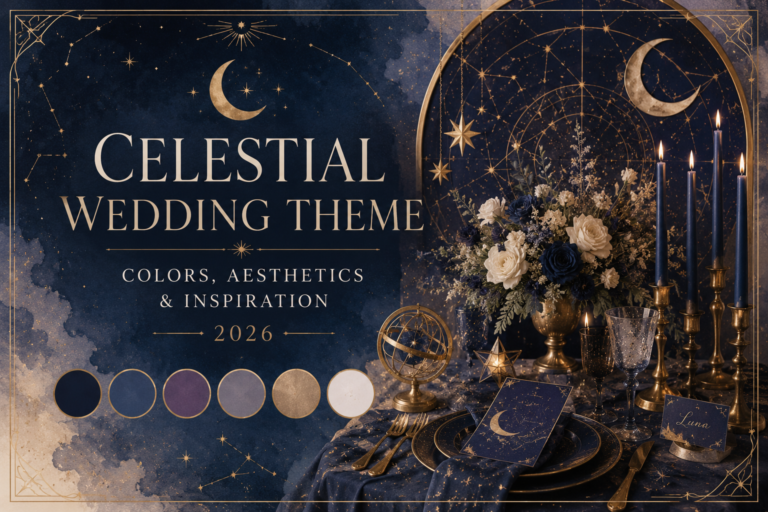
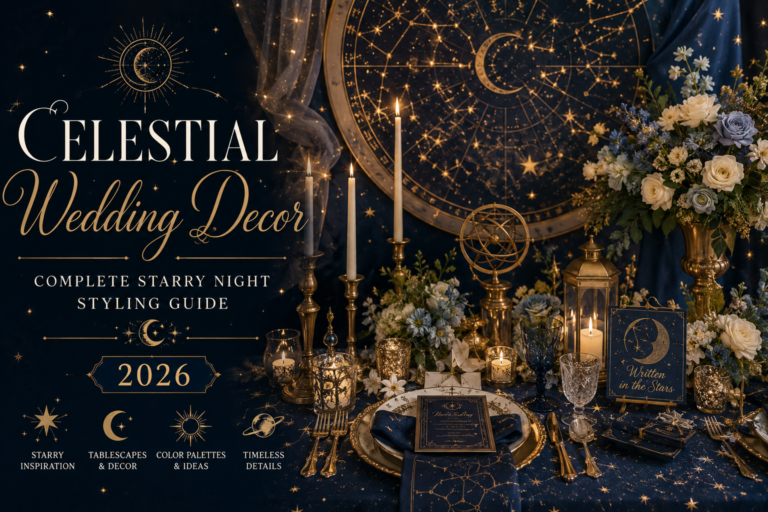
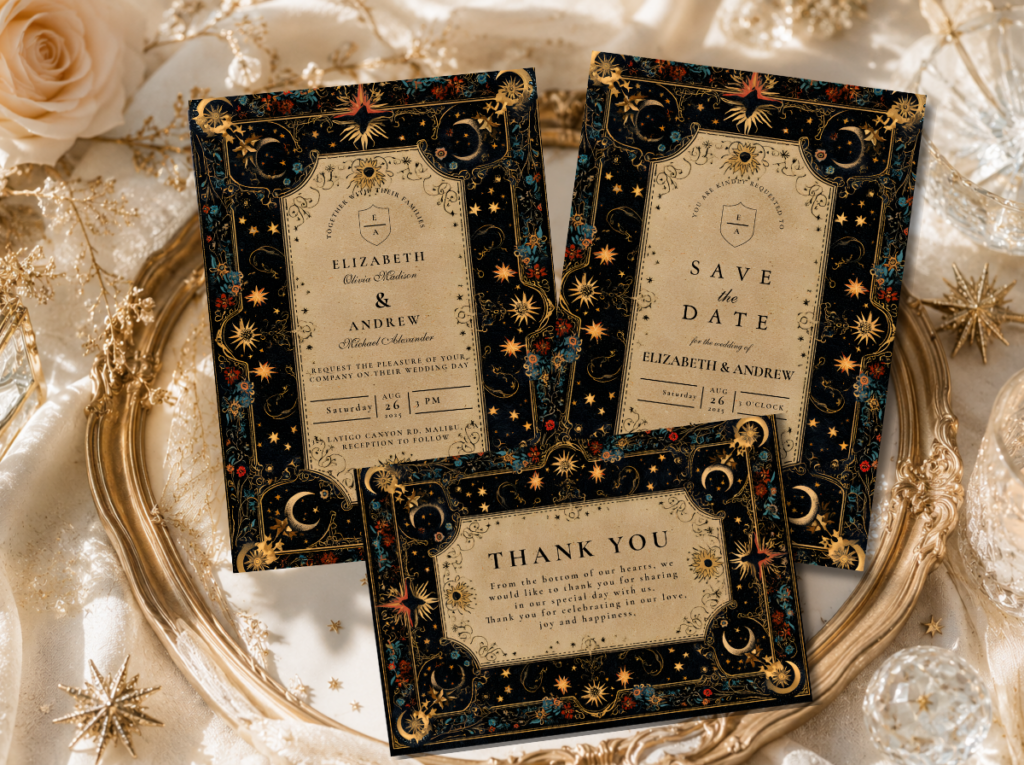
The Dark Starry Winter is the most dramatically atmospheric of the five aesthetics — it takes the winter sky at its darkest and its most brilliant and translates that quality into every design decision of the celebration, producing a wedding that reads as genuinely cinematic in the specific way that only a winter night can be cinematic. The palette is the darkest of the five directions: near-black as the complete base, with gold and silver star scatter as the only points of warm and cool light within that darkness, and no softening neutrals, no warm cream accents, no base colour that reduces the total commitment to depth and darkness.
The specific visual quality that distinguishes the Dark Starry Winter: the sharpness of the light within the darkness. Where warm summer and autumn celestial aesthetics produce a soft, atmospheric quality, the Dark Starry Winter produces a sharp, brilliant quality — the specific quality of winter starlight, which does not glow softly but appears with sudden precision against the absolute darkness that surrounds it. This is achieved in decoration by using high-contrast lighting design, by using the cooler metallic quality of silver alongside warm gold, and by maintaining the palette’s commitment to depth without any softening element.
The Dark Starry Winter aesthetic is most appropriate for evening and night-only celebrations with significant indoor time — because it requires the darkness to be sustained throughout the event. Winter sunset timing (which in northern latitudes can occur before 4pm in December) works to the Dark Starry Winter’s advantage: a celebration that begins as the sun sets and continues entirely through the night’s darkness can maintain the aesthetic’s full quality from the first moment of arrival.
Aesthetic 2.2
The Midnight Blue Winter
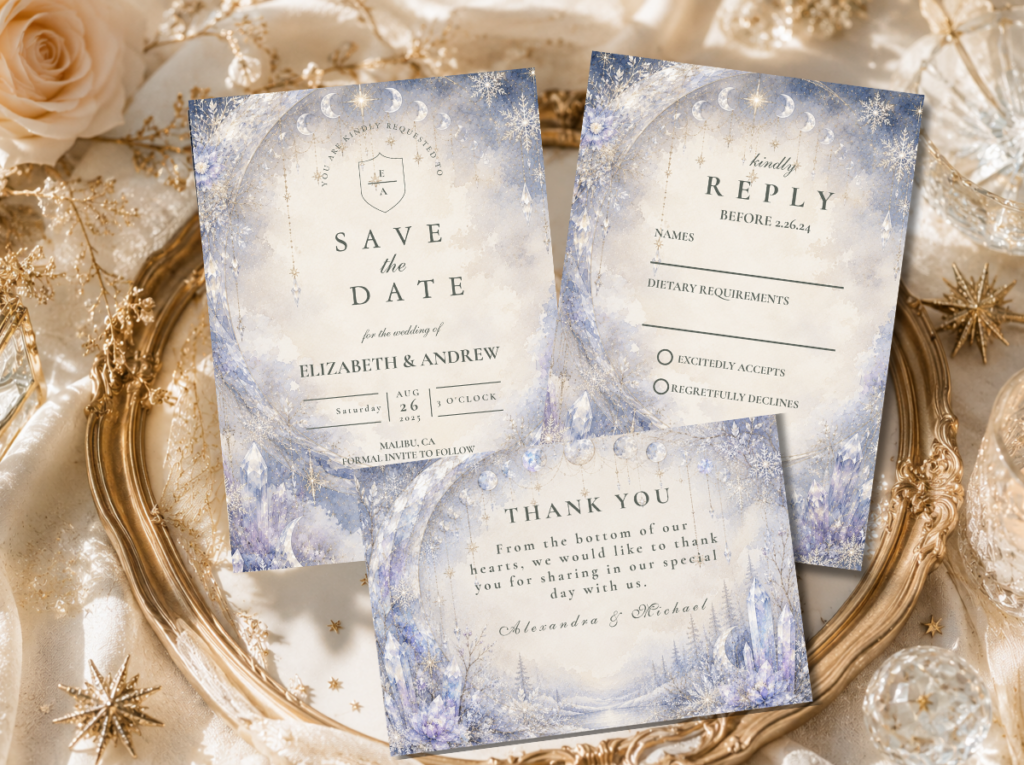
The Midnight Blue Winter is the most classically beautiful and the most immediately romantic of the five aesthetics — it takes the deep midnight blue of the winter sky at astronomical twilight and sustains that quality as the complete colour environment of the celebration. Midnight navy rather than near-black as the base colour; warm antique gold as the primary star scatter and metallic accent; the specific depth of a winter blue that is deeper than any summer midnight but still carries a blue quality that prevents it from reading as entirely dark.
The Midnight Blue Winter is the most appropriate of the five directions for couples who want the dramatic and atmospheric quality of the winter celestial aesthetic without the maximum darkness commitment of the Dark Starry Winter. The deep navy base is warm enough to read as welcoming and intimate rather than austere, and the warm antique gold against it produces the specific quality of warmth-within-darkness that is the fundamental appeal of the winter celestial aesthetic.
The specific decoration details that define the Midnight Blue Winter: midnight navy velvet tablecloths as the surface base; warm antique gold flatware, candleholders, and centrepiece elements throughout; white or cream flowers as the star-equivalent light accent (white garden roses, white anemone, white hellebore) in arrangements that position the white flowers against the deep navy linen the way stars appear against the winter sky.
Aesthetic 2.3
The Gold Winter Celestial
The Gold Winter Celestial is the warmest and the most intimate of the five aesthetics — it centres on the specific quality of warm candlelight and golden stellar light against a dark winter background, producing a celebration that reads as cosy, luminous, and deeply welcoming rather than dramatically atmospheric. The Gold Winter Celestial palette is the warmest of the five: deep amber rather than midnight blue as the dominant dark element; warm amber gold rather than cool antique gold as the primary metallic; ivory and warm cream rather than cool cream as the base neutral.
The Gold Winter Celestial is the most appropriate of the five directions for celebrations in historic buildings with stone walls and warm-toned architectural surfaces — because the amber and gold of the palette reads as contextually appropriate in a space already rich with warm stone and candlelit amber. It is also the most appropriate direction for couples who want the sun and moon aesthetic expressed in a specifically winter register — the low winter sun at golden hour provides the most amber quality of any season’s light.

Aesthetic 2.4
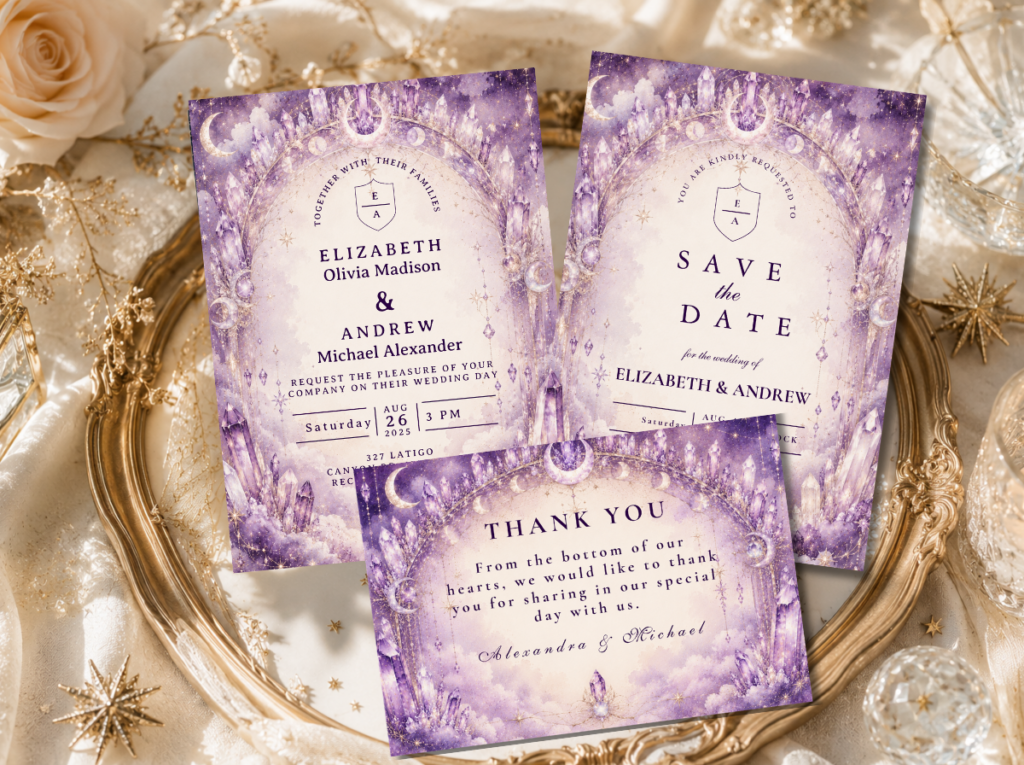
The Purple Winter Galaxy
The Purple Winter Galaxy is the most mystical and the most atmospherically distinctive of the five aesthetics — it takes the specific deep amethyst and midnight purple quality of galaxy photography and places it in the winter celestial context, producing a celebration that reads as genuinely otherworldly. The palette: deep amethyst and midnight purple as the base tones, with warm antique gold as the primary star scatter, and cool silver as the secondary metallic that references the frost and ice quality specific to the winter celestial context.
The Purple Winter Galaxy is most associated with the whimsigoth and mystical celestial aesthetics at their most seasonally specific — the winter version of the night court aesthetic and the purple galaxy mystical direction. It is also the most photographically dramatic of the five winter aesthetics — because the deep purple base with warm gold and cool silver scatter produces the highest contrast and the most visually complex flat lay photograph of any of the winter celestial aesthetics.
Aesthetic 2.5
The Vintage Winter Celestial
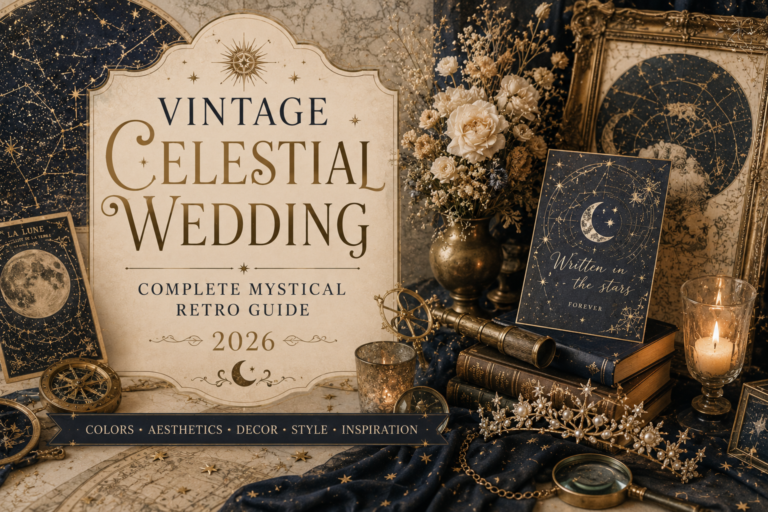
The Vintage Winter Celestial is the most historically grounded and the most intellectually specific of the five aesthetics — it takes the Victorian astronomical tradition and renders it as a complete winter wedding aesthetic. The winter constellations — Orion, Taurus, Gemini, Auriga, Perseus — are the most prominent and the most beautifully illustrated constellations in the historical celestial atlas tradition, which means the vintage winter celestial aesthetic has access to the most visually spectacular of all historical constellation imagery.
The Vintage Winter Celestial palette takes the standard vintage celestial warmth and adds the specific cool quality of winter frost: aged parchment as the base, burnished antique gold as the constellation metallic, with the addition of a specific cool frost-silver element — silver frost on parchment borders, silver botanical elements in floral arrangements, the specific visual quality of candlelight reflected in frosted glass. The combination of warm antique gold and cool frost silver on a parchment base is the most historically layered palette available in the winter celestial aesthetic category.
Section 03
Celestial Winter Color Palettes
Four winter sky palette directions — each calibrated to a different quality of the winter night and a different emotional register of the season’s celestial character.
Palette 01
Midnight Black & Brilliant Gold
Near-Black · Brilliant Antique Gold · Ice Silver · Midnight
The most dramatically atmospheric — near-black as the complete base, warm antique gold as star scatter, ice silver as cool secondary metallic. Total commitment to depth and darkness. For: Dark Starry Winter aesthetic.
Palette 02
Deep Navy & Ice Silver
Deep Midnight Navy · Ice Silver · Cool Champagne · Antique Gold
The coolest and most specifically seasonal — midnight navy deepened toward blue-black, ice silver as the primary metallic. The palette of winter nights that are brilliant and cold. For: Midnight Blue Winter aesthetic.
Palette 03
Winter Amethyst & Frost Silver
Deep Amethyst · Midnight Purple · Frost Silver · Warm Gold
The most distinctive and most mystical — deep amethyst and midnight purple as the winter galaxy base, frost silver as the cool metallic. For: Purple Winter Galaxy and whimsigoth winter celestial aesthetics.
Palette 04
Warm Candlelight & Deep Starry Black
Deep Amber · Antique Gold · Near-Black · Ivory
The warmest and most welcoming — deep amber and warm antique gold as the primary tones, near-black as backdrop darkness, warm ivory as the softening neutral. For: Gold Winter Celestial aesthetic.
Section 04
Celestial Winter Venue & Ceremony
Venues for the Celestial Winter Wedding
The ideal celestial winter wedding venue combines interior warmth with exterior sky access — the specific quality of being warm and gathered inside a beautiful space while having the dark winter sky directly visible, either through glass walls or windows or through easy access to an outdoor space. Victorian glasshouse venues are the single most appropriate venue category for the celestial winter wedding, because they provide the simultaneity of indoor warmth and outdoor sky that the aesthetic requires without making guests choose between the two.
Dark sky reserves in winter are the most experientially authentic of the celestial winter wedding venue categories. In winter at a dark sky location, the winter constellations (Orion, Taurus, the Pleiades, Auriga, Gemini) are visible at their maximum brilliance, and the specific sharpness of winter stars makes even the fainter constellations legible to the naked eye. Historic halls and stone buildings — venues whose architecture already carries the weight and authority of centuries of winter gatherings — are the most appropriate indoor venue category when outdoor sky access is not available.
Celestial Winter Ceremony Details
The celestial winter ceremony should be timed to begin at dusk — the specific moment when the sky is transitioning from the residual blue of daylight into the deeper blue of astronomical twilight, and the first stars are becoming visible. In December and January in northern latitudes, this moment can occur as early as 4pm, which means a winter celestial wedding can have its ceremony at a civilised hour while still offering guests the experience of watching the sky transition into full night during the ceremony itself.
The candlelit constellation aisle: taper candles in dark metal holders placed at the specific geometric positions of a named winter constellation — Orion’s Belt, the main stars of the Pleiades, or the bright winter hexagon — so that the aisle is a constellation map in candlelight that guests walk through on arrival and the couple walks through at the beginning of the ceremony. The candles should vary in height to suggest the different magnitudes of the stars they represent.
The Mystical Black Gold Wedding suite produces the ceremony program most aligned with the celestial winter aesthetic — deep midnight and warm gold in a quality that reads as belonging to the winter sky at its most committed to darkness and brilliance.
Section 05
Celestial Winter Reception Styling
The celestial winter reception is the moment when the celebration fully arrives in the night — when the sky outside has reached its darkest and most brilliant, the candles inside have been burning long enough to warm the cold architecture of the venue, and the guests are fully immersed in the specific atmosphere of a winter celestial world. The reception decoration should reach its full effect at this moment rather than on arrival, which means the lighting design is the most important single design decision of the entire event.
Table Styling for the Celestial Winter Reception
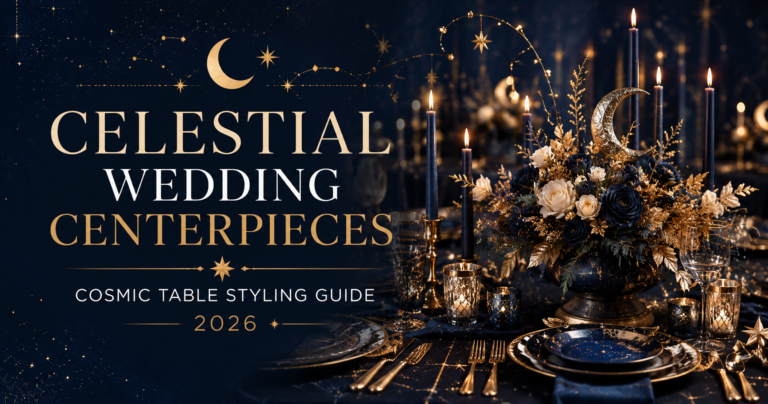
Dark velvet tablecloths in midnight navy or near-black provide the winter sky at the table level — the depth and texture of velvet in dark tones reads as specifically wintery in the celestial aesthetic because velvet absorbs and softens light the way the winter sky absorbs all ambient light sources. Silver and gold star scatter on the dark velvet surface should follow a constellation pattern from a winter star chart reference: Orion’s stars in their characteristic three-star belt; the Pleiades as a cluster; the individual bright stars of the winter hexagon positioned at their correct angular relationships.
Winter botanical celestial centrepieces: a centrepiece vocabulary drawn from the specific botanical elements most available and most beautiful in winter — white hellebore, white anemone, silver eucalyptus in the round-leaf variety, dried silver lunaria pods, dark dahlias where available, and black calla lily. The combination of white, silver, and dark elements in the winter botanical centrepiece produces the specific pale-and-dark quality of a frost-covered night landscape.
The Black Gold Celestial suite produces the table stationery most aligned with the classic winter celestial reception — deep midnight and warm gold in a clean, elegant quality that completes the dark velvet table and winter botanical centrepieces.
Section 06
Celestial Winter Florals
The winter floral vocabulary for the celestial wedding is the most specific and the most seasonally appropriate of any celestial floral direction — because winter has a genuinely distinct set of available botanical elements that suit the celestial aesthetic in ways that summer and autumn florals do not. The winter celestial bouquet and centrepiece should draw from this specific vocabulary rather than attempting to reproduce the summer celestial palette with out-of-season forced flowers.
White Hellebore
White hellebore is the most specifically midwinter flower available — it blooms in the coldest months, facing downward in a way that preserves its warmth, and its star-shaped centres make it one of the most specifically celestial-looking flowers in the winter botanical vocabulary. The downward-facing quality of the flower reads as modest and lunar in the celestial context — the moon face turned slightly away, the flower’s interior kept private against the cold.
White Anemone in Winter
White anemone is available from specialist cultivation in winter and is, in winter light, even more specifically star-like than in summer — because the cold, low-angle winter light hits the white petals at a sharper angle, creating more pronounced shadows that emphasise the star-form quality of the flower. A winter white anemone photographed under a single candle flame produces one of the most specifically celestial flower photographs available in any season.
Silver Eucalyptus & Frosted Botanicals
Silver eucalyptus in its round-leaf variety is the most moon-like of all available foliage — its flat circular leaves and cool silver-grey surface read as a collection of small moons when arranged in a winter celestial bouquet. In cold outdoor temperatures, frost on eucalyptus leaves creates a specific quality of crystal-and-silver that is impossible to reproduce artificially and that belongs entirely to the winter celestial aesthetic. Dried silver lunaria seed pods provide the lunar element at a smaller scale: their translucent discs read as cool, minimal, and specifically lunar in any lighting condition.
Dark Dahlias & Black Calla Lilies
The darkest flower elements of the celestial winter centrepiece: deep burgundy or near-black dahlias, which provide the visual depth and colour density that the midnight sky element requires at the table level; and black calla lily, whose architectural trumpet form and near-black colouring are the most dramatically celestial of all dark flower choices. These elements provide the darkness within the winter floral arrangement that the light elements read against — the same relationship as stars against the winter sky.
Evergreen Foliage with Star Detail
Evergreen foliage elements specific to the winter celestial aesthetic: dark ivy (whose star-shaped leaf form is the most literally star-referencing of all common evergreen foliage); rosemary; dark green eucalyptus in its needle-leaf forms (which read as dark winter branches against which the lighter floral elements appear as stars against a dark sky); and dark holly with its combination of deep glossy green and bright red, which provides the most specifically winter of all foliage tones.
Section 07
Celestial Winter Stationery
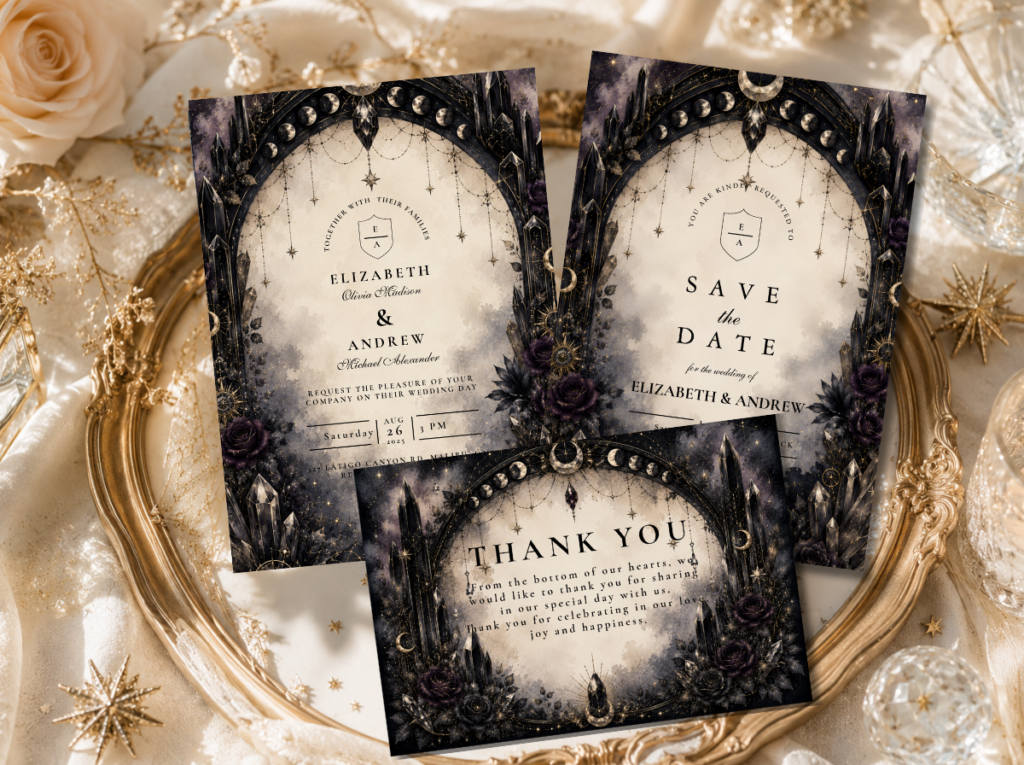
The celestial winter invitation is the darkest and the most dramatically atmospheric of all the celestial stationery options — because the winter celestial aesthetic is the darkest and most dramatically atmospheric of all the celestial aesthetic directions, and the invitation should communicate this quality from the first moment the guest encounters it. A near-black envelope with a wax seal in the form of a winter constellation; an invitation on deep midnight or near-black stock with warm gold constellation work — these are the printed objects that introduce the winter celestial celebration before any venue is visited or any decoration seen.
The winter celestial stationery differs from general celestial stationery in a specific and important way: the palette temperature is colder. General celestial stationery uses warm antique gold as the primary metallic and warm cream as the standard neutral. The winter celestial stationery adds a cool metallic element — ice silver or frost silver — alongside the warm antique gold, and uses the cooler end of the midnight blue-to-near-black range. The result is a stationery piece that reads as specifically cold and specific in its season, belonging to the winter night as distinctly as a spring floral invitation belongs to its season.
The photography connection between winter celestial stationery and winter decoration is the most atmospherically potent of any stationery flat lay category: a deep midnight invitation with warm gold constellation work, photographed beside frosted botanical elements on a dark velvet surface — this is the flat lay photograph that most specifically and most immediately communicates the winter celestial aesthetic in a single image.
Winter Signature
Celestial Winter
The most specifically winter-calibrated celestial collection — the primary stationery direction for the Dark Starry Winter and Midnight Blue Winter aesthetics.
Dark Starry
Celestial Dark
Near-black and antique gold — the most dramatically atmospheric stationery direction for the darkest winter celestial aesthetics.
Mystical Galaxy
Mystical Black Gold Celestial
The signature atmospheric suite — the most photographically dramatic combination for the winter celestial flat lay with frost botanicals and crystals.
Purple Winter
Celestial Purple
Deep amethyst and gold — for the Purple Winter Galaxy and whimsigoth winter celestial directions.
Gold Winter
Celestial Gold
Warm amber gold and ivory — the most welcoming and most warmly intimate stationery for the Gold Winter Celestial aesthetic.
Vintage Winter
Vintage Celestial Renaissance
Parchment and antique gold — the most historically grounded stationery for the Vintage Winter Celestial and dark academia winter directions.
Frequently Asked Questions
Common Questions
Why is winter the best season for a celestial wedding?
Winter is the peak season for the celestial wedding for three measurable astronomical reasons: the night is longer (darkness can arrive before 4pm in December); the stars are sharper and brighter (cold, dry winter air means significantly less atmospheric refraction); and the winter constellations — Orion, Taurus, Gemini, Auriga, Perseus — are the most visually spectacular of any season. The winter solstice (around December 21st) is additionally the most ancient and most universally celebrated celestial event in the human calendar.
What flowers work for a celestial winter wedding?
The winter celestial wedding has access to a genuinely distinct floral vocabulary: white hellebore (the most specifically midwinter flower, with star-shaped centres); white anemone (more specifically star-like in winter’s cold low-angle light); silver eucalyptus in round-leaf form (the most moon-like of foliage); dried silver lunaria seed pods; dark dahlias or dark ranunculus; black calla lily; and evergreen foliage — dark ivy, needle-leaf eucalyptus, dark holly.
What is the difference between a winter celestial and a general celestial wedding?
The winter celestial wedding differs in three primary ways: palette temperature (cooler — ice silver alongside warm gold, the cooler end of the midnight blue range, and the specific frost quality); atmospheric intensity (more dramatic — the actual winter sky is darker and more brilliant); and floral specificity (more seasonal — the winter floral vocabulary of hellebore, silver eucalyptus, frosted lunaria, and winter evergreens cannot be replicated in summer).
What stationery is best for a winter celestial wedding?
The winter celestial stationery should carry the specific palette temperature of the winter sky — cooler than general celestial stationery, with ice silver alongside warm antique gold, and the deepest available base tone. The six collections in the showcase above cover every winter celestial direction: Celestial Winter, Celestial Dark, Mystical Black Gold Celestial, Celestial Purple, Celestial Gold, and Vintage Celestial Renaissance. Choose the collection whose palette temperature most closely matches your specific winter aesthetic direction.
The Darkest & Most Brilliant Sky
Find the Stationery for the Winter Sky’s Most Dramatic Season
The invitation is the first winter star the guest holds — choose the collection that carries the same cold brilliance and atmospheric depth as the season itself.