Victorian Goth Wedding
The Dark Wedding Edit · 2026
Victorian Goth Wedding
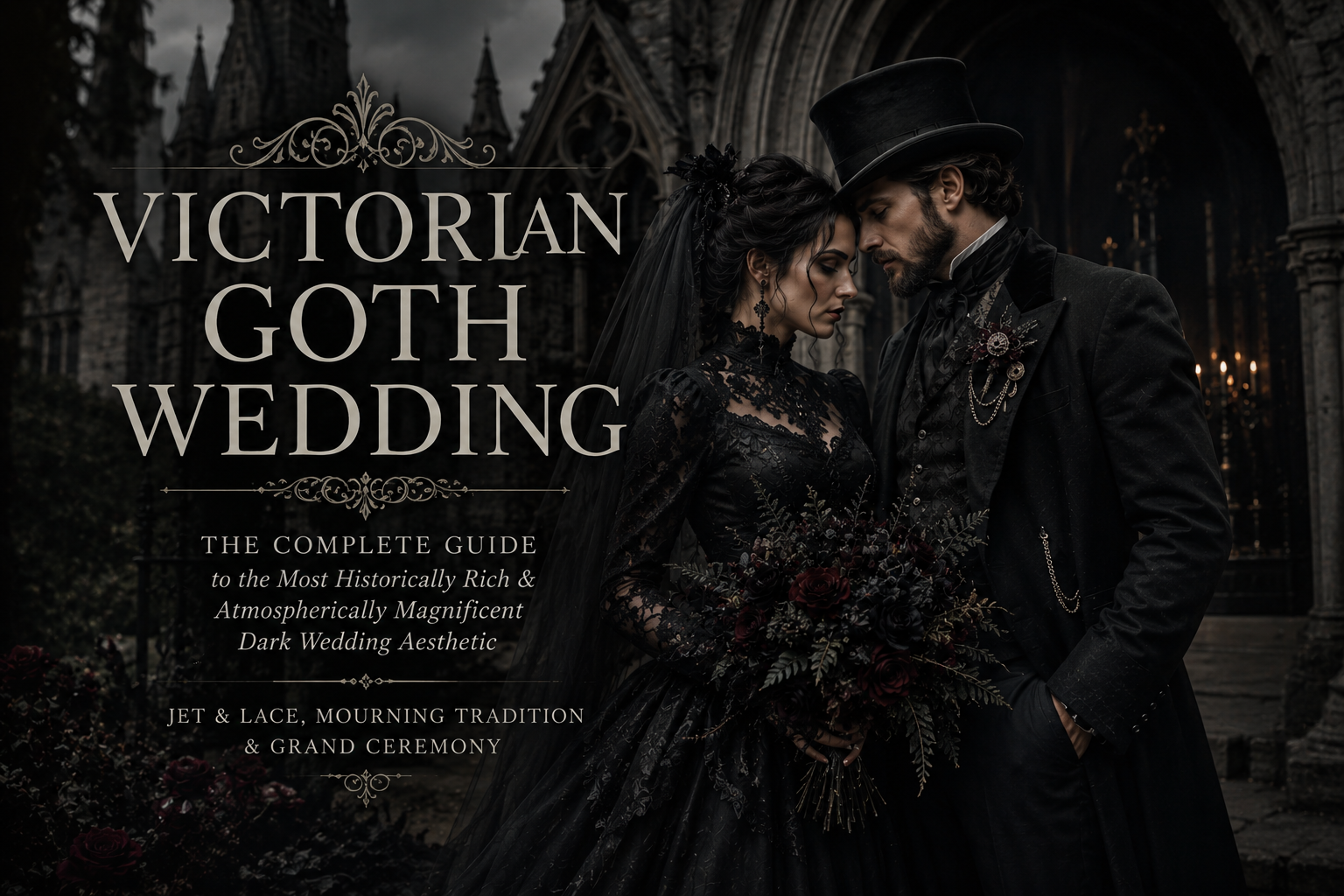
The Complete Guide to the Most Historically Rich & Atmospherically Magnificent Dark Wedding Aesthetic — Jet & Lace, Mourning Tradition & Grand Ceremony
From candlelit church processionals in black lace and jet jewellery to black rose and white lily arrangements, velvet-draped reception halls, and the specific visual world of the century that invented the gothic as a bridal concept — your definitive guide to planning a Victorian goth wedding.
The Victorians were the first people in history to take the question of how to celebrate beautifully and solemnly at the same time — how to make a ceremony that was simultaneously grand and intimate, formal and felt, magnificent in its architecture and completely sincere in its human content — and turn it into a material culture of extraordinary refinement and extraordinary darkness. They produced the most completely elaborated aesthetic of formal human ceremony that has ever existed. We have been borrowing from it ever since.
Shop the Collection
Browse our most loved designs — customizable invitations, party supplies, and stationery for every celebration.
Section One
What Is a Victorian Goth Wedding?
The Victorian goth wedding draws on the richest and the most completely elaborated material culture for human ceremony that history has produced — the Victorian era’s extraordinary relationship with formal ritual, material decoration, and the specific aesthetic of darkness deployed in service of celebration. The Victorians developed formal wedding and mourning rituals of extraordinary complexity: the specific fabrics and their prescribed uses, the jewellery and its meanings, the flowers and their carefully documented symbolic language, the protocols of the wedding breakfast and the layered ceremony of the processional and the exchange of vows. They built the most elaborate set of conventions around the most important human ceremonies that any culture has produced before or since — and they built them with a thoroughness and a seriousness of aesthetic intent that makes every element of the Victorian ceremonial vocabulary available to the contemporary couple who chooses to inhabit it as a genuinely extraordinary aesthetic and symbolic resource.
The Victorian goth wedding is distinct from merely vintage or period-inspired weddings in an important way: it is not attempting to recreate a specific Victorian wedding as it might actually have occurred — the white dress tradition, the specific floral arrangements, the precise social protocols — but to inhabit the specific aesthetic and symbolic world of the Victorian era as a conscious creative choice. It draws on the mourning tradition’s extraordinary visual language (the jet, the black crape, the elaborate symbolism of the memorial jewellery) as aesthetic material for a celebration. It uses the Victorian botanical vocabulary — the language of flowers — not as a nostalgic charm but as a genuine symbolic communication system. And it applies the era’s most characteristic aesthetic qualities — the combination of material excess and genuine emotional seriousness, the layering of historical reference and personal expression, the conviction that beauty and meaning are the same thing — to a contemporary celebration that understands what it is choosing and chooses it with complete intention.
The Victorian Ceremonial Vocabulary
- Jet jewellery — the specific black fossilised wood used in mourning adornment, communicating depth and seriousness through a material that is both beautiful and irreversibly dark
- Black crape, bombazine, and the specific mourning fabrics — textiles that were prescribed for their specific visual quality of absorbing rather than reflecting light
- The language of flowers — a complete symbolic system in which every flower communicates a specific meaning, used throughout the Victorian wedding ceremony
- The memorial tradition — mourning rings, hair jewellery, the elaborate Victorian rituals of remembering the dead at occasions that simultaneously celebrate the living
- The processional and its protocols — the specific order, the music, the dress codes, the architectural requirements of the Victorian wedding ceremony
- The wedding breakfast — the first shared meal as a married couple, with its specific dishes, its toasts, and its symbolic relationship with the ceremony just concluded
Why Couples Choose It
- The most historically grounded and the most symbolically rich of all dark wedding aesthetics — every element carries genuine meaning from a specific and extraordinarily elaborated tradition
- The material culture is the most beautiful and the most completely developed in the history of human formal ceremony
- It allows the gothic aesthetic to be expressed with the full weight of historical legitimacy — this is not an invented dark aesthetic but the recovered vocabulary of an era that genuinely lived within it
- The fashion possibilities are extraordinary — the Victorian era produced bridal and formal dress of incomparable beauty and material sophistication
- Photographs with an immediate and unmistakable quality of historical depth that no contemporary aesthetic can fully replicate
- The most available of all dark aesthetics in terms of venue — virtually every grand historic building in Britain and much of Europe was built in or adapted to the Victorian period
Section Two
Five Victorian Goth Directions
The Victorian goth wedding encompasses several distinct aesthetic directions, each drawing on a different aspect of the Victorian period’s own complex and richly elaborated visual culture. The specific direction you choose determines not only your colour palette and your fashion but the entire symbolic and atmospheric register of the celebration — each direction communicates a different aspect of what it means to inhabit this specific historical aesthetic in the context of a contemporary wedding celebration.
01
Full Mourning Gothic
The most historically specific and the most atmospherically intense of all Victorian goth directions — drawing directly on the formal Victorian mourning tradition, in which the specific materials, colours, jewellery, and protocols of bereavement were as elaborately prescribed as those of any royal court. Black crape and bombazine for dress, jet for jewellery, white lilies and dark evergreen for flowers, the specific vocabulary of the funeral-adjacent ceremony applied to a wedding that understands itself as a celebration of commitment in full awareness of mortality. The full mourning gothic direction is not morbid — it is the most sober and the most serious of all Victorian aesthetic choices, the direction that most directly communicates the era’s understanding that the most important human ceremonies are the ones that acknowledge, rather than avoid, the weight of what they are doing. It produces photographs of extraordinary formal beauty and photographs guests as participants in something genuinely historically and personally significant.
02
Gothic Revival Architecture
The direction built around the Victorian Gothic Revival in architecture — the extraordinary flowering of neo-medieval Gothic building that produced some of the most beautiful and the most dramatically atmospheric buildings in Britain and Europe: Pugin’s Houses of Parliament, the great Victorian Gothic churches, the extraordinary Gothic Revival country houses with their pointed arches and elaborate stonework, the railway stations and civic buildings that adopted the Gothic vocabulary for entirely secular purposes. A celebration in a Gothic Revival building — with its pointed arches, its carved stone details, its stained glass, and its specific quality of Victorian seriousness expressed through medieval architectural forms — inhabits the most completely realised version of the Victorian Gothic aesthetic available, and produces photographs of extraordinary architectural depth and historical resonance.

03
Victorian Dark Romantic
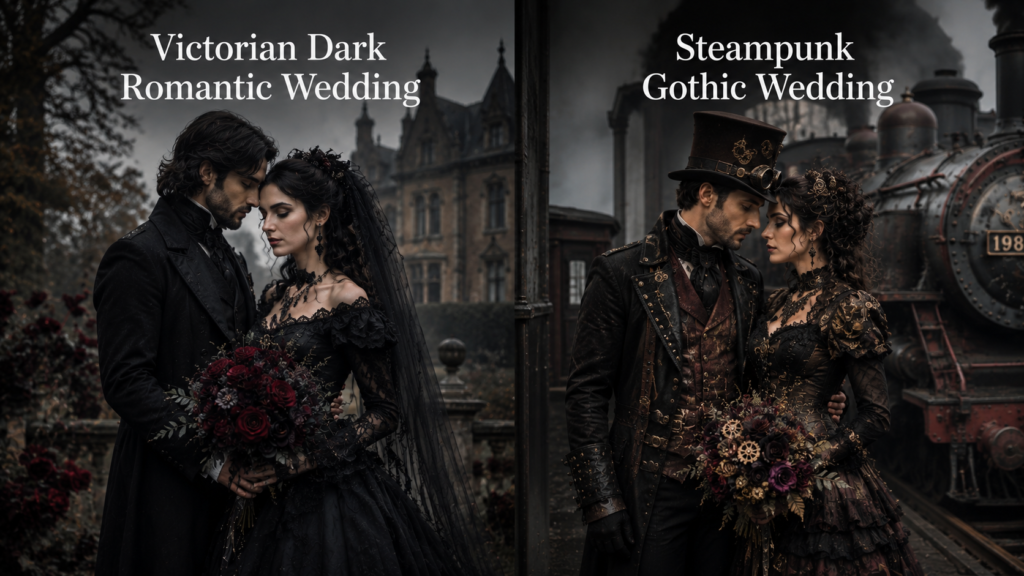
The Victorian dark romantic direction draws on the specifically literary and imaginative dark tradition of the Victorian era — the gothic novels of Wilkie Collins and Sheridan Le Fanu, the Pre-Raphaelite Brotherhood’s specific aesthetic of brooding, symbolically loaded, historically dense romantic painting, the poetry of Christina Rossetti and Algernon Swinburne, and the specific quality of Victorian artistic dark romanticism that was always concerned with beauty at the edge of dissolution. This direction is warmer and more chromatic than the full mourning direction — it allows deep plum and midnight green alongside the near-black, it incorporates the Pre-Raphaelite floral abundance of complex, symbolically specific botanical arrangements, and it produces a celebration atmosphere of extraordinary visual and intellectual richness that communicates both the era and the aesthetic with equal commitment.
04
Steampunk Gothic
The most playful and the most creatively expansive of all Victorian goth directions — drawing on the steampunk aesthetic’s specific reimagining of the Victorian era as a world of brass and leather, of clockwork and steam, of technological innovation applied with Victorian material seriousness to produce objects of extraordinary functional beauty. The steampunk gothic wedding uses the Victorian material culture but with the specific additions of industrial and mechanical elements: copper and brass rather than silver as the metallic, cogs and clockwork as decorative motifs, leather corsetry and tailored coats alongside the more conventional Victorian formal dress elements. It is the most immediately visually distinctive of all Victorian goth directions and the one that communicates the aesthetic’s playful as well as its serious aspects with equal conviction.
05
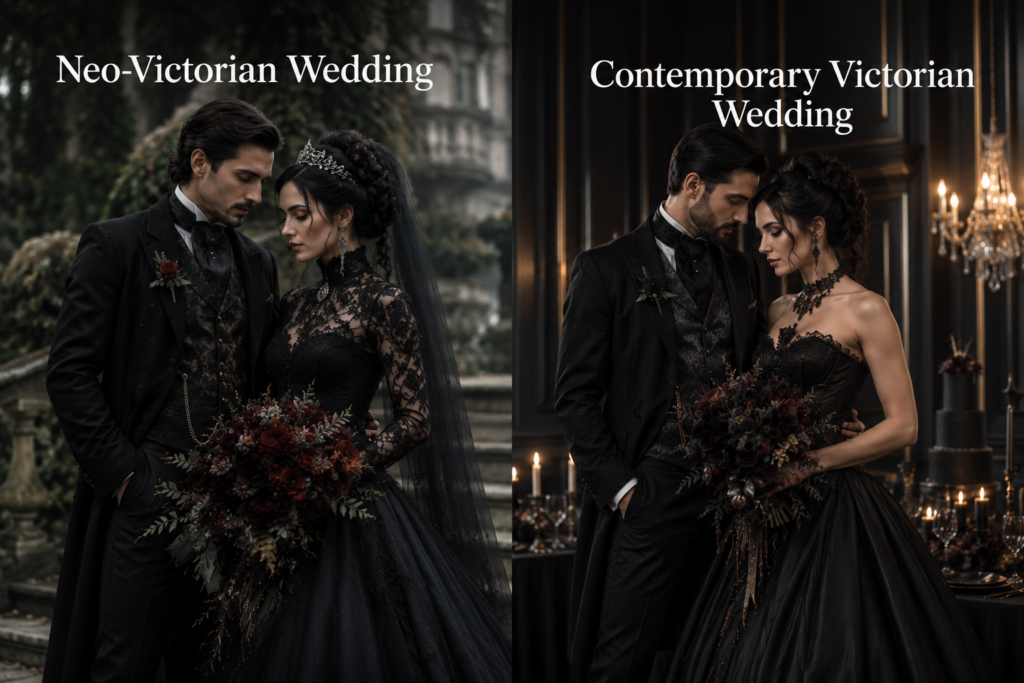
Neo-Victorian Contemporary
The most accessible and the most broadly applicable of all Victorian goth directions — a celebration that draws on the Victorian aesthetic vocabulary without attempting to recreate a specific Victorian context, using the period’s specific material and symbolic language as creative resources within a thoroughly contemporary celebration design. Victorian lace over a modern silhouette. Jet jewellery alongside contemporary metalwork. The language of flowers applied to a contemporary floral brief. The Gothic Revival architectural vocabulary used as the framework for a reception table that uses twenty-first century floristry techniques. This is the Victorian goth wedding for couples who love the aesthetic but want to inhabit it as a creative choice rather than a historical reconstruction — and it is the most practically achievable and the most personally adaptable of all the directions available.
Section Three
The Victorian Goth Colour Palette
The Victorian goth palette is the most materially specific of all dark wedding palettes — because the Victorian era prescribed the specific colours of its formal occasions with a precision that no other period in history has matched, and each of those colours carries both the historical weight of its prescribed use and the specific visual quality of the materials from which it was produced. The near-black of black crape and bombazine is different from the near-black of contemporary matte fabric — it absorbs light differently, reflects it differently, and communicates a different quality of deliberate darkness. The specific cream of aged Victorian lace is different from modern ivory. The antique gold of Victorian jewellery is different from contemporary gold. The palette is built from these historically specific materials and their specific colours, and it communicates through material authenticity as much as through chromatic choice.
Mourning Black
The full mourning colour — crape-textured, light-absorbing, absolute
Antique Gold
Victorian jewellery — aged, warm, specific to the period
Oxblood
Half-mourning and dark romantic — the warmest Victorian dark
Midnight Plum
Half-mourning purple — the prescribed transition colour
Aged Ivory
Victorian lace — warm, cream, never bright white
Dark Bottle Green
Victorian botanical garden — deep, specific, period-correct
Silver
Sterling and jet — the mourning jewellery combination
Dark Crimson
Victorian roses and the specific red of Georgian garnet
Copper & Bronze
Steampunk direction — industrial metals of the Victorian age
Sepia
The photographic tonality of the Victorian period itself
Section Four
Victorian Goth Venues
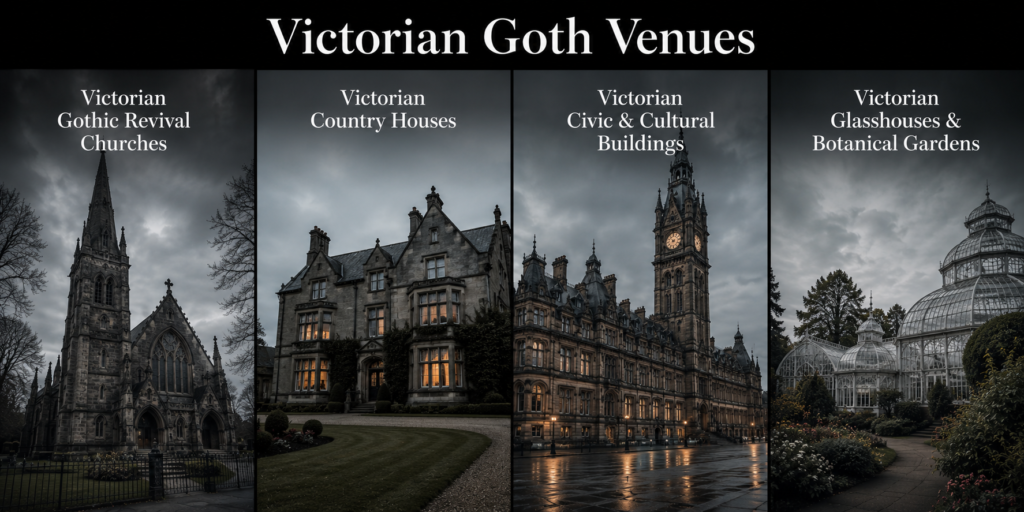
The Victorian goth wedding is the dark aesthetic direction with the widest range of genuinely appropriate venue options — because the Victorian era produced an extraordinary abundance of buildings of every type and scale that were designed and built with the specific aesthetic values of the Gothic Revival tradition, and most of these buildings still exist, are still in use, and are available for weddings. The challenge is not finding a Victorian-appropriate venue but choosing which aspect of the Victorian architectural world belongs most completely to your specific direction.
⛪
Victorian Gothic Revival Churches
Pugin, Butterfield, Street, Pearson, Bodley — the great Victorian Gothic Revival church architects produced hundreds of buildings of extraordinary beauty and atmospheric depth throughout Britain and beyond. A Victorian Gothic Revival church, with its pointed arches, its carved stone detail, its stained glass filling the interior with coloured light, and its specific quality of Victorian serious piety expressed through neo-medieval architectural forms, is the most perfectly appropriate venue for a Victorian goth wedding ceremony available anywhere.
🏰
Victorian Country Houses
The Victorian Gothic Revival country house — Scarisbrick Hall, Tyntesfield, Knightshayes, Humewood Castle and their many equivalents — provides the most completely immersive Victorian goth celebration environment available. With their original interiors, their ornate carved woodwork, their stained glass and encaustic tile floors, and their specific quality of Victorian domestic gothic at its most completely realised, they are settings of extraordinary atmospheric depth whose every surface communicates the period.
🏛️
Victorian Civic & Cultural Buildings
Victorian town halls, civic buildings, museums, and libraries — with their grand marble staircases, their elaborate ironwork, their high ceilings and their specific quality of Victorian public seriousness expressed through architectural grandeur — provide the most formally magnificent and the most publicly ambitious Victorian goth venue option. The Victorian civic building communicates the era’s conviction that public life was worth celebrating with the same seriousness as sacred life.
🌿
Victorian Glasshouses & Botanical Gardens
The Victorian glasshouse — with its cast iron and glass construction, its tropical botanical abundance, and its specific quality of the Victorian era’s fascination with exotic plant species brought into a controlled environment — provides the most visually distinctive Victorian venue option and the one most naturally suited to the Victorian dark romantic and Pre-Raphaelite directions. The combination of elaborate Victorian ironwork and abundant dark botanical matter creates settings of extraordinary atmospheric complexity.
Section Five
Victorian Goth Fashion: The Most Elaborate Bridal Aesthetic in History
Victorian bridal and formal dress represents the most completely elaborated and the most materially sophisticated clothing tradition in the history of Western fashion — a tradition in which every element of a garment communicates something specific, in which the construction of the garment is itself considered a moral and aesthetic act, and in which the specific materials and their specific combination communicate the wearer’s relationship with the occasion being observed with a precision and a seriousness that contemporary fashion rarely approaches. The Victorian goth bride who chooses to inhabit this tradition, even partially, is putting on not just a beautiful dress but an entire aesthetic philosophy — one that takes beauty seriously enough to make it the medium through which the most important human occasions are acknowledged.
Bridal Looks
- Black crape or bombazine gown with fitted bodice and full skirt — the full mourning direction in its most historically accurate form; a floor-length gown with the specific light-absorbing texture of Victorian mourning fabrics, a high neck, long sleeves, and the modest but elaborately constructed silhouette of Victorian formal dress
- Victorian lace gown in aged ivory over black slip — the most materially beautiful of all Victorian goth bridal options; genuine or reproduction Victorian botanical lace (or the most closely authentic contemporary equivalent) over a near-black or midnight silk slip, creating a garment that communicates both the Victorian bridal tradition and the gothic aesthetic simultaneously through the layering of light and dark fabric
- Deep plum or midnight green silk with Victorian construction — for the dark romantic and half-mourning directions; a gown constructed with the specific structural approach of Victorian dress (the fitted bodice, the full or trained skirt, the attention to the specific quality of the fabric’s drape) in a colour from the Victorian half-mourning palette
- Jet parure — the complete Victorian mourning jewellery set in jet: necklace, earrings, bracelet, and brooch, each piece made from the specific black fossilised wood of Whitby jet or its closest contemporary equivalent; the most historically accurate and the most completely Victorian of all bridal jewellery options
- Victorian black lace gloves — long or wrist-length black lace gloves communicating the Victorian formal dress tradition through the most specific and the most immediately recognisable hand-covering available in any historical period
- Mourning veil in black or deep purple silk net — a full mourning veil in black silk net or a purple silk tulle alternative, pinned to the hair with a jet or silver comb; the most specifically Victorian of all veiling options and the one that most completely transforms a contemporary bridal look into a Victorian one
Groom Looks
- Black Victorian frock coat — the most historically correct and the most formally magnificent of all Victorian groom options; a full-length black wool frock coat with silk lapels, worn over a white or black shirt with a black cravat and waistcoat, communicating the Victorian gentleman’s full formal dress with complete historical authenticity
- Morning coat in dark grey or black — the Victorian gentleman’s standard formal daywear, adapted for the dark gothic aesthetic through the choice of the darkest possible grey or near-black wool and the most sober accessories
- Black cravat with jet stickpin — the cravat as the Victorian gentleman’s most personally expressive formal accessory; in near-black or the darkest possible silk, pinned with a jet and silver stickpin that directly references the mourning tradition’s jewellery vocabulary
- Top hat in black or very dark grey — the Victorian gentleman’s essential outdoor accessory and the single garment that most immediately and most completely communicates the period’s specific visual register in any portrait or documentary photograph
- Black leather gloves and cane — the completing accessories of the Victorian formal gentleman’s outdoor dress; the gloves in the finest possible black leather, the cane in dark wood or black lacquer with a silver or jet handle
Shop the Collection
Browse our most loved designs — customizable invitations, party supplies, and stationery for every celebration.
Section Six
The Language of Flowers: Victorian Goth Florals
The Victorians developed the most complete and the most systematically elaborated symbolic flower language in the history of any culture — a system (known as floriography) in which every species of flower communicates a specific meaning, allowing the composition of a bouquet to be as precisely expressive as a piece of writing. A Victorian goth wedding that uses this system deliberately — choosing species for their symbolic meanings as well as their visual qualities — produces floral arrangements of extraordinary symbolic depth in which the botanical composition is simultaneously beautiful and meaningful in a way that conventional floristry rarely achieves. Every flower in a Victorian goth arrangement should be chosen with its specific floral meaning understood and intended.
🌹 Dark Rose
In the Victorian language of flowers, the dark red rose communicates unconscious beauty and passionate devotion. The near-black or deep burgundy garden rose — ‘Black Baccara’, ‘Midnight Blue’, ‘Dark Desire’ — provides the most Gothic of all rose colours while maintaining the species’ central symbolic position in the Victorian floral vocabulary as the primary flower of love and commitment. In a Victorian goth bouquet, the dark rose should be the dominant species, as it was in the conventional Victorian wedding bouquet — but in the darkest possible cultivar.
🌸 White Lily
The white lily communicates purity, majesty, and — in the Victorian mourning tradition — the restored innocence of the soul at the moment of death. In a Victorian goth context, white lilies alongside dark roses create the most classically Victorian of all floral juxtapositions: the innocence of the lily against the passionate darkness of the rose, purity and desire in the same arrangement. The Madonna lily (Lilium candidum) was the specific Victorian mourning flower; the white oriental lily is its more readily available contemporary equivalent.
💜 Anemone & Dark Pansy
The anemone communicates forsaken love, the withered hope, and the specific quality of something beautiful that is also transient — a perfect Victorian goth sentiment for a wedding that understands commitment in full awareness of mortality. The dark pansy communicates loving thoughts and the faithful remembrance of the absent. Both flowers carry the specific quality of dark, symbolically loaded Victorian botanical sentiment that distinguishes the Victorian goth arrangement from any merely dark floral composition.
🌿 Cypress & Dark Evergreen
Cypress communicates mourning and death in the Victorian floral vocabulary — the specific conifer of the Victorian cemetery that provides the dark structural backbone of the most sober and the most historically authentic Victorian goth arrangement. Dark ivy communicates fidelity and eternal life. Rosemary communicates remembrance. Together these dark evergreen elements provide the most completely Victorian symbolic botanical framework available.
🌺 Dark Chrysanthemum & Dahlia
The chrysanthemum in its darkest bronze and near-black cultivars communicates truth and cheerfulness-in-adversity in the Victorian vocabulary — a specifically Victorian sentiment that perfectly suits a goth wedding, which is precisely a celebration that holds cheerfulness and darkness simultaneously without contradiction. Dark dahlias communicate elegance and dignity. Both flowers provide the Victorian arrangement with the formal, complex, multi-petalled dark floral forms that the period’s aesthetic most characteristically favoured.
The Victorian Goth Bouquet
A tightly constructed posy or a cascade bouquet in the Victorian hand-tied tradition — dark roses as the primary species, white lilies providing the mourning contrast, dark anemones and pansies for their specific symbolic weight, cypress and dark ivy for the evergreen backbone. Tied with black velvet ribbon with the ends hanging loose, a small mourning ring or a jet brooch pinned to the ribbon at the stems. The most symbolically complete and the most historically authentic of all dark bridal bouquets.
Section Seven
The Victorian Goth Ceremony
The Victorian goth ceremony is the most formally elaborate and the most symbolically rich of all dark wedding ceremony formats — because the Victorian tradition developed the most completely detailed ceremonial protocols of any period in wedding history, and every element of those protocols, from the specific order of the processional to the particular flowers decorating the pew ends, communicates something specific and deliberate. The couple who understands these protocols and uses them consciously — incorporating the Victorian ceremony structure not as a nostalgic reproduction but as a genuine symbolic framework for their specific celebration — produces an experience of extraordinary formal beauty and genuine emotional depth.
The Gothic Revival Church Processional
The processional through a Gothic Revival church — the full length of the nave, with its pointed arches above, its carved stone detail on every surface, its stained glass filling the interior with coloured light, and the candlelit altar visible at the far end — is the most dramatic and the most historically resonant ceremony entrance available in any contemporary wedding. In full Victorian goth fashion, with the appropriate organ music (Purcell’s Trumpet Voluntary or Jeremiah Clarke’s Prince of Denmark’s March rather than the Victorian Mendelssohn), it creates a ceremony of extraordinary ceremonial power.
The Memorial Ritual
For the full mourning and dark romantic directions: a ceremony that incorporates a specific memorial moment — a candle lit for absent loved ones, a place set at the celebration for those who have died, or a specific symbolic element of the Victorian mourning tradition (a flower placed on an empty chair, a locket containing a photograph or a lock of hair) that acknowledges the presence of loss within the celebration. This is not morbid but the most genuinely Victorian of all ceremony gestures — the era was deeply familiar with death and chose to incorporate it honestly into its most important celebrations.
The Floriography Bouquet Ceremony
Including a moment in the ceremony where the specific symbolic meaning of the bouquet’s species is communicated to the guests — explaining what each flower communicates and why it was chosen — transforms the floriography bouquet from a beautiful object into a fully Victorian symbolic communication. The Victorian tradition of the talking bouquet, read by those who knew the language, is one of the most beautiful and the most personal of all ceremony details available in this aesthetic.
Victorian Candlelit Interior
The Victorian ceremony space at its most completely atmospheric is one lit by the specific combination of candlelight and the coloured light of stained glass — the amber warmth of the candles and the jewel-toned colour of the windows creating an interior light quality of extraordinary complexity and historical resonance that exists in its purest form in the Gothic Revival church at an afternoon winter ceremony, and that no contemporary lighting system can fully replicate.
Shop the Collection
Browse our most loved designs — customizable invitations, party supplies, and stationery for every celebration.
Section Eight
The Victorian Goth Reception: The Wedding Breakfast & Beyond
The Victorian wedding reception — which was, in the Victorian tradition, called the wedding breakfast regardless of the time of day at which it was held — was the most formally structured of all the celebration’s elements, with specific dishes, specific toasts, specific protocols for the cutting of the cake, and a clear progression from the formal ceremony of eating and drinking to the less formal celebrations that followed. The Victorian goth reception uses this structure as a framework — not reproducing it literally but using its specific qualities of formality, abundance, and ceremonial seriousness as the foundation on which the gothic aesthetic is expressed through every available material channel.
The Victorian Table
- Black or very dark damask linen tablecloths — the Victorian table was always formally clothed; dark damask provides the material quality of Victorian domestic luxury while communicating the gothic palette
- Silver candelabras and candlesticks — silver rather than gold as the Victorian mourning metallic; multiple silver candelabras at the appropriate formal heights communicating the specific quality of Victorian table formality
- Victorian-style floral table arrangements — tightly structured, formally balanced arrangements in dark roses, white lilies, and dark evergreen, in silver epergnes or dark ceramic vessels in the Victorian domestic tradition
- Mourning cards as place settings — small cards in the Victorian mourning card format, with the guests’ names in a Victorian copperplate script, placed at each setting as both practical and decorative elements
- Jet and crystal details — small jet beads and dark crystal elements scattered among the floral matter and candles, communicating the Victorian jewellery tradition through the table decoration
The Wedding Breakfast Details
- Dark elderflower and sloe gin punch — served in a Victorian punch bowl with appropriate ceremony; the most Victorian-appropriate dark celebratory drink and the one that communicates both the period and the gothic palette through its colour and its botanical provenance
- Victorian wedding cake tiers — the traditional multi-tiered Victorian wedding fruitcake, dark and dense with dried fruit and preserved by the specific Victorian method of covering with almond paste and royal icing; one tier preserved to be opened at the first anniversary in the specific Victorian tradition
- Mourning ring favours — small replicas of Victorian mourning rings (available from specialist Victorian jewellery makers) as the most historically specific and the most personally meaningful Victorian goth favour format
- Victorian-format menus and order of service — printed in the specific Victorian typographic tradition, with the appropriate formal language and the decorative borders of the Victorian printed ephemera tradition
Section Nine
Victorian Goth Wedding Cakes
The Victorian goth wedding cake must balance historical authenticity against the contemporary context — because the Victorian wedding cake itself was a specific and elaborate object with its own rules and its own symbolic vocabulary, and the most powerful Victorian goth cakes are those that draw on this historical model while using contemporary cake decoration techniques to communicate its visual world at a level of execution unavailable in the original period. The most beautiful Victorian goth cakes communicate an unmistakable quality of period-specific formal excess: the layering of icing, the dark botanical decoration, the specific combination of white and near-black that was the mourning tradition’s most characteristic formal visual contrast.
Victorian Mourning Tier Cake
A multi-tiered cake with alternating near-black and aged ivory fondant tiers — the Victorian mourning colour combination applied to the most formally Victorian of all cake structures. Each tier decorated with different black lace fondant appliqué patterns, sugar dark roses and white lily elements, and silver metallic detailing at the tier borders. A silver or jet decorative element at the top rather than a conventional cake topper. The most completely Victorian and the most formally magnificent of all gothic wedding cake options.
Black Lace Victorian Cake
A near-black fondant cake with black fondant lace appliqué in a Victorian botanical pattern covering the entire surface — the specific combination of black lace on near-black ground creating a textile-quality surface that communicates both the Victorian dress tradition and the gothic aesthetic simultaneously through a single visual technique. Dark rose, lily, and cypress sugar decorations providing the floriography vocabulary within the lace surface. The most texturally specific and the most materially referential of all Victorian goth cake formats.
Dark Fruitcake in Victorian Tradition
The actual Victorian wedding cake — a dark, dense, heavily fruited fruitcake preserved with brandy and covered with marzipan and royal icing in the specific Victorian manner — is the most historically authentic and the most personally significant option for a Victorian goth wedding. The tradition of preserving the top tier to eat at the christening of the first child, or at the first anniversary, connects the wedding cake to a specifically Victorian understanding of marriage as a continuous and long-lasting commitment rather than a single-event celebration.
Shop the Collection
Browse our most loved designs — customizable invitations, party supplies, and stationery for every celebration.
Section Ten
Victorian Goth Wedding Photography
Victorian goth wedding photography operates in a specific and historically resonant visual tradition — the formal portrait photography of the Victorian era itself, in which every image was composed with the same deliberate formality as a painted portrait, in which the subjects communicated their relationship to the occasion through the specific quality of their stillness and their direct gaze, and in which the surrounding architectural and material world was as much a part of the composition as the human figures within it. The most powerful Victorian goth wedding photographs are those that carry this quality of formal photographic seriousness — images that look as though the photographer understood that the moment being recorded was genuinely significant, and allowed that understanding to determine every compositional choice.
The Formal Victorian Portrait
A full-length formal portrait in the specific tradition of Victorian photographic portraiture — the subjects standing or seated in a Victorian interior, facing the camera directly, their full dress and accessories visible, the architectural and decorative elements of the setting providing the historical context. Processed or edited in a warm sepia or near-monochrome palette that references the specific tonality of Victorian albumen photography. The most historically resonant and the most immediately distinctive of all Victorian goth portrait formats.
Stained Glass Silhouette
The couple photographed against a large Victorian stained glass window — the coloured light of the glass filling the interior of the image while their silhouettes are visible in the foreground, the specific jewelled colours of Victorian stained glass creating a backdrop of extraordinary visual richness that exists nowhere outside the Gothic Revival tradition. One of the most immediately distinctive and the most specifically Victorian of all dark wedding portrait formats.
Jet Jewellery Detail
A raking-light close-up of the jet parure — the necklace, earrings, and brooch in the specific quality of Whitby jet, their carved surfaces and their specific near-black depth visible in the detail that only close-range photography can achieve. The jet detail photograph is the single most historically specific and the most materially beautiful of all Victorian goth jewellery images and the one that most powerfully communicates the aesthetic through the most specifically Victorian of all its material objects.
Gothic Revival Architecture Detail
The couple photographed within the architectural detail of the Gothic Revival building — in the arch of a doorway, at the foot of a carved stone staircase, within a cloister walk, or against an ornate carved wooden screen — the architectural detail providing both the compositional structure and the historical depth of the image simultaneously. The Gothic Revival building is the most completely appropriate architectural context for Victorian goth wedding photography available.
Victorian Churchyard
The Victorian churchyard — with its ancient yew trees, its Gothic Revival headstones, and the specific quality of a Victorian cemetery’s highly elaborated stone vocabulary of mourning symbols — provides the most completely historically resonant outdoor portrait setting for a Victorian goth wedding. A portrait among Victorian Gothic headstones is not morbid but the most directly Victorian of all outdoor portrait locations available in Britain — the Victorians understood that the most beautiful settings for human ceremony were those that acknowledged death as part of life.
Candlelit Interior by Window Light
A portrait lit by the combination of candle warmth from within and the natural light from a Victorian stone-mullioned window — the two light sources creating the most historically correct indoor photographic condition available, replicating the actual lighting conditions under which Victorian portrait photographs were made and producing images of a specific historical warmth and depth that no contemporary indoor lighting can approach.
Bonus — Highly Shareable
10 Victorian Goth Wedding Images Everyone Saves on Pinterest
The photographs and design decisions that consistently drive the highest saves, shares, and inquiries in the Victorian goth wedding space.
01
Black Lace Bride in Gothic Revival Church
Full Victorian mourning dress — black crape or lace gown, jet parure, mourning veil — photographed in the nave of a Gothic Revival church, the pointed arches above and the candlelit altar visible behind. The most completely Victorian goth bridal image available and the single most historically resonant dark wedding portrait in the contemporary alternative bridal space.
02
Stained Glass Silhouette Portrait
The couple silhouetted against a large Victorian stained glass window — the jewelled colours of the Victorian glass filling the image while the dark figures are visible against it. One of the most visually extraordinary portrait formats available in any style of wedding photography, existing only in buildings that contain genuinely Victorian stained glass of sufficient scale.
03
Jet Parure Close-Up Detail
Raking-light macro photograph of the jet necklace, earrings, or brooch — the carved surfaces of the Whitby jet visible in extraordinary detail, the specific near-black depth of the material communicating through the close-range image both the material quality and the historical tradition it represents. The most materially specific and the most symbolically loaded of all Victorian goth detail photographs.
04
Victorian Lace Detail in Candlelight
A close portrait of the Victorian lace gown sleeve or bodice, photographed by candlelight — the botanical lace pattern visible in the warm amber of flame light, the specific quality of aged lace in candlelight communicating the Victorian material world with a historical specificity that no other photographic condition can produce. The most texturally extraordinary and the most historically resonant dark lace detail image available.
05
Groom in Frock Coat on Victorian Staircase
The groom in full Victorian frock coat, black cravat, jet stickpin, and top hat, photographed on the grand Victorian staircase of a Gothic Revival country house or civic building — the architectural grandeur of the staircase communicating the period with the same directness as the costume, creating a portrait of extraordinary historical depth and formal beauty.
06
Victorian Churchyard Portrait
Full Victorian goth fashion photographed among Gothic Revival headstones — the ancient yew trees, the elaborate Victorian carved stone vocabulary, and the specific quality of a Victorian cemetery’s deliberate architectural attention to death and memory providing the most historically resonant outdoor Victorian goth portrait setting available.
07
Floriography Bouquet Flat Lay
The Victorian goth bouquet flat-laid on a Victorian damask surface — dark roses, white lilies, dark anemones, cypress, and dark ivy visible alongside a small card identifying the floriography meaning of each species. The most intellectually and symbolically rich of all dark bridal bouquet images, communicating the Victorian tradition’s unique relationship between botanical beauty and intentional symbolic communication.
08
Victorian Mourning Tier Cake Detail
A close photograph of the alternating black-and-ivory Victorian mourning tier cake — the black lace fondant appliqué pattern, the sugar dark rose and lily elements, the silver metallic tier borders — photographed in the candlelit reception space. The most formally elaborate and the most visually distinctive of all Victorian goth cake images.
09
Pre-Raphaelite Glasshouse Portrait
Victorian goth fashion photographed within a Victorian glasshouse — the elaborate iron and glass architecture above and around, the tropical botanical abundance providing a living green-and-dark backdrop, and the specific quality of diffused light through glass communicating the Victorian era’s particular passion for controlled botanical display. The most Pre-Raphaelite-adjacent of all Victorian goth portrait settings.
10
Formal Victorian Group Portrait
The complete wedding party in full Victorian dress — photographed in the specific formal tradition of Victorian group portraiture, with the subjects arranged by the same compositional logic as a Victorian family photograph, facing the camera directly, and communicating through their collective stillness the specific seriousness with which the Victorian era regarded the human occasions that brought people together in their best dress. The most completely historically resonant group photograph available in any dark wedding aesthetic.
“The Victorians understood something that subsequent generations have largely forgotten: that taking beauty seriously is not a frivolous activity but one of the most important things a human being can do, that the quality of care and attention and material investment brought to a formal ceremony is a direct measure of how seriously that ceremony is taken, and that the difference between a celebration that is merely pleasant and one that is genuinely significant is the difference between decoration and meaning — which is also, in the end, the difference between fashion and dress.”
— The Dark Wedding Edit
Final Thoughts
Learn the Vocabulary. Choose the Direction. Then Make It Completely and Deliberately Yours.
The Victorian goth wedding at its most powerful is not a costume party in a historic building. It is a celebration in which a couple has taken the time to understand a specific and extraordinarily rich historical aesthetic tradition — its values, its materials, its symbolic vocabulary, its specific relationship with beauty and mortality and the importance of formal ceremony — and has then applied that understanding to a contemporary celebration with complete intention and complete sincerity. The couple who wears jet and crape because they understand what jet and crape communicated to the people who developed the tradition, and who chooses every flower in their bouquet with its Victorian floriography meaning understood and intended, is not playing dress-up but engaging in one of the most genuinely serious and most historically grounded creative acts available in contemporary wedding planning.
Choose the direction that belongs most completely to your aesthetic sensibility and your personal relationship with the Victorian tradition — the full mourning gothic, the Gothic Revival architectural direction, the dark romantic Pre-Raphaelite, the playful steampunk, or the accessible neo-Victorian contemporary. Find the building that already contains the period within its architecture before a single decoration is added. Learn the language of flowers and use it deliberately in the bouquet. Source the jet — genuine Whitby jet if possible, as the specific material of the tradition, in which the carver’s skill and the fossilised wood’s specific depth communicate the same quality as the architecture of the buildings the couple stands within. And approach the day with the same conviction that the Victorian tradition brought to its most important ceremonies: that beauty is not decoration but meaning, that material care is not vanity but respect, and that the couple who takes the trouble to celebrate well is making a statement, through the specific quality of their celebration, about the specific quality of what they are celebrating.
Shop the Collection
Browse our most loved designs — customizable invitations, party supplies, and stationery for every celebration.