Art Nouveau Wedding Centerpieces & Table Decor Guide 2026
Art Nouveau Wedding · 2026
Art Nouveau Wedding Centerpieces & Table Decor Guide 2026
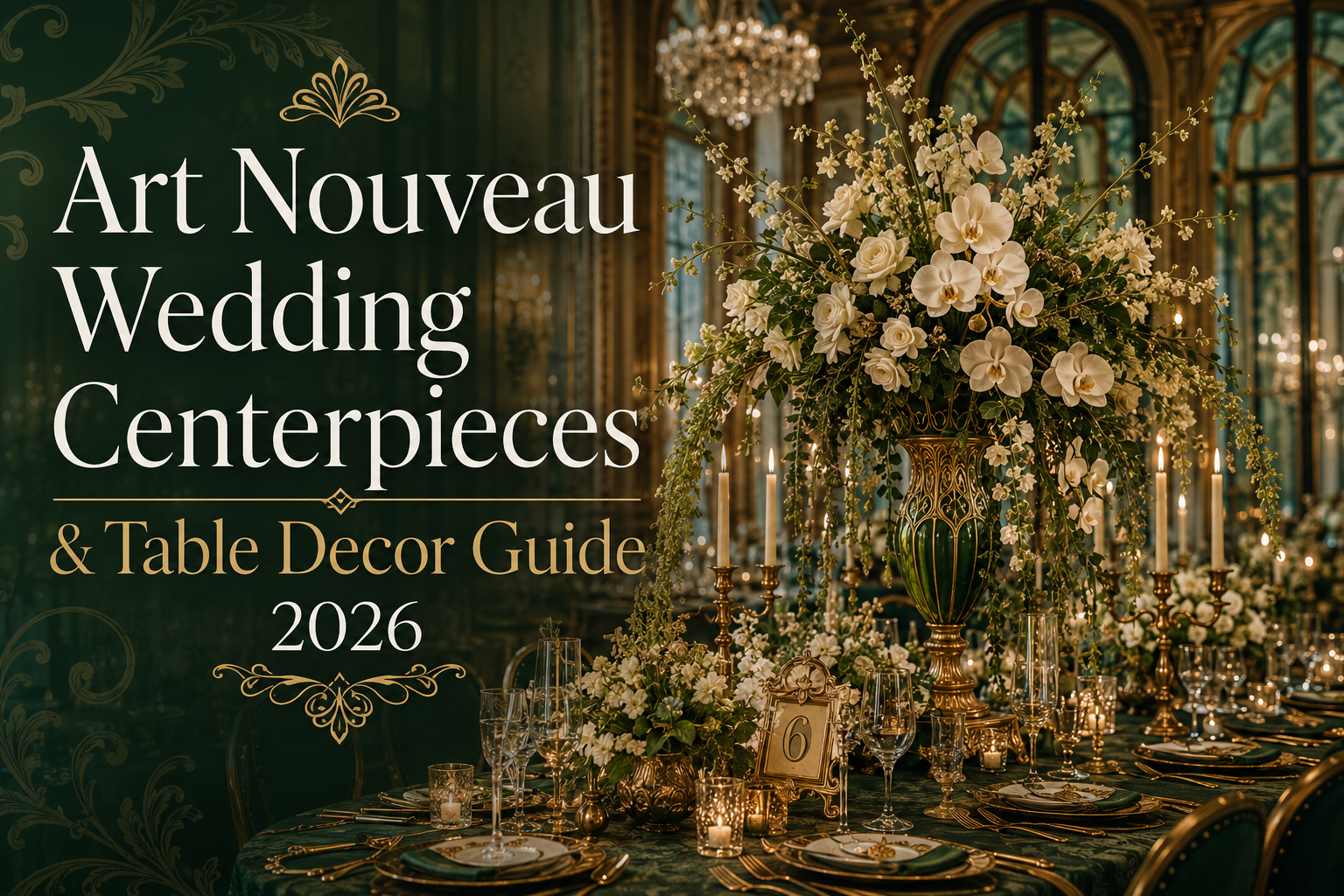
From cascading wisteria centerpieces and sculptural iris arrangements to gold-rimmed place settings and candlelit table glow — the complete guide to art nouveau wedding centerpieces in 2026.
Every guest at a wedding reception spends more time looking at one table — their own — than at any other single decorative element of the entire day, which makes art nouveau table decor one of the highest-impact design decisions a couple will make. This guide covers four distinct centerpiece styles, the place setting and table styling details that complete the look, vessel and vase choices, the lighting that makes the whole composition glow, and how every table element connects back to the stationery sitting at each guest’s place.
Each table is its own small gallery for the evening — a frame the size of a tablecloth, looked at for hours by the same eight or ten people, who deserve exactly as much consideration as the ceremony space everyone glances at once.
Section 01
The Art Nouveau Table Philosophy
Asymmetric arrangements are favoured over symmetric ones throughout the art nouveau table tradition, for the same underlying reason that governs every other element of this aesthetic: a centred, perfectly mirrored centerpiece reads as designed and placed, while an asymmetric one — heavier on one side, with stems and trailing elements distributed irregularly rather than evenly — reads as having grown into its position rather than been assembled there. This single principle, applied consistently from the largest floral arrangement down to the smallest place card positioning, is what separates a genuinely art nouveau table from a table that has simply been decorated with botanical material in the movement’s colour palette.
Sculptural composition is favoured over uniform mass throughout: a centerpiece with genuine height, visible negative space between individual stems, and structural botanical material (iris, lily, single dramatic trailing elements) reads as a considered three-dimensional object rather than a dense mass of colour. This quality matters as much functionally as aesthetically — a tall, structural arrangement with visible air between its elements allows guests across the table to actually see and speak to one another, solving the conventional centerpiece’s most common practical failure more elegantly than a low, wide arrangement ever could.
Gold accents function as the single unifying thread that connects every element on the table to every other element, and to the rest of the celebration beyond it: gold-rimmed charger plates connecting to gold flatware, connecting to the gold line work on the place cards and menus, connecting to the gold candle holders, connecting back to the gold detail on the invitation suite guests received months earlier. No individual table element needs to be elaborate on its own for this thread to work — the cumulative effect of consistent, restrained gold detail repeated across every surface is what produces the genuinely coherent, considered table that this aesthetic depends on.
Section 02
Four Art Nouveau Centerpiece Styles
Bring these descriptions to your florist as a starting reference for the specific centerpiece direction you want your reception tables to take.
Centerpiece 2.1
The Wisteria Cascade Centerpiece
The most dramatic and most specifically art nouveau of the four — the wisteria cascade centerpiece trails cascading wisteria blooms down and along the length of the table from a low base arrangement, rather than building upward in the conventional centerpiece silhouette. Where the budget and season allow genuine fresh wisteria, this style requires very little supplementary botanical material to achieve its full visual effect; the wisteria’s own trailing structure does almost all of the compositional work. Where fresh wisteria is unavailable, jasmine vine, trailing amaranthus, or clematis can substitute with comparable cascading character.
This centerpiece style works most powerfully along a long table’s full length rather than as discrete, separated arrangements at intervals, since the continuous trailing line is what creates the centerpiece’s most distinctive visual quality — a single flowing botanical gesture running the length of the table rather than a series of individually beautiful but disconnected moments. For round tables, position the cascade so it trails over one edge rather than centring it symmetrically, maintaining the asymmetric principle that governs the broader aesthetic even at the scale of an individual table.

Matching Stationery
The wisteria cascade centerpiece is the precise visual companion to the Wisteria Arch Botanical stationery collection — the same cascading motif carried from the invitation suite to the dinner table. The Wisteria Arch Botanical collection — fully customizable with your names, date, and wedding details.

Centerpiece 2.2
The Sculptural Botanical Centerpiece
The most classically art nouveau and most structurally distinctive of the four — the sculptural botanical centerpiece builds around iris, lily, and other architectural-stemmed flowers in sinuous vases, letting the naturally sword-like or sculptural form of these species create height and genuine three-dimensional presence rather than relying on density of bloom. Deep blue-violet iris alongside white or pale lily, arranged with visible negative space between individual stems, creates a centerpiece that functions as sculpture viewed across the table rather than as a mass of colour competing with conversation.
The vase itself matters as much as the botanical material in this style: a sinuous, curved-profile vessel in aged brass or dark glass, rather than a straight-sided conventional vase, extends the organic line work of the flowers down into the vessel that holds them, so the entire object — vase and flowers together — reads as a single continuous composition. This style suits the broadest range of table sizes and shapes of the four, since its height and visible structure work as well on a long banquet table as on an individual round table.

Matching Stationery
The sculptural botanical centerpiece belongs with the Art Nouveau Floral stationery collection — the same sculptural, sinuous botanical illustration that defines the movement’s most classic graphic tradition. The Art Nouveau Floral collection — fully customizable with your names, date, and wedding details.

Centerpiece 2.3
The Vintage Garden Centerpiece
The warmest and most nostalgic of the four — the vintage garden centerpiece uses old-garden roses in their loosely petalled, slightly informal varieties alongside dusty botanical material in antique brass or aged ceramic vessels, creating tables that look as though each one was cut from a garden that has been growing, untended in the most beautiful sense, for decades. The palette leans warm and slightly faded: dusty rose and aged ivory rather than bright saturated tones, in the same warm vintage register that runs throughout the broader vintage art nouveau aesthetic.
Achieving the genuinely antique quality this style depends on requires the same attention to bloom maturity that the matching bouquet style elsewhere in this series calls for: roses at varying stages of opening rather than uniformly fresh buds, arranged with deliberate looseness in vessels that themselves look collected over time rather than purchased as a uniform set. Mismatched antique-style vessels across different tables, rather than identical centerpieces repeated throughout the room, reinforce this style’s essential character of accumulated, gathered beauty.

Matching Stationery
The vintage garden centerpiece pairs naturally with the Flora Vintage Art Nouveau stationery collection — warm, nostalgic botanical illustration with the same antique garden character. The Flora Vintage Art Nouveau collection — fully customizable with your names, date, and wedding details.

Centerpiece 2.4
The Olive & Gold Centerpiece
The most distinctive and most unexpected of the four — the olive and gold centerpiece builds around olive branches and sage as its primary structural and textural material, with a smaller proportion of bloom than any of the other three styles, creating tables that read as genuinely botanical and slightly wild rather than conventionally floral. This style suits the muted, earthy register of the art nouveau tradition’s shadowed botanical palette, and it pairs naturally with late summer and autumn celebrations where the olive tones connect to the surrounding seasonal landscape.
Because this style depends more on structural foliage than on bloom count, it is among the more cost-flexible of the four centerpiece options without sacrificing any genuine distinctiveness — olive branches and sage provide substantial visual volume and sculptural interest at a lower cost than an equivalent volume of fresh bloom. A restrained number of warm dusty flowers (small garden roses, ranunculus in muted amber tones) against the olive and sage base, with gold candle holders providing the metallic connecting thread, completes a centerpiece with real textural sophistication.

Matching Stationery
The olive and gold centerpiece connects to the Olive Green Vintage Floral Art Nouveau stationery collection — the same distinctive muted olive palette carried from the invitation suite to the dinner table. The Olive Green Vintage Floral Art Nouveau collection — fully customizable with your names, date, and wedding details.

Section 03
Table Settings & Place Styling
Gold flatware — in antique or aged gold finishes rather than bright polished gold — is the single most direct way to extend the metallic thread from the centerpiece vase down to the place setting itself, and it reads as genuinely art nouveau in a way that silver or contemporary matte black flatware does not, since gold is the one metallic note the movement never varied on across any of its decorative media. Jewel-tone or ivory linens, depending on the chosen palette register, provide the base surface the rest of the setting builds upon: deep forest green or burgundy for the more dramatic palettes, warm ivory or aged parchment for the vintage register.
Ornate charger plates with gold rim detail or botanical embossing add a layer of considered detail beneath each place setting that most guests register subconsciously rather than consciously, but which contributes substantially to the cumulative sense of a table that has been designed with genuine care at every level. Stained-glass effect votives — small candle holders in amber or jewel-toned coloured glass — placed individually at each setting rather than only in the centerpiece extend the table’s warm, glowing light source down to the most intimate scale, so even a guest looking only at their own immediate place setting encounters the same warm, jewel-coloured light quality that defines the room as a whole.
Place cards and menus function as mini art nouveau prints rather than merely informational paper — each piece should carry the same botanical illustration and gold line detail as the rest of the stationery suite, at a scale appropriate to its function. A guest who picks up their place card before sitting down, or glances at the menu while waiting for the first course, is encountering a small, genuine piece of the same printed botanical world that arrived in their invitation months earlier, and this consistency across the entire stationery suite — from the largest welcome sign down to the smallest place card — is what produces the cumulative, immersive effect that the best art nouveau tables achieve.

Place Setting Stationery
The Fancy Classic Decorative Art Nouveau collection carries the most maximally ornate botanical illustration through every table detail — place cards, menus and table numbers as genuine mini art prints. Fully customizable.

Section 04
Vessel & Vase Choices
Sinuous glass vessels, blown or shaped with genuinely curved, organic profiles rather than the straight cylindrical sides of conventional rental glassware, were one of the art nouveau movement’s own most celebrated decorative media — the same craft tradition that produced the movement’s most famous decorative glassware translates directly to a centerpiece vessel that extends the botanical material’s organic line down into the object holding it. Where genuinely sinuous glass is available, even a single dramatic example used across all centerpieces creates a stronger, more coherent visual impression than a wider variety of straight-sided vessels with botanical material doing all the aesthetic work alone.
Art nouveau-inspired ceramic vessels, with botanical relief detail moulded or carved into the surface, glazed in the deep jewel tones or warm vintage palette of the broader table scheme, offer an alternative to glass that suits the more maximalist and the more dark, atmospheric registers particularly well — a ceramic vessel can carry far more surface decoration than glass without becoming visually busy, since the decoration is integrated into the material itself rather than competing against what is visible through transparent glass. Antique brass and gold vessels, in aged rather than bright polished finishes, are the most universally appropriate choice across every centerpiece style and palette in this guide, and they connect directly to the gold thread running through every other table element.
Across all three vessel categories, the practical principle worth holding consistently is that the vessel should disappear into the composition rather than asserting its own geometric presence against the flowing botanical material it contains — a straight-sided, undecorated vessel in a neutral material is a more successful choice than an ornate vessel that introduces a competing decorative logic, even if that ornate vessel is individually beautiful. Consistency of vessel style across all tables, rather than variation for its own sake, also matters more in this aesthetic than in many others, since the gold thread and the asymmetric organic principle both depend on repetition across the room to read clearly.
Section 05
Lighting the Table
Candlelight should function as the table’s primary light source rather than a decorative supplement to overhead venue lighting — this single decision affects how every other element on the table reads more than any individual design choice covered elsewhere in this guide. The gold detail on the flatware, charger plates, and stationery all catch and return warm light far more richly under candlelight than under any electric lighting, however warm-toned, and the botanical colours in the centerpiece achieve a depth and jewel-like quality in candlelight that flat overhead illumination simply cannot produce. A table styled with genuine care but lit only by standard venue lighting will read as noticeably less considered than the identical table lit primarily by candles.
Ornate candle holders — in the sinuous, curved-profile form of art nouveau metalwork rather than the straight-sided form of conventional candle holders — should be distributed at varying heights across each table rather than at a single uniform height, creating the same vertical, irregular architecture of light that the centerpiece itself pursues in its botanical structure. A mix of taller taper candles in antique gold holders alongside lower votive candles in coloured glass produces the most visually layered and most genuinely atmospheric result, with light sources at multiple heights catching different elements of the table composition as the evening progresses and natural light fails.
Warm amber tones, whether from candle flame itself or from any supplementary electric lighting brought in specifically for the reception, are essential to enhancing rather than flattening the botanical arrangements — cool or neutral white light drains the depth from deep forest green and burgundy botanical material in a way that warm amber light never does, and it has the same flattening effect on gold metalwork detail throughout the table. Confirm with your venue, as covered in the venue guide elsewhere in this series, exactly what candle policy applies and what supplementary warm lighting is permitted, since this single practical confirmation has more bearing on how the finished table actually looks than almost any other planning decision in this guide.
Section 06
Table Decor & Stationery Together
The place setting is the single closest physical encounter most guests will have with both the centerpiece and the stationery suite simultaneously, since the place card and menu sit inches from the botanical arrangement for the entire duration of the meal — closer and longer than any other moment in the celebration brings printed and living botanical material into the same field of view. This proximity makes the table the single highest-leverage location in the entire wedding for demonstrating genuine visual coherence between the printed and the decorative elements of the art nouveau aesthetic, because a guest seated at that table has nothing else to look at for the better part of an hour but the centerpiece in front of them and the stationery in their hands.
The practical version of this principle: select your centerpiece style with explicit reference to your stationery collection, rather than choosing the two independently and hoping they coordinate. A table with a wisteria cascade centerpiece beside a place card from a stationery collection with no wisteria or cascading botanical reference creates a small but real disconnect, however beautiful each element is individually. Bringing your stationery suite, or photographs of it, to your florist consultation — as recommended throughout this series — ensures the centerpiece’s specific botanical species and palette are chosen with direct reference to what is already printed and waiting at each place setting.
The flat lay or table-detail photograph capturing the centerpiece beside the place setting stationery — menu, place card, and table number arranged together near the base of the floral arrangement — is among the most reliably beautiful images produced at art nouveau weddings, precisely because it documents the genuine coherence between printed and living botanical material in a single, easily composed frame. Brief your photographer to capture this detail shot at one or two tables before guests are seated, in the same warm light the candles will provide once the reception begins, positioning the stationery so its gold line work and the centerpiece’s own gold-accented vessel or candle holders sit in visual conversation.
The five collections below each correspond to one or more of the centerpiece and table styling approaches described in this guide. All are fully customizable with your names, date, and wedding details.
Shop the Collections
Stationery Matched to Every Table Style
Art Nouveau Floral
Flowing botanical illustration and antique gold detail — the natural match for the Sculptural Botanical Centerpiece.
Flora Vintage Art Nouveau Wedding
Pure vintage botanical elegance — for the Vintage Garden Centerpiece’s warm, antique register.
Wisteria Arch Botanical Wedding
Cascading wisteria and botanical abundance — the precise visual companion to the Wisteria Cascade Centerpiece.
Fancy Classic Decorative Art Nouveau
Maximally ornate classical art nouveau — for place cards, menus and table numbers as genuine mini art prints.
Olive Green Vintage Floral Art Nouveau
Distinctive olive green botanical illustration — the stationery match for the Olive & Gold Centerpiece.
The Art Nouveau Wedding Series
Explore the Full Series
Art Nouveau Wedding — The Complete Aesthetic Guide · Art Nouveau Wedding Invitations · Art Nouveau Wedding Dress · Art Nouveau Wedding Decorations · Art Nouveau Wedding Theme & Colors · Art Nouveau Wedding Ring · Art Nouveau Wedding Cake · Art Nouveau Wedding Flowers · Art Nouveau Wedding Venue · Art Nouveau Wedding Color Palettes · Art Nouveau Bridal Style
Frequently Asked Questions
Common Questions
How tall should an art nouveau centerpiece be?
There is no single correct height, but the sculptural and wisteria cascade styles described in Section 02 both work best when the centerpiece either rises well above eye level (tall sculptural arrangements with iris and lily) or stays low along the table surface (a trailing wisteria cascade), rather than sitting at the awkward mid-height that most commonly blocks sightlines across a table. This is a practical as well as aesthetic consideration: a centerpiece in the eight-to-eighteen-inch range typically obstructs conversation more than either a genuinely tall or genuinely low arrangement.
Can I use the same centerpiece style on every table?
Yes, and consistency across all tables is generally the stronger choice for this aesthetic, since the gold thread and asymmetric organic principle described in Section 01 both depend on repetition across the room to read as a coherent, intentional design language rather than a collection of individually nice but disconnected tables. Genuine variation within a single style — the same vessel and palette, with each individual arrangement’s asymmetric lean and trailing direction varying naturally — provides enough visual interest from table to table without sacrificing the room-wide coherence the aesthetic depends on.
What is the most budget-friendly art nouveau centerpiece style?
The Olive & Gold centerpiece described in Section 2.4 is generally the most cost-flexible of the four, since it relies more heavily on structural foliage — olive branches and sage — than on bloom count, and foliage typically costs significantly less per stem than fresh flowers while providing comparable visual volume. The Sculptural Botanical style can also be relatively economical at smaller scale, since a few well-placed structural stems (iris, lily) with genuine negative space between them require fewer total stems than a dense, conventional centerpiece of equivalent visual size.
How do I match my centerpieces to my stationery?
Choose your stationery collection first, then bring it to your florist consultation as a precise visual brief. A wisteria-illustrated suite pairs with the Wisteria Arch Botanical centerpiece style; an iris and lily illustration pairs with Art Nouveau Floral. Plan a detail photograph of the centerpiece beside the place setting stationery in warm candlelight — it is one of the most reliably beautiful images in this aesthetic, since printed and living botanical material sit in genuine visual conversation just inches apart.
Art Nouveau Wedding Stationery · 2026
Give Your Florist the Perfect Brief
A fully customized stationery suite documents your exact botanical species and palette — the most useful reference you can bring to a florist consultation.