Vintage Celestial Wedding
Celestial Wedding · 2026
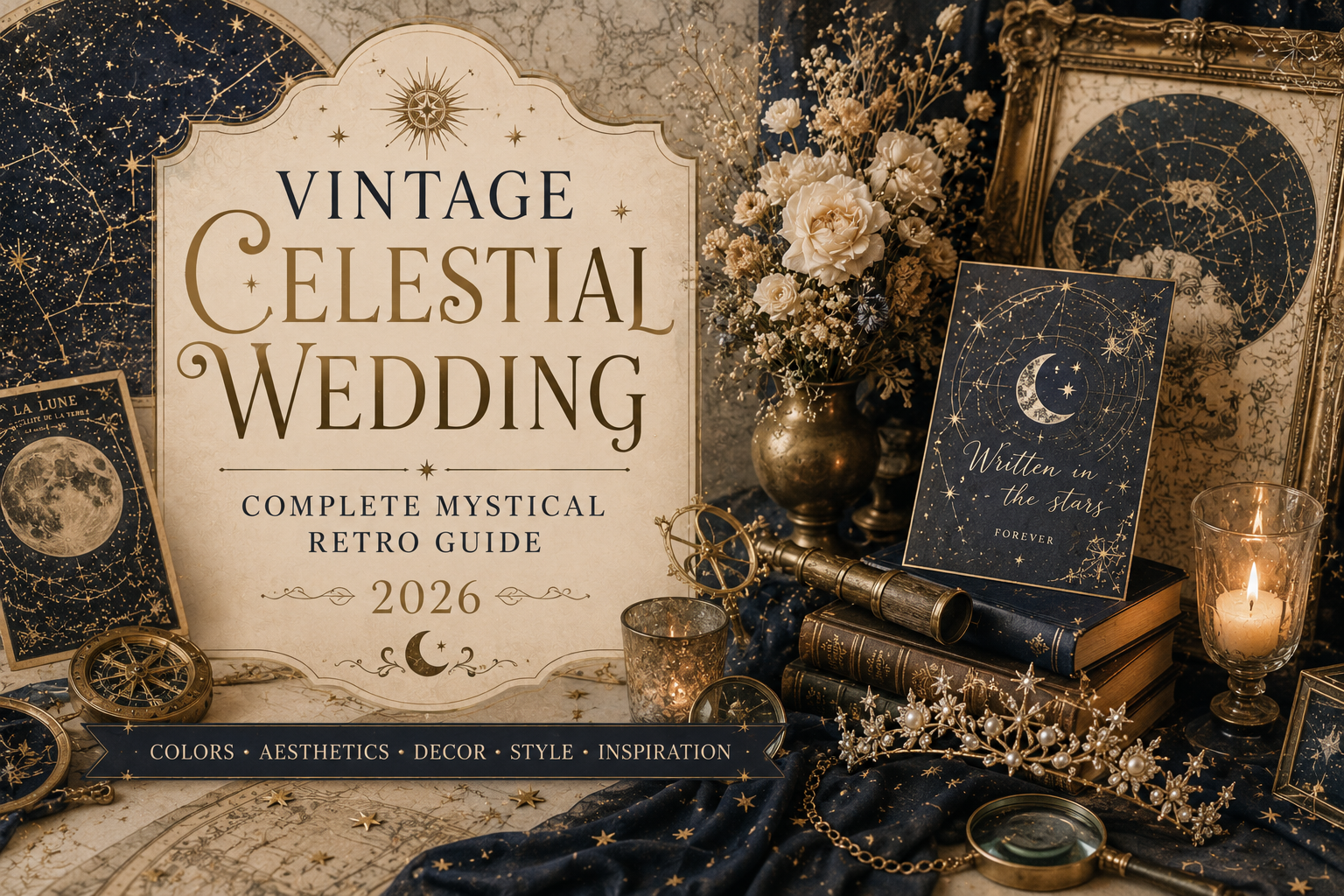
Vintage Celestial Wedding — Complete Mystical Retro Guide 2026
Where aged star maps meet antique gold — four vintage celestial aesthetics, their palettes, venues, and the stationery that carries the world of the historical sky into every detail.
The vintage celestial wedding aesthetic is one of the most specific and the most beautiful in the entire celestial family — because it grounds the romance of the night sky in something that the purely modern celestial aesthetic does not reach: human history. The astronomers and cartographers who first mapped the constellations, the illustrators who turned star charts into works of art, the scientists who found poetry in measurement — this is the tradition the vintage celestial wedding borrows from, and it gives the celebration a quality of depth and meaning that contemporary starry aesthetics, however beautiful, cannot replicate.
This guide covers four distinct vintage celestial aesthetics — Renaissance, Victorian, Art Nouveau, and Dark Academia — with their precise palette directions, the venues and ceremony details that suit each one, decoration and floral decisions, and the stationery that brings the visual language of the historical celestial world into the printed layer of the celebration.
“The first astronomers did not only name the stars — they drew them, charted them, and made of the night sky a document of wonder that has outlasted every other record of their age. A vintage celestial wedding borrows from this act: it makes something beautiful enough to last.”
Section 01 What Is a Vintage Celestial Wedding?
The vintage celestial wedding aesthetic is defined not by darkness and drama but by warmth and history. Where the classic celestial aesthetic uses midnight blue and bright gold to create the experience of looking up at the actual night sky, the vintage celestial aesthetic uses aged parchment, warm sepia, antique gold, and the specific visual language of historical astronomical illustration to create the experience of being in the presence of someone else’s wonder about that same sky — the wonder of the Renaissance cartographer, the Victorian scientist, the Art Nouveau illustrator who found in star maps a subject as worthy of beauty as any flower or figure.
The visual sources that define the vintage celestial aesthetic are specific and recognisable: the star atlases of Bayer (1603) and Flamsteed (1729), which rendered constellations as mythological figures in a style that sits between scientific diagram and fine art illustration; the antique celestial globes and armillary spheres that stood in wealthy libraries for centuries as objects of both knowledge and beauty; the Victorian astronomical drawings that combined scientific precision with the specific romantic wonder of an era that believed the cosmos contained more than it had yet discovered; and the Art Nouveau celestial illustrations that brought the organic, sinuous line-work of the natural world into contact with the geometry of the star charts.
The distinction between the vintage celestial aesthetic and the classic celestial aesthetic is primarily one of temperature and warmth. Classic celestial is cool: midnight blue, silver, the crisp graphic quality of modern star photography. Vintage celestial is warm: parchment, sepia, antique gold, the specific warmth of aged paper and candlelight and the crackling of a fire in a room full of old books. The two aesthetics share the sky as their inspiration; what separates them is the era from which they draw their visual language and the emotional register that results from that choice.
The dark academia crossover is worth understanding explicitly because it appears so naturally in vintage celestial weddings that it is often unintentional. Dark academia is the aesthetic category defined by the romance of old libraries, learned objects, and the specific quality of intellectual life conducted in beautiful old buildings — and it overlaps significantly with the vintage celestial aesthetic because both draw on the same material world: aged books, antique brass instruments, candlelight, the specific warmth of rooms furnished with old things that carry stories. A vintage celestial wedding planned entirely without reference to dark academia will almost inevitably contain dark academia elements — and this is not a problem to be avoided but a quality to be embraced, because the combination produces one of the most coherent and most beautiful wedding aesthetics available in 2026.
Section 02 Four Vintage Celestial Aesthetics
Each direction below is a complete aesthetic world — palette, material vocabulary, emotional register, and stationery reference. Identify which historical era and visual tradition most resonates with the couple’s own sensibility and build from there.
2.1 The Renaissance Celestial Aesthetic
The Renaissance Celestial Aesthetic is the most directly historical of the four — it draws its visual language from the specific tradition of Renaissance astronomical illustration, in which the night sky was rendered not as abstract geometry but as a populated world of mythological figures, divine beasts, and heroic forms holding their positions among the stars. The visual quality of this tradition is immediately recognisable: bold, confident illustration in deep ochre and burnt sienna on aged parchment, gold leaf applied to the star positions with the same authority as in an illuminated manuscript, and a quality of hand-made specificity that makes each element look as if it was drawn by a specific person with a specific belief about what they were documenting.
The wedding aesthetic that emerges from this tradition is the most formally beautiful of the four directions: rich in visual reference, specific in its material vocabulary (parchment linens, gold leaf candleholders, aged vellum stationery), and deeply suited to historic stone venues that look as if they might have hosted a Renaissance court. The colour palette is warm and specific: aged parchment as the base, deep ochre and terracotta as the secondary tones, and warm burnished gold as the metallic accent that connects to the gold leaf tradition of the illuminated manuscript. Deep navy blue appears in this palette as the historical ink colour rather than as a night-sky reference — it is the blue of Bayer’s star charts, specific and learned, not romantic and general.
The specific details that most successfully invoke the Renaissance Celestial Aesthetic in a wedding context: ceremony programs printed in the style of an antique star chart, with the couple’s names positioned where the constellation names appear; table centrepieces featuring aged astronomical prints in ornate frames; menu cards with the visual quality of an illuminated manuscript margin — gold-bordered, beautifully lettered, celestial motifs in the corners; and the wedding invitations themselves designed as if they were pages from the great Renaissance star atlases, with the couple’s details written in the spaces where Bayer or Flamsteed would have written the constellation notes.

The Vintage Celestial Renaissance collection brings the Renaissance star atlas aesthetic into a complete stationery suite — aged parchment tones, illuminated-quality gold constellation work, and the visual authority of historical celestial illustration.

2.2 The Victorian Astronomy Aesthetic
The Victorian Astronomy Aesthetic is the most romantically intellectual of the four directions — it draws from the specific cultural moment in which scientific discovery and romantic sentiment were understood not as opposites but as aspects of the same human response to the cosmos. The Victorians were the first people to see photographs of the night sky; they were also the people who wrote the most extensively about the emotional effect of looking at the stars. The Victorian astronomy aesthetic holds both of these qualities simultaneously: the precision of the scientific instrument and the wonder of the person holding it.
The material vocabulary of the Victorian Astronomy Aesthetic in a wedding context: antique telescope props as table decorations (actual vintage instruments or beautifully made reproductions in aged brass), aged celestial globes as centrepiece focal points, constellation maps in Victorian framing (heavy ornate frames, the specific warm cream of old paper), antique brass candleholders and scientific instruments arranged among floral elements, and the specific quality of sepia and warm gold that characterises Victorian-era printing and photography. The palette is the warmest of the four directions: deep warm sepia, aged ivory, warm amber gold, and the specific brown-black of Victorian ink on yellowed paper.
The Victorian Astronomy Aesthetic is the direction most suited to the dark academia wedding aesthetic — because dark academia draws specifically on the Victorian intellectual tradition, the material culture of Victorian libraries and studies, and the specific quality of buildings that were designed in that era to hold knowledge as well as people. A Victorian astronomy wedding in a university library or a Victorian institution reads as genuinely historically coherent; a Victorian astronomy wedding in a contemporary venue requires more deliberate decoration effort to create the same quality of atmosphere.

The Cosmic Vintage Constellation collection brings the Victorian astronomy aesthetic into stationery — warm sepia, antique gold, and aged star map illustration quality that references the scientific romance of Victorian celestial exploration.

2.3 The Art Nouveau Celestial Aesthetic
The Art Nouveau Celestial Aesthetic is the most decorative and the most visually ornate of the four directions — it takes the moment at the end of the 19th and beginning of the 20th century when the flowing, organic line-work of Art Nouveau illustration came into contact with the precise, geometric vocabulary of celestial cartography and produced something that belonged fully to neither tradition and was more beautiful for it. In Art Nouveau celestial illustration, stars become flowers; constellation lines become the stems of night-blooming plants; the border between the garden and the sky dissolves, and both become part of the same sinuous, golden, endlessly intricate visual world.
The colour palette for the Art Nouveau Celestial Aesthetic introduces elements not present in the other three vintage directions: deep teal, cool midnight blue, and the specific gold that suggests moonlight rather than candlelight — a slightly brighter, less warm gold that reads as more decorative and less aged. The combination of these cool tones with the organic Art Nouveau line-work and the celestial motifs produces a palette that is simultaneously historical and fresh, ornate and purposeful. This is the most appropriate of the four vintage directions for couples who want the vintage quality without the warmth — who are drawn to the Art Nouveau visual tradition specifically and find that a purely warm palette reads as too conventional.
The specific Art Nouveau celestial details that work most effectively in a wedding context: botanical arrangements in which the floral choices reference the night-blooming plants that appear in Art Nouveau celestial illustration (moonflower, night jasmine, black-eyed Susan, dark clematis); stationery with the characteristic Art Nouveau border treatment — sinuous lines in deep teal or midnight blue surrounding constellation motifs in gold; and table linens in deep cool tones with organic botanical patterns that read as Art Nouveau rather than as generic floral.
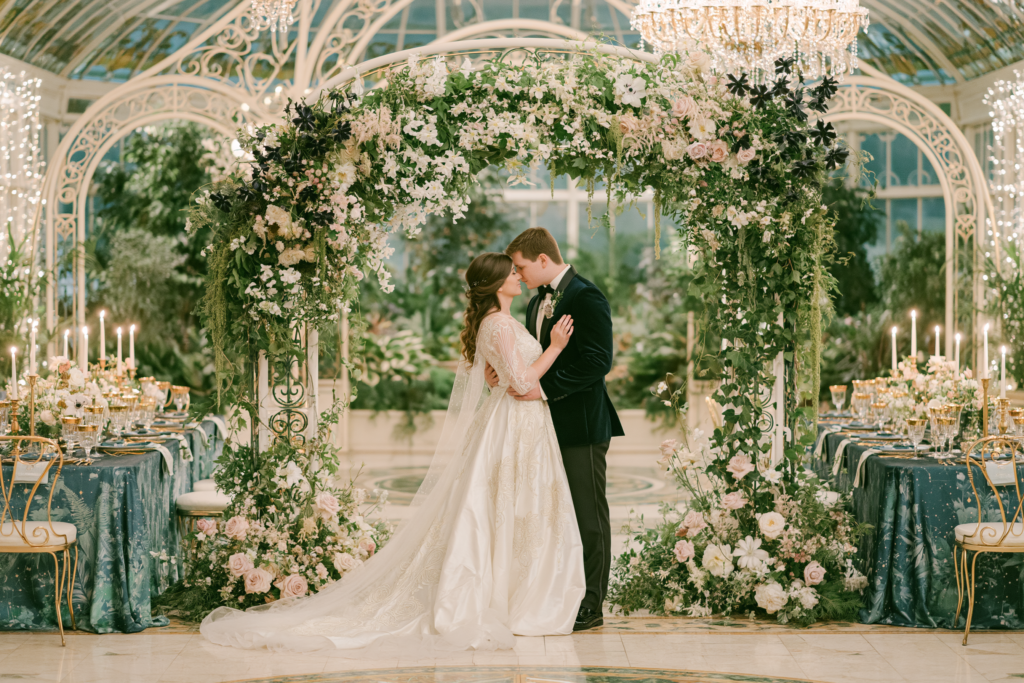
The Celestial Art Nouveau Blue Gold collection brings the botanical-and-cosmic Art Nouveau aesthetic into stationery — flowing organic line-work in deep teal and gold that captures the sinuous beauty of this most ornate vintage celestial direction.

2.4 The Dark Academia Celestial Aesthetic
The Dark Academia Celestial Aesthetic is the direction that most explicitly names the crossover between the vintage celestial world and the contemporary aesthetic category that has shaped the visual sensibility of a generation of couples who came of age in the 2010s. Dark academia — the aesthetic of old libraries, leather-bound books, candlelit studies, and the specific romance of intellectual life conducted in beautiful old buildings — overlaps with the vintage celestial aesthetic so naturally that distinguishing between them is often a matter of emphasis rather than category: a dark academia wedding that includes celestial elements is a Dark Academia Celestial wedding; a vintage celestial wedding that leans into the library and book quality of the dark academia aesthetic arrives at exactly the same place from a different direction.
The colour palette for the Dark Academia Celestial Aesthetic is the darkest and most dramatic of the four vintage directions: deep navy (the colour of the sky at its darkest, just before midnight) with warm leather-toned gold and the specific aged cream of old paper. The material vocabulary is the most specifically dark academia: leather-bound books as decoration (stacked in the centrepieces, open to star chart pages, used as alternative menu holders), antique brass compass and globe elements, candles in significant quantity, dark wood surfaces, and the specific warmth of a room that is lit primarily by fire and flame rather than by artificial overhead light.
The Dark Academia Celestial Aesthetic is the most suitable of the four vintage directions for couples with genuine intellectual interests that they want to express in their wedding — couples who actually own old books and antique instruments and find in them not a decorative vocabulary but a personal one. A dark academia celestial wedding planned by a couple who genuinely loves libraries, who has opinions about specific star atlases, who finds the history of astronomy as romantic as the stars themselves, reads entirely differently — and entirely more personally — than the same aesthetic planned as a style exercise. The authenticity of the couple’s relationship to the source material is the most important quality variable in this direction.
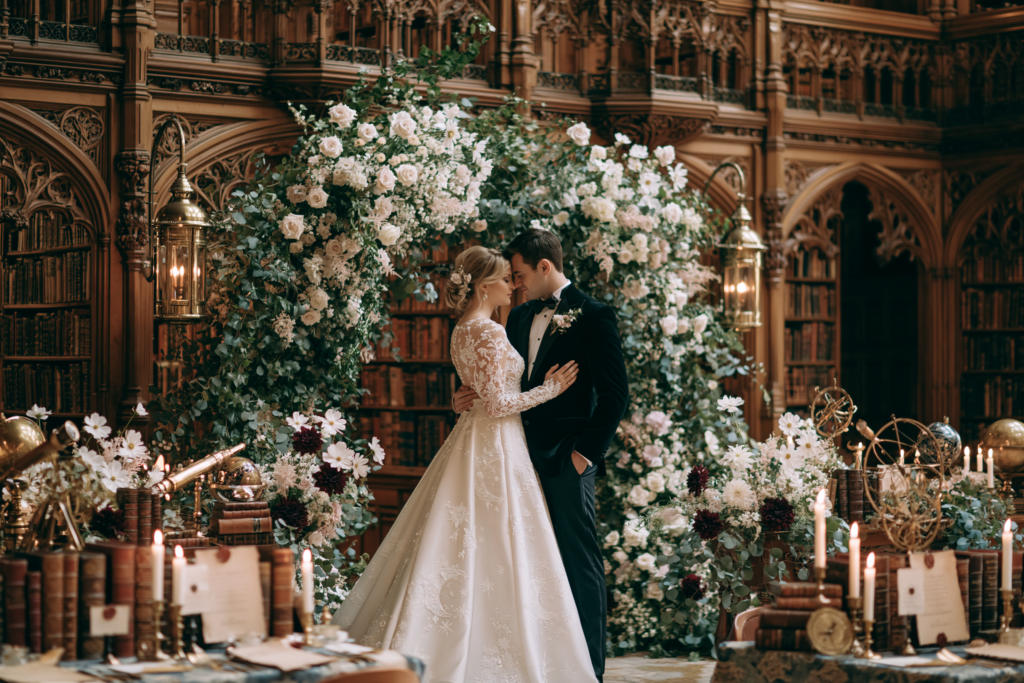
The Celestial Vintage collection and Mystical Black Gold Celestial suite together bring both the warmer parchment register and the darker dramatic register of the Dark Academia Celestial direction into stationery — use the Vintage collection for the warmer library quality, and the Mystical Black Gold for the more dramatic cosmic depth.

Section 03 Vintage Celestial Color Palettes
Four distinct palette directions — each named, colour-described, and annotated for use. Choose the one that most closely matches the aesthetic direction chosen in Section 02 and use it as the reference for every subsequent decision.
Palette 01
Aged Parchment & Constellation Gold
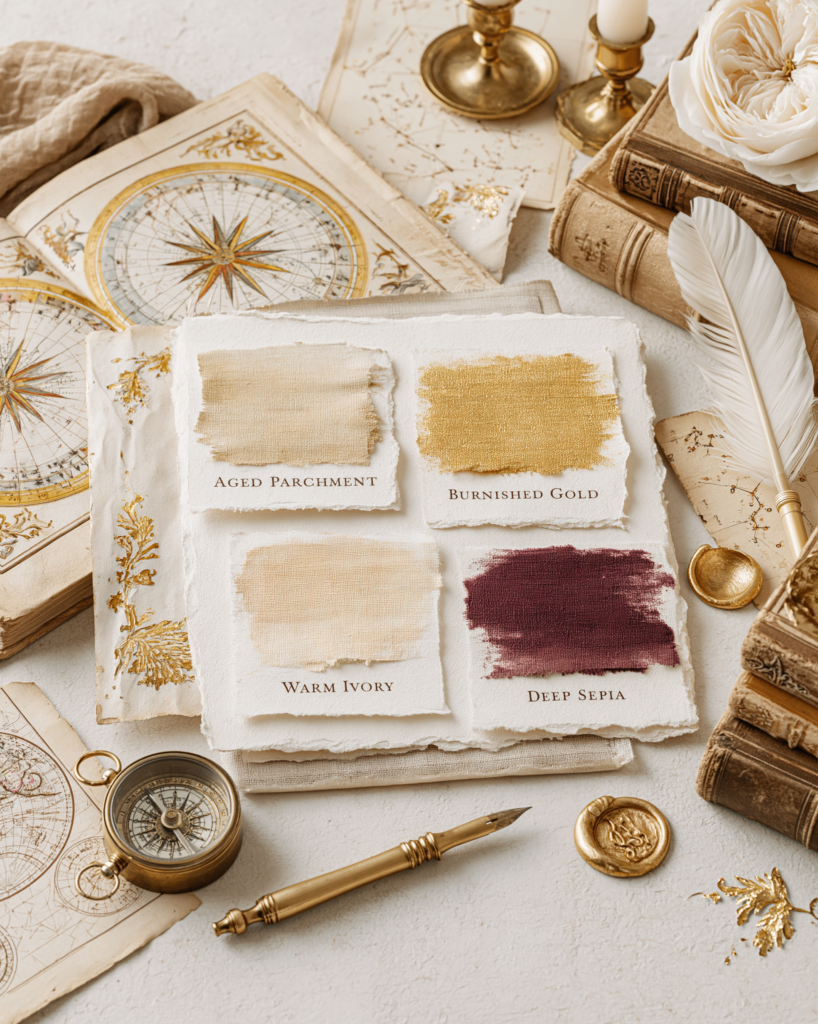
Aged Parchment · Burnished Gold · Warm Ivory · Deep Sepia
The palette of the Renaissance star atlas — warm, learned, and specifically beautiful in candlelight and natural light equally. The base is aged parchment (a warm cream that reads as having been kept in a library) rather than bright white or cool ivory. The gold is burnished and slightly brown-toned rather than bright — the gold of old book spines rather than of new jewellery. Use for: Renaissance and Victorian Astronomy aesthetics.
Palette 02
Renaissance Blue & Antique Gold
Deep Ochre · Renaissance Navy · Antique Gold · Warm Cream
The palette of the great Renaissance star atlases — specifically the deep blue-black ink and warm gold of Bayer’s Uranometria, which used this combination to map the entire sky in a series of plates that remain among the most beautiful scientific illustrations ever produced. The navy here is a deep historical ink tone rather than the romantic midnight of the classic celestial aesthetic. Use for: Renaissance Celestial and Dark Academia aesthetics.

Palette 03
Victorian Sepia & Warm Gold
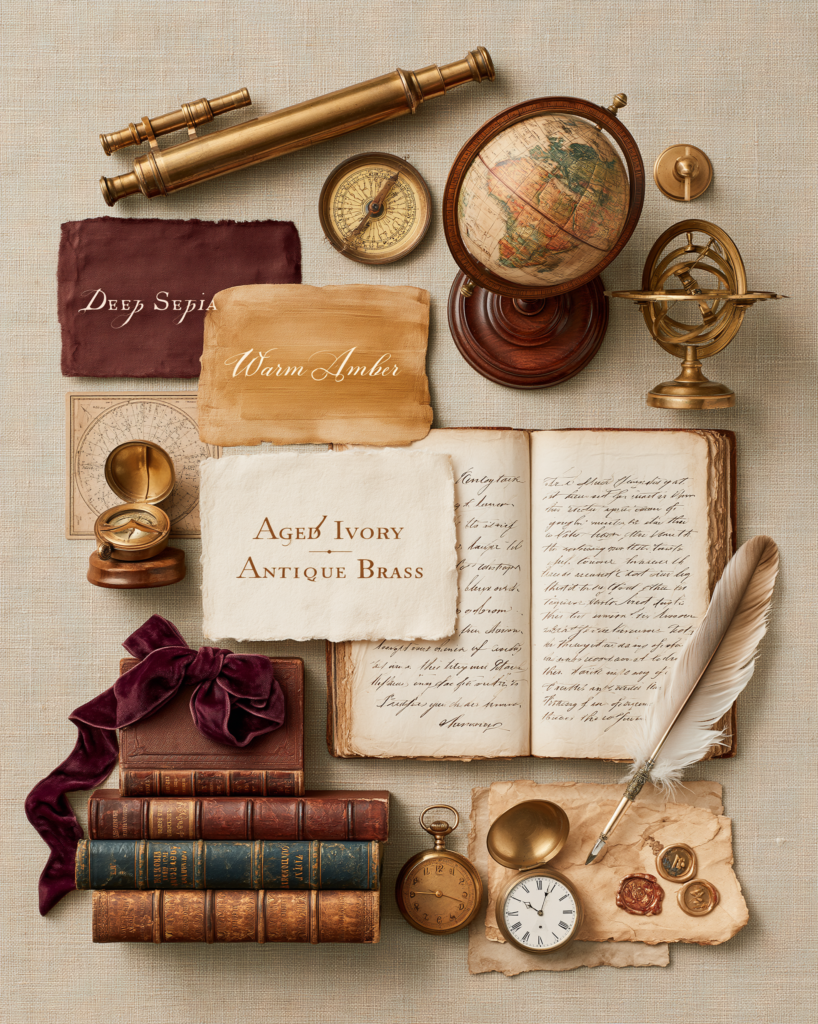
Deep Sepia · Warm Amber · Aged Ivory · Antique Brass
The palette of Victorian astronomical illustration and early celestial photography — the specific warm brown-gold of daguerreotype and sepia print, which gives this palette a quality of time that no other vintage celestial palette achieves. The amber is the colour of candlelight and fire rather than of the sun; the aged ivory is the colour of paper that has been read many times. Use for: Victorian Astronomy and Dark Academia aesthetics.
Palette 04
Dark Academia Navy & Leather Gold
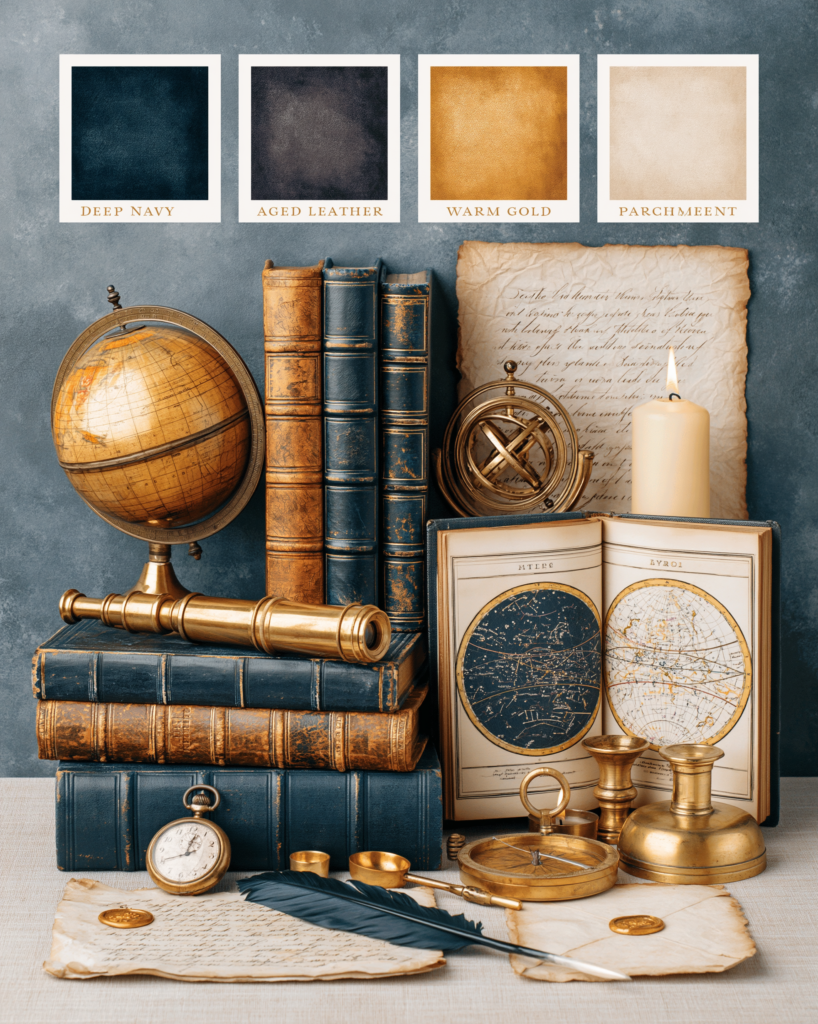
Deep Navy · Aged Leather · Warm Gold · Parchment
The palette of the dark academia celestial direction — darker than the other three, with the specific quality of a room lit by insufficient light that makes every object in it look more interesting than it would in full sun. The navy is genuine midnight blue rather than the warmer navy of the Renaissance palette. The leather tone is the colour of old book covers. Use for: Dark Academia and the most dramatic Victorian Astronomy aesthetics.
Section 04 Vintage Celestial Venue & Ceremony
The Venues That Carry the Vintage Celestial Aesthetic Naturally
The vintage celestial aesthetic is one of the most venue-specific of all wedding aesthetics — because it depends on architecture and atmosphere for a significant portion of its effect, and not every building can carry that atmosphere regardless of decoration investment. The venues that work best for a vintage celestial wedding are the ones that already carry the qualities the aesthetic requires: age, patina, the accumulation of beautiful old things, the quality of a space that was built to house knowledge or ceremony or both.
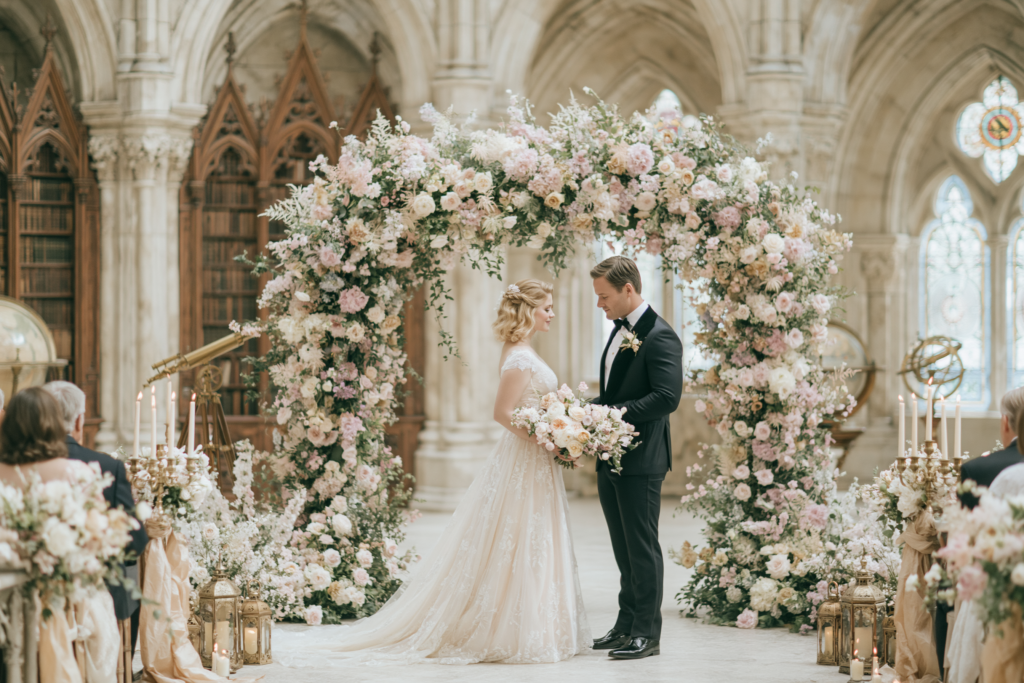
University libraries and old scholarly institutions are the most natural vintage celestial venues — they carry the dark academia crossover quality inherently, they are typically designed with the proportional authority that makes candlelight and astronomical decoration look appropriate rather than theatrical, and their bookshelves and oak panels and high windows provide a backdrop that requires less decoration investment than a blank venue precisely because the building itself is already decorated. Historic observatories — particularly those with original domed ceilings and antique instrument collections — are the most specifically celestial of all vintage venue categories, though they require more advance planning and creative use of space than conventional venues.
Renaissance-inspired halls, country manor houses with long galleries, Victorian botanical gardens with glass houses, old stone churches and collegiate chapels: these are the venues that produce the most beautiful vintage celestial wedding without requiring the couple to build the atmosphere entirely through decoration. In all of these spaces, the combination of the inherent architectural quality with the warm parchment-and-gold palette of the vintage celestial aesthetic and the learned, historical celestial motifs produces something that reads as entirely designed and yet entirely natural — as if the wedding were the occasion for which the building had been waiting.
Ceremony Details
The ceremony program for a vintage celestial wedding is the most important single printed element of the day — more so than for any other wedding aesthetic — because it arrives in guests’ hands before the first decoration is seen, before the flowers are arranged, before the candlelight is lit. A program designed as an antique star chart, with the order of service written in the spaces where a historical atlas would have placed constellation notes, with the couple’s names in the position of the star whose light is brightest — this is the program that transforms the ceremony from a wedding to an event that belongs to a specific and deeply considered aesthetic world.
The vintage celestial ceremony details that produce the most atmosphere with the least logistical complexity: aged parchment paper for all printed elements, handled and imperfect in quality rather than crisp and machine-perfect; constellation aisle markers in aged brass or antique gold rather than modern metallic; a ceremony backdrop in the specific visual language of the vintage direction chosen — a Renaissance star chart print for the Renaissance aesthetic, a Victorian celestial map for the Victorian direction, an Art Nouveau botanical-celestial panel for the Art Nouveau aesthetic; and a ring box or ring bearer object that belongs to the same material vocabulary as the rest of the ceremony (a small aged brass box, a wooden box with a constellation inlaid in gold, a velvet-lined box in the palette’s deep navy or warm sepia).
The Celestial Vintage collection brings the antique celestial aesthetic into ceremony stationery — parchment, aged gold, and historical star chart illustration quality that makes every printed ceremony element feel like an artefact from the era being celebrated.
Section 05 Vintage Celestial Décor & Table Styling
Centrepieces & Table Elements
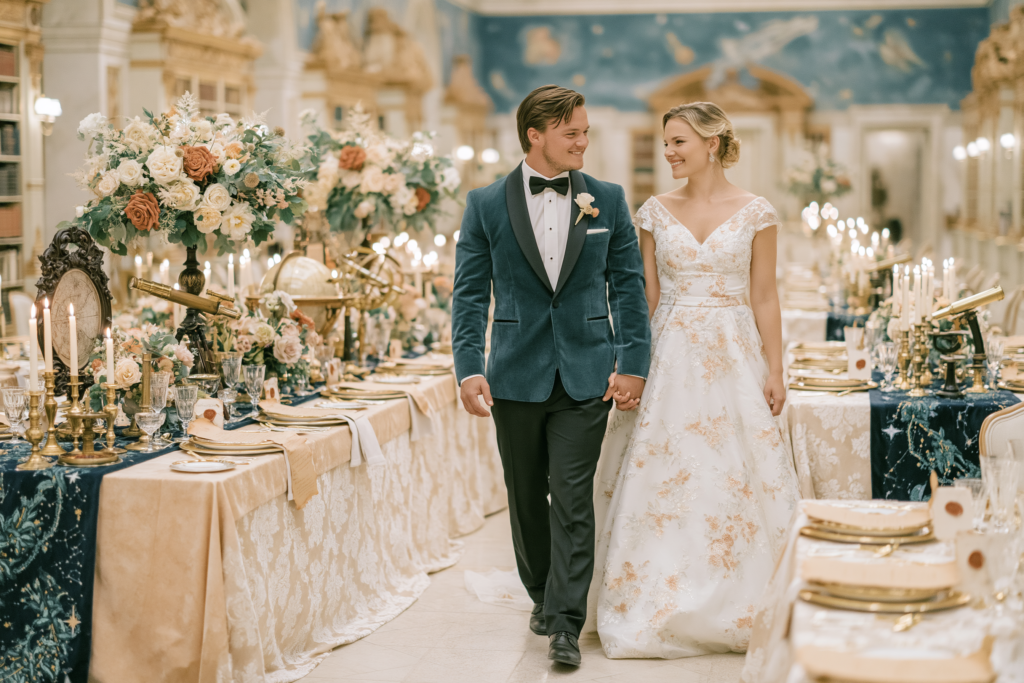
The centrepiece for a vintage celestial table is built from the material vocabulary of historical astronomy rather than from the standard floral arrangement with a celestial element added to it. The most beautiful and most specifically vintage celestial centrepiece combines three elements: an aged star map or celestial print in a suitable frame (heavy, dark wood or antique brass) as the primary visual element; a botanical arrangement in the palette’s warm tones (described in more detail in Section 06) as the organic element; and a scientific instrument or object — an antique globe, a miniature armillary sphere, a brass compass or orrery — as the learned element that places the centrepiece specifically in the vintage celestial world rather than in a generic floral-and-dark aesthetic.
The table linen for a vintage celestial wedding should be warm-toned: aged ivory, natural linen in an undyed or very lightly toned warm cream, or parchment-coloured damask if the venue suits a more formal table setting. Deep teal or navy linen runners suit the Art Nouveau Celestial and Dark Academia Celestial directions specifically. The table runner should carry some visual interest — a subtle constellation print, a damask pattern with celestial motifs, or a botanical print in the direction’s palette tones — rather than being entirely plain, because the vintage celestial aesthetic rewards texture and layering in the table setting more than it rewards restraint.
Props & Signage
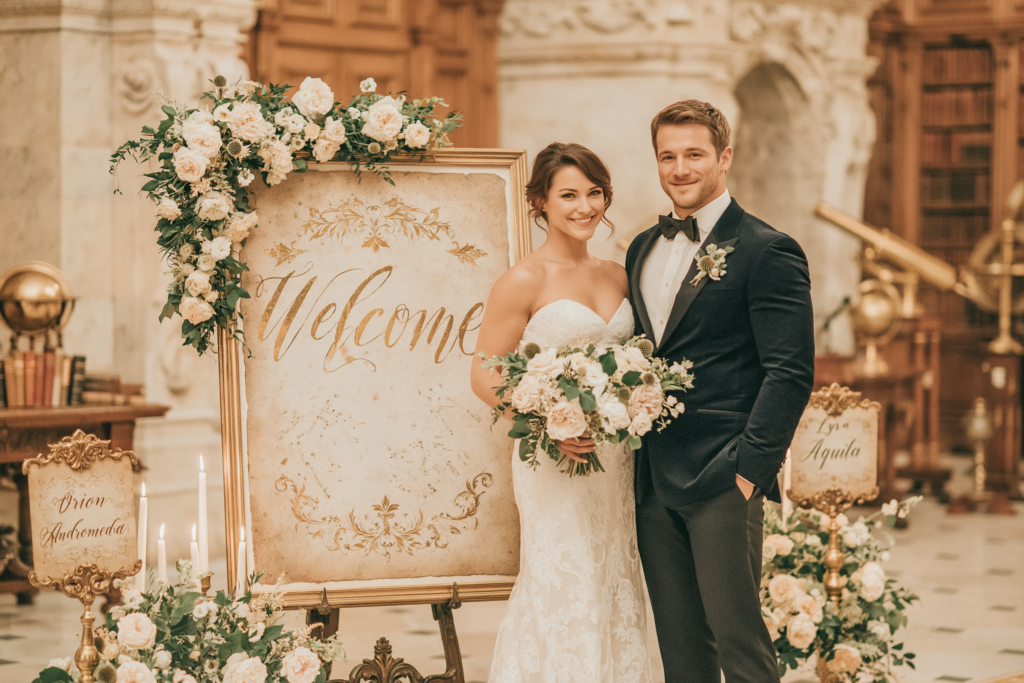
The props that most effectively communicate the vintage celestial aesthetic: antique telescopes and astronomical instruments (both genuine antiques where available and high-quality reproductions in aged brass or copper), vintage celestial globes (the kind that show the constellations as figures rather than as geometric dots), old books open to relevant pages (constellation plates, star chart reproductions, natural history illustrations of night-blooming plants), and the specific category of aged maps and prints that read as having been framed and hung in libraries for generations rather than purchased from a modern reproduction supplier.
Celestial signage for the vintage aesthetic should avoid the most common error in themed wedding signage: the sign that reads as new and clean in a context that calls for old and warm. All text for the vintage celestial wedding — welcome signs, table names, bar menus, directional signs — should be in a hand-lettered or calligraphic style rather than in a printed or typeset one, on aged parchment or warm cream card stock rather than on white or bright card, and with constellation or gold-leaf motifs in the corners that are consistent with the stationery suite’s visual language. Table names drawn from the constellation vocabulary — Orion, Andromeda, Cassiopeia, Aquila, Lyra — are more specific and more coherent than generic star-related names, and they give guests a conversation topic at every table.
Section 06 Vintage Celestial Florals
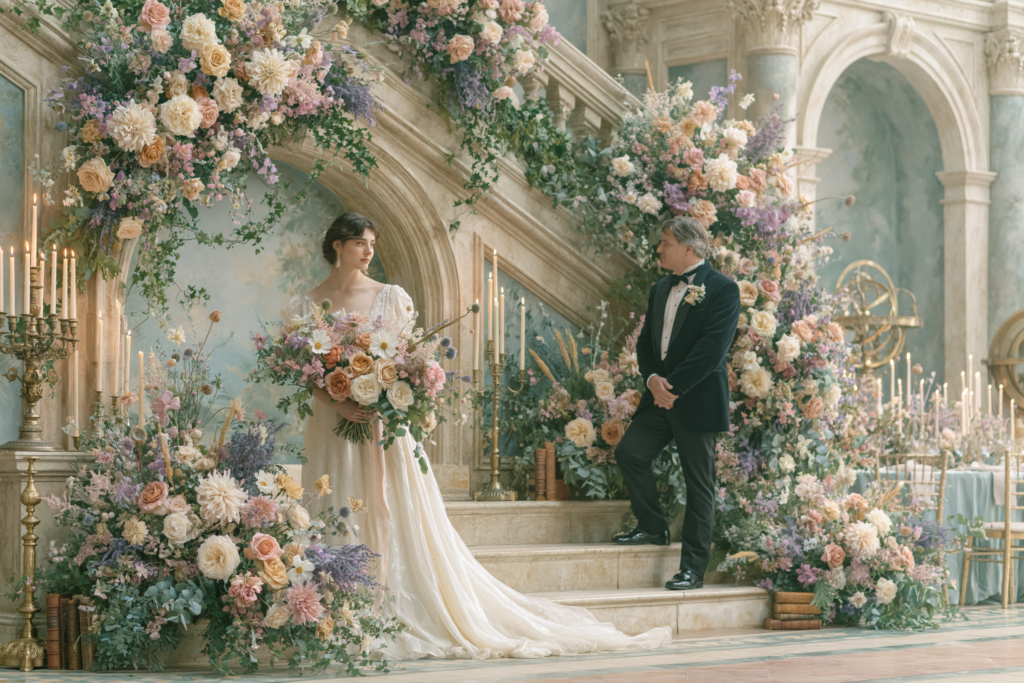
The floral palette for a vintage celestial wedding is one of the most specific and most rewarding of all the celestial directions to work with — because the vintage aesthetic rewards the use of flowers that have been in cultivation for centuries and carry their own historical associations, rather than the most contemporary and fashionable blooms that most wedding florists default to. The vintage celestial bride is not choosing David Austin roses because they are fashionable; she is choosing them because they have been grown in English gardens since the era whose visual language she is borrowing.
The dried and dried-adjacent floral elements are central to the vintage celestial aesthetic in a way they are not to the classic or dark celestial aesthetics. Dried lavender, dried rose, wheat, dried herbs, pressed botanical specimens, and dried wildflowers all carry the warm aged quality that fresh flowers, however beautiful, cannot quite achieve. A centrepiece arrangement that combines fresh garden flowers with dried and aged botanical elements reads as vintage in a way that an entirely fresh arrangement cannot, regardless of the palette. The specific dried elements that read most specifically as vintage celestial: dried astrantia (whose star-shaped form is the most explicitly celestial of any botanical element), dried cosmos (whose name is itself a celestial reference), dried clematis seed heads, dried poppy seed pods, and dried lunaria — which is literally named for the moon.
The fresh flowers that most suit the vintage celestial aesthetic are those with the quality of having been grown in a specific place by someone who cared about the specific plant rather than about the general category of flower: old-fashioned roses in deep cream, apricot, and blush rather than in the bright saturated colours of contemporary commercial rose cultivation; antique dahlias in warm amber and terracotta for the Victorian and Renaissance directions; cosmos in white and soft pink for the Art Nouveau direction (cosmos is both celestial in name and sinuous in growth habit, which makes it the perfect Art Nouveau botanical); and wildflowers and meadow flowers (scabious, astrantia, ammi, cow parsley) for the overall sense of something gathered from a specific landscape rather than ordered from a wholesale catalogue.
The colour palette for vintage celestial florals follows the same warm, aged temperature of the stationery and decoration palette: warm cream, aged apricot, terracotta, and the specific warm white that reads as parchment rather than as bright. Cool or saturated colours — bright white, vivid pink, electric blue — should be avoided entirely, as they introduce a temperature conflict that the warm parchment palette of the vintage celestial aesthetic cannot absorb without losing its distinctive character.
Section 07 Vintage Celestial Stationery
The vintage celestial invitation is a different object from the classic celestial invitation, and the difference is not only visual but material and tactile. A classic celestial invitation announces the night sky: dark, graphic, printed with gold foil on midnight stock, designed to be seen across a room. A vintage celestial invitation is an artefact: warm, aged in quality, printed on stock that reads as parchment rather than paper, in an illustration style that references the historical star atlases rather than the contemporary star photograph, with a quality that invites close examination rather than immediate visual impact. The invitation for a vintage celestial wedding should look as if it might have been found in a drawer of beautiful old things — and the guest who receives it should feel that it was made specifically for them rather than produced at scale.
The illustration quality that defines the vintage celestial stationery is the single most consequential design decision available in this category. Constellation motifs in the style of the great star atlases — with constellation figures rendered as they were in the original Bayer and Flamsteed plates, with the specific hand-drawn quality of pre-photographic scientific illustration, with the warm burnished gold of real gold leaf rather than the bright uniformity of modern metallic printing — produce an invitation that reads as genuinely from another era rather than as a contemporary design inspired by another era. The difference is subtle in description and immediately visible in person, which is why the quality of the illustration source material is worth significant investment in this specific aesthetic.
The paper stock for vintage celestial stationery is the second most consequential decision. Aged cream or warm ivory card with a slight tooth — the specific texture of a card that was not made on modern calendar-pressed equipment — carries the vintage quality in material terms before any illustration is applied. The envelope for the vintage celestial invitation suite should be deep teal, warm navy, or aged cream, lined with a celestial map print in the palette’s secondary colour. The suite should extend through save-the-date, invitation, envelope, inner envelope, ceremony program, place card, menu card, and thank-you card — all in the same illustration register, so that the visual identity of the vintage celestial world is consistent from first communication to last.
What distinguishes vintage celestial stationery from the other celestial directions in both visual and emotional quality: the warmth. A vintage celestial invitation held alongside a classic celestial invitation in the same room reads as the more human of the two — because the warm parchment and aged gold palette belongs to human hands and human time in a way that the cool, crisp, graphic quality of the midnight-and-silver palette does not. The vintage celestial stationery carries the same celestial world as the other directions, but it carries it as a record of human wonder rather than as a simulation of the sky itself. This is the quality that makes the vintage celestial invitation the one that guests are most likely to keep.
Renaissance
Vintage Celestial Renaissance
Parchment and illuminated gold — the stationery suite most directly aligned with the Renaissance Celestial aesthetic.
Victorian
Cosmic Vintage Constellation
Warm sepia and antique gold — the Victorian astronomy aesthetic in a complete stationery suite.
Art Nouveau
Celestial Art Nouveau Blue Gold
Flowing botanical-celestial line-work in deep teal and gold — the most ornate vintage celestial stationery direction.
Vintage Category
Celestial Vintage
The full vintage celestial category — parchment, antique gold, and aged star map illustration across all suite elements.
Dark Academia
Mystical Black Gold Celestial
For the Dark Academia Celestial direction — deep midnight with warm gold, the most dramatically atmospheric vintage option.
Gold & Luminous
Celestial Gold
Sun and moon warmth in the vintage register — the most approachable and most seasonally flexible vintage celestial stationery.


Explore the Full Celestial Wedding Series
This guide is part of the complete celestial wedding series. The resources below cover every planning category from venue and ceremony to dress and flowers.
Complete Guide
Celestial Wedding — Complete Celebration Guide 2026
Venue, ceremony, reception styling, and complete stationery showcase for all six celestial aesthetics.
Color Guide
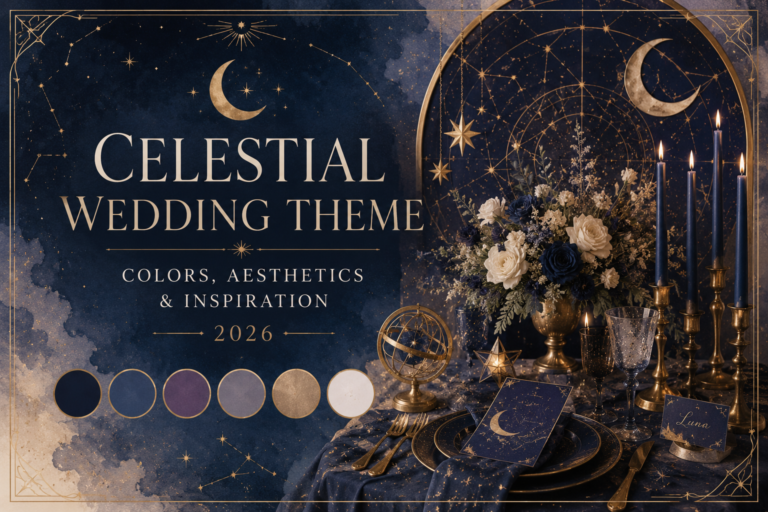
Celestial Wedding Theme — Colors & Aesthetics 2026
Eight celestial color palettes with swatches, feeling descriptions, and venue guidance.
Dress Guide
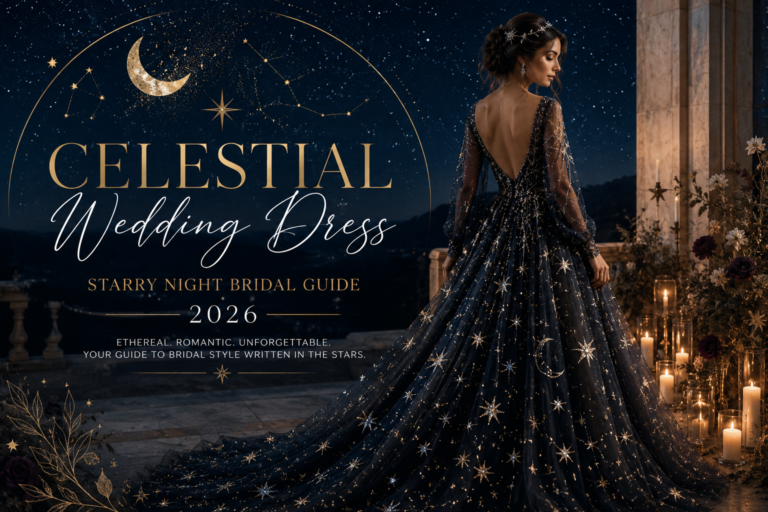
Celestial Wedding Dress — Starry Night Bridal Guide 2026
Six celestial dress styles, fabrics, embellishments, and accessories for the celestial bride.
Frequently Asked Questions
What is a vintage celestial wedding aesthetic?
A vintage celestial wedding aesthetic uses the visual language of historical celestial illustration — Renaissance star atlases, Victorian astronomical drawings, Art Nouveau celestial motifs, dark academia library aesthetics — to create a wedding that connects to the long human tradition of finding beauty in the night sky rather than simply to the contemporary visual language of space and astronomy. The defining qualities are warmth (aged parchment, antique gold, sepia tones rather than midnight blue and silver), historical specificity (the visual sources are particular historical traditions rather than generic celestial imagery), and the quality of something made rather than produced — the aged, handmade, specifically beautiful quality of objects that carry time as part of their appearance.
What is the difference between vintage celestial and classic celestial?
The key distinction is temperature and historical reference. Classic celestial is cool: midnight navy or near-black base, bright silver or clean gold, the graphic quality of a modern star photograph or a contemporary constellation illustration. Vintage celestial is warm: aged parchment or sepia base, burnished antique gold rather than bright metallic, the hand-drawn quality of pre-photographic scientific illustration. Classic celestial looks up at the actual night sky; vintage celestial looks at the record that humans have made of that sky across history. Both are beautiful — the choice between them depends on whether the couple is drawn to the sky itself or to the human relationship with the sky, and that distinction usually corresponds quite naturally to a preference for the cool graphic quality of the classic aesthetic or the warm historical quality of the vintage one.
What is dark academia in a wedding context?
Dark academia is an aesthetic category defined by the romance of old libraries, scholarly objects, beautiful old buildings, and the specific quality of intellectual life conducted in spaces designed for it. In a wedding context, the dark academia aesthetic means leather-bound books as décor, antique brass scientific instruments as props, candlelight as the primary light source, dark wood and stone architecture as the preferred venue, and a general quality of warmth, age, and learning throughout the visual presentation of the day. The dark academia celestial wedding is the overlap between this aesthetic and the vintage celestial wedding — a celebration in which the historical human relationship with the night sky (the old books, the antique telescopes, the aged star maps) is as central as the sky itself. The Dark Academia Celestial direction in this guide is the specific aesthetic that names and develops this overlap.
What florals suit a vintage celestial wedding?
The florals most suited to a vintage celestial wedding are those that carry the quality of age, specificity, and the natural world in the same register as the rest of the aesthetic: dried botanical elements (dried astrantia, dried cosmos, dried lunaria, dried lavender), old-fashioned roses in warm cream and aged apricot, antique dahlias in terracotta and amber, wildflowers and meadow flowers (scabious, ammi, cow parsley, astrantia) in warm neutral tones, and any botanical element whose name or form has a direct celestial connection (cosmos, lunaria, moonflower). The colour palette for vintage celestial florals is warm and aged: warm cream, apricot, terracotta, amber, and the specific warm white that reads as parchment. Bright saturated colours — vivid pink, electric blue, stark white — should be avoided because they introduce a temperature conflict that the warm vintage palette cannot accommodate without losing its distinctive character.
Begin with the Stationery
Find the Vintage Celestial Collection That Belongs to Your Historical World
The invitation is the first artefact of the vintage celestial world — choose it in the right aesthetic register and let it set the palette for everything that follows.