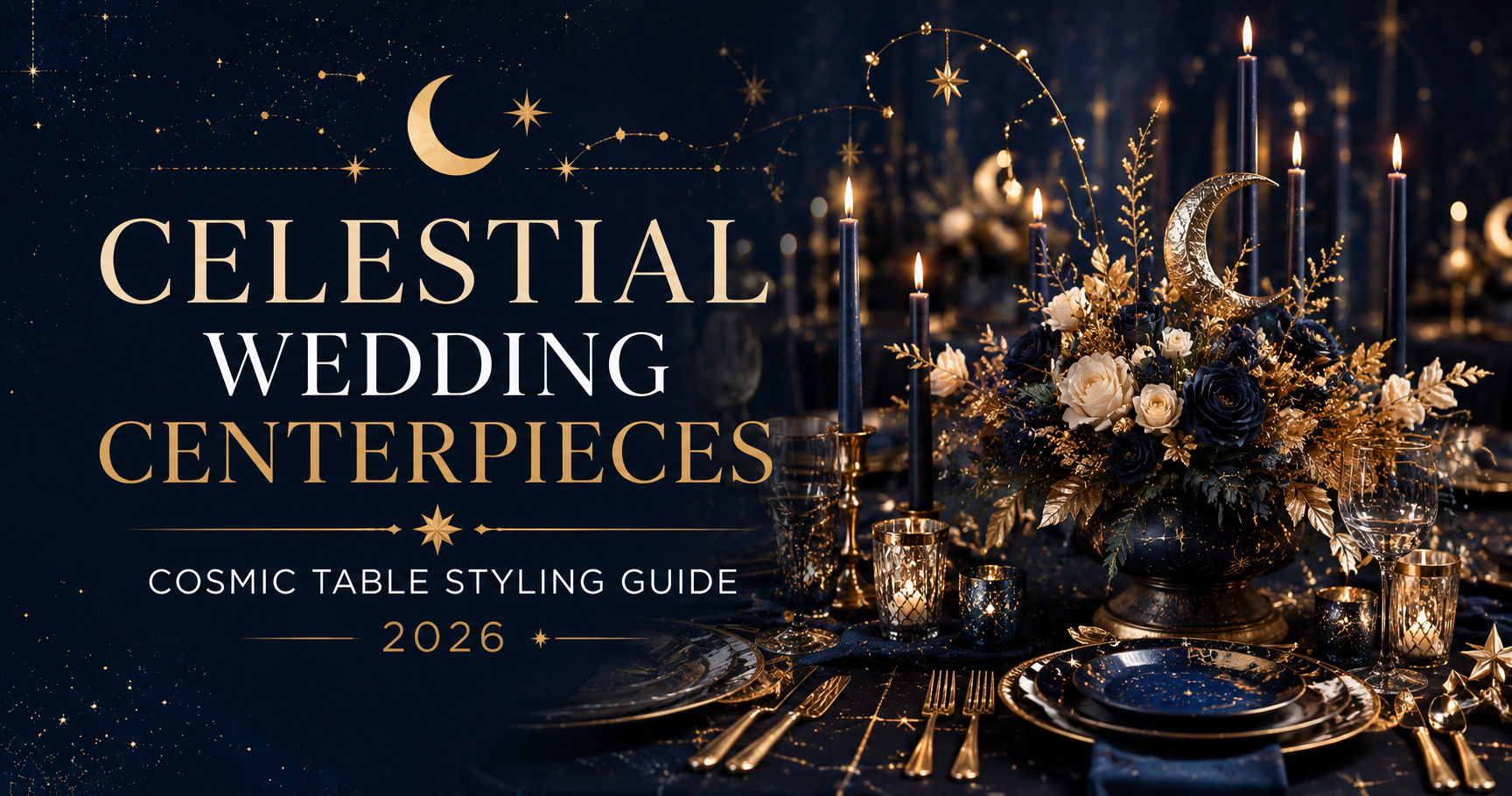
Celestial Wedding Centerpieces
Celestial Wedding · 2026
Celestial Wedding Centerpieces — Cosmic Table Styling Guide 2026
Six celestial centrepiece styles, the vessels and flowers that make them work, and the stationery that completes every table into a designed celestial world.
The centrepiece is the decoration element that guests experience most closely and most consistently throughout the reception — they sit beside it for hours, they look across it during conversation, they reach around it for candles and glasses, and they photograph it as the frame for every portrait taken at their seat. A celestial centrepiece that is genuinely beautiful at close range — that rewards examination with the kind of specific detail that a professionally designed object provides — produces a reception table that feels like a small, complete, celestial world.

This guide covers six distinct celestial centrepiece styles with the vessel, floral, and material decisions that make each one work, the flower palette that suits the celestial aesthetic across all six styles, how the centrepiece works in relation to the full table setting, and the stationery suite that carries the same palette from the centrepiece into every printed element on the table surface.

“Each table is a miniature cosmos — a small universe complete in itself, with its own star clusters in the candle arrangement, its own galaxy in the dark vessel at the centre, its own horizon in the linen below. A reception of well-made celestial tables is a sky made intimate.”
Section 01 The Celestial Centrepiece Philosophy
The celestial centrepiece works differently from most wedding centrepieces because its primary design challenge is depth rather than abundance. Most wedding centrepieces achieve their effect through volume — enough flowers, enough height, enough material to create a presence at the table. The celestial centrepiece achieves its effect through the specific contrast between darkness and light: a deep vessel that seems to hold space within it, lit from within or surrounded by candlelight, with gold and white detail emerging from the dark the way stars emerge from the night sky. The quality of this effect depends on restraint rather than abundance — fewer, better-placed points of light against a richer, deeper background is always more effective than more points of light against a lighter or more generic background.
Height variation is the structural principle that organises every successful celestial table: the low elements (votive candles in blackened metal holders, small star-scatter arrangements in dark vessels, moss and botanical material at base level), the mid elements (the primary centrepiece vessel and its floral or botanical arrangement, typically at eye level when seated), and the tall elements (taper candles in slender blackened or antique brass holders, a tall single-flower stem in a dark glass flute, or a delicate celestial garland element at height). Each height level carries its own visual role: the tall elements create the sky quality of the arrangement, the mid elements create the star-field quality, and the low elements create the earth quality from which the arrangement grows upward.
The layered celestial table works spatially as a vertical composition: dark linen below (the earth), star scatter on the tablecloth (the horizon and the beginning of the sky), centrepiece elements at mid height (the atmospheric layer where the first stars become visible), and candle flame at high points (the individual stars at maximum brightness). A celestial table that achieves this vertical progression reads as genuinely designed — as if the table surface is a landscape and the centrepiece is the moment of looking up from it into the night sky above. A celestial table that uses the right palette but in a single undifferentiated height zone reads as a decorated table rather than as a spatial composition, regardless of the quality of its individual elements.

Section 02 Six Celestial Centrepiece Styles
Each style below is a complete centrepiece direction — vessel type, floral or botanical vocabulary, lighting approach, and the specific visual effect it creates at table level. Choose the one that most closely matches the wedding’s overall celestial aesthetic direction.
2.1 The Galaxy Globe Centrepiece
The Galaxy Globe Centrepiece is the most editorial and the most immediately distinctive of the six celestial centrepiece styles — it takes the galaxy painting technique used in professional cake decoration and applies it to a three-dimensional vessel, producing a centrepiece that reads as a contained piece of the cosmos rather than as a decorated table element. The vessel is a large glass globe, cylinder, or apothecary jar, partially filled with dark substrate material — activated charcoal, black sand, dark river stones, or deep charcoal pebbles — from which a dark botanical arrangement emerges upward. The glass is lit from below with a small battery-operated LED in warm amber, so the dark substrate glows from within and the botanical arrangement above it appears to grow from luminous dark earth toward the ceiling.
The specific botanical vocabulary for the Galaxy Globe: deep burgundy or near-black dahlia at the base of the emerging arrangement, dark blue delphinium or navy thistle in the mid zone, and white or cream flowers (garden rose, anemone, gypsophila in small clusters) at the top to suggest the light of distant stars. The dark substrate visible through the glass around the botanical material is the galaxy effect — and the quality of this effect depends entirely on the depth and consistency of the substrate colour: pale or mixed substrate reads as generic terrarium, not galaxy centrepiece. Scatter a very small quantity of iridescent or gold glitter into the uppermost layer of the substrate before placing the floral arrangement, so that close examination reveals pinpoints of gold within the dark material — the specific reward-on-examination quality that distinguishes a genuinely designed centrepiece from a decorated one.
The Galaxy Globe Centrepiece is the most appropriate of the six styles for the dark celestial, classic celestial, and constellation celestial wedding aesthetics — and the least appropriate for the vintage and botanical celestial aesthetics, where the glass globe reads as too modern and too graphic. A table with Galaxy Globe centrepieces benefits from the most minimal surrounding decoration: the globe carries enough visual weight that additional elements should be small and subordinate (a scatter of gold tea light holders, a few individual dark flower heads at the base, a constellation place card), rather than competing with the globe for attention.

The Celestial Dark collection and Black Gold Celestial suite carry the Galaxy Globe palette into the table’s printed elements — near-black with warm gold constellation work across place cards, menu cards, and table numbers, completing the dark celestial table surface.
2.2 The Constellation Candelabra
The Constellation Candelabra is the most dramatically romantic of the six styles — it uses height and candlelight as its primary visual elements, producing a centrepiece that transforms the table into an intimate version of a night sky in which the brightest stars are large candle flames surrounded by smaller votives in the pattern of supporting stars. The candelabra itself should be in blackened metal or antique brass — never chrome or modern silver, which reads as generic rather than celestial — with arms at multiple heights to create the vertical variation that the style requires. The taper candles in the arms should vary in height as well as position, so that the overall form reads as organic and atmospheric rather than as a symmetrical candle arrangement.
The star scatter detail that makes a candelabra celestial rather than simply dramatic: a very fine scatter of gold leaf pieces or gold-painted dried botanical elements placed around the base of the candelabra at table level, and small votive candles in blackened metal holders placed in the table surface around the candelabra base in the specific irregular clustering pattern of a real constellation — using a star chart reference to place them in the correct geometric relationship rather than in a random scatter or a symmetrical ring. The constellation at table level and the candelabra flames above it together create the specific visual metaphor of looking up from the earth at the night sky.
The Constellation Candelabra works best at tables where it will be viewed from a distance of several feet — its visual impact is in the quality of the candlelit composition seen across the room rather than in close-range examination detail. For this reason it is particularly well suited to larger reception rooms with higher ceilings, where the scale of the candelabra (which should be tall enough to be visible above guests’ heads when seated) is proportional to the space. At smaller intimate tables in lower-ceilinged rooms, a lower candelabra with shorter tapers — or a transition to the Galaxy Globe style — produces a more appropriate visual scale.

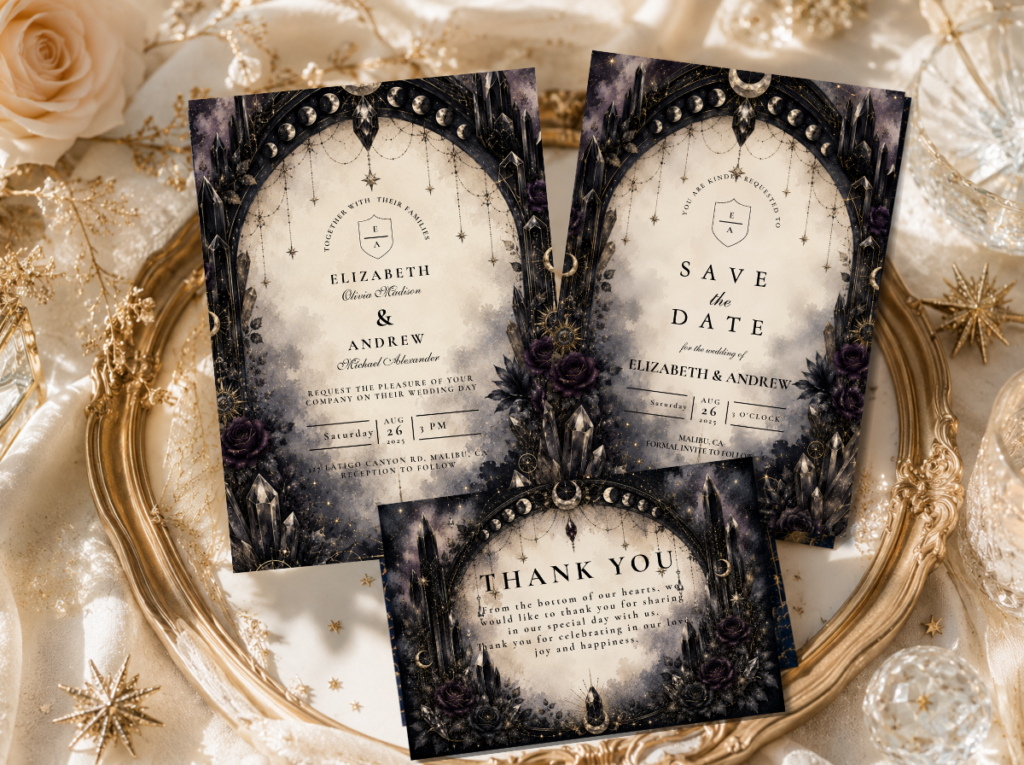
The Mystical Black Gold Celestial collection brings the Constellation Candelabra’s midnight-and-gold vocabulary into the table’s printed suite — the most dramatically atmospheric stationery direction for the most romantic celestial centrepiece style.

2.3 The Moon Phase Floral Centrepiece
The Moon Phase Floral Centrepiece takes the moon phase narrative — the progression of the moon from new to full — and expresses it in the specific visual language of flowers and botanical material rather than in geometric or graphic form. The arrangement moves from the darkest, most closed elements at one side (the new moon position: deep near-black dahlia buds, tightly closed dark anemone, deep midnight blue thistle) through the progressively lighter and more open elements (waxing crescent: opening dark florals with the first cream accents emerging) to the full moon position at the opposite side of the arrangement (wide-open white garden roses, fully opened white anemone with dark centres, white cosmos, white gypsophila in maximum density). The progression is visible and readable from any position at the table.
The silver and gold detail of the Moon Phase Floral Centrepiece: silver dusty miller foliage integrated throughout the arrangement provides the cool silver metallic quality of moonlight; small gold wire moon phase forms (crescent to circle, bent from thin gold wire) positioned at intervals among the florals provide the warm gold accent; and dried silver lunaria seed pods (whose transparency and silver-white colour give them a genuinely lunar quality) scattered through the mid zone of the arrangement provide the most specifically moon-connected botanical material available in this style.
The Moon Phase Floral Centrepiece is the most narratively structured of the six styles and the one with the most personal potential — because the specific moon phase most significant to the couple can be positioned as the focal point of the arrangement (at the centre of the table, at maximum visual prominence), while the surrounding phases serve as the surrounding context. This level of personal specificity transforms the centrepiece from a beautiful decoration into a personal record of the celebration, which is the quality that the celestial aesthetic rewards most consistently.

The Celestial Starry Nights collection carries the Moon Phase Floral palette into the table’s printed elements — midnight blue and warm gold with moon and star motifs that extend the centrepiece’s lunar narrative into every place card and menu card on the table.

2.4 The Vintage Star Map Centrepiece
The Vintage Star Map Centrepiece is the most intellectually specific and the most appropriate for the vintage celestial and dark academia wedding aesthetics — it draws its visual vocabulary from the material culture of historical astronomy (the antique celestial globe, the aged star map print, the leather-bound astronomical atlas) rather than from floral or lighting techniques. The primary element is a large antique celestial globe — a spherical representation of the night sky with constellations as mythological figures, in aged brass or antique cream-and-gold — positioned as the centrepiece’s centrepiece, around which all other elements are arranged as supporting context rather than as competing focal points.
Around the antique globe: a framed aged star map print or celestial atlas page positioned flat on the table surface or slightly propped at an angle, so that it reads as the horizontal plane from which the globe rises; a dark botanical arrangement (dried lavender, dried herbs, aged rose heads, dried astrantia) in small antique vessels to each side; antique brass candlesticks with unscented taper candles; and small aged books open to relevant pages (constellation plates, celestial diagrams) arranged among the other elements. The overall effect should read as if a learned person arranged a section of their study on this table and forgot to remove it before the guests arrived — which is precisely the dark academia quality the vintage celestial aesthetic seeks.
The Vintage Star Map Centrepiece is the most venue-specific of the six styles — it is most at home in historic library settings, stone manor halls, Victorian institutions, and old ecclesiastical spaces where the antique material vocabulary reads as contextually appropriate rather than as imported decoration. In a modern or neutral venue, this style requires the most supporting decoration investment to create the period atmosphere it needs — dark wood surfaces or aged fabric underlays on the table, warm candlelight as the primary light source, and the consistent vintage celestial palette throughout every surrounding detail.

The Cosmic Vintage Constellation collection brings the Vintage Star Map palette into stationery — warm sepia and antique gold with historical celestial illustration quality, completing the vintage star map table with place cards and menus that read as artefacts from the same era as the globe and prints.

2.5 The Botanical Celestial Centrepiece
The Botanical Celestial Centrepiece is the most organically beautiful of the six styles — it brings the celestial aesthetic into dialogue with the natural world in the specific register of the Art Nouveau tradition, where botanical and celestial motifs coexist in the same visual language rather than one decorating the other. The floral vocabulary: deep teal and midnight blue flowers (blue delphinium, dark iris, black-eyed Susan, deep blue morning glory where available) alongside night-blooming botanicals whose names or forms carry a direct celestial reference (white cosmos, white moonflower, dried lunaria). Gold wire constellation forms embedded in the arrangement at intervals — the straight geometric lines of constellation maps providing a precise counterpoint to the organic curved forms of the botanical material — are the specific detail that positions this style in the celestial aesthetic rather than in a conventional botanical aesthetic.
The Art Nouveau quality of the Botanical Celestial Centrepiece comes from the visual relationship between the precise geometric constellation wire forms and the flowing organic botanical material that surrounds them — the contrast between the drawn line of the constellation and the grown form of the flower is the specific aesthetic quality that Art Nouveau celestial illustration exploited, and that the botanical celestial centrepiece can reproduce in three dimensions. The gold wire should be used sparingly rather than abundantly: three or four constellation forms of different sizes, positioned at different depths within the arrangement, reward close examination with the discovery of precision within organic abundance.
The Botanical Celestial Centrepiece is the most appropriate of the six styles for outdoor and garden wedding settings — because the organic quality of its botanical material reads as naturally right in outdoor environments, and because the celestial gold wire detail provides sufficient decoration intentionality to distinguish the arrangement from a simple garden arrangement. It is also the most appropriate for the Art Nouveau celestial and botanical celestial wedding aesthetics, and the least appropriate for the dark and dramatic celestial aesthetics where its organic quality reads as insufficiently atmospheric.
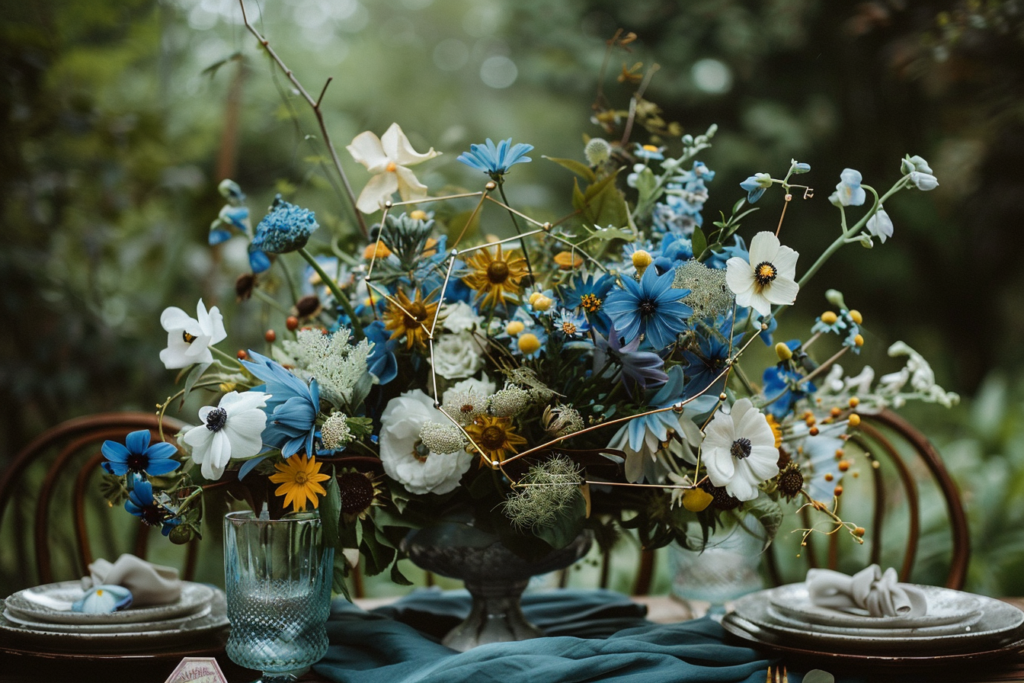
The Celestial Floral collection and Celestial Art Nouveau Blue Gold suite bring the botanical-and-cosmic Art Nouveau quality into the table’s stationery — flowing organic celestial line-work in deep teal and gold, completing the botanical centrepiece’s world in every printed surface at the table.

2.6 The Gold Sun & Moon Centrepiece
The Gold Sun and Moon Centrepiece is the warmest and the most luminous of the six styles — it takes the sun and moon as the primary visual motifs rather than the night sky in general, and organises every element around the warmth and light of these specific celestial bodies rather than around the depth and drama of the darker celestial styles. The palette: warm amber gold as the dominant metallic, ivory and warm cream as the neutral base, and touches of deep terracotta or burnt orange as the accent that references the specific warmth of the rising or setting sun. The arrangement is filled with warm-toned florals — golden ranunculus, amber sunflower, peach and coral dahlia, ivory garden rose — with gold sculptural sun and moon elements (cast in gold metal, or made from gold-painted dried botanical material) positioned as the focal elements among the flowers.
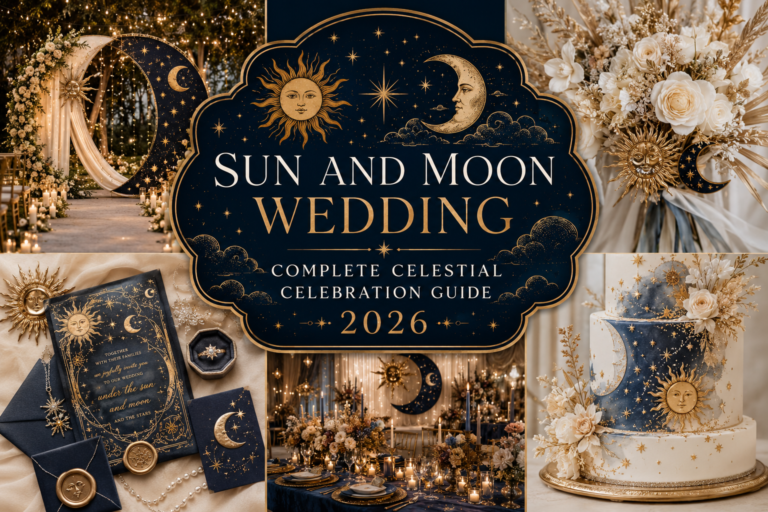
The sun and moon sculptural elements that define this style should be in warm antique gold rather than bright metallic gold, and they should be dimensional rather than flat — the sun as a disc with slightly raised rays in the style of a historical celestial illustration rather than a sharp-edged geometric star, and the moon as a full crescent with slight surface texture suggesting the actual topography of the lunar surface. These elements are available from specialist wedding decoration suppliers and artisan makers, and their quality is the quality decision that most determines whether the Gold Sun and Moon Centrepiece reads as genuinely celestial or as generic sun-and-moon decoration.
The Gold Sun and Moon Centrepiece is the most versatile of the six styles in terms of venue and seasonal compatibility — the warm gold palette works as naturally in a summer garden setting as in a winter candlelit interior, and the luminous quality of the warm tones produces a centrepiece that reads as inviting and romantic in any light condition. It is also the most accessible of the six styles for couples who want to use celestial motifs in a celebration that feels genuinely warm and welcoming rather than dramatically atmospheric — for guests who might find the darker celestial styles surprising or overwhelming, the Gold Sun and Moon Centrepiece is the celestial option that reads as universally beautiful.
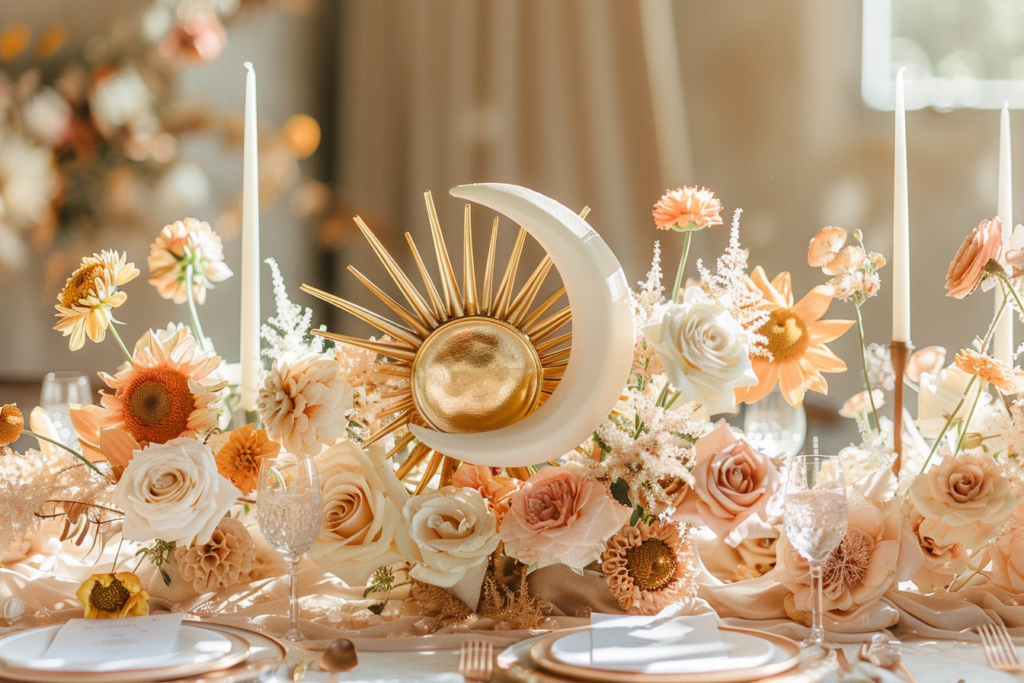
The Celestial Gold collection carries the sun and moon palette into the table’s printed stationery — warm amber gold and ivory with solar and lunar motifs in the most romantic and most luminous register of the celestial aesthetic.

Section 03 Vessels & Materials for Celestial Centrepieces
The vessel is the first and most consequential decision in any centrepiece design — it defines the centrepiece’s scale, its relationship to the table surface, and the aesthetic register it communicates before any floral or botanical material is added. For celestial centrepieces, the vessel should carry the palette in itself: dark glass, mercury glass, antique brass, midnight blue ceramic, or gold-detailed urn, depending on the specific celestial aesthetic direction chosen.
Dark Glass and Mercury Glass
Dark glass vessels — deeply tinted glass in midnight navy, near-black, or deep charcoal — are the most dramatic and the most appropriate for the Galaxy Globe, Constellation Candelabra, and dark celestial aesthetic styles. The depth of colour in the glass is what allows the internal lighting (if used) to produce the galaxy glow effect rather than a generic lit vessel effect. Mercury glass — antique-mirror glass with its characteristic silver-and-dark mottled appearance — is the most atmospheric vessel material available in the celestial category, because its surface quality suggests the cosmic rather than the decorative. Mercury glass in dark tones (there are both clear and deeply tinted mercury glass vessel types) suits the classic and constellation celestial aesthetics particularly well.

Antique Brass and Blackened Metal
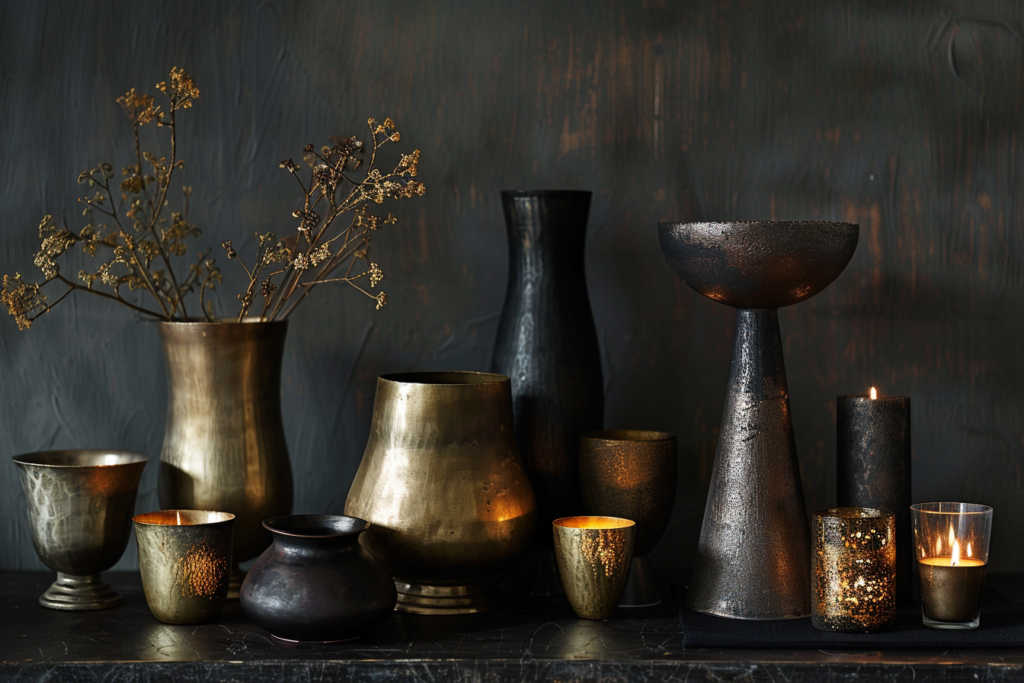
Antique brass vessels — urns, bowls, tall vases, and candle holders in aged yellow brass rather than bright polished brass — are the most appropriate vessel material for the vintage and dark academia celestial aesthetics, because their warmth and apparent age connect them to the historical scientific and astronomical tradition from which those aesthetics draw their visual vocabulary. Blackened metal (iron, steel, or aluminium with a dark finish) is the most specifically celestial vessel material for the dramatic dark aesthetics — it reads as deliberately chosen rather than as neutral, and it produces the strongest visual contrast with the gold metallic accents of the centrepiece.
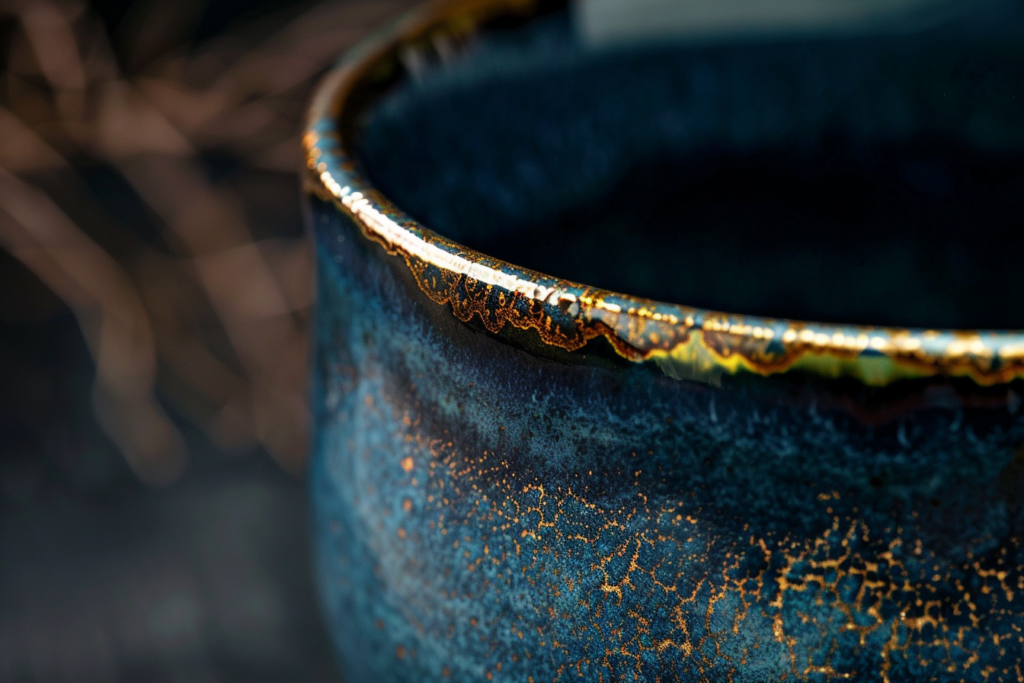
Midnight Blue Ceramic and Glazed Pottery
A midnight blue ceramic vessel — particularly one with a slight glaze variation (not perfectly uniform, but with the specific depth variation of a hand-thrown or hand-glazed pot) — reads as the night sky in material form, and as such is among the most appropriate vessel choices for any celestial centrepiece. The glaze variation across the surface of a well-made midnight blue ceramic vessel is the material equivalent of the depth variation of the actual sky: darker in some areas, lighter in others, never the same at two different moments of lighting. A midnight blue ceramic vessel with a gold-detailed rim or a gold glaze accent is the most complete single vessel available in the celestial aesthetic category, combining the palette’s primary colour and primary metallic in a single object.
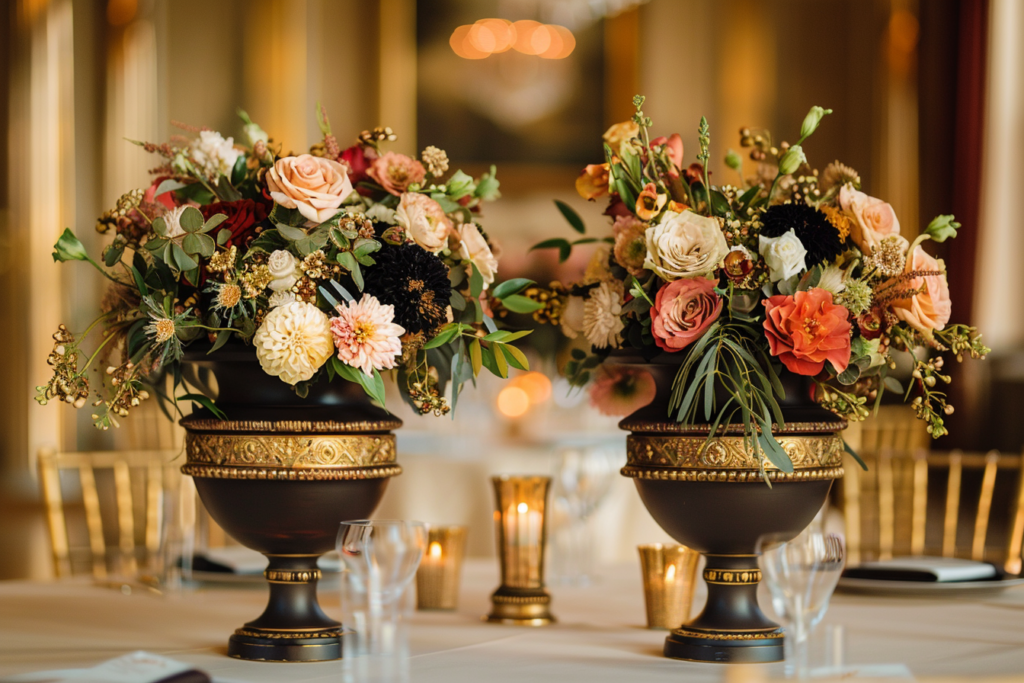
Gold-Detailed Urns and Statement Vessels
Gold-detailed urns — large urn-form vessels in dark material (ceramic, glass, or metal) with gold banding, gold leaf detail, or gold relief motifs — are the most formal and most architecturally significant of the celestial vessel options. They suit the most formal celestial wedding aesthetics and the largest reception tables. The gold detail should be warm antique gold rather than bright or cool metallic, and it should be applied as a deliberate design element (banding, leaf detail, or celestial motif relief) rather than as a scattered or generic gilt finish. A pair of gold-detailed dark urns with asymmetric floral arrangements produces a centrepiece with genuine formal authority at the longest and most prominent tables in the reception room.
Section 04 Flowers for Celestial Centrepieces
The flower palette for celestial centrepieces follows the same principle as the rest of the celestial decoration: depth first, light as accent, and the specific quality of something chosen for a reason rather than for generic abundance. The celestial florist’s vocabulary is specific rather than universal — there are flowers that belong to the night sky and flowers that do not, and the distinction is not always about colour.
Deep Blue Delphinium
Deep blue delphinium is the most specifically celestial of all wedding flowers — its colour (a genuine deep blue-violet in its best cultivars, rare in the floral world) maps directly onto the midnight blue base of the classic and dark celestial palettes, and its tall, architectural stem form works at the height needed for the mid and tall zones of the centrepiece composition. Delphinium at maximum depth of colour (the deepest blue-violet cultivars rather than the paler lavender-blue of the most common varieties) reads as a genuine piece of the night sky placed in a vase, which is the quality the celestial centrepiece is attempting to create.
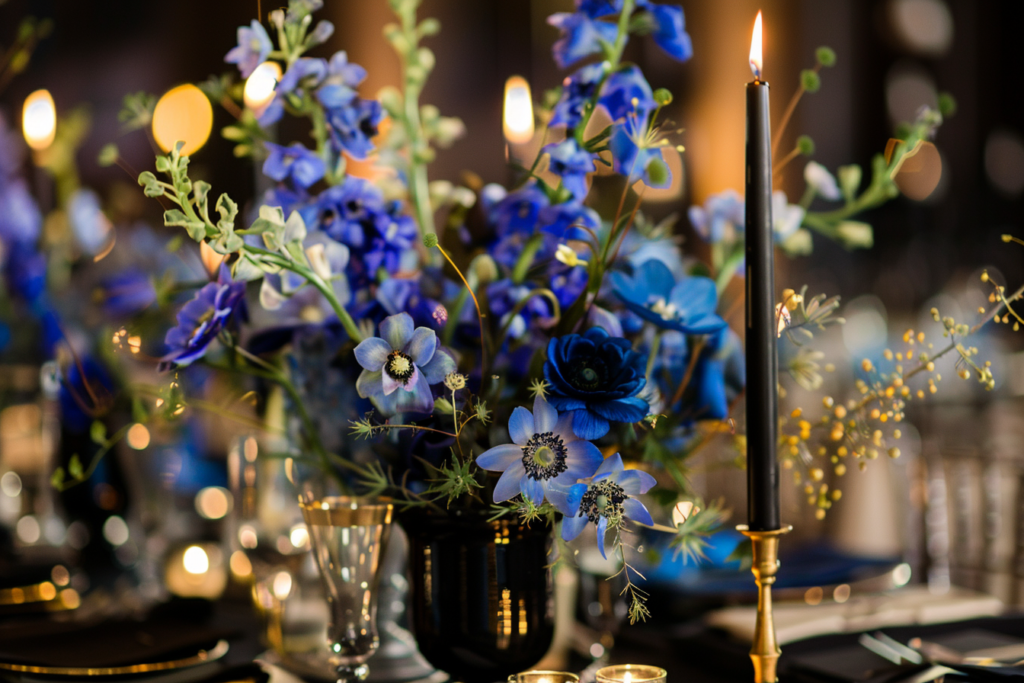
White Anemone and Dark-Centred Flowers
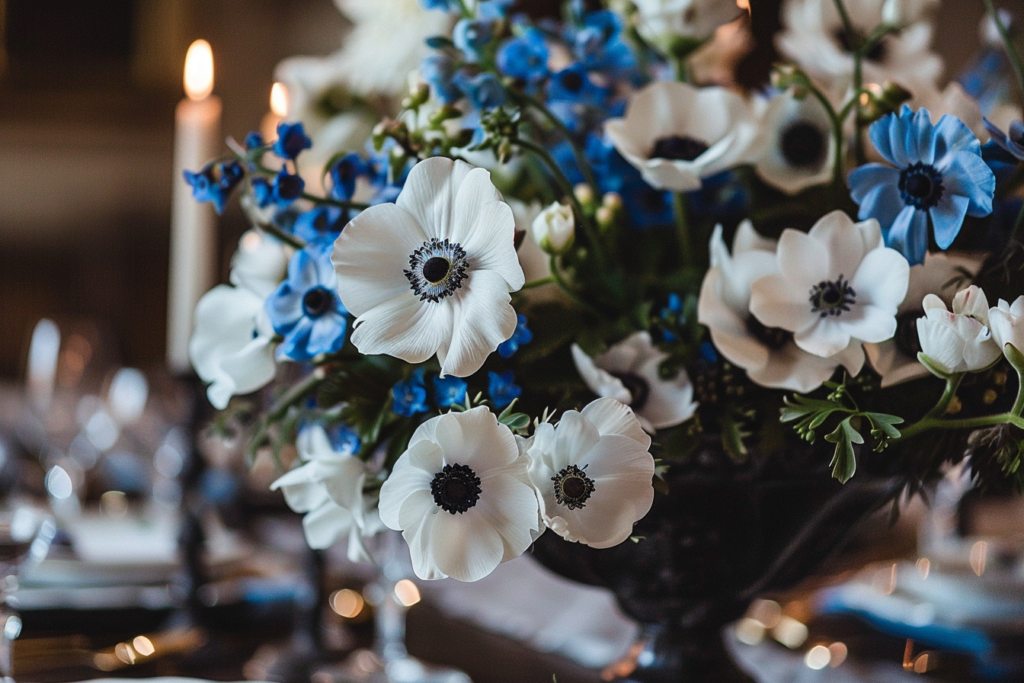
White anemone — a white flower with a dark, almost black centre — is the celestial flower that most directly reproduces the visual experience of looking at a star: the white petal mass reads as the star’s glow, and the dark centre reads as the darkness from which the star emerges. This specific quality makes white anemone the most visually accurate celestial flower available, and a centrepiece that uses deep delphinium (the sky) alongside white anemone (the stars) has reproduced the fundamental visual experience of the night sky in floral form. Dark-centred flowers more generally — black-eyed Susan, chocolate cosmos, dark-centred ranunculus — carry this quality of star-in-darkness and suit all celestial centrepiece styles.
Dark Dahlia and Near-Black Florals
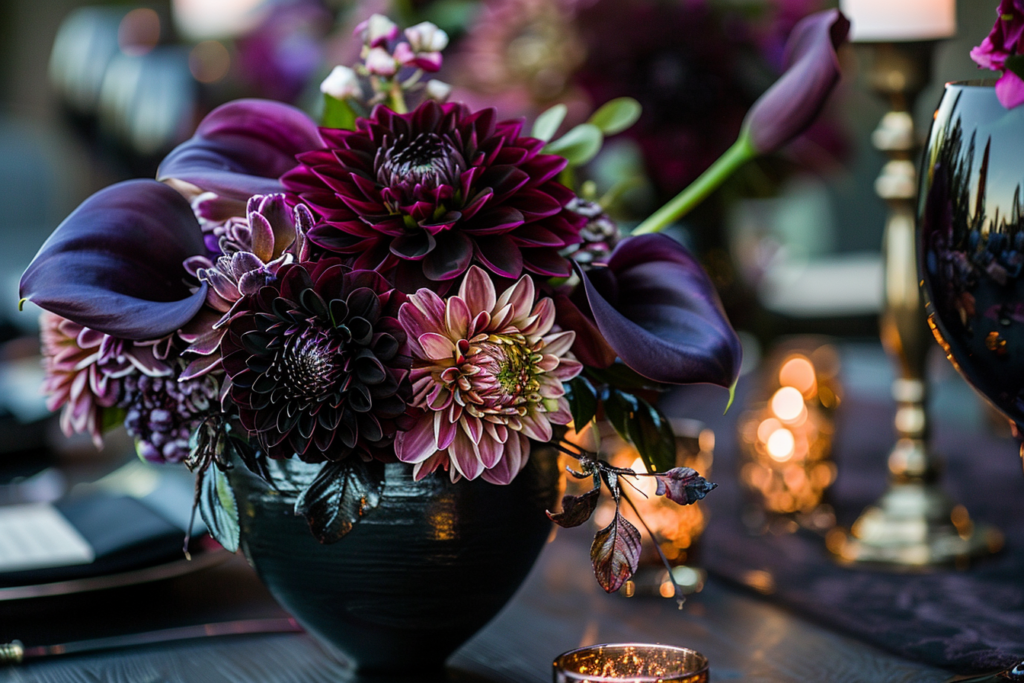
Deep burgundy, near-black, and dark chocolate dahlia — in the large ball, decorative, or café au lait varieties — are the celestial centrepiece flowers for the darkest zones of the arrangement. Their size and the density of their petal form give them visual weight at close range, and their dark colour provides the necessary deep background against which lighter elements read as luminous. Dark calla lily (in deep purple, near-black, or deep burgundy) is the most architecturally elegant of the dark floral options, and the most appropriate for the most formal celestial centrepiece styles.
White Cosmos and Celestially Named Botanicals
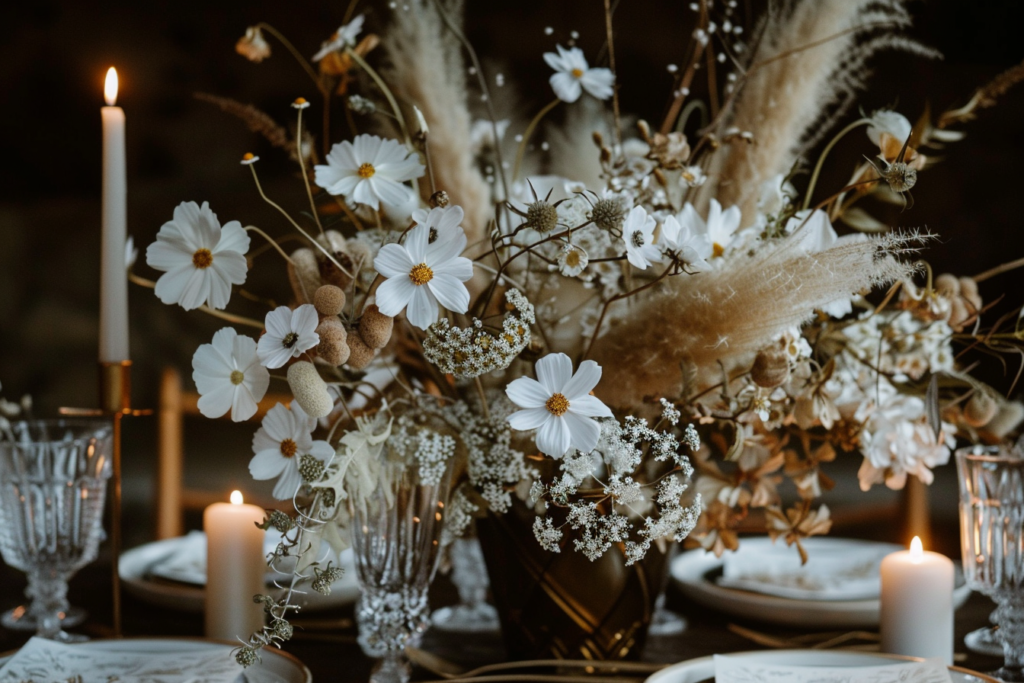
White cosmos is the flower most directly connected to the celestial aesthetic by name — cosmos is the Latin word for the ordered universe — and by form, its delicate single-petal structure suggesting a specific star form rather than the complex density of a rose or dahlia. Dried lunaria (honesty seed pods) are the dried botanical most directly lunar in reference: their common name, honesty, their scientific name, Lunaria annua, and their translucent silver disc form all connect them to the moon. Dried astrantia seed heads, dried grasses in warm gold tones, and dried pampas in small quantities complete the dried botanical vocabulary for celestial centrepieces across all six styles.
Section 05 The Complete Celestial Table Setting
The centrepiece is the focal point of the celestial table, but it does not work in isolation — it works in a designed relationship with every other element on the table surface. The linen, the place settings, the stationery elements (place card, menu card, table number), and the scatter details (votives, star scatter, botanical elements) are all part of the same composition, and the quality of the table as a whole is determined by how coherently all these elements belong to the same visual world.
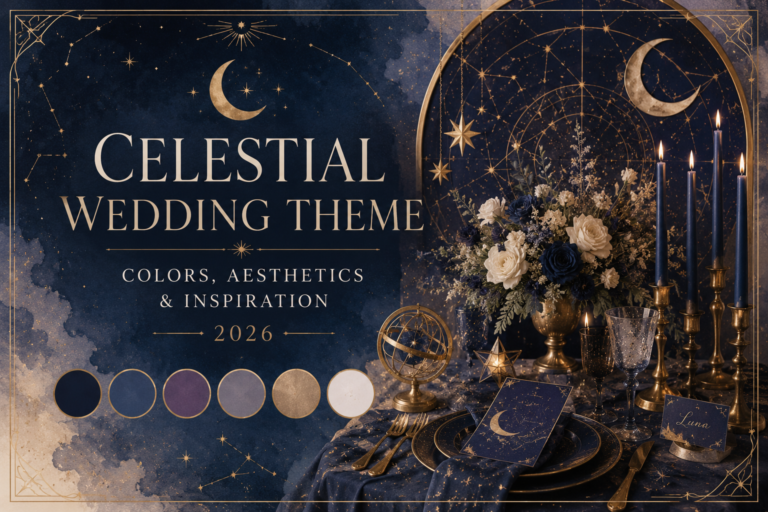
The dark linen rule for the celestial table: the tablecloth or table runner should be in the darkest tone available in the palette — midnight navy velvet, deep charcoal linen, or near-black cotton — and it should underlay every other element on the table surface. The contrast between the dark linen and the gold and white elements above it produces the fundamental celestial visual experience (dark sky, bright stars) at the horizontal scale of the table surface. A celestial centrepiece placed on a white tablecloth reads as a dark decoration against a light background — the opposite of the sky — and loses the atmospheric quality that the dark linen provides.
Star scatter on the tablecloth surface — small iridescent or gold star shapes, gold glitter in controlled quantities, or tiny dried flower heads in gold or cream — should be applied in the specific irregular clustering pattern of actual constellations rather than in a uniform scatter. The distinction between a scatter that has been placed from a star chart reference and one that has been sprinkled randomly is immediately visible at close range — the former reads as intentional and specific, the latter as generic decoration. The place card, the menu card, and the table number should all be in the same illustration register and palette as the centrepiece’s own colour vocabulary, so that the printed elements at the table read as continuous with the decorated centrepiece rather than as separately sourced decoration.
The celestial table plan — the seating chart that directs guests to their tables — is the first celestial decoration element guests interact with on arrival, and it should be designed in the same visual language as the centrepieces it points toward. A constellation seating chart (table names drawn from the celestial vocabulary: Orion, Lyra, Cassiopeia, Andromeda, each with its constellation diagram) that matches the constellation place cards on the tables creates a continuous visual world that guests navigate from arrival through the end of the meal. This is the specific quality of the most completely designed celestial wedding — every element, from the largest (the seating chart) to the smallest (the individual place card), belongs to the same designed world.
The Mystical Black Gold Celestial collection produces the most coherent dark celestial table stationery — place cards, menu cards, and table numbers in the same midnight-and-gold palette as the Galaxy Globe and Constellation Candelabra centrepieces. For the vintage table, the Cosmic Vintage Constellation suite matches the antique globe and star map vocabulary of the Vintage Star Map Centrepiece.
Section 06 Centrepieces & Stationery Together
The relationship between the centrepiece and the table stationery is the most visually productive design relationship at the reception table — because both elements exist at the same scale, both are experienced at close range by guests seated at the table, and both appear in every photograph taken at table level. When the place card’s illustration matches the centrepiece’s palette and motif vocabulary, when the menu card’s typography reads in the same aesthetic register as the centrepiece’s floral style, and when the table number’s design connects to the centrepiece’s constellation reference, the table as a whole reads as a single designed object rather than a collection of separately sourced elements.
The flat lay photography moment — the image composed of the place setting (invitation suite, menu card, place card, and florals) arranged on the table surface before or after guests are seated — is where this relationship becomes most visible and most photographically productive. A midnight navy place card with gold constellation piping beside a Galaxy Globe centrepiece; a parchment menu card with antique gold star map illustration beside a Vintage Star Map Centrepiece with an antique celestial globe; a warm ivory card with sun and moon motifs beside a Gold Sun and Moon Centrepiece arrangement: each of these pairings produces a flat lay photograph that communicates the specific designed world of the celestial wedding in a single image.
The stationery element that most powerfully completes the centrepiece at the table is the place card — because it is the most personal, the most individual, and the most specifically connected to the guest’s own experience of the table. A place card that carries the guest’s name alongside a hand-lettered or printed constellation (their star sign, or simply a beautiful constellation chosen for its visual quality) transforms the table’s celestial decoration from a general aesthetic into a personal one: each guest’s position at the table is their position in the celestial map of the celebration. When this place card is designed in the same illustration register and palette as the centrepiece’s own decoration, it completes the designed world of the table in a way no other stationery element can.
Browse all six collections below before making a stationery selection — each represents a distinct palette temperature and illustration register within the celestial aesthetic, and the right collection is the one whose visual quality most closely matches the specific centrepiece style the couple has chosen. A Galaxy Globe centrepiece paired with a classic midnight-and-gold stationery suite will read as more complete and more specifically designed than the same centrepiece paired with a warm vintage stationery suite in the wrong temperature. The stationery choice is the final quality decision in the celestial table — and it is one of the most visible.
Classic Celestial
Celestial Starry Nights
Midnight blue and gold stars — for Moon Phase Floral and Constellation Candelabra tables.
Dark & Dramatic
Celestial Dark
Near-black and antique gold — the stationery for Galaxy Globe and dark celestial tables.
Warm Luminous
Celestial Gold
Sun and moon warmth — for Gold Sun & Moon Centrepiece tables and garden settings.
Signature Suite
Mystical Black Gold Celestial
The most atmospheric dark suite — for Galaxy Globe and Constellation Candelabra flat lay photography.
Antique & Vintage
Cosmic Vintage Constellation
Warm sepia and antique gold — for Vintage Star Map Centrepiece and dark academia tables.
Art Nouveau
Celestial Art Nouveau Blue Gold
Botanical-celestial line-work — for Botanical Celestial Centrepiece and garden tables.

Explore the Full Celestial Wedding Series
Every planning category for the complete celestial wedding — use these guides alongside this centrepiece resource.
Complete Guide
Celestial Wedding — Complete Celebration Guide 2026
Venue, ceremony, full reception styling, and stationery showcase.
Color Guide
Celestial Wedding Theme — Colors & Aesthetics 2026
Eight celestial palettes with swatches and venue guidance.
Dress Guide
Celestial Wedding Dress — Starry Night Bridal Guide 2026
Six celestial dress styles, fabrics, and accessories.
Vintage Guide
Vintage Celestial Wedding — Mystical Retro Guide 2026
Four vintage aesthetics: Renaissance, Victorian, Art Nouveau, Dark Academia.
Decor Guide
Celestial Wedding Decor — Complete Styling Guide 2026
Full decoration guide: ceremony, reception, DIY, lighting, and signage.
Coming Soon
Celestial Wedding Flowers Guide
Which florals suit each of the eight celestial aesthetics.
Frequently Asked Questions
What makes a good celestial wedding centrepiece?
The most effective celestial centrepiece creates depth and dimension at the table by using three height levels (low votives, mid floral or botanical arrangement, tall candles or architectural elements), a vessel in a dark or celestial material (dark glass, mercury glass, antique brass, midnight blue ceramic), and a palette that follows the fundamental celestial principle: dark as the base, gold and white as the points of light within the dark. The specific quality that elevates a celestial centrepiece from a decorated table element to a genuinely beautiful object is the reward-on-examination detail — the iridescent substrate visible through the glass globe vessel, the gold wire constellation form embedded in the botanical arrangement, the silver lunaria pods whose translucency reads as lunar at close range. The most important single quality decision in any celestial centrepiece is the vessel: its material, its depth of colour, and its relationship to the floral or botanical material that emerges from it.
What flowers work for a celestial wedding centrepiece?
The flowers most specifically suited to the celestial centrepiece aesthetic are: deep blue delphinium (the most genuinely celestial colour available in the floral world, mapping directly to the midnight blue of the classic celestial palette); white anemone with dark centres (whose visual quality — white glow against dark centre — directly references the experience of looking at a star); dark dahlia in near-black, deep burgundy, or chocolate tones (for the darkest zones of the arrangement); white cosmos (celestial by name and star-like in form); and dried silver lunaria (lunar by name and translucent silver by appearance). The key compositional principle: the darkest flowers at the base and mid zone of the arrangement, the lightest (white or cream) at the tips and upper edges, so that the arrangement itself describes the movement from darkness to light — from earth to sky.
How do I choose the right vessel for a celestial centrepiece?
The vessel should carry the celestial palette in its own material before any floral or botanical element is added to it. Dark glass or mercury glass suits the Galaxy Globe and classic celestial styles; antique brass or blackened metal suits the vintage and dark academia celestial styles; midnight blue ceramic suits the most atmospheric dark celestial aesthetics; gold-detailed urns suit the most formal and the most luminous (Gold Sun and Moon) styles. The most consequential single vessel decision is the depth of colour: a vessel that is deep enough in tone to provide the dark background against which the gold and white elements read as luminous is a celestial vessel; a vessel that is too pale or too transparent to create this contrast is simply a vase with celestial flowers in it, which is a significantly different (and significantly less effective) thing.
What is a celestial wedding table plan?
A celestial wedding table plan — also called a constellation seating chart or star map table plan — organises the seating information for the reception using the framework of a celestial map, with each table named for a constellation and the seating chart displaying the actual constellation diagram alongside the table name and guest list. The most effective format is a large-format printed or hand-lettered display on dark midnight board with constellation diagrams in warm gold and guest names in cream, designed in the same illustration register as the invitation suite and the table stationery. The celestial table plan is both a functional document (it directs guests to their seats) and a decoration element (it is the first celestial object guests encounter on arrival, and it sets the visual register of the entire reception space before they enter it). The table plan should be designed as part of the complete stationery suite rather than as a separate decoration sourced independently — the most coherent and most beautiful celestial weddings treat every printed element, from the invitation to the table plan to the place card, as part of the same designed world.
Complete the Celestial Table
Find the Stationery That Completes the World Your Centrepiece Begins
The place card beside the centrepiece, the menu card on the dark linen, the table number in the constellation vocabulary — choose the collection that matches the centrepiece’s palette and let the printed layer complete the celestial table.