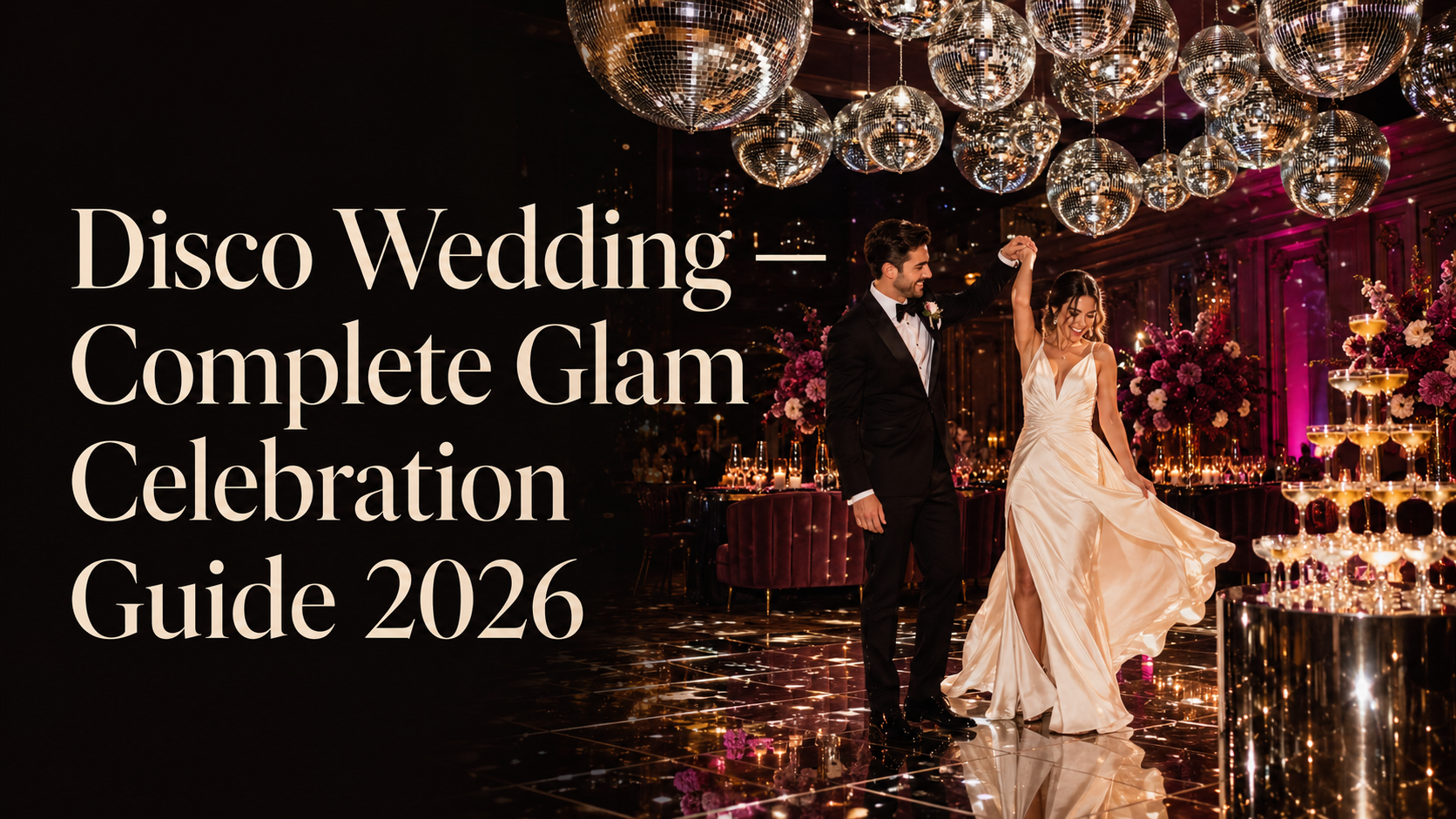
Disco Wedding — Complete Glam Celebration Guide 2026
Wedding Guide · Disco Glam · 2026
Disco Wedding — Complete Glam Celebration Guide 2026
Four disco aesthetics, the full glam palette, ceremony and reception guidance, and everything from mirror ball to sequin table runner — the most glamorously fun wedding available in 2026.
There is a specific quality of glamour that belongs only to disco — not the cool geometric glamour of the 60s, not the earthy warmth of the broader 70s, but something louder, more joyful, more deliberately spectacular. The mirror ball spinning above a dance floor, scattering light across every surface in the room. Gold and sequin and the specific energy of a room full of people who are there to celebrate something and do not intend to leave until they have celebrated it completely. The disco wedding is the most fun wedding aesthetic available — and when it is executed with intention rather than with irony, it is also genuinely glamorous.
The disco wedding aesthetic has returned to contemporary wedding culture in 2026 not as nostalgia but as a statement of values: a celebration that prioritises joy over formality, movement over stillness, abundance over restraint. The couples choosing disco in 2026 are couples who want their wedding to feel like the best night of their lives rather than the most tasteful photograph of it. The mirror ball does not need to be ironic. The gold lamé does not need to be in quotation marks. The dance floor does not need to be earned after dinner; it can be the thing the whole celebration is organised around.
“Disco gave the 1970s its glitter and its nerve — the conviction that a night of dancing and celebration was not a frivolity but an art form. A disco wedding takes that conviction seriously. The dance floor is the venue. The mirror ball is the décor. The music is the ceremony.”
Section 01 What Is a Disco Wedding?
A disco wedding is not a 70s costume party with a strobe light and a DJ in a sequin waistcoat. The distinction is the same one that separates any authentically executed retro aesthetic from a themed party: the difference between drawing from a decade’s design philosophy and raiding its props cupboard. A disco wedding draws from the specific glamour philosophy of the late 1970s — the belief that a celebration should be spectacular, that abundance is a form of generosity, and that the dance floor is the most important room in the building.
The visual vocabulary of the disco wedding is built from the specific material culture of the era’s most glamorous spaces. Gold: warm, deep, and abundant rather than bright or garish — the gold of candlelight reflected in antique mirrors, of warm amber spotlights on a burnished dance floor. Silver: chrome and mirror surfaces that multiply light and produce the specific quality of a room that appears to be lit from everywhere simultaneously. Sequins: the surface material that most efficiently captures and redistributes light, applied to table runners, to stationery elements, to the decorative objects that catch the light and throw it back into the room. And the mirror ball: the single most powerful and most specifically disco decorative object available, which takes a single light source and turns it into a hundred moving points of light across every surface in the room.
What distinguishes disco glamour from other retro aesthetics is that it is unambiguously about pleasure rather than philosophy. The 70s boho wedding is about connecting with the natural world; the 60s mod wedding is about visual confidence and design precision. The disco wedding is about having the most spectacular, most joyful, most fully experienced night of celebration available — and it makes no apology for that priority. The glamour is not decorative; it is the point.
The disco wedding differs from general retro and vintage in one crucial quality: it reads as glamorous rather than nostalgic. Vintage reads soft and slightly faded; disco reads vivid and fully illuminated. Where most retro aesthetics look backward with affection, disco looks backward with unapologetic envy — because what it is looking back at is an era that knew exactly how to fill a room with light and people and music and make it feel like the most alive place on earth.
Section 02 Four Disco Wedding Aesthetics
The disco wedding encompasses four distinct aesthetic directions, each applying the era’s glamour philosophy to a different palette and emotional register. All four share the commitment to light, abundance, and joyful excess; the specific colour temperature and visual character differ.
2.1 Studio 54 Glamour — Gold, Black & Sequins
The Studio 54 Glamour direction is the most sophisticated and most immediately recognisable disco wedding aesthetic — the direction that most closely captures the specific quality of the era’s most legendary celebration space. Deep black and warm gold in a high-contrast, deliberately luxurious combination: black as the negative space that makes gold appear to glow, gold as the material of every object that catches and holds the light. Sequins appear on every surface that benefits from light multiplication: the table runners, the backdrop panels, the invitation’s envelope lining. The palette’s single accent colour is a warm, deep pink or amber rather than a bright primary, which keeps the direction in the glamorous register rather than crossing into the kitschier territory of the broader disco spectrum.
The Studio 54 Glamour wedding reads as grown-up disco — the direction for couples who want maximum glamour without maximum visual chaos. The dance floor is still central, the mirror ball is still present, and the celebration is still organised around the principle of spectacular fun; but the visual register is warm and considered rather than saturated and exuberant. A candlelit dinner in a darkened room with gold-sequin table runners, warm amber lighting, and a mirror ball overhead is disco at its most genuinely glamorous — the direction that most guest lists will find both beautiful and exciting.
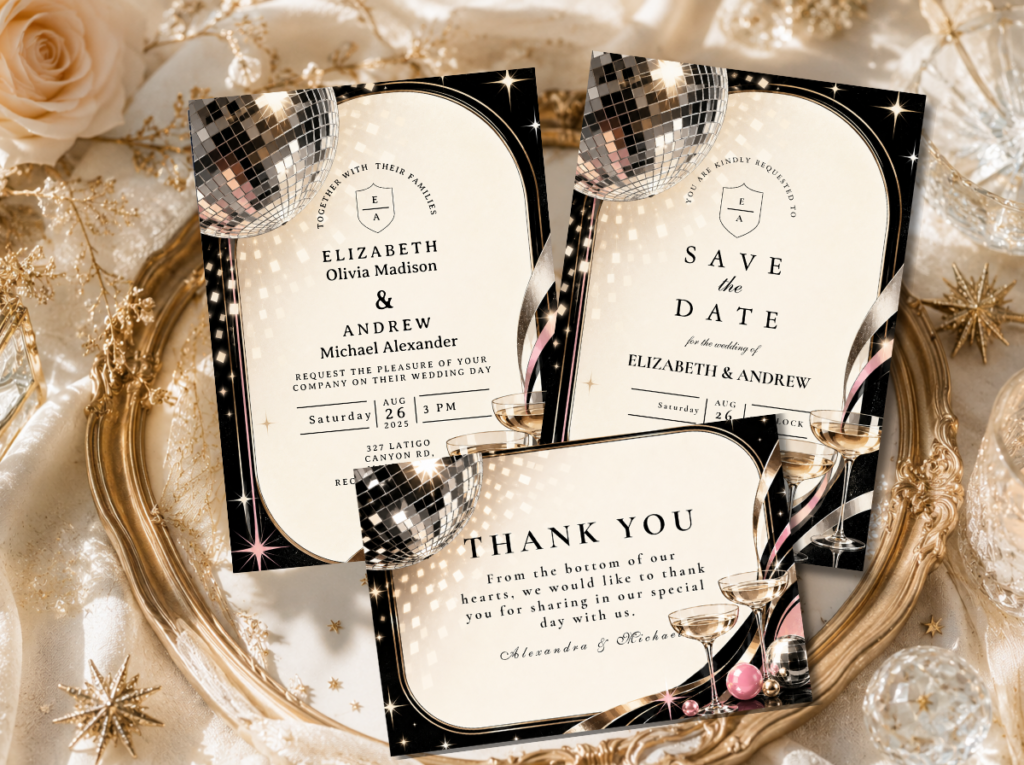
The Disco Wedding stationery category — gold, sequin-inspired, and glamorous invitation suites for the Studio 54 direction.
2.2 Mirror Ball Maximalist — Silver, Chrome & Sparkle
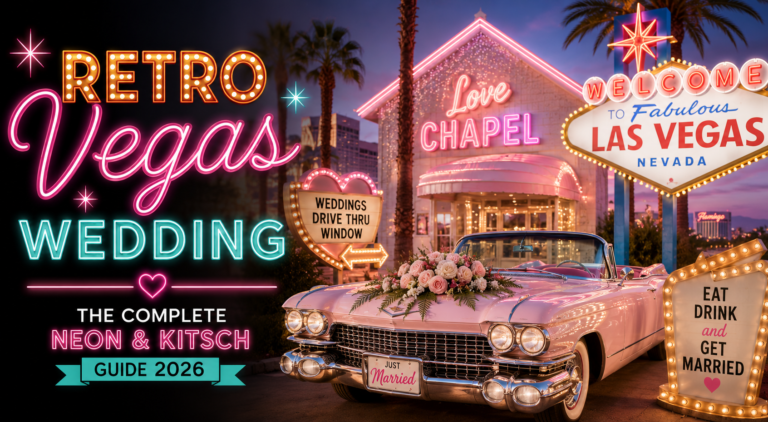
The Mirror Ball Maximalist direction takes the disco aesthetic to its most light-saturated and most visually spectacular extreme: silver, chrome, and reflective surfaces in a palette that is almost entirely about the multiplication and redistribution of light rather than about colour per se. The mirror ball is not an accent element in this direction; it is the room’s primary decorative object, and every other surface decision is made to maximise the effect of the light it throws. Silver sequin table runners, chrome-finished vessels, clear crystal glassware that catches and refracts light at every place setting, and the specific quality of a room where every surface is slightly reflective and the light therefore seems to come from everywhere simultaneously.
The Mirror Ball Maximalist direction is the most technically demanding of the four to execute well, because the success of a primarily reflective palette depends entirely on the quality and warmth of the light source. In warm candlelight and amber spot lighting, a silver and chrome room reads as spectacular. In cold overhead fluorescent lighting, the same room reads as clinical. The lighting design for the Mirror Ball Maximalist direction should be considered as carefully as any decorative element — and warm, directional light sources at varying heights produce a more glamorous result than any amount of additional silver decoration.
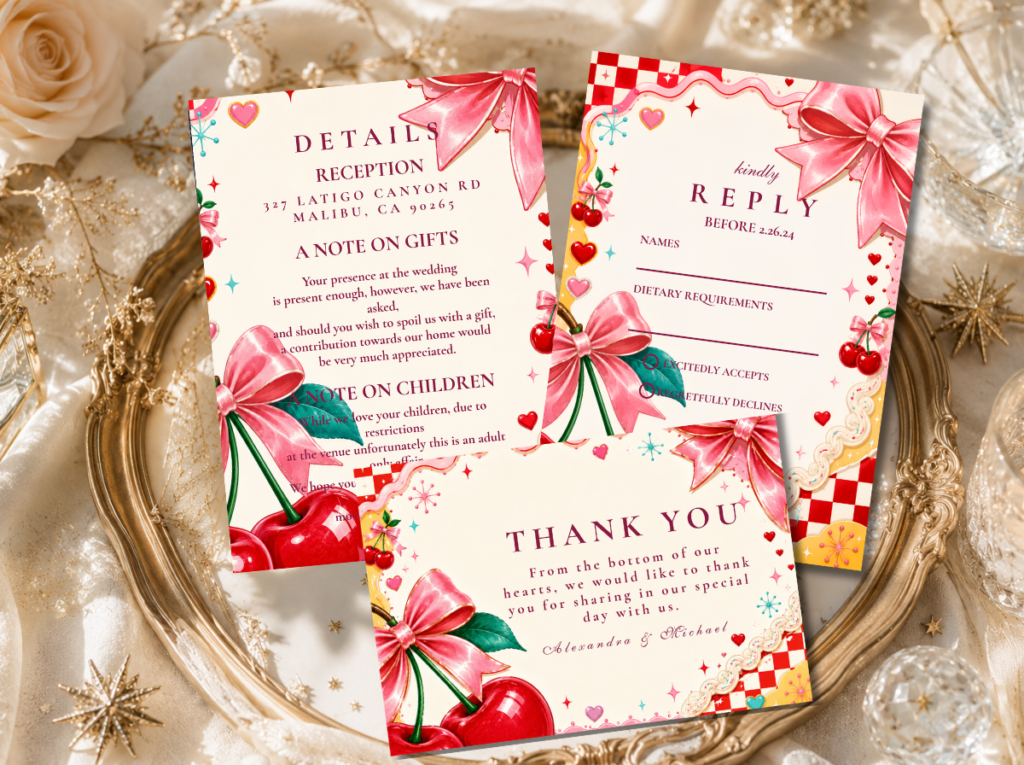
The Kitschy Wedding category — maximalist, unapologetically abundant stationery for the Mirror Ball direction.
2.3 Disco Pink — Hot Pink, Gold & Feminine Glam
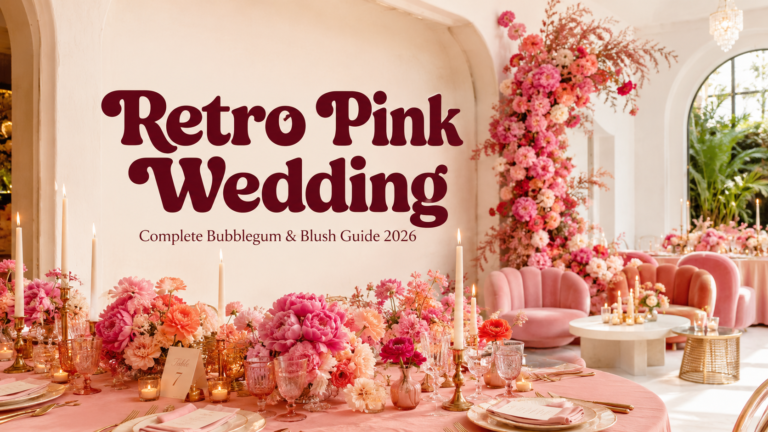
The Disco Pink direction is the most joyful and most femininely glamorous of the four disco aesthetics — the direction that places hot pink alongside warm gold in the most energetically celebratory combination the disco palette offers. Hot pink in the disco context is not the pastel blush of conventional feminine wedding aesthetics; it is full-saturation, fully committed, unapologetically vivid pink that reads as glamorous rather than sweet because it is placed alongside gold rather than alongside white. The gold warms the pink and prevents it from reading as girlish; the pink electrifies the gold and prevents it from reading as conservative.
The Disco Pink wedding is the direction most suited to evening celebrations with a large, energetic guest list: a pink-and-gold balloon installation overhead, hot pink blooms in gold vessels on the reception tables, a pink sequin dance floor border that glows under the mirror ball’s scattered light. The stationery arrives as a statement piece — hot pink and gold, with the decade’s retro typography, on a card that the guest wants to keep before they have even read the contents. The party starts the moment the invitation arrives.
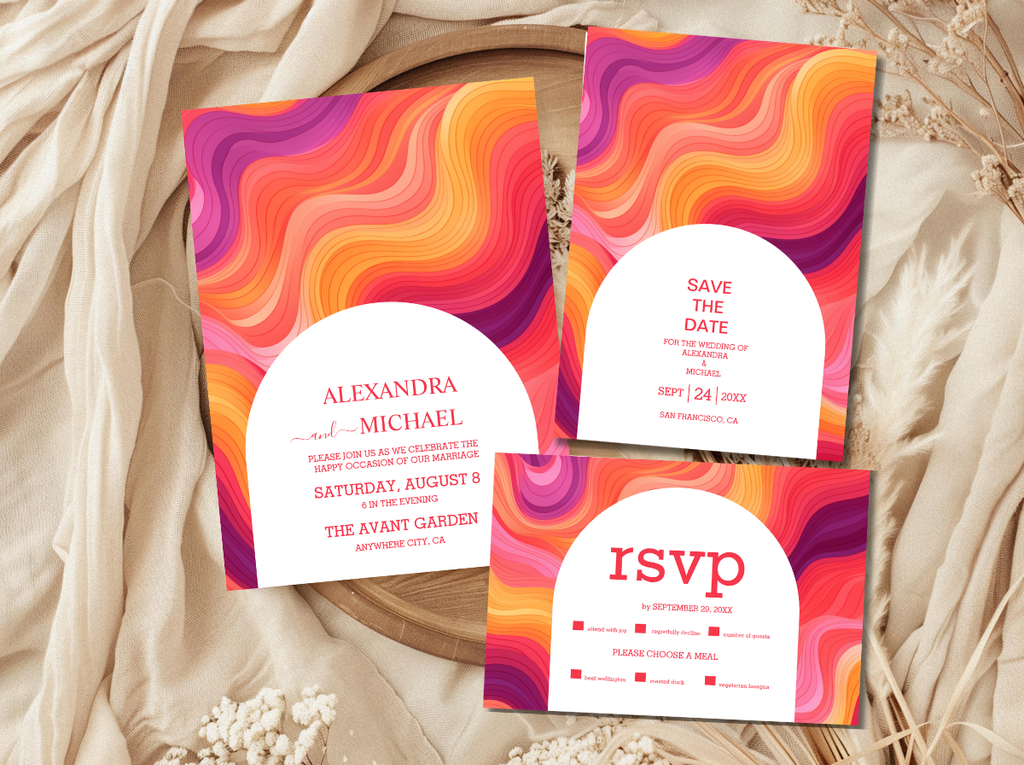
The Groovy Retro Pink and Orange Arch collection — hot pink and warm gold in the most joyfully glamorous disco direction.
2.4 Groovy Disco Typography — Bold Fonts & Retro Energy
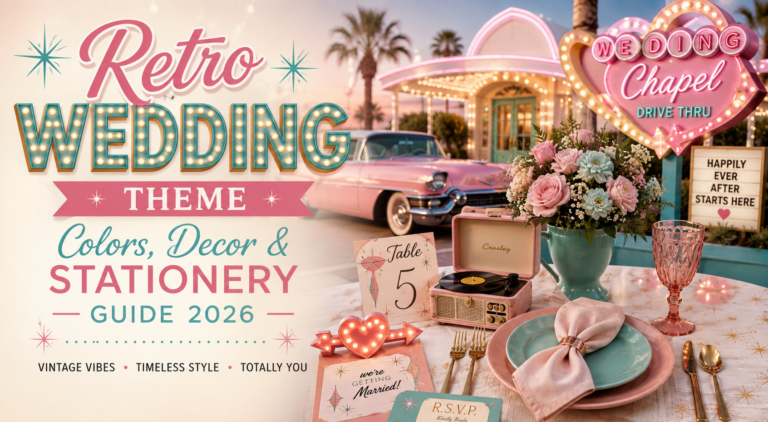
The Groovy Disco Typography direction is the most design-forward of the four disco aesthetics — the direction that leads with the era’s specific typographic character rather than with its material palette. The disco era produced a specific graphic design vocabulary: rounded, inflated letterforms in bold warm colours that read as simultaneously retro and joyful, applied to club flyers and album covers and the printed ephemera of the era’s entertainment culture. Applied to a wedding invitation, this typographic language produces a stationery piece that reads as a graphic artefact before it reads as a wedding announcement.
The Groovy Disco Typography wedding is the direction for the couple who wants the era’s energy more than its material palette — who wants the feeling of a disco invitation rather than a room full of sequins. The typographic direction can be applied across a broader range of colour palettes than the other three disco aesthetics, from the gold and black Studio 54 palette to the hot pink and orange of the Disco Pink direction to a warm cream and amber scheme that reads as more restrained while retaining the era’s graphic character.
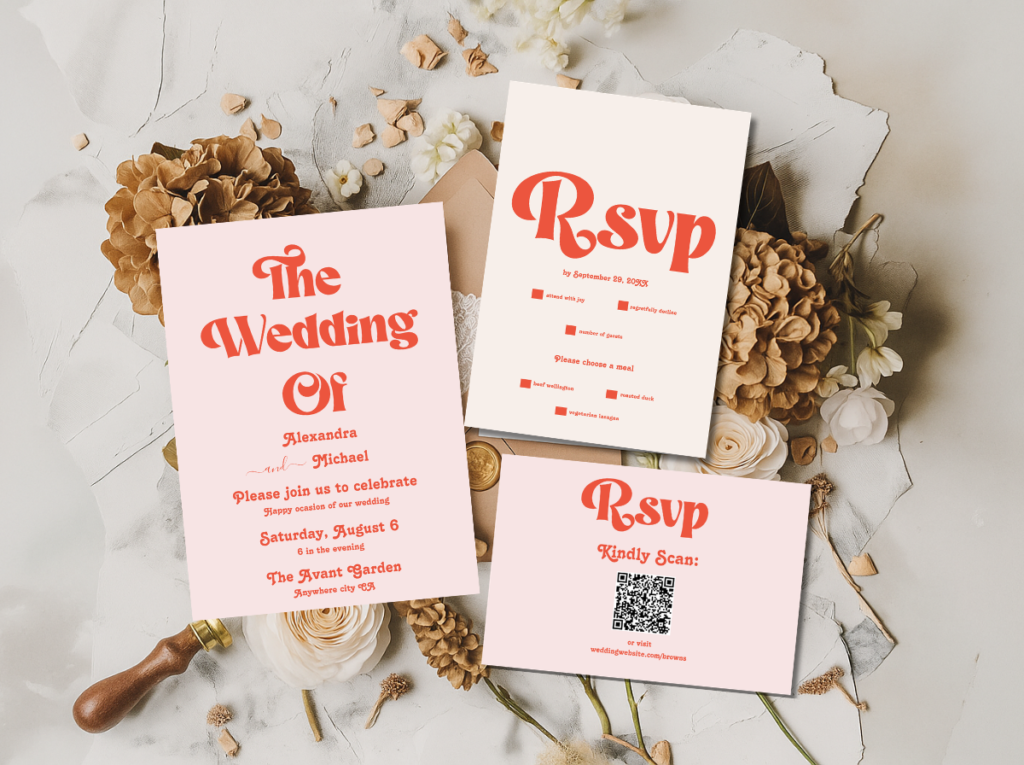
The Modern Retro Pink and Orange Typography collection — bold retro typographic stationery in the groovy disco energy direction.
Section 03 Disco Wedding Colour Palettes
Four palette systems for four disco directions. All four share the fundamental disco quality: every colour should read as luminous rather than flat, warm rather than cool, and abundant rather than restrained.
3.1 Studio 54 Glamour Palette
Deep black and warm antique gold, with a single accent of deep warm pink — the most sophisticated and most specifically glamorous disco palette. Black as the space that makes gold glow; gold as the warm light that fills that space. Every tone warm rather than cool.
3.2 Mirror Ball Maximalist Palette
Silver, chrome, and reflective white on deep navy — the most light-saturated disco palette. The success of this direction depends entirely on warm light sources; without warm directional lighting, silver and chrome read as cold rather than glamorous.
3.3 Disco Pink Palette
Hot pink and warm gold, with sunshine yellow as the tertiary accent and warm cream as the base — the most joyful and most energetically celebratory disco palette. All tones at full warmth and full saturation rather than muted or pastel.
3.4 Groovy Typography Palette
Warm orange-red, hot pink, antique gold, and warm cream — the most graphic and most typographically led disco palette. Applied in bold, flat planes of colour against the warm cream ground, in the rounded inflated letterforms of the era’s graphic design output.
Section 04 Disco Wedding Venue & Ceremony
The disco wedding’s venue relationship is the most specific of any retro aesthetic: disco requires a space that can be dramatically lit, that has enough ceiling height for a mirror ball to distribute its light effectively across the room, and that can be transformed from a ceremony setting into a fully operational dance floor reception without the transformation reading as an afterthought. The venue is not just a backdrop; it is the mechanism by which the whole celebration works.
The right space. A dark, dramatically lit interior — a ballroom, a warehouse space, a loft with high ceilings and the ability to control light levels fully — is the most natural home for the disco wedding aesthetic. The disco direction struggles in outdoor settings and in rooms with large windows that let in natural light, because disco’s visual glamour depends on controlled artificial lighting: the warm amber spotlights, the mirror ball’s scattered points, and the specific quality of a room where the light sources are deliberate rather than ambient. If a natural or semi-outdoor setting is required, the ceremony can take place in a brighter outdoor space and the reception can move entirely indoors into a transformed, dramatically lit room.
The ceremony aesthetic. The disco wedding ceremony is more restrained than the reception — not because restraint is a disco value, but because the ceremony is the build before the release, and the specific pleasure of a disco reception is intensified by the contrast with a ceremony that is beautiful and warm but not yet spectacular. A ceremony in warm candlelight and gold floral arrangements, with stationery that already signals the direction in its typographic energy, sets the aesthetic expectation without fully delivering on it. The reception delivers on it completely.
Mirror ball installation. The mirror ball should be hung before guests arrive and should be operational — slowly rotating, lit by at least one dedicated spotlight — from the moment guests enter the reception room. The specific quality of a room in which a mirror ball is already moving when you walk in is entirely different from the quality of a room in which a mirror ball is switched on at the reception’s official beginning: the former feels like entering a space that is already alive; the latter feels like a theatrical effect added to an otherwise conventional room. Hang the mirror ball and turn it on. Do it first.
The ceremony arch. The disco ceremony arch is not a macramé structure or a geometric frame; it is a spectacular object in its own right. A circular arch covered in gold metallic foil or warm gold floral elements, a framed panel of gold balloon clusters at the ceremony backdrop, or a simple structure hung with warm-toned floral garlands and lit from within by warm amber LEDs: the arch should read as the first glamorous moment of the celebration, the first visual signal that this ceremony is not going to end with dinner and speeches.
The Disco Wedding stationery category — gold, glamorous, and specifically spectacular from the invitation outward.
Section 05 Disco Reception & Dance Floor
The disco reception is organised around a single non-negotiable premise: the dance floor is not an afterthought at the end of a seated dinner. It is the room’s primary space, and every other element of the reception — the dinner, the speeches, the stationery, the floral arrangements — exists in service of the moment when the music starts and the dancing does not stop until the evening ends.
The mirror ball centrepiece. In the reception room, the mirror ball functions as the primary decorative element at ceiling level — which means that the table centrepieces below it should be designed in relationship to the light it throws rather than as independent floral compositions. Low centrepieces — gold vessels of warm-toned blooms at a height that does not interrupt the mirror ball’s light distribution — work better in a disco reception than tall statement arrangements, which block the light and create shadows rather than allowing the room’s surface to be uniformly illuminated by the ball’s scattered points. A small disco ball at each table as a supplementary decorative object provides the mirror ball’s visual vocabulary at the per-table scale.
Sequin table linens. Gold or silver sequin table runners — or full sequin tablecloths for a more maximalist direction — are the single most glamorous and most specifically disco table surface element available. They catch and redistribute the warm candlelight and the mirror ball’s scattered points in a way that no other textile can replicate, and they provide the specific ‘this room is alive’ quality that makes a disco reception feel different from any other glamorously styled event. The sequin runner should run the full length of the table rather than the centrepiece section only; the longer the run, the more effective the light multiplication.
The reception from the start. The disco reception’s most significant structural decision is one that happens before any decoration is purchased: the decision that the dance floor is available and the music is playing from the moment guests arrive at the reception. A conventional wedding reception organises itself as dinner first, dancing after; a disco wedding organises itself as dancing always, with dinner in the middle. This means that the room must be set up as a dance space — enough floor cleared, music playing at a level that invites movement, warm lighting already engaged — before the first guest arrives. The formal seated dinner can happen; the speeches can happen; but neither is the main event. The dance floor is.
Gold and warm floral elements. The disco reception’s floral vocabulary is warm-toned, abundantly arranged, and chosen for its visual presence in low light rather than for its botanical delicacy. Chrysanthemums in deep gold, warm amber dahlias, orange roses, and deep red carnations — all in full-bloom arrangements in gold or metallic vessels at the table level — read as glamorous and abundant in candlelight and mirror ball illumination in a way that more conventionally bridal pale blooms do not. The flowers should read as part of the room’s warmth rather than as individual floral compositions; their job is to be beautiful in the light rather than to be beautiful in close inspection.
Section 06 Disco Wedding Stationery
The disco wedding invitation is the guest’s first experience of the celebration’s glamour — and it should deliver on that glamour from the moment it arrives. A disco invitation that is doing its job makes the guest want to attend the celebration before they have finished reading the card. It communicates not just the date and location but the specific quality of the experience that awaits: spectacular, joyful, worth putting on your finest for.
The typographic language of the disco invitation is the era’s most immediately recognisable design signature. The rounded, inflated letterforms of the late 1970s — soft-edged and boldly weighted, in warm colours that read as simultaneously retro and energetic — communicate the disco aesthetic before the guest has processed the words they spell. Applied to a warm cream or black card ground, with gold foil detail or a sequin-effect printed element, the typographic language of the disco invitation produces a stationery piece that reads as both historically specific and completely contemporary.
The envelope is as important as the card it contains. A disco invitation arrives in a gold or black envelope with a sequin-effect or foil-lined interior — the first moment of glamour, before the card is even removed. The contrast between the plain exterior of a letter in a standard post box and the gold interior of a disco invitation envelope is itself a small theatrical moment that communicates the same philosophy as the mirror ball: the room is more spectacular on the inside than you expected from the outside.
The full stationery suite extends the invitation’s typographic and palette language through the ceremony programme — which can be a single bold card in the invitation’s colour system rather than a multi-page booklet — the place card, the menu, and the dance floor song-request card, which is the disco reception’s most specifically appropriate stationery element. A song-request card at each place setting — ‘what do you need to hear tonight?’ — in the invitation’s typographic style serves both as a practical tool for the DJ and as a piece of the evening’s participatory design: guests arrive already thinking about the dance floor. The five collections and categories below cover the full range of disco wedding stationery direction.
Primary Direction
Disco Wedding
Gold, glamorous, and specifically spectacular stationery for the disco wedding — the primary starting point for any disco direction.
Retro Energy
Retro Wedding
The full retro wedding stationery category — warm, vintage-adjacent, and specifically of its era across every retro direction.
Maximalist Direction
Kitschy Wedding
Unapologetically abundant stationery for the Mirror Ball Maximalist and most exuberant disco directions.
Pink & Gold Glamour
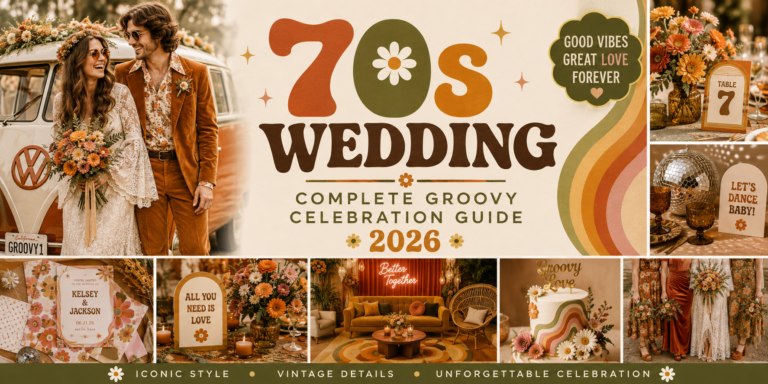
Groovy Retro Pink and Orange Arch
Hot pink and warm gold in the Disco Pink direction — the most joyfully feminine and most energetically celebratory disco stationery.
Typographic Direction
Modern Retro Pink and Orange Typography
Bold retro typographic stationery in the groovy disco energy direction — the invitation as graphic artefact.
Browse the full disco wedding stationery range — five collections and categories from Studio 54 Glamour to Mirror Ball Maximalist to Disco Pink.
Frequently Asked Questions
What is a disco wedding theme?
A disco wedding theme is a celebration aesthetic drawn from the glamour philosophy of the late 1970s disco era: gold, sequins, mirror balls, bold retro typography, and a dance floor that is the reception’s primary space rather than its afterthought. It is distinguished from general 70s or retro aesthetics by its specific glamour vocabulary — it is glam rather than earthy, spectacular rather than natural, and organised explicitly around the pleasure of dancing and celebration. The four main disco wedding directions — Studio 54 Glamour, Mirror Ball Maximalist, Disco Pink, and Groovy Disco Typography — each apply this glamour philosophy to a different palette and emotional register, from the warm sophisticated gold-and-black of Studio 54 to the joyfully saturated pink-and-gold of the Disco Pink direction.
What colors are used in a disco wedding?
The disco wedding uses four primary palette systems. The Studio 54 Glamour palette uses deep black, warm antique gold, and a single accent of warm deep pink — the most sophisticated and most genuinely glamorous combination. The Mirror Ball Maximalist palette uses silver, chrome, and reflective white on deep navy — the most light-saturated direction, entirely dependent on warm lighting to read as glamorous rather than clinical. The Disco Pink palette uses hot pink and warm gold with sunshine yellow as a tertiary accent — the most joyful and most energetically celebratory combination. The Groovy Typography palette uses warm orange-red, hot pink, and antique gold in flat planes of colour against a warm cream ground. All four palettes share the quality of warmth: every colour should read as luminous and warm rather than cool or flat.
How do I organise a disco wedding reception?
The most important structural decision in a disco wedding reception is to make the dance floor available from the moment guests arrive rather than as an activity that begins after dinner and speeches. The room should be set up as a dance space — enough floor cleared, music playing, warm lighting and mirror ball engaged — before the first guest enters. Dinner happens in the middle of the evening rather than at the beginning; the dance floor is the frame that everything else fits inside. Song-request cards at each place setting invite guests to contribute to the evening’s musical direction and communicate, from the moment they are seated, that the dance floor is the main event. The sequin table runners, the gold centrepieces, and the mirror ball overhead are all in service of this central premise: this room was designed for dancing.
How do I make a disco wedding feel glamorous rather than tacky?
The distinction between glamorous disco and tacky disco lies in two decisions: the warmth of the palette and the quality of the light. Gold that reads as warm and antique rather than bright and synthetic, combined with warm amber candlelight and directional spotlighting rather than harsh overhead illumination, produces a disco aesthetic that reads as genuinely luxurious. The same sequins and mirror balls under cold fluorescent light read as cheap theatrical props. The second decision is restraint within abundance — not restraint in the sense of using fewer elements, but restraint in the sense of ensuring that every element belongs to the same warm, considered colour system. A gold sequin runner on a black-linen table with warm gold floral arrangements reads as glamorous; the same sequin runner on a hot pink tablecloth with silver chrome vessels and cold-white lighting reads as a confused assortment of disco references rather than a coherent aesthetic.
Gold · Mirror Ball · Sequin · Dance Floor First
Shop Disco Wedding Stationery
Gold, sequin-inspired, and spectacularly fun — invitations and full stationery suites for every disco wedding direction.