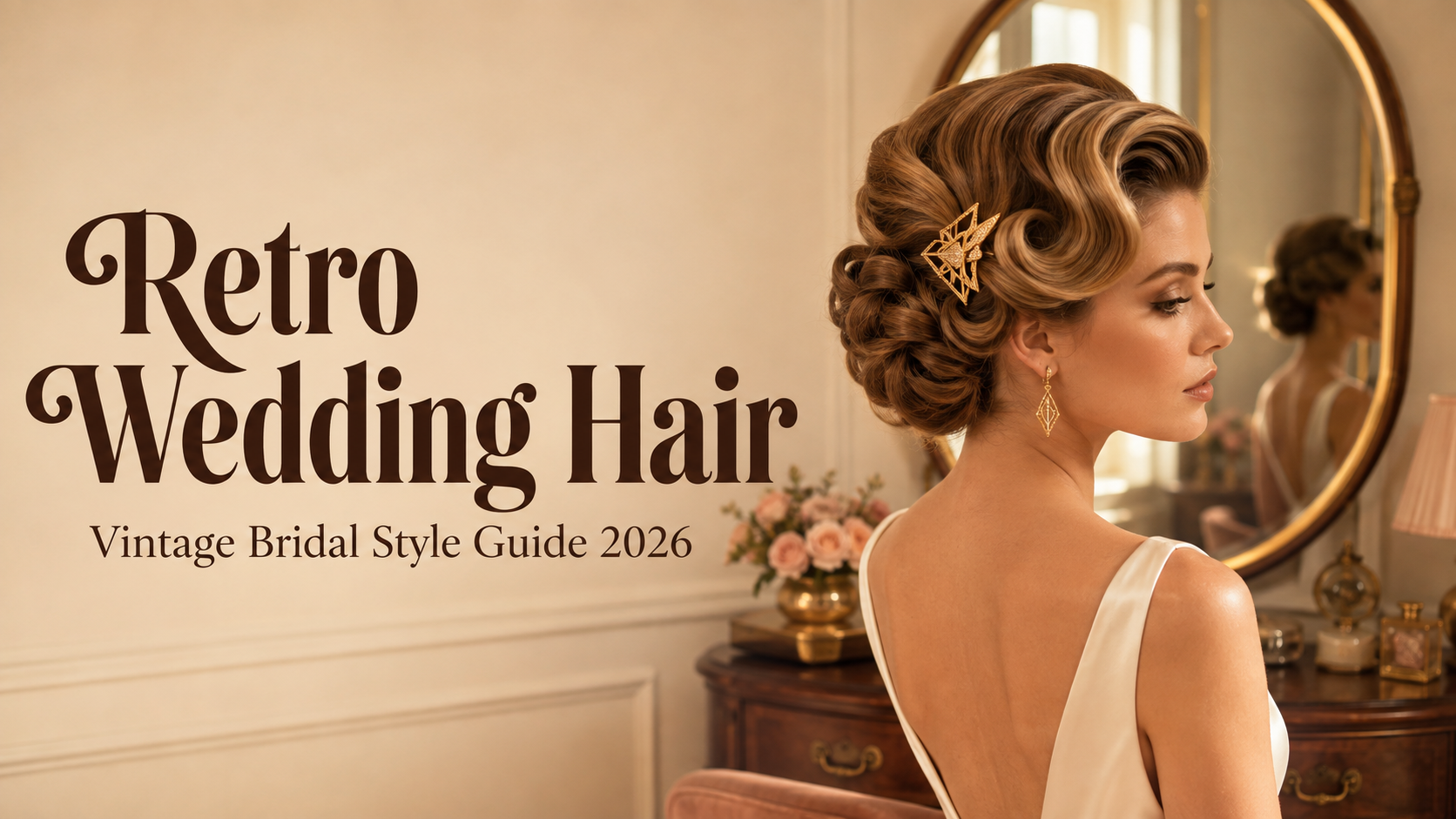
Retro Wedding Hair
Wedding Avenue Studio · Retro Wedding · Bridal Hair 2026
Retro Wedding Hair
Vintage Bridal Style Guide 2026
Six retro bridal hair directions by decade, accessory guides, the dress–hair pairing principle, and the stationery that completes the decade picture from invitation to getting-ready flat lay.
The retro wedding hair choice is, in many ways, the most personally visible decade decision in the whole celebration — more immediately read than the stationery, more immediately personal than the venue, and the element that appears in every photograph from ceremony to reception. When the hair belongs to the same decade as the dress, the flowers, and the stationery, the resulting photographs read as coherent and specifically designed. When the hair is stylistically from a different era than everything else, the photograph reads as assembled rather than chosen.
“Hair is the most decade-specific detail a bride carries with her. The right retro style does not look like a costume — it looks like a decision made with complete confidence in a specific era’s specific beauty logic.”
Section 01 The Retro Bridal Hair Aesthetic
What makes bridal hair retro is not simply its age or its styling technique — it is the specific quality of belonging to a particular decade’s beauty language with intention and confidence. The 1970s boho wave does not just happen to look like it was styled in 1973; it references that decade’s specific relationship to naturalness, movement, and the deliberate rejection of the rigid structure that characterised 1960s beauty. The 1960s mod updo does not just look structured and architectural; it references that decade’s graphic design logic, its love of geometric shapes, and its specific understanding of hair as a sculptural medium.
Five decades produce the clearest and most consistently beautiful retro bridal hair references in 2026: the 1950s, the 1960s, the early 1970s, the mid-to-late 1970s disco era, and the 1980s. Each has a specific beauty logic that is immediately readable and that produces, when applied with confidence, a bridal look that reads as cohesive and deliberately chosen rather than as a contemporary style with a vintage pin added for effect.
Retro bridal hair is surging in 2026 for the same reason retro wedding palettes are surging: the contemporary bridal aesthetic — soft, dewy, loosely waved, universally flattering — has become so dominant that anything stylistically specific reads as a confident personal statement. Choosing a victory roll or a geometric 60s updo or a full disco blowout is not choosing an unfashionable style; it is choosing a style with a stronger identity than most contemporary alternatives can offer.
📷 Style Tip
Brief your hair stylist with a decade and a reference image from that decade’s films, fashion editorials, or cultural photography — not a contemporary bridal editorial that loosely references the decade. Contemporary interpretations of retro styles are often softened to the point of losing the decade’s specific character. The original reference produces the most specific and most cohesive result.
Section 02 Six Retro Bridal Hair Directions
Six hair directions, each with a specific decade reference and a specific styling philosophy. All six are designed to be worn with confidence rather than apologetically.
2.1 — The 70s Boho Waves
The 1970s boho wave is the most free-spirited and the most widely photographed retro bridal hair direction of the current decade — the style that appears most frequently in retro wedding editorial content and that translates most naturally to a wide range of venues, from outdoor garden ceremonies to barn receptions to bohemian-adjacent industrial spaces. The styling logic is natural over structured, movement over rigidity, and warmth over precision: long hair worn loose or with soft sections pinned back, a centre or deep side parting, and waves that read as sun-dried rather than salon-set.
The 70s boho wave is completed by its accessory rather than by its styling alone. A flower crown in the wildflower palette — small dried flowers and botanical elements rather than large fresh statement flowers — reads as specifically 1970s and specifically bridal simultaneously. A macramé headband in natural cotton reads as the decade’s craft aesthetic applied to a celebratory context. Wooden or bone hair pins holding a loose section above the ear: the most minimal and most photogenic 70s hair accessory choice. The accessory defines the decade; the waves are the foundation.
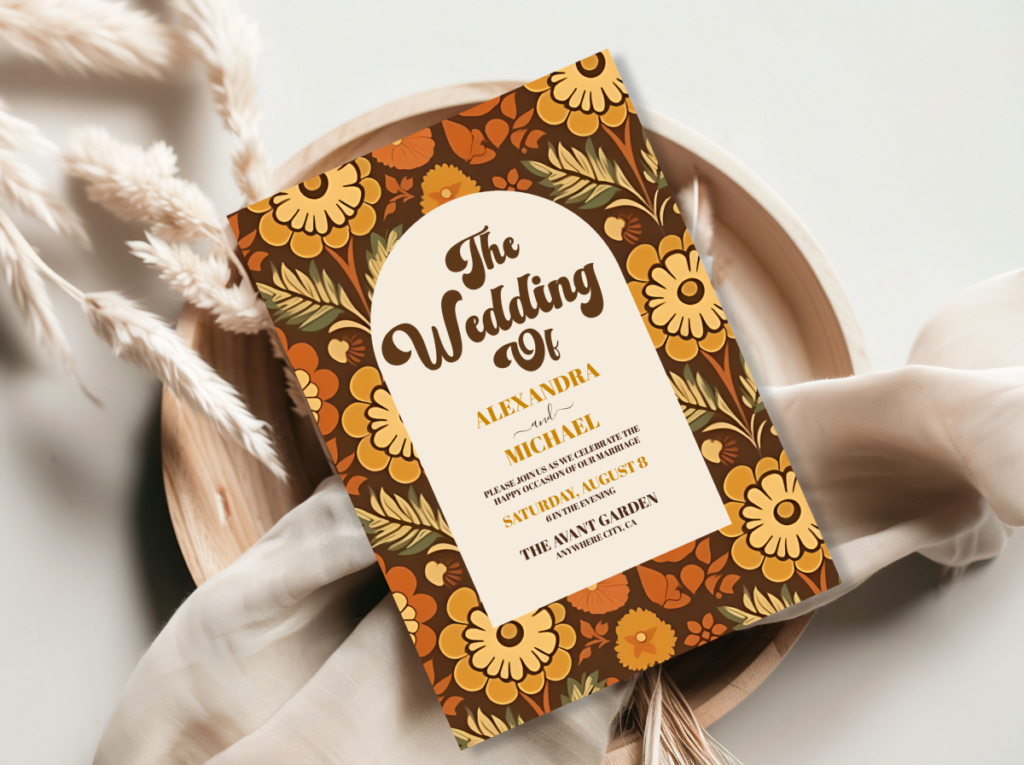
70s Groovy Wedding and Arch Modern Retro 70s Floral stationery — the natural pairing for the boho wave’s warm earth decade.
2.2 — The 60s Mod Updo
The 1960s Mod updo is the most graphic and most architecturally specific retro bridal hair direction — the style that most directly references the decade’s design logic rather than simply its aesthetic warmth. The Mod updo is geometric and architectural: hair pulled sleekly back from the face, structured into a high rounded chignon or a flat, smooth horizontal line at the nape, with the face left completely clear and the styling’s precision doing all the expressive work. The hair reads as a design decision — as deliberately shaped as the decade’s shift dress or its Op Art textile pattern.
The 60s Mod updo pairs most specifically with the decade’s graphic make-up language: strong graphic liner, pale or nude lips, and lashes that are the face’s primary statement. The combined effect — geometric hair, graphic eye, pale lip — is the most complete and the most immediately period-specific bridal look available in the retro hair range. The stationery that belongs with this direction is equally graphic: black and white, minimal, clean architecture, the Mod decade’s typography logic applied to every printed element.
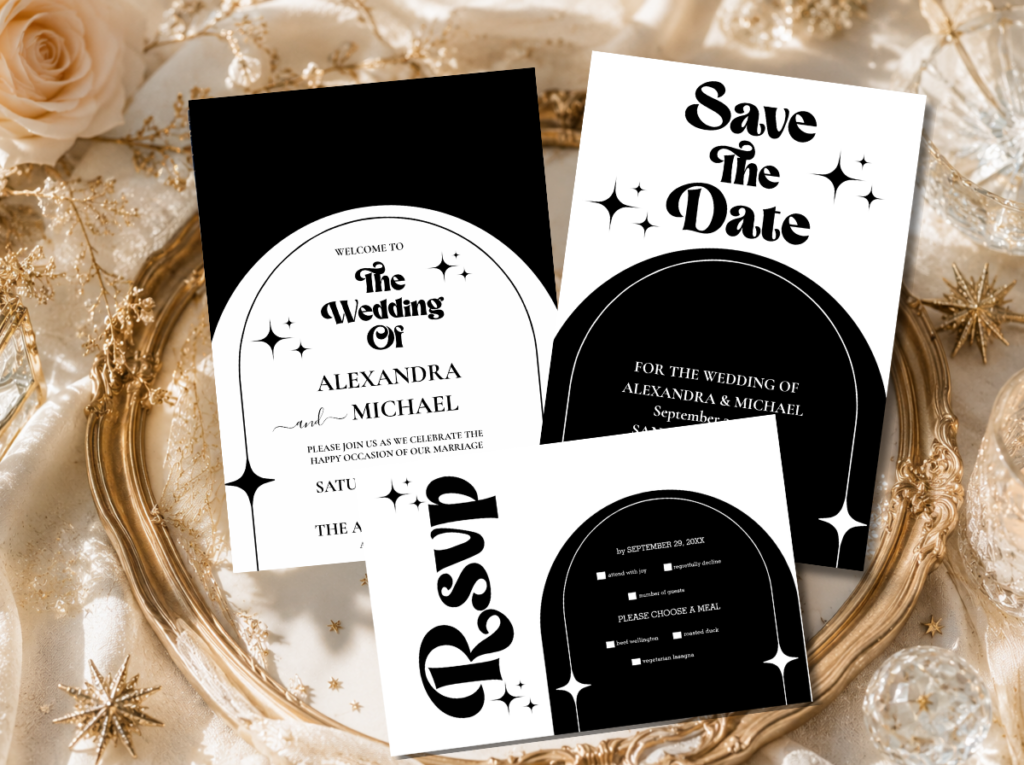
60s Wedding and Minimal Retro Arch Black and White stationery — graphic, clean, and specifically 60s Mod.
2.3 — The 50s Victory Roll
The 1950s victory roll is the most dramatically retro bridal hair choice of all six directions — the style that most emphatically announces itself as belonging to a specific decade and that requires the most deliberate confidence to carry. Victory rolls are pinned cylindrical sections of hair that frame the face on either side, rolled upward and fixed in the specific form that became the decade’s most iconic hairstyle. Worn at the front of an otherwise loose set, or as part of a fully pinned updo, they reference the 1940s-into-1950s transition period with a specificity that no other style can match.
The victory roll works best when the hair is also set in the decade’s manner: pin-curled overnight or hot-roller-set rather than wand-curled, producing the soft, rounded curl that belongs to the period rather than the more open, contemporary wave. The make-up that completes the 50s look is equally specific: red lip, winged liner, and warm complexion — the three elements that together produce the full decade portrait. Paired with a 1950s-silhouette gown — fitted bodice, full circle skirt — the victory roll produces the most complete and most photographically cohesive retro bridal look available.
Retro Wedding stationery — the full retro collection for the most classically vintage decade direction.
2.4 — The Disco Glam Blowout
The late 1970s disco blowout is the most glamorous and the most volumetrically dramatic retro bridal hair direction — the style that maximises warmth, movement, and the specific photographic quality of hair lit by warm, theatrical light. The styling logic is volume first, movement second, and structure third: hair blown out to maximum fullness, feathered layers framing the face on both sides, the specific winged quality that characterised the decade’s most glamorous hair moments. The result is warm, confident, and specifically cinematic.
The disco blowout belongs to the evening wedding. Where the 70s boho wave reads most beautifully in afternoon light at an outdoor ceremony, the disco blowout reads most beautifully in warm ballroom or restaurant light — the kind of light that activates the hair’s movement and warmth simultaneously. The stationery that belongs with this direction is warm and theatrical in the same register: the disco wedding palette’s mirror gold and deep plum, the warm typographic confidence of the retro collection’s evening-forward directions.
Retro Wedding stationery — the warm, theatrical direction for an evening disco blowout celebration.
2.5 — The Retro Pink Statement
The retro pink statement is the most joyfully non-traditional and the most specifically 2026 retro hair direction — not a decade-specific style so much as a colour decision applied to any retro styling direction: a hot pink hair accessory, a blush or rose-tinted extension woven through a boho braid, or a pink-toned statement clip at a sleek updo’s focal point. The pink element belongs to the retro pink wedding palette’s specific register — bold, saturated, unapologetically not-natural-bridal — and it reads as the most personal and most joyful of all six directions.
The retro pink statement works at any level of commitment: a single pink silk hair scarf tied around a 70s low ponytail; a cluster of hot pink dried flowers at a loosely pinned boho updo; a statement pink barrette at a 60s mod updo’s centre; a full hot pink ribbon woven through a braided crown. The pink element is the statement; the underlying style is the foundation. It pairs most naturally with the retro pink wedding palette — the hot pink, bubblegum, cream, and vintage gold combination that produces the most joyfully feminine retro direction available.
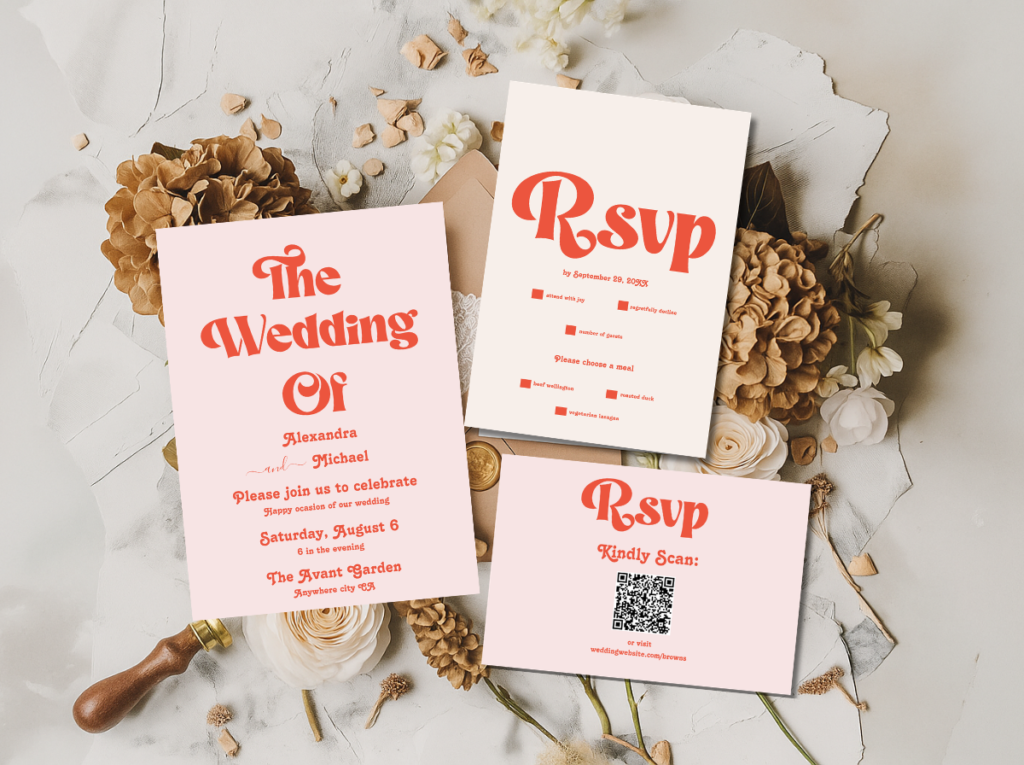
Retro Pink Wedding and Modern Retro Pink And Orange Typography stationery — the pink-forward collections that pair with the retro pink hair statement.
2.6 — The Retro Updo with Statement Accessory
The retro updo with statement accessory is the most elegant and the most broadly wearable of all six directions — the choice that allows the accessory rather than the styling to carry the decade reference. A sleek chignon at the nape, a classic French twist, or a low structured bun: all three are elegant and timeless foundations that read as bridal without reading as specifically retro until the accessory makes the decade declaration. A bold geometric clip in gold or chrome reads 1960s. A statement floral comb in warm amber and ivory reads 1950s. A woven macramé pin reads 1970s. A glitter-scattered rhinestone piece reads disco.
The appeal of the retro updo with statement accessory is its flexibility: the underlying style is refined enough to suit any venue and any dress silhouette, while the accessory makes the decade commitment without requiring the full styling confidence of a victory roll or a Mod geometric updo. For a bride who wants a clear retro reference that does not read as theatrical, this direction produces the most accessible and the most universally photographable result.
Retro Wedding stationery — elegant and decade-specific across every retro direction.
Section 03 Retro Hair Accessories by Decade
The accessory is often the element that most clearly signals the decade in a retro bridal hair look — the difference between a loose wave and a specifically 1970s loose wave.
1970s accessories. Flower crowns in dried wildflowers and botanical elements (fresh flowers read contemporary; dried flowers read decade-specific). Macramé headbands in natural cotton or jute. Wooden hair pins and bone-coloured accessories. Long trailing ribbon in warm earth tones tied at a low ponytail or braid. Rattan-wrapped accessories in the decade’s natural material palette.
1960s accessories. Geometric clips in gold or chrome — rectangular, circular, or abstract shapes in the decade’s Mod design language. Pillbox hats for the most formally decade-specific 60s bridal look. Graphic headbands in black, white, or bold primary tones. Patent leather or structured fabric accessories in the decade’s high-contrast graphic palette.
1950s accessories. Pearl hair pins in classic single-strand or cluster arrangements. Fascinators in the decade’s structured, sculpted form — small, forward-tilted, and specifically architectural. Structured fabric bows at the crown or nape. Rhinestone clips in the decade’s glamour register.
Disco (late 1970s) accessories. Glitter-scattered rhinestone pieces in the disco palette’s mirror gold and silver. Sequin hair bands. Statement crystal clips in bold, maximalist arrangements. Gold chain hair pieces woven through the disco blowout’s layers. The disco accessory register is theatrical and maximalist — the opposite of the 70s boho direction’s natural restraint.
💼 Style Tip
Source retro hair accessories from vintage or estate sale contexts rather than contemporary bridal accessory collections — the real item almost always reads more specifically than a new item made to reference the era. A genuine 1960s geometric clip costs less and photographs more authentically than a contemporary interpretation. Vintage accessories are also among the most personal and most meaningful wedding day details.
Section 04 Retro Hair & Dress Pairing
The most coherent retro bridal look is one in which the hair and the dress reference the same decade — not because mixing eras is inherently wrong, but because each decade’s dress silhouette and each decade’s hair styling logic were designed to work together as a complete aesthetic system. When they belong to the same era, they produce a portrait of a complete moment in fashion history. When they belong to different eras, the result reads as two separate decade references placed in the same photograph.
70s dress and 70s boho waves. A 1970s-silhouette dress — flowing, empire-waisted, wide sleeves, natural fabrics in warm earth tones — reads most cohesively with the boho wave or the flowing centre-parted style. The dress’s movement and the hair’s movement belong to the same naturalness philosophy. A sleek updo with a 70s dress produces a decade conflict; the boho wave amplifies the dress’s decade signal.
60s shift dress and 60s Mod updo. A 1960s shift silhouette — geometric, collarbone-revealing, sleeveless, knee-length — reads most cohesively with the geometric Mod updo. The dress’s graphic minimalism and the updo’s architectural precision belong to the same design logic. Flowing waves with a shift dress produce the same decade conflict: one element reads as minimalist; the other reads as romantic.
50s full skirt and 50s victory roll. A 1950s full circle skirt with fitted bodice reads most cohesively with the victory roll, the structured set curl, or the fascinator-topped updo. The dress’s formality and theatrical silhouette call for the hair’s equivalent theatricality. Contemporary loose waves with a 50s dress produce a look where the dress and the hair seem to belong to different photographs.
Retro Wedding stationery — the full collection to complete whichever decade pairing you choose.
Section 05 Hair & Stationery — The Coherence Principle
The retro wedding stationery and the retro bridal hair tell the same decade story — and when they belong to the same era, the getting-ready photographs and the ceremony photographs share the same visual world. The invitation propped against a hair accessory flat lay on the morning of the wedding is one of the most consistently beautiful wedding day detail photographs: invitation, accessory, and perhaps a dried flower element from the bouquet, all in the same warm decade palette. The photograph works when all three elements share the same colour world and the same decade’s design logic.
The 70s Groovy Wedding stationery collection’s warm earth tones — burnt orange, avocado, mustard on warm cream — belong beside a macramé headband and a dried wildflower crown. The Minimal Retro Arch Black and White collection’s graphic monochrome belongs beside a geometric gold clip and a 60s Mod liner reference. The Modern Retro Pink And Orange Typography collection’s bold pink and orange belongs beside a hot pink statement hair accessory and a carnation from the bouquet. In each case, the stationery and the hair accessory are elements of the same decade-specific world.
The cohesion principle extends to the whole celebration’s photographic narrative. When the getting-ready photographs share the same colour world as the ceremony photographs share the same colour world as the reception photographs, the wedding album reads as a single coherent design rather than as a collection of beautiful but disconnected moments. The stationery is the palette reference; the hair accessory carries it into the most personal and most visible element of the bride’s appearance; the flowers carry it into the table and ceremony space. All three belong to the same world when all three are chosen from the same decade.
All Wedding Avenue Studio retro stationery collections are available below.
70s Groovy
70s Groovy Wedding
Warm earth tones and groovy typography — for boho waves, macramé headbands, and wildflower crowns.
Retro Pink
Retro Pink Wedding
Hot pink and warm gold — for the retro pink statement hair direction.
60s Mod
60s Wedding
Graphic, clean, and bold — for the Mod updo and geometric clip direction.
Full Retro Range
Retro Wedding
The complete retro wedding stationery collection across all decades.
Arch 70s Floral
Arch Modern Retro 70s Floral
Botanical arch illustration in the warm earth palette — natural pairing for 70s boho hair.
Frequently Asked Questions
What is the most retro bridal hairstyle in 2026?
The 70s boho wave is the most frequently requested and most broadly photographed retro bridal style of 2026 — long, flowing, centre-parted, with a dried wildflower crown or macramé headband as the decade-specific accessory. The 60s Mod updo is the most architecturally specific and the most immediately decade-readable. The 50s victory roll is the most dramatically retro and the most emphatically decade-committed of all six directions. The choice between them depends on the dress’s silhouette and the decade the celebration as a whole is referencing.
Should my wedding hair match the decade of my dress?
Yes — when the hair and the dress belong to the same decade, they produce a complete portrait of a specific era rather than two separate vintage references placed in the same photograph. A 1970s-silhouette gown reads most cohesively with the 70s boho wave or flowing centre-parted style. A 1960s shift reads most cohesively with the Mod updo or geometric accessory. A 1950s full-skirt silhouette reads most cohesively with the victory roll or structured set curl. The cohesion principle produces the most photographically unified result in every decade pairing.
Can I have coloured hair for a retro wedding?
Yes — and in a retro wedding, coloured or colour-accented hair is more thematically consistent than it is in a contemporary bridal context, because the retro wedding’s design philosophy already embraces bold, saturated, decade-specific colour as a deliberate aesthetic statement. A hot pink hair accessory, a blush extension woven through a boho braid, or a pink-toned statement clip all read as retro-specific and specifically beautiful in the retro pink wedding direction. The colour element should belong to the decade’s palette rather than existing as a standalone choice — pink alongside the retro pink palette, warm amber alongside the earth palette, jewel tones alongside the disco palette.
How do I make retro wedding hair look intentional rather than costume-like?
Three decisions prevent the costume reading. First, the hair decade should match the dress decade — decade cohesion reads as intentional; decade conflict reads as assembled. Second, the make-up should belong to the same era as the hair: 60s graphic liner with the Mod updo, 70s warm peachy tones with the boho wave, 50s red lip with the victory roll. Third, the accessory should be sourced from the era or a high-quality reproduction — a genuine vintage clip reads as specifically chosen; a generic contemporary accessory reads as a nod rather than a commitment. Confidence is the fourth element: retro bridal hair looks intentional when it is worn with the same certainty as any other personal aesthetic decision.
Wedding Avenue Studio · Retro Stationery · Every Decade
Shop Retro Wedding Stationery
The palette reference your stylist and florist need to make every element of the celebration belong to the same decade.