Baroque Wedding – The Complete Guide to Planning a Celebration of Extraordinary Grandeur
The Baroque Wedding Edit · 2026
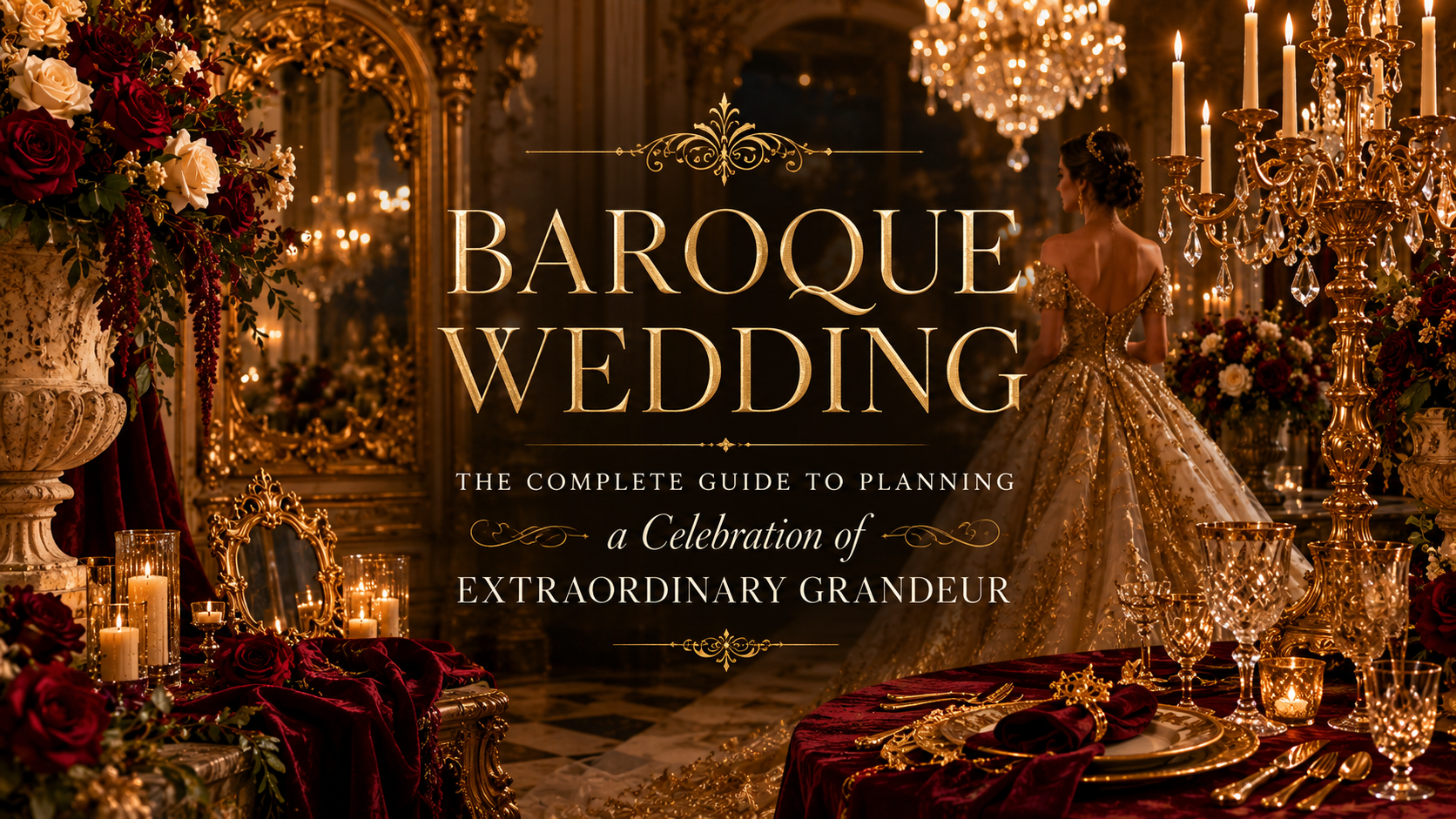
Baroque Wedding
The Complete Guide to Planning a Celebration of Extraordinary Grandeur
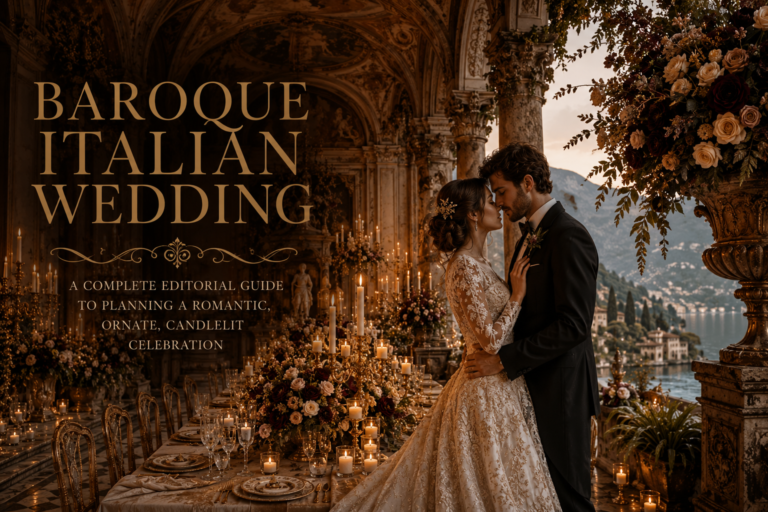
Gold leaf and candlelight, opulent florals and dramatic architecture, velvet and brocade, towering centrepieces and the most exquisitely abundant tables ever set — your definitive guide to the baroque wedding in 2026.
Introduction
The Baroque Wedding: Where Grandeur Becomes Genuinely Personal
The baroque aesthetic is one of the most misunderstood in all of wedding design. To the uninitiated it reads as excess — as too much gold, too many candles, too large a floral arrangement, too heavy a fabric, too grand a room. But this misreading entirely misses what the baroque tradition is actually about. Baroque is not excess for its own sake. It is abundance in the service of emotion. It is grandeur deployed as a form of generosity — the offer to every guest of an experience so visually rich, so sensorially overwhelming, so completely and deliberately extraordinary that they feel, for the duration of the evening, elevated beyond the ordinary circumstances of their lives. This is what the greatest baroque interiors have always done, and what the best baroque weddings of 2026 are doing with equal ambition and equal success.
The baroque wedding in 2026 draws on the full aesthetic inheritance of the seventeenth and early eighteenth century — the period that gave us Versailles, the painted ceilings of the Vatican, the carved altarpieces of Central European churches, and the candlelit banqueting halls of European royal courts — and applies it to the contemporary wedding with both historical literacy and genuine creative ambition. It is not a costume. It is not a theme park. It is a fully considered aesthetic direction — as demanding and as rewarding as any other — that requires a specific kind of venue, a specific kind of supplier, and a specific kind of creative courage from the couple who chooses it.
This guide covers every dimension of the baroque wedding in full — the color palette, the venue, the flowers, the decor, the fashion, the stationery, the food, the music, the guest experience, the mistakes to avoid, and a final reflection on what the baroque wedding, at its best, actually offers the couple brave enough to commit to it completely.
Color Palette
The Baroque Wedding Color Palette: Gold, Darkness, and the Drama of Contrast
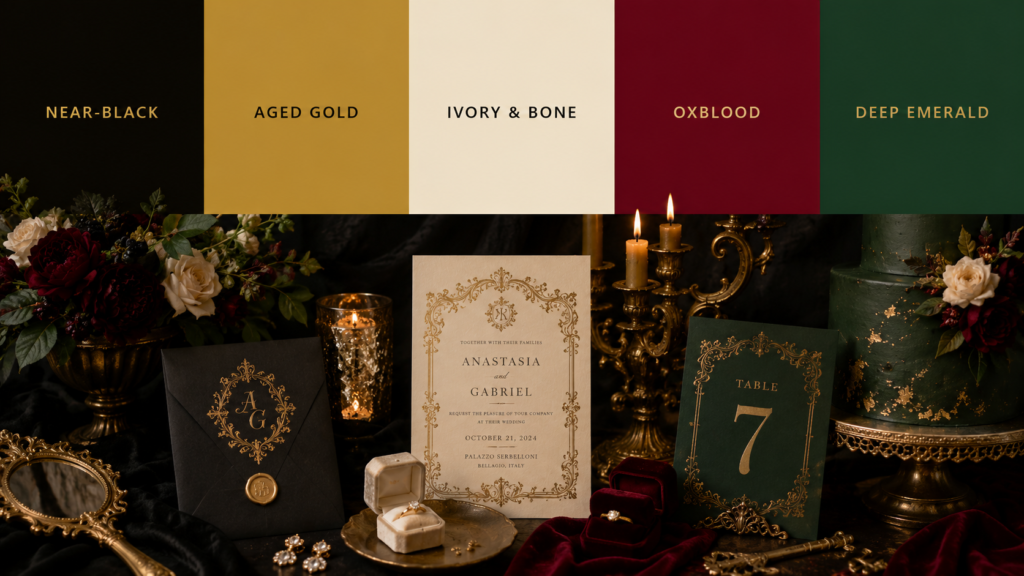
The baroque color palette is built on one of the most powerful and enduring visual principles in all of Western art: the dynamic contrast of deep darkness against luminous warmth. Caravaggio understood it. Rembrandt perfected it. The architects of Versailles deployed it on an architectural scale. And the baroque wedding palette that works most magnificently in 2026 applies the same principle — rich, near-black backgrounds against which gold, ivory, and deep jewel tones appear to almost glow with their own light.
The anchor of any baroque wedding palette is deep darkness — near-black, very deep navy, or the most intense forest green — against which all other colors operate. Gold is the defining accent: aged gold rather than bright, a burnished, patinated tone that suggests centuries of use rather than freshness from a spray can. Ivory and bone-white provide the luminous contrast that prevents the darkness from becoming oppressive. Deep jewel tones — oxblood, deep emerald, midnight plum — introduce variety and richness without disturbing the overall sense of weight and drama. And the metallic elements — gold leaf, aged brass, antique bronze, and the warm mercury glass of period mirrors — provide the reflective surfaces that allow candlelight to multiply itself across the room.
Near-Black
The anchor. The dark canvas against which everything else blazes.
Aged Gold
The defining accent. Burnished, patinated, luminous by candlelight.
Ivory & Bone
The luminous contrast. Makes darkness appear intentional and beautiful.
Oxblood
The jewel tone. Deep, rich, dramatic. In velvet and in blooms.
Deep Emerald
The alternative jewel. Forest-dark and intensely luxurious.
Venue
The Baroque Wedding Venue: Where Architecture Is the First Act of Decoration
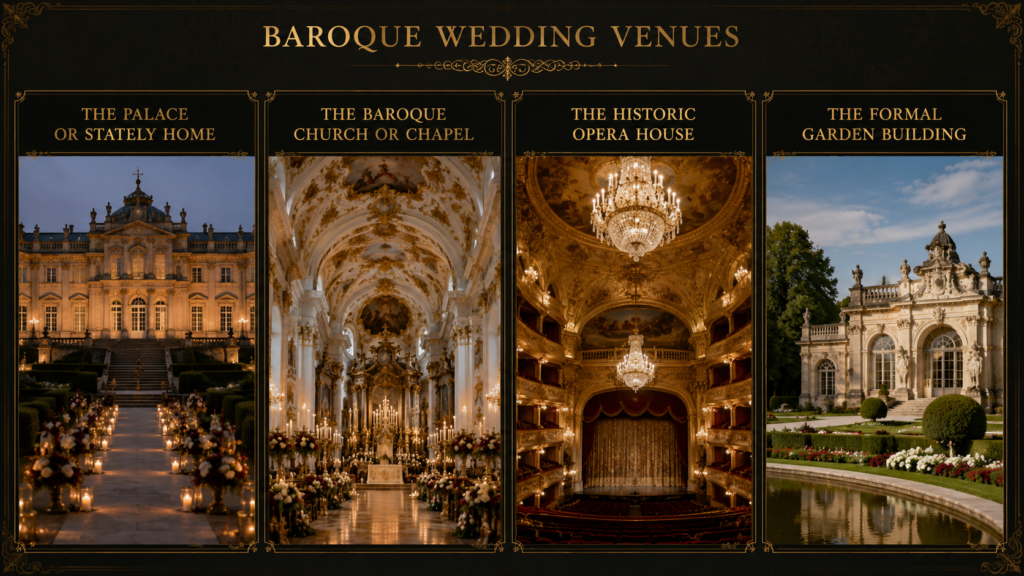
The baroque wedding demands a venue of genuine architectural ambition — one where the ceilings are high enough to accommodate towering floral installations, where the walls carry the evidence of craft and history, where gilded mouldings and painted plasterwork exist not as decorative additions but as the fundamental character of the space. The baroque aesthetic cannot be constructed from scratch in a marquee or a blank-canvas venue. It requires a foundation of actual historical grandeur — a palace, a stately home, a cathedral, a gilded opera house, a baroque church, or a formal European garden building — and it rewards that foundation with decoration that deepens and completes what the architecture has already begun.
The ideal baroque wedding venue has ceiling height as its first qualification — because the defining feature of baroque floral and decor design is vertical scale, and a low ceiling eliminates the most spectacular installation options entirely. It has painted or gilded surfaces that will interact with candlelight and gold-leaf decoration in the way only period interiors can. It has architectural symmetry and formal geometry that the baroque decorator can echo and amplify. And it has the specific quality of aged grandeur — the kind of beauty that requires generations to accumulate and that no amount of contemporary styling budget can replicate from a standing start.
🏰
The Palace or Stately Home
The gold standard of baroque wedding venues. Painted state rooms, gilded cornices, formal gardens, mirrored ballrooms, and the kind of ceiling height that makes a towering candelabra look proportionate rather than overwhelming. The venue that needs the least decoration to achieve the most effect.
⛪
The Baroque Church or Chapel
For the ceremony. Carved altarpieces, gilded side chapels, painted vault ceilings, and the sacred geometry of ecclesiastical baroque architecture provide a ceremony backdrop of genuinely overwhelming grandeur. The processional aisle beneath a baroque vault is one of the most magnificent spaces available anywhere.
🎭
The Historic Opera House
Red velvet boxes, gilded balconies, painted ceilings, and the theatrical grandeur that baroque opera was literally invented to fill. A historic opera house reception is the most dramatically baroque venue setting available and one of the most unforgettable in all of wedding photography.
🌿
The Formal Garden Building
An orangery, a glasshouse, or a formal garden pavilion within the grounds of a historic estate. Baroque garden architecture — with its formal symmetry, stone urns, clipped topiary, and ornamental water features — provides the perfect outdoor ceremony and portrait setting.
“The baroque wedding venue is not a backdrop. It is the first collaborator — the space that brings the grandeur, the history, and the architectural ambition that no decorator’s budget can manufacture. Choose it first, and let everything else respond to what it offers.”
— The Baroque Wedding Edit
Flowers
Baroque Wedding Flowers: Abundance, Scale, and the Flemish Still-Life Tradition
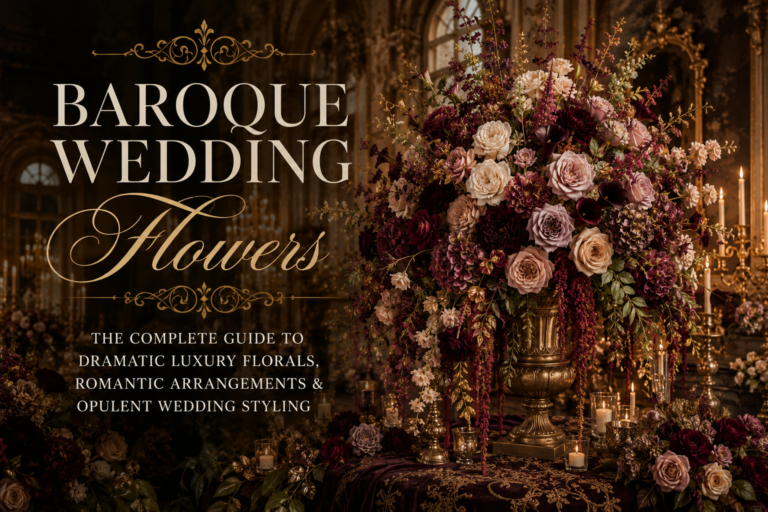
Baroque floral design takes its aesthetic cue from the Flemish flower paintings of the seventeenth century — those extraordinary, impossibly abundant canvases by Jan Brueghel the Elder, Rachel Ruysch, and Ambrosius Bosschaert in which dozens of flowers that could never bloom simultaneously in the same season are arranged together in stone or bronze niches with a virtuosity and a visual richness that remains genuinely staggering more than three centuries later. The baroque wedding florist is working in that tradition — constructing arrangements of such abundance, such textural complexity, and such dramatic scale that they read not as flower arrangements but as compositions, as objets d’art, as the botanical equivalent of a painted ceiling.
The defining characteristics of baroque wedding floristry are scale, density, and a chromatic richness that privileges depth over brightness. Towering arrangements in stone or bronze urns that reach toward the ceiling. Centrepieces so generously scaled that they spill over the table edge and require the candles to be arranged around and beneath them rather than alongside. Ceremony arches that are not frames for the couple but architectural features in their own right — structures of flowers and foliage substantial enough to read as part of the building. And throughout, the specific palette of baroque horticulture: deep burgundy and oxblood roses, near-black anemones, ivory peonies, dark ranunculus, chocolate cosmos, deep plum hellebores, and the whole range of garden flowers rendered at their richest and most dramatically beautiful.
Baroque Blooms
- Deep burgundy and oxblood garden roses — the heart of every arrangement
- Ivory and champagne peonies for volume and softness
- Near-black anemones for graphic depth and drama
- Dark ranunculus in deep plum, wine, and rust
- Chocolate cosmos — velvety and intensely dark
- Deep hellebores in near-black and oxblood
- Ivory and champagne dahlias for textural complexity
- Garden carnations — restored to baroque glory in dark burgundy
Foliage & Structural Elements
- Dark smoke bush in deep burgundy-purple for cloud texture
- Copper beech for rich dark foliage year-round
- Olive branches for silvery contrast and classical reference
- Twisted willow for architectural structure and movement
- Ivy trails for cascading length and period authenticity
- Gold-leaf-sprayed branches for baroque metallic detail
- Seed pods and dried botanicals for textural density
- Moss and lichen for the sense of deep natural age
Decor
Baroque Wedding Decor: 10 Design Elements That Define the Aesthetic
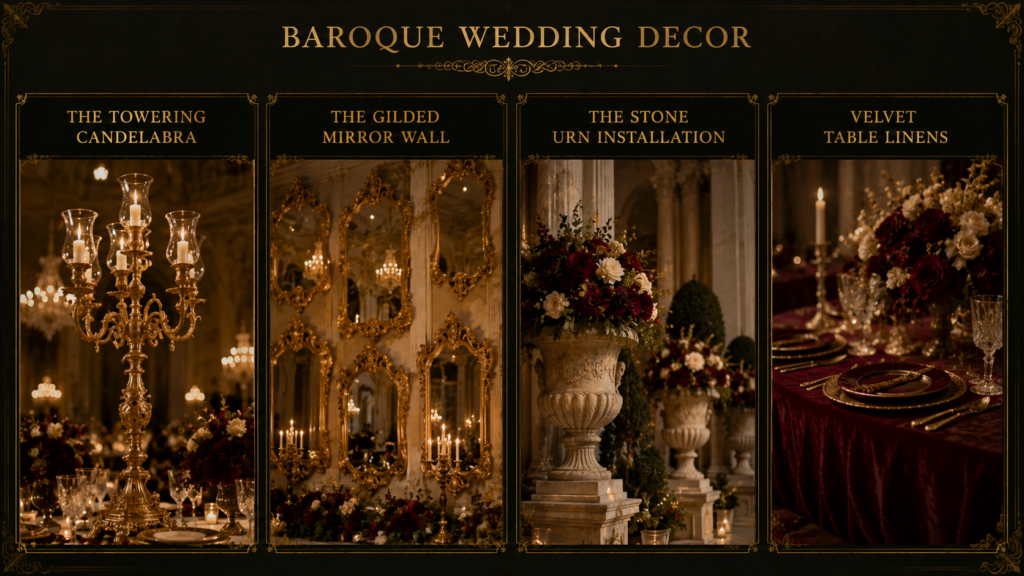
The baroque wedding decoration scheme operates on a principle of considered maximalism — every element abundant and richly detailed, but each chosen with specific purpose and in relationship with everything around it. Nothing is present for shock value. Everything is present because it contributes something specific to the total atmosphere. The following ten design elements are the defining vocabulary of baroque wedding decoration in 2026, and the most visually impactful when executed with genuine ambition and creative intelligence.
01
The Towering Candelabra
Cast iron or gilded bronze candelabras of two metres or more, holding multiple taper candles at heights that allow their light to fall across the full dining table. These are the vertical anchors of the baroque reception table — they command the room, they photograph with extraordinary drama, and they produce the specific quality of flickering, multi-source candlelight that is utterly irreplaceable in the baroque aesthetic. A table of eight with two tall candelabras at its centre, flanked by abundant floral arrangements and surrounded by votives, is one of the most beautiful dining environments in all of wedding photography.
02
The Gilded Mirror Wall
A collection of ornately gilded antique mirrors arranged as a salon-style gallery on a key wall of the reception room — varying in size, frame style, and degree of foxing, but all in gold frames and all positioned to reflect the candlelight and the floral arrangements in the room before them. This single design decision can transform an already beautiful room into something genuinely extraordinary, multiplying the apparent depth of the space and the warmth of its lighting without a single additional candle being required.
03
The Stone Urn Installation
Pairs of large stone or aged bronze urns — positioned at venue entrances, flanking the ceremony space, and at the ends of the dining tables — filled with towering baroque arrangements that overflow their vessels in cascades of blooms, foliage, and botanical material. The stone urn is one of the most authentically baroque decorative objects available: it references the garden architecture of the period directly, it provides the scale and visual weight that the aesthetic requires, and it photographs with a grandeur and a timelessness that no contemporary vase can approach.
04
Velvet Table Linens
Deep jewel-toned velvet tablecloths — in oxblood, midnight plum, or the most intense forest green — over which aged ivory or champagne linen runners are layered. Velvet absorbs candlelight rather than reflecting it, creating a surface of extraordinary visual depth and warmth against which every gold, bronze, and floral element of the tablescape glows with heightened intensity. No other textile creates the same quality of baroque richness at the table surface.
05
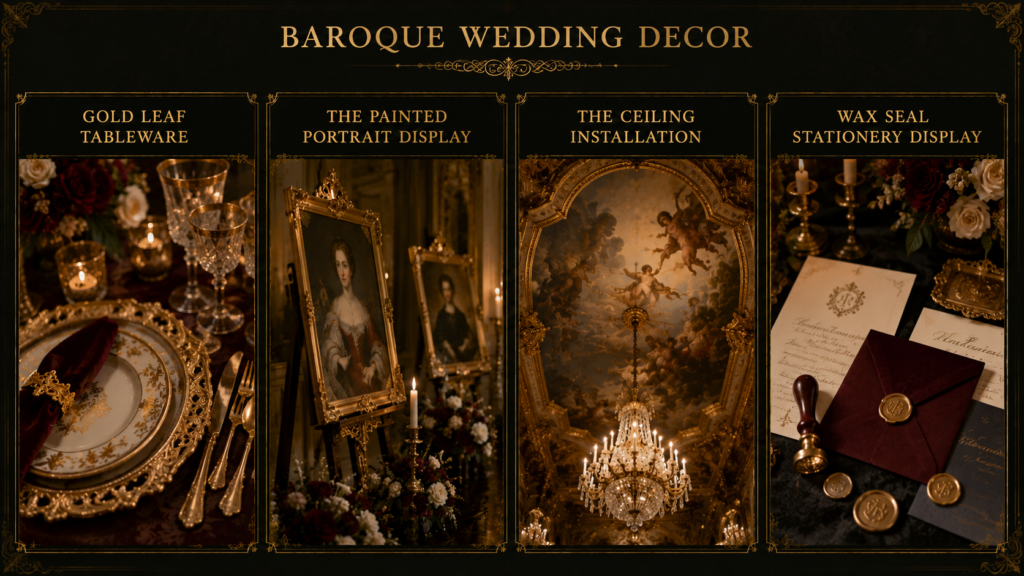
Gold Leaf Tableware
Gold-rimmed charger plates, aged brass cutlery, and gold-leaf-edged glassware at every place setting. These details operate at the most intimate scale of the baroque decoration scheme — noticed individually by each guest as they sit down, and collectively producing a table surface of extraordinary refinement and period authenticity. The charger plate alone changes the visual quality of an entire place setting in a way that no other single object quite manages.
06
The Painted Portrait Display
A wall of large-scale antique or reproduction oil paintings — landscapes, still lifes, and portraits in heavy gilded frames — arranged salon-style in a key room of the reception venue. This uniquely baroque decorative approach transforms a dining room into something approaching a great house interior, giving it the visual density and cultural weight that is essential to the aesthetic. Hire from specialist picture libraries or antique dealers who offer event lending.
07
The Ceiling Installation
A suspended ceiling installation of floral material — dark blooms, trailing ivy, gold-sprayed branches, and hanging crystal drops — that transforms the overhead plane of the reception room into an active element of the decoration scheme. In a baroque venue with high ceilings and painted plasterwork, a generous ceiling installation completes the all-encompassing immersive quality that the aesthetic demands. The eye should find beauty in every direction simultaneously.
08
Wax Seal Stationery Display
Escort cards displayed on a baroque-styled board — a velvet-covered frame, an ornate gilt mirror, or a moss-covered board punctuated with flowers — with each card sealed with a gold or oxblood wax seal and tied with silk ribbon. The escort card display is one of the most photographed installations at any baroque wedding and sets the tone for the level of detail that awaits guests inside the dining room.
09
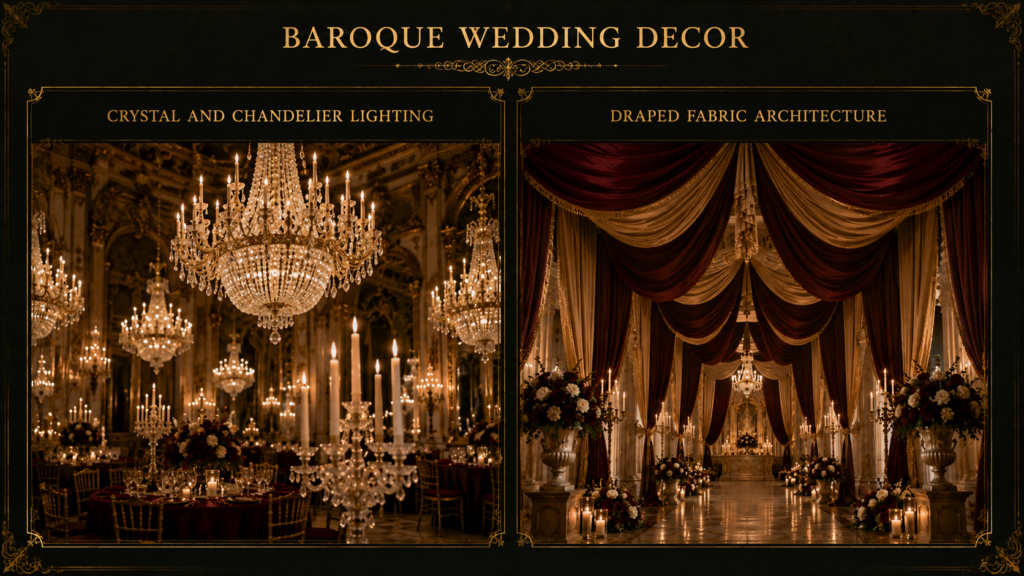
Crystal and Chandelier Lighting
Original chandeliers fully lit where the venue possesses them, supplemented with hanging crystal drops threaded through floral ceiling installations. The baroque aesthetic belongs to the chandelier more than to any other light fitting — the way crystal refracts candlelight into a thousand moving points of warm gold is entirely unreplicable by any other light source and entirely essential to the baroque atmosphere.
10
Draped Fabric Architecture
Heavy silk, velvet, or brocade fabric draped from ceiling fixings to frame ceremony spaces, create fabric ceilings above the head table, or define the processional aisle. The draped fabric is one of baroque’s most powerful spatial tools — it adds warmth, creates intimacy within grandeur, and introduces the specific texture and movement of heavy textile to spaces that might otherwise feel more architectural than inhabited.
Fashion
Baroque Wedding Fashion: Dressed for a World That Demands Grandeur
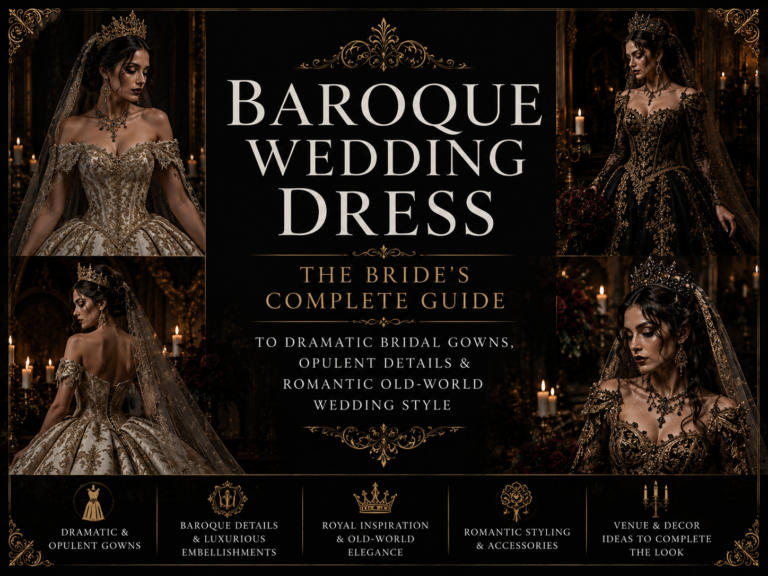
The baroque wedding creates a fashion context unlike any other — one that actively rewards drama, structure, and the kind of gown that has genuine architectural presence. In a baroque setting, the minimalist slip dress disappears. The clean column gown is swallowed by the grandeur of the room. What the baroque aesthetic demands from bridal fashion is a gown of substance and visual weight — something that holds its own in a gilded state room, that photographs with equal authority at every scale from the wide establishing shot to the close detail, and that communicates, in its cut and its fabric and its construction, a level of formal ambition that matches the occasion it dresses.
The Bride
A full-skirted ballgown in ivory silk duchess satin or silk mikado — structured, voluminous, and architectural in its silhouette — is the most authentically baroque bridal choice. A cathedral train of five metres or more. A corseted bodice with delicate boning visible through sheer organza. Intricate embroidery or lace overlay in a floral pattern that references the Flemish textile tradition. For the bride who wants drama without volume — a deeply structured column gown with a dramatic back detail, a long silk train, and a statement veil of cathedral length in French silk tulle. Accessories: pearl and gold jewellery, a delicate tiara or hair piece with gold detailing, and a bouquet of deep oxblood roses and ivory peonies that cascades rather than simply hangs.
The Groom
A black or midnight blue dress coat — the most formally baroque of all male wedding garments — with white waistcoat, crisp white dress shirt, white bow tie, and patent Oxford shoes. For a slightly less formal interpretation: a deep velvet dinner jacket in midnight plum, forest green, or oxblood with matching velvet bow tie and ivory dress shirt. The groom at a baroque wedding should look as though he belongs in the room’s portraiture — not as a contemporary interloper but as a natural and correctly dressed inhabitant of a formal world of genuine grandeur.
The Wedding Party
Bridesmaids in deep oxblood, midnight plum, or rich forest green — floor-length gowns in silk velvet or duchess satin with a simple, structured silhouette that provides visual mass without competing with the bride’s more elaborate styling. Gold jewellery throughout. The uniformity of the bridal party in a baroque setting is not sameness — it is the formal, considered coordination of a visual group that has been dressed to appear as a painting rather than simply as a photograph.
Stationery
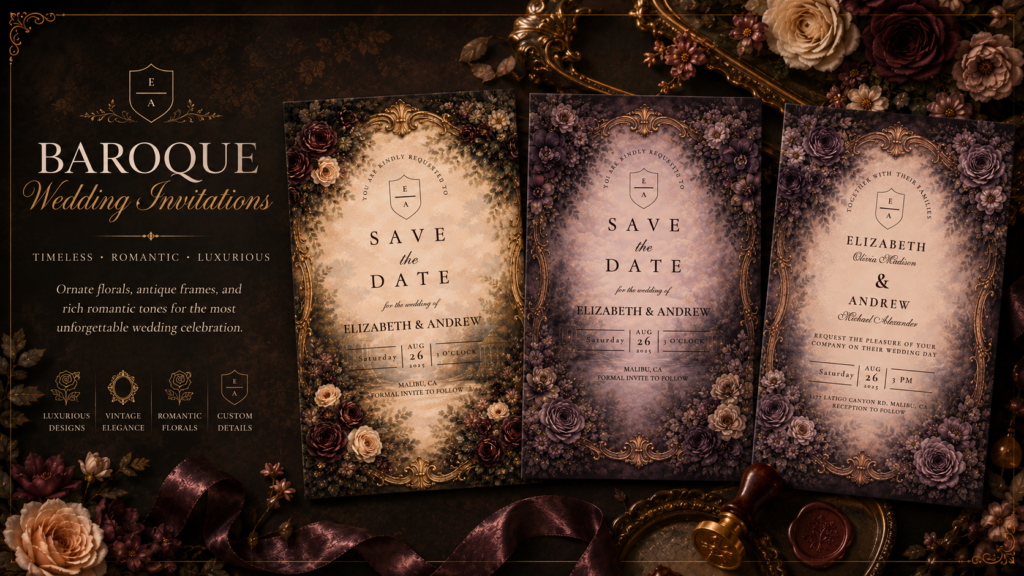
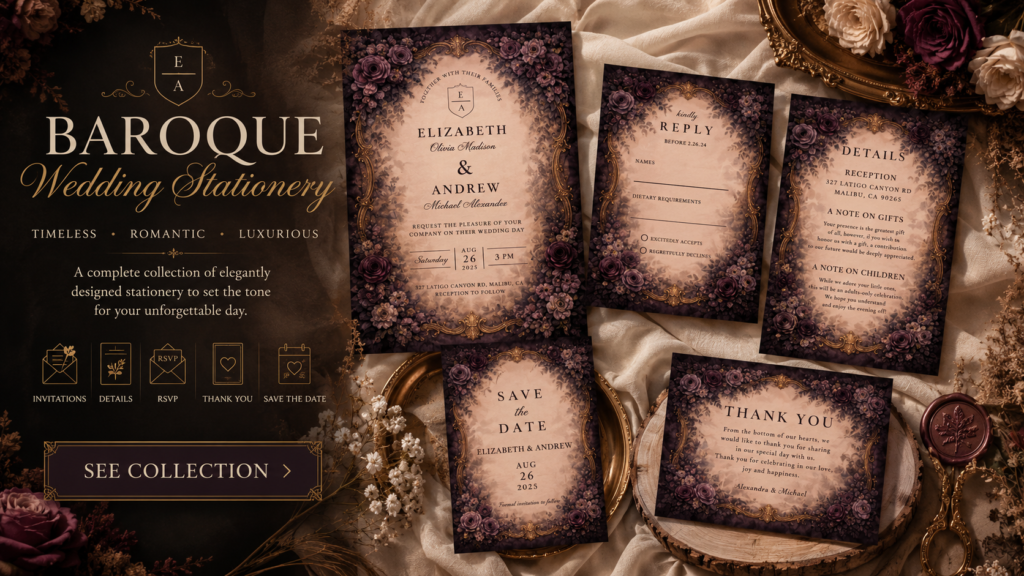
Baroque Wedding Stationery: The Invitation as a Work of Art
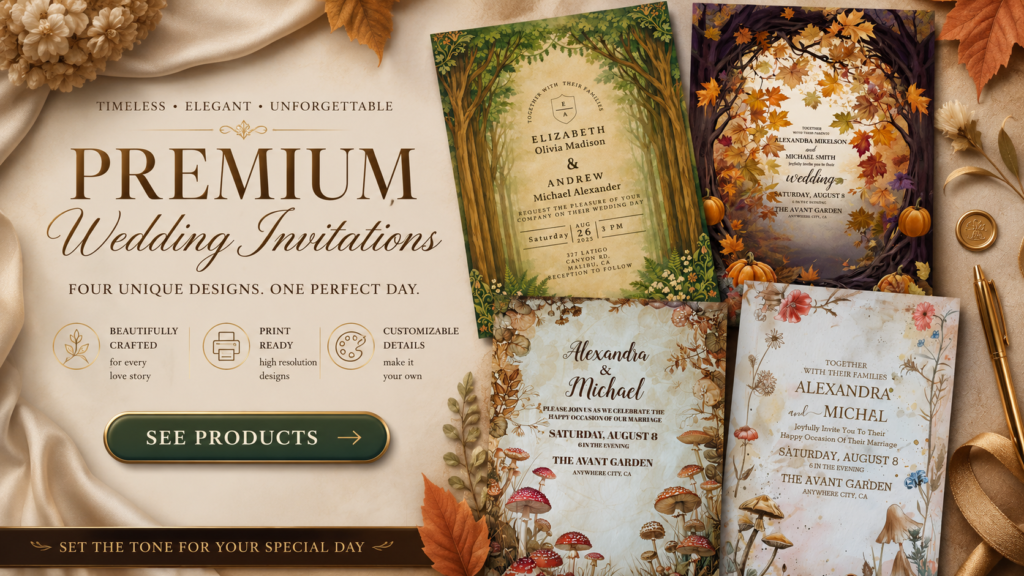
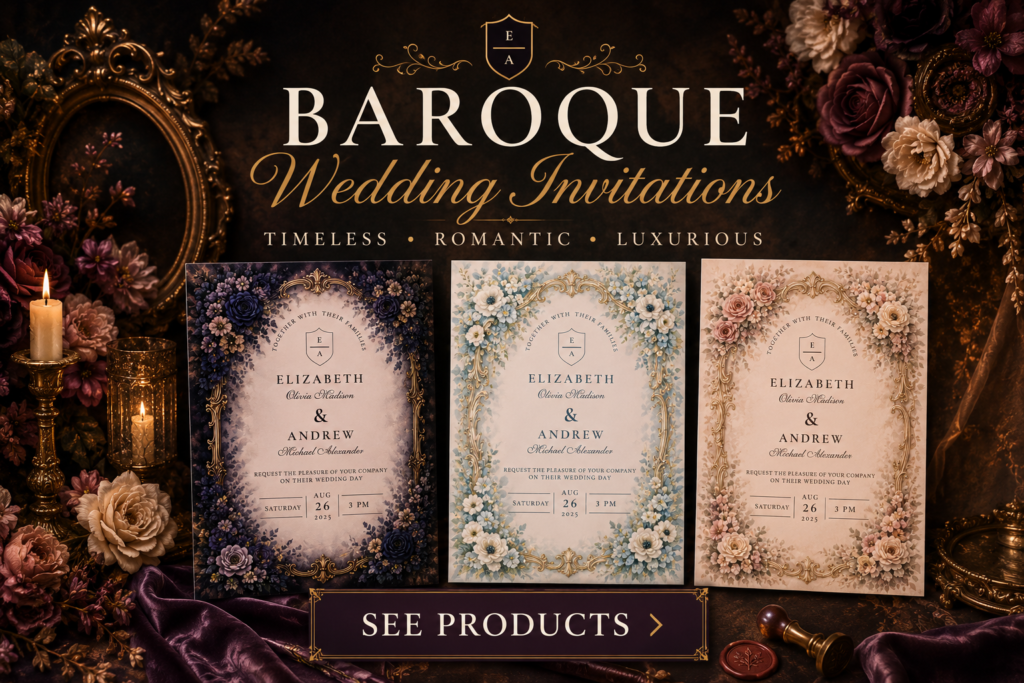
The baroque wedding stationery suite is not simply information delivery. It is the first physical object from the wedding that enters a guest’s hands — and in the baroque tradition, it should be an object of genuine beauty in its own right. Heavy card stock in deep black, ivory, or rich burgundy. Letterpress or engraved printing in aged gold ink. Ornate botanical or architectural border illustration. A wax seal — large, deeply embossed, in gold or oxblood — on the envelope. Silk ribbon in the wedding palette tied around the full suite. And inside, a small card of hand-gilded edge detailing that makes the act of opening the envelope feel like opening a gift.
Stationery Materials
- 600gsm black or deep ivory cotton rag card stock
- Letterpress or engraved printing — never digital flat print
- Aged gold, champagne, or ivory ink throughout
- Hand-gilded or gold-leaf card edges on the invitation
- Large, ornate wax seal in gold, oxblood, or midnight blue
- Silk ribbon in the wedding palette binding the full suite
On-the-Day Pieces
- Menus in folded black card with gold letterpress printing
- Place cards on heavy ivory card with gold ink calligraphy
- Table plan displayed in an ornate gilded frame
- Order of service as a booklet bound in silk with wax seal
- Escort cards sealed individually with gold wax
- Favour cards tied with silk ribbon to gilded boxes
Food & Menu
The Baroque Wedding Menu: A Feast Worthy of the Room
The baroque wedding menu follows the same governing principle as every other element of the aesthetic: abundance deployed with intention. The baroque banquet tradition is one of extraordinary generosity — multiple courses of genuine quality and visual splendour, presented with the same formal ceremony as the room in which they are served. A baroque wedding dinner is not a tasting menu of precious minimal portions. It is a feast — rich, warming, generous, and unambiguously celebratory. Every course should be as visually beautiful on the plate as the room it arrives into, and the cumulative effect of an evening of great food in a great room should be one of genuinely total experience.
🥂
Arrival & Canapés
Champagne or vintage Crémant on arrival. Duck liver parfait with Sauternes jelly on brioche. Seared scallop with cauliflower and saffron. Caviar blinis with crème fraîche. Aged parmesan gougères warm from the oven.
🦞
First Course
Lobster bisque poured tableside with tarragon cream. Or a tower of heritage beetroot and aged goat’s cheese with walnut oil and micro herbs. Or a game terrine with port jelly and toasted brioche. Each dramatically plated for visual impact.
🦌
Main Course
Roasted venison haunch with truffle jus and celeriac purée. Côte de boeuf carved tableside. Whole roasted turbot with champagne beurre blanc. Each presented with the theatre and ceremony the occasion demands.
🍮
Dessert & Cheese
Dark chocolate and salted caramel opera cake. Pear and almond tart with aged Armagnac cream. A formal cheese trolley with five aged selections and seasonal accompaniments. Port served with the Stilton, always.
Music
Baroque Wedding Music: From Vivaldi to the First Dance
The music at a baroque wedding is one of its most powerfully atmospheric elements — and one of the most immediately and completely seasonally specific. Baroque music belongs to this aesthetic in a way that no other musical tradition quite does. A string quartet playing Vivaldi as guests arrive, Bach’s Cello Suite No. 1 as the processional begins, Handel’s Water Music during the drinks reception — these are not simply beautiful musical choices. They are the audio equivalent of the gilded mirrors and the towering candelabras. They complete the world that the decoration has built.
🎻 Ceremony
A string quartet playing period repertoire as guests are seated. Bach’s Air on the G String for the bridal processional — the most completely correct piece of music for a baroque ceremony. Handel’s Arrival of the Queen of Sheba as the recessional. Purcell’s Trumpet Voluntary for a more martial, celebratory exit.
🎺 Drinks Reception
Handel’s Water Music suite played by a small ensemble in a corner of the reception room. Vivaldi’s Four Seasons at low conversational volume. Or a solo harpsichordist for the most period-authentic option of all — the instrument’s distinctive timbre transforms the sonic atmosphere of any baroque room instantly.
🎶 Dinner
A string quartet or small chamber ensemble playing Baroque and early Classical repertoire throughout dinner — Corelli, Telemann, Scarlatti — at a volume that enriches rather than competes with conversation. The music should feel as though it belongs to the room.
🎵 Evening
The transition from period music to the evening celebration requires care. A jazz trio or a sophisticated band playing classic and contemporary repertoire maintains the formal elegance of the occasion without feeling anachronistic. Brief them to dress appropriately for the setting.
Guest Experience
The Baroque Wedding Guest Experience: Every Sense, Every Moment
The baroque aesthetic promises its guests not merely a beautiful evening but a complete experience — one that engages every sense simultaneously and maintains an elevated atmosphere from the moment of arrival to the final farewell. This promise, once made by the invitation and the venue, must be kept at every point throughout the day. There must be no weak links — no moments where the guest steps from the extraordinary back into the ordinary. The baroque wedding guest experience is built from a series of carefully orchestrated sensory encounters, each designed to deepen rather than interrupt the total immersion that the aesthetic demands.
👁️ The Visual
Every surface, every angle, every detail designed and considered. From the gilded invitation to the final mirror in the farewell corridor — the eye should find beauty without interruption at every scale and in every direction throughout the entire evening.
👂 The Auditory
Period music from arrival through to dinner. The sound of the room — conversation, crystal, candleflame — is itself a baroque element. Brief musicians to fill the space without overwhelming it. The music should feel as though it belongs to the walls.
👃 The Olfactory
Unscented beeswax candles on the dining tables. A diffuser of warm amber, labdanum, or vetiver at the venue entrance. Fresh flowers throughout — roses, peonies, and dark botanicals whose natural fragrance completes the sensory world. Never competing scents.
👅 The Gustatory
Food of genuine quality and formal ambition, served with ceremony and with wine of appropriate stature. Every course presented as beautifully as the room it arrives into. The flavour should match the grandeur of the visual setting at every moment of the meal.
The Baroque Wedding Promise
The baroque wedding makes a specific and demanding promise to its guests — one that no other aesthetic quite replicates. It promises that every moment of the evening will be extraordinary. Not just the ceremony, not just the first dance, not just the flowers on the table, but every transition, every threshold, every sensory encounter from the arrival to the farewell. This promise, made by the invitation and confirmed by the venue and completed by every detail between them, is what distinguishes the baroque wedding that succeeds completely from the one that merely looks impressive in photographs. Keep the promise in every room, at every hour, for every guest. That is the entire brief.
Common Mistakes
10 Baroque Wedding Mistakes to Avoid
- Choosing a modern or blank-canvas venue and attempting to construct the baroque aesthetic from scratch. The baroque aesthetic requires genuine architectural grandeur as its foundation. A blank white industrial space dressed with gold props and dark florals will not produce a baroque wedding — it will produce a baroque-adjacent event that reads as costume rather than conviction. The venue is the non-negotiable first decision.
- Confusing baroque with kitsch. Baroque is not gold spray paint on everything. It is not plastic candelabras from a party supplier. It is not a chandelier above a table that is otherwise unstyled. Baroque requires quality, craft, and genuine historical literacy at every level of the decoration scheme. The cheapest version of each element will always undermine the whole.
- Using bright or cool-toned gold rather than aged gold. Nothing undermines the baroque palette more immediately than the wrong tone of gold. Bright, brassy, or yellow-toned gold reads as garish rather than luxurious. The correct tone is burnished, aged, slightly dark — the gold of old picture frames and period furniture, not of contemporary metallic paint.
- Underscaling the floral arrangements. A baroque wedding with normally-scaled flower arrangements looks unfinished — as though the florist ran out of budget before the vision was complete. The baroque floral aesthetic requires arrangements that are noticeably, deliberately larger than conventional. If the centrepiece does not feel too large in the florist’s studio, it is probably the right size for the room.
- Choosing a bridal gown that is too simple for the setting. The minimalist slip dress that looks extraordinary in a contemporary venue disappears in a baroque one. The gown must have presence and visual weight — structural fabric, significant volume or detail, and the kind of silhouette that holds its own against gilded architecture and towering arrangements.
- Playing contemporary or casual music during any part of the formal reception. The atmospheric coherence of a baroque wedding is profoundly vulnerable to musical incongruity. A pop covers band playing in a gilded state room breaks the spell entirely and irrecoverably for the duration of their performance. The music must be appropriate to the setting at every stage of the evening, and the transition to contemporary entertainment must be managed with great care.
- Neglecting the transitional spaces. The baroque promise is a total immersive experience — which means the corridors, the staircases, the cloakroom approach, and the outdoor spaces must all be styled to the same standard as the ceremony and dining rooms. A gilded ballroom approached through an unstaged corridor produces a jarring discontinuity that breaks the total-world illusion the aesthetic requires.
- Using too many different metallic finishes simultaneously. Gold, silver, rose gold, bronze, and copper existing in the same decoration scheme create visual confusion rather than richness. Choose one metallic family — aged gold and antique bronze — and apply it consistently throughout. The discipline of one metallic palette produces a far more sophisticated and coherent result than the apparent generosity of several.
- Over-lighting the space with modern electrical fittings. Bright overhead lighting, modern spotlights, and contemporary LED installations are incompatible with the baroque aesthetic at any level. Every electrical light source in a baroque wedding venue should be filtered, dimmed, or replaced with warm-toned period-appropriate alternatives. The baroque aesthetic belongs to candlelight and to no other primary light source.
- Treating the baroque aesthetic as a theme rather than a conviction. The guests at a baroque wedding can feel the difference between a couple who chose this aesthetic because they are genuinely, deeply drawn to its history, its beauty, and its specific grandeur — and a couple who chose it as a stylistic option among several. The baroque wedding that succeeds completely is the one where the aesthetic is not a costume but a genuine expression of who the couple are and what they believe a wedding day should feel like. Commitment is everything. Half-commitment produces half a baroque wedding — which is always less than the sum of its parts.
“The baroque wedding that succeeds completely is not one where the guests are impressed. It is one where they are transported — where the whole weight of a great aesthetic tradition is deployed in the service of a single evening’s joy, and where they step back into ordinary life feeling, briefly but profoundly, that they have been somewhere extraordinary.”
— The Baroque Wedding Edit
Final Thoughts
The Baroque Wedding Is an Act of Genuine Creative Courage
In a wedding landscape that continues to favour the minimal, the neutral, and the safely contemporary, the couple who chooses the baroque aesthetic is making a statement of genuine creative conviction. They are saying, with every gilded mirror and every towering candelabra and every over-scaled floral arrangement, that they believe a wedding day should be extraordinary — not tastefully beautiful but genuinely, unapologetically magnificent. That the people they have invited deserve to spend an evening inside a world that was built specifically for them, from the most ambitious and most beautiful aesthetic tradition that Western decorative culture has produced.
This conviction, when it is genuine and when it is supported by the right venue, the right suppliers, and the right level of creative investment, produces weddings that guests describe not as beautiful but as extraordinary. Not as lovely but as unforgettable. Not as impressive but as genuinely moving — because the baroque tradition at its best does not merely delight the eye. It elevates the spirit. It creates the specific, rare sensation of being present in a space that has been made magnificent by human hands and human imagination, and of being grateful for both.
Choose the venue with the highest ceilings you can find. Commission the florist who thinks in terms of scale and composition rather than arrangement. Light everything with real candles and period chandeliers. Dress for a room that belongs to another century. Feed your guests as though the harvest of the entire kingdom has been brought indoors for the occasion. Play Handel. And then, when the candles are lit and the room is full and the music begins, step back and look at what you have built — and know that you chose the most beautiful and the most difficult path, and that it was worth every moment of the journey.
Ready to Plan Your Baroque Wedding?
Explore our curated directory of baroque wedding specialists — venues, florists, decorators, caterers, musicians, and stylists chosen for their mastery of the aesthetic, their historical literacy, and their ability to build a world of genuine, extraordinary grandeur around a single magnificent day.