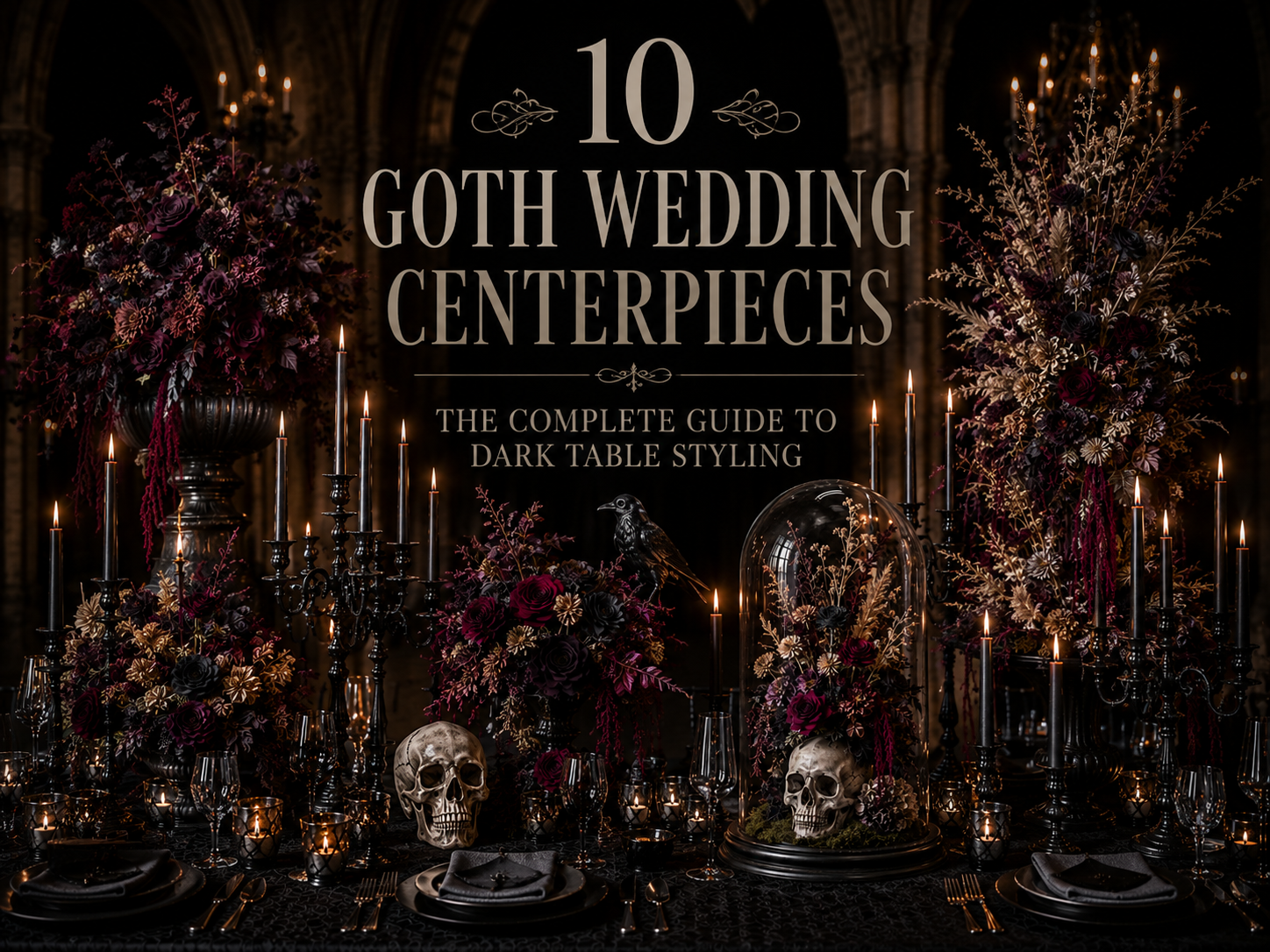
10 Goth Wedding Centerpieces – The Complete Guide to Dark Table Styling
The Gothic Wedding Edit · 2026
Goth Wedding Centerpieces
The Complete Guide to Dark, Dramatic & Deeply Intentional Table Styling
From towering iron candelabras and dark floral abundance to dried botanical constructions, memento mori vignettes, and the layered tablescapes that transform a dining room into a gothic world — your definitive guide to goth wedding centerpieces in 2026.
Introduction
Why Goth Wedding Centerpieces Require More Creative Intention Than Any Other Element of the Table
The wedding centerpiece is the decoration that guests live with most intimately and for the longest sustained period of the entire celebration. The ceremony arch is seen for thirty minutes. The entrance wreath is noticed on arrival. The ceiling installation is glanced at between conversations. But the table centerpiece is directly in front of every guest for two, three, sometimes four hours — close enough to touch, close enough to examine in detail, close enough to assess the quality and intention of every element within it. It is the decoration that is most completely, most personally experienced by the people the wedding is being built for. And for the goth wedding, which depends more than any other aesthetic on the total coherence of its world, the centerpiece is the element that either completes the immersive atmosphere or reveals its limits.
Goth wedding centerpieces in 2026 operate across a richer creative range than at any previous point in the history of alternative wedding design. They encompass the dramatically tall — towering iron candelabras carrying multiple real flames above generous spilling floral arrangements — and the intimately low — a moss-covered, candle-scattered, memento mori vignette that rewards close examination at table level rather than demanding attention from across the room. They encompass fresh dark flowers in stone urns, dried botanical constructions bound in dark ribbon, and mixed fresh-and-dried compositions of extraordinary visual complexity. They encompass the architectural and the organic, the formally symmetrical and the deliberately wild, the Victorian and the contemporary. What all of them share is the quality that the gothic aesthetic always demands: complete, deliberate creative intention applied to every element of the composition, at every scale, simultaneously.
This guide covers the full landscape of goth wedding centerpieces in 2026 — from the ten defining centerpiece designs and the specific materials and techniques that build them, through table styling principles, the role of candlelight, height and scale considerations, layering a complete tablescape, coordination with the wider decoration scheme, and the practical planning knowledge that ensures every table in the dining room is a complete, extraordinary expression of the dark world being built.
The Edit
10 Goth Wedding Centerpiece Ideas That Will Transform Your Reception Tables
Each of these ten centerpiece concepts represents a complete creative direction — a specific approach to the goth wedding dining table that can be adapted to different venue contexts, budget levels, and aesthetic emphases. Read each as a starting brief for a conversation with your florist and decorator, and notice which one makes you feel, immediately and instinctively, that this is the table you want your guests to find when they sit down for dinner.
01
The Towering Iron Candelabra
A tall branching iron candelabra — two metres or more in height — holding multiple real taper candles at varying heights, positioned as the central vertical anchor of the dining table and surrounded at its base by a generous, spilling arrangement of dark florals: black Baccara roses, deep burgundy dahlias, dark anemones, and trailing botanical elements that cascade from the base of the candelabra outward across the table surface. The iron candelabra centerpiece is the most dramatically atmospheric and the most completely gothic of all wedding table centerpiece formats — it provides vertical scale, multiple real flames, and the specific quality of iron patina against candlelight that is one of the most powerfully Victorian and most instantly recognisable visual signatures of the goth wedding aesthetic. Photographed from across the room, a row of tables each anchored by a tall iron candelabra in full flame creates one of the most extraordinary dining room images in all of contemporary wedding photography.
02
The Dark Floral Abundance in Stone Urn
A large stone or aged bronze urn — genuinely heavy, genuinely aged, with the patina of a piece that has been somewhere before — filled with an overflowing abundance of dark florals constructed in the Flemish still-life tradition: every bloom at its most fully open, foliage and trailing elements extending beyond the vessel’s edge, the composition deliberately asymmetric and apparently uncontrived. The arrangement spills rather than sits, cascades rather than stands, and communicates a quality of lavish botanical generosity that is both completely gothic and completely, overwhelmingly beautiful. This centerpiece works equally powerfully at low table height — positioned directly on the table surface with candle clusters arranged around and between the trailing elements — and at medium height on a small stone or wooden plinth. It is the most romantically abundant of all goth wedding centerpiece formats.

03
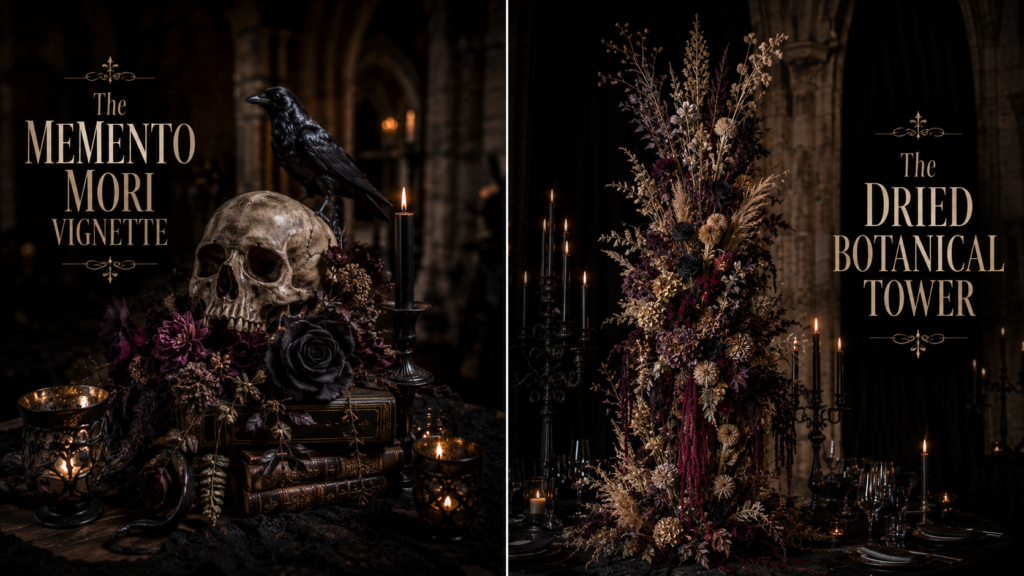
The Memento Mori Vignette
A low, intimately scaled table centerpiece constructed as a memento mori composition — a small oxidised silver skull candleholder at the centre, surrounded by a cluster of dark votives in amber and dark glass, with a handful of dried botanicals arranged organically around them: a few lunaria seed discs, a small twisted willow stem, scattered dried rose petals in near-black, and a single perfect near-black anemone placed as though it simply arrived there. The memento mori vignette operates at a completely different scale and register from the towering candelabra — it is not a spectacular centerpiece but an intimate one, noticed at close range by guests sitting at the table rather than from across the room, and communicating a depth of gothic aesthetic intelligence and cultural literacy that scale and spectacle cannot replicate. It is the centerpiece of a Victorian goth wedding that takes its own tradition seriously.
04
The Dried Botanical Tower
A tall construction of dried botanical material — dark pampas grass stems at the apex, descending through dried cotton stems, lunaria seed discs, twisted willow, dried dark roses preserved at their deepest colour, seed pods, and dried botanical grasses — assembled into a vertical arrangement of extraordinary textural complexity and organic darkness that can be built to almost any height without the wilting concerns of fresh flower arrangements. The dried botanical tower is the most durable and the most sustainably produced of all goth wedding centerpiece options — it can be constructed weeks in advance, it holds its appearance throughout the entire event regardless of temperature or humidity, and it can be taken home and displayed indefinitely after the wedding. At the right height — approximately seventy to ninety centimetres — it reads as a statement centerpiece without blocking cross-table conversation, which makes it the most practically versatile of all the tall centerpiece options.
05
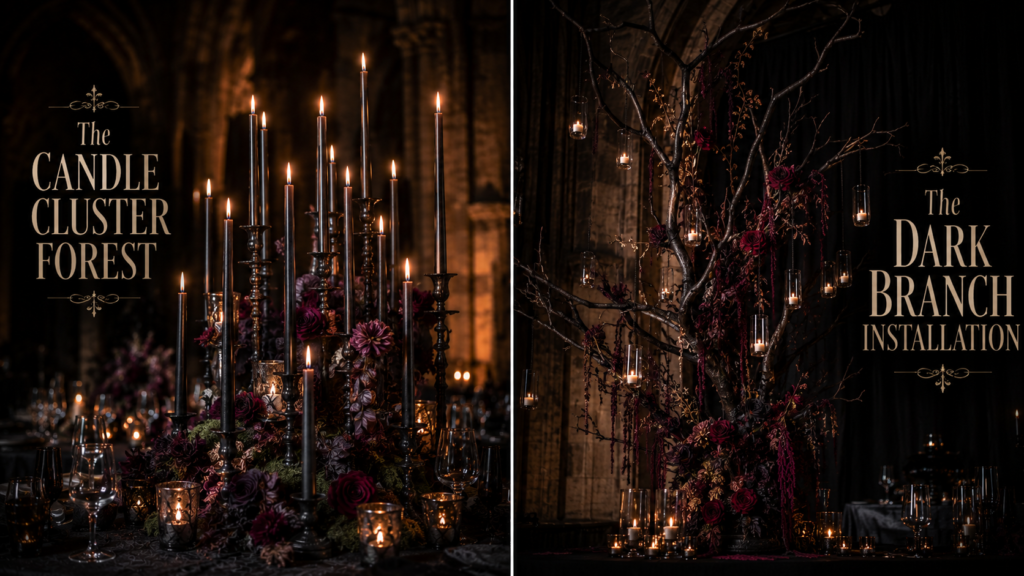
The Candle Cluster Forest
No flowers. No dried botanicals. No decorative objects. Simply a dense, richly varied cluster of real pillar candles in near-black, deep burgundy, or unbleached beeswax — in every available height from five centimetres to sixty — grouped in a mass of varying heights and widths on mirrored surfaces, dark slate tiles, or a spread of moss, with amber glass votives filling every gap between the larger pillars. The candle cluster forest centerpiece is the most purely atmospheric of all goth wedding table concepts — it communicates the gothic aesthetic entirely through light rather than through objects, and it creates a quality of warm, multi-source, constantly flickering illumination at table level that is impossible to replicate through any other centerpiece format. It also requires the most careful venue management of all the options — naked flame at that density demands attentive staff and clear guidelines about proximity of flammable materials.
06
The Dark Branch Installation
A dramatic bare branch or twisted willow stem — genuinely architectural in its scale, potentially as tall as the ceiling allows — positioned at the centre of the table and decorated with hanging elements: tiny dark florals wired to specific branch points, hanging crystal drops catching the candlelight, suspended tea lights in small glass holders at varying heights along the branches, and scattered dark dried elements woven through the structure. The dark branch installation creates a vertical presence of extraordinary organic drama — it reads as something that grew in the room rather than being placed in it, and in a stone-walled venue with high ceilings it produces one of the most dramatically beautiful goth wedding table images available. The installation format also allows each table to be slightly different from every other as the natural variation of each branch produces a naturally unique silhouette.
07
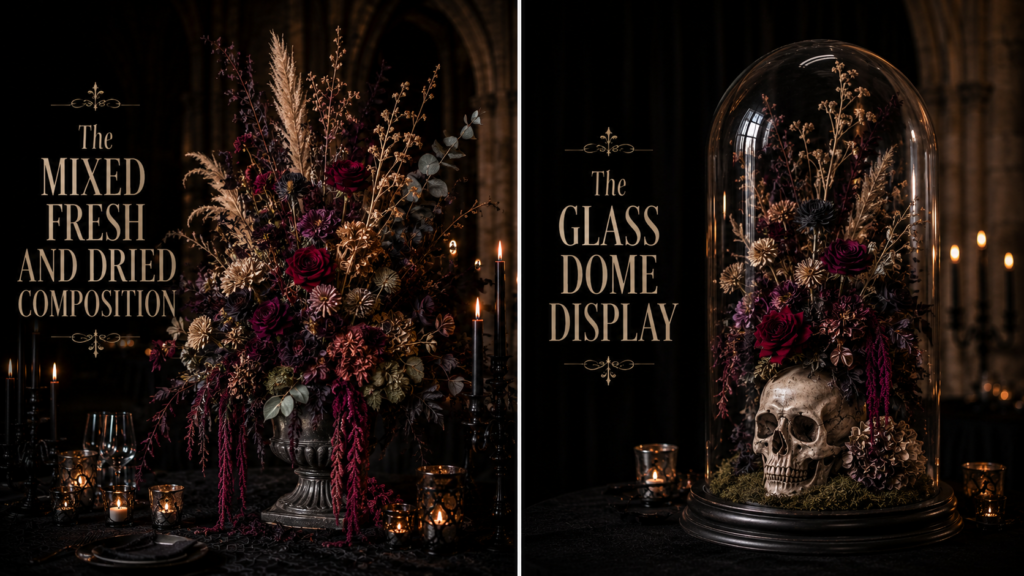
The Mixed Fresh and Dried Composition
A centerpiece that combines fresh dark blooms with dried botanical elements in a single, richly layered composition — dark Baccara roses and deep burgundy dahlias among lunaria seed discs and dried cotton stems, near-black anemones beside dark preserved leaves and twisted willow, chocolate cosmos placed against a background of dried pampas and seed pods. This combination creates a visual and textural complexity that neither fresh flowers alone nor dried botanicals alone can achieve — the softness and fragrance of the fresh blooms against the papery texture and aged quality of the dried elements creates a centerpiece that reads simultaneously as living and ancient, as richly contemporary and deeply historic. It is the most creatively layered and the most aesthetically sophisticated of all the goth wedding centerpiece formats, and it is also one of the most durable — the dried elements hold their appearance throughout the entire event while the fresh flowers provide the fragrance and the specific luminous quality that distinguishes fresh from preserved.
08
The Glass Dome Display
A Victorian glass dome — the kind originally designed to protect taxidermy, wax flowers, and natural history specimens on Victorian mantelpieces — placed over a carefully constructed gothic interior composition: a small skull surrounded by dark moss and dried botanicals, a cluster of preserved dark roses at the peak of their bloom, a single dark anemone on a bed of dried lunaria, or a small architectural arrangement of dark branches and crystals. The glass dome centerpiece is the most purely Victorian of all goth wedding table formats — it references the Victorian domestic aesthetic of the parlour and the natural history cabinet directly, and it creates a specific, contained, theatrically framed quality of display that no open arrangement can approach. Photographed at table level with candlelight reflecting in the glass, the dome centerpiece produces images of extraordinary intimacy and historical depth.
09
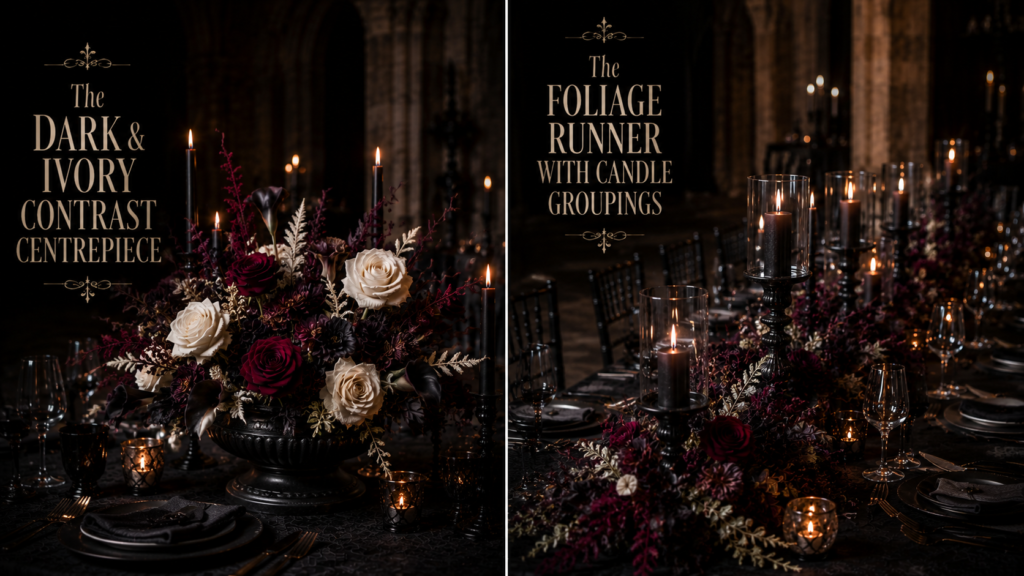
The Dark & Ivory Contrast Centrepiece
A centerpiece that uses the contrast between very dark and ivory or bone-white elements as its defining visual language — near-black anemones with their white centres beside ivory peonies, black Baccara roses interspersed with champagne garden roses, dark smoke bush foliage against pale ivory ranunculus, all arranged in a dark stone or oxidised silver vessel with ivory beeswax pillar candles of varying heights clustered at the arrangement’s base. The dark and ivory contrast centerpiece is the most photographically complex and the most broadly beautiful of all goth wedding table formats — it works magnificently on both dark velvet and pale linen table surfaces, it reads as simultaneously gothic and formally elegant, and it suits the widest range of wedding contexts of any option on this list. It is also the most sympathetically received by guests whose aesthetic sensibilities span the widest range.
10
The Foliage Runner With Candle Groupings
A long, loosely constructed runner of dark foliage — copper beech, dark ivy, rosehip vine, trailing dark smoke bush, and scattered dried botanicals — running the entire length of the dining table and interspersed at regular intervals with groupings of three to five pillar candles in iron and aged brass holders of varying heights, with clusters of amber votives filling the spaces between. Individual dark blooms — a single black Baccara rose, a single dark anemone — placed at irregular points along the runner rather than gathered into a central arrangement. This format creates a continuous, organic dark botanical landscape the full length of the table rather than a single focal centerpiece, and it produces a quality of abundance and natural generosity that no individual centerpiece can match. It suits long banquet tables particularly powerfully and creates one of the most beautiful dining room vistas in all of goth wedding photography when photographed from the end of the table looking down its length.
“The goth wedding centerpiece that guests remember is not the tallest or the most expensively constructed. It is the one they found themselves examining from thirty centimetres away at 9pm, two hours into dinner, noticing a detail — a single perfectly preserved dark rose, a crystal drop catching a candle, a lunaria disc casting its own shadow — that they had not noticed before and that made the table feel, in that moment, like somewhere entirely extraordinary.”
— The Gothic Wedding Edit
Height & Scale
Height and Scale in Goth Wedding Centerpieces: The Creative Decision That Changes Everything
The height of a wedding centerpiece is not simply a practical decision — it is a fundamental aesthetic one that determines what the table looks and feels like for every person sitting at it. A very tall centerpiece changes the visual dynamic of the room, adds vertical drama visible from across the space, and creates a quality of occasion and grandeur that low arrangements cannot approach. But it also blocks the line of sight between guests sitting opposite each other, which affects the social atmosphere of the dinner in ways that must be considered alongside the visual ambitions of the decoration scheme. A very low centerpiece preserves cross-table visibility and conversation but reduces the visual impact of the table in the overall room. The most sophisticated goth wedding table designs are those that use height intelligently — combining genuinely tall elements that create room-level drama with low, intimate elements that reward close attention — rather than choosing a single height for the entire composition.
🕯️
Very Tall: 120cm+
Iron candelabras and tall branch installations at this height read from across the entire room and create genuine architectural drama. They require high ceilings to look proportionate. The stem or structure must be slim enough that the line of sight between seated guests passes below the spread of the arrangement above — typically clearing at around 70cm and spreading above 120cm.
🌹
Medium: 50–80cm
The most challenging height range for table centerpieces — too tall to see comfortably over but too low to see under. Generally avoided by experienced decorators unless the arrangement is deliberately narrow and transparent enough to see through. Dried botanical towers work at this height if their silhouette is open rather than solid.
🌿
Low: Under 35cm
Low centerpieces and table runners preserve full cross-table sightlines and create intimacy at table level. They photograph most beautifully from a low angle and reward close examination. The most appropriate height for vignette-style centerpieces, candle cluster forests, and foliage runner compositions. The dominant height choice for long banquet tables.
✨
Combined Heights
The most visually sophisticated approach: one very tall element — an iron candelabra or a branch installation — combined with a low floral arrangement and a candle cluster at table level. The eye moves vertically through the table composition, finding beauty at every height simultaneously. The most complete expression of the layered goth aesthetic at the table surface.
Layering the Tablescape
The Complete Goth Wedding Tablescape: Layering Every Element From Base to Apex
The goth wedding centerpiece exists within a complete tablescape — a layered composition of base elements, mid-level details, and vertical anchors that together create the total aesthetic experience of the dining table. The centerpiece, however extraordinary in isolation, is always most powerful in the context of the table surface it inhabits: the colour and texture of the tablecloth, the quality of the place settings, the finish of the cutlery and glassware, the style of the napkins, and the small personal details at each place setting all contribute to or detract from the total visual impact of the centerpiece above them. A magnificent iron candelabra arrangement on a generic ivory polyester tablecloth loses most of its power. The same arrangement on a deep jewel-toned velvet tablecloth gains it entirely.
Base Layer: The Table Surface
- Tablecloth: Deep jewel-toned velvet in oxblood, midnight plum, or near-black — the single most impactful single table decision available
- Runner: A length of dark lace, aged linen, or loose foliage running down the centre over the tablecloth
- Charger plates: Gold-rimmed, dark-edged, or aged bronze — never white or bright silver
- Cutlery: Aged brass or oxidised silver — not polished chrome or stainless steel
- Glassware: Dark-stemmed or smoked glass where available; at minimum dark-toned wine glasses
- Napkins: Dark linen or very deep ivory, tied with dark ribbon or a sprig of dried rosemary
Detail Layer: Personal & Intimate Elements
- Place cards: Dark card stock hand-lettered in gold or silver ink — or on dried magnolia leaves
- Menus: Dark card with letterpress or foil printing — placed across the napkin or on the charger
- Scatter elements: Dried petals, scattered lunaria discs, individual dried seed pods, or a few crystals
- Personal favour: Placed at each setting as a deliberate part of the table composition
- Small votive: One amber glass votive per place setting in addition to the central candle groupings
- A single bloom: One perfect dark rose or anemone laid across the place card at selected settings
The Rule of Odd Numbers in Goth Wedding Table Styling
Every professional decorator working in the goth and dark wedding space applies the same foundational principle to candle groupings, votive clusters, and botanical vignettes: always use odd numbers. Three pillar candles of varying height read as a composed arrangement; two or four read as symmetrical and lifeless. Five mismatched vessels in a centerpiece grouping appear curated; four or six appear mechanical. Seven votives scattered at the base of a candelabra create energy; six sit in static formation. The odd number creates the eye movement and visual interest that the gothic aesthetic — which is fundamentally about depth, tension, and the barely controlled abundance of dark material — requires at every scale. Apply it to every candle group, every votive cluster, every botanical arrangement, and every scatter element on the table surface. It costs nothing and produces a measurably more beautiful and more visually alive composition every time.
Vessels & Materials
Vessels and Materials for Goth Wedding Centerpieces: What to Use and Why It Matters
The vessel that contains a goth wedding centerpiece is as important a creative decision as the flowers or botanicals placed within it — because the vessel communicates the age, the quality, and the aesthetic intelligence of the entire composition before a single bloom has been examined. A dark floral arrangement in a clear glass cylinder vase communicates nothing gothic regardless of how dark the flowers are. The same arrangement in a stone urn, an aged terracotta pot, an oxidised iron vessel, or an antique bronze bowl communicates the gothic aesthetic immediately and completely through the material quality of the container alone. The vessel must carry the same aged, patinated, historically resonant character as every other element of the goth wedding decoration scheme — it must look as though it belongs to the same world, not as though it was borrowed from the nearest florist’s supply catalogue.
Correct Vessel Materials
- Stone urns and bowls — the most authentically gothic vessel; heavy, aged, and architecturally powerful
- Oxidised iron and blackened metal — candleholders, vases, and containers with genuine dark patina
- Aged terracotta and dark ceramic — organic texture and the suggestion of age and outdoor origins
- Antique bronze and aged brass — warm metallic with the patina of genuine age and genuine use
- Dark stained or reclaimed wood — for bases, platforms, and low-profile botanical displays
- Mercury and foxed glass — dark-toned, antique-effect glass for votives and smaller vessels
- Victorian glass domes — for enclosed display compositions; the most historically specific vessel available
What to Avoid
- Clear glass cylinder vases — the most common wedding vessel and the most aesthetically neutral; communicates nothing gothic
- Bright polished chrome or stainless steel — too contemporary and too clean for the aged gothic aesthetic
- White ceramic — aesthetically incompatible with any dark gothic palette regardless of the contents
- Plastic or acrylic in any form — the quality of material matters as much as the colour in gothic aesthetics
- Novelty or themed vessels — skull-shaped vases as the vessel rather than the accent; too literal and too light
- Brightly coloured glazed pottery — competes with the dark palette and communicates the wrong aesthetic entirely
Practical Planning
Ten Things Every Couple Should Know Before Planning Goth Wedding Centerpieces
- Confirm the venue’s candle policy before building any centerpiece design around real flame. This is the first practical question to ask any venue and the answer that should most significantly influence the centerpiece approach. A goth wedding centerpiece scheme built around the candle cluster forest, the iron candelabra, or any heavily candle-dependent format requires explicit venue permission for naked flame — and many historic and licensed venues prohibit or significantly restrict it. Know this from the first site visit, not the week before the wedding.
- Brief the florist and decorator together on the complete table vision, not just the centerpiece. The centerpiece exists within a complete tablescape and the most powerful results come from a florist and decorator who have discussed the table composition as a whole — choosing vessel types, table surface materials, scatter elements, and candle formats in direct conversation rather than as separate commissions. Brief both suppliers together at the same meeting and bring photographs of every element of the aesthetic world so both can make decisions in the right context.
- Build a sample table before the wedding and photograph it in the actual venue lighting. A centerpiece that looks extraordinary under studio or daylight conditions may look entirely different in the specific low-light, warm-amber, candlelit conditions of the actual reception venue. Building a complete sample table — with the actual tablecloth, the actual vessel, the actual candles and votives, and a close approximation of the planned floral arrangement — at a venue visit several weeks before the wedding is the single most valuable planning step available for any goth wedding centerpiece scheme. Photograph it from multiple angles and in multiple lighting conditions, and use the results to confirm or adjust every element of the design before committing to the full-scale execution.
- Plan the installation timeline with significantly more buffer than seems necessary. A goth wedding centerpiece scheme — particularly one involving iron candelabras, heavy stone urns, complex dried botanical towers, or elaborate mixed fresh-and-dried compositions — takes far longer to install than its finished appearance suggests. Every candle must be individually placed and positioned. Every floral element must be arranged rather than simply distributed. Every votive must be placed and lit. For a reception with fifteen tables, this process can take three to five hours. Confirm the venue’s access schedule well in advance and build a realistic, generously buffered installation timeline before the celebration begins.
- Candle height matters as much as candle quantity. The most atmospherically powerful goth wedding tables are those where candles exist at multiple different heights simultaneously — very tall tapers in the candelabra, medium pillar candles in iron holders, and low votives at table level — because the varying heights of flame create a visual rhythm and depth that a single candle height cannot produce. When planning candle quantities and holder types, always specify the range of heights to be used rather than a single standard height, and ensure the venue team understands the intended arrangement before installation begins.
- Dark flowers in very dark rooms require specific planning for visibility. Near-black flowers — dark anemones, black Baccara roses, chocolate cosmos — can appear as undifferentiated dark shapes in very low candlelight photography if not specifically accounted for in the centerpiece design and the lighting scheme. Ensure every centerpiece incorporates some elements that will catch and reflect the available light — pale flowers or ivory elements for contrast, glass or crystal objects that scatter candlelight, gold or metallic accents at the arrangement’s edge. Brief the photographer specifically on how the centerpiece should be lit for close detail shots.
- Consider the practical implications of very tall centerpieces for service and conversation. A two-metre iron candelabra is visually spectacular but practically demanding — it requires careful management during service to prevent waiting staff from colliding with it, it restricts the eye contact and conversation across tables in certain configurations, and it must be stable enough to withstand the incidental contact of a busy reception dining room without tipping. Discuss these practical considerations explicitly with your venue’s events team before finalising any very tall centerpiece format.
- Source dried botanical materials at least three months before the wedding. The specific dark dried botanicals that produce the most extraordinary goth wedding centerpieces — large statement pampas grass, well-formed lunaria seed heads in their most translucent and beautiful form, perfect dried dark roses, artistically formed twisted willow — sell out quickly in the months approaching the wedding season and particularly in the autumn months when the goth wedding aesthetic is most popular. Begin sourcing dried materials at least three months before the wedding, and store them in a cool, dry, dark space until they are required for installation.
- The centerpiece must be assessed in the context of the complete table setting, not in isolation. The most common mistake in goth wedding centerpiece planning is approving a design based on photographs of the centerpiece alone — without seeing it on the actual table surface, with the actual charger plates, cutlery, glassware, and napkins that will surround it on the day. A centerpiece that looks magnificent against a plain white background may look entirely different against a deep velvet tablecloth surrounded by gold-rimmed charger plates and dark-stemmed glassware. Always assess the complete table composition together, at a sample table, before confirming any centerpiece design.
- The most powerful goth wedding centerpiece is always the one that feels completely inevitable in its specific venue, on its specific table, at its specific celebration. Not the most dramatic, not the most expensive, not the one that most closely matches a reference photograph from a different wedding in a different space — the one that belongs to this specific dark world so completely that removing it would leave not just a gap but a fundamental incoherence. That quality of felt inevitability is achieved through patient, specific, completely contextual design thinking — through knowing the venue’s architecture, the tablecloth’s colour, the candlelight’s quality, and the couple’s own deepest aesthetic instincts, and building something that could only ever have been made for exactly this occasion. That is the standard. Everything else is simply working toward it.
“A goth wedding centerpiece planned with complete intention does not look designed. It looks discovered — as though the iron, the velvet, the dark roses, and the candles were always going to be arranged exactly like this, on exactly this table, in exactly this room, on exactly this evening. That inevitability is the hardest thing to manufacture and the only thing that ultimately matters.”
— The Gothic Wedding Edit
Final Thoughts
Build the Table Completely. Every Detail. Every Height. Every Surface.
The goth wedding centerpiece is where the dark world of the celebration is most completely and most personally inhabited by every guest — the element they sit with longest, examine most closely, and carry most specifically in their sensory memory of the evening. A tall iron candelabra lit with real flame above a spilling abundance of dark roses on a deep velvet tablecloth at ten o’clock in a candlelit stone room, with the sound of the band beginning in the distance and a glass of dark wine in the hand — this is what remains. This specific, completely achieved combination of dark material and warm light and organic abundance and the quality of absolute intention applied to every detail of the table beneath it.
Brief the florist and decorator on the total table vision. Build a sample table and assess it in the actual light. Choose the vessel with the same care as the flowers. Apply the odd numbers. Confirm the candle policy. And then — when the tables are set and the candles are lit and the room is exactly what you imagined it to be — let your guests find their places at the dark, abundant, completely intentional tables you have built for them, and know that the world you have made is exactly, completely, without compromise the one you always intended.