Celestial Autumn Wedding
Autumn Wedding · 2026
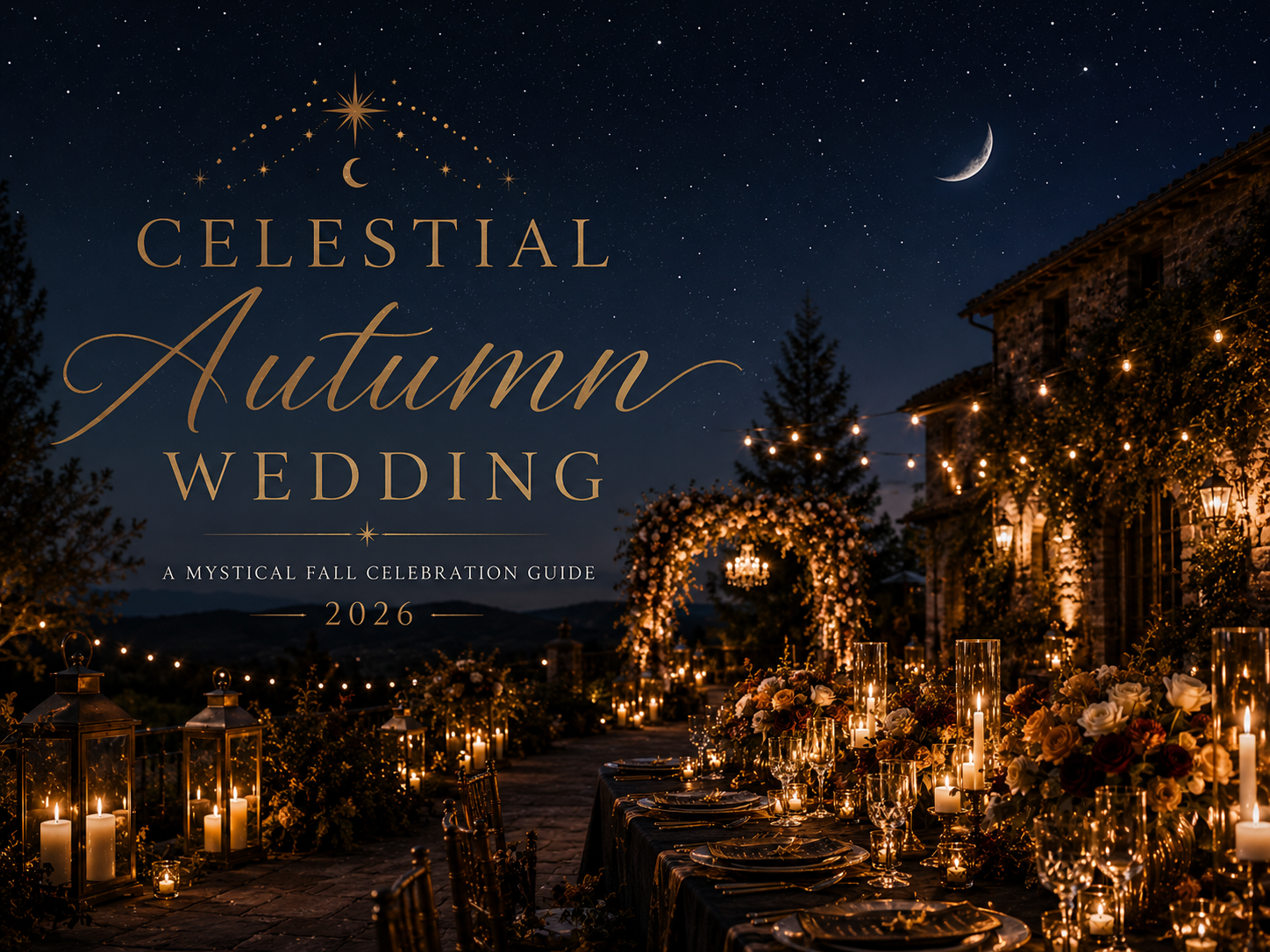
Celestial Autumn Wedding — A Mystical Fall Celebration Guide 2026
From the last gold light of an autumn dusk to a sky full of stars and the quiet hour before dawn — a celestial wedding follows the sky itself. Here is how to build a mystical autumn celebration around its phases.
A celestial autumn wedding is not a theme applied to an evening — it is an evening, followed honestly from its first warm light to its last quiet hour before sunrise. Autumn gives this aesthetic something no other season can: darkness that arrives early and lingers, air cold and clear enough to make stars feel close rather than distant, and a sky that seems, more than at any other time of year, worth paying attention to. This guide does not divide itself into styles or moments of a wedding day. Instead, it follows the sky itself — six phases of a single autumn night, each with its own colour, its own mood, and its own stationery to match.
Every night is the same length in theory and never in feeling. An autumn night begins earlier, deepens faster, and holds its stars longer — and for one evening, the sky will move through every phase of itself while a single celebration moves through its own.
Section 01
Why Celestial Weddings Belong to Autumn
A celestial wedding theme can be attempted in any season, but it belongs, in a very literal sense, to autumn. By October, darkness arrives while a reception is still in its early hours rather than waiting until guests are already leaving — which means that more of the celebration genuinely happens under a visible sky than at any other point in the year. The practical consequence is significant: a celestial wedding in June might see its first stars appear as the last guests are saying goodnight; a celestial wedding in October sees them appear while dinner is still being served.
Autumn air is also, simply, clearer. The humidity that softens and scatters starlight through a summer night thins considerably by October, and the result is a sky that looks — to the naked eye, with no equipment and no special conditions required — sharper, deeper, and closer than it does for most of the rest of the year. The harvest moon, when it falls near a wedding date, rises larger and more golden than at any other time. And there is something older at work too: the turning of the seasons has been marked by the sky for as long as humans have looked up at it, and an autumn celestial wedding taps, whether consciously or not, into that ancient habit of organising a significant moment around the movement of the night.
What follows is not a list of ideas to choose from, but a single evening, followed honestly from its first warm light to its last quiet hour. Six phases, each with its own colour story and its own stationery — because a wedding that takes its aesthetic from the sky should, in some sense, unfold the way the sky itself does.
Phase One
Golden Hour: The Last Light
Antique gold · Warm amber · Soft blue-grey · Bronze
Every celestial evening begins the same way every evening begins — with the sun still present, low in the sky, turning everything it touches gold and amber and bronze. Shadows stretch long across the ground. The sky directly overhead may already be losing its blue, fading toward something paler, while the horizon holds onto warmth for as long as it possibly can. This is the hour most ceremonies happen — not because of any celestial significance yet, but because this is simply when the light is most generous, most flattering, most alive. The night to come is not yet visible. It is only, faintly, anticipated — a coolness just beginning to enter the air, a sense that the warmth of the day is on loan rather than owned.
In the story of a celestial wedding, this golden hour is the invitation. Weeks or months before the actual evening, the save the date and the invitation suite arrive — the first warm light of the wedding, so to speak, before anything else unfolds. The invitation suite is the golden hour of the wedding story: the first warm light before everything else begins. A celestial wedding invitations suite in warm gold tones — antique gold typography, perhaps a single constellation rendered in metallic ink against a cream or soft amber background — captures this moment perfectly: the sense of something beautiful beginning, with the deeper mysteries of the night still ahead.
For Invitations & Save the Dates
The Vintage Gold Mystical Botanical Wedding and Celestial Art Nouveau Blue Gold Wedding collections — fully customizable with your names, date, and wedding details — both carry the warm gold tones of this opening phase, one in vintage botanical detail, the other with the first hints of the blue hour to come.
Phase Two
Blue Hour: Between Day and Night
Deep indigo · Sapphire blue · Antique gold · Soft silver
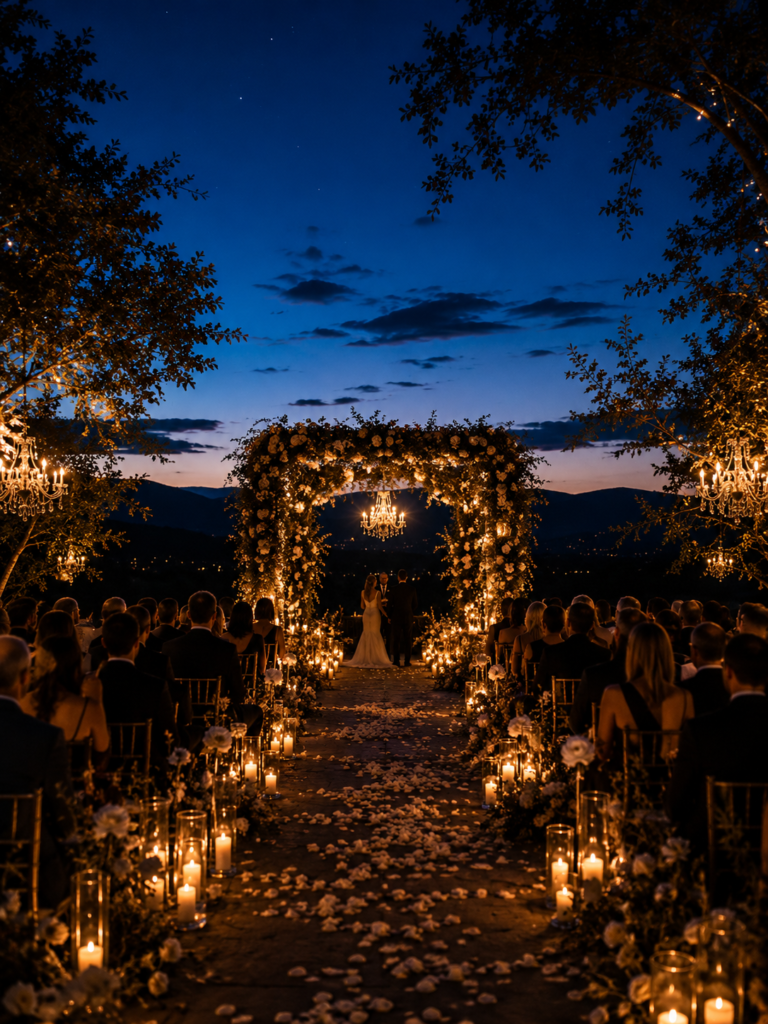
The sun goes, and for perhaps twenty minutes — sometimes less, in autumn, when everything happens faster — the sky becomes something it is at no other point in the day: a deep, saturated indigo and sapphire, lit from somewhere below the horizon rather than above it, with a colour so specific that photographers have a name for it precisely because it is so brief. The first stars, if you know where to look, are already visible — not many, but enough. This is the blue hour, and it is, by general agreement among anyone who has stood outside during it, the single most photographed and most quietly extraordinary phase of any evening.
For a celestial wedding, this is often when the ceremony itself happens, or when the transition from ceremony to reception unfolds — vows exchanged with that deep sapphire sky as a backdrop, or guests moving between spaces while the world around them performs its brief, nightly transformation. Blue hour is when celestial aesthetics feel most alive — and it’s often when ceremony programs and order-of-service cards are held in guests’ hands, the deep blue sky behind them matching the ink on the page almost exactly. There is something quietly moving about a guest glancing up from a printed programme, in deep indigo and gold, to find the sky above doing the same thing the page just did.
For Ceremony Programs
The Vintage Celestial Art Nouveau Wedding collection — fully customizable with your names, date, and wedding details — captures the deep blue twilight of this phase in botanical detail, ideal for programs held during the ceremony or the transition that follows it.
Phase Three
Early Night: Stars Emerging
Deep black · Antique gold · Scattered silver · Warm candlelight
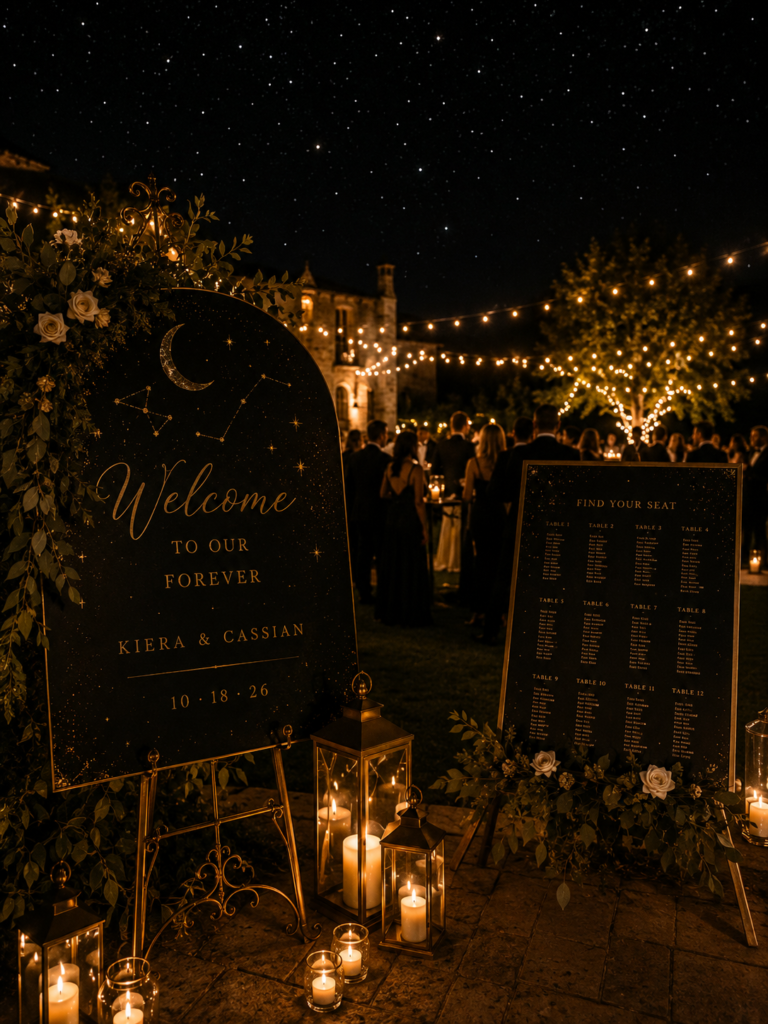
The indigo deepens to true black faster than seems reasonable. Within perhaps half an hour of the blue hour’s end, the sky has committed entirely — and the first proper constellations become visible, not as a faint scattering but as recognisable shapes, the kind that even a casual observer can pick out without trying. On the ground, the balance of light has shifted too: candlelight and string lights, which have been present but secondary all evening, now become the primary source of illumination. The reception is beginning in earnest.
This is the phase of arrival and entrance — guests moving from ceremony to reception, finding their welcome sign and table plan in the gathering dark, the first candles of the evening catching their attention before their eyes adjust fully. As the sky fully darkens, welcome signs and table plans often catch the first candlelight — and black and gold celestial designs seem to glow rather than simply reflect light, the metallic ink picking up every flicker of flame nearby in a way that no other colour combination quite achieves. A guest reading a welcome sign at this hour is, in effect, reading it by starlight and candlelight in roughly equal measure.
For Welcome Signs & Entrance Signage
The Black Gold Celestial Wedding collection — fully customizable with your names, date, and wedding details — was made for exactly this moment: the first true darkness, candlelight catching gold ink as guests arrive at the reception.
Phase Four
Deep Night: The Sky Fully Open
Deepest black · Scattered gold & silver · Rich antique gold
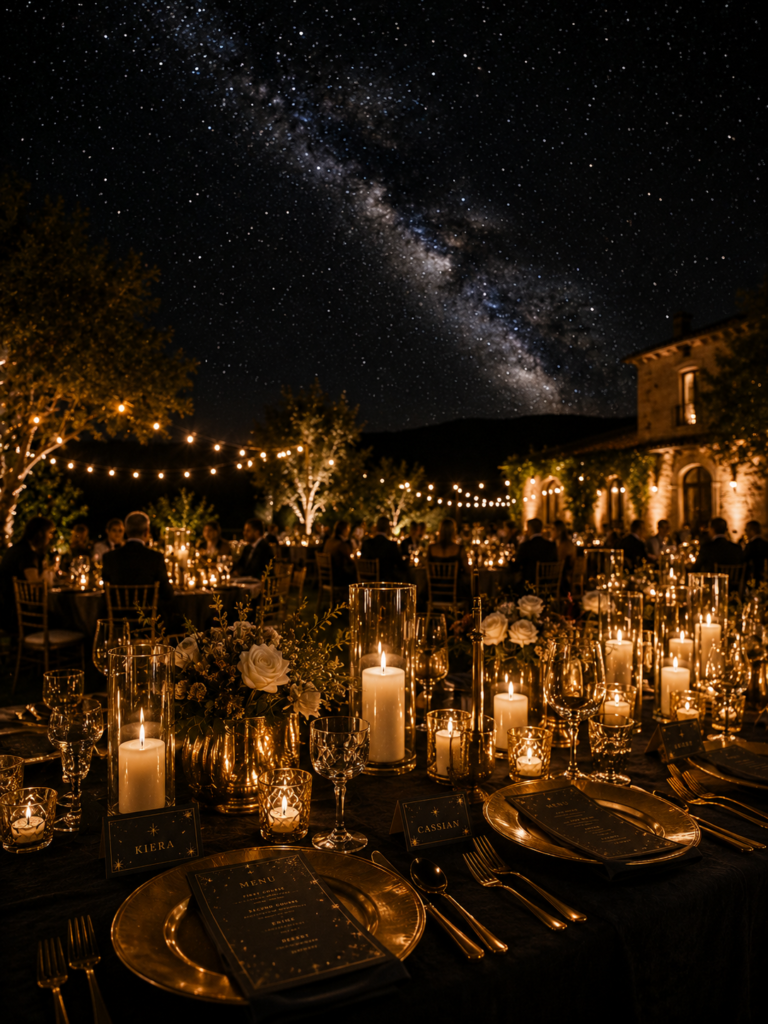
By full night, the sky has reached its most complete state — not just dark, but open, in the sense that the longer you look, the more it gives back. Stars that weren’t visible an hour ago reveal themselves as the eyes adjust fully; under genuinely dark conditions, the pale band of the Milky Way may even become visible, stretching across the sky in a way that no amount of description quite prepares a person for the first time they see it properly. This is the heart of the night, and it is also, not coincidentally, the heart of the reception — dinner well underway, the energy of the evening at its warmest, conversation loud enough to compete with whatever music is playing.
This is the moment the celestial aesthetic is truly at home — table settings under an open sky, menus and place cards that mirror the stars scattered overhead. The mystical black-and-gold palette finds its truest setting here: every place card a small dark rectangle with its own scattering of gold or silver stars, every menu a miniature version of the sky above the table it sits on. Guests at this hour are seated, settled, surrounded by candlelight and — if the venue allows it — an actual sky doing exactly what the stationery in front of them has been quietly suggesting all evening.
For Table Settings, Menus & Place Cards
The Mystical Black Gold Celestial Wedding Collection and Mystical Black Gold Wedding Collection — both fully customizable with your names, date, and wedding details — offer two distinct registers of the same deep-night palette, each suited to menus, place cards, and table numbers under an open sky.
Phase Five
The Witching Hour: Midnight & Beyond
Midnight black · Deep silver · Scattered stars · Cool moonlight
Something shifts after midnight that has nothing to do with the sky itself — the stars have not moved meaningfully, the temperature has only dropped a little further — and yet the hour feels different. Slightly eerie, slightly outside of ordinary time, the way late nights always do. On the dance floor, string lights overhead take on a different character against the now-total darkness beyond them; the sky, if anyone looks up between songs, seems closer than it did even a few hours ago, the silver of moonlight where there is moonlight, or simply an even deeper black where there isn’t. This is the most dramatic hour of the entire night, and it knows it.
Midnight is when celestial weddings lean into their most dramatic register — this is the hour for stationery with genuine gravity, midnight black backgrounds and scattered stars that feel like looking straight up rather than at a printed page. Late-night menu cards for coffee and dessert stations, large-format signage directing tired guests toward taxis or late-night snacks, the kind of pieces that don’t need to be subtle because subtlety is not what this hour is for. Everything at this point in the night can afford to be a little bolder, a little more dramatic — the same way the night itself has become.
For Late-Night Signage & Dessert Menus
The Celestial Midnight Black Stars Wedding collection — fully customizable with your names, date, and wedding details — is the boldest and most dramatic in this guide, built for exactly this hour and the pieces that belong to it.
Phase Six
Before Dawn: The Quiet Return
Deep indigo softening · Grey-blue · Antique gold
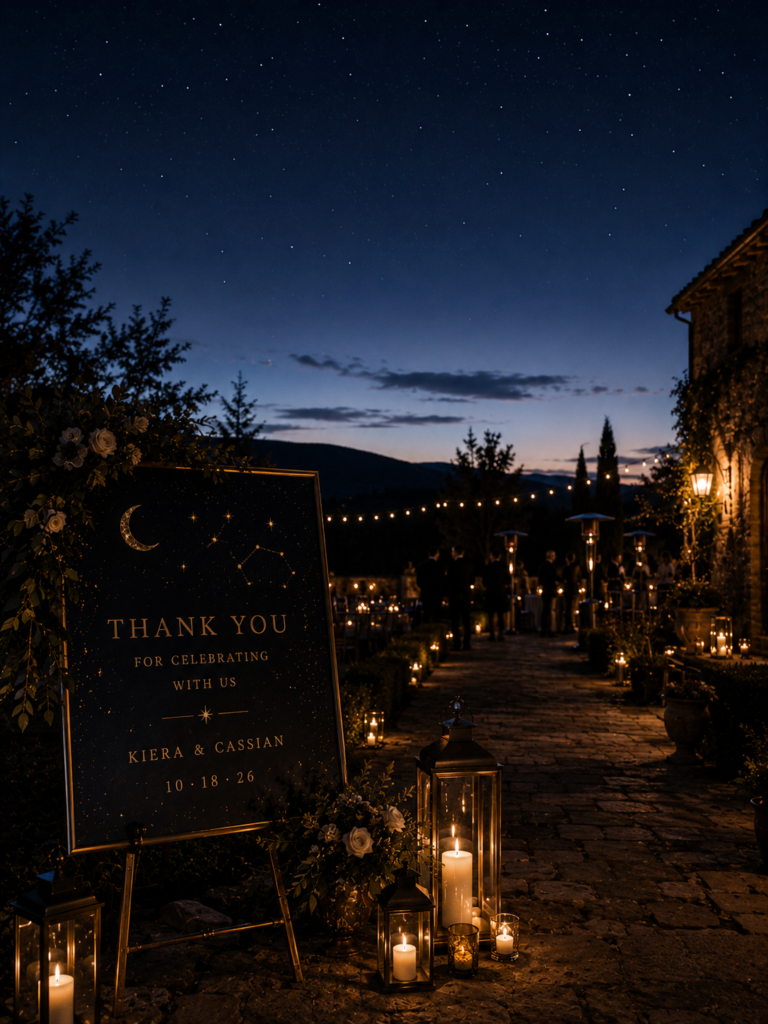
By the time the last guests are leaving, the witching hour has already passed its peak, and something in the night has begun, almost imperceptibly, to soften. The deepest black starts to admit the faintest grey-blue at its edges — not dawn itself, not yet, but the earliest suggestion that the sky is no longer only deepening, that it has, in fact, begun its long return toward light. Stars that were brilliant an hour ago seem to dim slightly, less because they have changed and more because the sky around them has started, very gradually, to brighten.
This phase belongs not to the wedding day itself but to what comes after — the thank you cards, sent in the weeks following, that close the story the invitation opened. Thank you cards arrive after the wedding itself — but for a celestial wedding, they can complete the night sky’s story, carrying the same deep tones and gold details that began with the invitation. There is something genuinely satisfying about a stationery suite that begins in warm gold, travels through indigo and black and silver, and ends — in the thank you card, sent weeks later — back in tones that echo where it started. The night has come full circle, and so has the story told in paper.
For Thank You Cards & Keepsakes
The Vintage Celestial Renaissance Wedding collection — fully customizable with your names, date, and wedding details — closes the celestial story in thank you cards that echo the gold tones the night began with.
Section 08
Building Your Celestial Wedding
8.1 — Venue Considerations
A genuinely celestial wedding decor scheme depends on guests being able to see the sky — which sounds obvious but rules out more venues than expected. An outdoor reception space, a marquee with open sides or a clear or retractable roof, or any venue with genuine access to an unobstructed view upward are the baseline requirements. Timing matters as much as venue: working backward from the phases above, a ceremony beginning around an hour before sunset allows the golden hour, blue hour, and early night phases to unfold in sequence during the most socially active part of the evening. Light pollution is the final and most overlooked consideration — a venue with minimal artificial lighting nearby will reveal a dramatically richer sky than one near a town or busy road, and the difference between the two is often the difference between a celestial theme that’s merely decorative and one that’s genuinely, observably true.
8.2 — Lighting Design Through the Night
Lighting for a celestial wedding decor scheme should evolve in step with the sky rather than working against it. During golden and blue hour, minimal artificial light is needed — the sky itself is doing the work. As early night arrives, candles and string lights become primary, but should remain warm and low rather than bright: the goal is to complement starlight, not compete with it. By deep night and the witching hour, the lighting palette can lean into cooler tones — small amounts of silver or white light alongside the warm candlelight, echoing the moonlight and starlight overhead. The single rule that holds throughout: no harsh overhead lighting at any point. A floodlit reception space cannot also be a celestial one — the two are, quite literally, mutually exclusive.
8.3 — The Complete Celestial Stationery Journey
Across the six phases above, the stationery for a celestial autumn wedding follows the sky as faithfully as the day itself does: the save the date and invitation, in warm gold, arrive during golden hour — months before the wedding, but carrying its first light. Programs, in deep indigo and gold, belong to blue hour and the ceremony itself. Welcome signs and entrance signage, in black and gold, catch the first candlelight of early night. Menus and place cards, in the richest black-and-gold registers, belong to deep night and the heart of the reception. Late-night signage and dessert menus, bold and midnight-black with scattered stars, belong to the witching hour. And finally, thank you cards — sent after the wedding — return to the warm tones of the beginning, closing the circle the way the sky itself closes, every single night, before opening again.
Shop By Phase
Eight Collections, One Night Sky
Fully customizable with your names, date and wedding details — each collection matched to its phase of the night.
Vintage Gold Mystical Botanical Wedding
Golden hour warmth for invitations and save the dates.
Celestial Art Nouveau Blue Gold Wedding
Blue hour elegance for invitations and programs.
Vintage Celestial Art Nouveau Wedding
The deep blue twilight, captured in botanical detail.
Black Gold Celestial Wedding
Early night glow for welcome signs and signage.
Mystical Black Gold Celestial Wedding Collection
Deep night drama for table settings and menus.
Mystical Black Gold Wedding Collection
An alternative deep-night palette with its own character.
Celestial Midnight Black Stars Wedding
The witching hour — bold, dramatic, full of stars.
Vintage Celestial Renaissance Wedding
Before dawn — the closing chapter, in thank you cards and keepsakes.
Frequently Asked Questions
Common Questions
What makes a wedding theme “celestial”?
A celestial wedding theme takes its visual language and its structure from the night sky — deep indigo and black palettes, gold and silver accents representing stars and constellations, and a sense of vastness and mystery that conventional daytime aesthetics don’t reach for. At its best, as this guide describes, a celestial theme isn’t just black backgrounds with star illustrations applied decoratively — it’s an aesthetic that genuinely follows the progression of an actual night, from the warm light of dusk through deep darkness and back toward dawn, with each phase getting its own colour story and its own role in the day.
Is a celestial wedding theme better for autumn or summer?
Autumn, decisively. A starry night wedding in summer often doesn’t see true darkness until guests are already leaving — the sun can remain above the horizon until nine or ten in the evening at the height of summer, leaving very little time for the sky’s phases to unfold during the reception itself. In October, darkness arrives by early evening, meaning a celebration can move through golden hour, blue hour, early night, and deep night all within the normal hours of a wedding reception. Autumn air is also clearer and crisper, making stars appear sharper and more numerous than the haze of a summer night typically allows.
What time should a celestial wedding ceremony start?
Working backward from sunset is the most reliable approach. A ceremony beginning roughly an hour before sunset will move through the end of golden hour during the vows themselves, arrive at blue hour during the transition to the reception — often the most photographed moment of the day — and reach early night as the reception properly begins. In a typical October, this often means a ceremony start time somewhere between 3pm and 5pm depending on latitude and exact date, with the reception’s deepest celestial phases (deep night and the witching hour) arriving naturally as the evening progresses without any need to artificially delay them.
What stationery works best for a celestial autumn wedding?
As covered in the phase system above: warm gold tones (Vintage Gold Mystical Botanical, Celestial Art Nouveau Blue Gold) for invitations and save the dates; deep blue and gold (Vintage Celestial Art Nouveau) for ceremony programs; black and gold (Black Gold Celestial) for welcome signs; the richest black-and-gold registers (the two Mystical Black Gold collections) for menus and place cards; bold midnight black with scattered stars (Celestial Midnight Black Stars) for late-night signage; and tones that echo the opening gold (Vintage Celestial Renaissance) for thank you cards. Choosing pieces from collections that correspond to each phase creates a stationery suite that mirrors the night itself.
Follow the Sky
Follow the Sky — Shop Celestial Wedding Stationery
Eight collections for every phase of an autumn night — all fully customizable with your names, date and wedding details.