Wedding Guest Dress – The Complete Guide to Dressing Beautifully for Someone Else’s Big Day
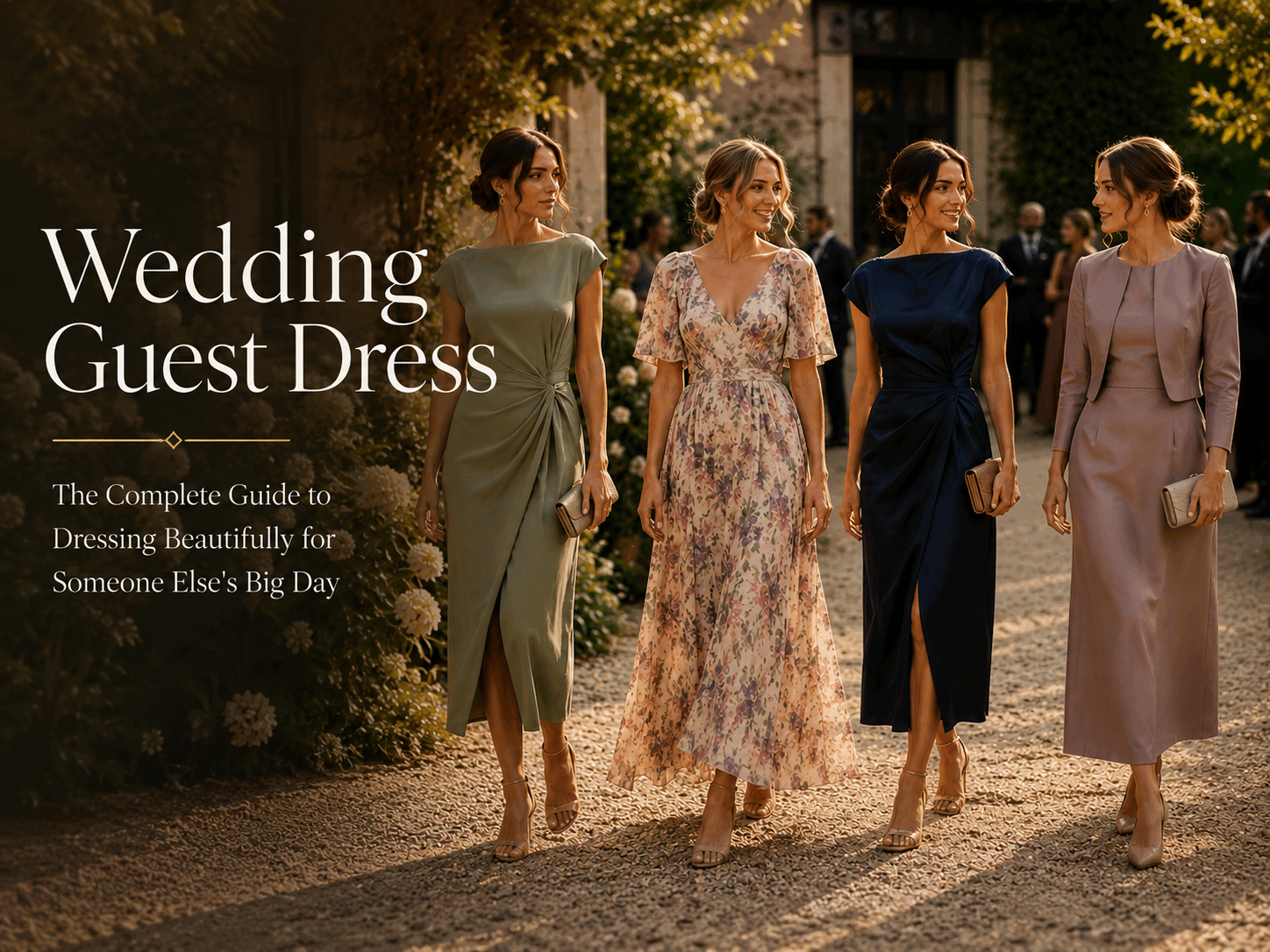
Wedding Guest Dress
The Complete Guide to Dressing Beautifully for Someone Else’s Big Day
From black tie to beach ceremony, summer garden parties to winter receptions — everything you need to choose the perfect wedding guest dress for every occasion in 2026.
Choosing the perfect wedding guest dress is one of fashion’s most genuinely pleasurable challenges — and in 2026, the rules have never been more liberating or the options more beautiful.
Introduction
The Art of the Wedding Guest Dress
There is a particular kind of pressure that arrives with a wedding invitation — the exquisite, entirely self-imposed pressure of deciding what to wear. Unlike the bride, who has months of careful, joyful deliberation and an entire industry devoted to her decision, the wedding guest navigates her choice largely alone, armed with a dress code that may say nothing more helpful than “smart casual” or “black tie optional” and a venue that could be anything from a Hampshire estate to a Tuscan vineyard to a London rooftop at sunset.
The good news is that wedding guest dress codes in 2026 have genuinely expanded — in every direction simultaneously. The era of rigid rules has given way to something far more interesting: a set of considered principles that allow for enormous personal expression within a framework of appropriate elegance. The wedding guest dress of 2026 can be a floor-length silk gown, a sharp tailored midi, a maximalist printed wrap, a structured jumpsuit, or a floaty floral two-piece. What matters is not the silhouette — it is the thought behind it.
This guide is your definitive companion for every wedding you will attend in 2026 — covering dress codes, seasonal dressing, colour rules, silhouettes, fabrics, and all the considered details that separate a wedding guest who looks beautiful from one who looks truly, memorably exceptional.
Dress Codes Decoded
What Every Wedding Dress Code Actually Means
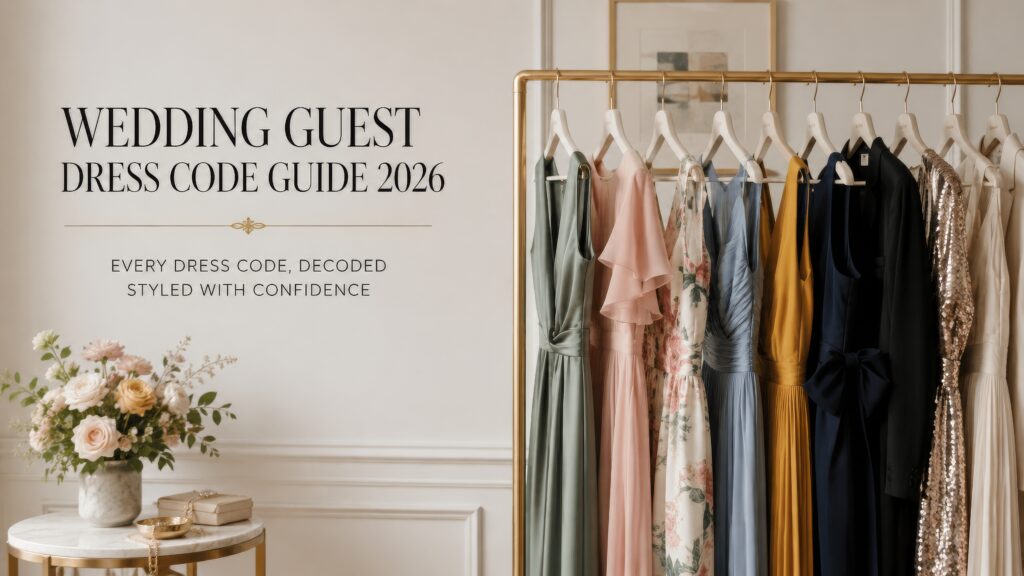
Before choosing your wedding guest dress, understanding the dress code on your invitation is essential — because it is the couple’s clearest signal about the kind of day they are hosting, and dressing appropriately is one of the most genuinely considerate things a guest can do. Here is what the most common wedding dress codes actually mean in practice, translated out of the vague and into the specific.
01
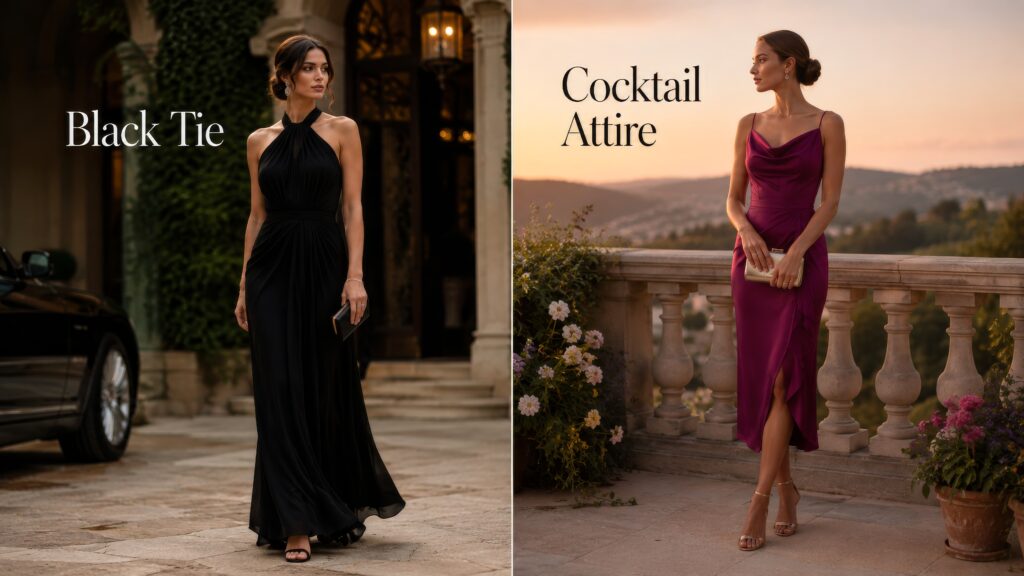
Black Tie
A full-length gown is the gold standard — but a sophisticated floor-grazing midi or wide-leg palazzo suit in a luxurious fabric reads beautifully at black tie. Think silk, velvet, or heavily embellished chiffon. Heels are expected; jewellery should be considered and significant.
02
Cocktail Attire
The most versatile wedding guest dress code. Knee-length to midi, in elevated fabrics — crepe, satin, lace, or silk. Neither casual nor full-length formal. This is where the most interesting wedding guest dress choices happen: structured midis, asymmetric hems, bold colours.
03
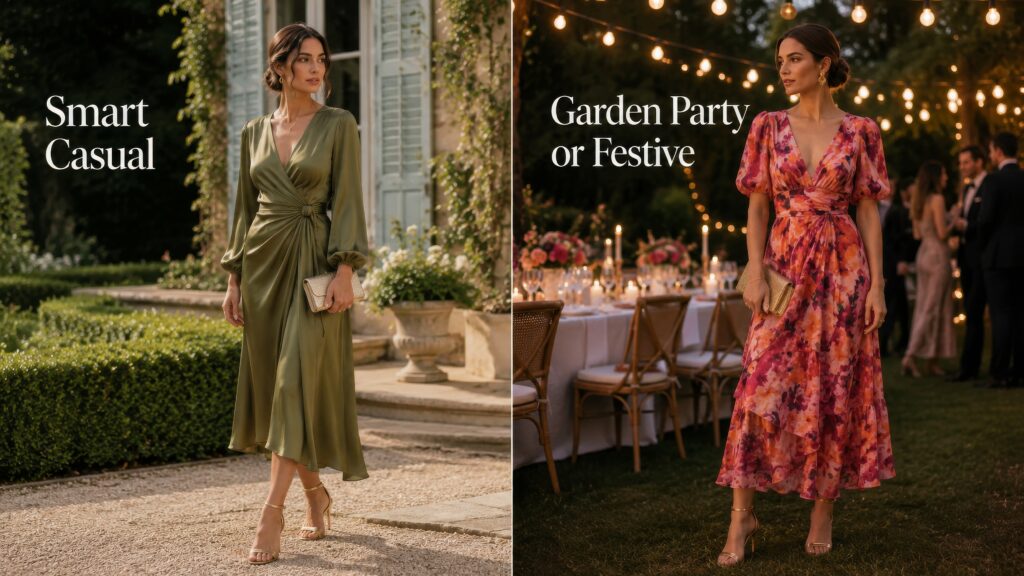
Smart Casual
More relaxed, but still considered. A floaty midi dress, a tailored trouser suit, or a beautiful wrap dress all work beautifully. Avoid anything too casual — denim, trainers, or overly revealing styles — but feel free to bring personality and colour.
04
Garden Party or Festive
The most joyful dress code to receive. Printed florals, bold colour, midi or maxi lengths, and fascinators or wide-brimmed hats are all celebrated. This is where a truly show-stopping wedding guest dress earns its moment — embrace it fully.
“Dressing for a wedding is an act of generosity. You are not the focus — but you are part of the picture. Dress in a way that honours both truths simultaneously.”
— The Wedding Style
Colour Rules
Wedding Guest Dress Colours: What to Wear and What to Avoid
Colour is the most emotionally immediate decision you will make when choosing your wedding guest dress — and the one most fraught with unspoken social convention. The rules, however, are simpler than the anxiety around them suggests. There are really only two firm guidelines: do not wear white, ivory, or cream in any shade that could be mistaken for bridal, and do not wear black to a daytime wedding unless the invitation explicitly encourages it or the couple is known to you well enough that you can be certain it will be received warmly.
Beyond those two conventions, the colour world for the wedding guest dress is gloriously open. In 2026, the most admired wedding guest dress choices are those that commit fully to a colour rather than retreating to safe neutrals out of indecision. A saturated emerald midi. A rich cobalt wrap dress. A deep terracotta silk column. A dusty rose floor-length gown with a plunging back. These are the choices that photograph magnificently, that feel genuinely celebratory, and that reflect the confidence of someone who dressed with intention.
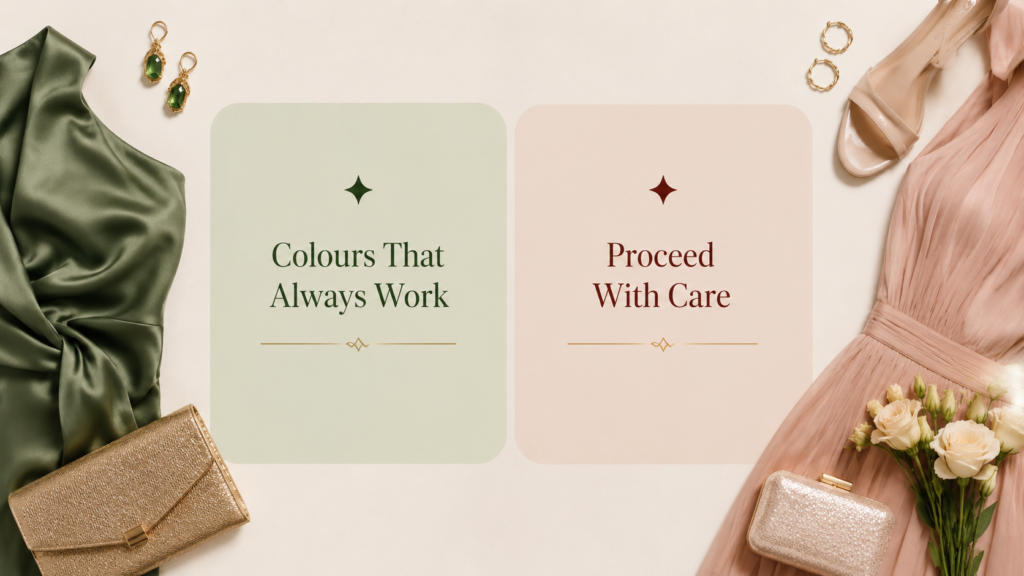
✦ Colours That Always Work
- Jewel tones — emerald, sapphire, ruby, amethyst
- Dusty rose, blush, and soft pinks at any formality
- Rich earth tones — terracotta, rust, warm camel
- Navy at evening or formal weddings
- Bold prints — floral, geometric, abstract
- Metallics — gold, bronze, and silver at evening
✦ Proceed With Care
- White, ivory, cream — avoid entirely as a guest
- Black at daytime weddings — check with the couple
- Champagne — can read as bridal; choose carefully
- All-over sequins at daytime ceremonies
- Very pale gold or silver that photographs as white
- Matching the bridesmaids — check their colour first
Seasonal Dressing
The Wedding Guest Dress by Season
Season is the single most practical consideration in choosing your wedding guest dress, and the one most frequently underestimated. A dress that looks perfect in an online image can be genuinely uncomfortable in a July garden or an October church if the fabric, weight, and layering have not been thought through with the actual conditions of the day in mind. Dressing well for a wedding is dressing appropriately for the season — with style layered on top of that foundation, never in place of it.
🌸
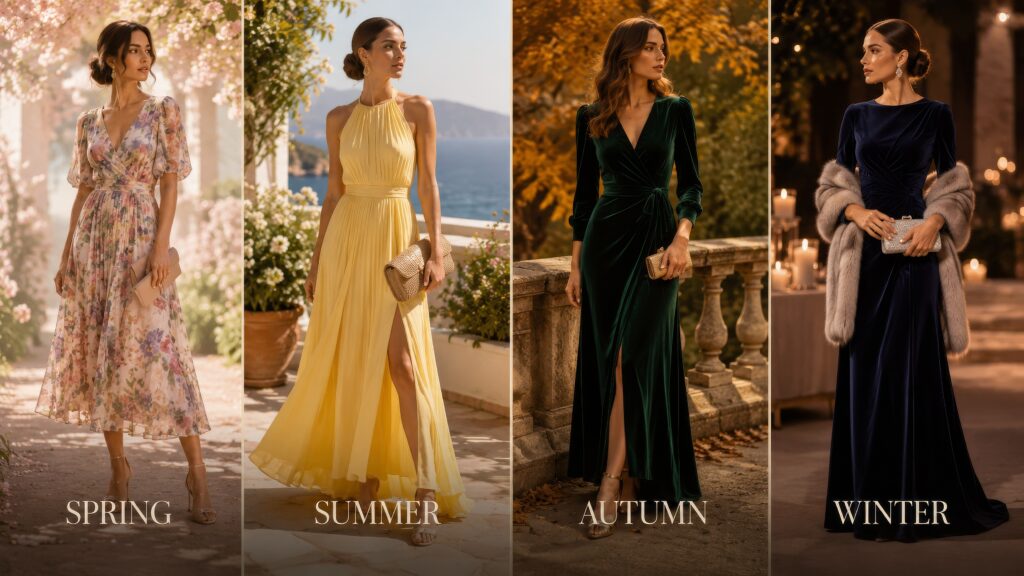
Spring
Floral prints, soft pastels, and midi lengths. Layer with a fine-knit cardigan or tailored blazer for unpredictable temperatures. Block-heel shoes over stilettos for outdoor venues.
☀️
Summer
Lightweight fabrics only — chiffon, cotton voile, linen, or silk georgette. Vibrant colours and bold prints read beautifully in strong light. Always bring a wrap for air-conditioned receptions.
🍂
Autumn
Rich jewel tones, velvet, and heavier crepe come into their own. Midi and maxi lengths with long sleeves or a beautiful jacket. Ankle boots instead of heels work perfectly at countryside venues.
❄️
Winter
Velvet floor-length gowns, deep jewel tones, and embellished fabrics that catch candlelight beautifully. A faux-fur stole or cashmere wrap is both practical and luxurious at winter venues.
The Fabric-First Rule for Wedding Guest Dresses
Before you consider silhouette, colour, or price, always ask one question: what is this dress made of? Fabric determines how a wedding guest dress behaves in heat and cold, how it photographs, how it moves, and how it holds up across a ten-hour day that includes a church, a garden, a reception, and a dance floor. A beautifully cut dress in the wrong fabric will disappoint. An elegant fabric in a simpler cut will never let you down.
The Best Wedding Guest Dress Silhouettes Right Now
The silhouette landscape for the wedding guest dress in 2026 is broader and more interesting than it has been in years. The dominant direction continues to be the midi — specifically the structured or floaty midi that sits between the knee and the ankle, which has proven itself to be the most universally flattering, most venue-adaptable, and most stylistically versatile length in the wedding guest dress wardrobe. But several other silhouettes are having genuinely strong moments, and understanding where each works best will help you make the right choice for each specific wedding you attend.
The Structured Midi
The workhorse of the 2026 wedding guest wardrobe and deservedly so. A well-cut midi dress in a quality fabric — crepe, satin, or ponte — reads appropriately at almost every wedding short of the most ultra-formal black tie. It photographs at every angle with equal elegance, requires minimal accessorising to look complete, and transitions naturally from ceremony to reception to the dance floor without adjustment. If you are building a wedding guest wardrobe around a single silhouette, this is it.

The Floaty Maxi
For garden parties, outdoor ceremonies, destination weddings, and any celebration with a relaxed, romantic spirit, the floaty maxi remains one of the most beautiful wedding guest dress choices available. In chiffon, silk georgette, or cotton voile, it moves with extraordinary grace in outdoor spaces and photographs magnificently in natural light. The key is fit at the top — a floaty maxi needs a bodice that fits precisely to avoid reading as shapeless rather than effortful.

The Power Suit & Jumpsuit
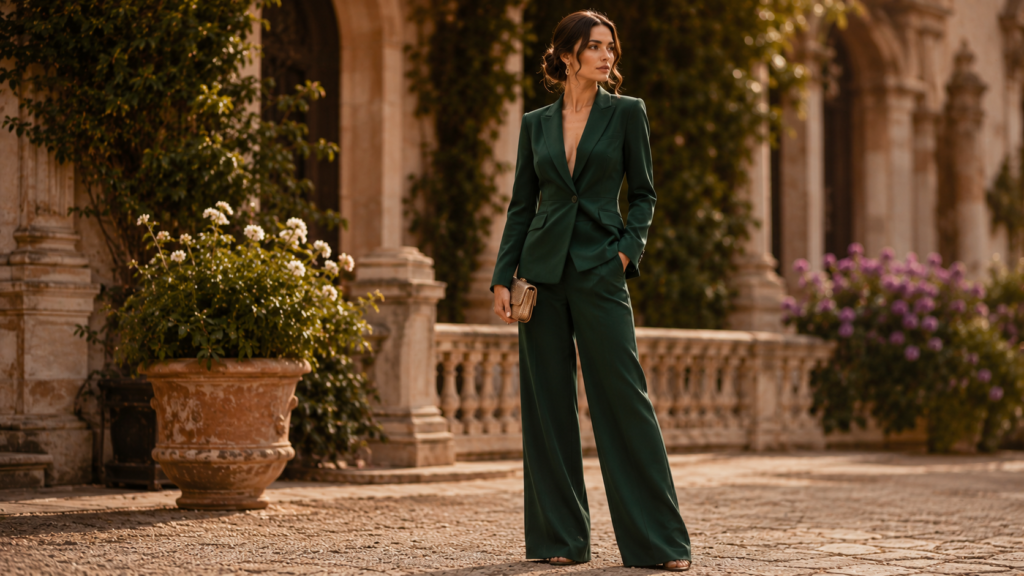
The most confident and contemporary wedding guest dress alternative available in 2026 is, strictly speaking, not a dress at all. A sharply tailored trouser suit in a luxurious fabric — silk, satin, or a fine wool blend — or a wide-leg jumpsuit in a jewel tone is now fully accepted and genuinely celebrated at weddings across every formality level. It photographs with enormous impact, requires zero anxiety about the dance floor, and makes a quiet, assured statement about personal style that a dress simply cannot replicate.
Accessories & The Complete Look
Finishing the Look: Accessories, Shoes & Bags
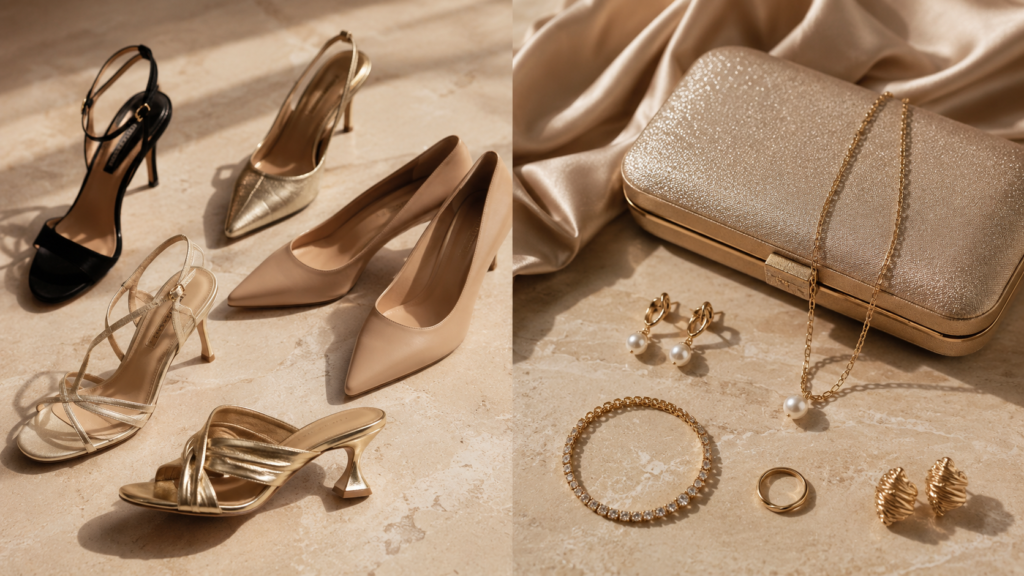
The wedding guest dress, however carefully chosen, is only the beginning of the look. Accessories at a wedding carry disproportionate visual weight — because the elevated context of the day means guests are looking at each other more carefully, photographing each other more frequently, and noticing the details with far more attention than they would in any ordinary social setting. Your shoes, your bag, your jewellery, and your hair accessories are not afterthoughts. They are the resolution of the story your dress has begun.
Shoes to Consider
- Block-heeled sandals — elegant and genuinely wearable all day
- Kitten heels — the most stylish practical shoe for weddings
- Pointed-toe flats in satin or metallic leather
- Strappy heeled mules for evening or cocktail weddings
- Embellished ankle-strap heels for maximum formality
- Chelsea or heeled ankle boots for autumn countryside
Bags & Jewellery
- A small clutch in satin, beaded fabric, or metallic leather
- Top-handle evening bag for cocktail or formal weddings
- Statement earrings rather than competing necklace and earrings
- A delicate gold or pearl necklace with simple earrings
- One significant ring or bracelet — not both simultaneously
- A silk or cashmere wrap that works as both layer and accessory
“The shoe decision is made before you leave the house and unmade the moment you step onto a lawn. Always consider the venue surface before choosing your heel height — your ankles will thank you, and you will dance for longer.”
— The Wedding Style
Venue & Setting
Dressing for the Venue: Location Changes Everything
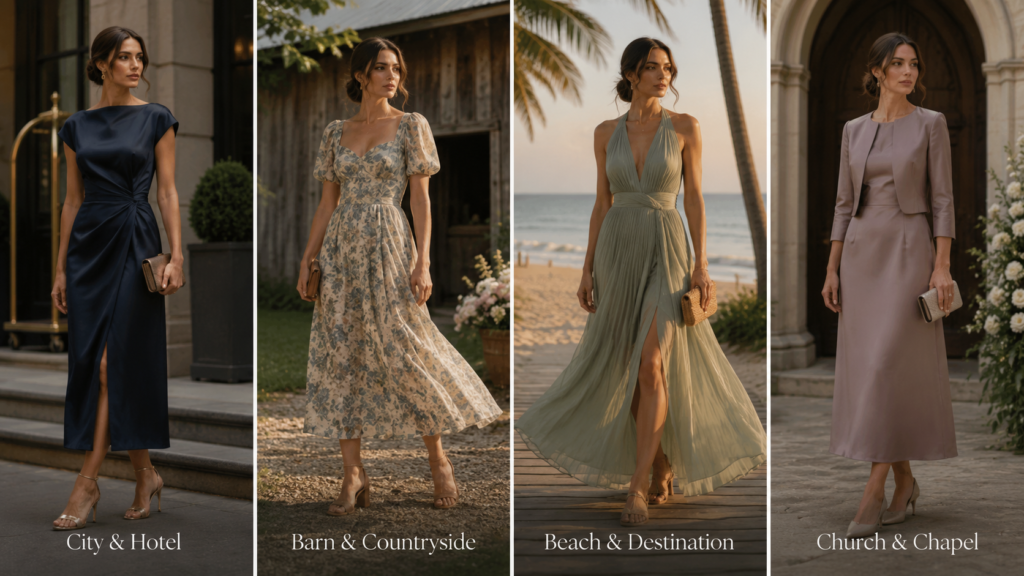
The venue of a wedding is the second most important consideration — after the dress code — when choosing what to wear as a guest. A dress that is perfectly appropriate for a London townhouse wedding may be wildly impractical for a Cotswolds barn, and vice versa. Venue-appropriate dressing is not simply about aesthetics — it is about genuine comfort and functionality across a ten-hour day in a specific physical environment.
🏛️
City & Hotel
Structured silhouettes, polished fabrics, heels are practical. The most formal setting for a wedding guest dress — lean into sophistication.
🌾
Barn & Countryside
Block heels or dressy flats are essential. Earthy tones and florals feel natural. Midi length avoids muddy hems — a non-negotiable consideration at outdoor rural venues.
⛵
Beach & Destination
Floaty maxi dresses, flat sandals, and lightweight fabrics. Vivid colour reads beautifully against sea and sky. Avoid anything that catches wind dramatically.
⛪
Church & Chapel
Covered shoulders are often expected and always respectful. A beautiful jacket, wrap, or long-sleeved dress is both appropriate and elegant in a religious ceremony setting.
Practical Planning
Ten Rules for the Perfect Wedding Guest Dress
- Read the dress code literally, then contextually. “Smart casual” at a Notting Hill townhouse is different from “smart casual” at a Somerset farm. The venue tells you as much as the words themselves.
- Never wear white, ivory, or anything bridal-adjacent. This rule is not outdated. It is a matter of basic consideration for the person whose day it is — and it applies regardless of how beautiful the dress is.
- Invest in the fabric before the silhouette. A beautiful fabric in a simple cut will always outperform a complex cut in a disappointing fabric. Quality is visible at ten metres and in every photograph.
- Test the dress before the day. Sit in it, walk in it, raise your arms, and check the back in a mirror you do not usually use. A wedding involves all of these movements for many hours consecutively.
- Consider the full twelve-hour trajectory. You will be wearing this dress from getting dressed in the morning until the last song at midnight. Comfort and beauty must coexist — one without the other will fail you by 9pm.
- Plan the shoes for the venue surface, not the outfit. A stiletto that looks perfect in the fitting room is a liability on a gravel drive, a lawn, or a cobblestone courtyard. Block heels and kitten heels are equally elegant and significantly more intelligent.
- Limit accessories to one statement piece. A beautiful wedding guest dress needs space to breathe. Let the dress be the statement and support it with considered restraint rather than competing loudly for attention.
- Bring a layer regardless of the weather forecast. Churches are cold in summer. Air conditioning is aggressive in hotel ballrooms. An elegant wrap, blazer, or lightweight cardigan is always the right packing decision.
- Check photographs from the venue if possible. Instagram and wedding blog imagery of your venue will tell you exactly how light behaves in that space — and whether your chosen colour and fabric will photograph as you intend.
- Dress for the couple, not for yourself. The finest wedding guest dress is one that honours the occasion, respects the aesthetic the couple has created, and makes you feel genuinely, confidently beautiful — in that order.
“The best-dressed guest at any wedding is never the most expensively dressed, or the most dramatically dressed. She is the one who looks as though she dressed specifically and thoughtfully for this day, this couple, and this celebration.”
— The Wedding Style Edit
Closing Thoughts
The Wedding Guest Dress Is a Celebration in Itself
There is something genuinely delightful about the wedding guest dress — the particular pleasure of dressing for a day that is simultaneously about someone else entirely and an opportunity to feel, yourself, more elegant, more considered, and more beautifully dressed than ordinary life usually demands. Weddings give us permission to make an effort. And making that effort — thoughtfully, joyfully, with attention paid to every detail from the colour to the heel height to the bag — is one of the small pleasures of being included in someone else’s most important day.
The principles in this guide are not rules designed to constrain you. They are the framework within which your personal style can operate with confidence — knowing that you are dressed appropriately, dressed beautifully, and dressed in a way that honours both the occasion and the couple who invited you to share it. Within that framework, the specific choices — the colour, the silhouette, the accessories, the shoes — are entirely, gloriously yours.
Choose with intention. Dress with joy. And dance in it until the last song ends.