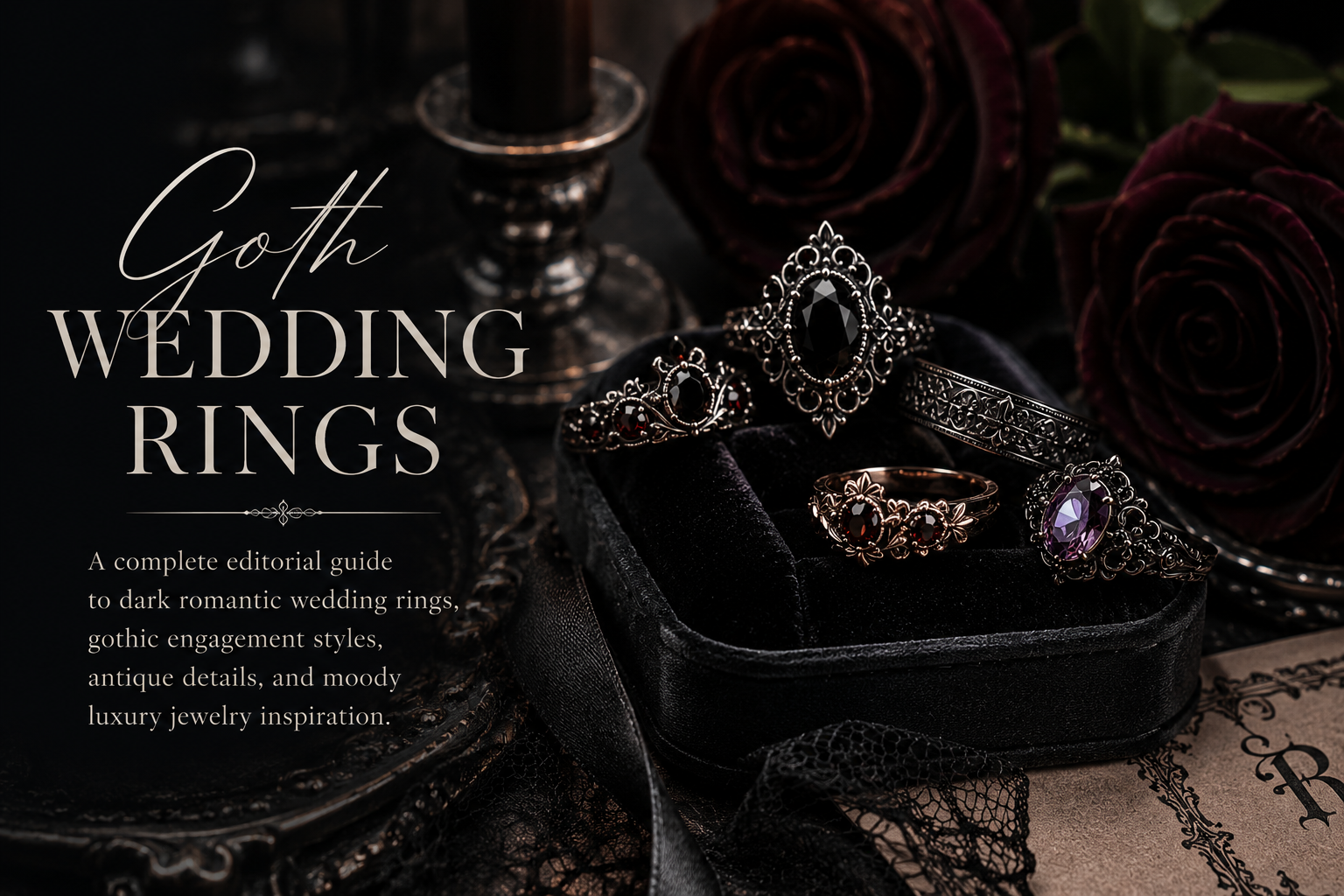
Goth Wedding Rings – A complete editorial guide to dark romantic wedding rings, gothic engagement styles, antique details, and moody luxury jewelry inspiration.
The Gothic Bridal Edit · 2026
Goth Wedding Rings
The Complete Guide to Dark, Meaningful & Alternative Wedding Bands
From black diamond solitaires and oxidised silver bands to skull motifs, gemstone halos, and deeply personal dark jewellery — your definitive guide to goth wedding rings in 2026.
A goth wedding ring is not a compromise between who you are and what a ring is supposed to look like. It is the most intimate piece of jewellery you will ever choose — and it should look exactly like the person who will wear it every single day for the rest of their life.
Introduction
Why Goth Wedding Rings Are in a Category of Their Own
The wedding ring is the one piece of jewellery from the entire celebration that does not go into a box after the day ends. It stays on. It becomes part of the hand, part of the daily uniform, part of the physical story of a life lived with another person. And because of that permanence — that daily, worn, tactile presence — the wedding ring is arguably the most important jewellery decision in the entire wedding planning process. Not the most photographed, not the most discussed in planning meetings, but the most lived with. The one that matters every morning for decades.
For the couple whose aesthetic runs dark — whose wedding dress is near-black velvet, whose florals are oxblood dahlias and black roses, whose venue is a candlelit stone hall — a conventional gold band with a round brilliant diamond sits on the hand like a category error. It is not that the diamond is not beautiful. It is that it belongs to a different visual language entirely, and the hand wearing it tells a different story from the person attached to it. Goth wedding rings solve this problem completely. They are rings designed for people whose relationship with beauty operates on a different register — darker, richer, more historically layered, and more personally specific than the mainstream bridal jewellery market typically addresses.
This guide covers the full landscape of goth wedding rings in 2026 — from the defining stones and metals to the ten most distinctive ring styles, from engagement rings to wedding bands for both partners, styling considerations, and everything you need to know before commissioning or purchasing the rings that will be on your hands for the rest of your life.
Metals
Goth Wedding Ring Metals: Dark, Aged, and Deliberately Unconventional
The metal of a goth wedding ring is not a neutral background decision — it is a primary aesthetic choice that determines the entire character of the piece. Where conventional bridal jewellery operates within a narrow range of yellow gold, white gold, and platinum, the goth wedding ring aesthetic opens a significantly broader and more interesting palette of metal options. Each carries a different visual quality, a different degree of darkness, and a different relationship to the stones and design elements that will be set within it.
Blackened Silver
Oxidised to near-black. The most distinctively goth of all metals — dramatic, tactile, and historically rich.
Black Gold
Rhodium-plated or ruthenium-finished yellow or rose gold. The most luxurious goth metal — deeply dark and completely contemporary.
Dark Rose Gold
A warmer, more romantic alternative. Deep rose gold reads as blood-warm against dark stones — beautiful and unexpected.
Titanium
Naturally dark grey, lightweight, and virtually indestructible. The most practical dark metal — ideal for those who work with their hands.
Meteorite & Damascus
The most dramatically unique of all goth ring materials. Each piece is entirely one of a kind — carrying a natural, ancient pattern that no jeweller could replicate.

Stones
Goth Wedding Ring Stones: Beyond the White Diamond
The stone is the soul of any ring — the element that draws the eye, carries the light, and communicates the most immediately and powerfully about the person wearing it. For the goth wedding ring, the stone choice is one of the most exciting and most personal decisions in the entire jewellery planning process. The conventional white diamond — however objectively beautiful — is simply not the right stone for most goth aesthetics. Its brilliance is too bright, its associations too mainstream, its visual language too far removed from the dark, richly layered aesthetic it would need to inhabit. The goth ring stone is one that carries depth rather than brightness — that looks like it belongs to an older, darker, more mysterious world.
Dark & Near-Black Stones
- Black diamond — the defining goth engagement stone. Opaque, dark, and completely unlike any other diamond.
- Black onyx — deeply absorbing and intensely dark, with a flat, polished face that suits bold architectural settings.
- Black spinel — rarer than black diamond, with a natural dark lustre that gemologists consistently choose over onyx.
- Black tourmaline — deeply dark with occasional flashes of green-black depth visible in strong light.
- Jet — the most historically gothic of all stones. Fossilised wood worn in Victorian mourning jewellery for centuries.
Deep Colour & Jewel-Toned Stones
- Deep ruby and garnet — blood-red and intensely alive, with a warmth that contrasts magnificently against dark metal.
- Dark amethyst — deep violet-purple, the most romantic of the goth stones. Rich and luminous in low light.
- Alexandrite — changes from deep green to wine-red depending on the light. The most dramatically beautiful of all goth stones.
- Dark sapphire — midnight blue, almost as dark as black but with visible depth and movement in the colour.
- Labradorite — dark base stone with sudden, unexpected flashes of blue, green, and gold. Otherworldly and completely unique.
The Black Diamond Question
The black diamond has become the defining stone of the goth engagement ring — and for good reason. It is a genuine diamond in every chemical and geological sense, which means it carries the same cultural weight of permanence and commitment as a white stone, while reading visually in an entirely different register. However, it is worth knowing that most commercially available black diamonds are white or grey stones that have been heat-treated or irradiated to produce the colour. Truly natural black diamonds — called carbonados — are significantly rarer and significantly more expensive. Ask your jeweller specifically about the origin of the stone’s colour before purchasing, and decide what matters to you: natural origin, or visual impact.
The Edit
10 Goth Wedding Ring Styles That Define Dark Bridal Jewellery
Each of these ten ring styles represents a complete aesthetic direction — a specific design philosophy that can be realised across a range of metals, stones, and custom details. Read each as a starting point for a conversation with your jeweller rather than a finished prescription, and notice which one resonates most instinctively with who you are and how you want your hands to look every day for the rest of your life.
01
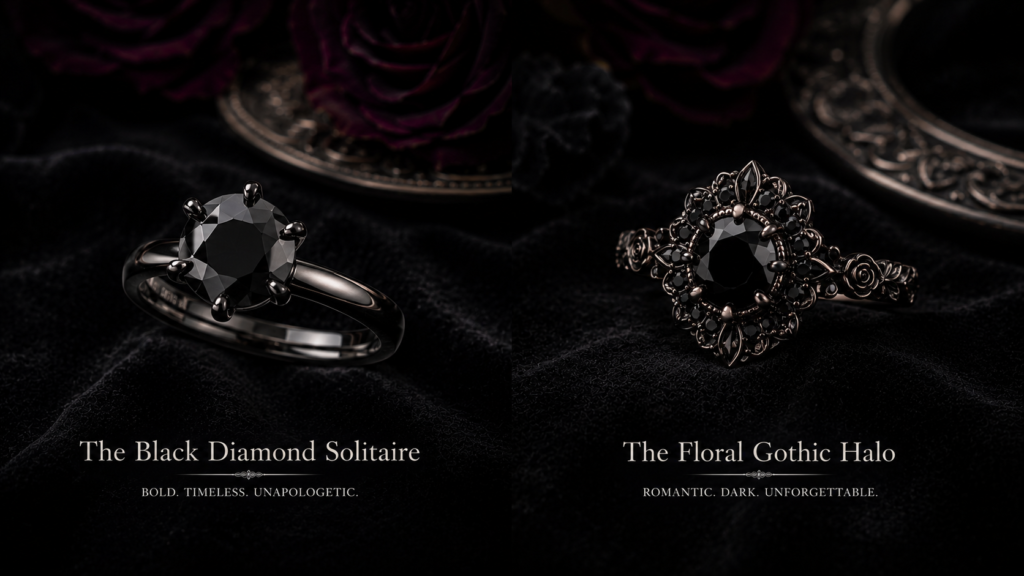
The Black Diamond Solitaire
A single black diamond — round, oval, or cushion cut — set in blackened silver or black gold on a clean, minimal band. The solitaire is the most universally understood engagement ring form, and choosing a black diamond in place of a white one transforms it entirely while retaining its essential simplicity and permanence. The contrast between the opaque darkness of the stone and the precision of the setting is visually striking and photographically extraordinary. This is the goth wedding ring that works equally well in a conventional office environment and a candlelit gothic reception — quietly, confidently dark in any context.
02
The Floral Gothic Halo
A central dark stone — black diamond, deep amethyst, or dark sapphire — surrounded by a halo of smaller stones set in a petal or gothic arch pattern rather than a conventional round halo. The floral or pointed gothic halo echoes the architectural motifs of medieval and Victorian gothic design directly, and in blackened silver or dark gold it creates one of the most visually complex and most historically literate of all goth ring aesthetics. Beautiful on the hand and extraordinary in close-up photography.
03
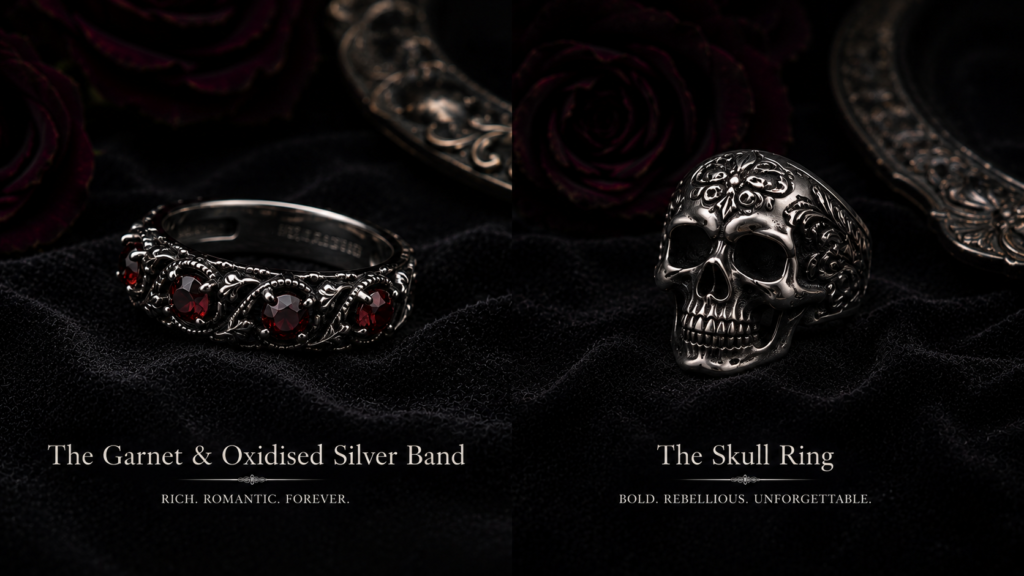
The Garnet & Oxidised Silver Band
Deep red garnets set into an oxidised silver band — either in a flush pavé setting or in individual claw mounts along the band’s length. This is the most warmly romantic of all goth wedding ring styles — the blood-red of the garnet against the near-black of the oxidised metal creates a combination of extraordinary visual warmth and darkness simultaneously. It references Victorian memorial and mourning jewellery directly, which in the goth tradition makes it one of the most historically resonant choices available.
04
The Skull Ring
A skull motif — either as the central design element of the ring face or incorporated into the band as a repeated detail — in blackened silver, dark gold, or titanium. In 2026 the skull ring as a wedding band has moved far beyond its novelty origins into genuinely fine jewellery territory, with craftspeople producing pieces of extraordinary detail and quality. A well-made skull wedding band in the right metal is not a gimmick. It is a beautifully crafted piece of memento mori jewellery with a tradition stretching back to the medieval period and an aesthetic relevance that is entirely contemporary.
05
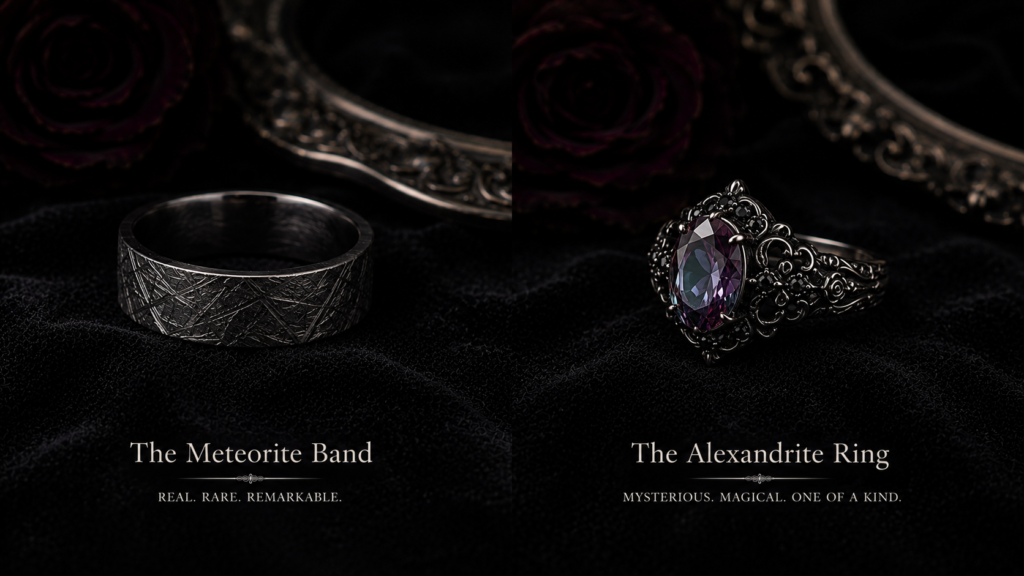
The Meteorite Band
A wedding band incorporating genuine meteorite material — typically Gibeon or Muonionalusta meteorite, both of which display the distinctive Widmanstätten pattern of interlocking crystalline lines that is unique to meteoric iron and entirely unrepeatable by any jeweller’s hand. Set into a titanium, gold, or blackened silver band, the meteorite inlay creates a ring of genuinely cosmic uniqueness — a band that carries in its metal a piece of the solar system older than the Earth itself. No two meteorite bands are identical. The symbolism, for a couple who finds it meaningful, is extraordinary.
06
The Alexandrite Ring
Alexandrite — the colour-change chrysoberyl that shifts from deep teal-green in daylight to wine-red in incandescent light — is one of the most dramatically beautiful and most symbolically resonant stones available for any goth wedding ring. The colour change means that the ring you wear in the garden is not the ring you wear by candlelight. It changes with the light around it, as the best gothic aesthetics always do — appearing differently in different contexts while remaining always, completely itself. Lab-grown alexandrite is now available at accessible price points without any sacrifice of the colour-change phenomenon.
07
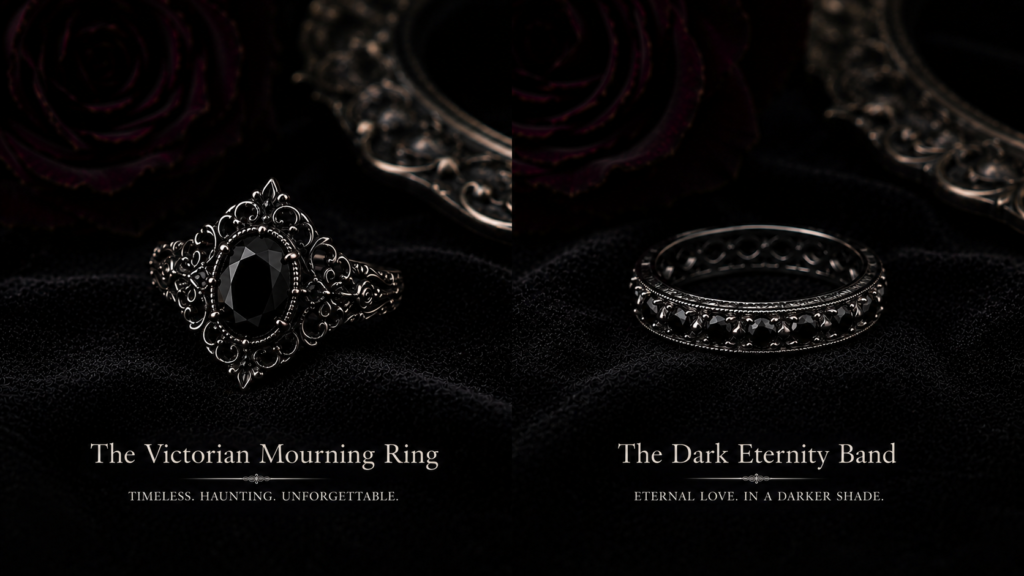
The Victorian Mourning Ring
A contemporary interpretation of the Victorian memorial ring tradition — a dark stone, typically jet, black onyx, or very deep garnet, set in blackened silver with delicate engraving or enamelling on the band. The original Victorian mourning rings were made to commemorate a loved one’s death, and they carry a weight of memento mori sentiment that is entirely aligned with the goth aesthetic’s relationship with mortality as something beautiful rather than something to be avoided. A wedding ring in this tradition reframes the relationship between love and mortality as the deeply, darkly romantic thing it has always been.
08
The Dark Eternity Band
A full eternity band — stones set continuously around the entire circumference of the ring — in black diamonds, dark garnets, or deep amethysts flush-set or pavé-set in blackened gold or silver. The eternity band is the most visually continuous and most symbolically clear of all wedding band forms: the unbroken circle of stones representing the unbroken commitment it marks. In dark stones on a dark metal, it is also one of the most quietly spectacular things on a hand — something that reveals its full beauty only when looked at closely and in the right light.
09
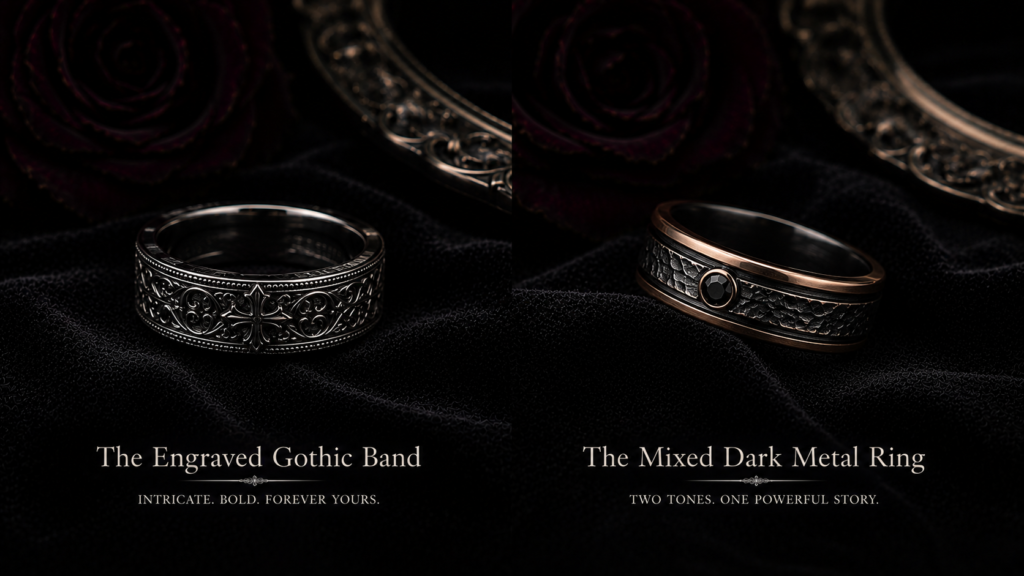
The Engraved Gothic Band
A plain dark metal band — blackened silver, titanium, or black gold — engraved with gothic lettering, runic script, botanical line drawing, or intricate geometric pattern on its outer surface. The engraving may be entirely personal — a date, a name, a phrase in Latin or Old English that carries meaning specific to the couple — or purely decorative, in the tradition of the medieval ring with its carved surface pattern. The engraved gothic band is the most intimate and the most literary of all goth wedding ring styles: a wearable text that only the wearer fully understands.
10
The Mixed Dark Metal Ring
A ring combining two or more dark metals in a single piece — oxidised silver and black gold, titanium and meteorite inlay, Damascus steel and dark rose gold — to create a band of visual complexity and tactile interest that a single-metal ring cannot achieve. The mixed metal goth wedding ring is the most contemporary of all the options on this list and the one that best reflects the 2026 direction in alternative jewellery: technically sophisticated, visually layered, and completely impossible to replicate exactly. Every mixed metal ring is, to some degree, unique.
“The right goth wedding ring is not the darkest one, or the most unusual one, or the one with the most impressive stone. It is the one that looks inevitable on your specific hand — the one that you stop noticing as a ring and simply begin to notice as part of you.”
— The Gothic Bridal Edit
For Both Partners
Goth Wedding Rings for Both Partners: Coordinating Without Matching
The question of how the two wedding rings relate to each other — and to the engagement ring worn alongside them — is one of the most practically important and most creatively interesting in goth ring planning. Matching rings are not required, and in the goth aesthetic they are often not desirable: the individual expression that makes a goth wedding ring feel personal and right tends to produce different rings for different people, even when those people are deeply aligned in their overall aesthetic. What matters is not that the rings match but that they cohere — that they share a visual language, a metal family, or a design principle that makes them clearly related without being identical.
🖤 Same Metal, Different Design
Both rings in blackened silver or black gold, but one with a stone and one plain, or one with engraving and one smooth. The shared metal creates visual coherence; the different designs allow each ring to reflect its wearer individually. The most balanced of all coordination approaches.
💎 Same Stone, Different Setting
Both rings using the same stone — black diamond, garnet, or alexandrite — but in entirely different settings and silhouettes. The shared stone creates an intimate visual connection that is visible only to those who know to look for it. A private symbol of commitment embedded in two individual pieces.
✒️ Matching Engraving
Two entirely different rings — different metals, different designs, different stones — sharing only an engraved inscription on the inner surface. A phrase in Latin, a line from a beloved text, or a date rendered in runic script. The connection is invisible to everyone but the two people wearing the rings.
Practical Planning
Ten Things Every Couple Should Know Before Buying Goth Wedding Rings
- Oxidised silver will change over time. The black patina of oxidised silver is not permanent — it will wear away at friction points over months and years of daily wear, revealing the lighter silver beneath. This is either a feature or a flaw depending on your perspective. Some wearers love the gradual revelation of the lighter metal as part of the ring’s living quality. Others want to maintain the original darkness. Both are valid, but you should know which you are before you buy.
- Black gold is a coating, not a base metal. Black gold is produced by applying a rhodium or ruthenium coating over yellow or rose gold. This coating will wear over time, particularly at the highest friction points of the ring. A well-made black gold ring will need re-plating every few years to maintain its appearance. Factor this into the long-term cost and care commitment of the ring.
- Seek a jeweller who works specifically with alternative and goth aesthetics. A conventional high street jeweller will not have experience with the metals, stones, and design principles of the goth ring aesthetic and is unlikely to produce results of the quality you are looking for. Search specifically for alternative jewellers, gothic jewellery designers, and independent craftspeople whose portfolio contains the kind of work you want to commission.
- Lab-grown stones are not a compromise. Lab-grown black diamonds, alexandrite, sapphires, and rubies are chemically and physically identical to their mined equivalents. They are also significantly more affordable, consistently higher in clarity, and free from the ethical concerns of mining. For the goth aesthetic, where the visual and symbolic qualities of the stone matter more than its provenance, lab-grown is almost always the more intelligent choice.
- Consider the durability of every material in the context of daily wear. A ring worn every day for decades will be exposed to water, chemicals, impact, and friction that a ring worn occasionally for special occasions will not. Meteorite inlay is beautiful but requires more maintenance than solid metal. Jet and onyx are softer than diamond and can scratch. Oxidised silver needs periodic re-blackening. Understand the maintenance requirements of every material you choose before committing.
- The engagement ring and wedding band must be considered together. If you are planning both an engagement ring and a separate wedding band to be worn together, the two pieces must be designed in relationship with each other from the beginning — not purchased independently and hoped to fit together visually and physically. Discuss the pairing with your jeweller from the first conversation and consider commissioning both from the same maker.
- Titanium and Damascus steel cannot be sized after purchase. Unlike gold and silver, which can be sized up or down by a skilled jeweller, titanium and Damascus steel rings cannot be resized. The ring must be ordered at the correct size from the start. Have your finger sized at the end of the day when it is at its largest, in the temperature conditions closest to those you will be wearing the ring in long-term.
- Photograph the ring at multiple scales before purchasing. The goth ring that looks spectacular in a jeweller’s close-up photograph may read very differently at normal viewing distance — from across a table, in a group photograph, or in a candlelit room. Ask for or take photographs at multiple distances and in multiple lighting conditions, including low-light conditions closest to your actual wedding venue.
- Allow significantly more lead time than for a conventional wedding ring. Bespoke goth wedding rings — particularly those in unusual metals, with complex engravings, or incorporating meteorite or Damascus steel — require longer production times than standard off-the-shelf pieces. Six months is a reasonable minimum for anything complex, and twelve months is not excessive for fully bespoke work in specialist materials. Begin the process significantly earlier than the mainstream wedding timeline suggests.
- The most important quality of any goth wedding ring is that it feels right every single day. Not impressive to others. Not photographically dramatic. Not conceptually interesting in theory. Right — on your hand, in the context of your daily life, in the way it catches whatever light is available, in the way it feels when you absentmindedly turn it in moments of thought. That daily rightness is what the ring will be judged by, long after the wedding photographs have found their album and the celebration has become memory. Choose accordingly.
Final Thoughts
A Ring Made for Who You Actually Are
A goth wedding ring is for people who understand that beauty does not require brightness. That a ring can be dark and still be luminous — still catch light, still draw the eye, still communicate something profound about the commitment it marks and the person wearing it. The black diamond that absorbs light rather than reflecting it. The oxidised band that carries its age visibly, like the patina on a well-loved object. The engraved gothic lettering that no one else can read. The alexandrite that shifts from green to red with the light, like something alive.
These are not unusual rings. They are simply honest ones. Rings that look like the people wearing them — people whose relationship with beauty has always been richer, darker, and more personally specific than the mainstream jewellery market tends to address. Find the jeweller who understands that. Commission the ring that fits your hand and your aesthetic and your particular, unrepeatable version of what love and commitment look like. Wear it every day without apology. That is the only brief that matters.