Art Nouveau Wedding Cake
Art Nouveau Wedding · 2026
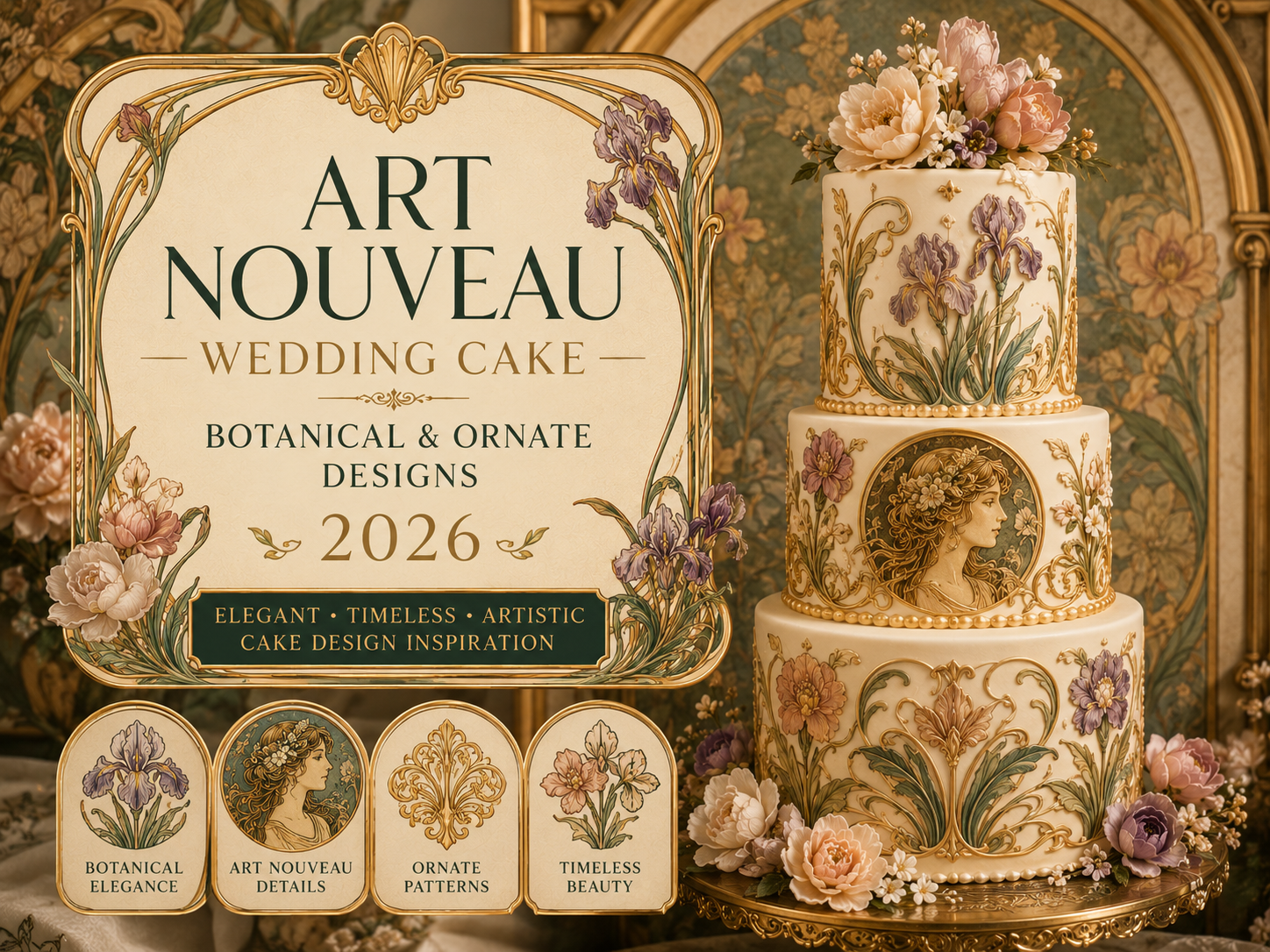
Art Nouveau Wedding Cake — Botanical & Ornate Designs 2026
From sinuous gold leaf piping and cascading sugar wisteria to vintage lace botanical tiers — the complete design guide to an art nouveau wedding cake in 2026.
An art nouveau wedding cake is, at its best, the single edible expression of the entire movement’s visual philosophy — organic line work, botanical accuracy, gold detail, and the conviction that even a thing meant to be eaten deserves to be designed with the same care as a piece of fine art. This guide covers what genuinely distinguishes an art nouveau cake from a generally pretty botanical one, five distinct design directions to discuss with your cake designer, the specific flavour profiles that suit the aesthetic, and how to style the cake table and connect it visually to the stationery suite guests have already encountered. Note: weddingavenuestudio.com is a stationery studio and does not design or sell wedding cakes — this guide is intended as design inspiration and a reference to bring to your own cake designer.
The movement never drew a line between the art worth framing and the art worth eating. A cake piped with the same sinuous botanical logic as a Mucha poster is not a cake decorated to look like art — in the only sense that matters for an afternoon, it simply is.
Section 01
The Art Nouveau Wedding Cake Aesthetic
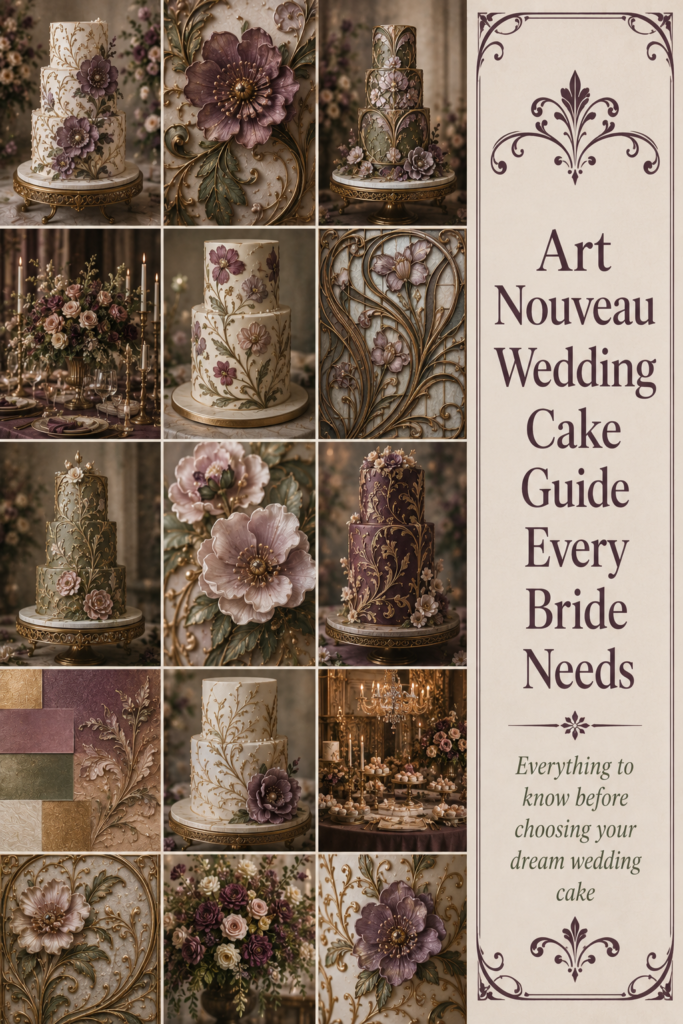
The defining quality of an art nouveau wedding cake is sinuous piped line work — royal icing or buttercream piping that curves and trails in the organic rhythm of botanical growth rather than the regular geometric beading and shell-work that conventional wedding cake decoration favours. This is the single most important technical distinction between a cake that is simply pretty and floral and a cake that is genuinely art nouveau: the piped line should never repeat at a fixed, regular interval the way a conventional pearl border or lattice pattern does. It should flow, narrow, widen, and branch with the asymmetric irregularity of a real climbing vine, exactly as the movement’s graphic and metalwork ornament always did.
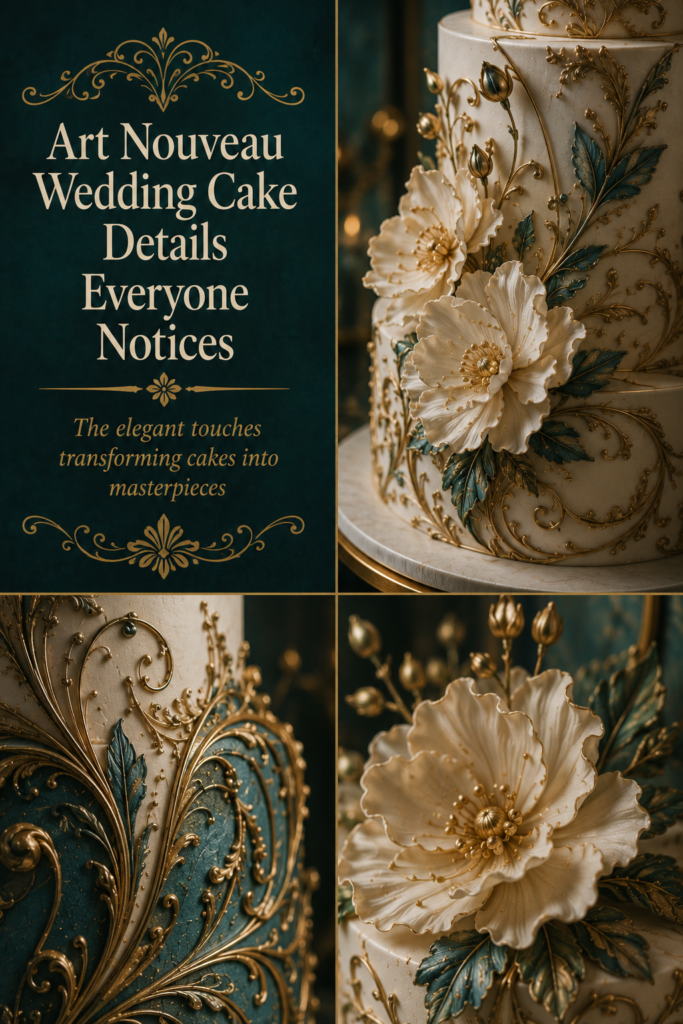
Botanical sugar flowers are the second defining element, and the standard to hold them to is the same standard the movement held its printed botanical illustration to: genuine species accuracy rather than generic decorative blooms. Sugar wisteria with the specific clustered, cascading structure of the real flower; sugar roses in the loosely petalled old-garden varieties rather than the tight, symmetrical contemporary florist rose; sugar poppies with their characteristic crumpled-tissue petals — these read as art nouveau in a way that generic round sugar blossoms, however skilfully made, do not. Gold leaf detail is the third essential element and the most immediately recognisable: applied not as a uniform metallic band around a tier but as an irregular, organic accent that follows the piped botanical line work, exactly as gold detail in art nouveau jewellery and illustration follows the curve of a stem rather than sitting as a separate decorative element.
Stained-glass effect panels — created with isomalt sugar work or painted gel panels in the jewel tones the movement favoured, set into a tier to create the impression of light passing through coloured glass — are among the most technically ambitious and most specifically art nouveau techniques available to a cake designer, directly referencing one of the movement’s most celebrated architectural media. Asymmetric tiers, where the layers are not perfectly centred or uniformly sized but shift slightly in the organic, irregular manner the aesthetic favours throughout, complete the structural vocabulary. Taken together, these elements produce a cake that functions as genuine sculpture rather than as a iced dessert with floral decoration applied to its surface — the specific quality that separates an art nouveau cake from a cake that has simply been given a botanical theme.
Section 02
Five Art Nouveau Cake Styles
Bring these descriptions to your cake designer as a starting reference for the specific art nouveau register you want your cake to inhabit.
Style 2.1
The Botanical Gold Leaf Cake
The most directly recognisable and most broadly suitable of the five — the botanical gold leaf cake pairs sugar flowers in the deep forest green and dusty rose palette of the classic art nouveau register with irregular, organic gold leaf accents that trace the piped vine work climbing each tier. The gold leaf should never be applied as a continuous foil band; it should appear in fragments and irregular patches that follow the botanical line work the way real light catches the edges of leaves rather than coating them uniformly. This style suits the widest range of venues and the broadest range of overall wedding aesthetics within the art nouveau family, since it draws on the movement’s most universally recognised visual vocabulary.
Tier structure for this style typically favours a moderate asymmetry — each tier slightly different in its botanical coverage, with the lower tiers carrying more abundant sugar flower work and the gold leaf becoming more concentrated toward the top, drawing the eye upward in the way a climbing plant naturally does. Discuss with your cake designer the option of a single dramatic cascading sugar flower arrangement descending from the top tier rather than uniform decoration distributed evenly across all tiers, which creates the asymmetric, organic-growth quality the aesthetic depends on.
Matching Stationery
The botanical gold leaf cake pairs naturally with the Art Nouveau Floral stationery collection — the same flowing botanical illustration and antique gold detail carried from the invitation suite to the cake table. The Art Nouveau Floral collection — fully customizable with your names, date, and wedding details.

Style 2.2
The Vintage Lace Piping Cake
The most nostalgic and most technically intricate of the five — the vintage lace piping cake uses extended royal icing piping work to create the impression of antique lace draped over the tiers, in the warm ivory and aged parchment palette of the vintage art nouveau register. The piping should follow the same sinuous, organic logic as the gold leaf cake’s botanical line work rather than the more rigid, repeated lattice patterns of conventional lace-effect cake piping — this is the detail that separates a genuinely vintage art nouveau lace cake from a generically Victorian-lace-inspired one.
This style achieves its full effect with warm ivory fondant or buttercream rather than bright white, since the slight cream undertone reads as genuinely aged rather than simply unadorned, in the same way the vintage register of the art nouveau stationery and dress aesthetics favour warm ivory over pure white. Dusty rose sugar flowers, used sparingly against the extensive piping work, provide colour without competing with the intricate lace detail that is the primary visual interest of this style.
Matching Stationery
The vintage lace piping cake belongs with the Art Nouveau Vintage stationery collection — warm, nostalgic botanical illustration that shares the same aged ivory palette and antique character. The Art Nouveau Vintage collection — fully customizable with your names, date, and wedding details.

Style 2.3
The Wisteria Cascade Cake
The most dramatically beautiful and the most specifically art nouveau of the five — the wisteria cascade cake takes the movement’s most beloved single botanical motif and builds the entire cake design around it: sugar wisteria blooms cascading from the top tier down one side of the cake in the same asymmetric, abundant manner as a real wisteria vine growing over a garden structure. This is the cake style most visually connected to the wisteria ceremony arch described elsewhere in the art nouveau wedding series, and choosing both creates a powerful visual echo between the ceremony space and the reception cake table.
The technical demand of sugar wisteria is considerable — each individual bloom within a cluster is small and must be assembled in genuine quantity to create the visual impression of abundance the style requires — so discuss timeline and cost implications with your cake designer well in advance. The colour palette for this style is naturally cooler than the other four: pale lavender and violet from the wisteria itself, set against deep forest green foliage and warm ivory fondant, with antique gold appearing only as a minimal accent rather than a dominant element.
Matching Stationery
The wisteria cascade cake is the natural visual companion to the Wisteria Arch Botanical stationery collection — the same cascading floral motif carried from the very first save the date through to the cake table. The Wisteria Arch Botanical collection — fully customizable with your names, date, and wedding details.

Style 2.4
The Ornate Decorative Cake
The most maximalist and most jewel-toned of the five — the ornate decorative cake belongs to the fullest expression of the art nouveau aesthetic, with every tier carrying dense botanical and sinuous line detail in the deep jewel tones — burgundy, midnight green, deep violet — that characterise the movement’s most atmospheric register. Stained-glass effect isomalt panels are particularly well suited to this style, since the deep jewel colours and the technique’s light-catching quality work together most powerfully when the overall design commits fully to maximal ornamentation rather than restraint.
This style suits couples who have committed to the most fully realised art nouveau aesthetic throughout their celebration — ornate historic venues, the most maximalist stationery and decoration choices, candlelit evening receptions where the jewel tones and any stained-glass panel work catch warm flickering light to full effect. Discuss with your cake designer how to balance density of detail with structural visibility: an entirely covered surface can lose the specific sinuous line quality that makes the ornamentation read as art nouveau rather than simply busy, so even the most maximalist version benefits from areas where the piped line work is visible against open fondant.
Matching Stationery
The ornate decorative cake pairs with the Fancy Classic Decorative Art Nouveau stationery collection — the most fully ornamented stationery register in the same maximalist botanical tradition. The Fancy Classic Decorative Art Nouveau collection — fully customizable with your names, date, and wedding details.
Style 2.5
The Olive & Gold Botanical Cake
The most distinctive and most unexpected of the five — the olive and gold botanical cake uses a muted olive green fondant or buttercream base, a palette choice with genuine precedent in the art nouveau tradition’s exploration of botanical colour in shadow and aged pigment, rather than the brighter forest green of the classic register. Gold botanical detail — piped line work and gold leaf accents — reads with particular richness against this warmer, more muted green, creating a cake that is immediately recognisable as distinctive within the broader category of botanical wedding cakes.
This style suits late summer and autumn celebrations particularly well, where the olive tones connect naturally to the seasonal palette of the surrounding landscape, and pairs effectively with sugar botanical work in warm dusty tones — muted rose, soft amber, dried-flower cream — rather than the brighter pinks and greens of a spring botanical cake. Discuss this palette with your cake designer early, since olive green fondant requires specific colour mixing that not every cake designer will have prepared in advance.
Matching Stationery
The olive and gold botanical cake connects to the Olive Green Vintage Floral Art Nouveau stationery collection — the same distinctive muted olive palette carried from the invitation suite through to the reception table. The Olive Green Vintage Floral Art Nouveau collection — fully customizable with your names, date, and wedding details.

Section 03
Art Nouveau Cake Flavors
The most thoughtfully designed art nouveau cake extends the botanical philosophy to flavour as well as decoration — the movement’s underlying conviction that nature provides the finest available material applies as naturally to what a cake tastes like as to what it looks like. Elderflower is the most directly botanical choice available, with the delicate, slightly honeyed floral character that pairs beautifully with a light sponge and a citrus or berry filling, and a genuine connection to the hedgerow and garden botanicals the movement’s illustration celebrated. Rose, used with restraint so the floral note remains delicate rather than overwhelming, suits the romantic register of the classic and vintage art nouveau styles particularly well, especially paired with a vanilla or almond sponge base.
Lavender honey brings together two genuinely botanical flavour sources in a combination that suits the warmer, more rustic end of the art nouveau palette — particularly the olive and gold botanical style, where the muted, earthy quality of the flavour pairing echoes the visual register of the cake itself. Earl Grey, while not a literal botanical flavour in the same sense, carries the specific quality of refined, slightly old-fashioned elegance that suits the vintage lace piping style especially well, its bergamot note adding sophistication without competing against delicate piping detail. Fig and honey, rich and warmly autumnal, pairs naturally with the wisteria cascade and ornate decorative styles when the wedding falls in late summer or autumn, bringing a depth of flavour that matches the visual richness of the more maximalist cake designs.
Discuss flavour layering with your cake designer in the same way you would discuss the visual tier design — different tiers can carry different botanical flavours, allowing guests to discover the same kind of variety within a single cake that the movement’s botanical illustration achieved through its abundance of detail. A wisteria cascade cake with a lavender honey lower tier and an elderflower upper tier, for instance, creates a flavour journey that echoes the visual journey from the cake’s grounded base to its cascading floral crown.
Section 04
Styling the Cake Table
The cake stand itself is the first styling decision and one that is often underweighted: a cake stand in aged brass or antique gold, with the sinuous curved profile of art nouveau metalwork rather than a plain contemporary pedestal, extends the cake’s design language to its base rather than allowing a generic stand to interrupt the visual composition. Where possible, choose a stand with botanical or organic detail in its own structure — a base that curves like a flower stem, or feet shaped with the same sinuous quality as the piped line work on the cake itself — so the entire cake-and-stand composition reads as a single piece rather than a beautiful object placed on a neutral support.
Botanical garlands trailing across the cake table surface extend the cake’s botanical detail outward, creating a transition zone between the cake itself and the surrounding table rather than leaving the cake to stand in visual isolation against a bare surface. Fresh botanical material in the same species as the cake’s sugar flowers — real wisteria alongside sugar wisteria, real roses alongside sugar roses — creates a particularly powerful effect, since the living and the sugar-crafted botanical material are in genuine visual conversation. Antique gold candle holders at varying heights around the cake table, lit as the reception moves into evening, provide the warm candlelight that makes the gold leaf and gold piping detail on the cake itself read with its full richness; bright overhead lighting flattens gold leaf detail in a way that candlelight never does.
The detail shot of the cake beside the invitation suite is among the most reliably beautiful and most frequently requested images in art nouveau wedding photography: the botanical illustration on the invitation and the botanical sugar work on the cake, photographed together in warm natural or candlelight, demonstrate the complete visual coherence of the celebration’s aesthetic in a single frame. Bring a single piece of the stationery suite — the invitation itself, or a place card if the full suite is in use elsewhere — to the cake table specifically for this photograph, and ask the photographer to position it so the gold detail on both pieces catches the same light source.
Section 05
From Cake to Complete Wedding: Stationery
The cake is, in the sequence of an art nouveau wedding day, very often the last major piece of botanical art a guest encounters — arriving after the stationery that announced the celebration, after the ceremony arch and the dress, after the reception table’s centrepieces and place settings, as the final and most literally consumable expression of the day’s complete aesthetic. This sequencing makes visual consistency between the cake and everything that preceded it especially important: a guest who has spent the entire day inside a coherent art nouveau botanical world, and who then encounters a cake in a completely different decorative register, experiences a small but noticeable break in the celebration’s visual story at its most photographed and most anticipated moment.
The most practical way to ensure this consistency is to bring your stationery suite — or photographs of it — to your cake design consultation, so the same botanical species, the same gold tone, and the same general density of ornamentation that appear on your invitation suite can inform the cake designer’s choices. A couple whose stationery features wisteria in cascading abundance and antique gold line work has given their cake designer a precise and specific visual brief, far more useful than a general request for “art nouveau” or “botanical gold,” and the resulting cake is correspondingly more likely to feel like a genuine continuation of the visual world the stationery established months earlier.
Where weddingavenuestudio.com can help directly is in providing that visual brief in its most concrete and shareable form: a complete, fully customized art nouveau stationery suite — invitation, save the date, ceremony programme, menu, place cards, table numbers — that documents the specific botanical species, palette, and gold detail your cake designer, florist, and every other vendor can reference. We don’t design or sell wedding cakes, but the stationery suite you choose is the single most useful reference document you can hand to the person who will.
The six collections below each match one or more of the cake styles described in Section 02. All are fully customizable with your names, date, and wedding details.
Shop the Collections
Stationery Matched to Every Cake Style
Art Nouveau Floral
Flowing botanical illustration and antique gold detail — the natural match for the Botanical Gold Leaf Cake.
Art Nouveau Vintage
Warm nostalgic botanical art nouveau — the visual companion to the Vintage Lace Piping Cake.
Flora Vintage Art Nouveau Wedding
Pure vintage botanical elegance — for cakes that share the warmest, most romantic register of the aesthetic.
Fancy Classic Decorative Art Nouveau
Maximally ornate classical art nouveau — the stationery match for the Ornate Decorative Cake.
Wisteria Arch Botanical Wedding
Cascading wisteria and botanical abundance — the precise visual companion to the Wisteria Cascade Cake.
Olive Green Vintage Floral Art Nouveau
Distinctive olive green botanical illustration — the stationery match for the Olive & Gold Botanical Cake.
The Art Nouveau Wedding Series
Explore the Full Series
Art Nouveau Wedding — The Complete Aesthetic Guide · Art Nouveau Wedding Invitations · Art Nouveau Wedding Dress · Art Nouveau Wedding Decorations · Art Nouveau Wedding Theme & Colors · Art Nouveau Wedding Ring
Frequently Asked Questions
Common Questions
Do you design or sell wedding cakes?
No — weddingavenuestudio.com is a wedding stationery studio. This guide is design inspiration only, intended to help you describe the art nouveau aesthetic precisely to your own cake designer. We don’t recommend specific bakers or cake designers, since the right choice depends entirely on your location, budget, and the designer’s specific skill with sugar flower work and piping. What we can offer is the fully customizable stationery suite that documents your exact botanical palette and gold detail — a useful, concrete reference to bring to that consultation.
What makes a cake genuinely art nouveau rather than just floral?
Sinuous, asymmetric piped line work that never repeats at a regular interval; sugar flowers with genuine botanical species accuracy rather than generic decorative blooms; gold leaf applied as an irregular organic accent following the botanical line rather than as a uniform metallic band; and asymmetric tier structure rather than perfectly centred, uniform layers. The simplest test: does the design look as though it grew, with the irregular logic of a real climbing plant, or does it look assembled from regularly repeated decorative elements? The former reads as art nouveau; the latter reads as conventionally floral.
How far in advance should I book my art nouveau cake design?
Cake designers working in detailed sugar flower and gold leaf work typically require longer lead times than simpler designs — the wisteria cascade and ornate decorative styles in particular involve significant hand-crafted sugar work that cannot be rushed. As a general guide, secure your cake designer eight to twelve months ahead for a popular designer or a particularly detailed design, and bring your stationery suite or photographs of it to the initial consultation so the designer can plan the necessary sugar flower and piping work around your specific botanical palette from the outset.
How do I match my cake to my stationery?
Bring your stationery suite, or clear photographs of it, to your cake design consultation as a precise visual reference — the specific botanical species, gold tone, and density of ornamentation on your invitation gives your cake designer far more useful direction than a general “art nouveau” request. The Art Nouveau Floral, Wisteria Arch Botanical, and other collections above each correspond to a specific cake style described in Section 02, so choosing your stationery suite first can also help clarify which cake design will feel most cohesive with the rest of your celebration.
Art Nouveau Wedding Stationery · 2026
Give Your Cake Designer the Perfect Brief
A fully customized stationery suite documents your exact botanical palette and gold detail — the most useful reference you can bring to a cake consultation.