Art Nouveau Wedding Dress
Art Nouveau Wedding · 2026
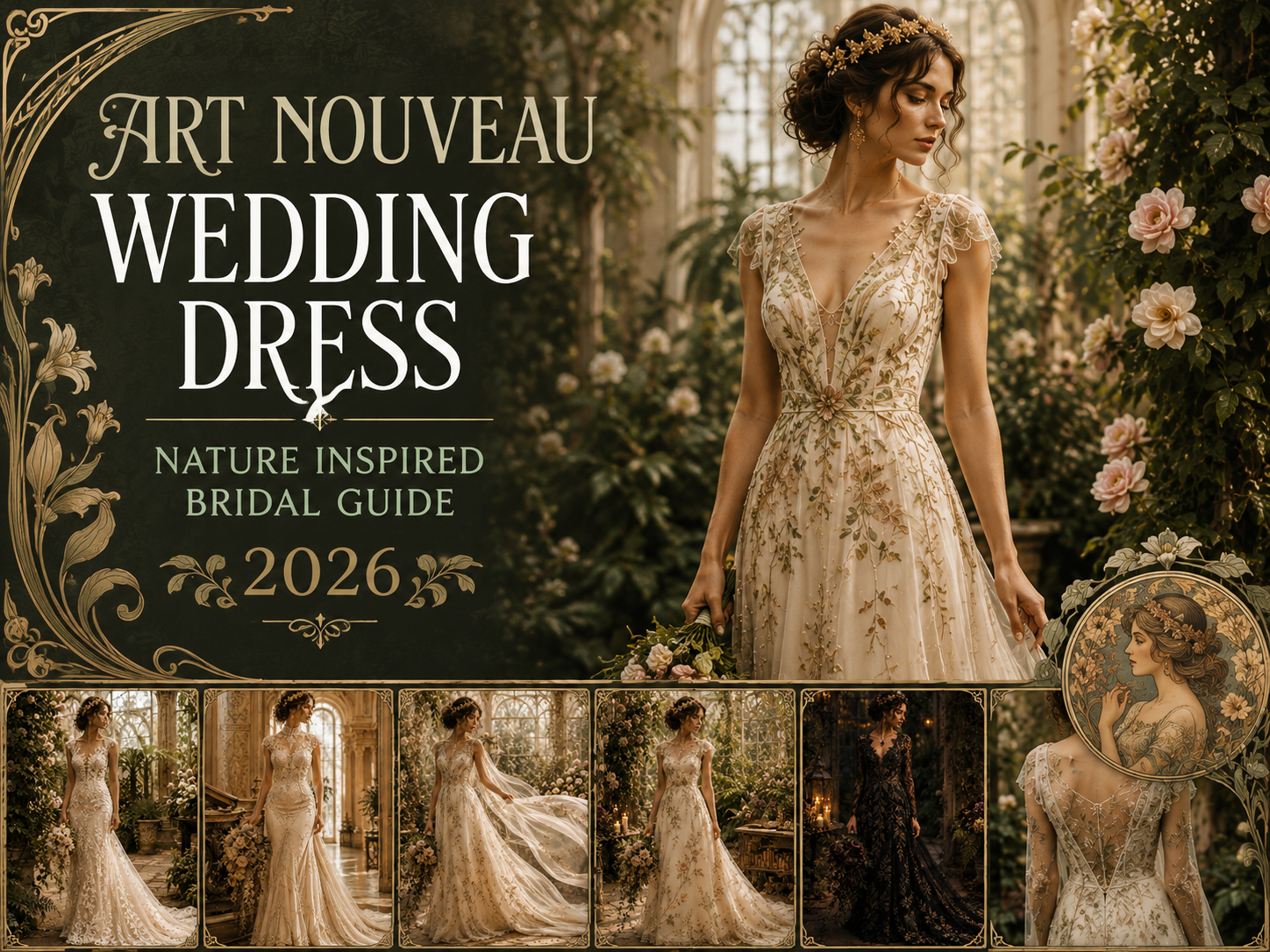
Art Nouveau Wedding Dress — Nature Inspired Bridal Guide 2026
From flowing botanical lace gowns and Belle Époque period silhouettes to goddess-draped florals and dark botanical alternatives — the complete guide to choosing your art nouveau wedding dress in 2026.
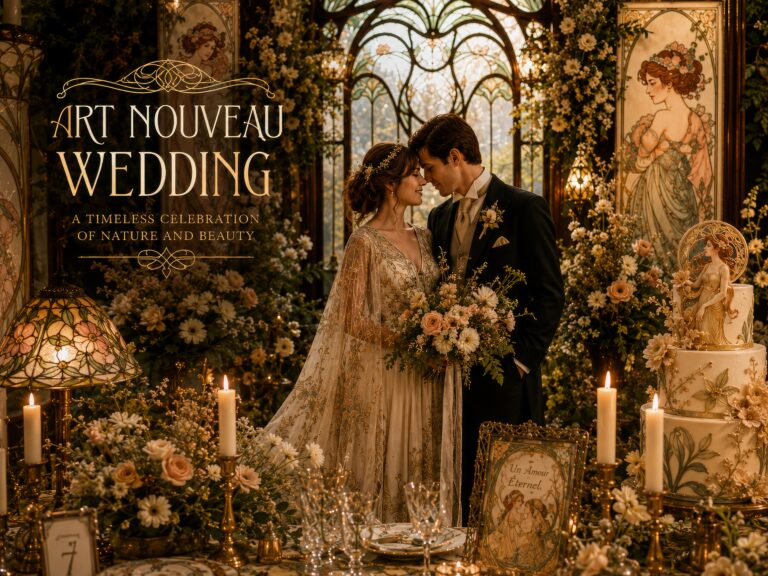
The art nouveau bride has a specific vision that is immediately recognisable in the mood boards she has been building for months: the flowing botanical lace dress photographed in a glasshouse in the late afternoon, the climbing rose embroidery that trails across the bodice with the same organic logic as a real climbing rose against old stone, the specific silhouette of a woman who looks as though she might have been painted by Mucha rather than dressed by a contemporary bridal designer. She is not looking for a specific gown so much as a specific feeling — the feeling of botanical beauty made wearable, of the natural world rendered in lace and embroidery with the same care and precision that the art nouveau movement brought to every surface it touched. This guide identifies six distinct art nouveau bridal styles for 2026, describes what makes each one genuinely of the aesthetic, and covers the accessories, the bouquet, and the stationery suite that completes the botanical visual world from the first invitation through to the ceremony itself.
The women in Mucha’s paintings were not dressed. They grew. Their hair and their garments and the botanical world surrounding them were all part of the same organic composition — flowing in the same direction, responding to the same unseen breeze, belonging to the same world so completely that the boundary between the human and the botanical was exactly where the artist meant it to be.

Section 01
The Art Nouveau Bridal Aesthetic
An art nouveau wedding dress is distinct from a vintage dress, a romantic dress, or a botanical-inspired dress in a specific and important way: it does not borrow elements from the art nouveau aesthetic and apply them to a conventional silhouette. It embodies the movement’s central visual philosophy, which is that organic form is the highest form, and that the most beautiful things grow rather than being constructed. The distinction in practice is between a dress with floral lace applied to it and a dress in which the botanical illustration is so organically integrated into the structure that it looks as though the flowers grew on the fabric rather than being placed there. This quality — of organic integration rather than applied decoration — is what separates genuinely art nouveau bridal design from its many less specific neighbours.
The key qualities of a genuinely art nouveau bridal aesthetic are: flowing silhouette that moves with the body rather than constraining it, in the specific way that art nouveau illustration depicted the human form as always in motion; botanical detail in the fabric, lace, or embroidery that is not symmetrical, not repeated uniformly, but distributed with the organic irregularity of real growing things; sinuous line work in any structural element of the gown — a neckline, a hem, a sleeve edge — that curves and flows rather than making right angles or sharp geometric shapes; and the overall impression of a garment that looks as though it belongs in a botanical setting rather than looking transplanted into one. An art nouveau bridal gown worn in a glasshouse should look as though the glasshouse was designed around the dress rather than the dress was chosen for the venue.
Pinterest searches for art nouveau bridal aesthetics have grown significantly in 2026 for the same reason the art nouveau wedding aesthetic broadly has grown: the combination of maximum botanical ornamentation and the specific quality of the Mucha-inspired feminine ideal — flowing, botanical, powerful in its organic beauty rather than its formal structure — answers something that contemporary bridal fashion rarely does. The bride drawn to this aesthetic has been looking for a dress that looks like it belongs to the natural world, and has been finding that most contemporary bridal gowns, however beautiful, don’t achieve this quality in the specific register she recognises from the mood boards she has been building. The six styles below offer six distinct ways of achieving it.
Section 02
Six Art Nouveau Wedding Dress Styles
Six distinct ways of being an art nouveau bride — from the most historically authentic to the most contemporary editorial. Find the description that matches the dress you have been imagining.
Style 2.1
The Botanical Lace Gown
The most directly art nouveau of the six — the botanical lace gown is the dress whose connection to the movement is visible at every scale of examination, from the silhouette visible across a ceremony space to the individual lace motifs visible only at close range. Botanical lace with genuine art nouveau character is distinguished from ordinary floral lace by the quality of the botanical illustration in the lace pattern itself: the flowers and leaves should be rendered with the specific accuracy and the specific organic irregularity of real botanical illustration, with petals at different stages of opening, stems that curve rather than line up, and the occasional detail — a seed head, an unfurling leaf, a botanical element caught in a specific moment of growth — that rewards the viewer who looks closely enough to find it.
Climbing flower appliqué that appears to ascend the bodice from the hem is one of the most specifically art nouveau bridal details available: it takes the movement’s characteristic representation of botanical forms climbing and growing over architectural surfaces and translates it directly into the structure of the dress, so the garment appears to be a surface that botanical life has chosen to inhabit. The sinuous line work of the lace pattern — the organic curves that connect botanical elements rather than the geometric grids of conventional lace — is the other defining detail. A truly botanical lace gown looks as though the lace itself grew rather than was woven.
This dress photographs magnificently in botanical settings for a reason that is aesthetically straightforward: the botanical illustration in the lace is in the same visual register as the real botanical material behind it. In a glasshouse, the lace pattern and the living planting behind the bride are both part of the same botanical world, rendered in different media but sharing the same visual logic. The most extraordinary botanical lace gown photographs are taken when this connection is acknowledged and positioned deliberately: the lace against living foliage that shares the same plant forms, the bride positioned so the climbing rose behind her echoes the climbing botanical lace on her bodice.
Styling the botanical lace gown: hair worn loose or in a loose updo that allows individual strands to trail, rather than tightly pinned, so the softness of the hair is in the same organic register as the botanical lace. A botanical crown, flower crown, or detailed botanical hairpiece rather than a conventional veil. Jewellery with the sinuous, organic character of art nouveau metalwork — botanical motifs in antique gold rather than geometric settings in contemporary metals. And the specific quality of shoe that disappears — barely visible beneath the hem, so nothing interrupts the long flowing line of the botanical lace as it trails.
Complete the Look: Stationery
The botanical lace gown belongs to the same visual world as the Art Nouveau Floral stationery collection — flowing botanical illustration that shares the same organic logic as the lace pattern on the dress itself. The Art Nouveau Floral collection — fully customizable with your names, date, and wedding details.

Style 2.2
The Belle Époque Gown
The most historically grounded of the six — the Belle Époque gown draws directly on the specific silhouettes of the period in which the art nouveau movement flourished, translating the actual fashion of 1890 to 1910 into a contemporary bridal context. The defining silhouette of this aesthetic is the S-curve: the specific shape created by a fitted bodice that pushes the bust forward, a narrow waist, and a skirt that flows backward from the hips in the characteristic sweep of Edwardian fashion. This is genuinely the silhouette of art nouveau women’s fashion rather than a romantic approximation of it, and the bride who chooses it is making the most historically specific connection to the movement available in contemporary bridal design.
The bodice of a Belle Époque gown is where the most important design decisions are concentrated: high neck or deep sweetheart neckline depending on the specific period reference, ornate bodice detail in embroidery or botanical lace, the specific quality of a structured bodice that achieves its shape through the construction of the garment rather than modern understructure. The high-neck option is the more historically authentic of the two and creates the most period-specific impression; the sweetheart version is more contemporary in feel while maintaining the S-curve silhouette and the bodice ornamentation that define the aesthetic.
The flowing skirt of the Belle Époque gown is where the organic, flowing quality of the art nouveau aesthetic expresses itself in the lower half of the dress. It should not be stiff or heavily structured but genuinely flowing — moving with the bride as she walks in a way that creates the specific quality of Edwardian fashion in movement that photographs as genuinely of the period. Heavy fabrics that hold a rigid shape work against this quality; lightweight silk, chiffon over silk, and soft organza achieve it most naturally.
The Belle Époque gown is the art nouveau bridal style that suits historic venue settings most specifically: the ornate architecture of a period hall or a Victorian glasshouse, the architectural details of a Belle Époque building, or any setting that has genuine period character. The dress looks as though it belongs in these settings because it was designed according to the same aesthetic principles that produced them. In a contemporary minimalist venue, the same dress would look genuinely extraordinary as a piece of historical costume — but it is in a setting with period character that it achieves what it was made to achieve.
Complete the Look: Stationery
The Belle Époque gown belongs to the warmly nostalgic register of the Flora Vintage Art Nouveau stationery collection — botanical illustration with genuine period character that echoes the historical grounding of the dress itself. The Flora Vintage Art Nouveau collection — fully customizable with your names, date, and wedding details.

Style 2.3
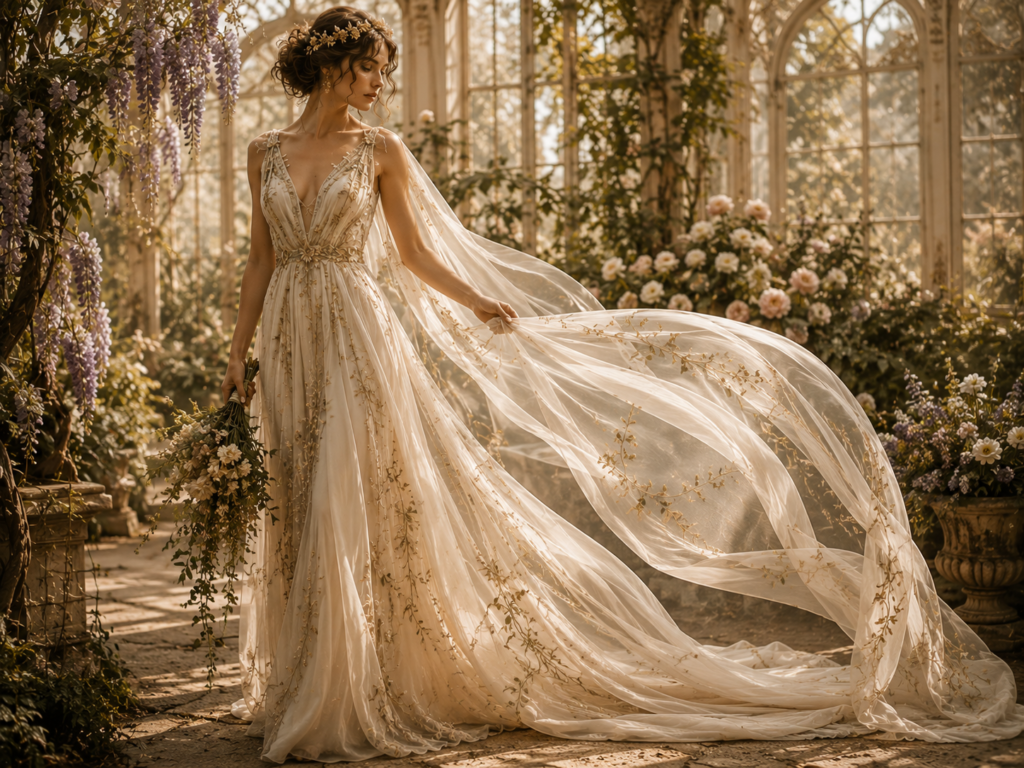
The Flowing Goddess Gown
The most directly Mucha of the six — the flowing goddess gown takes the specific representation of the feminine ideal in art nouveau poster art and translates it into a bridal silhouette. In Mucha’s most celebrated works, the women are not dressed in structured contemporary fashion but draped — garments that fall and wrap and trail with an organic quality that reads as less constructed than discovered, as though the fabric had arranged itself around the figure in a moment of botanical grace. This is the quality the flowing goddess gown pursues: a draping silhouette in the lightest possible fabrics, botanical embroidery as the primary decorative element rather than the structural element, and the overall impression of a woman who is part of the natural world rather than observing it from within a garment.
The fabrics that achieve this quality most successfully are those with genuine movement and transparency: silk georgette, fine chiffon, and the lightest qualities of silk organza, all in single or double layers that respond to the slightest movement and create the flowing, almost liquid quality of fabric in motion that Mucha’s illustration achieved through the controlled chaos of organic line work. The colour palette for the flowing goddess gown is the most expansive of the six styles: the specific ivory of aged silk, pale champagne, the particular warm tone of natural undyed fabric, or — for the more adventurous art nouveau bride — the palest botanical tints: the faintest sage, the most diluted dusty rose, the barest hint of the specific pale lavender of wisteria in flower.
Botanical embroidery on a flowing goddess gown should feel as though it arrived on the fabric independently of any human intention — scattered rather than placed, growing rather than positioned. The specific quality to look for is embroidery that appears to be in the middle of something: a stem mid-climb, a flower mid-opening, a botanical element that looks as though it will have moved by the time the next photograph is taken. This quality of apparent motion in the embroidery, combined with the actual motion of the flowing fabric, creates the specific visual effect that the Mucha women possess and that is the defining quality of this bridal style.
The flowing goddess gown suits outdoor ceremonies and glasshouse settings most naturally, because both environments allow the fabric’s movement qualities to be fully visible in the photographs. In a still interior, the gown can look extraordinarily beautiful at a single moment; in a space with gentle movement of air, the fabric responds to every subtle change and creates a series of photographs in which no two images are identical, because the gown is always slightly different. The practical consideration is that this is the style most sensitive to weather conditions: plan an outdoor goddess gown ceremony with a genuine weather contingency, and choose the specific fabric weight with the climate of the venue in mind.
Complete the Look: Stationery
The flowing goddess gown belongs to the most romantically botanical register of the art nouveau stationery world — the Wisteria Arch Botanical collection, where cascading floral abundance and organic botanical beauty exist in the same visual world as the draped fabric and scattered embroidery of the dress itself. The Wisteria Arch Botanical collection — fully customizable with your names, date, and wedding details.

Style 2.4
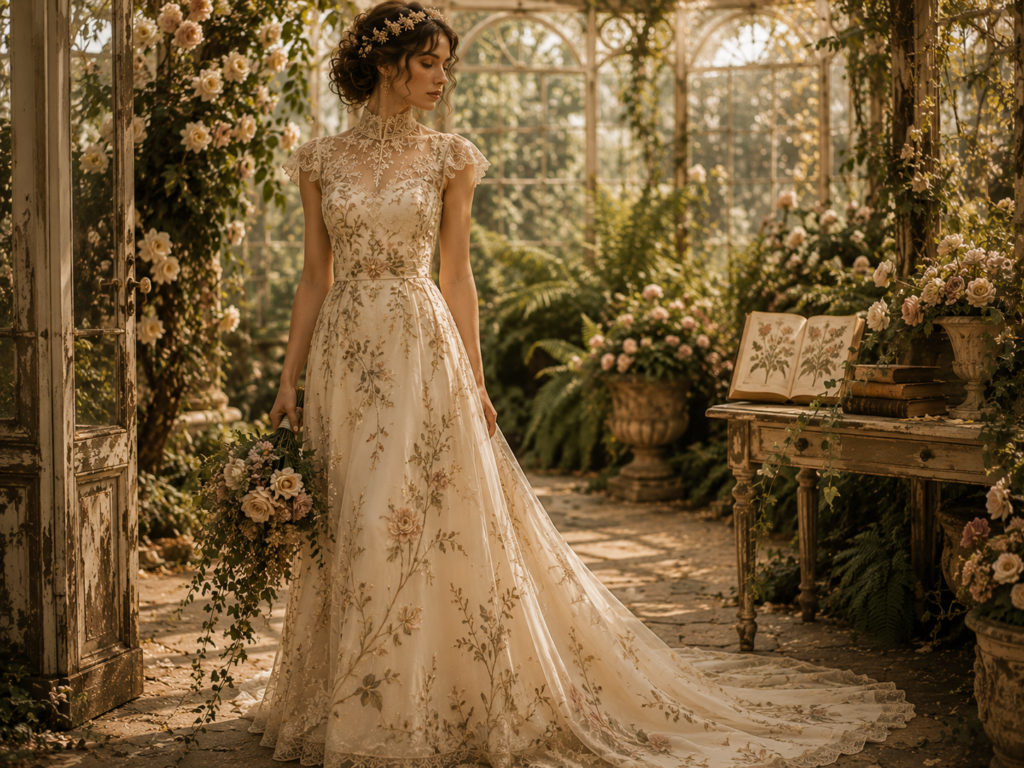
The Vintage Botanical Gown
The most warmly nostalgic of the six — the vintage botanical gown sits at the intersection of Victorian botanical illustration and art nouveau design, in the specific territory where the two aesthetics share their deepest common ground: the intense attention to botanical accuracy, the quality of ornamentation that treats the natural world as the highest subject available to human representation, and the warm, slightly aged palette of antique ivory and champagne and aged parchment that belongs to the most treasured botanical prints of the period. The vintage botanical bride wants her dress to feel discovered rather than chosen — as though it arrived from a different era already perfect for this moment.
The aged ivory or champagne palette of the vintage botanical gown is perhaps its most distinctive quality, because it is the palette that most immediately communicates the vintage register to anyone who encounters the dress. Bright white belongs to contemporary bridal fashion and to the specific cultural associations of late twentieth century weddings. The warm, slightly yellow ivory of aged silk belongs to the nineteenth century and carries the specific beauty of old things that have been treasured. For the vintage botanical gown, the colour of the fabric should feel as though the fabric has been waiting for this occasion for a long time and is glad to finally have it.
Victorian botanical inspiration in the specific details of the vintage botanical gown means looking to the botanical illustration tradition of the nineteenth century rather than to contemporary bridal floral trends: the specific botanical species that appeared most frequently in Victorian botanical prints (roses, ferns, ivy, wisteria, passionflower, clematis), rendered with botanical illustration accuracy rather than floral design looseness. The embroidery should look as though it was painted with the same hand as a Victorian botanical watercolour, not as though it was chosen from a contemporary bridal embroidery catalogue. This is a dress for a bride who loves the botanical illustration tradition specifically, not botanical decoration generally.
The venue for the vintage botanical gown should have genuine age — an established walled garden with climbing roses that have been growing against the stone for decades, a conservatory with original Victorian botanical planting, an orangery with period ironwork and established specimen trees. This is the art nouveau bridal style that most depends on its setting to complete the visual logic it establishes: placed in a genuinely old botanical setting, the vintage botanical gown looks as though it belongs there by right. Placed in a contemporary venue with botanical decoration, the same dress looks like beautiful costume.
Complete the Look: Stationery
The vintage botanical gown connects naturally to the Art Nouveau Vintage stationery collection — warm, nostalgic botanical illustration that shares the specific quality of beautiful aged botanical material that the dress itself embodies. The Art Nouveau Vintage collection — fully customizable with your names, date, and wedding details.

Style 2.5
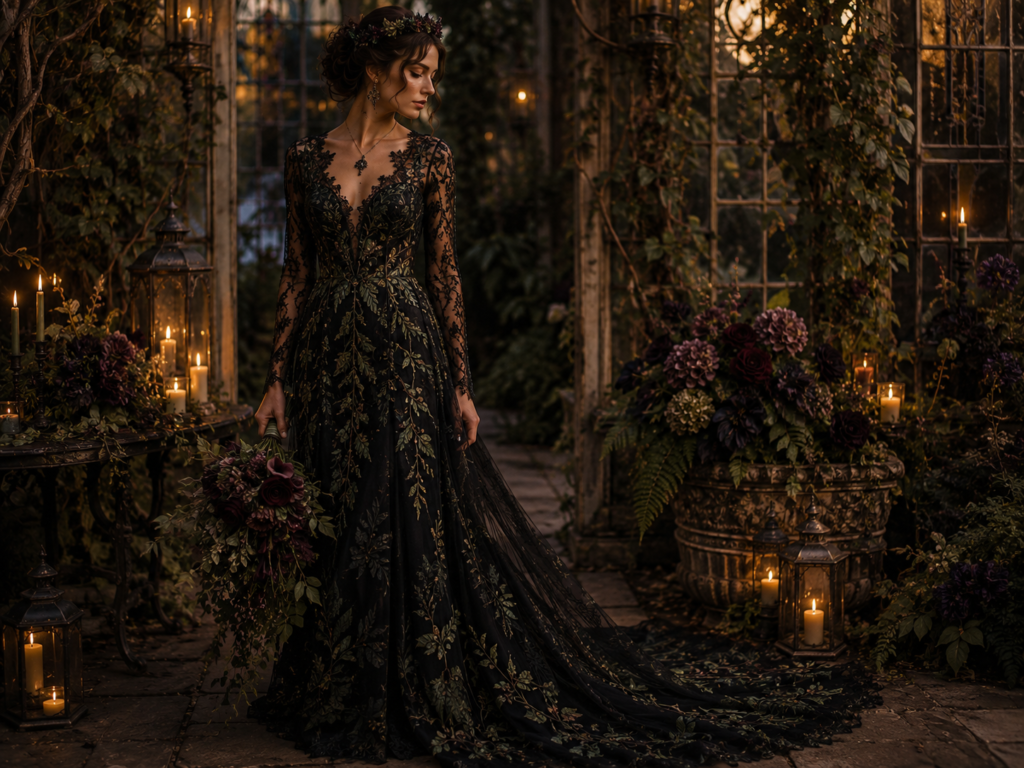
The Dark Art Nouveau Gown
For the alternative art nouveau bride who finds the movement most compelling in its darker and more mysterious register — the dark art nouveau gown takes the same botanical lace and organic silhouette principles as the other five styles and places them in a colour palette that belongs to the jewel-toned, candlelit end of the art nouveau tradition. Deep midnight forest green, richest burgundy, near-black with botanical detail visible only in the right light: these are the colours that appear in the movement’s most atmospheric works, in the stained glass and dark botanical illustration that belongs to the symbolist strand of art nouveau rather than its more celebrated bright and floral manifestation.
The dark art nouveau gown is not a gothic gown in botanical disguise — it is genuinely art nouveau in its approach to botanical detail, its organic silhouette, and its sinuous line work, with the distinction being purely the palette. The botanical lace in this dress is as detailed and as organically rendered as in the lighter versions; the silhouette is as flowing and as movement-friendly. The difference is that the dark colour absorbs light rather than reflecting it, creating a depth in the botanical illustration that is different from and — in the right lighting conditions — more extraordinary than the same detail in lighter fabric. Dark botanical lace in candlelight has a luminosity that cannot be achieved with pale fabric, because the light caught in the raised lace details reads as genuinely lit from within against the dark ground.
This dress requires specific lighting conditions to achieve its most beautiful form: not the bright afternoon daylight that suits the lighter botanical lace styles, but the specific warmth of late afternoon light beginning to fail, or the rich candlelight and warm atmospheric lighting of an evening reception. The getting-ready photographs for the dark art nouveau bride should be planned for the most beautifully lit room available, with warm morning light if possible rather than harsh overhead illumination. And the ceremony timing should lean toward late afternoon, when the light has the specific warm quality that makes dark fabric simultaneously most beautiful and most photographically extraordinary.
The accessories for a dark art nouveau gown follow the same principle as the dress: the most atmospheric and the most dramatically beautiful options rather than the most conventional. Deep botanical florals in the bridal crown — dark dahlias, deep plum anemones, near-black botanical foliage — rather than conventional pale wildflowers. Art nouveau jewellery in aged silver or oxidised gold rather than bright gold or contemporary white metal. And the bouquet in the deep botanical palette that belongs to the same visual world as the dress: dark, dramatic, and genuinely beautiful in the register that this dress inhabits.
Complete the Look: Stationery
The dark art nouveau gown belongs to the Art Nouveau Goth stationery collection — jewel-toned botanical illustration that carries the same atmospheric depth and dark romance as the dress itself, from the first invitation through to every candlelit table detail. The Art Nouveau Goth collection — fully customizable with your names, date, and wedding details.

Style 2.6
The Modern Art Nouveau Gown
The most contemporary and the most broadly wearable of the six — the modern art nouveau gown takes the movement’s botanical ornamentation and sinuous line work and applies them to a clean, contemporary silhouette that does not require a Victorian setting or a dramatically botanical venue to read as genuinely art nouveau. The defining characteristic of this style is that the art nouveau elements — the botanical embroidery, the organic lace details, the sinuous border or hem treatment — are treated as the primary design interest of a dress that is otherwise structurally contemporary rather than period-inspired. The result is a gown that looks simultaneously modern and deeply beautiful in a register that conventional contemporary bridal gowns rarely achieve.
The clean lines that characterise the modern art nouveau gown’s silhouette are deliberately chosen to make the botanical embroidery or lace detail more visible and more powerful as a design element. In a highly structured dress with multiple design elements competing for attention, the botanical illustration becomes one element among many. In a dress with a clean, uncluttered silhouette, the botanical embroidery becomes the complete visual statement, and every guest who sees it focuses immediately on the extraordinary quality of the botanical illustration rather than being distracted by other design details. This approach — clean structure, botanical detail as the primary statement — is the most editorial version of the art nouveau bridal aesthetic and the one that photographs most powerfully in contemporary bridal settings.
The botanical embroidery on a modern art nouveau gown can take several forms, each creating a different visual impression. All-over embroidery in the art nouveau botanical style, distributed across the full surface of the skirt and bodice, creates the most maximally botanical impression and belongs to the most directly art nouveau aesthetic register. Concentrated botanical embroidery at a single focal point — trailing down one side of the skirt from hip to hem, or climbing the bodice from the waist upward — creates a more specifically art nouveau visual quality because it suggests the organic growth logic of a climbing plant: starting somewhere specific and moving in a determined organic direction. The second approach is often more visually striking in photographs, because the asymmetry and the sense of directional movement are specifically art nouveau qualities that symmetrical all-over embroidery cannot achieve.
Styling the modern art nouveau gown: the contemporary silhouette allows for more flexibility in accessory choices than the more specifically period-inspired styles, but the botanical and sinuous detail of the embroidery still requires accessories that belong to the same visual register. Hair that is loosely styled rather than tightly architectural — a loose low bun with botanical hair pins, or soft waves with a fine botanical hairpiece. Art nouveau jewellery in antique gold or aged brass, with the botanical or sinuous line motifs that connect the accessories to the dress detail. And the bouquet: loose, organic, in the botanical palette of the dress rather than in the florist’s seasonal offering, chosen to look as though it was gathered rather than arranged.
Complete the Look: Stationery
The modern art nouveau gown’s refined botanical elegance connects naturally to the Elegant Decorative Floral Art Nouveau stationery collection — sophisticated botanical illustration that carries the same quality of being beautifully art nouveau without being ostentatiously so. The Elegant Decorative Floral Art Nouveau collection — fully customizable with your names, date, and wedding details.
Section 03
Art Nouveau Dress Details to Look For
3.1 — Botanical Embroidery & Appliqué
The single most important detail in an art nouveau bridal gown is the quality of the botanical embroidery or appliqué — and the distinction between genuinely art nouveau embroidery and ordinary floral embroidery is entirely in the accuracy and the organic quality of the botanical representation. Art nouveau botanical illustration depicted real plant species with real accuracy: specific leaf shapes, specific petal structures, specific botanical details that belong to the identifiable plant rather than to a generalised floral decoration. The embroidery on a genuinely art nouveau gown should have this same quality of botanical specificity: roses that look like actual roses rather than decorative rose symbols, fern fronds with actual fern venation, wisteria blooms with the specific clustered structure of real wisteria. This quality of genuine botanical accuracy is what makes the detail reward close examination in the way that all genuinely art nouveau work does.
3.2 — Sinuous Line Work in Lace
Lace for an art nouveau gown should have sinuous, organic line work rather than the geometric regularity of conventional lace patterns. The difference is visible immediately: conventional lace repeats its pattern with mathematical regularity, the same motif at the same interval across the entire surface. Art nouveau lace — or lace chosen for art nouveau suitability — has organic line work that curves and flows without repetition, botanical elements distributed with the irregular abundance of real botanical growth, and the specific quality of a surface where every area rewards individual examination rather than the eye moving smoothly across the pattern without stopping.
3.3 — Sleeve Styles
Three sleeve styles suit the art nouveau bridal aesthetic most naturally. Fitted botanical lace sleeves in the full-length or three-quarter variety, with the botanical lace continuing from bodice through sleeve without interruption, create the most specifically period-authentic silhouette and the most dramatic botanical lace effect in photographs. Dramatic flowing sleeves in lightweight chiffon or silk georgette, in the tradition of the Mucha woman’s draped garments, suit the flowing goddess aesthetic most naturally and create extraordinary movement in both still photographs and video. Flutter sleeves in sheer fabric with botanical detail at the edge are the most contemporary of the three options and suit the modern art nouveau aesthetic, adding the soft movement quality of art nouveau without the historical weight of a full period sleeve.
3.4 — Neckline Options
The high Victorian neckline is the most specifically period-accurate option for the Belle Époque and vintage botanical styles and creates the most dramatic impression when combined with the fitted botanical lace bodice. The sweetheart neckline suits the most romantic register of the art nouveau aesthetic and is the most versatile neckline for the six styles, working from the most period-inspired through to the most contemporary. The off-shoulder neckline is the most specifically goddess-aesthetic option, creating the draped quality of Mucha’s illustrated women while remaining entirely contemporary in its bridal associations. The specific quality to look for in any neckline for an art nouveau gown is the organic quality of the line: a neckline that curves rather than following a straight horizontal should always be chosen over one that doesn’t.
3.5 — Silhouettes
The A-line silhouette is the most broadly suitable for the art nouveau aesthetic and the most versatile across all six styles — it creates the flowing, movement-friendly skirt that the aesthetic requires while allowing the full bodice detail to be visible from the front. The empire waist silhouette suits the flowing goddess style most specifically, creating the high-waisted, draped quality of classical and Regency dress that art nouveau illustration frequently referenced. Fitted and flare suits the most contemporary register of the aesthetic: the closely fitted bodice allows the botanical embroidery detail to be fully visible against the body, and the flare at the hem creates the flowing movement quality without requiring a full A-line skirt from the waist. Any of these silhouettes can achieve the art nouveau aesthetic when combined with the botanical details, sinuous lace, and organic line work that the movement requires.
Section 04
Art Nouveau Bridal Accessories
4.1 — The Botanical Hair Crown or Headpiece
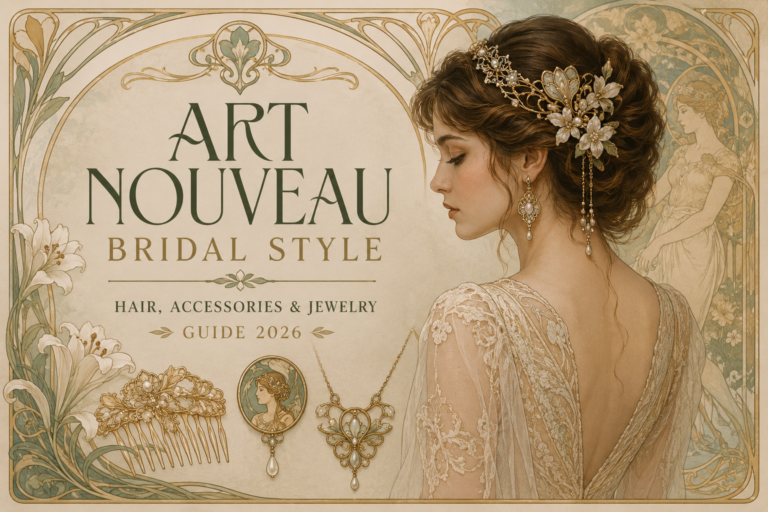
The botanical hair crown is the single most important art nouveau bridal accessory — not because it is the most visually prominent, but because it is the accessory that most directly references the defining visual quality of art nouveau feminine representation. In Mucha’s posters and paintings, the women’s hair is never simply dressed: it is part of the organic botanical composition of the image, flowing with the same directional quality as the surrounding botanical elements, adorned with botanical details that blur the boundary between the woman and the natural world surrounding her. The botanical crown in a contemporary art nouveau bridal context is the physical realisation of this principle: fresh botanical elements wound into the hair with the specific loose, organic quality of something that arrived rather than was placed.
The most beautiful art nouveau botanical headpieces are those that look most like a painting rather than most like a conventional hair accessory: botanical elements wound through the hair at the level of individual stems and flowers rather than arranged as a formal crown, tendrils of botanical material trailing from the main arrangement, the overall impression of the natural world visiting the bride’s hair rather than decorating it. Wisteria tendrils, climbing rose stems with the blooms at various stages of opening, and the specific trailing quality of ivy or small fern fronds all create this impression effectively. For the dark art nouveau bride, the same principle applies in a darker botanical palette: deep botanical foliage, dark dahlias or plum anemones, the specific drama of botanical material that is beautiful in its darkness rather than its brightness.
4.2 — Art Nouveau Jewellery
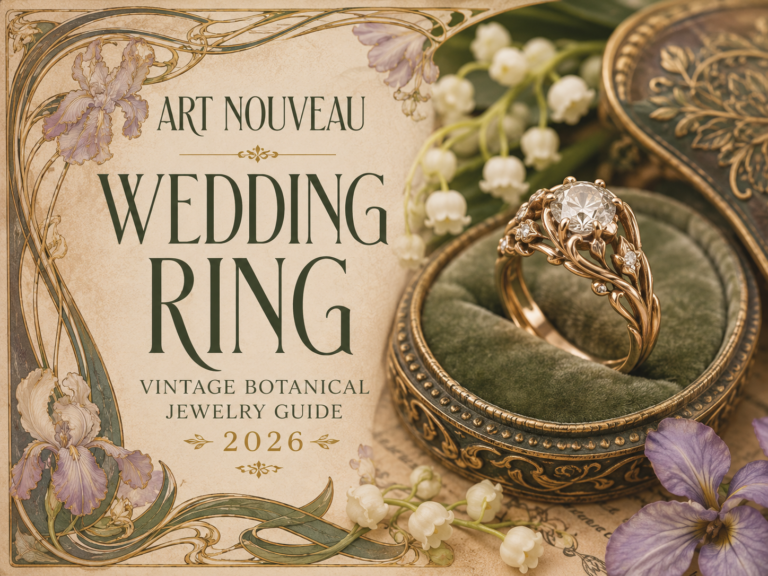
Art nouveau jewellery is as distinctive and as specifically beautiful as the movement’s poster art, and it translates directly to the bridal context: sinuous organic line work in the metalwork, botanical motifs rendered with the same accuracy as the botanical illustration tradition, enamel colour work in the jewel tones of the movement’s palette, and the specific quality of pieces that look as though they grew from the metal rather than being constructed from it. An art nouveau engagement ring or wedding ring — a category with its own specific and growing search interest — typically features a stone set in an organic, non-geometric setting with botanical detail in the metalwork surrounding it: the dragonfly wing, the climbing vine, the floral calyx, all rendered in aged gold or yellow gold rather than contemporary white metals. This is one of the most historically specific and most photographically distinctive jewellery choices available to a contemporary bride.
4.3 — The Botanical Bouquet
The bouquet for an art nouveau wedding dress should feel as though it was gathered from the botanical world the dress belongs to rather than purchased from a florist. Wisteria, where it can be sourced ethically, is the most specifically art nouveau floral element available and creates an immediately recognisable visual reference to the movement’s most beloved botanical motif. Climbing roses in the specific loosely-petalled varieties that art nouveau illustration favoured — the old-garden rose forms with their abundant, slightly informal petals rather than the tight, formal roses of contemporary floristry — are the next most specifically art nouveau choice. And trailing botanical elements — ivy stems, small fern fronds, botanical material that cascades below the main arrangement rather than being contained within it — create the flowing quality that connects the bouquet to the movement’s characteristic representation of botanical abundance. The bouquet should be held lower than conventional, so the trailing elements have room to fall with their full natural length, creating the painting-like quality of trailing botanical material that art nouveau illustration achieved in two dimensions.
Every element of the art nouveau bridal look speaks the same botanical language — the lace on the dress, the botanical crown in the hair, the sinuous line of the jewellery, the trailing blooms of the bouquet. Including the invitation suite that guests received months before the ceremony completes this language in its most comprehensive form: the botanical illustration on the stationery belonging to the same visual world as every physical element the guest encounters at the wedding itself.
The Bouquet Stationery Connection
The Wisteria Arch Botanical collection carries cascading botanical floral illustration from the invitation through every printed detail of the day — fully customizable with your names, date, and wedding details.
Section 05
How the Dress Relates to the Stationery
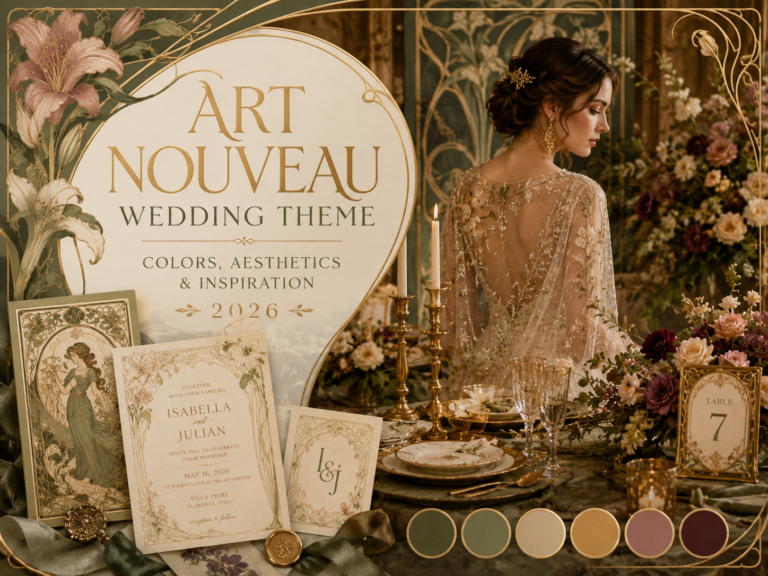
Visual coherence is the quality that makes the most beautifully planned art nouveau weddings feel genuinely immersive rather than merely decorated, and it is achieved by ensuring that every visual element speaks the same botanical language: the lace on the dress, the botanical illustration on the invitation, the embroidery on the bodice, the sinuous gold line work on the stationery border, the botanical crown in the bride’s hair. When these elements are all drawn from the same visual vocabulary — the specific botanical species that appear in the lace appearing also in the invitation illustration, the palette of the embroidery appearing in the stationery’s colour register — the celebration achieves the specific quality of a complete illustrated world that the art nouveau tradition consistently produced in its most celebrated works.
The practical connection between the dress aesthetic and the stationery choice is both obvious and, in practice, often overlooked: the botanical lace gown belongs with botanical floral stationery in the same register; the vintage botanical gown belongs with vintage art nouveau stationery that shares its warm, nostalgic botanical quality; the dark art nouveau gown belongs with art nouveau goth stationery in the same jewel-toned, atmospheric palette; the flowing goddess gown belongs with the most romantically botanical stationery collection available. These pairings are not merely aesthetically pleasing but logically correct: the invitation created the expectation of a specific world, and the dress is the most important physical element of that world, so they should be making the same argument to everyone who encounters them.
Wedding photographers consistently request the detail shot of the botanical lace dress against the invitation suite as one of the specific images they want to create at art nouveau weddings, because the connection between the two is visible and beautiful in a single frame: the illustrated botanical border of the invitation echoing the botanical lace at the dress hem, the gold line work on the stationery matching the antique gold thread in the embroidery. Plan this photograph deliberately: ask the photographer specifically to create it, bring the invitation suite to the getting-ready location for morning detail shots, and position the dress against the invitation in the most beautifully lit part of the room available. These images will be among the most saved and shared from the entire wedding.
The six stationery collections below each match one or more of the six dress styles described in Section 02. All are fully customizable with your names, date, and wedding details.
Stationery Matched to Dress
Six Art Nouveau Stationery Collections
Best for: Botanical Lace Gown, Modern Art Nouveau Gown
Art Nouveau Floral
Flowing botanical illustration and antique gold detail — the natural match for the botanical lace gown.
Best for: Vintage Botanical Gown, Belle Époque Gown
Art Nouveau Vintage
Warm nostalgic botanical art nouveau — the perfect visual companion to the vintage botanical gown.
Best for: Dark Art Nouveau Gown
Art Nouveau Goth
Jewel-toned dark botanical illustration — the stationery match for the dark art nouveau bridal aesthetic.
Best for: Belle Époque Gown, Vintage Botanical Gown
Flora Vintage Art Nouveau
Warm vintage botanical illustration — for the Belle Époque and vintage botanical bridal aesthetics.
Best for: Flowing Goddess Gown, Botanical Lace Gown
Wisteria Arch Botanical
Cascading wisteria and botanical abundance — the romantic botanical match for the flowing goddess gown.
Best for: Modern Art Nouveau Gown
Elegant Decorative Floral Art Nouveau
Refined botanical elegance — for the modern art nouveau bride who wants sophistication alongside botanical beauty.
The Art Nouveau Wedding Series
Explore the Full Series
Art Nouveau Wedding — The Complete Aesthetic Guide 2026 · Art Nouveau Wedding Invitations — Stunning Botanical Stationery Suites 2026 · Art Nouveau Wedding Decorations (coming soon) · Art Nouveau Wedding Cake (coming soon)
Frequently Asked Questions
Common Questions
What style of dress suits an art nouveau wedding?
Any of the six styles described in Section 02, depending on the specific register of the art nouveau aesthetic you want to inhabit: the botanical lace gown for the most directly art nouveau botanical look; the Belle Époque gown for the most historically authentic silhouette; the flowing goddess gown for the most romantic and Mucha-inspired aesthetic; the vintage botanical gown for the warmest nostalgic version; the dark art nouveau gown for the most atmospheric and jewel-toned alternative; and the modern art nouveau gown for the most wearable and contemporary editorial version. The consistent quality across all six is that the dress should look as though it belongs to the natural botanical world rather than simply visiting it.
What fabrics work best for an art nouveau bridal gown?
Botanical lace for the most directly art nouveau detail; silk georgette and fine chiffon for the flowing goddess aesthetic, where movement quality is the primary consideration; lightweight silk organza for structured flowing skirts that maintain shape while moving beautifully; and soft crepe for the modern art nouveau gown, which benefits from a fabric that drapes cleanly so the botanical embroidery is the primary visual element. The consistent principle: fabrics with genuine movement and organic drape quality rather than heavy structure, in warm ivory, champagne, or aged natural tones rather than bright white.
Can I wear a coloured dress for an art nouveau wedding?
Yes — the art nouveau tradition had strong precedents for coloured and non-white feminine dress, and the movement’s jewel-toned palette makes several colour options entirely appropriate. Deep midnight forest green suits the dark art nouveau and botanical aesthetics strongly; deep plum or burgundy suits the dark art nouveau goth aesthetic; and the palest botanical tints — barely-there sage, the faintest wisteria lavender, the most diluted dusty rose — suit the flowing goddess aesthetic and create an effect in the right botanical setting that is genuinely extraordinary. The specific colours to avoid are those without botanical precedent: bright primary colours, sharp contemporaryshades, and pure white, which belongs to contemporary bridal fashion rather than the art nouveau tradition.
What accessories complete an art nouveau bridal look?
The botanical hair crown is the single most important accessory — organic, loosely wound, with botanical elements that trail rather than being formally positioned. Art nouveau jewellery in antique gold or aged brass with botanical and sinuous line motifs (including the art nouveau engagement or wedding ring, which features organic non-geometric settings with botanical detail in the metalwork). A botanical bouquet in the botanical species that the movement favoured — wisteria, old-garden roses, climbing botanicals with genuine trailing elements — carried lower than conventional so the trailing botanical material has its full visual presence.
How do I match my art nouveau dress to my stationery?
Match by botanical register and palette: the botanical lace gown and the modern art nouveau gown connect to the Art Nouveau Floral collection; the vintage botanical and Belle Époque gowns connect to the Art Nouveau Vintage and Flora Vintage collections; the dark art nouveau gown connects to the Art Nouveau Goth collection; the flowing goddess gown connects to the Wisteria Arch Botanical collection. Ask the photographer to create a detail shot of the dress beside the invitation suite on the morning of the wedding — it will be among the most saved images of the day.
Art Nouveau Wedding Stationery · 2026
Complete Your Art Nouveau Bridal Look
Botanical stationery suites matched to every art nouveau dress aesthetic — fully customizable with your names, date and wedding details.