Art Nouveau Wedding Flowers
Art Nouveau Wedding · 2026
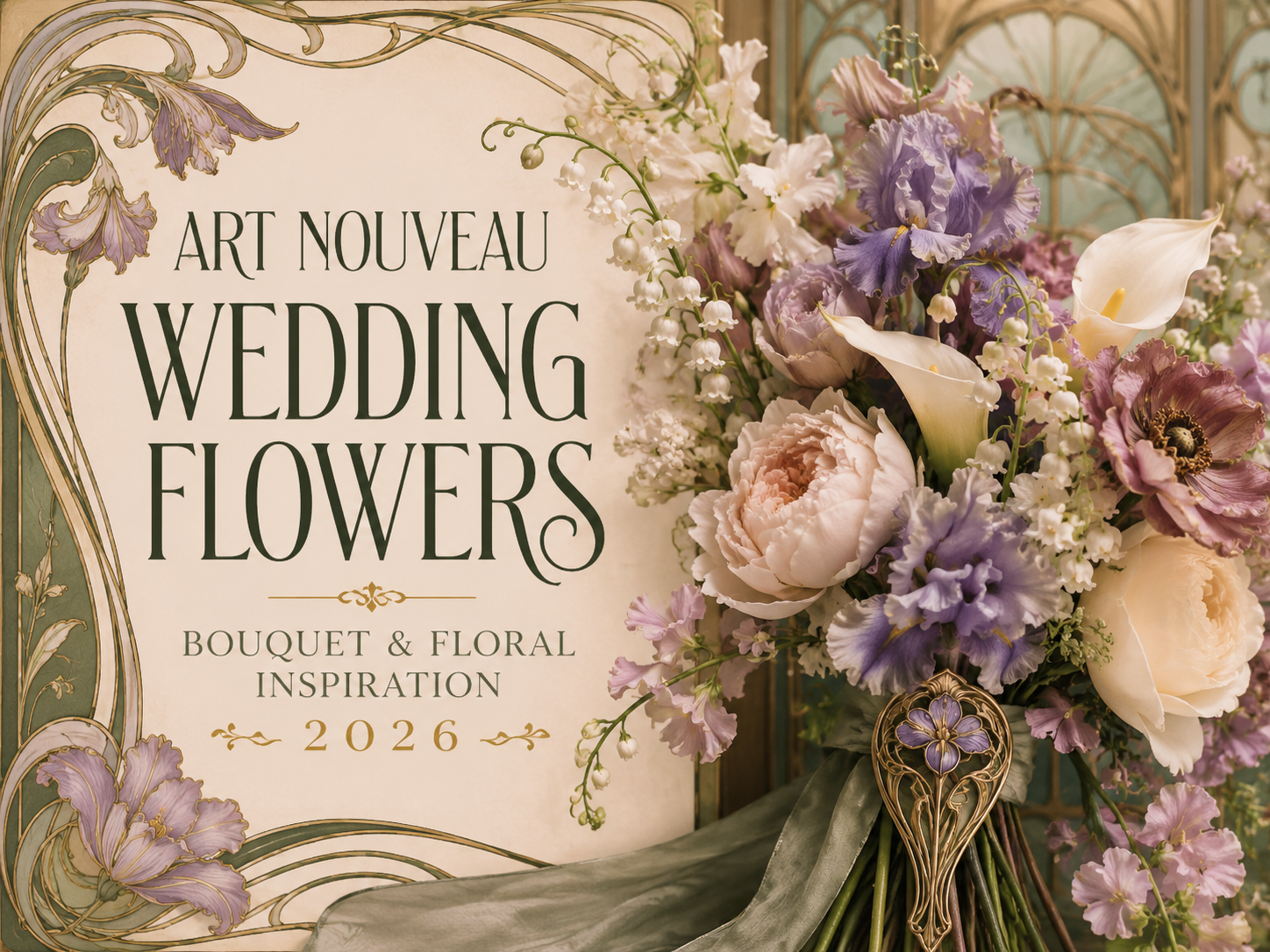
Art Nouveau Wedding Flowers — Bouquet & Floral Inspiration 2026
From cascading wisteria bouquets and sculptural iris arrangements to asymmetric ceremony installations — the complete floral guide to an art nouveau wedding bouquet in 2026.
No element of the art nouveau wedding is more directly connected to the movement’s founding philosophy than the flowers. Before there was a poster style, before there was a jewellery tradition, there was a generation of artists looking closely at growing things and deciding that what they saw there was more beautiful and more worth depicting than anything human geometry could invent. This guide covers five distinct art nouveau wedding flowers bouquet styles, the ceremony floral installations and centrepiece approaches that complete the aesthetic, and the stationery collections that carry the same botanical philosophy from the first invitation through to the flowers in your hands.
Every sinuous line the movement ever drew, every curve of gold in every poster and pendant, began as someone’s patient observation of how a stem actually bends. The flowers are not a decoration applied to art nouveau. They are the reason it exists.
Section 01
The Art Nouveau Floral Philosophy
The single governing principle of art nouveau wedding flowers is asymmetry: a flowing, organic distribution of botanical material that follows the irregular logic of real plant growth rather than the formal, mirrored balance that conventional bridal floristry favours. A conventional bouquet is built to be visually balanced from every angle, with stems and blooms arranged so the overall silhouette reads as a controlled, rounded dome. An art nouveau bouquet is built to look as though it was gathered rather than arranged — heavier on one side, trailing further in one direction than another, with individual stems visible and distinct rather than compressed into a uniform mass. This is not carelessness. It is a specific and demanding design discipline that requires more skill to execute well than a symmetrical arrangement, because every asymmetric choice must still read as intentional rather than simply unfinished.
Trailing and cascading botanical forms are favoured throughout the art nouveau floral tradition over round, tight, contained forms, for the same underlying reason: a trailing stem or a cascading cluster of blooms demonstrates the organic growth logic that the movement’s entire visual philosophy was built around, while a tightly massed round bouquet conceals the individual stems and blooms within a uniform, almost architectural silhouette that has more in common with a sphere than with a living plant. The visual difference is immediate: a conventional round bouquet reads as an object; an art nouveau trailing bouquet reads as a moment captured from something still in the process of growing.
Wisteria, lilies, and irises define the art nouveau botanical aesthetic above every other species for specific and consistent reasons. Wisteria offers the cascading, trailing structure the aesthetic prizes more completely than almost any other flower available to a florist, with individual blooms arranged along a flowing stem in a way that requires no styling intervention to look organically art nouveau. Lilies, with their sculptural, slightly architectural petal structure and their long elegant stems, appeared throughout the movement’s most celebrated illustration and translate directly into arrangements with genuine structural presence. Irises, with their distinctive sword-like foliage and their sinuous, almost calligraphic stem line, were one of the most frequently illustrated flowers in art nouveau graphic design specifically because the plant’s natural form already embodies the curved, flowing line the movement was trying to achieve in every other medium.
Section 02
Five Art Nouveau Bouquet Styles
Bring these descriptions to your florist as a starting reference for the specific botanical direction you want your bouquet to take.
Bouquet 2.1
The Wisteria Cascade Bouquet
The single most iconic and most immediately recognisable art nouveau bouquet style — the wisteria cascade bouquet takes the movement’s most beloved botanical motif and lets it do almost all the visual work, with trailing wisteria stems cascading down from the hand grip to well below the knee, in the same abundant, slightly irregular profusion the flower displays growing naturally over a garden arch. Where it can be ethically and seasonally sourced (wisteria has a genuinely short flowering window, typically late spring into early summer), this bouquet style requires very little additional botanical material to achieve its full effect: the wisteria itself, allowed to trail with minimal structural interference, is the entire composition.
Because genuine fresh wisteria has real seasonal and sourcing limitations, many florists supplement or substitute with other trailing botanicals that share its cascading structure — jasmine vine, trailing amaranthus, or clematis — particularly for weddings outside the narrow wisteria season. Discuss sourcing realistically with your florist well in advance: this is the bouquet style most likely to require either careful seasonal planning around an actual wisteria bloom window or a thoughtful substitution strategy using a botanical with comparable trailing structure and a similarly soft, clustered bloom.

Matching Stationery
The wisteria cascade bouquet is the precise visual companion to the Wisteria Arch Botanical stationery collection — the same cascading motif carried from the very first save the date through to the flowers in your hands. The Wisteria Arch Botanical collection — fully customizable with your names, date, and wedding details.

Bouquet 2.2
The Iris & Lily Bouquet
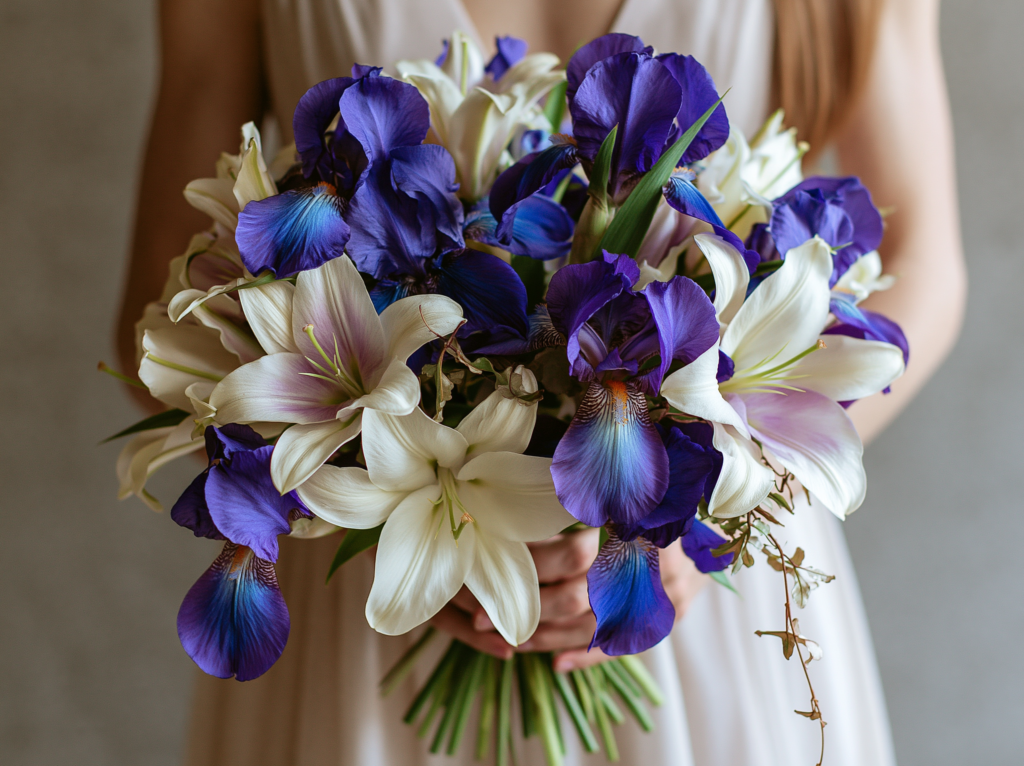
The most classically art nouveau and most sculpturally distinctive of the five — the iris and lily bouquet builds its composition around the two flowers that appeared most consistently in the movement’s graphic illustration, letting their naturally sinuous stems and structural petal forms create the bouquet’s primary visual interest rather than relying on density of bloom. Deep blue-violet irises, with their sword-like foliage left partially visible rather than stripped away, alongside white or pale lilies in their full architectural form, create a bouquet with genuine negative space between individual stems — visible air and structure rather than the tightly packed mass of a conventional rounded bouquet.
This style rewards a florist with genuine confidence in restraint: the temptation to fill every gap between the structural iris and lily stems with additional filler botanical material works directly against the aesthetic’s defining quality. Discuss explicitly with your florist the goal of visible stem structure and intentional negative space, since this runs counter to the training and instinct of florists accustomed to conventional bridal bouquet density. A small amount of trailing greenery — ivy or a single delicate vine — can soften the composition without undermining its sculptural clarity.
Matching Stationery
The iris and lily bouquet belongs with the Art Nouveau Floral stationery collection — the same sculptural, sinuous botanical illustration that defines the movement’s most classic graphic tradition. The Art Nouveau Floral collection — fully customizable with your names, date, and wedding details.

Bouquet 2.3
The Vintage Garden Bouquet
The warmest and most nostalgic of the five — the vintage garden bouquet uses old-garden roses in their loosely petalled, slightly informal varieties (rather than the tight, symmetrical contemporary florist rose), alongside dusty botanical material — muted sage, dried-looking grasses, soft antique-toned foliage — to create a bouquet that looks as though it was cut from a garden that has been growing, untended in the most beautiful sense, for several decades. The palette leans warm and slightly faded: dusty rose and aged ivory rather than the bright, saturated tones of a contemporary garden bouquet, in the same warm vintage register that characterises the broader vintage art nouveau aesthetic.
Achieving the genuinely antique quality this bouquet style depends on requires specific attention to bloom selection: roses at varying stages of opening rather than uniformly fresh buds, with a few blooms allowed to be fully, almost extravagantly open rather than every stem at the same tight stage. This variation in bloom maturity is what reads as garden-gathered rather than florist-arranged, and it is worth discussing explicitly with your florist, since many bridal bouquet conventions favour uniform bloom stage for a tidier, more uniform appearance that works directly against this style’s intended effect.
Matching Stationery
The vintage garden bouquet pairs naturally with the Flora Vintage Art Nouveau stationery collection — warm, nostalgic botanical illustration with the same antique garden character. The Flora Vintage Art Nouveau collection — fully customizable with your names, date, and wedding details.

Bouquet 2.4
The Olive & Botanical Bouquet
The most distinctive and most unexpected of the five — the olive and botanical bouquet builds around olive branches and sage as its primary structural and textural material, with a smaller proportion of bloom than any of the other four styles, creating a composition that reads as genuinely botanical and slightly wild rather than conventionally floral. This is the bouquet style for the bride drawn to the muted, earthy register of the art nouveau tradition’s shadowed botanical palette — the same sensibility that produces the olive green vintage stationery and cake styles elsewhere in this series — and it suits late summer and autumn celebrations particularly well.
Olive branches bring a genuinely sculptural, slightly silvered foliage quality that few conventional bridal bouquet greens can match, and pairing them with sage, eucalyptus in its more muted grey-green varieties, and a restrained number of warm dusty blooms (small garden roses, ranunculus in muted amber tones) produces a bouquet with real textural sophistication. This style depends more on foliage and structural botanical material than on bloom count, which makes it among the more cost-flexible of the five styles without sacrificing any of the aesthetic’s genuine distinctiveness.
Matching Stationery
The olive and botanical bouquet connects to the Olive Green Vintage Floral Art Nouveau stationery collection — the same distinctive muted olive palette carried from invitation to bouquet. The Olive Green Vintage Floral Art Nouveau collection — fully customizable with your names, date, and wedding details.

Bouquet 2.5
The Trailing Vintage Bouquet
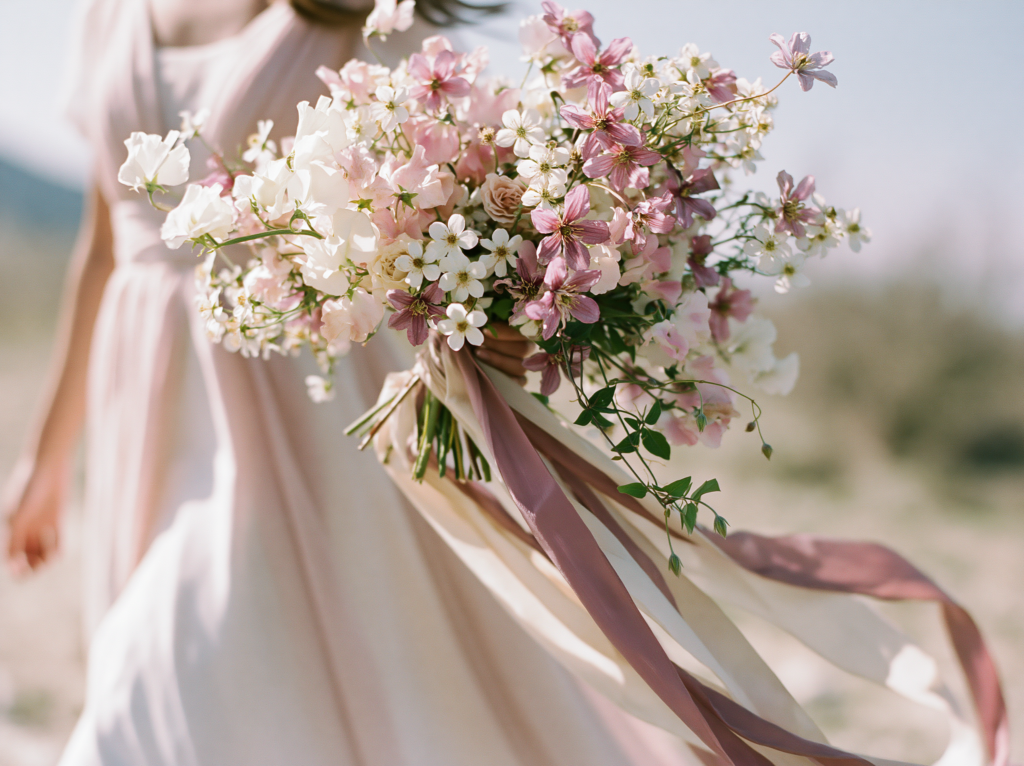
The most romantically antique of the five — the trailing vintage bouquet combines climbing florals (sweet pea, jasmine, small clematis blooms) with long ribbon trails in aged ivory or dusty rose silk, creating a composition where the fabric trailing from the hand grip continues the visual line that the climbing florals establish in the bouquet itself. The ribbon trails should be cut to genuinely varying lengths and allowed to move and fall naturally rather than being pinned into a fixed, formal cascade, in keeping with the broader art nouveau principle that nothing in the composition should read as too precisely controlled.
This bouquet style works particularly well photographed in movement — walking down the aisle, caught by a breeze in an outdoor ceremony — since the trailing ribbon and climbing florals both depend on a degree of natural movement to display their full visual character. A bouquet of this style held perfectly still in a static studio-style portrait loses some of the dynamic quality that makes it distinctive; brief your photographer to capture genuine movement shots specifically for this bouquet style, in addition to the more conventional still portraits.
Matching Stationery
The trailing vintage bouquet belongs with the Art Nouveau Vintage stationery collection — the same warm, romantic antique register carried from the invitation suite through to the ribbon trailing from your hand. The Art Nouveau Vintage collection — fully customizable with your names, date, and wedding details.

Section 03
Art Nouveau Ceremony Florals
The wisteria arch is the single most photographed and most specifically art nouveau ceremony floral structure available, and it depends entirely on the same asymmetric principle that governs the bouquet styles above: wisteria cascading more heavily from one side than the other, in the irregular abundance of real growth rather than a perfectly mirrored arrangement. The frame itself should have the sinuous, curved quality of art nouveau metalwork rather than a rigid geometric structure, and the botanical material should be allowed to fall below the bottom edge of the arch frame in places, so the completed structure looks as though the wisteria has been growing there for a season rather than installed that morning.
Asymmetric floral installations beyond the ceremony arch — a large-scale arrangement positioned to one side of the altar rather than centred, or a single dramatic floral moment suspended above the ceremony space rather than distributed evenly — extend the same governing principle to the full ceremony environment. The temptation in ceremony floral design is always toward symmetry and even distribution, since this reads as conventionally finished and complete; the art nouveau approach deliberately resists this instinct, concentrating botanical abundance unevenly and trusting that the asymmetric composition reads as more genuinely organic rather than as incomplete.
Trailing botanical aisle markers — ground-level arrangements at alternating rather than uniform intervals along the aisle, with trailing elements extending into the aisle space itself rather than staying contained within a vessel — continue the asymmetric philosophy down to the smallest scale of ceremony floral detail. A consistent, evenly spaced row of identical aisle arrangements is the conventional approach; an art nouveau aisle instead favours irregular spacing and varying scale between markers, so the overall effect reads as a botanical environment the guests are walking through rather than a corridor that has been uniformly decorated on either side.
Section 04
Art Nouveau Centerpieces
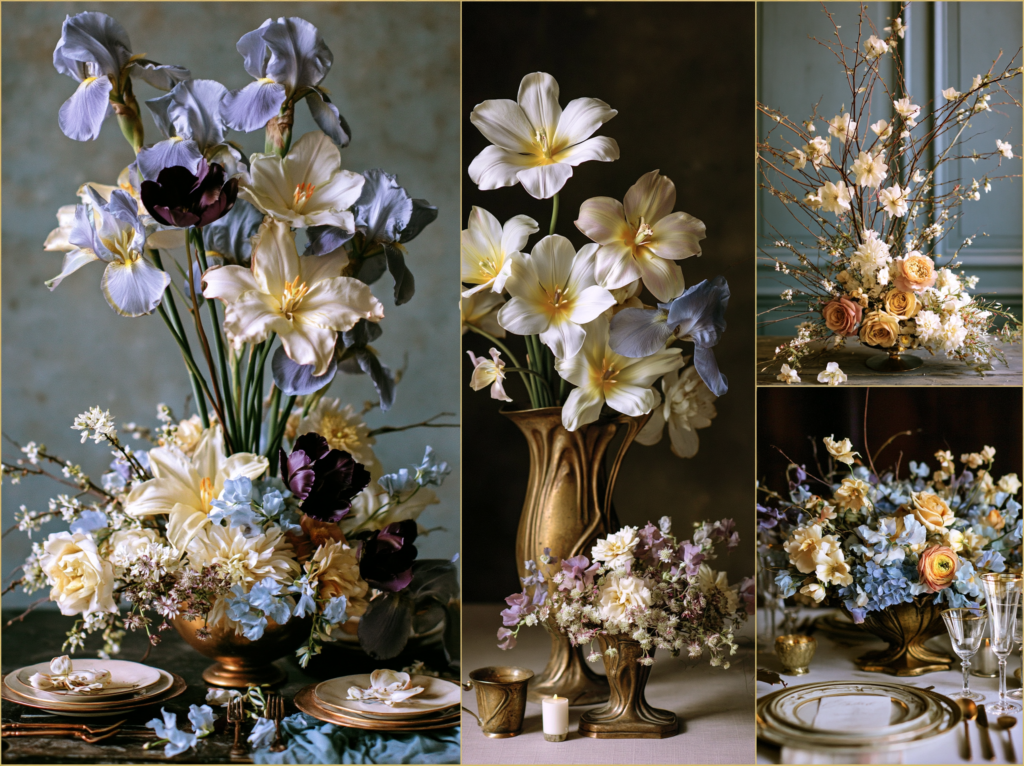
Sculptural arrangements — centrepieces with genuine height and structural presence rather than the low, rounded mass that conventional reception florals favour — suit the art nouveau aesthetic’s preference for visible stem line and architectural botanical form. Tall arrangements built around iris, lily, or single dramatic trailing elements, with real negative space visible between the structural stems, create centrepieces that read as sculpture viewed across the table rather than as a mass of colour. This approach also solves the practical problem of guest sightlines across a reception table more elegantly than a low, wide centrepiece, since the visual interest is concentrated above and below eye level rather than directly across it.
Sinuous vase choices matter as much as the botanical material itself: aged brass or antique gold vessels with the curved, organic profile of genuine art nouveau metalwork, rather than the straight-sided contemporary vases that dominate conventional event floristry. Where a curved or organically shaped vessel cannot be sourced, a tall, simple cylindrical vase in aged brass or dark glass at minimum avoids competing visually against the botanical material’s own organic line. The vessel should disappear into the composition rather than asserting its own geometric presence against the flowing botanical material it holds.
Asymmetric table florals extend the bouquet and ceremony arch principle to the reception surface: rather than a perfectly centred arrangement on every table, consider varying the placement slightly from table to table, or building a single arrangement with a deliberate lean or directional growth rather than a perfectly vertical, centred stem structure. This detail is subtle enough that most guests will never consciously register it, but it contributes to the cumulative sense, table after table, of a reception that has been considered with genuine botanical logic rather than templated and repeated identically throughout the room.
Section 05
Flowers & Stationery: The Connection
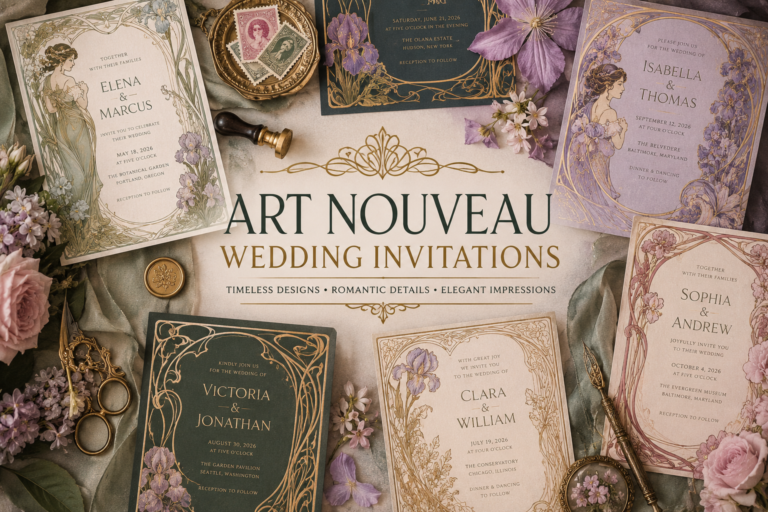
The connection between the flowers a couple carries and chooses for their ceremony and the botanical illustration on their stationery suite is closer in the art nouveau aesthetic than in almost any other wedding style, because the movement’s graphic tradition was built directly from botanical observation in the first place. A Mucha poster’s flowing botanical border was not invented independently of real plants; it was a direct artistic response to looking closely at how wisteria actually trails, how an iris stem actually curves, how a climbing rose actually grows. This means that genuinely art nouveau stationery and genuinely art nouveau florals are not simply colour-matched to one another — they are drawing on the same underlying observational source material, which makes the visual coherence between them unusually deep when both are chosen with real attention to the specific botanical species involved.
The practical version of this connection: choose your stationery’s specific botanical illustration — wisteria, iris and lily, vintage garden rose, olive branch — before your final florist consultation, and bring the suite or photographs of it as a precise reference. A florist shown an invitation with cascading wisteria illustration and antique gold line work has a far more specific and useful brief than a florist told simply “art nouveau” or “vintage botanical,” and the resulting bouquet and ceremony florals are correspondingly more likely to feel like a genuine extension of the printed botanical world your guests encountered months earlier.
The flat lay photograph of the bouquet beside the invitation suite is among the most reliably beautiful images produced at art nouveau weddings, precisely because the connection between the two is genuine rather than merely coordinated: the same wisteria that appears in cascading illustration on the card appears in living, trailing form in the bouquet beside it. Plan this photograph for the morning of the wedding, in natural light, with the invitation suite positioned so its illustrated botanical line work and the bouquet’s real stems and blooms sit in genuine visual conversation — ask the photographer to look specifically for the moments where the printed and the living botanical material echo one another’s curves.
The five collections below each correspond to one or more of the bouquet styles described in Section 02. All are fully customizable with your names, date, and wedding details.
Shop the Collections
Stationery Matched to Every Bouquet Style
Art Nouveau Floral
Flowing botanical illustration and antique gold detail — the natural match for the Iris & Lily Bouquet.
Wisteria Arch Botanical Wedding
Cascading wisteria and botanical abundance — the precise visual companion to the Wisteria Cascade Bouquet.
Flora Vintage Art Nouveau Wedding
Pure vintage botanical elegance — for the Vintage Garden Bouquet’s warm, antique garden register.
Olive Green Vintage Floral Art Nouveau
Distinctive olive green botanical illustration — the stationery match for the Olive & Botanical Bouquet.
Art Nouveau Vintage
Warm nostalgic botanical art nouveau — the visual companion to the Trailing Vintage Bouquet’s ribbon and climbing florals.
The Art Nouveau Wedding Series
Explore the Full Series
Art Nouveau Wedding — The Complete Aesthetic Guide · Art Nouveau Wedding Invitations · Art Nouveau Wedding Dress · Art Nouveau Wedding Decorations · Art Nouveau Wedding Theme & Colors · Art Nouveau Wedding Ring · Art Nouveau Wedding Cake
Frequently Asked Questions
Common Questions
What flowers are most art nouveau?
Wisteria is the single most defining motif, with its cascading, trailing structure embodying the movement’s asymmetric philosophy more completely than any other flower. Irises and lilies follow closely, both appearing throughout the movement’s graphic illustration for their sculptural, sinuous structural form. Old-garden roses (loosely petalled rather than tightly symmetrical), poppies, climbing sweet pea and jasmine, and olive branches and sage as structural foliage all belong to the broader tradition. The consistent principle: botanical material with genuine trailing, climbing, or sculptural structural character rather than the round, tight forms of conventional contemporary florist blooms.
Is fresh wisteria available year-round for a bouquet?
No — wisteria has a genuinely short natural flowering window, typically late spring into early summer, and availability outside that season is limited and regionally variable. Discuss sourcing realistically with your florist if your wedding falls outside this window: many florists substitute jasmine vine, trailing amaranthus, or clematis, all of which share wisteria’s cascading structural quality and can achieve a very similar visual effect in the Wisteria Cascade Bouquet style. Plan this conversation early, since trailing botanical sourcing for any season benefits from advance ordering.
How do I brief my florist on the art nouveau aesthetic?
Bring this guide and your stationery suite as concrete references rather than relying on the term “art nouveau” alone, since the word means different things to different florists. Be specific about the asymmetric principle — explicitly ask for an arrangement that looks gathered rather than arranged, with visible individual stems and intentional negative space rather than a tightly massed round bouquet. Name the specific botanical species you want prioritised (wisteria, iris, old-garden rose, olive branch) and show reference images of trailing, asymmetric florals rather than conventional bridal bouquet photography.
How do I match my bouquet to my stationery?
Choose your stationery’s specific botanical illustration first, then bring it to your florist consultation as a precise visual brief. A wisteria cascade illustration pairs with the Wisteria Arch Botanical collection and the matching bouquet style; an iris and lily illustration pairs with Art Nouveau Floral. Plan a flat lay photograph of the bouquet beside the invitation suite in natural morning light — it is one of the most reliably beautiful images in this aesthetic, since the printed and living botanical material genuinely echo one another.
Art Nouveau Wedding Stationery · 2026
Give Your Florist the Perfect Brief
A fully customized stationery suite documents your exact botanical species and palette — the most useful reference you can bring to a florist consultation.