Art Nouveau Wedding
Art Nouveau Wedding · 2026
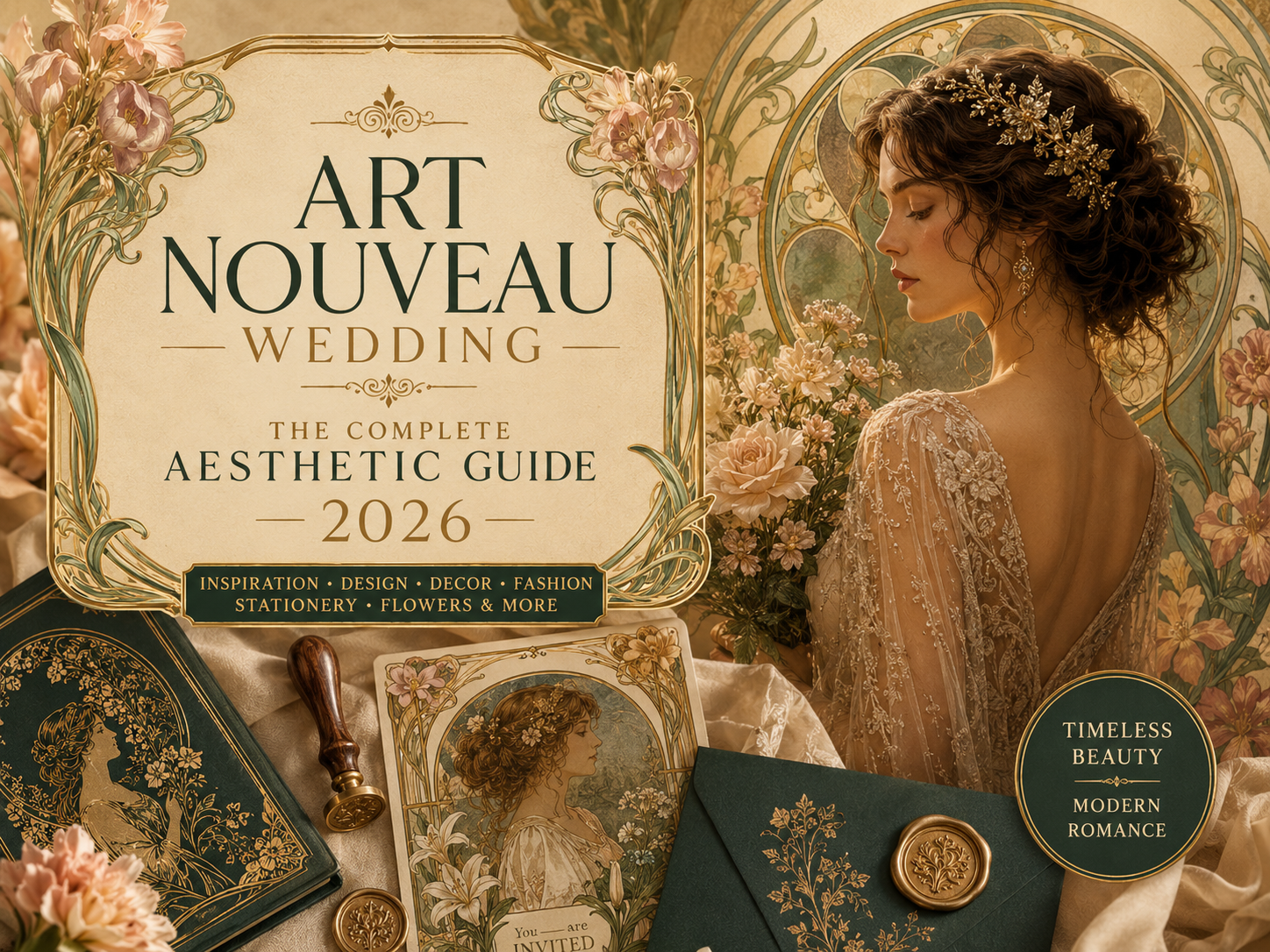
Art Nouveau Wedding — The Complete Aesthetic Guide 2026
From flowing botanical illustrations and sinuous gold line work to deep jewel tone palettes and ornate floral ceremony spaces — the complete guide to planning an art nouveau wedding in 2026.
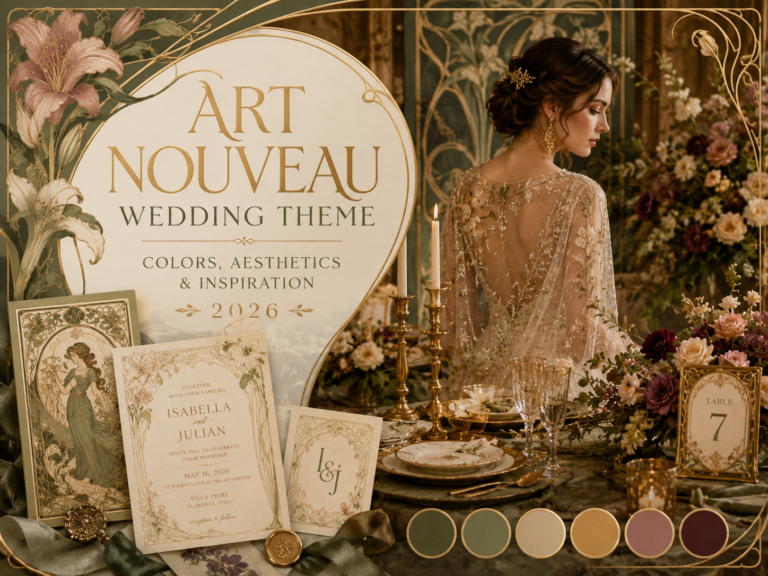
The art nouveau wedding aesthetic is one of the most visually distinctive and most genuinely beautiful available to a bride planning a celebration in 2026 — and it is also one of the most misunderstood, because it sits at the intersection of historical and contemporary, botanical and ornate, feminine and deeply artistic in a way that requires genuine understanding to execute at its best. Rooted in the Belle Époque movement of the late nineteenth century, when European artists and designers declared that nature was the source of all true beauty and designed accordingly, the art nouveau aesthetic is experiencing a significant revival on Pinterest in 2026 because it answers something that contemporary bridal aesthetics rarely do: the longing for beauty that is both maximally decorative and profoundly natural, simultaneously. This guide covers everything required to plan an art nouveau themed wedding in 2026: the aesthetics, the palettes, the venues, the ceremony and reception design, the florals, and the stationery that carries the movement’s visual language from the first invitation through to every botanical detail on a reception table.
Art nouveau believed something specific and important: that the straight line belonged to industry, and that nature — which had never produced one — was the genuine source of all beauty worth pursuing. In this it was not wrong, and the fact that a movement built on that principle produced the most beautiful printed posters, glassware, jewellery, and illustration the world had yet seen suggests the hypothesis was worth testing.

Section 01
What Is Art Nouveau & Why It Works for Weddings
Art nouveau emerged in Europe in the 1890s and lasted approximately until 1910 — a relatively short period in which it produced some of the most beautiful designed objects in human history. The movement was a deliberate reaction against the industrialisation of design: against the rigid geometry of mass-produced objects, against the separation of fine art from the crafts and applied arts, and against the general ugliness that Victorian-era industrial production had introduced into everyday objects. Its answer was a complete return to the natural world as the source of all visual inspiration: the flowing, asymmetric curves of plant stems and the sinuous lines of flower tendrils; the jewel tones of dragonfly wings and peacock feathers; the cascading abundance of wisteria and the climbing urgency of botanical illustration that treats the natural world as inherently worth depicting with extraordinary care.
The visual elements that define art nouveau most immediately are: sinuous organic lines that never make right angles; botanical illustration of extraordinary detail and natural accuracy; flowing human figures, particularly women, rendered with the same organic quality as the botanical material around them; jewel tones — deep teal, rich burgundy, deep forest green, deep violet — as the dominant colour notes; antique gold as the line detail and the connecting thread between botanical elements; and the specific sense of abundance that characterises art nouveau composition, where every surface contains something beautiful and no element exists in isolation. The dragonfly and the peacock appear repeatedly as motifs because they represent the same qualities the movement valued: iridescent, organic, impossibly detailed, and proof that nature is the most accomplished designer available.
Art nouveau translates to weddings beautifully and specifically for a set of reasons that are not accidental. The aesthetic is inherently romantic — it was born in an era that valued beauty intensely and designed everything from railway stations to perfume bottles with the understanding that the visual world of daily life mattered. It is intensely botanical, in a way that connects naturally to every floral element of a wedding celebration. It is maximally ornate without ever feeling cold or masculine: the flowing, organic quality of art nouveau decoration has a softness and warmth that purely geometric ornament lacks. And it creates a complete visual world — an art nouveau wedding theme can extend from the architecture of the venue through the invitation suite, the ceremony florals, the reception table details, and the wedding dress, creating a celebration that feels genuinely immersive rather than simply decorated.
The 2026 Pinterest surge in art nouveau wedding aesthetics reflects a broader cultural moment in which brides are moving away from the minimal, neutral palettes that dominated bridal aesthetics in the previous decade and toward something more deliberately beautiful, more historically rooted, and more willing to be genuinely ornate. The art nouveau wedding inspiration search volumes on Pinterest have grown significantly because the aesthetic offers what increasingly popular alternatives — maximalist, botanical, vintage, dark romantic — each offer in isolation but art nouveau offers simultaneously: nature as the source of beauty, ornamentation as a form of respect for what is depicted, and the specific quality of an aesthetic that was designed, in its original form, specifically to make the world more beautiful.
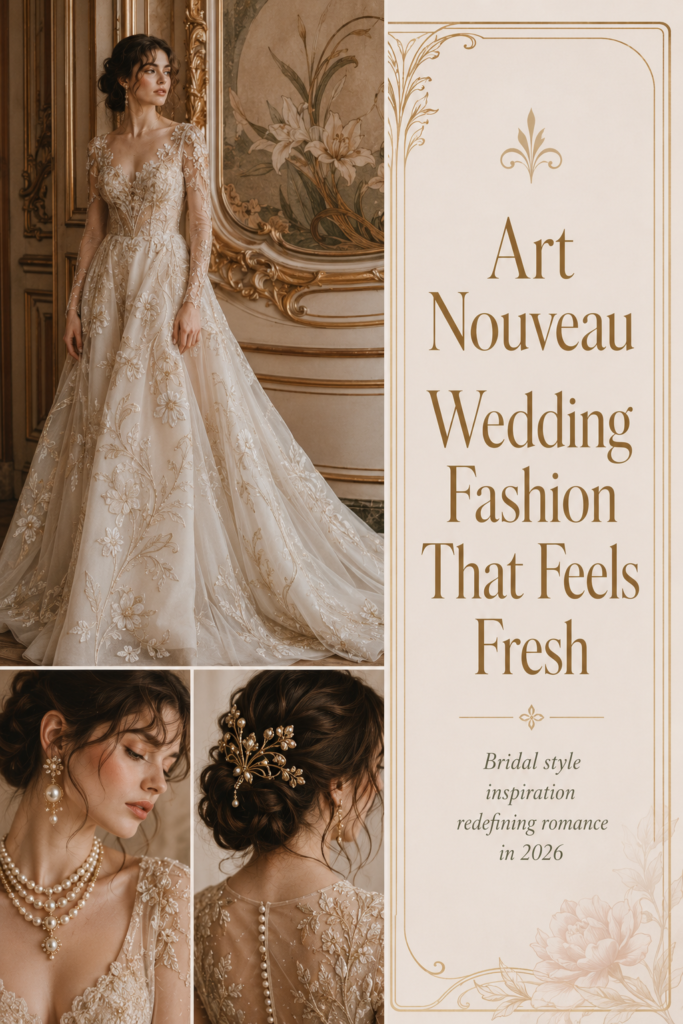
Section 02
The Four Art Nouveau Wedding Aesthetics
Art nouveau is not a single aesthetic. It contains at least four distinct visual registers, each drawing on different aspects of the movement’s visual vocabulary. Finding the one that most naturally matches your vision is the starting point for every other planning decision.
Aesthetic 2.1
The Classic Art Nouveau Botanical Aesthetic
The most directly recognisable and most immediately beautiful — the classic art nouveau botanical aesthetic draws on the movement’s defining visual language without modification: flowing botanical illustration in the specific lush detail that Alphonse Mucha and his contemporaries brought to the genre; sinuous gold line work that traces the curves of stems and petals with the same attention to organic form that the movement demanded; and the specific palette of deep forest green, antique gold, ivory, and dusty rose that characterises the most celebrated examples of art nouveau printing and design. This is the aesthetic for couples who want their celebration to feel as though it stepped directly out of a beautiful Belle Époque illustrated poster, without any additional distance or reinterpretation.
The classic botanical approach requires venues with ornate historic character that can sustain the visual weight of the aesthetic without the decoration looking applied to a blank canvas: glasshouses and orangeries with botanical planting behind every ceremony arrangement, historic halls with the period architectural detail that art nouveau ornamentation can respond to rather than contrast with, and botanical gardens where the living plant material is itself in the visual register of the botanical illustration the stationery and florals are referencing. The ceremony arch for this aesthetic should be the most lavish and most specifically botanical available — wisteria cascading from above, climbing roses wound through a curved frame, the entire composition more like a painted illustration come to life than a decoration placed in a space.
The antique gold detail throughout this aesthetic — in the stationery, in the candleholders, in the botanical vessel choices, in the table setting details — is the connecting thread that gives the celebration its specific sense of visual coherence. Everything that might be metal should be antique gold or aged brass. Nothing should be chrome, polished steel, or bright white. The overall warmth of the palette and the warmth of the metallic accents should feel as though the celebration exists in a specifically warm-toned world, as the movement’s most celebrated works do.
Stationery for this Aesthetic
The Art Nouveau Floral stationery collection was designed specifically for this aesthetic — flowing botanical illustration and antique gold detail that creates the most genuinely art nouveau invitation suite available.

Aesthetic 2.2
The Vintage Art Nouveau Aesthetic
More aged and more specifically nostalgic than the classic botanical approach — the vintage art nouveau aesthetic introduces the quality of discovered beauty that characterises the most treasured antique botanical prints: the slight warmth of aged paper in the palette, the specific quality of ink on old card that has been handled many times and loved, the feeling of a Victorian botanical illustration uncovered in a beautiful bookshop and immediately known to be extraordinary. The palette shifts from the fresh botanical green and ivory of the classic approach toward warmer, dustier tones: antique gold as dominant rather than accent, warm ivory deepening toward aged parchment, dusty rose with the specific warmth of a colour that has been in sunlight for a century.
This aesthetic suits couples who are drawn to the romantic and nostalgic quality of the vintage register alongside the botanical ornamentation of art nouveau — who want their celebration to feel as though it is recovering something beautiful rather than creating something new. The venue choice for vintage art nouveau should lean toward the genuinely aged: manor houses with original period plasterwork, walled gardens with established planting that looks as though it has been there for decades, conservatories with old botanical collections. The decoration should feel as though it was already in place when the couple arrived, assembled by someone with impeccable taste over many years rather than installed for a specific event.
The stationery for the vintage art nouveau aesthetic should carry the quality of a found botanical print into every piece — illustration that could pass for a genuine antique at a careful second glance, typography with the specific character of Victorian botanical publishing, and the warm ivory of aged paper as the background tone rather than bright white. Every guest who receives this invitation should immediately understand the register of the celebration they are being invited to, before they have read a single word of the wording itself.
Stationery for this Aesthetic
The Art Nouveau Vintage collection and the Flora Vintage Art Nouveau Wedding collection carry the warm, nostalgic quality of this aesthetic into every printed detail — aged botanical beauty in art nouveau illustration form.

Aesthetic 2.3
The Art Nouveau Goth Aesthetic
Where botanical art nouveau meets dark romance — the goth aesthetic within the art nouveau tradition draws on the movement’s deepest and most atmospheric jewel tones rather than its warmest and most floral qualities. Deep burgundy and midnight forest green replace the dusty rose and warm ivory of the classic approach; black botanical foliage detail appears alongside the gold line work; and the overall palette creates the impression of a botanical world seen by candlelight in a very old building rather than in the afternoon sunshine of the Belle Époque. This is an art nouveau wedding aesthetic for the couple who finds the dark and mysterious end of the art nouveau tradition most genuinely beautiful.
The art nouveau goth aesthetic is more historically specific than it might appear: the art nouveau movement itself had a darker and more atmospheric strand, particularly in the work of artists who were simultaneously engaged with symbolism and the exploration of death, decay, and the uncanny alongside the movement’s more celebrated botanical romanticism. Gustav Klimt’s most complex works, the symbolist botanical illustrations that appeared in continental European publications of the 1890s and 1900s, and the specific jewel-dark palette of art nouveau stained glass all belong to this tradition. The bride drawn to this aesthetic is not departing from art nouveau into darkness — she is finding the part of art nouveau that was always already there.
Venues for the art nouveau goth aesthetic should have genuine darkness available: not merely dim lighting but the capacity for genuinely atmospheric low light, ideally combined with architectural details that read as ornate and dramatic rather than simply historic. Candlelight is the primary light source for this aesthetic rather than a supplement to overhead lighting. Dark botanical centrepieces in the deep jewel tones of the palette — near-black burgundy dahlias, deep plum roses, dramatic dark foliage — should dominate the reception table. The stationery should feel as though it was sent from somewhere more beautiful and more mysterious than the ordinary world.
Stationery for this Aesthetic
The Art Nouveau Goth stationery collection carries the jewel-dark botanical atmosphere of this aesthetic into every printed piece — for the bride who wants her invitation to feel like a summons to something genuinely extraordinary.

Aesthetic 2.4
The Autumn Art Nouveau Aesthetic
Art nouveau botanical illustration meets the most generous and most dramatic season — the autumn art nouveau aesthetic draws on the movement’s love of botanical abundance and applies it to the specific palette of October woodland: deep rust and warm amber where the classic approach used cool botanical green, harvest gold throughout rather than antique gold only as accent, and the specific warmth of turning leaves and late dahlias as the primary floral register. This is the art nouveau aesthetic for the autumn celebration — for the couple who finds October woodland as beautiful as any ornate interior and wants their wedding to belong to both simultaneously.
The autumn art nouveau aesthetic is also the most specifically seasonal within the four — it belongs to a particular time of year in a way that the classic and vintage aesthetics do not. The botanical illustration style of art nouveau is particularly suited to autumn plant material: dahlias in their extraordinary variety of form, chrysanthemums in their ancient association with autumn and the turning season, the cascading form of wisteria (one of the movement’s key motifs) in its seed pod and bare branch autumnal form rather than its spring flowering form. The ceremony arch in this aesthetic carries both the art nouveau botanical vocabulary and the autumn seasonal palette, creating a combination that is genuinely extraordinary and genuinely specific to the month it happens in.
Venues for the autumn art nouveau celebration can be more varied than for the other three aesthetics, because the dramatic warmth of the autumn palette and the richness of the art nouveau botanical style create their own visual context rather than depending on the venue’s architectural character to do so. A barn reception decorated in autumn art nouveau botanical style will look as extraordinary as an orangery or historic hall, because the palette and the decoration create the aesthetic register independently of the architectural setting. The most important consideration is warm, low lighting — candlelight and warm-toned fairy lights — that allows the harvest gold of the palette to be at its most beautiful.
Stationery for this Aesthetic
The Art Nouveau Autumn stationery collection carries harvest botanical abundance in art nouveau illustration style into every printed detail — for autumn celebrations where ornate botanical beauty and the richness of October belong together.

Section 03
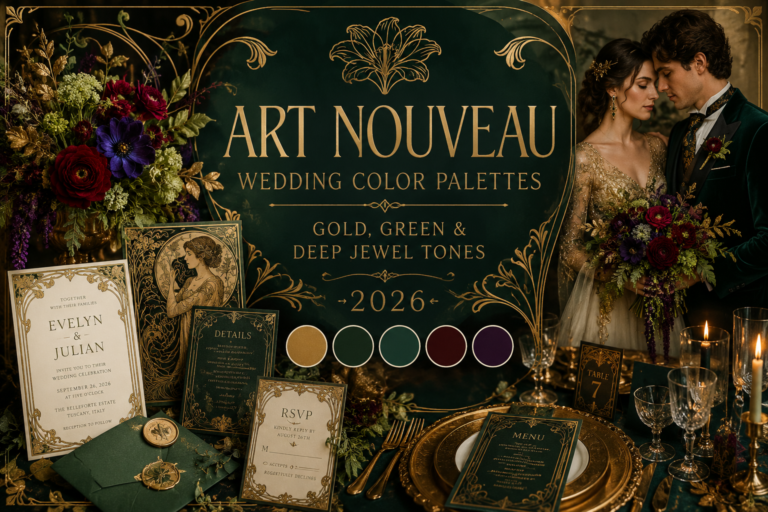
Art Nouveau Wedding Color Palettes
The Botanical Gold Palette
Deep Forest Green · Antique Gold · Ivory · Dusty Rose
The most directly botanical and the most immediately recognisable art nouveau palette — the combination of deep botanical green and antique gold that appears in the movement’s most celebrated printed works. Warm, lush, and simultaneously ornate and natural.
Glasshouses, botanical gardens, historic halls with period character.
Stationery: Art Nouveau Floral →
The Jewel & Dark Palette
Deep Burgundy · Midnight Green · Black · Antique Gold
The most dramatic and most atmospheric art nouveau palette — jewel tones that belong to the movement’s darker and more symbolist strand, where botanical beauty and dark romance exist simultaneously. Best experienced in candlelight.
Ornate historic interiors, candlelit cellars, dark atmospheric spaces with genuine architectural character.
Stationery: Art Nouveau Goth →
The Vintage Parchment Palette
Warm Ivory · Aged Parchment · Dusty Rose · Antique Gold
The most nostalgic and most specifically romantic of the four — the palette of a Victorian botanical illustration discovered in a beautiful antique bookshop, warm and slightly aged, with the gold of old metalwork rather than new. Best in natural daylight that softens and warms.
Manor houses, walled gardens, conservatories with established botanical planting.
Stationery: Art Nouveau Vintage →
The Autumn Botanical Palette
Deep Rust · Antique Gold · Forest Green · Warm Ivory
The most seasonally specific palette — art nouveau botanical illustration in the richest colours October provides, combining the movement’s love of botanical abundance with the most generous natural palette of any season. Warm, rich, and unmistakably autumnal.
Autumn woodland venues, barn receptions, orangeries with adjacent turning trees.
Stationery: Art Nouveau Autumn →
Section 04
Art Nouveau Wedding Venues
The ideal venue for an art nouveau themed wedding is one where the architecture is already doing some of the aesthetic work: curved lines in the building’s structure, ornate period details in the interior plasterwork or ironwork, botanical planting visible through or within the ceremony and reception spaces, and the specific quality of light that comes through glass rather than directly from above. What makes a venue suitable for this aesthetic is not period authenticity but the presence of the visual qualities the aesthetic requires: organic form, ornamental richness, the feeling that nature and human design are in active conversation.
4.1 — The Glasshouse & Orangery
The glasshouse is the most naturally art nouveau venue available, because it solves the central challenge of this aesthetic — creating a space where nature and ornate human design exist in the same frame — by construction: the building is an ornate human structure designed specifically to contain botanical life. The curved ironwork of Victorian glasshouse architecture and the botanical planting it supports create, without any additional decoration, the specific visual combination that art nouveau sought to achieve in its illustration and design. A ceremony arch built against a background of established glasshouse planting, with botanical arrangements at the scale and abundance the aesthetic requires, produces images that could illustrate a Belle Époque magazine. The orangery version provides the same quality in a warmer and more enclosed format that suits candlelit evening receptions particularly well.
4.2 — The Historic Hall or Manor
A historic hall or manor with genuine period plasterwork, original ironwork details, and the specific warmth of old stone or aged timber creates the architectural context that art nouveau decoration responds to most beautifully. The decoration does not look applied to this setting but natural within it — as though the botanical illustration of the stationery and the sinuous gold line detail of the centrepiece vessels are in conversation with the plasterwork and the period furniture around them. The most important quality to look for in a historic venue for this aesthetic is original decorative detail: not a venue that has been stripped back and repainted, but one where the original ornament is still present and creates the base visual register that art nouveau celebration can build upon.
4.3 — The Botanical Garden
A botanical garden venue provides something that no interior space can fully replicate: living botanical illustration at the scale of an actual garden, with the depth and variety of established planting that has been growing for decades. For the art nouveau wedding, this is the setting where the aesthetic’s central principle — that nature rendered with extraordinary care is the source of all genuine beauty — is most literally and most completely expressed. The ceremony arch, the florals, and the centrepieces are supplementing a living botanical world rather than creating one, which gives the decoration a visual authority and depth that is impossible to achieve in a blank space. The photography in a botanical garden venue, in the right season and at the right light, will produce images that belong in the same visual tradition as the art nouveau movement’s most celebrated botanical illustrations.
4.4 — The Art Nouveau Architecture Venue
Buildings designed in or inspired by the art nouveau period — which includes a substantial number of public and private buildings across Europe, particularly in Brussels, Barcelona, Paris, Prague, and Vienna, as well as in many British cities that developed significantly in the 1890s and 1900s — provide the most historically authentic setting for this aesthetic. Where these buildings are available as wedding venues, they offer the specific quality of architectural ornament designed according to the same principles the celebration is referencing: sinuous organic lines, botanical motifs in the ironwork and plasterwork, curved forms at every scale from the building’s overall silhouette to the individual door handles. Couples who have the option of an art nouveau period building should prioritise it over any other venue type for this aesthetic.
Section 05
Art Nouveau Wedding Ceremony Design
5.1 — The Ceremony Arch
The art nouveau ceremony arch is the most structurally ambitious and the most visually extraordinary element of this aesthetic, and it requires a different approach from any other wedding style because the art nouveau floral composition is not centred or symmetrical in the conventional wedding arch sense. Art nouveau composition is asymmetric, abundant, and deliberately cascading: heavier botanical material on one side, trailing elements falling further than would feel comfortable in a conventional design, the whole composition tipping slightly in the way that a climbing rose growing against a wall tips rather than in the way a placed decoration sits. Wisteria is the art nouveau botanical motif above all others — its cascading form, the specific quality of its trailing blooms, and the profusion of its flowering all belong entirely to the aesthetic. Climbing roses wound through an arch frame in their natural, slightly untamed form add the botanical abundance that art nouveau composition requires. The gold detail in the arch structure, rather than being purely functional, should be visible and intentional.
5.2 — Aisle Styling
The art nouveau aisle should feel like walking through a botanical illustration into the ceremony space: petal paths in the specific palette of the chosen aesthetic (deep rose and ivory for the classic botanical, burgundy and deep violet for the goth register, warm rust and gold for the autumn version), with botanical lanterns at ground level in aged brass or antique gold that carry the metallic note of the aesthetic down to the aisle level. Ornate candle holders at the row ends, in the sinuous curved form that belongs to art nouveau metalwork rather than the straight-sided form of conventional wedding candle holders, complete the aisle styling. The overall impression should be of a beautifully illustrated ceremony corridor rather than a decorated aisle.
5.3 — The Altar & Backdrop
The altar backdrop for an art nouveau ceremony should feel like stepping inside a Mucha poster — which is to say, surrounded by botanical abundance at every visible level, with gold detail connecting every element. The botanical arrangements flanking the altar space should be tall enough to create genuine vertical architecture, with trailing elements that cascade downward at the edges. Sinuous line work in the metallic elements — the candle holders, the vessel choices for botanical arrangements, any decorative signage — connects all elements through the aesthetic’s defining visual language. Ceremony programs for an art nouveau wedding should feel like beautiful illustrated prints guests want to keep: they are the piece of art nouveau art that every person in the ceremony holds in their hands during the vows, and they should be designed accordingly.
Ceremony Stationery Collections
Ceremony programmes and table details designed as botanical art nouveau prints — fully customizable with your names, date, and wedding details.
Section 06
Art Nouveau Wedding Reception Styling
6.1 — Table Styling
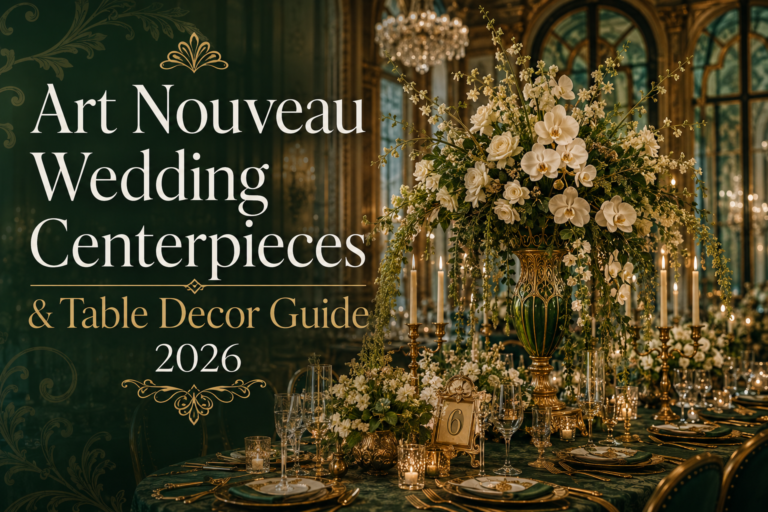
The art nouveau reception table is the most ornate and most deliberately beautiful surface in the celebration — every element chosen with the same care and the same aesthetic intention as a beautifully designed art nouveau object. Botanical centrepieces in vessels that carry the sinuous curved quality of art nouveau design rather than the straight-sided vessels of conventional floristry: aged brass urns, curved glass vases with gold line detail, ceramic vessels in the jewel tones of the aesthetic. Jewel tone linens — deep forest green or deep burgundy rather than neutral ivory for the tablecloth, with ivory or gold napkins — create the warm, richly coloured surface that the botanical centrepieces need to read with full visual impact. Ornate candle holders in antique gold or aged brass at varying heights throughout the arrangement. And the stationery pieces on every table — menus, place cards, table numbers — all functioning as small art nouveau prints that add the printed illustration layer to the living botanical one above them.
6.2 — Stationery on the Table
The table stationery for an art nouveau reception — menus, place cards, and table numbers — should function as mini art nouveau prints rather than merely informational paper. Each piece should carry the botanical illustration and the sinuous border detail of the stationery suite’s overall design at a scale appropriate to its function: the menu as a small illustrated object that guests examine and set down with some reluctance, the place card as a botanical detail that identifies each guest’s seat as though they were characters in a beautifully illustrated story, the table number as a small art nouveau poster that identifies the table while contributing to the visual decoration of the surface. The decorative function of these pieces is as important as their informational function in the art nouveau aesthetic, because every visual element in the celebration is part of the same illustrative world.
6.3 — Signage & Welcome Details
The welcome sign for an art nouveau wedding should be designed as a botanical illustration poster — the most direct reference to the art nouveau posters that the movement produced in extraordinary abundance and at extraordinary quality. A large-format welcome sign with a flowing botanical border, the couple’s names in typography with genuine period character, and the warm ivory or aged parchment background of the vintage art nouveau tradition creates an arrival piece that is both beautiful and functional in equal measure. Guests will photograph it. It will appear in wedding coverage. It should be designed to the standard of something worth framing, which in the art nouveau aesthetic means the standard of a genuine botanical illustration — detailed, ornate, and produced with obvious care for the beauty of what it depicts.
Section 07
Art Nouveau Wedding Stationery
For the art nouveau wedding aesthetic more than any other, the stationery is not merely the first piece of the celebration guests encounter — it is the single most important element of the entire wedding, and the piece that determines whether the celebration achieves what the aesthetic requires. The art nouveau invitation is not a vehicle for delivering information. It is a piece of art nouveau art — a botanical illustration that carries the movement’s core visual philosophy — that happens to contain the details of an occasion. Before the flowers have been chosen, before the venue has been visited, before any other element of the celebration exists in physical form, the invitation arrives and creates the world that the celebration will inhabit. For no other aesthetic is this more true or more consequential.
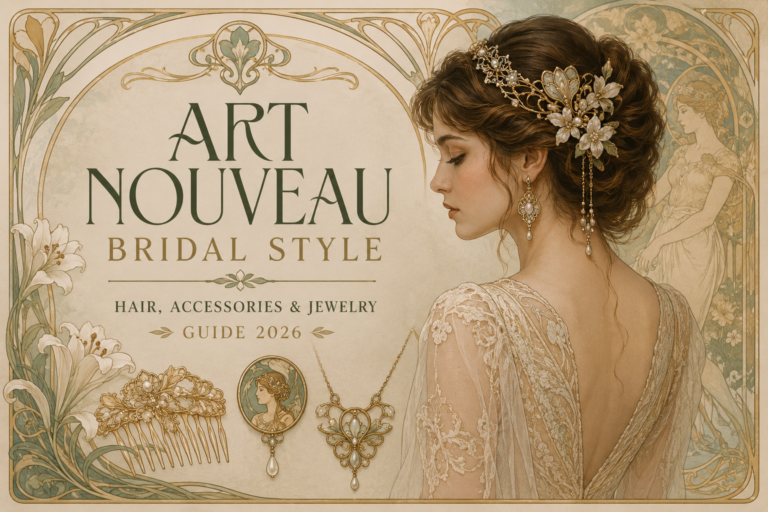
Art nouveau wedding stationery at its most beautiful looks like an Alphonse Mucha illustration given a wedding-specific purpose: flowing organic lines that curve and trail with botanical logic rather than geometric precision; plant forms rendered with the extraordinary detail and natural accuracy of the best botanical illustration tradition; sinuous borders that frame the invitation text in the same spirit as the movement’s celebrated poster borders; antique gold as the line detail and the metallic connecting thread throughout the composition; and the warm, rich palette — deep botanical green, deep rose, jewel tones, aged ivory — that characterises the movement’s most celebrated printed works. The typography should feel as though it belongs to the era: classic serif faces with genuine historical depth, or the more florid typography that the art nouveau printing tradition used for the most celebratory pieces.
The art nouveau stationery suite is, uniquely, a suite that should extend to every piece of printed paper a guest encounters across the entire journey from save the date to thank you card — not because this is true of all wedding stationery, but because in the art nouveau aesthetic the cumulative effect of a complete illustrated world is one of the most specific and most powerful qualities available to the celebration. A guest who receives a save the date in the art nouveau botanical style, then an invitation with the same visual world at greater depth and detail, then a ceremony programme that continues the illustration, then a place card that puts a small piece of the same world at their table setting, then a menu and table number in the same suite, then a thank you card that closes the story weeks later — that guest has inhabited a complete illustrated world across the course of the celebration. This is not achievable with any other aesthetic at the same level of consistency and cumulative impact.
Our art nouveau wedding collections were designed for brides who understand that beauty, at its deepest, comes from the natural world rendered with intention — and that a beautifully illustrated invitation suite is the most powerful first impression a wedding can make. Every collection below is fully customizable with your names, date, and wedding details, so the art nouveau world the illustration creates is entirely and specifically yours.
Explore the full Art Nouveau Wedding series: Art Nouveau Wedding Invitations (coming soon) · Art Nouveau Wedding Dress (coming soon) · Art Nouveau Wedding Decorations (coming soon) · Art Nouveau Wedding Cake (coming soon)
Shop the Collections
Art Nouveau Wedding Stationery Collections
Art Nouveau Floral
Flowing botanical illustration and antique gold detail — the definitive art nouveau floral collection for the most classically botanical celebration.
Art Nouveau Vintage
Warm, nostalgic and deeply romantic — vintage botanical art nouveau for the bride who wants timeless elegance with genuine period character.

Art Nouveau Goth
Where botanical art nouveau meets dark romance — jewel tones and dramatic depth for the alternative bride drawn to the movement’s most atmospheric register.
Art Nouveau Autumn
Harvest botanical abundance in art nouveau illustration style — for autumn celebrations where ornate botanical detail belongs to the season itself.
Flora Vintage Art Nouveau Wedding
Pure vintage botanical elegance — flowing floral illustration in the finest art nouveau tradition for the most romantically ornate celebration.
Fancy Classic Decorative Art Nouveau Wedding
Ornate, classical and deeply beautiful — decorative art nouveau for the maximalist botanical bride who wants every detail to be extraordinary.

Wisteria Arch Botanical Wedding
Wisteria cascades and botanical arch detail — the most romantically botanical art nouveau collection, named for the movement’s most beloved floral motif.
Frequently Asked Questions
Common Questions
What is an art nouveau wedding aesthetic?
An art nouveau wedding aesthetic draws on the Belle Époque design movement of 1890–1910, which declared that the natural world was the source of all genuine beauty and designed accordingly: sinuous organic lines, flowing botanical illustration, jewel tones, antique gold detail, and the specific abundance and ornamentation of a movement that treated every designed object as an opportunity to make the world more beautiful. Applied to a wedding, it creates a celebration that feels simultaneously historical and contemporary, maximally ornate and deeply natural, with a visual register that is genuinely distinctive and entirely beautiful in its own right.
What colors work best for an art nouveau wedding?
The four palettes in Section 03 represent the most important colour directions for this aesthetic. The Botanical Gold palette (deep forest green, antique gold, ivory, dusty rose) is the most classically art nouveau and the most versatile. The Jewel & Dark palette (deep burgundy, midnight green, black, antique gold) suits the more atmospheric and dramatic end of the aesthetic. The Vintage Parchment palette (warm ivory, aged parchment, dusty rose, antique gold) is the most romantic and nostalgic. The Autumn Botanical palette (deep rust, antique gold, forest green, warm ivory) is the most seasonally specific. Antique gold is the connecting metallic detail across all four.
What venues suit an art nouveau wedding theme?
In priority order: glasshouses and orangeries (the most naturally art nouveau setting, where botanical planting and ornate iron architecture are already in conversation); historic halls and manors with original period decorative detail; botanical gardens; and buildings designed in or inspired by the art nouveau architectural tradition. The consistent quality to look for is the presence of ornate, organic form in the architecture itself — curved ironwork, period plasterwork, botanical motifs in the building’s decorative elements. The art nouveau decoration responds to this quality rather than creating it, which is why the venue choice is as important as any decoration decision.
What stationery works for an art nouveau wedding?
Flowing botanical illustration with sinuous organic borders and antique gold detail, in a palette matched to the chosen aesthetic register. The Art Nouveau Floral collection suits the classic botanical aesthetic; the Art Nouveau Vintage collection and Flora Vintage Art Nouveau Wedding collection suit the romantic vintage register; the Art Nouveau Goth collection suits the dark jewel tone aesthetic; and the Art Nouveau Autumn collection suits the harvest botanical register. All fully customizable.
Art Nouveau Wedding Stationery · 2026
Complete Your Art Nouveau Wedding — Shop Our Collections
Fully customizable botanical illustration suites — add your names, date and wedding details online.