Art Nouveau Bridal Style — Hair, Accessories & Jewelry Guide 2026
Art Nouveau Wedding · 2026
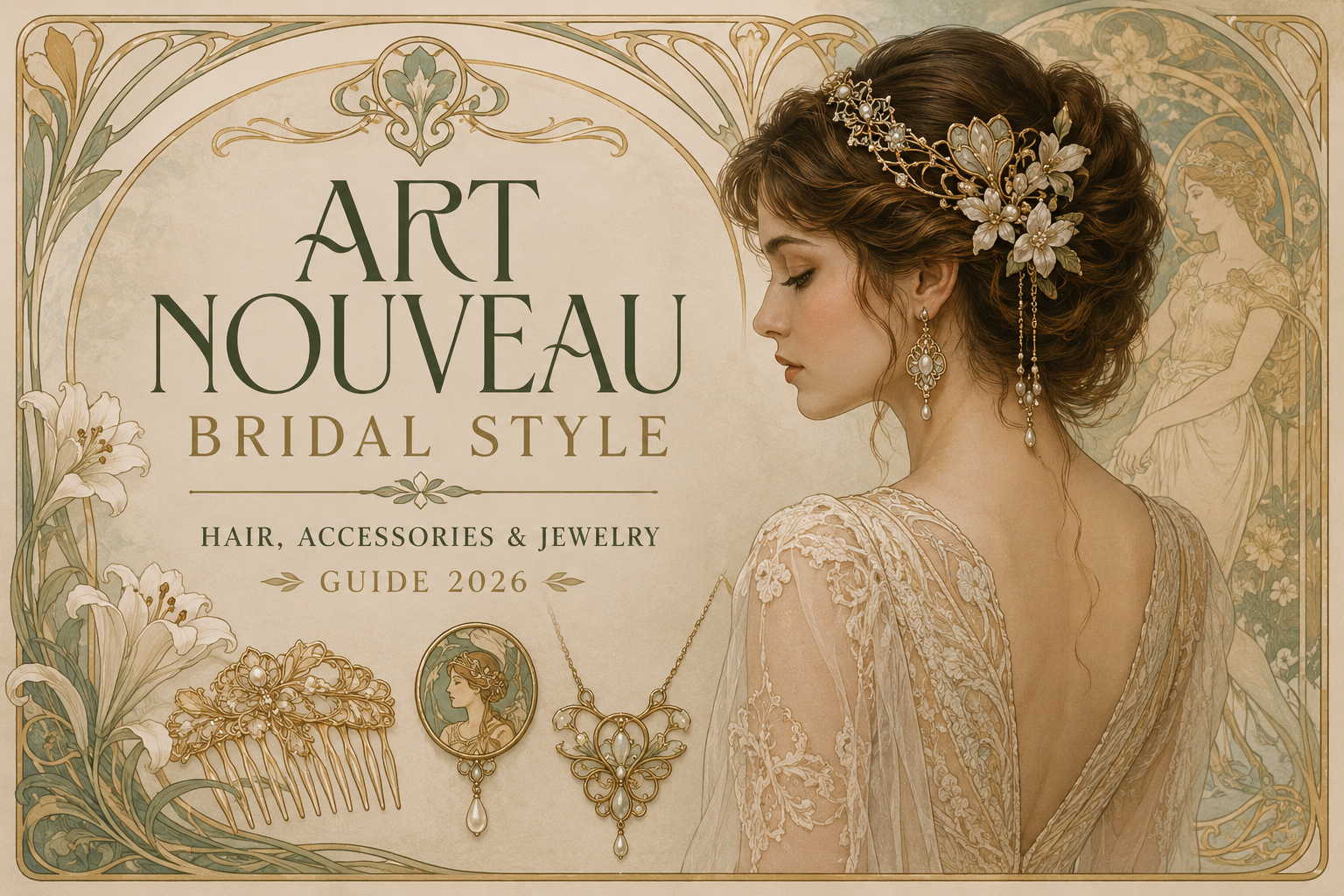
Art Nouveau Bridal Style — Hair, Accessories & Jewelry Guide 2026
From flowing botanical-crowned hair to sinuous gold jewellery and the perfect veil — the complete guide to art nouveau bridal style beyond the dress in 2026.
The dress is only the beginning of an art nouveau bridal style, and arguably not even the most important part of it. In the movement’s own visual tradition, the woman herself — her hair, her ornament, the way she was depicted moving through a botanical world — carried as much of the aesthetic’s meaning as anything she wore. This guide covers the complete art nouveau bridal accessories picture: hair styling, the botanical crown, jewellery beyond the ring, veils and headpieces, and how every accessory choice should echo the botanical illustration on the stationery your guests have already seen.
The Mucha woman was never simply dressed. Her hair flowed into the border ornament around her; the flowers in it were the same flowers climbing the frame behind her. She was not standing in front of the botanical world. She was made of the same material as it.
Section 01
The Complete Art Nouveau Bridal Look
A genuinely complete art nouveau bridal style treats hair, accessories, and dress as a single integrated composition rather than three separate decisions made in sequence. This is a meaningful departure from how most contemporary bridal styling is approached — where the dress is chosen first, hair and makeup are booked as largely independent services, and jewellery is selected last as a finishing accent. In the art nouveau tradition, this hierarchy inverts: the woman’s hair and her ornament were never secondary to her garment in the movement’s own visual representation. They were equally weighted compositional elements, often more visually dominant than the clothing itself.
The Mucha woman — the single most influential visual reference point for this entire aesthetic — is defined as much by her hair as by anything she wears: flowing, often impossibly long, arranged with a looseness that suggests movement even in a static image, frequently merging visually with the botanical or decorative border surrounding her so the boundary between figure and ornament becomes genuinely unclear. This is the reference point worth holding throughout every styling decision in this guide: not “what hairstyle looks nice with this dress” but “does this look like it could be part of the same flowing, organic composition as everything else in the image.”
Practically, this means treating hair, headpiece, and jewellery as a single styling consultation rather than three separate bookings, and choosing each element with explicit reference to how it will sit alongside the others rather than in isolation. A botanical crown chosen without reference to the planned hairstyle, or jewellery selected without reference to the neckline of the dress, breaks the integrated quality that makes the most successful art nouveau bridal looks so visually powerful. The sections below cover each element in turn, but the governing principle throughout is integration: every choice should look as though it grew from the same composition as everything else.
Section 02
Art Nouveau Bridal Hair
Flowing loose waves are the single most directly Mucha-referenced hair style available to a contemporary bride, and they suit the flowing goddess and botanical lace dress aesthetics particularly well: hair left down or only loosely secured, with soft, undefined waves rather than tight curls, allowed to move and catch light in the same way the movement’s illustrated hair does. This style requires hair with genuine length and movement to achieve its full effect, and it pairs naturally with minimal additional styling intervention — the goal is hair that looks as though it has simply been left to do what it naturally does, rather than elaborately constructed.
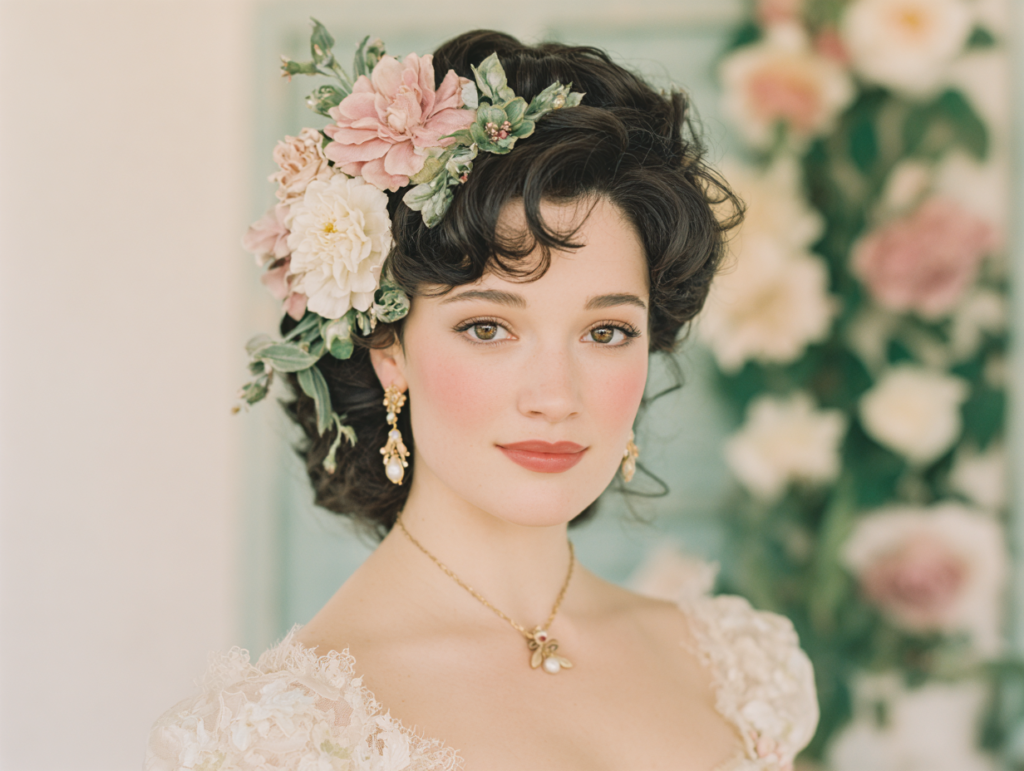
Low romantic updos with botanical detail offer a more structured alternative that still maintains the soft, organic quality the aesthetic requires: hair gathered loosely at the nape rather than pulled into a tight, high formal style, with deliberately loose strands left to frame the face, and botanical hairpieces — small flowers, trailing greenery, a single dramatic bloom — worked into the gathered hair rather than pinned as an obviously separate addition. This style suits the Belle Époque and vintage botanical dress aesthetics particularly well, since the slightly more controlled silhouette complements the period-referenced structure of those gown styles.
Braided crowns — hair woven into a soft, irregular braid that circles the head, with strands deliberately pulled loose along its length rather than tightly and uniformly braided — directly reference the botanical crown shape in the hair’s own structure, before any actual botanical material is added. This style works particularly well as a foundation for a separate botanical crown, since the braid’s circular structure provides a natural base for flowers or greenery to be woven through, and it suits brides who want the structural reliability of a more secured style without losing the organic, irregular quality the aesthetic depends on. Hair worn fully down with floral combs — one or two combs positioned asymmetrically rather than as a matched, symmetrical pair — offers the simplest styling approach while still incorporating genuine botanical detail.

Matching Stationery
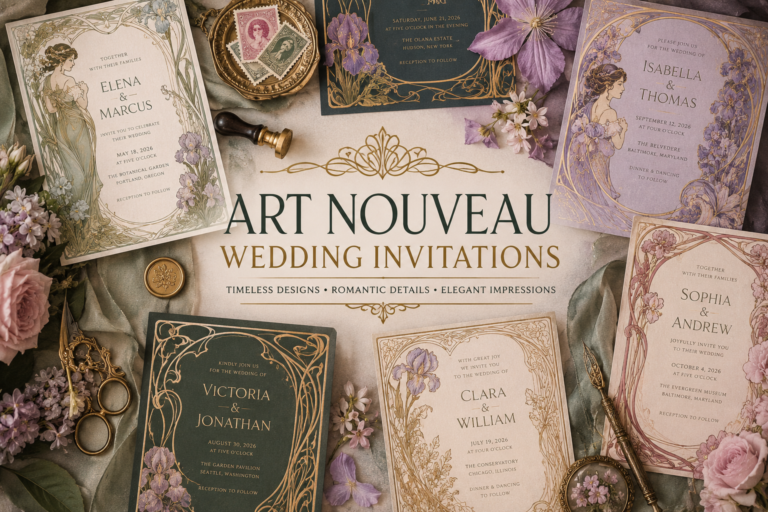
The flowing, organic hair styles described above belong to the same visual world as the Art Nouveau Floral stationery collection — botanical illustration with the same loose, sinuous quality. Fully customizable with your names, date, and wedding details.

Section 03
The Botanical Hair Crown
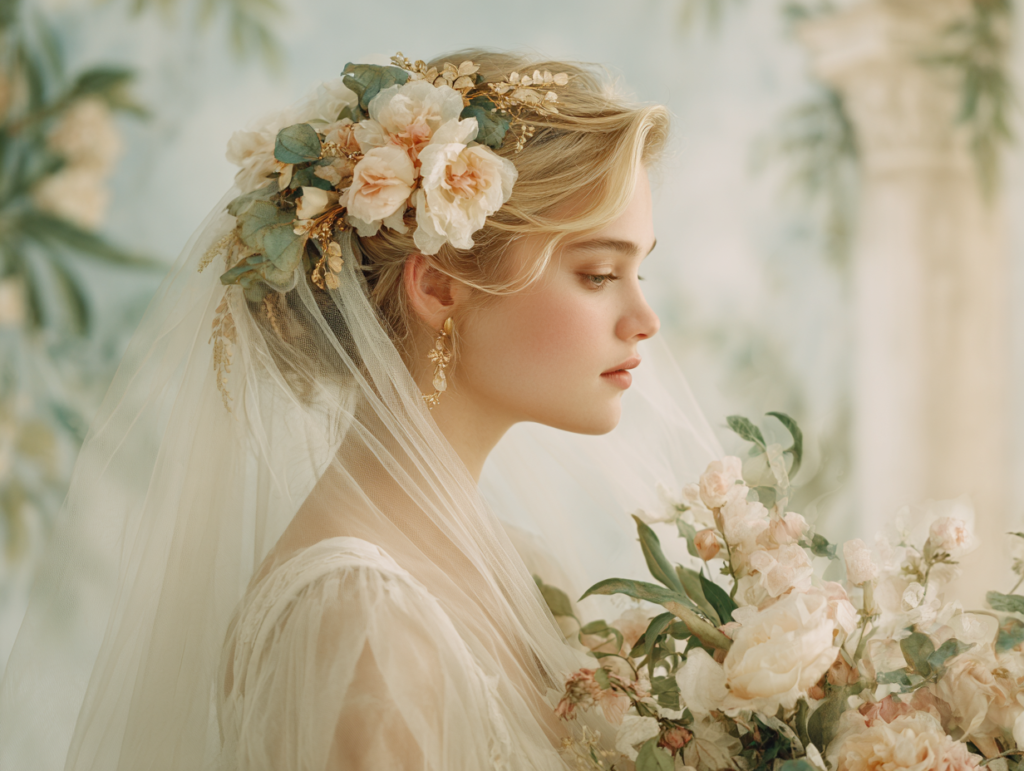
The botanical hair crown is the single most defining and most photographed art nouveau bridal accessory, and the reason is structural rather than merely decorative: it is the one accessory that directly enacts the Mucha woman’s defining quality of botanical material woven into hair itself, rather than added as a separate ornament. A crown worn loosely, with individual stems and blooms visible rather than compressed into a uniform band, photographs with the same organic, slightly irregular quality that defines every other element of this aesthetic — and a crown that is too uniform, too symmetrical, too tightly constructed works directly against the effect it is meant to achieve.

The choice between fresh and dried botanical material for the crown depends on the specific dress aesthetic and season. Fresh botanical crowns suit the flowing goddess and botanical lace gown styles, where the crown’s vitality and slight wilting over the course of the day actually reinforces the organic, living quality the aesthetic celebrates — a fresh crown is not meant to look as pristine at the end of the evening as it did that morning, and this is consistent with rather than a failure of the aesthetic. Dried and preserved botanical crowns, increasingly available with genuinely beautiful and realistic results, suit the vintage botanical and dark art nouveau aesthetics particularly well, where the slightly aged, preserved quality of dried material echoes the broader vintage register of those styles and offers the practical advantage of being prepared well in advance and preserved as a keepsake afterward.

Gold leaf details — small flecks or fragments of edible or cosmetic-grade gold leaf worked into the crown alongside the botanical material, or genuine gold wire wound through the arrangement — connect the crown to the antique gold detail that runs throughout every other element of the aesthetic, from the stationery’s gold line work to the jewellery’s metalwork. This detail should be used sparingly: scattered, irregular flecks of gold rather than a uniform metallic band, in keeping with the asymmetric, organic principle that governs every other art nouveau styling decision.

Choosing a crown style based on dress aesthetic: a full, abundant crown with substantial botanical coverage suits the botanical lace gown and the ornate decorative dress styles, where the dress itself carries significant botanical density and the crown should match that visual weight rather than appearing sparse by comparison. A delicate, minimal crown with just a few carefully placed stems suits the modern art nouveau gown’s cleaner silhouette, where a more restrained crown maintains the overall composition’s editorial simplicity. A trailing crown, with vine or wisteria elements extending down past the hairline at the back or side, suits the flowing goddess aesthetic’s emphasis on movement and cascading botanical material.

Matching Stationery
A trailing botanical crown belongs with the Wisteria Arch Botanical stationery collection — the same cascading, romantic floral motif carried from the invitation suite to the crown in your hair. Fully customizable.

Section 04
Art Nouveau Jewelry Beyond the Ring
Sinuous necklaces — with curving, asymmetric pendant settings in antique gold rather than a centred, symmetrical pendant on a plain chain — extend the same organic design principle that governs the ring, the crown, and every other accessory in this aesthetic. A necklace with a single asymmetric botanical or dragonfly pendant, or a fine chain with sinuous wirework rather than a uniform link pattern, suits this aesthetic far more naturally than a conventional symmetrical pendant necklace. The neckline of the dress matters considerably here: a high Victorian neckline suits a shorter, more delicate necklace or none at all, while a sweetheart or off-shoulder neckline provides the open chest space a more dramatic pendant necklace needs to read clearly.
Botanical earrings — small flower clusters, single trailing vine drops, or dragonfly studs with enamelled wings — are among the most versatile art nouveau jewellery pieces, since they read clearly even at the smaller scale earrings require and suit every dress and hair styling combination in this guide. Drop earrings with a trailing botanical or vine motif pair particularly well with hair worn up, where the earring’s movement and visibility are maximised; stud or small cluster earrings suit hair worn down, where a more dramatic drop earring would be visually competing with the hair itself for attention.
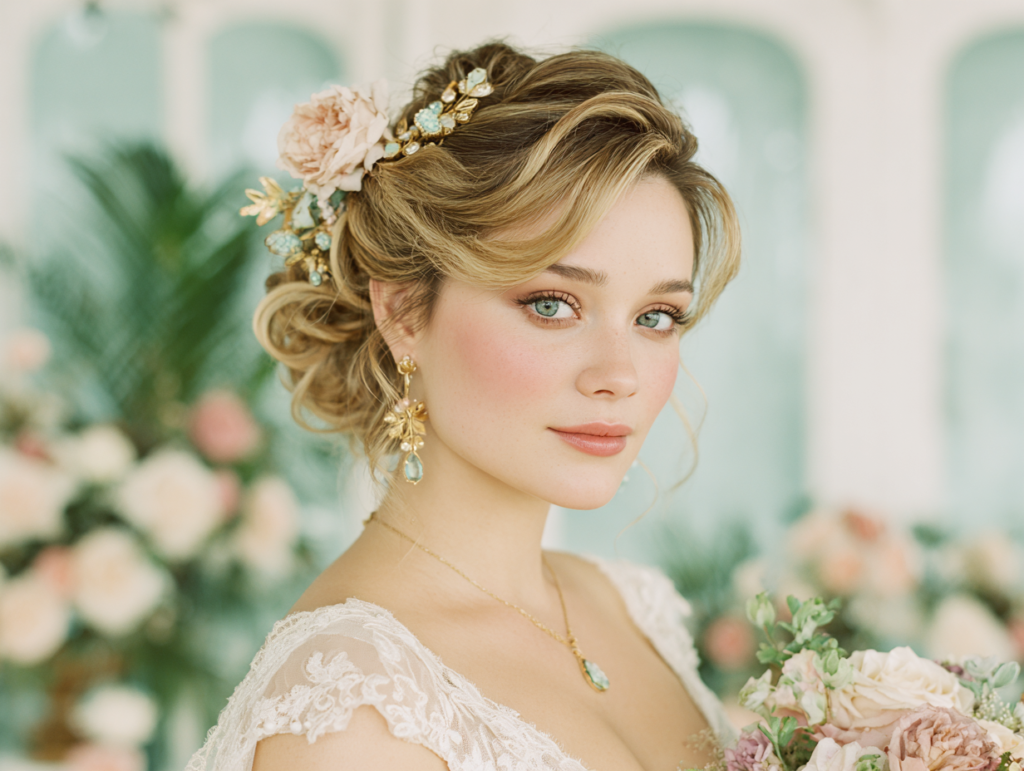
Hair combs with gemstone detail — small clusters of pearls or coloured stones set within a sinuous gold or silver comb frame, with the gemstones positioned asymmetrically along the comb’s botanical line work rather than in a uniform row — bridge the jewellery and hair accessory categories directly. These work particularly well positioned alongside or even woven into a botanical crown, where the gemstone detail catches light in a way that fresh or dried botanical material alone cannot, adding a controlled point of sparkle to an otherwise organic, matte composition.
For complete guidance on choosing an art nouveau engagement ring and wedding band — including botanical vine bands, flower cluster settings, dragonfly motif rings, and the specific distinctions between art nouveau and art deco or Victorian jewellery design — see the dedicated Art Nouveau Wedding Ring guide elsewhere in this series.
Matching Stationery
Fine filigree jewellery and warm vintage botanical detail belong with the Flora Vintage Art Nouveau stationery collection — the same delicate, nostalgic register carried from the invitation suite to your jewellery. Fully customizable.

Section 05
Veils & Headpieces
Flowing cathedral veils suit the flowing goddess aesthetic more naturally than any other veil length, since the veil’s own extended trailing fabric directly echoes the cascading, draped quality of the dress and the movement-focused styling that defines this dress aesthetic. A cathedral veil in the lightest available tulle or silk illusion, worn without excessive structure or stiffening, moves with the same organic quality as flowing hair and a draped gown, and the combination of all three elements moving together — hair, dress, and veil — creates the most complete realisation of the Mucha woman’s flowing, unified visual quality available to a contemporary bride.
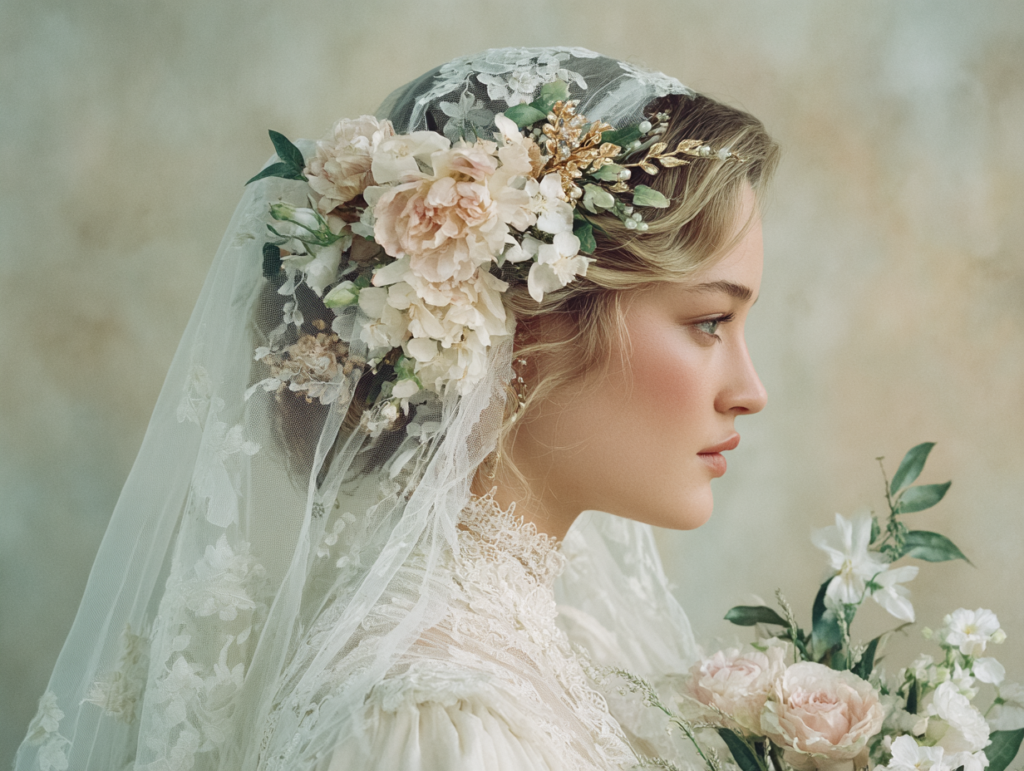
Birdcage veils — short, structured veils of stiffer netting that cover only the upper face or eyes, secured close to the head — suit the vintage botanical and Belle Époque dress aesthetics specifically, since this veil style has genuine period precedent in early twentieth-century bridal fashion and reinforces the historically grounded character of those dress styles more directly than a longer contemporary veil would. A birdcage veil paired with a low romantic updo and a small botanical hair comb creates one of the most period-authentic complete looks available within this guide’s entire range of options.
Botanical comb attachments — a simple, shorter veil attached to or positioned alongside a botanical hair comb rather than a separate dedicated veil comb — offer the most integrated option for brides who want to minimise the number of distinct hair accessories competing for visual attention. This approach works particularly well for the modern art nouveau and dark art nouveau dress aesthetics, where a more restrained overall accessory count suits the cleaner silhouette or the more atmospheric, focused styling those looks favour. For brides choosing no veil at all, the botanical crown described in Section 03 above should be considered the primary headpiece and styled with correspondingly greater care and visual weight.
Section 06
Bridal Style & Stationery Coherence
Every accessory choice covered in this guide — hair styling, crown, jewellery, veil — should echo the illustration style of the stationery suite guests have already received, in the same way the dress, the florals, and the cake all connect back to the same printed botanical world. This is not a coincidental aesthetic alignment but the same underlying principle that governs every element of an art nouveau wedding: a single, consistent botanical visual language, observed closely and rendered with genuine accuracy, running through every surface and every detail a guest encounters across the full duration of the celebration.
The practical version of this principle: if your stationery features flowing botanical illustration with visible individual stems and loose, asymmetric composition, your hair and accessory styling should pursue the same loose, asymmetric quality rather than a more structured, formal look that would sit awkwardly against the invitation’s visual language. If your stationery belongs to the vintage register — warm ivory, aged gold, dusty rose — your jewellery and crown should draw from the same warm, slightly antique palette rather than introducing bright, contemporary metal tones that would read as visually disconnected from everything guests have already seen printed on the invitation suite.
The getting-ready photographs — hair and makeup application, the crown being placed, jewellery being fastened — are among the most intimate and most frequently shared images from any wedding, and for an art nouveau celebration they offer a specific opportunity: positioning the stationery suite visibly in the getting-ready space, so it appears in the background of these photographs or can be brought into a deliberate detail shot alongside the crown or jewellery. This connects the most personal, private moments of bridal preparation directly back to the printed botanical world that guests encountered months earlier, completing the visual story from its very first public moment to its most intimate one.
The four collections below each correspond to one or more of the styling approaches described in this guide. All are fully customizable with your names, date, and wedding details.
Shop the Collections
Stationery Matched to Every Bridal Style
Art Nouveau Floral
Flowing botanical illustration and antique gold detail — the natural match for loose, organic hair styling and botanical earrings.

Art Nouveau Vintage
Warm nostalgic botanical art nouveau — the visual companion to birdcage veils and dried botanical crowns.

Flora Vintage Art Nouveau Wedding
Pure vintage botanical elegance — for fine filigree jewellery and warm, nostalgic accessory styling.
Wisteria Arch Botanical Wedding
Cascading wisteria and botanical abundance — the precise visual companion to a trailing botanical crown.
The Art Nouveau Wedding Series
Explore the Full Series
Art Nouveau Wedding — The Complete Aesthetic Guide · Art Nouveau Wedding Invitations · Art Nouveau Wedding Dress · Art Nouveau Wedding Decorations · Art Nouveau Wedding Theme & Colors · Art Nouveau Wedding Ring · Art Nouveau Wedding Cake · Art Nouveau Wedding Flowers · Art Nouveau Wedding Venue
Frequently Asked Questions
Common Questions
What hairstyle suits an art nouveau wedding?
Flowing loose waves for the goddess and botanical lace dress aesthetics; low romantic updos with botanical detail for the Belle Époque and vintage botanical aesthetics; braided crowns as a structural foundation for an actual botanical crown; or hair worn fully down with asymmetric floral combs for the simplest styling approach. The consistent principle across all four: soft, organic movement rather than tight, formal structure, and asymmetric rather than perfectly symmetrical placement of any added botanical or jewelled detail.
Should my botanical crown be fresh or dried flowers?
Fresh botanical crowns suit the flowing goddess and botanical lace gown styles, where the crown’s natural movement and gentle wilting over the day reinforce the living, organic quality those aesthetics celebrate. Dried and preserved botanical crowns suit the vintage botanical and dark art nouveau aesthetics, where the slightly aged quality echoes the broader vintage register, and offer the practical advantage of being prepared in advance and kept afterward as a keepsake. Both are genuinely appropriate choices — the decision should follow your dress aesthetic rather than convenience alone.
What veil style works with an art nouveau gown?
A flowing cathedral veil in the lightest available tulle suits the flowing goddess gown most naturally, echoing the dress’s own draped, cascading quality. A birdcage veil suits the vintage botanical and Belle Époque gowns, with genuine period precedent reinforcing the historically grounded character of those styles. A short veil attached to a botanical comb suits the modern and dark art nouveau aesthetics, where a more restrained accessory count complements a cleaner overall silhouette. Brides choosing no veil should treat the botanical crown as the primary headpiece and style it with correspondingly greater care.
How do I match my accessories to my stationery?
Match by register: loose, asymmetric botanical illustration on your stationery calls for the same loose, organic styling in your hair and jewellery, while a vintage warm-ivory palette calls for warm, antique-toned metals and dried botanical material rather than bright contemporary finishes. The Art Nouveau Floral and Wisteria Arch Botanical collections suit looser, fresh-botanical styling; Art Nouveau Vintage and Flora Vintage Art Nouveau suit the warmer, antique register.
Art Nouveau Wedding Stationery · 2026
Complete Your Art Nouveau Bridal Story
Botanical stationery suites matched to every hair, jewellery and veil style — fully customizable with your names, date and wedding details.